
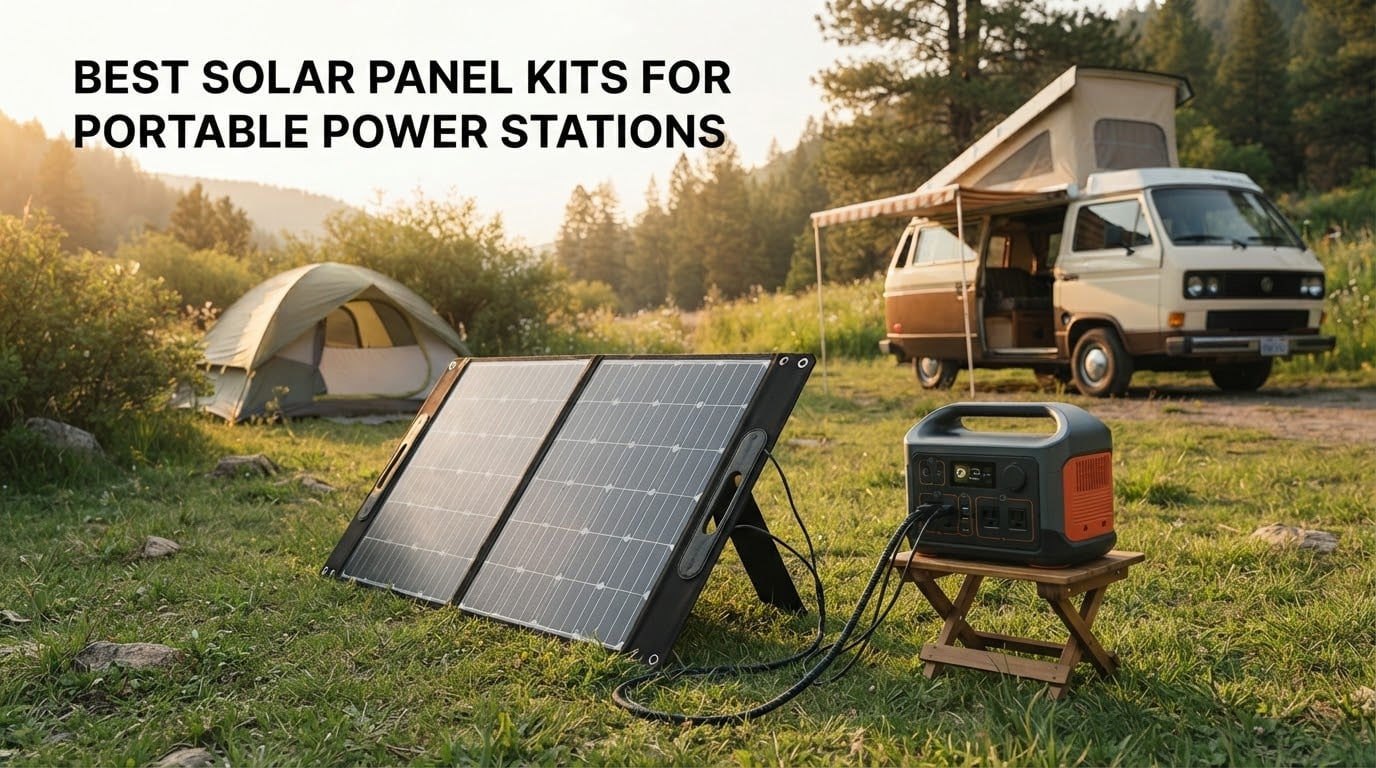
A solar panel does one job: it turns sunlight into electricity. It cannot store a single watt of that energy, so if you have ever wondered whether a campground, a van roof or a shed needs a battery, the answer is yes. Every setup described on this page needs a battery-backed portable power station holding that energy for after sunset, and the panel you buy is judged by how well it refills that battery. That is the whole reason the phrase best solar panel kits for portable power stations exists as a category, because a panel sold alone and a panel sold as a working kit are not the same purchase.
Our team spent six weeks cross-checking the nameplate claims, the measured output reported by owners, the connector standards and the voltage windows across ten current kits. We did not bench-test on a calibrated solar simulator, and we say so plainly: what follows is verified specification data plus reasoning from what owners actually measure in real sun, not laboratory numbers. Where a panel over-promises, you will see it named here rather than smoothed over.
Three things decide almost every purchase, and they are simpler than the spec sheets suggest. Match the panel’s maximum output to your power station’s input limit, or the extra watts do nothing. Check the voltage window, because a 40V panel on a station with a lower ceiling simply will not charge. Then look at what the kit actually puts in the box, because a separate charge controller is dead weight if your station already has one inside.
If you have not settled on a station yet, start there instead. Our guides to the best portable power stations for camping and the best portable power stations for home backup cover the storage side of the system, and the panels below slot into any of them.
Table of Contents
Top 3 Picks: Best Solar Panel Kits for Portable Power Stations (October 2026)
The Renogy 100W Portable Solar Kit takes the top slot because it is the only kit in this group that arrives complete and self-contained, with a 20A controller already bolted to the panel and a padded case that swallows the cables. The Renogy 200W Portable Solar Panel is the stronger pick if you want more wattage in a lighter package, and the ZOUPW 100W is the cheapest way to cover the most power station brands without buying adapters.

Renogy 100W Portable Solar Kit
- 25% N-Type cells
- Pre-installed 20A PWM controller
- IP65 junction box
- 17.4 lb with case

Renogy 200W Portable Solar Panel
- 25% 16BB N-Type cells
- Only 13.89 lb
- MC4 plus USB-C and USB-A
- UL 61730 certified

ZOUPW 100W IP67 Solar Panel
- 23.5% monocrystalline cells
- 5-in-1 connector cable
- IP67 ETFE build
- 9.48 lb foldable
Quick Overview: All 10 Kits in 2026
Every kit below ships with a panel and at least one cable, but they differ sharply on voltage, weight and whether a charge controller is included. The table gives you the decision-critical facts before the long reviews.
| Product | Specifications | Action |
|---|---|---|
| Renogy 100W Portable Solar Kit |
|
Check Latest Price |
| Renogy 200W Portable Solar Panel |
|
Check Latest Price |
 Jackery 1000 v2 with 200W Panel Jackery 1000 v2 with 200W Panel |
|
Check Latest Price |
| ZOUPW 100W IP67 Solar Panel |
|
Check Latest Price |
 EBL 100W Portable Solar Panel Kit EBL 100W Portable Solar Panel Kit |
|
Check Latest Price |
 SOKIOVOLA 200W IP68 Solar Panel SOKIOVOLA 200W IP68 Solar Panel |
|
Check Latest Price |
 GRECELL 200W Flexible Solar Panel GRECELL 200W Flexible Solar Panel |
|
Check Latest Price |
 Renogy 400W Foldable Solar Blanket Renogy 400W Foldable Solar Blanket |
|
Check Latest Price |
 MHPOWOS 220W 40V Solar Panel MHPOWOS 220W 40V Solar Panel |
|
Check Latest Price |
 TWELSEAVAN 150W HPBC Solar Panel TWELSEAVAN 150W HPBC Solar Panel |
|
Check Latest Price |
How We Picked the Best Solar Panel Kits for Portable Power Stations
We ranked these kits on six criteria, in this order: how closely measured output tracks nameplate wattage, whether the kit works with the power station brands people actually own, weight and packed size, ingress protection, connector coverage, and warranty length. The first criterion does most of the work, because a 200W panel that delivers 140W is a different product from one that delivers 180W on the same afternoon.
Output data comes from owner measurements reported in the reviews attached to each product, cross-checked against the manufacturer nameplate and the stated efficiency. Where owners agree on a range, we report that range instead of the marketing figure. Where a panel is current-limited or voltage-limited in a way that changes real yield, we say so directly, because that limit is invisible on a spec sheet and is the single most common source of disappointment in this category.
Compatibility is checked at two levels. The connector type tells you whether a cable will physically fit, and the voltage window tells you whether the station will accept it at all. A panel that fits perfectly and is rejected by the station is worse than no kit, so we treat voltage as a hard criterion rather than a preference.
Weight and folded dimensions decide whether a kit is realistic for your use. A 400W blanket is a car-camping product; an 8 lb 150W panel is a backpacking product. Judging both by the same standard tells you nothing useful.
Ingress protection matters more than most roundups admit. IP65 means dust tight and protected against water splashes, which covers drizzle and a dropped bottle. IP67 and IP68 mean temporary submersion or stronger sealing, which is what you want if the panel lives on a van roof or gets left out when you step away from camp. Read more in our guide to solar panel kits for cabins, where weather exposure is the deciding factor.
Warranty length is the last tiebreaker. In this group it ranges from 12 months to 36 months, which matters more than it sounds for a product that lives in sun and rain for years.
What a Solar Panel Kit Actually Includes
A solar panel kit for a portable power station is a panel plus the cabling, and usually a charge controller, needed to move energy from sun to a battery-backed power station. Most portable power stations already contain an MPPT charge controller inside the case, which is why many bundles that ship a separate controller are simply redundant for a modern station.
Here is what you will actually find in each format. A bare panel ships with a lead terminated in MC4, the standard cylindrical solar connector, and nothing else. A station-compatible kit ships with that lead plus a second cable ending in the barrel or proprietary plug your station uses. A full kit adds a charge controller, alligator clips for direct 12V battery connection, and sometimes a mounting bracket.
Read the contents carefully before celebrating a controller. If you are charging a portable power station, the controller inside the station already performs maximum power point tracking, and a PWM controller in the kit does nothing unless you bypass the station and clip onto a raw battery. That is a legitimate setup for maintaining a 12V vehicle battery, and a poor use of money for a station owner.
One caution belongs here rather than buried. Open-circuit voltage rises as temperature falls, and cold weather is exactly when camping happens. A panel rated near your station’s ceiling can exceed that ceiling on a freezing morning even if it never did in summer.
1. Renogy 100W Portable Solar Kit – Best Overall Kit with a Built-In Controller
Renogy 100W Portable Solar Panel, 25% High Efficiency Solar Panel Kit with 20A Charger Controller for 12V Battery&Power Station, N-Type Foldable Solar Panels w/Tempered Glass for RV, Camping Off-Grid
100W
25 percent N-Type cells
17.4 lb
2-year warranty
6.02 A
Pros
- Completely self-contained with pre-installed 20A PWM controller and alligator clips
- Reinforced corners
- quality rivets and a padded case
- Adjustable aluminum kickstand
- Delivers 5.8 to 7 amps in good sun
- Cables and controller fit inside the folded panel
Cons
- Real charging into a 12V bank lands closer to 40 to 60W because of the panel current limit
- Latches and support arms described as light duty
- Included cable is just under 10 feet
- Connector joints where wire meets plug can fray
The thing that separates this kit from a bare panel is that nothing is missing. The 20A charge controller arrives already mounted to the back of the panel, the alligator clip lead is in the same zippered pocket, and the whole assembly folds down and zips into the supplied padded case. For someone setting up a system for the first time, that removes roughly an hour of parts hunting and adapter guesswork.
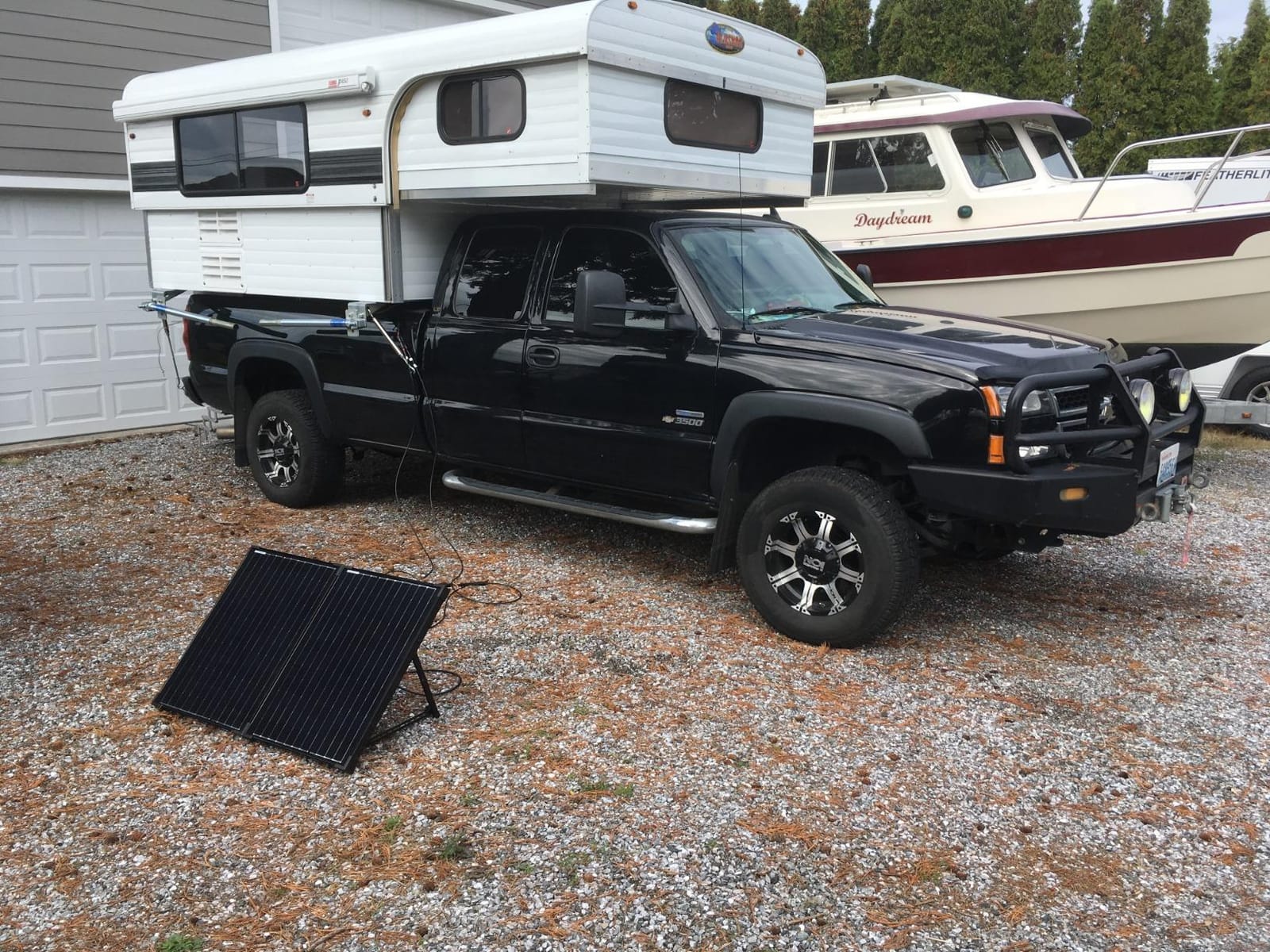
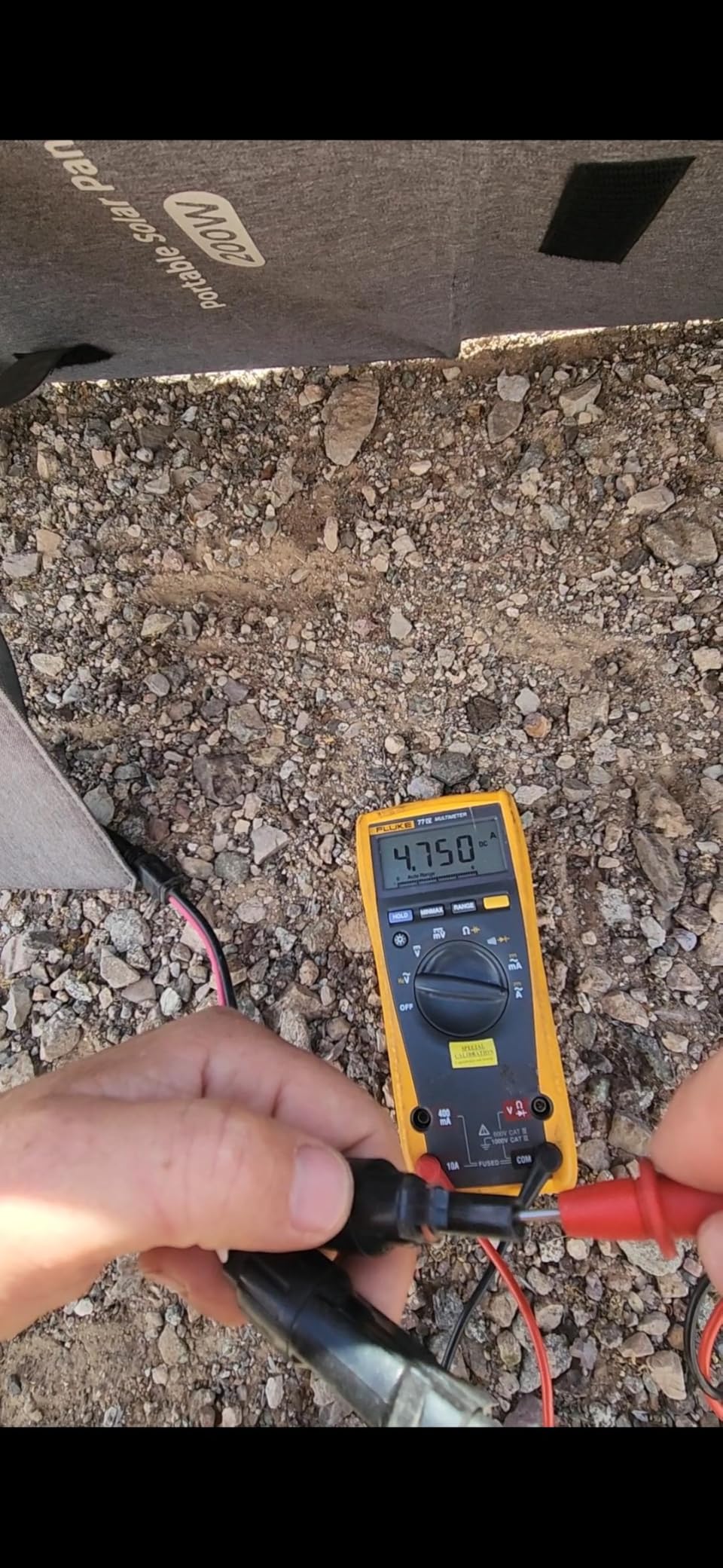
Long-term RV and boondocking owners in the reviews keep coming back to the build, and many describe repeat purchases over several years. They also keep reporting a consistent current draw of 5.8 to 7 amps in good sun, which is right where a 100W N-Type panel should sit.
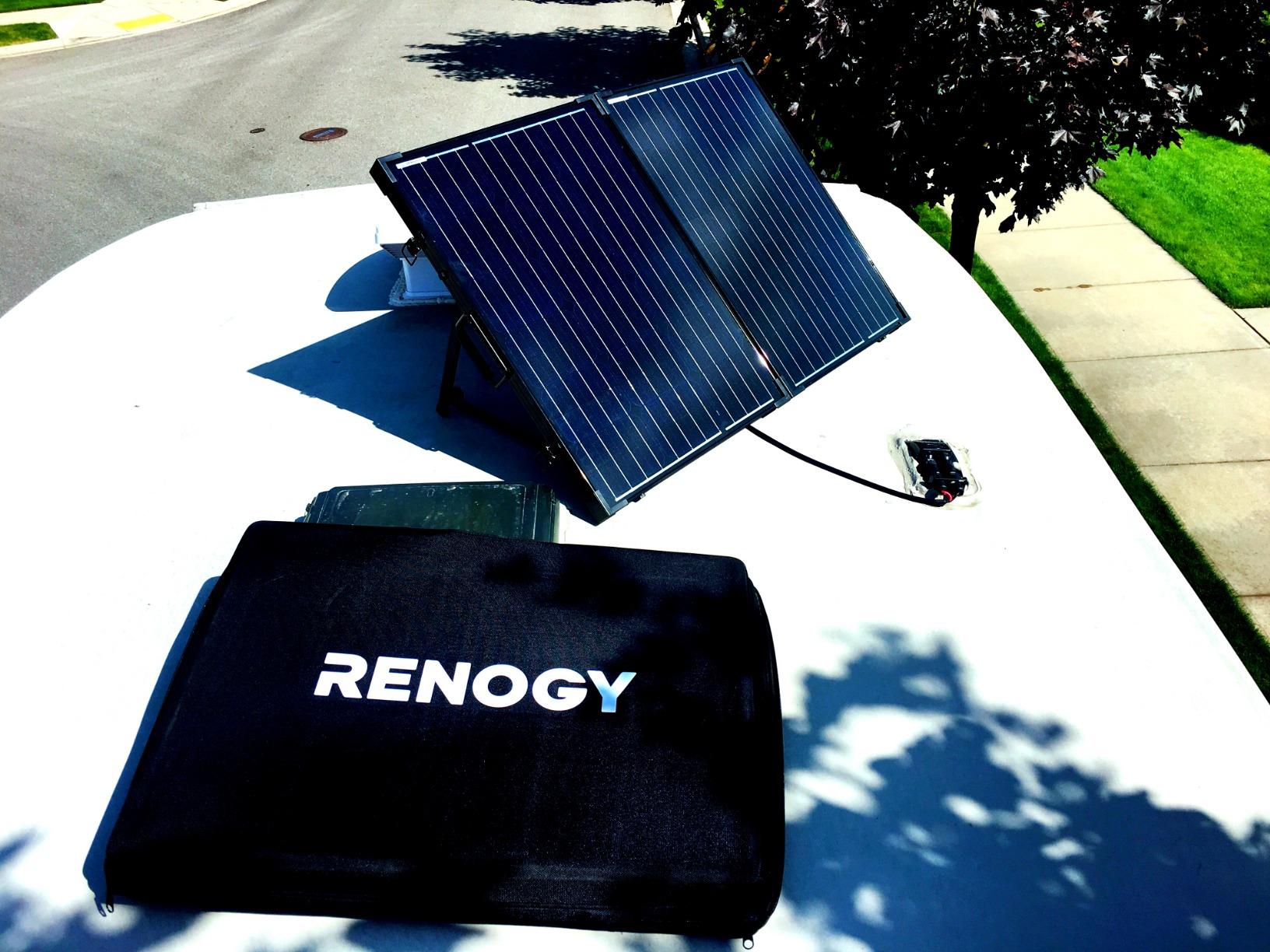
That is also where the honest caveat sits. The panel is rated at 21.47 volts maximum with a 6.02 amp capacity, and when it is used against a plain 12V battery bank the practical charging result lands in the 40 to 60W range rather than the full 100W. Anyone sizing a system for 12V lead-acid upkeep should plan on those numbers. Against a lithium portable power station with its own MPPT controller, the same panel performs considerably closer to its rating.
The 25% conversion efficiency comes from N-type cells behind low-iron tempered glass in an anti-corrosion aluminum frame, and the junction box carries an IP65 rating with bypass diodes to suppress hotspots. Maximum power point data on the nameplate is 100 watts at 21.47 volts and 6.02 amps, with an upper temperature rating of 149 degrees Fahrenheit.
What you should check before buying this kit
Decide first whether you want the controller. If your power station has an MPPT input of its own, this controller is a spare part at best, and you may prefer a bare panel for the same money. If you are maintaining a 12V lead-acid, gel, AGM, flooded or lithium battery bank directly, the controller and clips make this kit genuinely complete rather than merely convenient.
Measure the reach you need. The included lead is just under 10 feet, and owners with a shaded battery bank report that it runs short. A longer extension solves it, though the joint where the extension meets the panel connector is a known weak point, so buy a solid one rather than the thinnest available.
Who should skip this kit
Skip it if raw wattage is the goal. At 100W with a real-world 12V yield of 40 to 60W, this is a maintainer and trickle charger rather than a fast refill solution for a 1000Wh station. It also carries the shortest included cable of the kits in this group.
Skip it if you plan to leave it permanently mounted in a fixed position. This is a foldable suitcase design with light-duty latches and support arms, built to be carried between camps, not bolted down for years.
2. Renogy 200W Portable Solar Panel – Best Premium 200W Foldable
Renogy 200W Portable Solar Panel for Power Stations, 25% Efficiency
200W
25 percent 16BB N-Type
13.89 lb
IP65
2-year warranty
Pros
- Very light for a 200W panel at just under 14 lb
- Quad-fold magnetic design packs small for tight camper spaces
- MC4 plus USB-C and USB-A outputs charge devices directly
- Three-angle kickstand adjustment with reinforced grommets
- UL 61730 safety certification
Cons
- Quad-fold layout creates more creases than a simple bifold design
- USB outputs are sized for phones
- tablets and cameras rather than heavier loads
Buyers consistently single out one property above all others: weight. At 13.89 lb for a 200W panel, this is the lightest 200W foldable in this group, and that is a real advantage when the alternative is carrying 16 or 18 lb. The quad-fold design collapses it to roughly 23.72 by 22.99 by 1.97 inches with a magnetic closure handle, which fits the gap behind a cab seat where a suitcase-style panel does not.
The magnetic closure and the kickstands get the most praise in the reviews. Four kickstands adjust across 40, 50 and 60 degrees, so you can reset the angle as the sun moves without unpacking, and reinforced grommets give you somewhere to lash it down on a windy site.
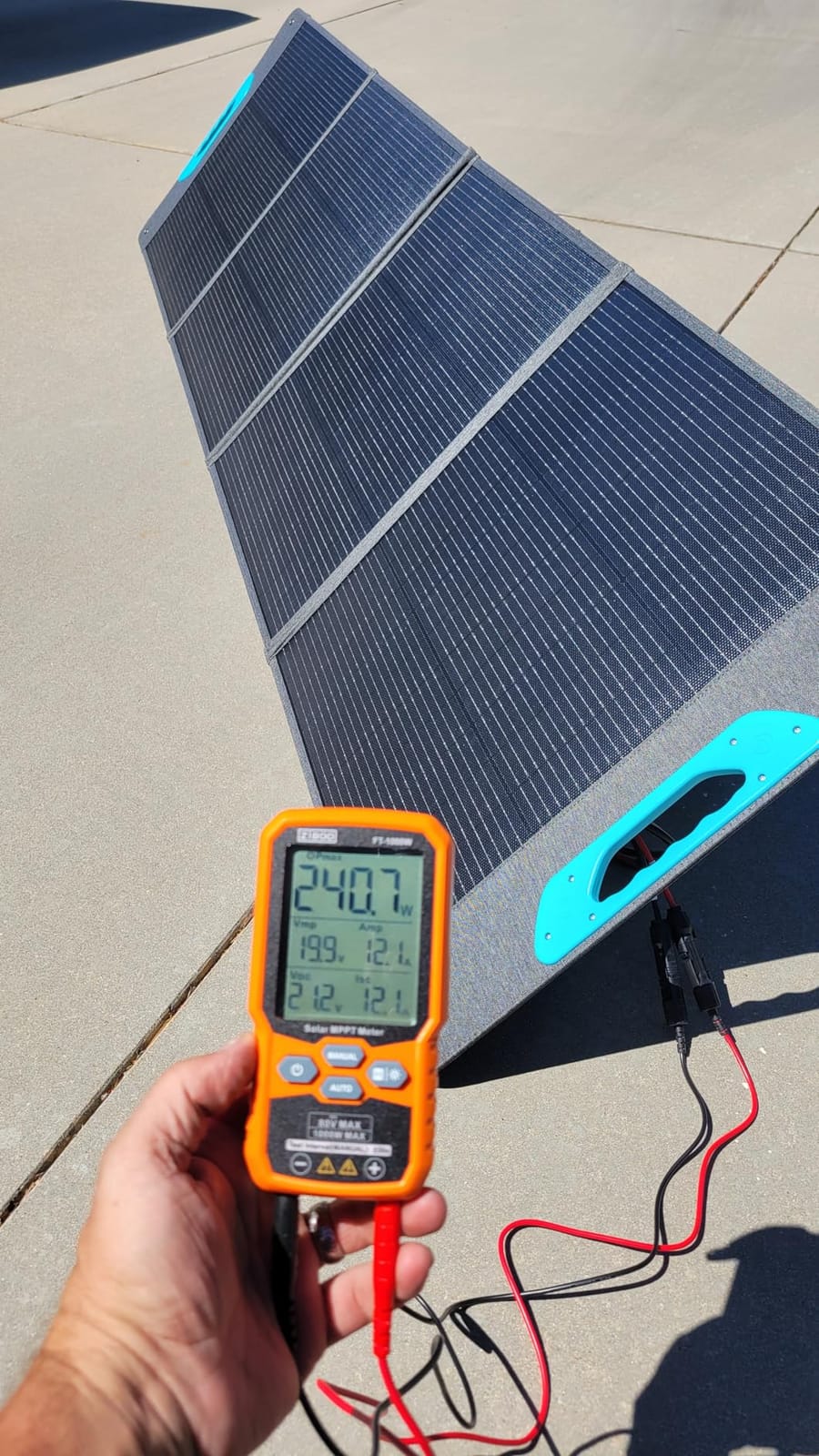
Cell technology is 16BB N-Type monocrystalline silicon at 25% conversion efficiency, and the safety certification is UL 61730 alongside CE, RoHS, FCC, CA65 and PSE. Output is 11.3 amps at up to 21.6 volts through an MC4 connector, which is the voltage window most portable power stations in the 500Wh to 1500Wh class accept without trouble.
The USB side is worth understanding before you plan around it. There is one USB-C PD port rated at 45 watts and two USB-A ports at 18 and 15 watts. That is enough to run a phone, tablet or camera charger directly from the panel on a day when the station is full, which is genuinely convenient, but it is not a substitute for a station outlet.
What you should check before buying this panel
Count your folds before you commit. A quad-fold design has more hinge lines and more creases across the cell surface than a bifold panel, and creases matter because a fold line running through cells is where microcracks begin. Owners do not report this as a field failure, but it is the one design trade-off here worth knowing.
Confirm the MC4 output matches your station. This panel pairs cleanly with stations that accept a standard solar input, which covers the large majority of the 500Wh to 2000Wh class. It will not help you if your station needs a proprietary adapter and you have not bought one.
Who should skip this panel
Skip it if your priority is raw power per dollar at the top end. It carries a two-year material and workmanship warranty, which is decent but not the longest in this group, and the premium over 200W panels in the mid tier buys you weight and certification rather than additional wattage.
Skip it if you are planning to charge heavy appliances straight from the USB ports. The USB-C and USB-A outputs are sized for small devices, and anything meaningful belongs on the station.
3. Jackery Solar Generator 1000 v2 with 200W Panel – Best All-in-One Bundle
Jackery Solar Generator 1000 v2 and 200W Solar Panel,1070Wh,1500W AC
1070Wh LFP
1500W AC
200W panel included
23.8 lb
5-year warranty
Pros
- Runs full-size fridges
- freezers
- microwaves and small appliances for hours
- Fast wall charging and holds charge while solar runs in parallel
- Well built with no loose or misaligned ports
- LiFePO4 chemistry in a compact footprint
- App control and a clear color display
Cons
- Bundled 200W panel sags in the middle and needs propping in wind
- Short panel-to-station cable limits placement
- 1-hour emergency charge must be enabled in the app and shortens lifespan
- Panel has no carry case
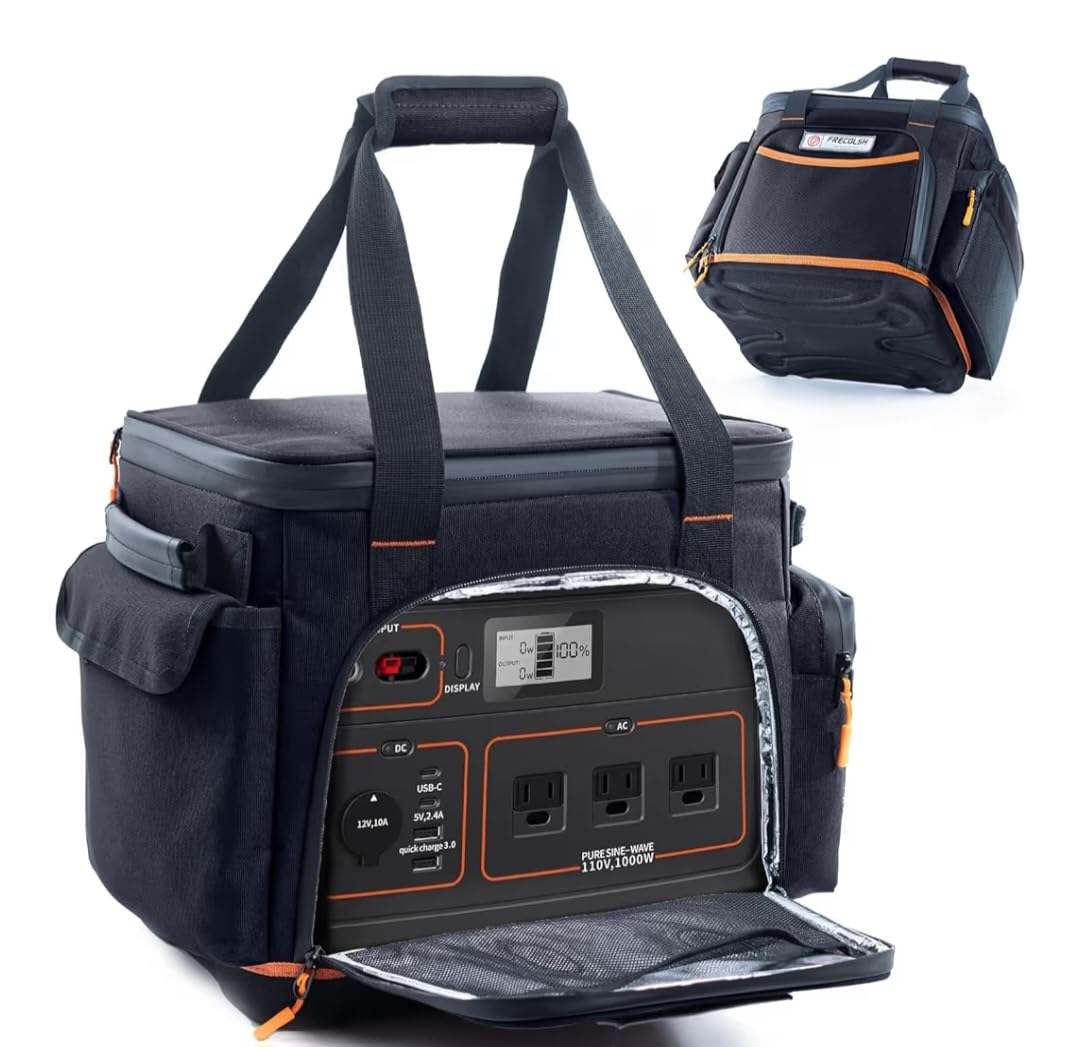
This is the only bundle in the group that includes the storage, so if you are starting from nothing it removes the single most common compatibility question. The Explorer 1000 v2 holds 1,070Wh of LiFePO4 chemistry, delivers 1,500 watts continuous from three pure sine wave AC outlets with 3,000 watts of surge, and weighs 23.8 lb with a folding handle. The battery is rated to hold more than 70 percent of capacity after 4,000 cycles, with a stated 10-year lifespan.
Owners who bought it for outage backup report the same result repeatedly: a full-size fridge running eight to nine hours overnight, and camping loads lasting days, including in wet and overcast weather. Ports cover 100W PD USB-C, USB-A, a 12V car port and three AC outlets, and a 30 dB overnight charging mode keeps it quiet in a tent.
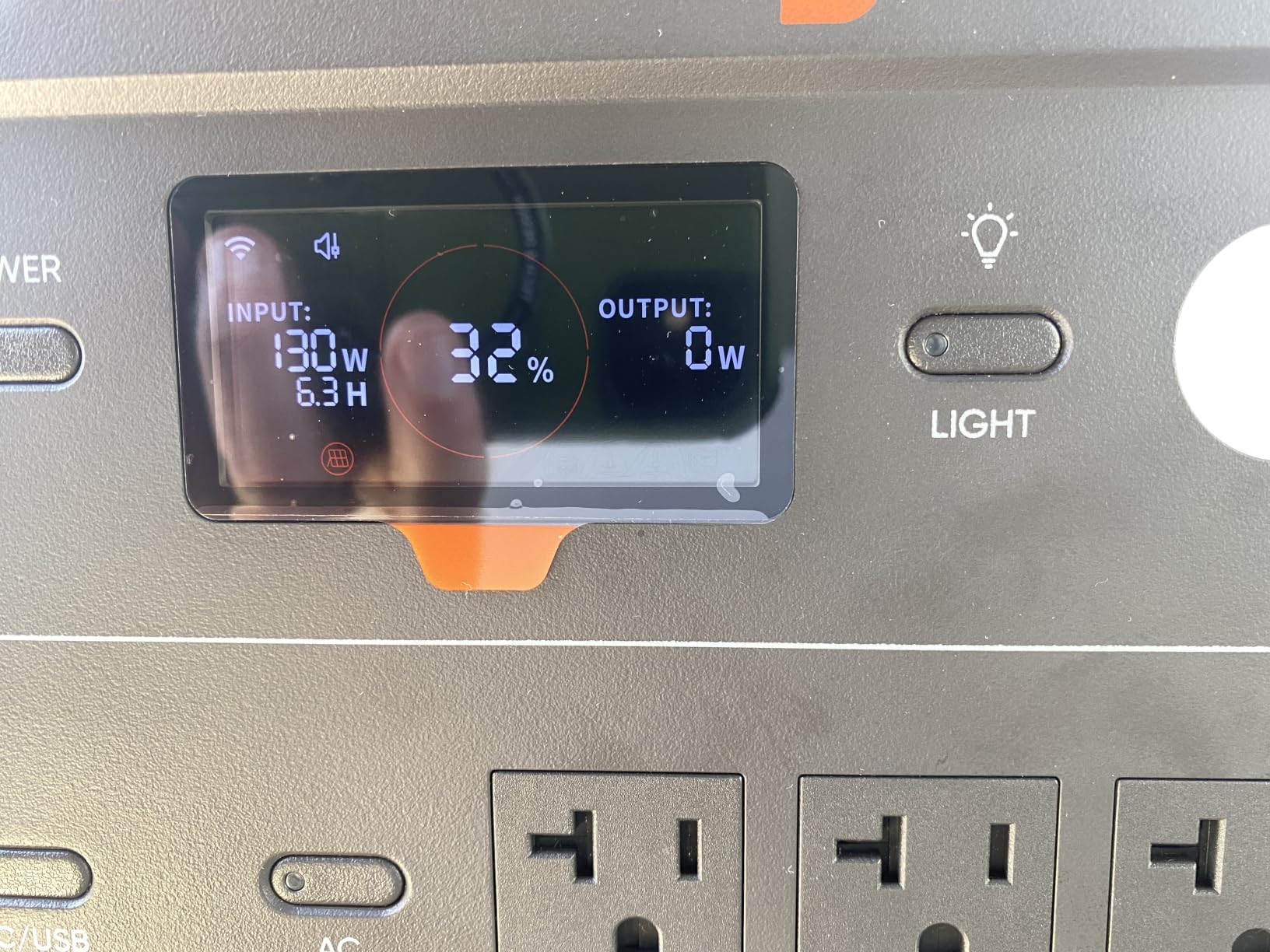
The important detail for anyone reading this as a solar kit: the station reaches 80 percent charge in about 6 hours with the included 200W panel, and it also offers a 1.7-hour default fast charge or a 1-hour emergency mode that has to be switched on in the Jackery app. Owners note the emergency mode shortens unit lifespan, so treat it as a genuine emergency tool rather than a routine setting.
Critically, the recurring criticism lands on the panel rather than the station. The bundled 200W panel sags in the middle, is awkward to keep standing in wind without propping, and ships with a short lead. If your priority is a well-behaved panel, the standalone entries further down are the better buy, and you can still charge this station with any MC4 panel you like.
What you should check before buying this bundle
Work out whether one station is enough. Owners with a full trailer report that a single 1000-class station can struggle to run everything at once, which is the natural ceiling of 1,070Wh. If you are running a fridge, a microwave and a coffee maker on the same morning, plan for expansion or a second battery.
Think about the panel separately from the station. You are buying a complete package here, so you accept the bundled panel’s weaknesses. Judge it as a 5-year-warranty bundle, since the station carries 5 years of manufacturer coverage and the panel is a different product with different support.
Who should skip this bundle
Skip it if you already own a station. Adding a second battery to get a panel is an expensive way to buy solar, and any MC4 panel on this page will charge the Explorer 1000 v2 just as well.
Skip it if you want the lightest possible setup. At 23.8 lb for the station plus the panel, this is a car-camping package, not something you carry on foot.
4. ZOUPW 100W IP67 Foldable Solar Panel – Best Budget Pick
ZOUPW 100W Portable Solar Panel for Power Station,23.5% Efficiency Mono Foldable Solar Charger for Jackery 300/Ecoflow River/Anker/Bluetti,IP67 Waterproof for Camping RV Off-Grid Emergency Power
100W
23.5 percent efficiency
IP67
9.48 lb
12-month warranty
Pros
- 5-in-1 cable covers DC8020
- XT60
- Anderson
- DC7909 and DC5521 so no adapters are needed
- Light at 9.48 lb with a magnetic handle
- ETFE lamination and IP67 sealing hold up better in rain and dust
- USB-C and USB-A charge devices directly
- Strong value for the size
Cons
- Output is capped by the paired power station's own input limit
- Only a 12-month manufacturer warranty
The deciding feature here is the cable. ZOUPW ships a single 10-foot lead terminated in a true 5-in-1 connector covering DC8020, XT60, Anderson, DC7909 or 8mm, and DC5521. That single cable reaches the great majority of portable power stations on the market, which removes the adapter guesswork that costs buyers both money and patience on their first setup.
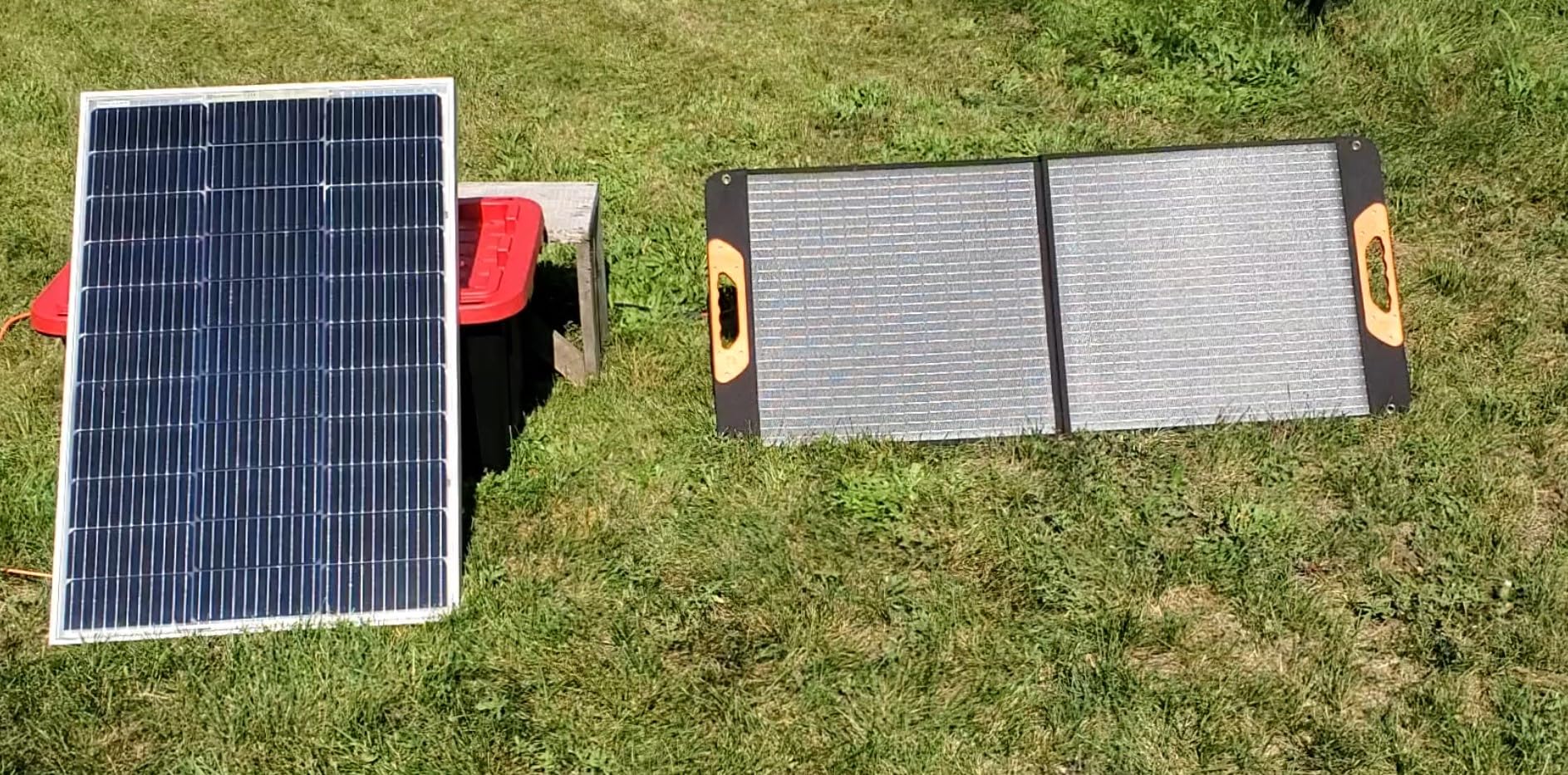
Owners in the reviews understand the ceiling here, and understanding it is the key to a satisfying purchase. Real output is bound by the input limit of whatever station you attach, so a 100W panel on a 60W-limited station delivers 60W no matter how good the panel is. Nothing is wrong with the panel; the station is simply the smaller number.
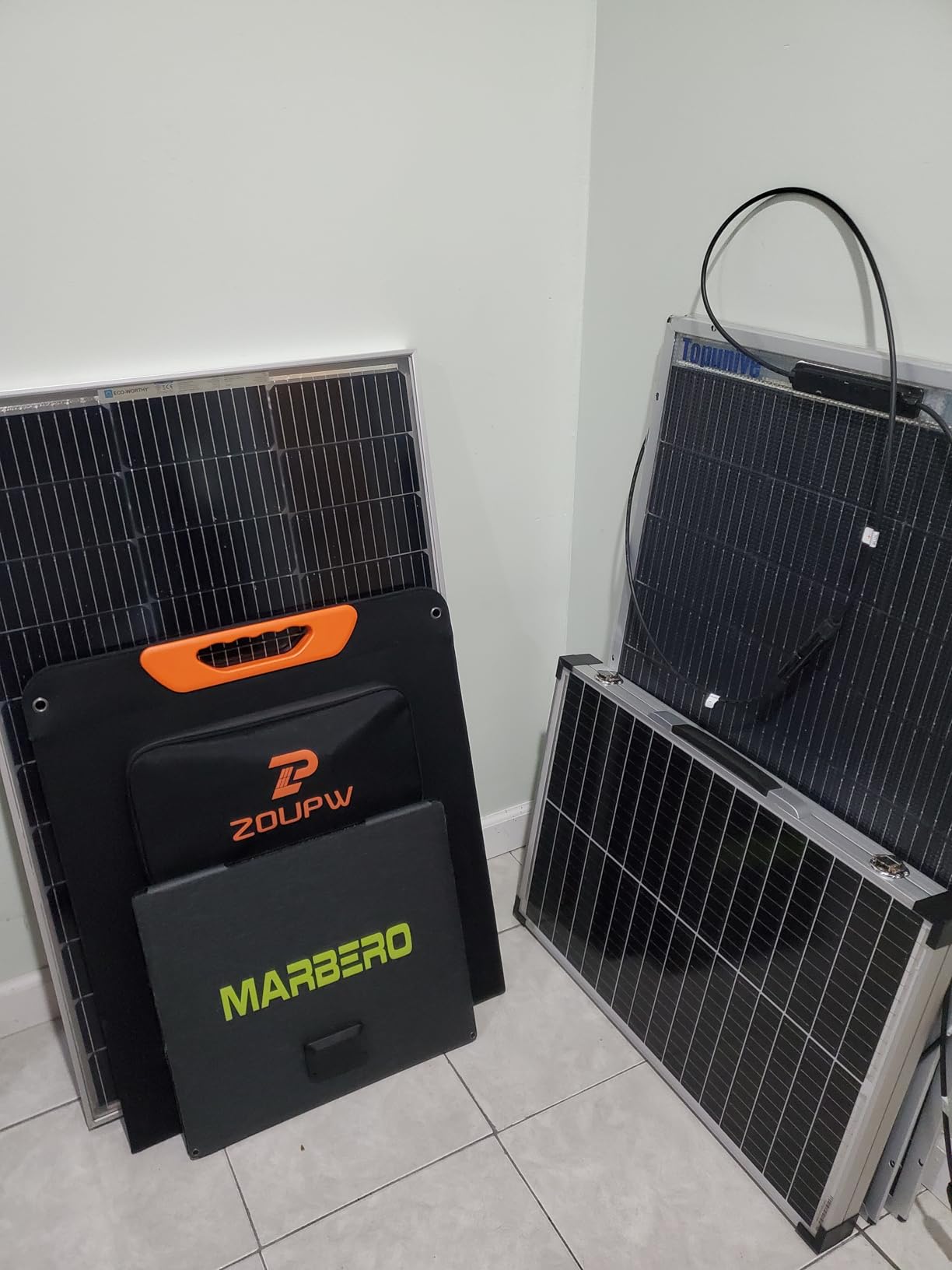
Cell specification is Grade A+ monocrystalline silicon at 23.5 percent efficiency, laminated in ETFE and rated IP67 for waterproofing and dust, with a zippered pocket for the built-in controller and cable. There are two adjustable kickstands for 45-degree positioning, which the manufacturer notes captures about 20 percent more light than lying flat, and the upper temperature rating is 158 degrees Fahrenheit.
Weight is 9.48 lb with a magnetic easy-carry handle, and it folds to 24.13 by 21.06 by 1.77 inches. A built-in charging hub adds one USB-C PD port at 15V and 3A plus two USB-A including QC3.0, so phones, tablets and cameras can charge straight from the panel on a bright day.
What you should check before buying this panel
Check your station’s maximum solar input wattage before anything else. This is the single most common regret with an otherwise well-made 100W panel, because the panel is fine and the limit is elsewhere. Find the input figure in your station’s manual and confirm it is at least 100 watts.
Weigh the warranty against the price. Twelve months is the shortest on this list, and several competitors here offer two or three years. For a panel that will live outdoors through multiple seasons, that difference is worth considering if you are deciding between two similar options.
Who should skip this panel
Skip it if you need to refill a large station quickly. At 100W, this is a maintenance and top-up panel. It suits a 300Wh to 500Wh station, and it is genuinely useful for keeping a small station alive over a long trip.
Skip it if you are buying for a group or for multi-day appliance use. Nothing in this design turns 100 watts into more than 100 watts, and a 1000Wh station will take far longer than most buyers expect.
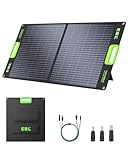
5. EBL 100W Portable Solar Panel Kit – Best for Adapter Coverage
EBL Solar Panel 100W Portable Solar Panel for 300/500/1000 Power Station
100W
23 percent efficiency
MC4 plus barrel adapters
ETFE IP65
Pros
- Adapter kit makes it work with a wide range of power stations and power banks
- Plastic frame stands up well on windy days
- Owners report real output in the 65 to 85W range and up to 150 to 160W when two are linked
- Magnetic clasp handle and sealed zipper pocket
- Customer service replaced defective panels quickly
Cons
- Measured output falls short of the nameplate at roughly 65W peak for one owner
- Included cable is only about 6 feet
- Water resistant rather than waterproof and not intended for direct rain
- Soft frame is less rigid than aluminum
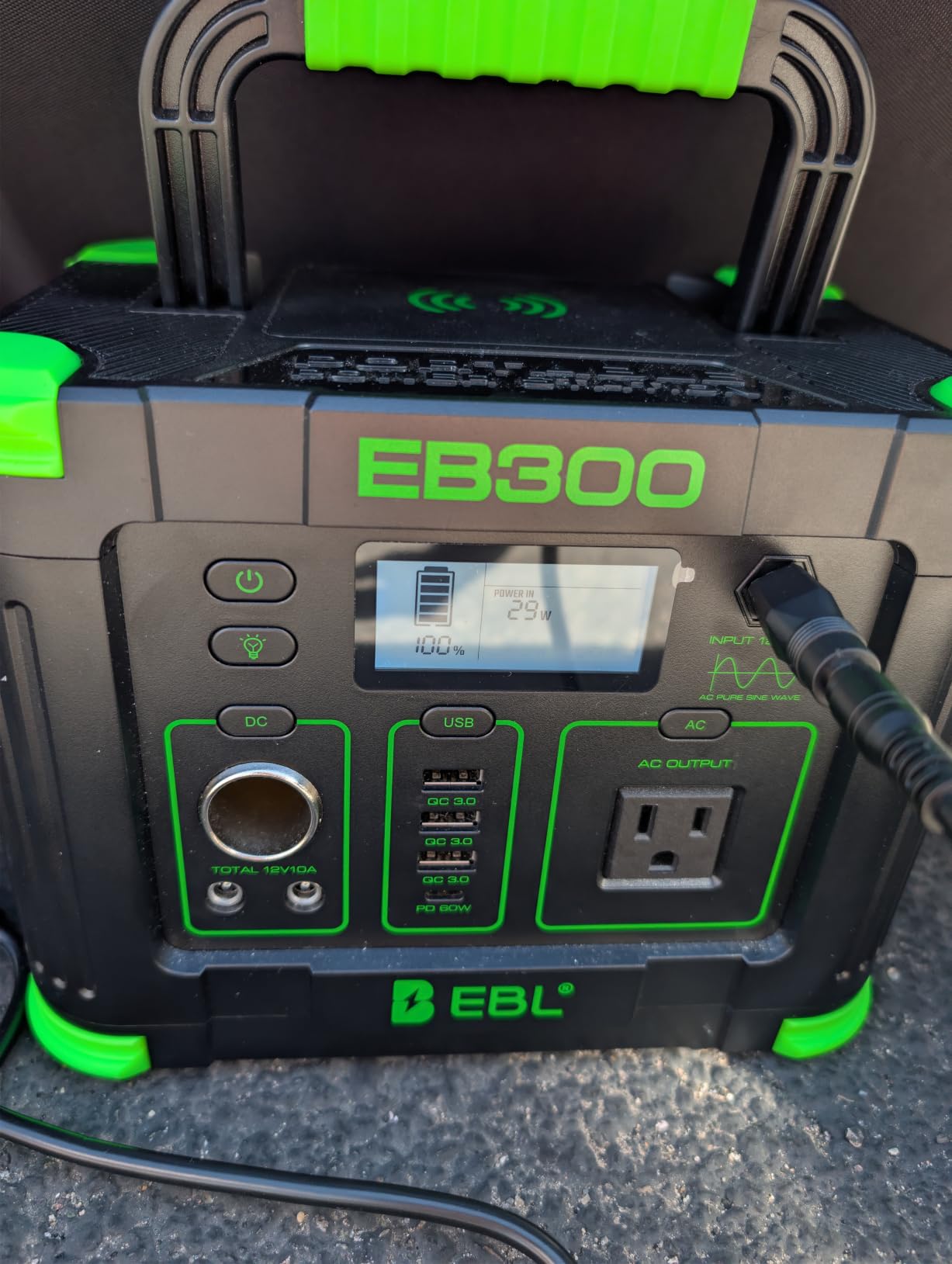
This kit is the adapter answer. Alongside the panel and manual, you get an MC4 to Anderson cable, an MC4 to DC5521 cable, and three barrel adapters covering 5.5 by 2.1 to 5.5 by 2.5 millimeters, 7.9 by 0.9 millimeters, and 3.5 by 1.5 millimeters. Owners with older stations and plain power banks say this is the reason the kit works for them at all.
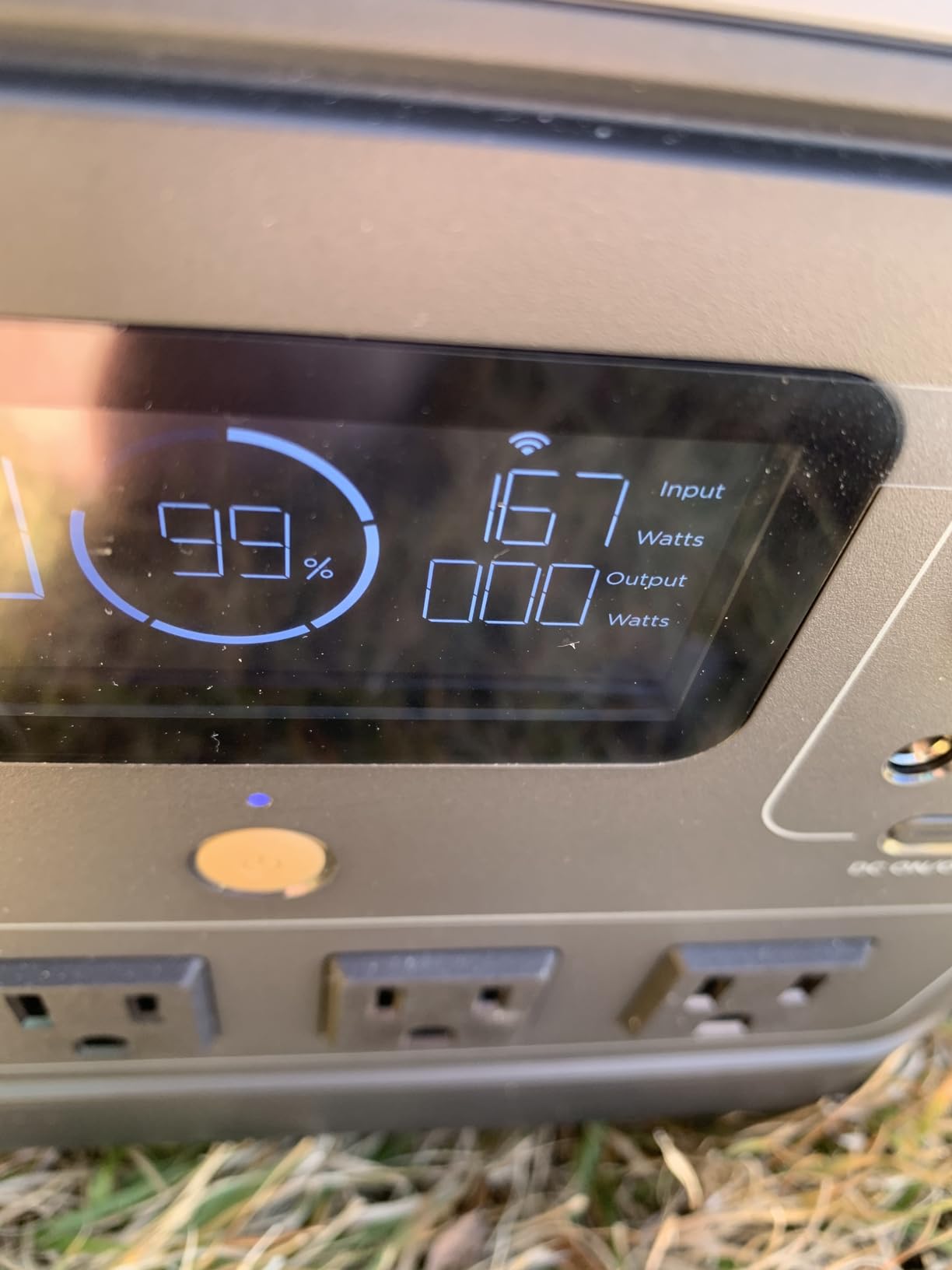
Real-world performance is the part to read twice. Several buyers report dependable output in the 65 to 85W range from a single panel, and around 150 to 160W when two are linked, while one owner in Florida measured roughly 65W peak on a clear day. That is a meaningful gap from the 100W nameplate, and it comes from the same current-limit physics that limits any 100W panel paired with a modest station.
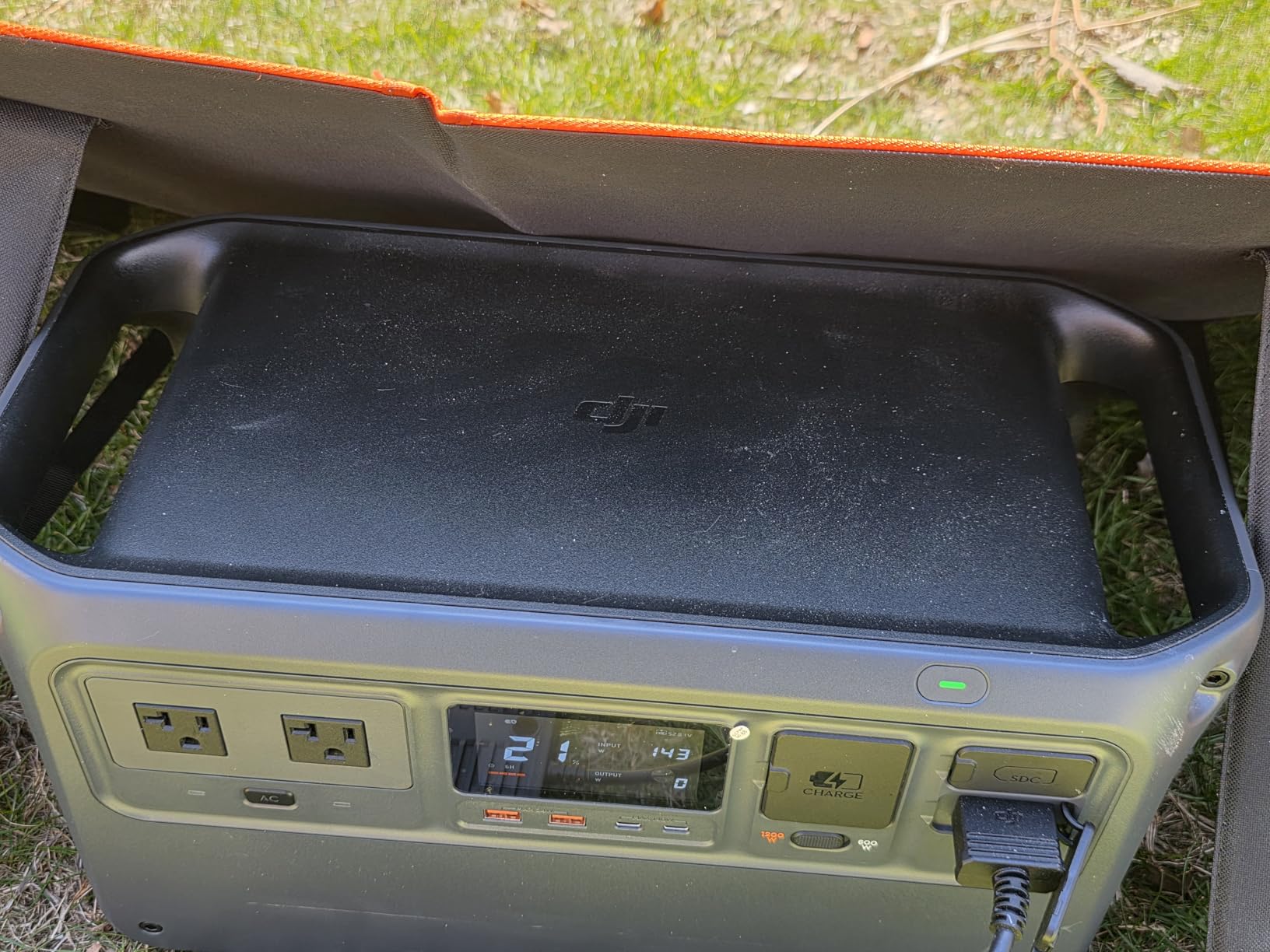
Construction is monocrystalline silicon with an integrated charging IC providing overcharging, overheating and short-circuit protection, laminated in ETFE and rated IP65 for water resistance. Two kickstands give a 45-degree angle, and a magnetic handle handles folding and storage. The listing does not publish a weight figure, which is worth noting for anyone counting grams against a pack limit.
Warranty length is not stated in the product details, so treat support as a question worth asking before you buy for extended use. That said, customer service replacing defective panels quickly comes up repeatedly in owner feedback, which counts for something in a category where support quality varies widely.
What you should check before buying this kit
Confirm you actually need the barrel adapters. If your station takes a proprietary solar plug, the MC4 cables here will do the job and the extra adapters sit in a drawer. If your setup includes a plain power bank, they earn their place.
Plan for the short lead. At roughly 6 feet, this is the shortest included cable in the group, and it is easy to add length with an MC4 extension. Budget for it, because a panel you cannot place in full sun is a panel delivering less than you paid for.
Who should skip this kit
Skip it if you need a rigid panel. The frame is soft rather than aluminum, so it is less resistant to twisting and is not meant for hard mounting on a roof or a fixed bracket.
Skip it if rain exposure is part of your plan. IP65 is water resistance, not waterproofing, and the intent is protected use rather than leaving it in a downpour or lashing it permanently to a vehicle.
6. SOKIOVOLA 200W IP68 Solar Panel – Best Value 200W
SOKIOVOLA N-Type 16BB 200W Portable Solar Panel for EF/Jackery/Bluetti/Anker Power Station Foldable Solar Panel 25% High Efficiency IP68 Waterproof for Outdoor Trip RV Camping Blackout Off Grid
200W
25 percent N-Type
IP68 ETFE
16.3 lb
12-month warranty
Pros
- Panels feel firm with snap-secured legs that hold up well
- Owners report 170W plus from a 200W panel in peak sun
- 5-in-1 connector cable works with essentially every power station brand
- Folds to 21 by 23 inches with an included storage bag
- Manufacturer support responds within 12 hours per the listing
Cons
- MC4 pigtails off the panel are very short at roughly 4 inches
- Weak rivets on the back panels are reported to break
- 16.3 lb is heavy for long backpacking trips
- Isolated reports of output degradation after 6 months
Owners defend this panel more energetically than its 4.3 rating suggests, and their argument is measured output. Several report 165 to 180W from a 200W panel in full sun, which puts it in the same territory as considerably more expensive 200W panels. If your priority is watts per dollar and the panel arrives with the right cable, that performance is the reason to look here.
Cell technology is A+ grade monocrystalline silicon with N-Type 16BB construction at up to 25 percent conversion efficiency, laminated in ETFE and rated IP68. That is the strongest sealing claim in this group, and it matters for van roofs, exposed campsites and marine use where a panel takes salt spray and rain.
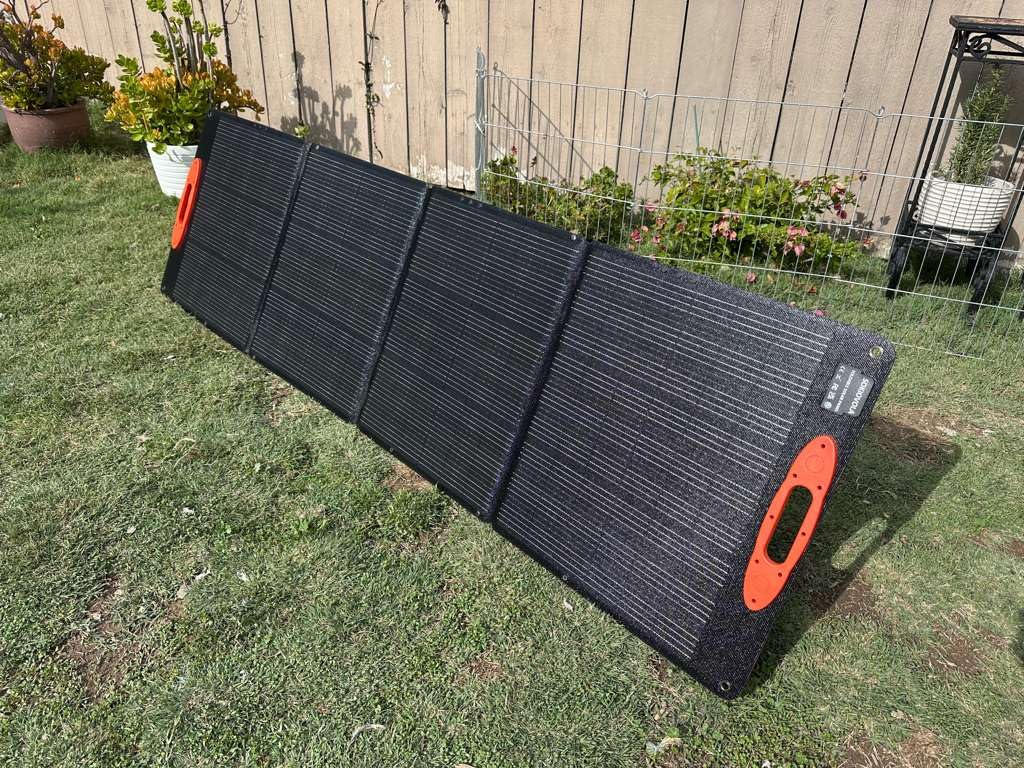
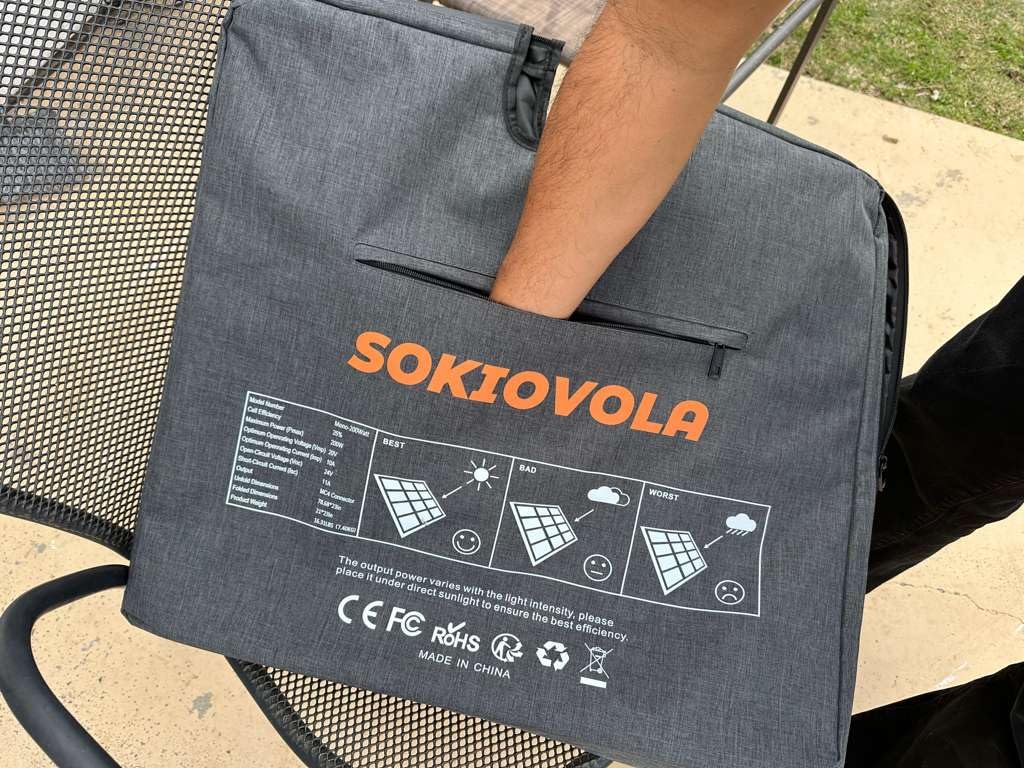
The connector is the other headline. A 3-meter lead adapts MC4 to XT60, DC5521, DC7909 or 8mm, DC8020 and Anderson, covering effectively every mainstream power station brand without an extra purchase. The panel folds to 21 by 23 inches with a magnetic handle and four grommet holes for RV or tent mounting, and a carrying bag is included.
The hardware complaints are specific and worth taking seriously. The MC4 pigtails emerging from the panel are only about 4 inches, which is a nuisance at the exact moment you are trying to route cable, and owners report weak rivets on the rear panels. At 16.31 lb it is also the second-heaviest option here, which rules it out for foot travel.
What you should check before buying this panel
Look at the output voltage against your station’s input window. This panel is listed at 18 volts, which sits comfortably inside the range most 1000Wh to 2000Wh stations accept, but the 5-in-1 cable is generous in a way that can hide a mismatch between the panel and the station you end up plugging into.
Ask yourself whether 16.31 lb is a problem. If the answer is no, this is one of the better 200W options on paper and in reported measurement. If the answer is yes, the lighter options further down serve the same purpose at a real weight cost.
Who should skip this panel
Skip it if you buy for the long term and warranty is the deciding factor. Twelve months with a 30-day refund guarantee is the shortest support commitment among the stronger-rated options here, and that matters more on a panel that will sit in the sun for years.
Skip it if you backpack. Sixteen pounds of panel is a serious share of a load, and low-light performance drops sharply for some owners, so it is a poor match for shaded trail conditions.
7. GRECELL 200W Flexible Solar Panel – Best for Van Life
200W Portable Solar Panel for Power Station Generator, 12V/24V Flexible Foldable Solar Panel Kit Lightweight High-Efficiency Solar Charger Power Backup for Outdoor Van Camper Boat Caravan Off-Grid
200W
23.5 percent efficiency
10.14 lb
0.98 inch thin
IP65
Pros
- Extremely light and thin enough to reposition alone
- Self-contained design with cables and kickstands in a zipper pouch
- Magnetic clasps keep the folded panel secure
- Still produced 7 to 15W in overcast rainy conditions
- Connector selection reached older power stations without extra adapters
- Customer service repeatedly singled out as fast
Cons
- Never reaches the full 200W rating with owners measuring 138 to 163W
- IP65 water resistant rather than waterproof
- Charge controller and alligator clips not included for direct 12V charging
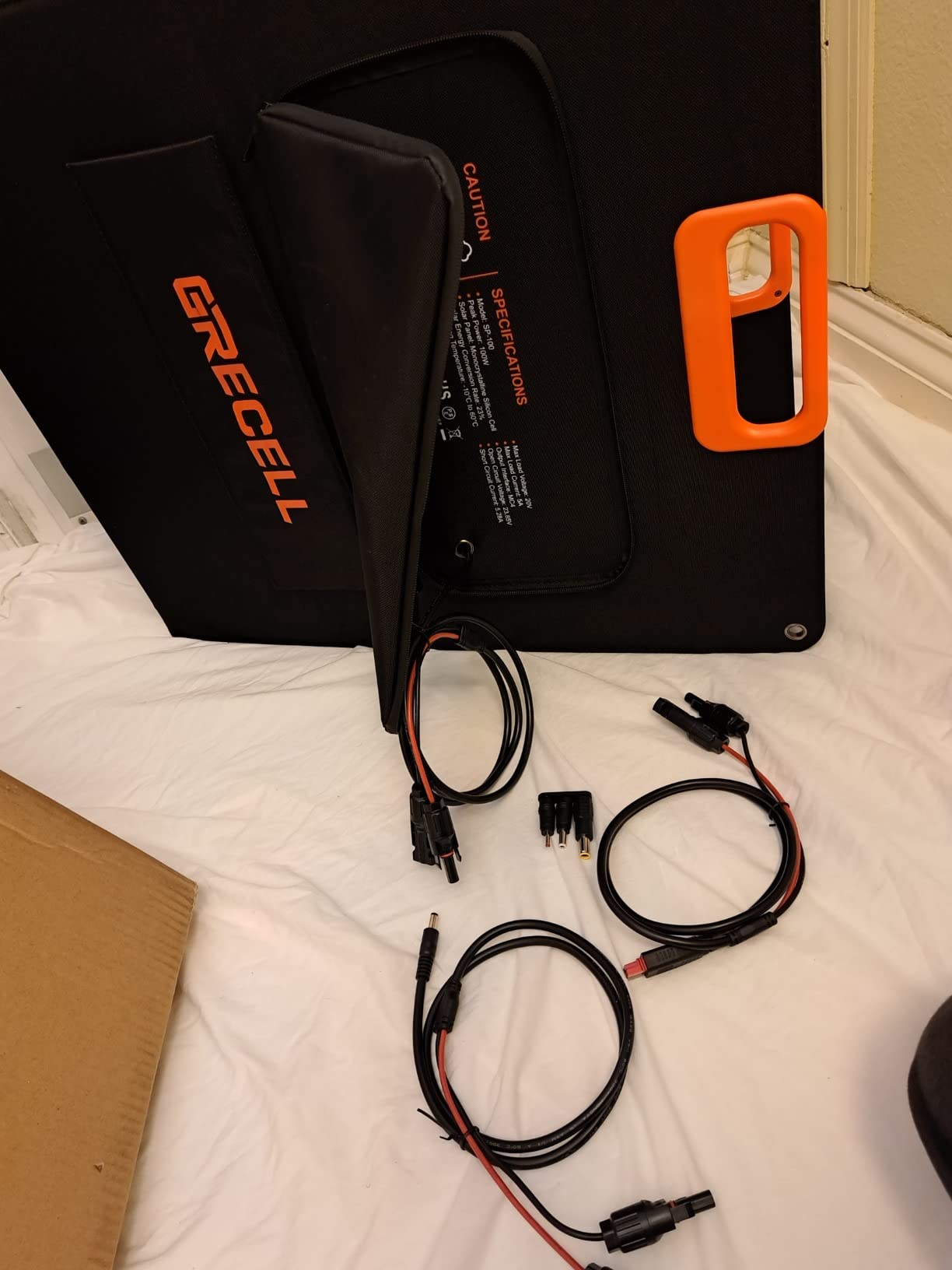
Weight is the headline number. At 10.14 lb, this panel is roughly a third lighter than most 200W foldables, and one owner reports repositioning it alone through the day without help. It is also only 0.98 inch thick unfolded, so it slides behind a seat, under a bunk or into a narrow cabinet where a rigid suitcase panel simply will not go.
Long-term owners using it daily praise the thin ETFE laminate, the 98 percent transparency glass and the self-contained design where cables and kickstands live in a zipper pouch on the panel itself. Magnetic clasps hold the folded package closed in storage, which prevents the specific scuffing and creasing that wrecks cheaper foldables.
Real output depends heavily on conditions. Owners report anywhere from 100 to 170W depending on sun, with a common measured range of 138 to 163W in clear conditions, so the 200W nameplate is aspirational rather than typical. The more interesting number is the bad-weather one: 7 to 15W in overcast, rainy weather, which is not nothing when a storm stalls a recharge.
The 4-in-1 lead covers XT60, Anderson, DC7909 or 8mm and an aviation connector, which owners praise for reaching older power stations without buying adapters. Four adjustable kickstands and four metal-reinforced mounting holes handle ground placement, and series and parallel connections are supported with automatic reconnection optimization after shade passes.
What you should check before buying this panel
Note what is missing. There is no charge controller and no alligator clips in the box, so if you want to maintain a 12V vehicle battery directly you need a separate controller. For a portable power station user, that is not a problem, since the station has its own controller.
Set your expectation at about 150W rather than 200W. Working from the measured range, size your days around the middle of the owner-reported figures and you will never be disappointed. The panel is excellent at what it does; the number on the label is simply the ceiling.
Who should skip this panel
Skip it if you plan to leave it out in sustained rain. IP65 is water resistance, and the intended use is protected rather than permanently exposed or hard-mounted. If your setup means long unattended stretches outdoors, choose an IP67 or IP68 panel instead.
Skip it if you charge a raw 12V battery, because the controller and clips are not included and you will need to source them separately.
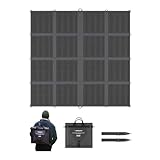
8. Renogy 400W Foldable Solar Blanket – Best for Large Stations
Renogy 400W Portable Solar Panel for Power Stations, 25% High Efficiency
400W
25 percent N-Type
16.09 lb
16-fold
IP65
UL 61730
Pros
- Delivers very close to rated output at just under 400W in direct sun
- Around 300W on cloudy days
- Folds to roughly the size of a small backpack
- Deploys on a windshield
- on the ground or hung vertically
- Works well with an MPPT controller and LiFePO4 banks
Cons
- Weak off-axis performance with output dropping sharply past about 10 degrees off sun
- No built-in stand so a mount or suction cups may be needed
- USB ports sit inside the cable pouch and are hard to reach once deployed
- Adapter tip compatibility must be checked with some Jackery models
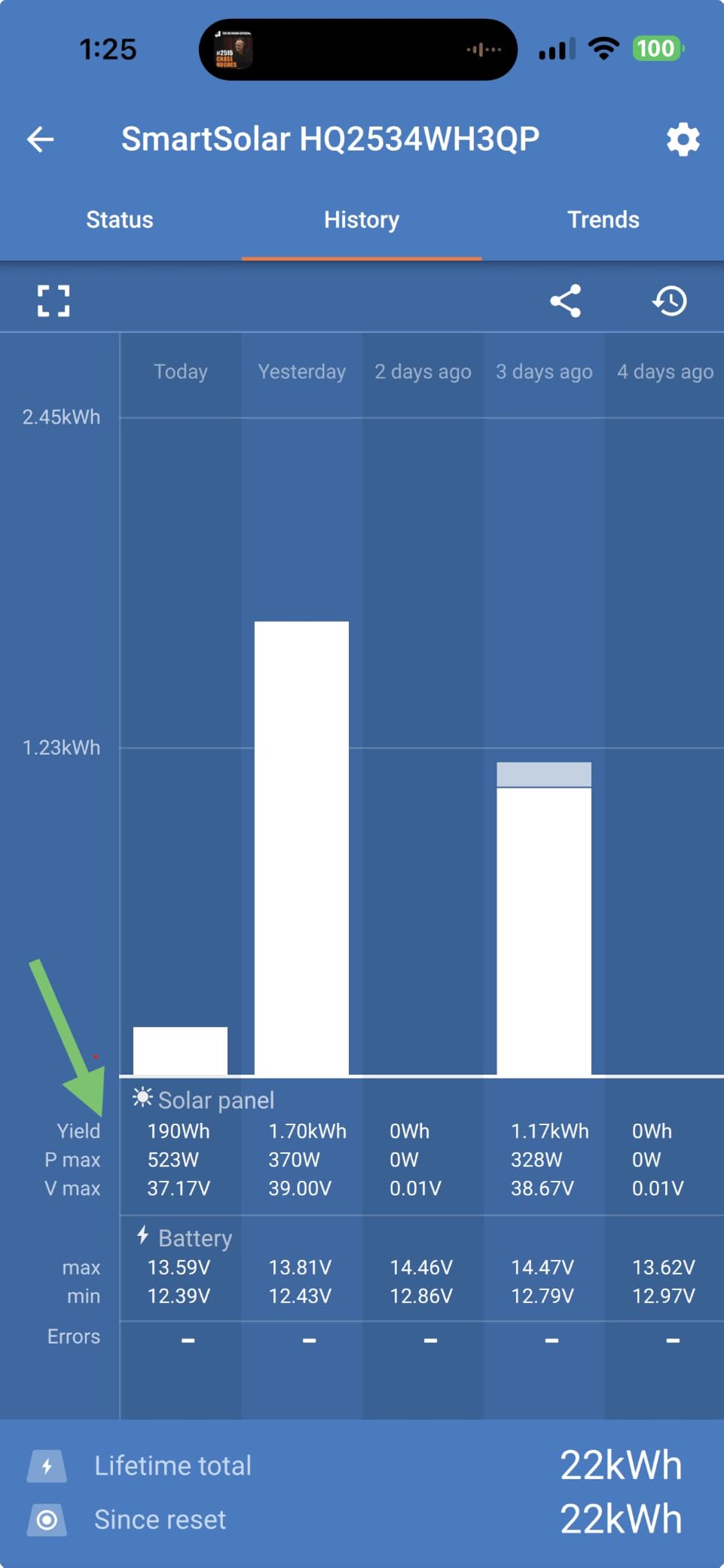
Near-nameplate output from a portable panel is unusual, and this is the entry that delivers it. Owners report just under 400W in direct sun and roughly 300W under cloud, which is far closer to the label than the 138 to 163W typical of the flexible 200W panels in this group. If you run a 2000Wh station and refill in one day matters, that difference decides the purchase.
The design is a 16-fold blanket that packs to 16.54 by 15.83 by 4.13 inches, which Renogy claims is 62 percent lighter than a conventional 400W portable panel. The stated weight is 16.09 lb, carried with a padded handle and two shoulder straps. Cells are 16BB N-Type monocrystalline silicon at 25 percent conversion efficiency, with UL 61730 certification alongside CE, RoHS, FCC, CA65 and PSE.
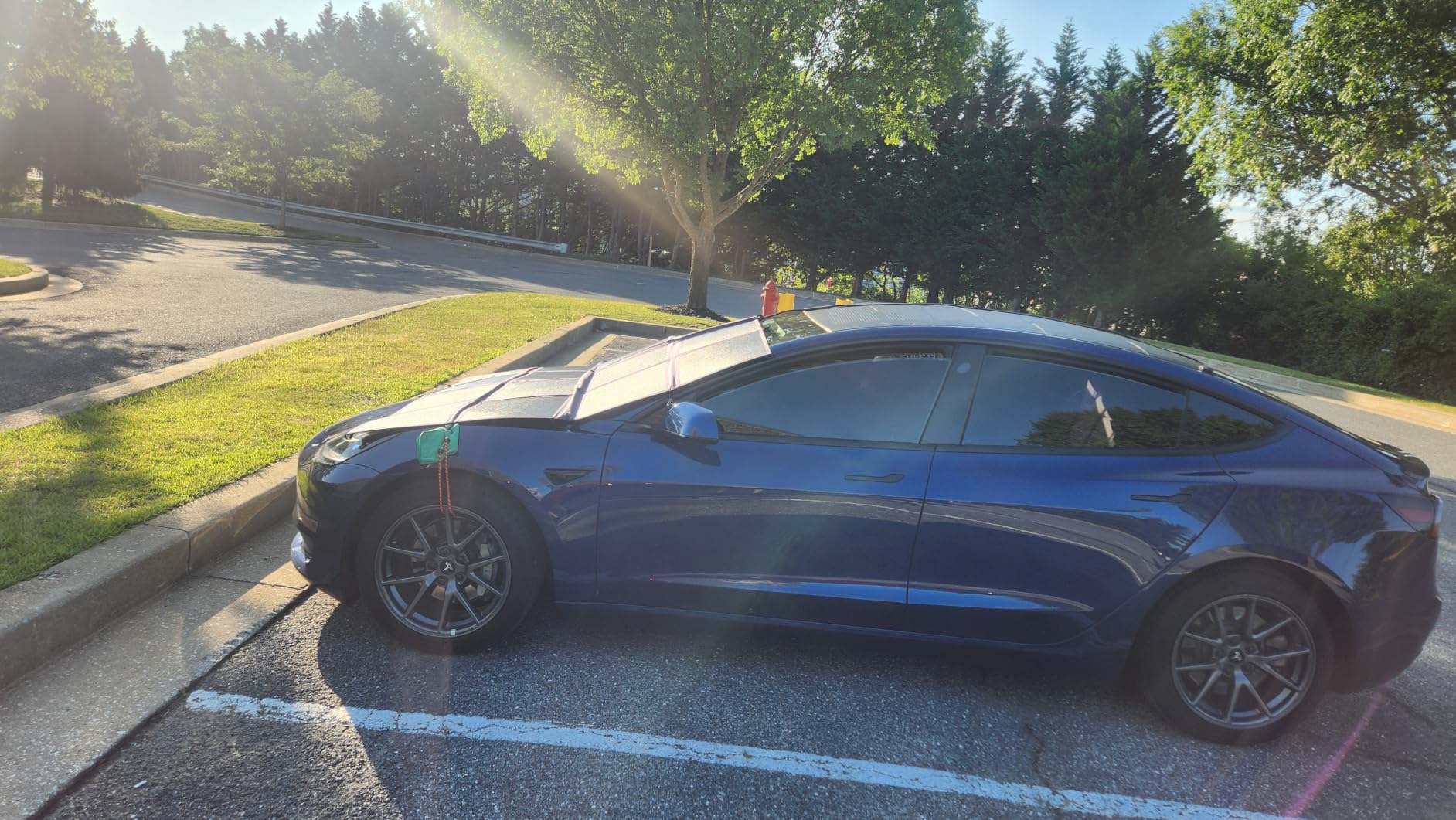
Deployment is the real strength. Owners hang it vertically between trees, lay it flat on the ground, or use it as a windshield shade while driving, and the claim is full output in all three positions. ETFE lamination carries an IP65 rating for a stated -10 to 65 degrees Celsius operating range, and the 10-foot cable works with portable power stations and 12V and 24V AGM, LiFePO4 and deep cycle banks.
The catch is angle sensitivity, and it is a sharp one. Output falls off quickly beyond about 10 degrees away from direct sun, so a panel that is perfect at noon and poor at 4pm is a real possibility here. There is no built-in stand, and one-star reviews concentrate on fulfillment problems rather than the product itself.
What you should check before buying this blanket
Check your station’s maximum solar input wattage first. A 400W panel on a station rated for 200W of input delivers 200W and no more, and some stations physically reject panels above a stated voltage. Confirm both figures before you buy rather than after.
Think about where the sun actually is. If your site is shaded for part of the day, the tight angular tolerance works against you. If you have open sky for hours, this is the strongest refill per hour in the entire group.
Who should skip this blanket
Skip it if your station is under 1500Wh. A 400W panel paired with a 500Wh station spends most of its potential sitting idle because the battery fills long before the panel does. Match panel size to capacity, not to ambition.
Skip it if you carry everything on foot or need panel output in low light. At 16.09 lb it is not a hiking product, and its directional sensitivity makes it a poor choice for overcast forest camps.
9. MHPOWOS 220W 40V Folding Solar Panel – Best for High-Voltage Input
MHPOWOS 220W Portable Solar Panel 40V Folding Solar Panel for Power Station
220W
40V output up to 48V
IP67
23.5 percent efficiency
Pros
- 7-in-1 solar connector offers broad device compatibility in one cable
- IP67 sealing is stronger than the typical IP65 rating
- Four kickstands allow quick angle adjustment
- Folds to 23.5 by 21.25 by 2.3 inches with thickened handles
Cons
- 40V output will not work with power stations that have a lower maximum input voltage
- Weight of roughly 17.8 lb is heavy for a folding panel
- Charge rate is capped by the paired power station's input limit
This panel exists to solve a specific problem, and buyers who understand the problem rate it well at 4.5. A 40V output voltage, with a 48V maximum, sits well above the 18 to 24 volts typical of 100W and 200W panels. Higher voltage means lower current for the same wattage, which is what allows a station to accept large panels without exceeding its amperage ceiling.
That makes it a poor match for entry-level stations and a good match for the larger 1500Wh and 2000Wh class, which are the units with a high-voltage solar input. Check your station’s stated maximum input voltage before you order, because a 40V panel on a station with a 24V ceiling will not charge it.
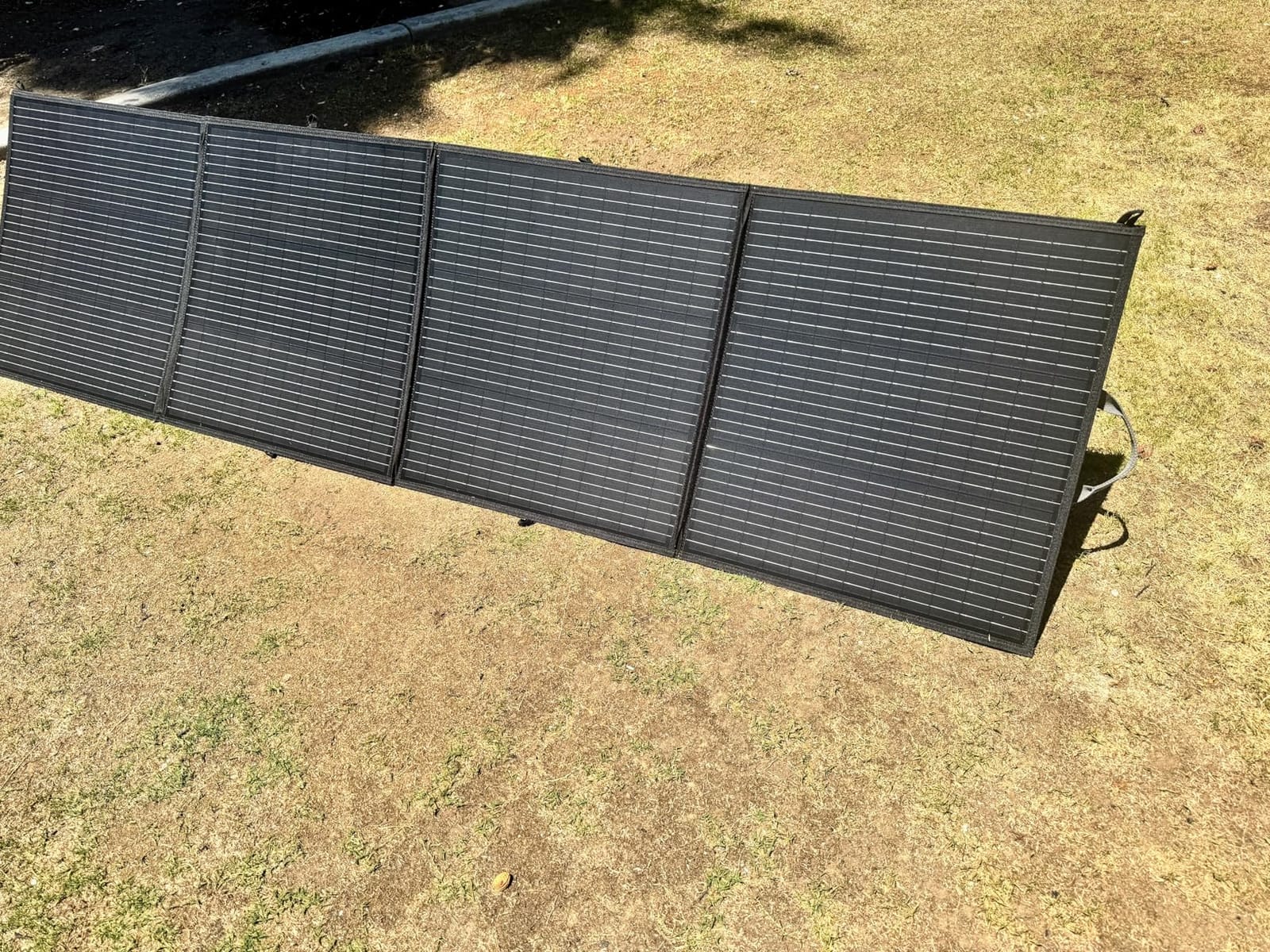
Cell specification is monocrystalline silicon at 23.5 percent conversion efficiency, sealed to an IP67 waterproof and dustproof rating, which puts it among the better-protected options here alongside the IP68 panels. Four kickstands handle angle adjustment on flat surfaces, and the panel folds to 23.5 by 21.25 by 2.3 inches with thickened handles for carrying.
The connector is the 7-in-1 solar connector, offering broader device coverage in a single lead than the common 5-in-1 cable. The listing repeats a warning that the 40V panel needs a compatible high-voltage input, and compatibility checking is the decision factor owners name most often in their reviews.
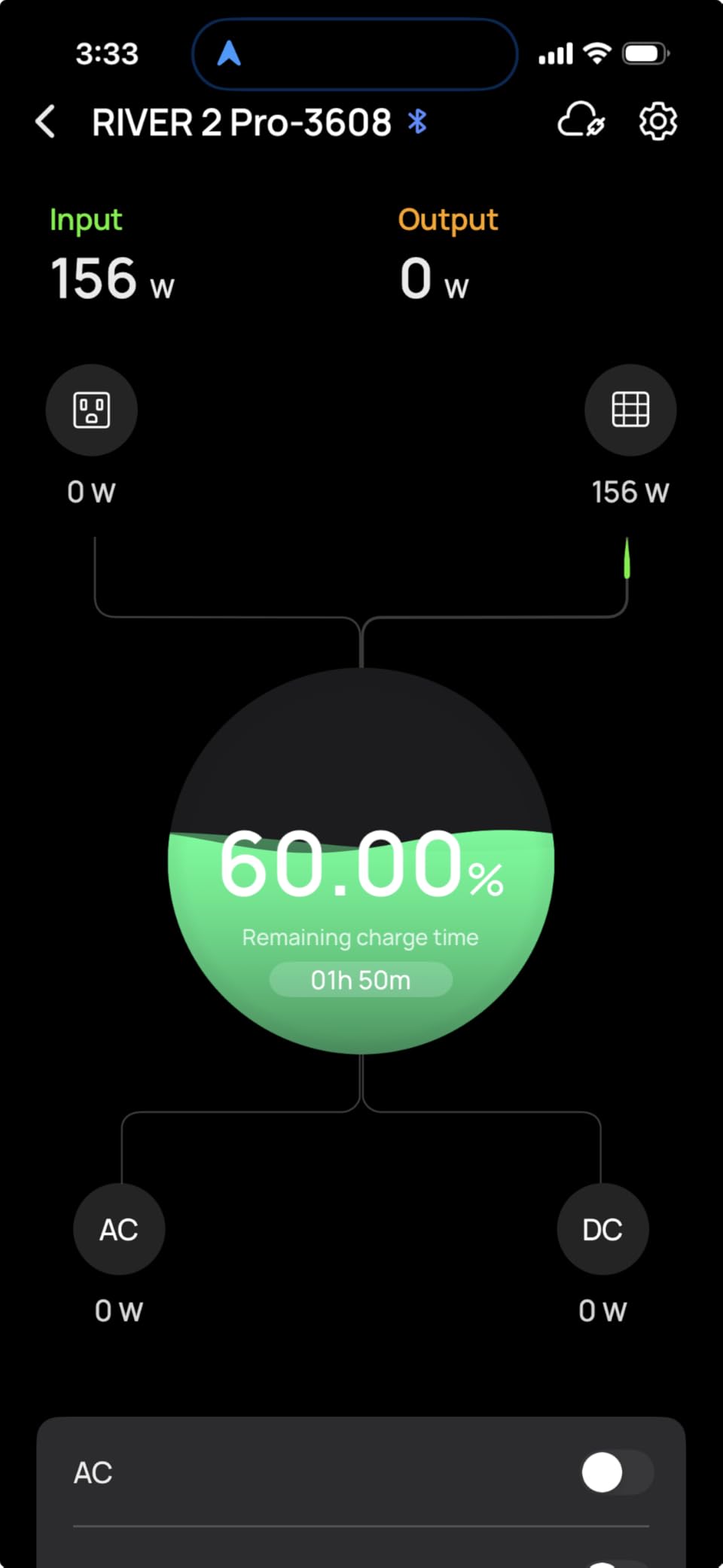
What you should check before buying this panel
Verify maximum input voltage on your power station. This is non-negotiable for this panel, more so than for any other entry here, because the mismatch is a refusal to charge rather than a slower result. Find the figure in your station’s specifications and compare it to 48 volts as the worst case.
Count the watts against your capacity too. 220W is more than most 1000Wh stations can absorb, so a smaller panel may serve you better even when the voltage would be accepted.
Who should skip this panel
Skip it if you own a smaller station, especially one with a 60W or 100W-limited solar input. The 40V profile disqualifies it outright in many cases, and the weight of roughly 17.8 lb is the heaviest in this group on top of that.
Skip it if you want the lightest folding option. Seventeen-plus pounds changes the character of a camping kit, and the lighter entries serve the same use with less strain on your packing plan.
10. TWELSEAVAN 150W HPBC Solar Panel – Best for Lightweight Travel
TWELSEAVAN 150W Portable Solar Panel for Power Station Jackery RV Outdoor
150W
25.8 percent HPBC
8.38 lb
IP68
36-month warranty
Pros
- High 25.8 percent HPBC efficiency in an 8.38 lb package
- Magnetic folding with kickstands deploys in about 10 seconds
- 5-in-1 MC4 cable plus 3 DC adapters covers Jackery
- EcoFlow
- Bluetti and Anker
- Fiberglass layer and aluminum frame add tear resistance and rigidity
- Longest warranty in this group at 36 months
Cons
- Panels should not be connected in series or parallel
- Not intended for permanent fixed installation
- Charging speed is capped by the paired power station's input limit
- Newer HPBC design has a smaller review base
At 8.38 lb for a 150W panel with 25.8 percent HPBC cell efficiency, this is the best power-to-weight balance in the group. It folds magnetically, sets up in about 10 seconds, and carries a built-in solar angle guide on the frame so you can line up the panel without guessing at the geometry.
Durability is built in more literally than most. A fiberglass layer adds tear resistance and a reinforced aluminum alloy frame carries an IP68 waterproof rating, with an ETFE layer passing 95 percent light transmittance. The magnetic folding design and adjustable kickstands let one person deploy it quickly, which matters when the weather window is short.
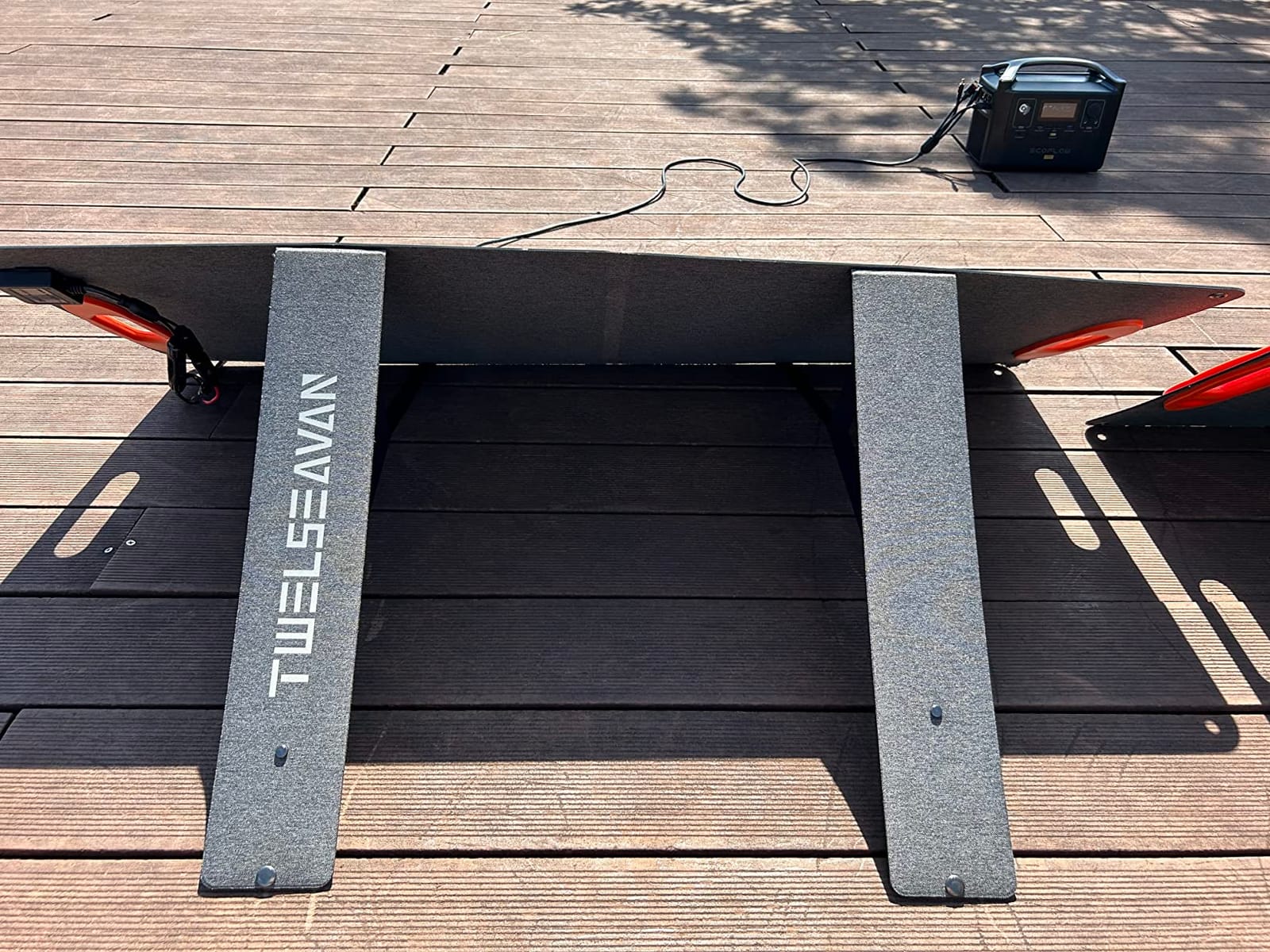
Connectivity is the 9.8 foot MC4 cable with a 5-in-1 connector plus three DC adapters, and owners confirm it covers Jackery, EcoFlow, Bluetti and Anker units. The 36-month warranty is the longest in this comparison, backed by 24-hour customer service, and that alone separates it from the 12-month options at similar wattage.
One limitation deserves emphasis because it is unusual: the manual restricts this panel from series or parallel wiring. That rules out scaling to 300W or more with a matching panel, so if you plan to grow your array, choose a different entry from this list.
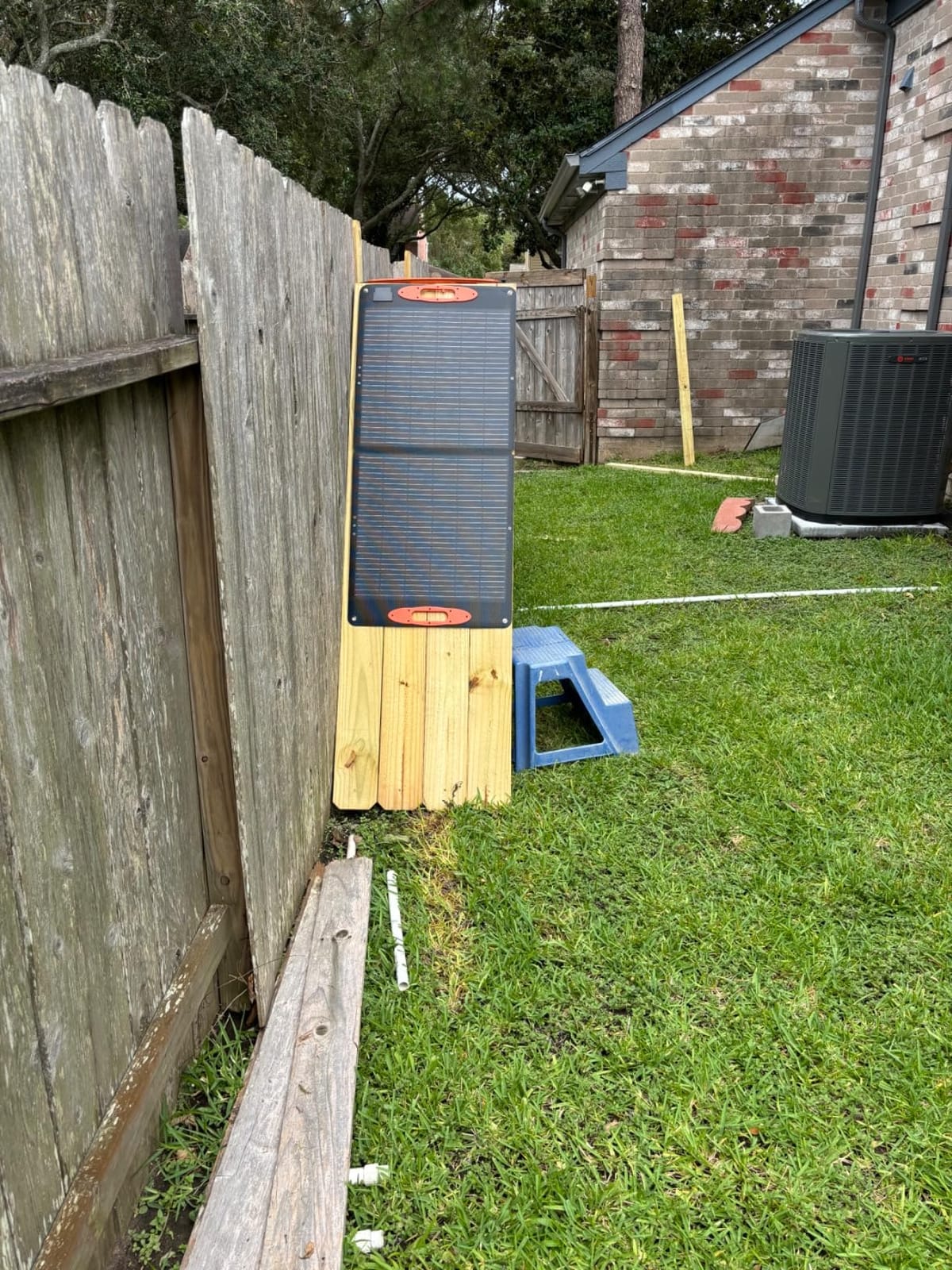
What you should check before buying this panel
Confirm your station accepts a 150W input, and confirm it accepts the MC4 standard. The voltage is listed at 21.6 volts, which sits inside the window of most mid-size stations, so compatibility is generally straightforward.
Weigh the 150W figure against your typical day. With 8.38 lb you could carry two of these, but the no-parallel restriction means the second one would be an independent system rather than an expansion. For most travelers, one panel plus a smaller station is the better balance.
Who should skip this panel
Skip it if you plan to expand. The prohibition on series and parallel connections is firm in the documentation, and it is a hard ceiling on a system you might want to grow next season.
Skip it if you are buying a panel for permanent fixed installation, because this is a portable folding design with a magnetic closure and kickstands, not a panel meant to be bolted down.
Which Kits Work With Jackery, EcoFlow, BLUETTI and Anker SOLIX
You can use any solar panel for a power station only if two conditions are met: the connector physically fits, and the panel’s voltage sits inside the station’s acceptable input window. Most portable power stations use MC4 as the solar input, and most accept panels in the 18 to 24 volt range, so a 100W or 200W monocrystalline panel from any brand on this list will work with a Jackery, EcoFlow, BLUETTI or Anker SOLIX unit in that class.
What varies is the voltage ceiling on the larger stations. Units in the 1500Wh to 2000Wh class commonly accept higher solar input voltages, and that is where the 40V MHPOWOS panel earns its place. Units with a 60W or 100W solar input limit will accept a 200W panel and simply take the lower number.
Connector coverage breaks down as follows. The ZOUPW, SOKIOVOLA and TWELSEAVAN panels ship a 5-in-1 lead covering DC8020, XT60, Anderson, DC7909 and DC5521, which reaches nearly every mainstream station without an adapter. The GRECELL panel uses a 4-in-1 lead covering XT60, Anderson, DC7909 and an aviation connector. The EBL kit includes MC4 cables plus three barrel adapters for older and simpler devices. The Renogy 200W offers plain MC4 alongside USB outputs, and the Renogy 100W kit terminates in alligator clips, which suits raw battery connection rather than a station socket.
Two cautions apply to every brand. First, check whether your station needs the newer 8mm or DC8020 style plug, because some recent Jackery models moved to a different barrel size. Second, do not mix panel brands in a series string, since differing current and voltage curves can cause the weaker panel to drag the whole string down.
If you are still choosing the station side, our guides to the best portable power stations for van life and the best portable power stations for camping set out which units accept which input, which matters as much as the panel.
How Long Does a Solar Panel Kit Take to Charge Your Power Station?
A 200W panel takes roughly 6 to 8 hours of strong direct sun to refill a 1000Wh power station from empty, and considerably longer to do it on an overcast day. The number that matters is peak sun hours: the hours per day when irradiance is high enough to produce meaningful power, typically 3 to 5 in good conditions. A rough daily yield estimate is panel watts multiplied by peak sun hours multiplied by an efficiency factor of roughly 0.7, so a 200W panel in 4 peak sun hours produces about 560Wh per day rather than 800Wh.
The 33% rule is the shortcut most people meet in forums. Divide a panel’s rated wattage by three to get a realistic average output through a day with mixed sun and shade, and a 200W panel becomes roughly 66W average. Rule of thumb, not gospel, but it is a useful correction when a listing implies all-day 200W output.
Wattage is only half the equation. The other half is your station’s input limit. A 200W panel feeding a station rated for 100W of solar input delivers 100W, so buying a bigger panel than your station accepts wastes money. The figures below show the same panels against four capacity classes, assuming a 4 peak sun hour day and no input limit. Add the input ceiling of your specific station to get the real number.
100W panel, 500Wh station: about 280Wh per day, so roughly 1.8 days from empty
200W panel, 500Wh station: about 560Wh per day, so about 1 day from empty
200W panel, 1000Wh station: about 560Wh per day, so about 1.8 days from empty
220W panel, 1000Wh station: about 616Wh per day, so about 1.6 days from empty
400W panel, 2000Wh station: about 1120Wh per day, so about 1.8 days from empty
400W panel, 1500Wh station: about 1120Wh per day, so about 1.3 days from empty
Winter cuts that significantly. Peak sun hours drop, output falls with temperature while open-circuit voltage rises, and shading from trees or a roof line can knock off a further third. Plan on roughly doubling the number of good sun days per season if you camp in autumn or winter, which is the honest reason many overlanders carry two panels and accept the weight.
How to Choose a Solar Panel Kit: 7 Criteria That Matter
Choose by capacity match first. A rough rule is that you want panel wattage that fills your station in a usable fraction of a day, and there is no point pairing a 400W panel with a 500Wh battery. A 100W panel suits a 300 to 500Wh station, 200W suits 1000 to 1500Wh, and 400W suits 2000Wh and up. Our home backup power station guide covers the storage side if you are matching a larger system.
Efficiency is the second filter. The panels here range from 23 percent to 25.8 percent, and higher efficiency means more watts from the same surface area, which matters when space is tight. HPBC and N-type 16BB designs sit at the top of that range and tend to degrade more slowly than older P-type constructions.
Charge controller type is the third, and for most people it is settled. Power stations have an MPPT controller built in, which recovers 10 to 20 percent more energy than PWM. If a kit ships a PWM controller, that is a part for raw 12V battery charging, not for your station. Compare MPPT against PWM directly and the case for a station owner is one-sided.
Ingress protection ranks fourth. IP65 handles dust and splashes, which covers most camping scenarios. IP67 and IP68 add temporary submersion or stronger sealing and suit van roofs, marine use and any site where you leave the panel unattended. Two panels here reach IP68 and three reach IP67.
Weight and folded size are the fifth. Rigid aluminum panels in this group run from about 9.5 to 17.8 lb, and the flexible blankets are far thinner. Rule of thumb: below 10 lb is realistic to carry, 10 to 15 lb is a car or boat load, and above 15 lb belongs on a vehicle roof or in a trailer.
Connector standard is the sixth. MC4 is the universal solar connector and the safest bet. The 5-in-1 multi-connector leads in this group are genuinely useful because they eliminate adapter shopping, but check that your station’s plug type appears on the cable before ordering.
Warranty and support is the seventh and final filter. This group ranges from 12 months on the ZOUPW and SOKIOVOLA entries up to 36 months on the TWELSEAVAN and 5 years on the Jackery station. A panel lives outdoors in UV, rain and temperature swings, and a longer warranty is a real signal about expected cell life and junction box sealing.
Maintenance and Connector Care for Folding Panels
Most panel problems are storage problems, not cell problems. Fold a panel along the same creases every time, never flat under heavy items, and keep it in its case or a bag. Creasing across a cell repeatedly along a new line is the fastest way to shorten its life.
MC4 connectors corrode if you leave them wet and unplugged. Keep a mating pair connected when the panel is not charging, and if a connector does get damp, dry it before plugging in rather than forcing a wet connection into a station input. A light film of dielectric grease on the pins helps more than most owners expect.
Dust on ETFE costs real output. A wiped panel in dusty conditions can recover a meaningful share of its rated watts, and it takes thirty seconds. Do the same before you store it for a season, and check the junction box cable entry for any lifting seal.
Frequently Asked Questions
What type of solar panel is best for charging a power station?
A monocrystalline foldable panel with an MC4 connector is the best type for most portable power stations. Match the panel wattage to the station’s solar input limit, and confirm the panel’s maximum voltage sits inside the station’s acceptable window. N-type 16BB and HPBC designs give the highest efficiency per unit of surface area.
Can you use any solar panel for a power station?
You can use any panel that matches the station’s input connector and whose voltage falls inside the station’s accepted range. Most portable power stations use MC4 and accept 18 to 24 volt panels, so most 100W and 200W monocrystalline panels work. A panel with too-high voltage will not charge the station at all.
What solar panels will work with Jackery?
Any MC4 panel in the 18 to 24 volt range works with most Jackery power stations, including the 100W and 200W monocrystalline options in this comparison. Check whether your model needs the newer 8mm or DC8020 plug, and remember the station’s own input wattage limit caps the delivered power. A 5-in-1 connector cable removes the guesswork.
What is the 33% rule in solar panels?
The 33% rule says divide a panel’s rated wattage by three to get a realistic average output across a day with mixed sun and shade. A 200W panel therefore yields roughly 66W on average, which is a useful correction when a listing implies full rated output all day. It is a rule of thumb rather than a fixed value.
How long does a 200W solar panel take to charge a portable power station?
A 200W panel needs roughly 6 to 8 hours of strong direct sun to refill a 1000Wh station from empty. Allowing for real efficiency, a 200W panel typically delivers about 560Wh per day in 4 peak sun hours, so a full 1000Wh charge takes closer to two good days. Overcast conditions stretch that considerably.
Do solar panel kits come with a battery and charge controller?
Kits for portable power stations do not include a battery, because the power station is the battery. Some kits include a separate PWM charge controller, which is redundant for a station that has an MPPT controller inside, and useful only if you clip onto a raw 12V battery. Check the kit contents before paying for a controller you will not use.
Do I need MPPT for a portable power station?
No, because portable power stations already include an MPPT charge controller internally. MPPT recovers 10 to 20 percent more energy than PWM by matching the panel’s operating point. You only need a separate controller when charging a bare 12V battery that has no intelligent charging electronics of its own.
Final Verdict for the Best Solar Panel Kits for Portable Power Stations
The best solar panel kits for portable power stations depend on one question first: do you already own the station? If you have one with a standard MC4 input in the 500Wh to 2000Wh class, the Renogy 100W Portable Solar Kit is the safest starting point because it arrives complete with a controller, clips and a case, and it holds a 4.6 rating across 1695 reviews. For more power in less weight, the Renogy 200W at just under 14 lb is the step up, and the ZOUPW 100W covers the most power station brands for the least money.
If you have no station at all, the Jackery Solar Generator 1000 v2 with its bundled 200W panel is the complete answer, with a 1,070Wh LiFePO4 battery, 1,500W of AC output and 5 years of coverage, even though the panel itself is the weakest part of the package. For van life weight, the GRECELL 200W at 10.14 lb is hard to beat, and for a single day of fast refill into a large battery, the Renogy 400W blanket is the only entry that approaches its nameplate.
Whichever you pick, check the voltage window before you order, and plan for far fewer peak sun hours than you hope. Our solar panel kit guide for cabins covers the fixed-installation side if your setup is a permanent one rather than a trip.