
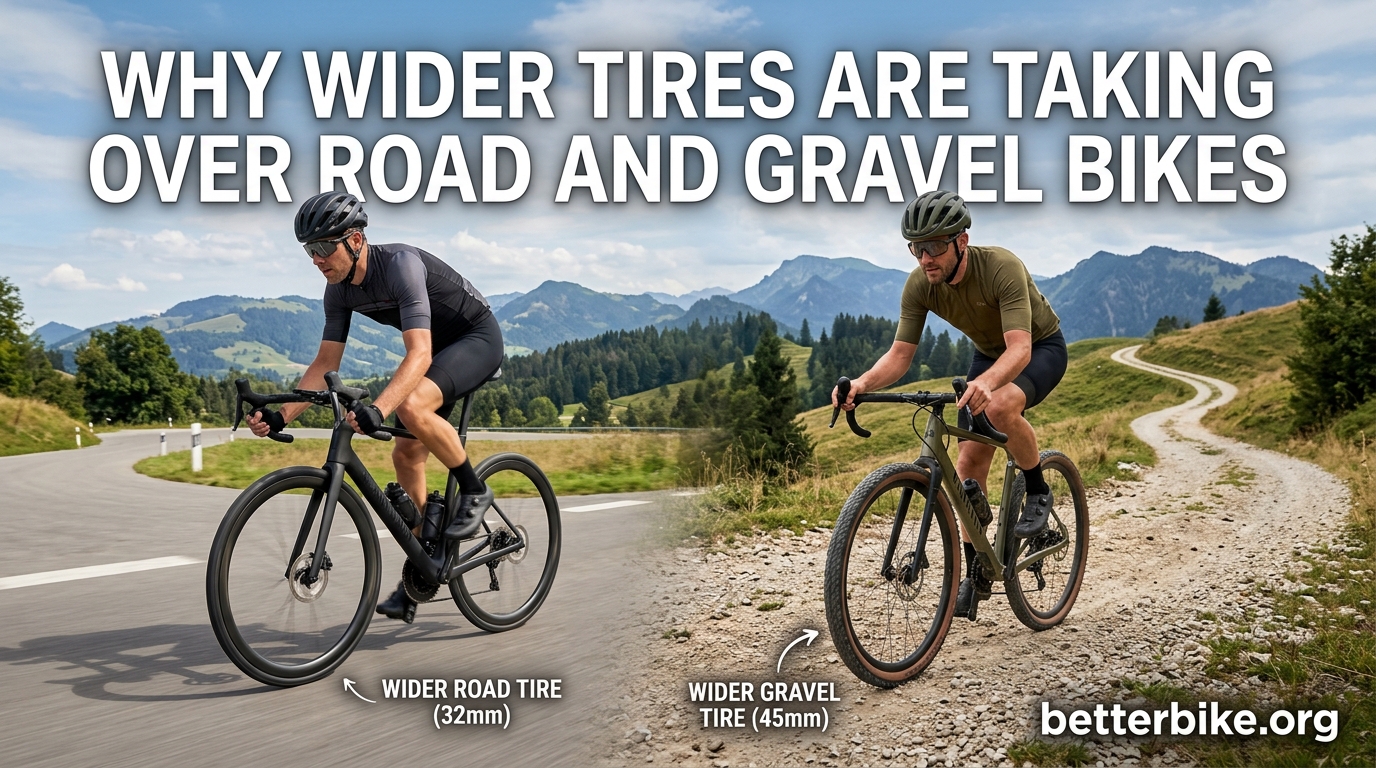
Wider tires are taking over road and gravel bikes because they roll as fast or faster than narrow tires on real surfaces while dramatically improving comfort, grip, and puncture resistance. The old assumption that thin, rock-hard tires are quickest has been overturned by years of real-world testing data. If you have wondered why your local bike shop now stocks 32mm road tires instead of 23mm, or why gravel bikes are shipping with 45mm rubber, the answer comes down to physics.
For decades, cyclists believed that narrower meant faster. Pump a 23mm tire to 120 PSI, feel the harsh buzz through the handlebars, and assume that vibration meant speed. It did not. That buzz was wasted energy, transferred from the road directly into your body instead of propelling you forward.
In this guide, I will break down the science behind the shift, explain why wider tires are taking over road and gravel bikes, and help you choose the right width for your riding. Whether you ride smooth tarmac, chunky gravel, or a mix of both, understanding tire width changes how you experience every mile. If you are also thinking about bikepacking, our guide on whether you need a special bike for bikepacking covers how wider tires factor into multi-day adventures.
Table of Contents
Why Wider Tires Are Taking Over Road and Gravel Bikes
Wider tires dominate modern road and gravel bikes because they reduce suspension losses, maintain speed on imperfect surfaces, and improve rider comfort without measurable aerodynamic penalty at typical riding speeds. The science is clear and has been validated by independent testing from sources like Rene Herse Cycles, whose real-road coasting tests showed that wider tires match or beat narrower ones in speed.
The shift happened gradually. In the early 2000s, pro pelotons rode 21mm and 23mm tires at extreme pressures. By 2026, most pro road races are won on 28mm to 32mm tires. Gravel racing pushed the envelope further, with top riders running 40mm to 50mm tires, and some adopting 53mm to 57mm cross-country mountain bike rubber for rough courses.
Several factors converged to drive this change. Tubeless technology eliminated pinch flats at lower pressures. Frame designers learned to build in more clearance without sacrificing stiffness. And testing methodology improved, moving from smooth steel drums to real-road measurements that capture what actually happens when rubber meets rough pavement.
The Rolling Resistance Myth
The biggest misconception in cycling is that narrow tires at high pressure have lower rolling resistance. On a perfectly smooth steel drum in a laboratory, they do. But real roads are not steel drums.
Rolling resistance refers to the energy lost as a tire deforms and recovers while rolling. In lab tests on smooth steel drums, a narrow tire at 120 PSI shows excellent numbers because it barely deforms on that perfect surface. The problem is that real pavement has texture, cracks, chip seal, and debris.
When a narrow high-pressure tire hits a bump, it cannot deform enough to absorb it. Instead, the entire bike and rider lift over the obstacle. That lifting motion consumes energy, and the resulting vibration travels through the frame into your body. Scientists call these suspension losses, and they are the hidden tax that narrow tires impose on real roads.
A wider tire at lower pressure simply absorbs the same bump. The tire deforms around the imperfection, the bike stays level, and the rider keeps moving forward. The energy that would have gone into lifting the bike stays in forward motion.
Rene Herse Cycles conducted some of the most influential testing on this topic. Their coast-down tests on real roads found that a 32mm tire at moderate pressure rolled as fast as a 23mm tire at high pressure on smooth pavement, and significantly faster on rough surfaces. The difference on rough chip-seal was dramatic, sometimes saving 10 to 20 watts of power at cycling speeds.
Why Narrow Tires Feel Fast
Here is the trick your brain plays on you. Narrow tires at high pressure transmit more vibration and road buzz. That buzz feels like speed because your body associates harshness with going fast. It is the same reason a loud car feels quicker.
Power meter data tells the opposite story. When riders switch from 23mm tires to 32mm tires and keep the same perceived effort, their actual power output and speed go up. The smoother ride masks the fact that they are producing more useful forward power.
This placebo effect is why the narrow-tire myth persisted for so long. Riders trusted their feelings over their data. Once affordable power meters became widespread, the truth became impossible to ignore.
Tire Pressure and Width: The Relationship Explained
Tire pressure and tire width are directly linked. As width increases, optimal pressure decreases. This relationship is the foundation of why wider tires work.
A 23mm tire typically runs at 100 to 120 PSI. That extreme pressure is necessary because a small volume of air must support the rider’s weight and resist pinch flats. A 32mm tire can run at 70 to 80 PSI. A 40mm gravel tire might run at 35 to 50 PSI. A 50mm tire can drop into the 25 to 35 PSI range.
Lower pressure lets the tire conform to the road surface. Instead of bouncing off every imperfection, the tire wraps around small bumps and keeps contact with the ground. This continuous contact improves traction, reduces vibration, and maintains forward momentum.
The key insight is that you are not losing pressure, you are gaining volume. A 40mm tire at 40 PSI contains roughly the same amount of air support as a 23mm tire at 110 PSI. The ride quality difference is night and day. One feels like a jackhammer, the other feels like silk.
The 105% Rule Explained
The 105% rule is a tire-fitment guideline stating that tire width should be no more than 105% of the rim’s inner width for optimal aerodynamic performance. For example, a 19mm inner-width rim pairs best with a tire up to about 28mm wide.
Breaking this rule does not make the tire dangerous, but it can create an aerodynamic penalty. The tire becomes wider than the rim, disrupting airflow and creating drag. For most recreational and endurance riders, this aero penalty is negligible at typical speeds. For elite time trial specialists chasing seconds, it still matters.
Comfort and Vibration Reduction
Comfort is not just about feeling good. It is about performance, because fatigue slows you down more than any other factor on long rides.
Every vibration that travels through your bike into your body costs energy. Your muscles work to stabilize against the shaking. Your hands go numb. Your back tightens. After four hours, the cumulative fatigue from road buzz can add minutes to your ride time.
Wider tires at lower pressure dramatically reduce this vibration. The tire absorbs the high-frequency buzz before it reaches the frame. Riders who switch from 25mm to 32mm tires consistently report feeling fresher at the end of long rides.
The comfort benefit compounds on rough surfaces. On gravel, chip seal, or broken pavement, the difference is even more pronounced. A 40mm tire at 40 PSI smooths out terrain that would rattle your teeth on a 28mm tire at 80 PSI.
For bikepacking and multi-day adventures, this comfort advantage is critical. Carrying extra weight over mixed terrain demands a tire that can handle low pressure without squirming. Our guide on packing a bike for bikepacking goes deeper into how tire pressure affects handling under load.
Cornering Grip and Safety Advantages
Wider tires corner better because they create a larger contact patch with the road. More rubber on the ground means more grip, which means more confidence and speed through turns.
The contact patch is the small area of tire actually touching the road at any moment. A wider tire at lower pressure creates a shorter but wider contact patch. The total area is larger than a narrow tire’s long, thin patch. This wider footprint provides better traction for cornering, braking, and acceleration.
On gravel and loose surfaces, the advantage multiplies. A wider tire at low pressure lets the tread conform around individual rocks and grip loose material. Narrow tires at high pressure skate across the surface, breaking traction unpredictably.
Riders on our forums consistently report that moving to wider tires transformed their descending confidence. One rider shared that 40mm tires on a 75% paved and 25% gravel route eliminated the sketchy moments they used to experience on 32mm rubber. If you want to improve your cornering technique to match your new grip, check out our breakdown of common cornering mistakes that slow you down.
Grip on Wet Surfaces
Wider tires also improve wet-weather grip. The lower pressure allows the tire to maintain better road contact when surfaces are slick. A narrow tire at high pressure can hydroplane or break traction suddenly on wet corners. A wider tire at lower pressure cuts through surface water and maintains grip.
This safety margin matters for commuters and year-round riders. The confidence to lean into a wet corner without fear is something narrow tires simply cannot provide.
The Gravel Bike Revolution: 40mm and Beyond
Gravel biking accelerated the wide-tire trend faster than any other discipline. What started as riders bolting 35mm tires onto cyclocross frames has become an arms race of clearance and capability.
Modern gravel bikes routinely clear 45mm tires on 700C wheels. Some models accept 50mm or more. The trend toward 53mm to 57mm cross-country mountain bike tires on gravel bikes began when racers discovered that on certain courses, especially those with loose rocks and deep ruts, mountain bike rubber offered a decisive advantage.
This trend reflects a fundamental truth about gravel riding. The surface varies more than any other cycling discipline. A single ride might include smooth pavement, packed dirt, loose gravel, mud, and rock gardens. A wider tire handles all of these better than a narrow one.
The bike industry has responded. Frames now feature dropped chainstays, sculpted seat tubes, and creative routing to maximize tire clearance. Suspension forks and seatposts complement the cushioning that wide tires already provide. For overnight trips, wide tire clearance on gravel bikes has become essential rather than optional.
When Wider Stops Making Sense
There are limits to the wider-is-better philosophy. On smooth pavement at race speeds above 25 mph, aerodynamic drag becomes the dominant resistance force. An extremely wide tire creates more frontal area and can measurably increase drag.
For pure road racing on smooth surfaces, 28mm to 32mm represents the sweet spot for most riders. Going wider than 35mm on a road bike offers diminishing returns unless the surfaces are genuinely rough.
On gravel, the calculus changes. The speed penalty from aero drag is smaller because speeds are lower. The grip and comfort gains are larger because surfaces are rougher. This is why 40mm to 50mm has become the standard for all-around gravel riding.
Frame Clearance and Practical Considerations
Frame clearance is the number one limitation when switching to wider tires. Not every frame can accept wide rubber, and guessing wrong can damage your bike.
Most road bikes built before 2018 max out at 25mm or 28mm tires. Modern endurance road bikes typically clear 32mm to 35mm. Gravel bikes generally clear 40mm to 50mm, with some adventure-focused frames accepting 700x50mm or 650Bx2.2 inch mountain bike tires.
You need at least 3mm of clearance on each side of the tire for safe riding. Mud and debris can pack into tight clearances and lock your wheel. Always measure your actual clearance with the specific tire model you plan to run, because labeled widths vary significantly between manufacturers.
650B vs 700C Wheel Considerations
When frame clearance is tight on 700C wheels, switching to 650B wheels can unlock much wider tire options. A 650B x 47mm tire has roughly the same outer diameter as a 700C x 30mm tire. This means you can run a very wide tire without changing the bike’s geometry or handling characteristics.
This approach is popular on gravel and adventure bikes. You can run 700C wheels with 35mm tires for fast mixed-surface days, then swap to 650B wheels with 47mm tires for chunky gravel or bikepacking.
Gearing Effects of Larger Tires
Larger tires increase the overall diameter of your wheel, which effectively raises your gearing. A 700C x 50mm tire has a noticeably larger circumference than a 700C x 28mm tire. This means each pedal stroke moves you slightly further.
For most riders, this difference is minor. But if you are already struggling on steep climbs, the effective gearing change could push you over the edge. Consider switching to a cassette with a larger large cog, or a smaller chainring, when you move to significantly wider tires.
One forum user noted that going from 700C x 40mm to 700C x 50mm tires felt like swapping from a 34T to a 36T small chainring. The gear inches shift enough to notice on sustained climbs above 10% gradient.
Weight Considerations
Wider tires weigh more than narrow ones. A 32mm tire typically weighs 40 to 80 grams more than an equivalent 25mm tire. Rotating weight affects acceleration, so heavier tires can make a bike feel slightly less snappy off the line.
For most riding scenarios, this weight penalty is trivial compared to the comfort, grip, and rolling efficiency gains. Sprinters and criterium racers may still prefer lighter, narrower tires. Endurance riders, gravel racers, and anyone who values all-day comfort benefit from wider tires despite the extra grams.
Choosing the Right Tire Width for Your Terrain
Selecting the right tire width depends primarily on the surfaces you ride and the type of performance you prioritize. Here is a practical guide based on real-world testing and community consensus.
Smooth Road (Track, Freshly Paved Tarmac)
For perfectly smooth pavement, 25mm to 28mm tires remain excellent choices. The surfaces are uniform enough that suspension losses are minimal, and the lower weight and better aerodynamics of narrower tires give a slight edge at high speeds.
Most riders will still benefit from 28mm over 25mm because real roads are rarely as smooth as they look. The comfort improvement costs essentially nothing in speed.
Typical Road (Public Roads, Chip Seal, Patched Pavement)
For everyday road riding on typical public surfaces, 28mm to 32mm is the sweet spot. These widths absorb road buzz, handle rough patches without drama, and roll efficiently on imperfect surfaces.
If your local roads include rough chip seal or frequent potholes, lean toward 32mm. The improvement in comfort and speed on rough pavement is substantial.
Mixed Surface (Road to Light Gravel)
For riders who split time between pavement and smooth gravel, 32mm to 38mm tires handle both duties well. File tread patterns work well here, providing grip on loose surfaces without excessive drag on pavement.
This category is where the all-road bike movement lives. A single bike with 35mm tires can handle 90% of what most riders encounter.
Gravel Racing and Adventure
For dedicated gravel riding and racing, 40mm to 45mm is the current standard. These widths provide the volume needed for low pressures, the grip needed for loose corners, and the puncture protection needed for sharp rocks.
For rough gravel, rocky terrain, or bikepacking with heavy loads, 45mm to 50mm tires excel. Many riders report that 40mm is the minimum width for confident riding on surfaces that are 25% or more gravel.
Extreme Gravel and Mountain Bike Territory
For the gnarliest gravel, singletrack, and adventure riding, 50mm to 57mm tires blur the line between gravel and mountain biking. Cross-country mountain bike tires in the 53mm to 57mm range are increasingly common on high-clearance gravel bikes for exactly this purpose.
At these widths, you are essentially riding a drop-bar mountain bike. The grip and comfort are extraordinary, and on truly rough terrain, these tires are measurably faster than 40mm alternatives.
If your adventures extend into steep mountain descents, the traction principles are the same. Our guide on descending steep terrain with confidence covers how tire choice affects control on technical trails.
Tubeless Setup and Supple Casings
Tubeless technology is what makes wide tires practical. Without tubes, you can run low pressures without risking pinch flats. Sealant handles most small punctures automatically. The combination of wide tires and tubeless setup is transformative.
Setting up tubeless requires tubeless-compatible rims and tires, tubeless valves, and sealant. The initial setup can be messy, but the long-term benefits are enormous. You get fewer flats, lower rolling resistance, and the ability to run the low pressures that make wide tires shine.
The Importance of Supple Casings
Tire casing quality matters as much as width. A supple casing, one made from thin, flexible threads wound tightly, conforms to the road surface better than a stiff, thick casing. This flexibility reduces rolling resistance and improves comfort.
A high-quality 32mm tire with a supple casing will outperform a cheap 32mm tire with a stiff casing in every measurable way. The supple tire rolls faster, grips better, and feels more comfortable. Width gives you the potential for performance; casing quality determines whether you realize it.
Top tire manufacturers like Rene Herse, Challenge, and Panaracer build tires with casing quality as a primary feature. When choosing tires, look for specifications mentioning threads per inch (TPI), casing type, and whether the tire uses a hand-made or vulcanized construction process.
Common Mistakes When Switching to Wider Tires
Switching to wider tires seems straightforward, but riders make several common errors that undermine the benefits.
The biggest mistake is running too much pressure. Riders accustomed to 100+ PSI often keep pumping their new 32mm tires to 80 or 90 PSI, which defeats the entire purpose. Start with manufacturer recommendations and adjust down based on feel. A wide tire should feel plush, not wooden.
Another frequent error is ignoring frame clearance measurements. Tire width labels are approximate. A tire labeled 40mm might measure 42mm on your specific rim. Always test-fit and measure actual clearance before committing to a tire swap.
Failing to set up tubeless properly is also common. Riders add sealant but do not shake and distribute it, or they use old sealant that has dried out. A properly set up tubeless system should hold air well and seal punctures quickly. Check your sealant every two to three months.
Finally, some riders go too wide too fast. Jumping from 25mm road tires to 50mm gravel tires on the same bike can feel disorienting. The handling characteristics change, the bike feels different in corners, and the gearing shifts. Consider stepping up incrementally to adapt your riding style.
Frequently Asked Questions
Why are wider tires changing road cycling?
Wider tires are changing road cycling because they roll as fast or faster than narrow tires on real road surfaces while significantly improving comfort, grip, and puncture resistance. Independent testing has proven that narrow high-pressure tires waste energy through suspension losses on imperfect pavement, while wider tires at lower pressure absorb road imperfections and maintain forward momentum.
Are wider tires faster on gravel?
Yes, wider tires are faster on gravel. On rough and loose surfaces, wider tires at lower pressure conform to the terrain, maintaining traction and momentum that narrow tires cannot match. Testing shows that on chunky gravel, a 44mm tire can save significant watts compared to a 38mm tire, because the wider tire absorbs impacts instead of bouncing over them.
What are the downsides of wider tires?
The main downsides of wider tires are increased weight, slightly higher aerodynamic drag at race speeds, potential frame clearance limitations, and the need to adjust tire pressure habits. Wider tires also can feel less responsive during sharp accelerations due to the additional rotating mass. For most riders, these tradeoffs are far outweighed by the comfort and grip benefits.
What is the 105% rule in cycling?
The 105% rule states that for optimal aerodynamic performance, your tire width should be no more than 105% of your rim’s inner width. For example, a rim with a 19mm internal width pairs best with a tire up to about 28mm. Exceeding this ratio creates a tire that is wider than the rim, which can increase aerodynamic drag at high speeds.
Can you put wider tires on a road bike?
You can put wider tires on a road bike only if the frame has sufficient clearance. Most road bikes built after 2018 can accept 28mm to 32mm tires, while older models may max out at 25mm. Always check your frame’s maximum tire clearance specification and measure actual clearance with at least 3mm of space on each side before installing wider tires.
What tire pressure should I use for wider tires?
For wider tires, use significantly lower pressure than narrow tires. A 32mm road tire typically runs 70 to 80 PSI, a 40mm gravel tire runs 35 to 50 PSI, and a 50mm tire can run 25 to 35 PSI. Start with manufacturer recommendations and adjust based on rider weight, terrain, and personal feel. The tire should feel smooth and compliant, not harsh.
Conclusion
Understanding why wider tires are taking over road and gravel bikes comes down to one principle: real surfaces reward conformity over rigidity. Wider tires at lower pressure absorb imperfections, maintain momentum, reduce fatigue, and improve grip, all without sacrificing speed on anything but the smoothest race courses.
If you are still riding 23mm tires at 120 PSI, you are leaving comfort, grip, and speed on the table. Start with a set of 32mm tires on your road bike, or 40mm on your gravel bike, set up tubeless, and drop your pressure. The difference is immediate and the data backs it up. Your hands, your back, and your average speed will all thank you.