
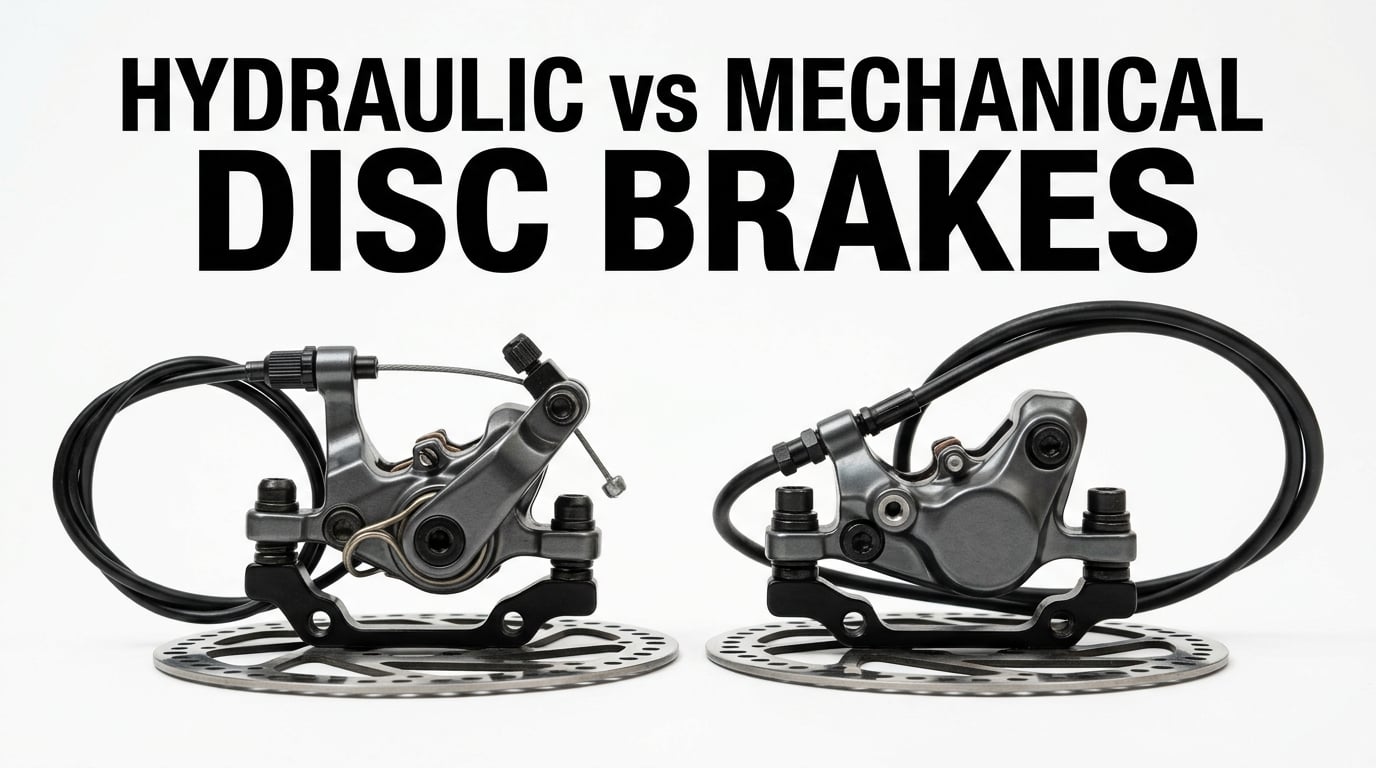
If you are shopping for a new bike or thinking about upgrading your current ride, the hydraulic vs mechanical disc brakes debate is one you will run into quickly. It is one of the most common questions we hear from cyclists at every level, and for good reason. Your brakes are the single most important safety component on your bike.
The choice between these two systems affects your stopping power, how much effort your hands put in on every ride, your maintenance routine, and your wallet. We have spent months researching forum discussions, analyzing technical specs, and synthesizing real-world rider experiences to give you a straight answer.
Here is the short version: hydraulic disc brakes offer noticeably better stopping power, smoother modulation, and less hand fatigue than mechanical disc brakes. Whether that difference justifies the cost depends entirely on how, where, and how often you ride. This guide breaks it all down so you can make the right call for your situation.
If you do a lot of remote riding, you may also want to check our roadside brake adjustment and repair guide for handling brake issues when you are far from a bike shop.
Table of Contents
What Are Disc Brakes? A Quick Primer
Disc brakes have become the standard on modern bicycles, replacing rim brakes on most mountain bikes, gravel bikes, and an increasing number of road bikes. The system is straightforward in concept. A metal rotor is bolted to your wheel hub, and a caliper mounted to your frame or fork squeezes brake pads against that rotor to slow you down.
Every disc brake system shares the same core components: the rotor (the metal disc attached to the wheel), the caliper (the mechanism that holds the pads), the brake pads themselves, and the lever you pull at the handlebar. What changes between mechanical and hydraulic is how your lever pull gets translated into braking force at the caliper.
That actuation method is where all the real-world differences live. It affects everything from raw stopping power to how your brakes feel under your fingers to how often you need to turn a wrench.
How Mechanical Disc Brakes Work
Mechanical disc brakes use a steel cable to transfer force from your brake lever to the caliper. When you squeeze the lever, the cable pulls on an actuation arm inside the caliper. That arm pushes one or both brake pads inward against the rotor, creating friction that slows the wheel.
Most mechanical disc brakes are cable-actuated with a single moving piston. This means only one pad moves to press the rotor against a stationary pad on the other side. Some higher-end mechanical models use a dual-piston design where both pads move simultaneously, but the cable mechanism remains the same.
The simplicity of this system is its biggest advantage. A steel cable is easy to inspect, replace, and adjust. If a cable snaps on a ride, you can carry a spare and fix it with basic tools. There is no fluid to leak, no seals to fail, and no bleeding procedure to learn.
The trade-off is that cables stretch over time. Every few weeks or months, depending on your riding frequency, you will need to dial in the barrel adjuster or re-tension the cable to keep the lever feel consistent. Cable friction also means some of your squeezing force gets lost between the lever and the caliper, especially on bikes with long or bent cable housing runs.
How Hydraulic Disc Brakes Work
Hydraulic disc brakes replace the steel cable with a sealed fluid system. When you pull the lever, a small piston inside the lever body (called the master cylinder) pushes brake fluid through a reinforced hose. At the caliper end, that fluid pressure drives one or more pistons outward, pressing both brake pads against the rotor simultaneously.
Because fluids cannot be compressed, nearly 100% of the force you apply at the lever reaches the caliper. This is the fundamental reason hydraulic brakes feel more powerful with less finger effort. The system multiplies your input force through piston size differences between the master cylinder and caliper pistons.
Hydraulic systems use either DOT fluid or mineral oil as their braking fluid. DOT fluid (used by SRAM and some other brands) offers a higher boiling point but is corrosive to paint and absorbs moisture over time. Mineral oil (used by Shimano, Magura, and Tektro) is gentler on components and easier to work with but has a slightly lower boiling point. Both work well for the vast majority of riders.
One key advantage of hydraulic systems is that they are self-adjusting. As brake pads wear down, the caliper pistons automatically extend to maintain consistent pad-to-rotor clearance. You never have to manually adjust cable tension or dial in pad spacing as the pads wear.
Hydraulic vs Mechanical Disc Brakes: Feature-by-Feature Comparison
Now let us get into the specifics. This is where the hydraulic vs mechanical disc brakes comparison gets interesting, because the differences show up in real, measurable ways on every ride.
We have broken this into five categories that matter most to riders: stopping power, modulation and feel, maintenance, cost, and wet weather performance.
Stopping Power
Hydraulic disc brakes deliver higher stopping power than mechanical disc brakes, and the gap is not subtle. Because hydraulic systems actuate both pads simultaneously and transfer force through incompressible fluid, you get more clamping force with the same amount of lever pressure.
In practical terms, this means shorter stopping distances and more confidence during hard braking. Riders who switch from mechanical to hydraulic frequently describe the difference as night and day, especially on steep descents or when carrying speed into a corner. For heavier riders or e-bike users dealing with extra mass, this additional stopping margin can be the difference between a controlled stop and a scary moment.
Mechanical brakes can still stop you effectively. They are not dangerous when properly set up and maintained. But they require more lever force to achieve the same deceleration, and that gap widens as cable friction increases or pads wear unevenly.
Modulation and Lever Feel
Modulation refers to how precisely you can control braking force. Think of it as the difference between an on/off switch and a dimmer. Hydraulic brakes are the dimmer, giving you smooth, progressive control from a feather-light touch all the way to a full lockup.
Mechanical brakes tend to have more of an on/off character. The cable system has a small amount of play and friction that makes fine control harder, especially at the threshold between slowing and skidding. Competitive riders and mountain bikers consistently choose hydraulic for this modulation advantage alone, because precise brake control translates directly to faster, safer cornering.
Lever feel also differs noticeably. Hydraulic levers have a firm, consistent point of engagement that stays the same ride after ride. Mechanical levers can feel spongy when cables stretch, and that engagement point shifts as the system wears.
Maintenance Requirements
This is where mechanical brakes have a genuine advantage. Cable replacement, pad swaps, and basic adjustments all require standard tools and minimal expertise. Most home mechanics can fully service a mechanical disc brake system with an Allen key set and a cable cutter. If something goes wrong on a tour, parts and fixes are simple.
Hydraulic brakes need less frequent adjustment but more specialized maintenance. The self-adjusting pad clearance means you rarely touch the system between pad changes. However, when the fluid needs refreshing (a process called bleeding), you need a bleed kit, the correct fluid type, and some practice. A poorly bled system can feel spongy or develop air bubbles that reduce performance.
For touring cyclists and bikepackers heading into remote areas, this matters. A snapped cable is a 10-minute roadside fix. A leaking hydraulic seal is a shop visit. If you ride far from support, check out our guide to handling mechanical problems far from a bike shop for practical advice.
Cost and Value
Mechanical disc brakes are significantly cheaper than hydraulic systems at every tier. A quality set of mechanical calipers costs roughly half what comparable hydraulic levers, hoses, and calipers cost. Replacement cables and pads are also less expensive, and you will not need to buy a bleed kit.
That cost gap narrows at the budget end of the market, where entry-level hydraulic systems have become more affordable in recent years. But at the mid-range and performance levels, hydraulic components carry a meaningful price premium that extends to replacement parts and professional service.
The value question depends on how much you ride and what type of riding you do. For a daily commuter or weekend trail rider, that extra cost buys tangible benefits in comfort and confidence. For a casual rider who logs a few flat miles a week, mechanical brakes deliver perfectly adequate performance at a lower total cost of ownership.
Weather and Wet Conditions Performance
Both hydraulic and mechanical disc brakes outperform rim brakes in wet conditions, since the rotor is closer to the hub and cuts through water more effectively. But hydraulic systems maintain more consistent performance when the weather turns.
Mechanical cables can develop surface rust in persistently wet conditions, increasing friction and degrading lever feel over time. The sealed hydraulic system is unaffected by water ingress, so your braking performance stays the same whether it is dry or pouring.
Pads and rotors behave similarly across both systems in the wet. You will experience the brief delay common to all disc brakes as the rotor clears water from the pad surface during the first wheel revolution. After that initial squeeze, hydraulic brakes give you more confidence-inspiring bite in sloppy conditions.
Hand Strength and Rider Comfort: The Overlooked Factor
One thing most comparison guides skip is how brake choice affects your hands. This matters more than most riders realize, and forum discussions consistently highlight it as a deciding factor.
Hydraulic brakes require significantly less hand force to achieve the same stopping power. On long descents, this translates directly to less hand fatigue and numbness. Cyclists on Reddit and bike touring forums routinely report that switching to hydraulic brakes eliminated hand pain and cramping on mountain descents that used to leave their grip strength depleted.
For older riders or anyone dealing with arthritis, tendonitis, or reduced grip strength, this difference is not a luxury. It is a quality-of-life improvement that can extend riding longevity. If your hands hurt after every ride with mechanical brakes, hydraulic is likely worth the investment regardless of your riding style.
Heavy riders also benefit disproportionately from hydraulic systems. The extra stopping power means you are not white-knuckling the levers on every descent. E-bike riders, who are carrying significant motor and battery weight, almost universally recommend hydraulic brakes for this reason.
Does the Upgrade Matter for Your Riding Style?
The answer to whether hydraulic vs mechanical disc brakes matters depends heavily on how you ride. Here is a breakdown by riding type.
Mountain Biking and Downhill
For mountain biking, especially technical trails or downhill riding, hydraulic disc brakes are essentially mandatory at any serious level. The combination of stopping power, modulation, and consistency gives you the control needed for steep, loose, or technical terrain. Almost no modern mountain bike ships with mechanical disc brakes above the entry level for this reason.
Gravel and Adventure Riding
Gravel riders are split. If your routes include technical descents, loose surfaces, or long alpine passes, hydraulic brakes give you meaningful advantages in control and confidence. If you ride primarily flat gravel roads at moderate speeds, mechanical brakes work fine and are easier to service on multi-day trips.
E-Bike Commuting
E-bikes carry extra weight from the motor and battery, and they often travel at higher speeds. The additional stopping power of hydraulic brakes is not optional here. It is a safety requirement. Most quality e-bikes now come with hydraulic brakes standard, and we would not recommend buying an e-bike with mechanical brakes unless you ride exclusively on flat terrain at low speeds.
Touring and Bikepacking
Long-distance touring presents a genuine trade-off. Hydraulic brakes perform better in every measurable category, but mechanical brakes are easier to repair in remote locations. If your tour passes through areas with bike shops, go hydraulic. If you are crossing deserts or developing regions where parts are scarce, the simplicity of mechanical brakes has real value.
Casual and Recreational Riding
If you ride a few times a week on flat or rolling terrain at moderate speeds, mechanical disc brakes will serve you well. The performance gap is real but less noticeable at lower speeds and lower stakes. Save the money or spend it elsewhere on the bike.
Can You Upgrade from Mechanical to Hydraulic Disc Brakes?
Yes, you can upgrade from mechanical to hydraulic disc brakes on most bikes. The process is straightforward but requires replacing several components and some mechanical know-how.
Here is what you need for a complete upgrade:
Step 1: Buy a complete hydraulic brake set, which includes the lever, hose, and caliper pre-assembled and pre-bled for each wheel. Shimano, SRAM, and Tektro all offer kits at various price points.
Step 2: Remove your existing mechanical levers, cables, and calipers. This is the easy part.
Step 3: Install the hydraulic levers on your handlebars and route the hoses through or along your frame. Internal cable routing frames may require removing bottom bracket caps or internal guides.
Step 4: Mount the new calipers to your frame mounts. Verify your mounts are compatible. Most disc brake frames use Post Mount or IS Mount standards that work with both mechanical and hydraulic calipers.
Step 5: Install the rotors if your current ones are not compatible. Most rotors work with both systems, but check the specifications.
Step 6: Trim hoses to length and bleed the system if you shortened the hoses. This is the most technical step and may require a bleed kit and some patience.
Most riders with moderate mechanical experience can handle the installation over a weekend. If you are not comfortable working with hydraulic fluid and bleed procedures, a bike shop can install the system in about an hour of labor.
Your existing rotors and brake pads are often reusable, but check compatibility with your new calipers. The mounting standards on your frame (Post Mount or Flat Mount) determine which calipers will fit, so verify this before buying.
Real Rider Experiences: What Cyclists Actually Say
We dug through hundreds of forum threads across Reddit, bike touring communities, and gravel cycling groups to synthesize what real riders think about this upgrade. The consensus is remarkably consistent.
The overwhelming forum opinion is that hydraulic brakes are objectively better in performance, but mechanical brakes are genuinely good enough for casual use. Riders who have made the switch rarely go back. The most common feedback is surprise at how much less hand effort is required, even on moderate terrain.
Touring cyclists are the most divided group. Some swear by mechanical brakes for their field-serviceability in remote regions. Others argue that the reliability of sealed hydraulic systems means fewer total failures, even if each failure is harder to fix. Both positions have merit depending on your route.
Competitive riders and mountain bikers are unanimous. Every rider in these categories uses hydraulic brakes and considers the performance advantage non-negotiable for racing or aggressive riding.
E-bike riders consistently report that hydraulic brakes transformed their riding experience. The combination of higher speeds and heavier bikes makes the additional stopping power a safety feature, not a luxury. One common sentiment: they wish they had upgraded sooner.
FAQ’s
Is it worth upgrading to hydraulic disc brakes?
Yes, if you ride mountain bikes, tackle steep descents, commute on an e-bike, or experience hand fatigue on long rides. The improved stopping power, better modulation, and reduced hand effort make a noticeable difference. For casual flat-terrain riders, mechanical brakes remain a perfectly capable and more affordable option.
Is mechanical disc brakes better than hydraulic?
Mechanical disc brakes are better only in terms of simplicity, cost, and field-serviceability. They are easier to repair on the road and cheaper to maintain. In every performance category (stopping power, modulation, consistency, and lever feel), hydraulic disc brakes are superior.
Can you upgrade mechanical disc brakes to hydraulic?
Yes, most bikes with mechanical disc brakes can be upgraded to hydraulic. You need to replace the levers, hoses, and calipers with a complete hydraulic brake set. Your existing rotors and frame mounts are usually compatible. The process takes a few hours and may require a bleed kit if you need to shorten hoses.
What are the disadvantages of hydraulic brakes?
Hydraulic disc brakes cost more upfront, require specialized tools and fluid for bleeding, are harder to repair in remote locations, and can leak fluid if seals fail. They also need specific fluid types (DOT fluid or mineral oil depending on the brand) that are not interchangeable.
The Verdict: Does the Upgrade Matter?
So, does the hydraulic vs mechanical disc brakes upgrade actually matter? The honest answer is: it depends on your riding, but for most active cyclists, yes, it matters a lot.
If you mountain bike, ride an e-bike, tackle steep terrain, or deal with hand fatigue on long rides, hydraulic disc brakes are worth every penny. The performance gap is real, noticeable, and meaningful for safety and comfort. For casual riders on flat terrain or long-distance tourers who prioritize field-serviceability, mechanical disc brakes remain a smart, reliable choice.
Our recommendation: test ride both systems if you can. The lever feel difference is something you will immediately understand once your hands experience it. From there, match the technology to your riding style, your terrain, and your budget.