
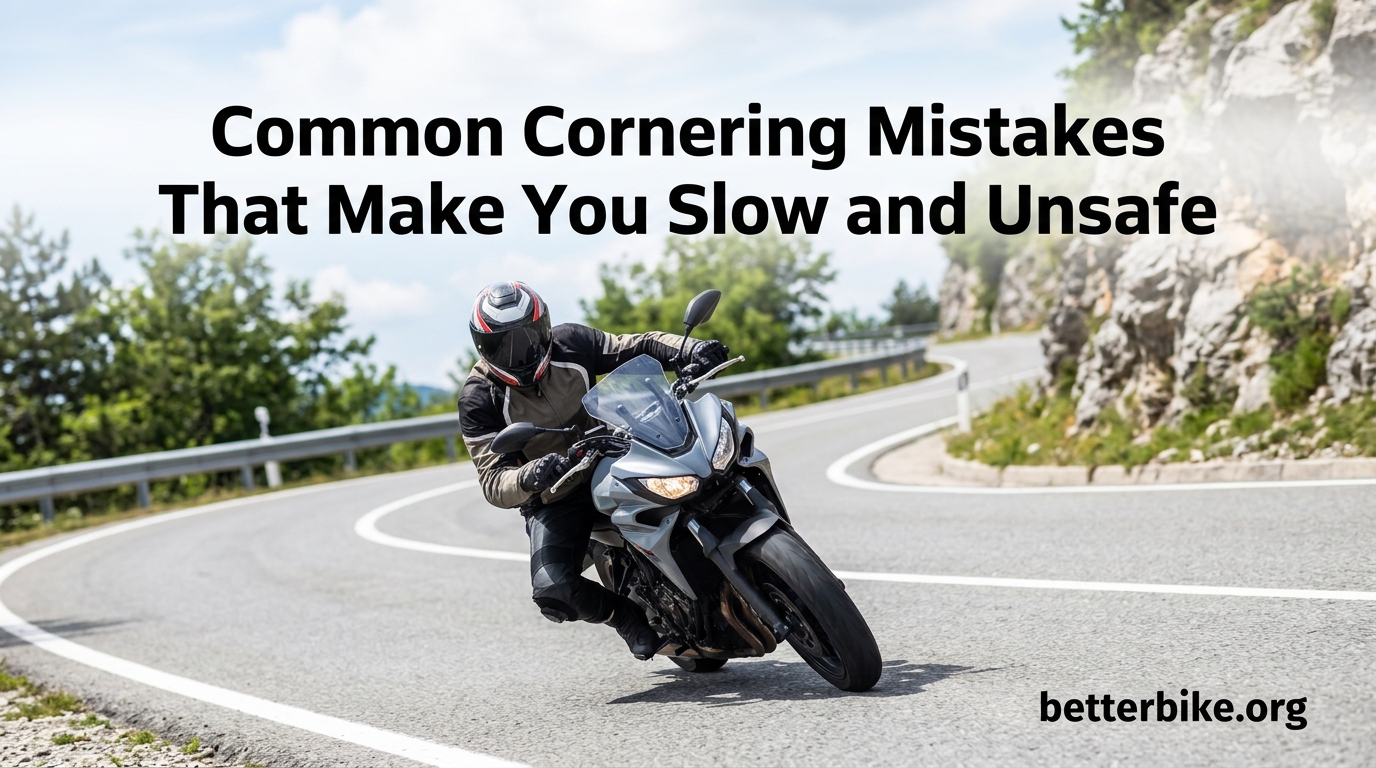
You lean into a familiar corner on your favorite road, and something feels wrong. The bike runs wide, your heart spikes, and you find yourself inches from the edge of the pavement. Almost every rider I have talked to has lived through a version of that moment, often more than once. The truth is that common cornering mistakes are rarely about lack of talent. They are about habits, vision, and the small technique errors that pile up until they cost you speed, traction, or worse.
Most cornering crashes and near-misses trace back to the same handful of mistakes: entering too fast, chopping the throttle, picking the wrong line, freezing on a hazard instead of looking through the turn, stiffening up on the bike, and grabbing brake while leaned over. I have spent years reading forum threads from r/motorcycles and r/NewRiders, watching training videos, and listening to instructors. The same patterns show up again and again, on motorcycles and on bicycles alike.
This guide breaks down the common cornering mistakes that make you slow and unsafe in plain language. For each one I cover why it happens, why it is dangerous, and the specific fix you can practice this weekend. Whether you ride a sportbike, a cruiser, a road bike, or a mountain bike, these principles apply. By the end you will have a checklist you can take to your next ride.
Table of Contents
The Common Cornering Mistakes You Are Probably Making
Here is the short list of mistakes I see most often, in rough order of how dangerous and how common they are. The rest of this article walks through each one in detail.
- Entering corners too fast – the number one cause of running wide and panic braking.
- Chopping the throttle mid-corner – unloads the rear tire and can cause a lowside.
- Choosing an early apex line – puts you wide on the exit when you should be accelerating.
- Target fixation – staring at what you fear instead of where you want to go.
- Poor body position and fear of leaning – stiff arms, locked joints, fighting the bike.
- Braking inside the corner – eats up the traction budget you need for turning.
- Ignoring tire pressure and grip – the silent killer of cornering confidence.
- Skipping practice drills – hoping track day reps alone will fix everything.
Each mistake below has a why-it-happens section, a why-it-is-dangerous section, and a how-to-fix section. Skim the headers if you are short on time, but the fixes are where the value lives.
1. Entering Corners Too Fast
Cornoring speed is the single biggest factor in whether you make it through a turn cleanly. Yet almost every new rider I have coached has the same story: they charge in hot, realize the corner keeps tightening, and then spend the entire turn trying to scrub speed while leaned over. The result is almost always running wide, a lowside crash, or a serious pucker moment.
The mistake usually comes from overconfidence or from misreading the corner. Blind corners, decreasing-radius turns, and downhill corners are the worst offenders. What looks like a gentle right-hander on approach can tighten into a hairpin you are not ready for. Forum riders on r/motorcycles repeatedly cite this as the most common cause of single-vehicle cornering crashes. The bike did not fail them. Their entry speed did.
The fix is simple but takes discipline: get your braking and downshifting done before you lean the bike in. Pick a braking marker (a tree, a sign, a shadow on the road) and commit to being at your turn-in speed by that point. A good rule of thumb is that you should be able to maintain or slightly roll on the throttle from the moment you commit to the lean. If you are still braking or slowing when the bike is tipped in, you entered too fast.
Entry speed should feel almost boringly slow on a street bike. You can always add throttle back on the exit. You cannot easily add traction back once you have committed to a corner at the wrong speed.
2. Chopping the Throttle Mid-Corner
Chopping the throttle means snapping the throttle shut while leaned over. It feels instinctive when a corner tightens or you spot gravel. The problem is that closing the throttle suddenly unloads the rear suspension and shifts weight forward, which shrinks the rear contact patch right when you need it most. In extreme cases this causes the rear tire to slide, and you are on the ground before you can react.
The same logic applies to panic grabbing the front brake. Both actions eat into the same finite traction budget. Your tires can only do so much at once. If you ask them to slow the bike hard while also turning, something gives. On a motorcycle that something is usually a lowside. On a bicycle it is usually a skid and a slide.
I have read dozens of crash reports that follow the exact same script: rider enters slightly too fast, panics, chops throttle, rear steps out, bike goes down. The fix is to maintain steady throttle through the apex and gently roll on as you exit. If you absolutely must slow down in a corner, trail off the brake gently rather than chopping anything. Smooth inputs are everything. The traction circle concept – the idea that your tire has a fixed amount of grip to share between braking, accelerating, and turning – explains why abrupt inputs are so dangerous.
Practice rolling on the throttle the instant you reach the apex. Make it a habit. Your corner exits will get faster and your crash risk will drop sharply.
3. Choosing the Wrong Line (The Early Apex Mistake)
Line selection is where beginners and experienced riders alike get caught out. The classic beginner mistake is the early apex: turning in too early, clipping the inside of the corner early in the turn, and then watching the road fall away from you on the exit. Early apexing forces you wide at exactly the wrong moment, when you should be unwinding the bike and accelerating toward the next straight.
The correct street line for most corners is outside-inside-outside: start wide on corner entry, drift toward the inside (the apex) around the middle of the turn, and exit wide on the far side. For blind corners or any turn where you cannot see the exit, use a late apex instead. A late apex means delaying your turn-in slightly so you can see deeper into the corner before committing. You give up a little entry speed but you gain a clear view and a much safer exit.
Here is the practical difference. With an early apex you are committed before you can see the corner finish. With a late apex you wait, you read the corner, and only then do you tip the bike in. Late apexing is the safest line on the street because corners tighten, debris appears, and oncoming traffic crosses the center line. The late apex gives you a margin for all of that.
On a bicycle the same principle applies. Road riders who hug the inside of a corner early find themselves drifting wide into traffic or off the road on exit. Pick your apex with the exit in mind, not the entry.
4. Target Fixation and Poor Vision
Target fixation is the rider’s worst enemy. You look at the guardrail, the ditch, the oncoming truck, and your bike follows your eyes straight toward it. This is not superstition. It is how human visual-motor wiring works. Your hands and the handlebars follow your gaze, especially under stress.
I have seen riders swear they were trying to make a corner and then ride straight into a curb they were staring at. The fix is to actively look where you want to go, not where you are afraid of going. Look deep into the corner, all the way through to the exit. Train yourself to turn your head, not just your eyes. On a motorcycle, your chin should point at where you want the bike to end up. The bike will follow.
Poor vision is the broader version of the same problem. Many riders look too close to the front wheel, which makes the corner feel fast and scary even when it is not. The further ahead you look, the slower the corner feels and the more time you have to react. The 12 second rule – looking ahead to where you will be in 12 seconds – is a good guideline. On twisty roads that means scanning through the next two or three corners when you can.
Practice the head-turn drill on a familiar corner. Look hard at the exit. Force your eyes away from the inside edge. The first time you do it correctly you will be shocked at how much calmer the corner feels.
5. Poor Body Position and Fear of Leaning
Body position errors are everywhere. Locked elbows, stiff shoulders, a death grip on the bars, butt planted in the center of the seat with knees clamped against the tank. All of these tell the bike you are tense, and a tense rider makes jerky inputs. Jerky inputs upset the chassis and eat traction.
The fix starts with relaxation. Grip the tank with your knees, not the bars with your hands. Keep your elbows bent and loose. Your core should support your upper body so your arms are free to make small smooth steering inputs. On a motorcycle, countersteering – pushing the inside bar to initiate the lean – is the cleanest way to tip the bike in. Practice it consciously.
Fear of leaning is the deeper issue for many new riders. The bike feels like it will fall over if you lean it further, even though motorcycles are designed to corner at lean angles far beyond what most street riders ever use. The fear shows up as stiff body position and as under-cornering – taking corners too upright, which actually reduces available traction and forces you to slow more than necessary. On a bicycle the same fear keeps riders from committing to a lean and leads to wide exits and panic braking.
The way through it is gradual exposure. Find a clean, smooth, empty corner (a parking lot turn or a quiet residential curve) and practice leaning a little further each session. You will quickly learn that the bike wants to corner. It is far more capable than your fear suggests.
6. Braking Inside the Corner
Braking in a corner is not always wrong, but panic braking in a corner almost always is. The issue goes back to the traction circle. Your tires have a finite amount of grip. When you are leaned over and turning, you are already using most of that grip. Asking the tires to also slow the bike down hard is asking them to do two things at once, and they will pick one. Usually they pick the braking, lose lateral grip, and the bike tucks into a lowside.
The mistake usually happens for one of two reasons. Either the rider entered too fast (see mistake #1) or they misread the corner and panicked. The fix is preventative: get all your braking done before the turn. Use your braking marker. If you do find yourself too fast in a corner, the safest response is usually to maintain steady throttle and lean angle and ride it out, rather than grabbing brake. Trail braking – light, smooth, gradual brake pressure maintained from entry through the apex – is an advanced technique that experienced riders use to fine-tune corner entry. It is not the same as panic braking.
The 70/30 brake rule is worth knowing here. In typical street braking, about 70 percent of your stopping power comes from the front brake and about 30 percent from the rear. In a corner, the rear brake can be used gently to tighten your line without upsetting the chassis as much as the front. But neither brake should be grabbed hard while you are leaned over.
Build the habit of finishing braking before turn-in. If you must slow in the corner, do it gradually and smoothly. Treat the brakes in a corner as a fine-tuning tool, not an emergency stop.
7. Ignoring Tire Pressure and Grip
Tire pressure is the most overlooked factor in cornering performance. Under-inflated tires feel vague and slow to respond. Over-inflated tires feel skittish and reduce the size of your contact patch, which means less grip in the corner. Either extreme hurts your cornering confidence and your safety margin.
I check my tire pressure before every long ride. Cold tires, consistent gauge, same routine. Motorcycle manufacturers and tire makers publish specific pressure recommendations for a reason – they are tuned for the right balance of grip, wear, and feel. Bicycle tire pressure is just as important. Road bike tires at the wrong pressure feel harsh and skip over bumps mid-corner. Mountain bike tires at the wrong pressure squirm and roll off the bead in hard turns.
Cold tires also have less grip than warm tires, which is why the first few corners of any ride deserve extra caution. Cold tire lowsides are common in early spring and on cool mornings. Give your tires time to warm up before you start pushing. On a street motorcycle that means a few miles of moderate riding before any aggressive cornering. On a bicycle the same concept applies, just with a much shorter warmup.
Tire condition matters too. A worn rear tire will slide earlier than you expect. An old, hardened tire – even one with tread left – will feel greasy in the corner. If your cornering confidence has dropped for no obvious reason, check your tires first.
8. Skipping Practice Drills (No Foundation Work)
The last mistake is the most meta: not practicing at all. Hoping that street miles alone will fix your cornering is like hoping that driving to work every day will make you a race car driver. Real improvement comes from deliberate practice on specific skills, in low-stakes environments, with feedback.
Here are the drills I recommend, broken down by the mistake they address.
- Speed control: Pick a quiet corner. Approach it at a fixed speed using a braking marker. Repeat until you can nail the entry speed every time without thinking.
- Throttle smoothness: Practice rolling on the throttle at the apex. The motion should be so smooth a passenger cannot feel it begin.
- Line selection: Ride the same corner three times – once early apex, once mid apex, once late apex. Feel the difference in exit speed and visibility.
- Vision: On a familiar corner, exaggerate your head turn. Look hard at the exit. Notice how the corner slows down in your perception.
- Body position: Set up a phone on a tripod in a parking lot. Film yourself cornering. Stiff arms and locked elbows will be obvious on playback.
- Brake discipline: Practice trail braking in a clean parking lot. Light, smooth, gradual pressure from entry through the apex.
- Countersteering: In a straight line at moderate speed, consciously push the right bar to lean right, push the left bar to lean left. Build the muscle memory.
Filming yourself is one of the most underrated tools. What feels smooth in the moment often looks stiff and jerky on camera. I have had riders tell me they thought their body position was great until they saw themselves on video. The camera does not lie.
How to Fix Common Cornering Mistakes
Knowing the mistakes is the first half. Fixing them is the second half. This section walks through the principles that tie everything together and gives you a step-by-step framework for cleaner cornering.
The Four Principles of Cornering
The four principles of cornering, as taught by most motorcycle training programs, are slow in, look through, smooth control, steady throttle out. Slow in means setting your entry speed before turn-in. Look through means turning your head and eyes toward the exit. Smooth control means no abrupt inputs on the bars, brakes, or throttle. Steady throttle out means gentle, consistent throttle from apex to exit. Every fix in this article ties back to one of these four principles.
Late Apex vs Early Apex: When to Use Each
For street riding, the late apex is almost always the safer choice. It gives you visibility, a margin for error, and a clean exit. The early apex is faster on a track when you can see the entire corner and you are willing to commit. On the street, where corners tighten, debris appears, and oncoming traffic exists, the late apex wins every time. Use the outside-inside-outside line as your default, and use a late apex on any corner you cannot fully see through.
Step-by-Step Cornering Technique (O-I-O Line)
Here is the outside-inside-outside line broken into steps.
- Approach: Position yourself toward the outside of your lane as you approach the corner. Get all braking and downshifting done.
- Look: Turn your head and eyes toward the apex and then through to the exit.
- Turn-in: Countersteer to tip the bike in toward the apex. Smooth, deliberate input.
- Apex: Clip the inside of the corner at the apex. Maintain steady throttle.
- Exit: Roll on the throttle gently as you unwind the lean and drift back to the outside of your lane.
The whole sequence should feel like one fluid motion, not five distinct steps. That fluidity comes with practice.
Motorcycle vs Bicycle Cornering Differences
Most of the principles carry over between motorcycles and bicycles, but there are some differences worth knowing. Motorcycles have suspension, which means chassis loading and unloading matters more. Chop the throttle on a motorcycle and the suspension reacts. Bicycles are lighter and more responsive to body position shifts. On a road bike, dropping your inside pedal and weighting the outside pedal is critical for clearance and grip. On a mountain bike, body position is even more dynamic, with the rider actively moving the bike underneath them.
On a motorcycle, countersteering is the primary steering method at speed above walking pace. On a bicycle, countersteering happens instinctively but is worth understanding consciously. Both bikes reward smooth inputs and punish abrupt ones. Both demand that you look where you want to go.
Cornering Confidence and Psychology
The psychological side of cornering deserves its own section because fear is the underlying cause of so many of the mistakes above. Fear of leaning causes stiff body position. Fear of speed causes choppy braking and throttle work. Fear of the corner causes target fixation on the hazards. The way through it is not bravado. It is gradual, structured exposure. Practice the drills. Build the muscle memory. Confidence on a bike is not the absence of fear. It is the trust that your technique will carry you through.
Forum riders consistently report that the moment they stopped fighting the bike and started trusting the technique, their cornering improved overnight. The bike is more capable than you are. Your job is to get out of its way.
What are common cornering mistakes?
Common cornering mistakes include entering corners too fast, chopping the throttle mid-corner, choosing an early apex line, target fixation on hazards instead of looking through the exit, poor body position and fear of leaning, panic braking inside the corner, riding on poorly inflated or cold tires, and skipping deliberate practice drills.
What are the four principles of cornering?
The four principles of cornering are slow in, look through, smooth control, and steady throttle out. Slow in means setting entry speed before turn-in. Look through means turning your head and eyes toward the corner exit. Smooth control means no abrupt inputs. Steady throttle out means gentle consistent throttle from apex to exit.
What is the 12 second rule on a motorcycle?
The 12 second rule on a motorcycle means looking ahead to where you will be in roughly 12 seconds of riding. On twisty roads that translates to scanning through the next two or three corners when visibility allows. Looking far ahead gives you more reaction time, makes corners feel slower, and helps you plan your line and speed instead of reacting to hazards at the last moment.
What is the 70 30 brake rule?
The 70 30 brake rule means that in typical braking on a motorcycle about 70 percent of your stopping power comes from the front brake and about 30 percent comes from the rear. This is because braking shifts weight forward, loading the front tire and unloading the rear. The ratio shifts in low-traction conditions like wet roads or gravel, where more rear brake helps stabilize the bike.
Final Thoughts on Common Cornering Mistakes
The common cornering mistakes that make you slow and unsafe all trace back to the same root causes: rushing the entry, fighting the bike, and looking at the wrong things. Fix your entry speed. Smooth your throttle. Pick a late apex. Look through the exit. Relax your body. Brake before the corner, not in it. Check your tires. Practice the drills.
Pick one mistake from this list and work on it for the next month. Then pick the next one. Cornering is a skill, not a talent. Build it one clean turn at a time.