
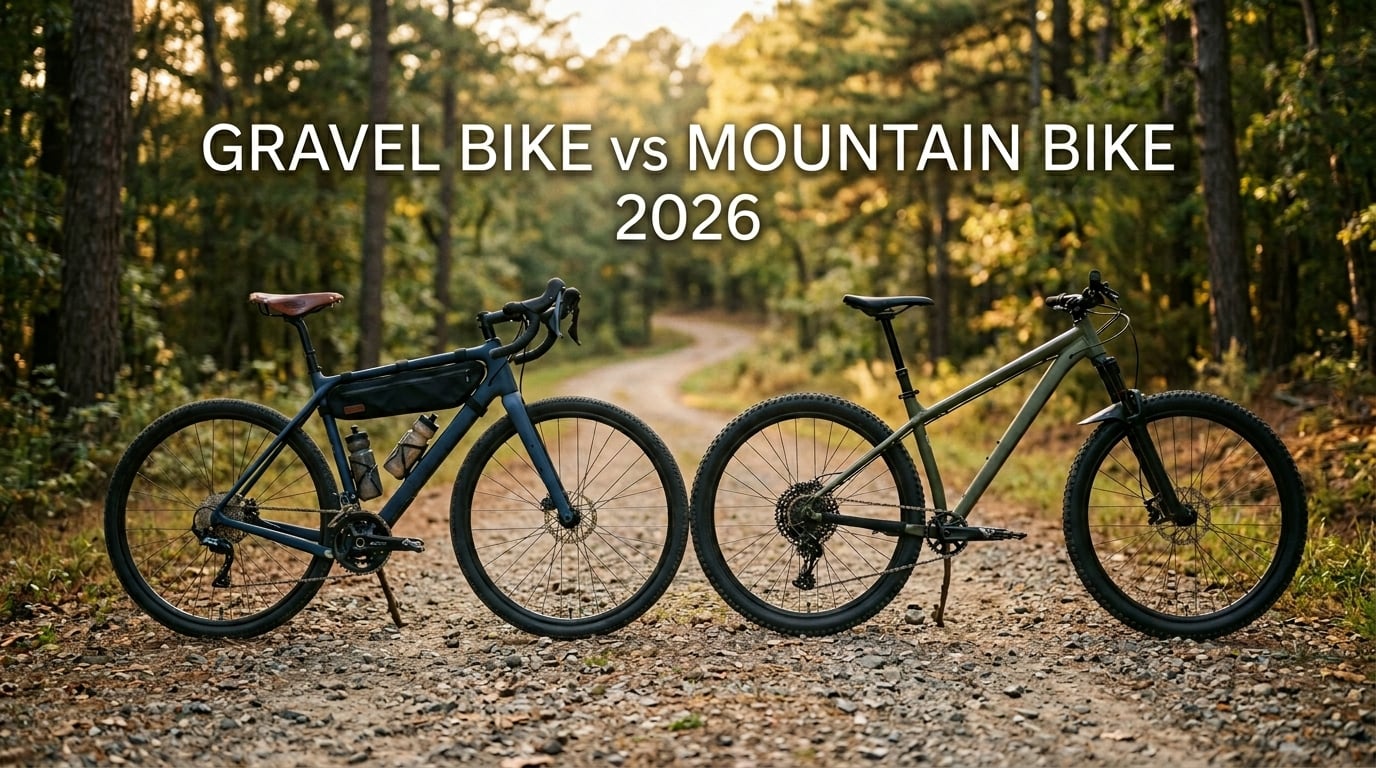
If you spend most of your time on paved or gravel roads and want one versatile bike, a gravel bike is the better pick. If you crave technical singletrack, roots, drops, and rough trail features, a mountain bike will serve you far better. The gravel bike vs mountain bike decision really comes down to one question: what percentage of your riding happens on smooth versus technical terrain?
I have spent years riding both disciplines, and I see the same dilemma play out in forums constantly. Riders worry about overbiking (buying too much bike for the terrain) or underbiking (struggling on trails that outmatch their rig). Neither regret is fun, and a wrong purchase can sit in the garage for seasons. This guide breaks down every meaningful difference so you can buy with confidence the first time.
Here is the quick version. Gravel bikes are drop-bar endurance rigs built for speed and efficiency across mixed surfaces. Mountain bikes are flat-bar machines designed for control and comfort on rough, technical ground. Most riders I talk to who regret their purchase misjudged their actual terrain split. If you ride 70 percent or more on paved or gravel roads, lean gravel. If you ride 50 percent or more on technical trails, lean mountain bike.
Throughout this guide I will reference specific numbers, geometry measurements, and real-world trade-offs. I am not interested in vague platitudes about which bike is more fun. Both are fun in the right context. What matters is matching the bike to the terrain you actually ride, week in and week out.
If you are also considering loaded adventures, our guide on whether you need a special bike for bikepacking pairs well with this comparison.
Table of Contents
Gravel Bike vs Mountain Bike: The Core Differences
A gravel bike is essentially a road-style endurance frame with clearance for wider tires, more relaxed geometry, and mounts for gear. It uses drop bars for multiple hand positions and aerodynamic efficiency over long distances. Think of it as the Swiss Army knife of cycling: competent on tarmac, confident on fire roads, and capable enough on smooth singletrack if you are careful.
A mountain bike is built specifically for off-road abuse. It features flat or riser handlebars for leverage, wider tires with aggressive tread, and often suspension front and rear. The geometry prioritizes stability and control at low speeds over rough ground. Even a hardtail mountain bike (front suspension only) is purpose-built for trail punishment that would rattle a gravel frame.
The head tube angle tells the story immediately. Gravel bikes typically run 71 to 72 degrees, which is steep enough for responsive road-style handling. Mountain bikes sit around 67 to 69 degrees, slackening the steering for stability on steep, technical descents. That three- to four-degree difference completely changes how each bike feels at speed and through corners.
Bottom bracket height follows the same logic. Gravel bikes keep the BB relatively high for pedal clearance on rough gravel without sacrificing cornering. Mountain bikes often run a lower BB to drop the center of gravity, which pays off on descents and technical features. The trade-off is more frequent pedal strikes on chunky climbs, which is why mountain bike cranks are typically shorter (170mm or less) compared to gravel cranks (172.5mm to 175mm).
Fork rake and trail measurement round out the geometry picture. Gravel bikes use more fork rake (45 to 55mm) to keep steering light and quick. Mountain bikes use less rake combined with a slacker head angle to produce more trail, which translates to a self-centering feel that resists deflection on rough ground. The same physics that make a mountain bike feel planted on rock gardens make it feel heavy and slow on pavement.
Geometry: Head Tube Angle, Reach, and Stack
Geometry is where the gravel bike vs mountain bike gap becomes obvious. Let me walk through the numbers that actually matter and explain why each one changes the ride feel.
Head tube angle: Gravel bikes land around 71 to 72 degrees. Mountain bikes run 67 to 69 degrees on trail and enduro models. A slacker head angle means slower steering but more stability when the trail gets steep and chunky. A steeper head angle means quicker, twitchier handling that feels at home on smooth surfaces. The difference becomes dramatic on descents steeper than 15 percent, where the slack mountain bike tracks straight and the steep gravel bike wants to wander.
Reach and stack: These two numbers define your riding posture. Gravel bikes have a longer reach and lower stack, putting you in a more aerodynamic, stretched position. Mountain bikes use a shorter reach with a taller stack, keeping you more upright for control and visibility on the trail. If you have ridden a road bike, the gravel position feels familiar. If you come from a hiking or outdoor sports background, the mountain bike posture feels natural.
Wheelbase: Gravel bikes sit around 1,020 to 1,050mm for a balance of stability and responsiveness. Mountain bikes stretch to 1,150mm or longer, especially on 29er trail bikes. The longer wheelbase on an MTB smooths out rough terrain at speed but makes the bike feel sluggish when you want to accelerate on pavement. Short wheelbases make a bike feel sporty and quick, but they also make it twitchier at low speeds.
Seat tube angle: Modern mountain bikes have steepened seat angles to around 76 to 78 degrees to keep the front wheel down on steep climbs. Gravel bikes sit closer to 73 to 74 degrees. Both work, but the MTB’s steeper seat angle pays dividends on technical climbs where weight distribution is everything. A steep seat angle also engages your glutes more efficiently, which helps on long fire-road climbs.
Chainstay length: Gravel bikes run 420 to 430mm chainstays for stability and heel clearance with loaded bags. Mountain bikes run 430 to 450mm, with longer stays on enduro and downhill bikes for descending stability. Shorter chainstays make a bike easier to manual and lift the front wheel, which is why dirt jump bikes run sub-400mm stays.
Handlebars and Riding Position
Drop bars are the defining feature of a gravel bike. They offer multiple hand positions (hoods, drops, tops), which matters enormously on long rides. After 60 miles, the ability to shift your hands prevents numbness and fatigue. The aerodynamic tuck you get in the drops also adds free speed on flat gravel sections.
Flat handlebars on a mountain bike give you maximum leverage for technical handling. You can muscle the front wheel over roots, manual off drops, and wrestle the bike through rock gardens. The trade-off is fewer hand positions, which is why many mountain bikers add ergonomic grips or bar ends to relieve pressure on long rides.
Gravel bars have evolved too. Modern flared drops (where the lower section angles outward) improve control on descents and give you more stability when riding off-camber gravel. Some gravel bikes now ship with 42cm hoods and 48cm drops, blurring the line between road control and trail confidence. The flare gives you leverage similar to a flat bar when you are in the drops on a rough descent.
Bar width is another consideration. Mountain bike bars have grown wider over the years, with trail bikes running 760mm to 800mm bars for maximum leverage. That width is a liability in tight trees and on narrow road shoulders. Gravel bars stay narrower, which is part of why they slip through wind and tight spaces more efficiently.
If your rides regularly exceed three hours, the gravel bike’s hand position variety is a real advantage. If your rides are shorter and more technical, the flat bar’s leverage wins. There is no universal correct answer, but the type of riding you do most often should drive this choice.
Tire Width, Tread, and Clearance
Tires might be the single biggest factor in how a bike handles different terrain. Gravel bikes typically clear 38mm to 50mm tires. Mountain bikes start at 2.0 inches (about 51mm) and run up to 2.6 inches or wider on trail bikes. That difference in air volume and contact patch is enormous.
For context, a 40mm gravel tire at 40 psi feels fast and efficient on smooth gravel. A 2.3-inch mountain bike tire at 22 psi feels plush and planted on roots but sluggish on pavement. The mountain bike tire has roughly twice the air volume, which means it absorbs impacts that would ping a gravel tire around. Lower pressures also mean a larger contact patch, which translates to more grip on loose surfaces.
Tread patterns tell the rest of the story. Gravel tires use tight, fast-rolling center knobs with minimal shoulder bite. They are designed to shed mud while maintaining speed on hardpacked surfaces. Mountain bike tires use tall, aggressive knobs that dig into loose soil, roots, and wet rock. Put a gravel tire on wet singletrack and you will slide. Put a mountain bike tire on pavement and you will hear it hum while losing 2 to 3 mph of cruising speed.
Tubeless setups have become standard on both platforms. Running tubeless lets you drop pressure for grip without risking pinch flats. If you want specific guidance on tire sizing across mixed terrain, our breakdown of tire recommendations for mixed terrain covers real-world numbers.
Tire clearance limits matter for future-proofing. Many modern gravel frames clear 45mm or even 50mm, which closes the gap with smaller mountain bike tires. Some riders run 2.0-inch mountain bike tires on gravel bikes with enough clearance. It is a popular hack for riders who want one bike that can dabble in light singletrack. The converse is also true: a hardtail mountain bike shod with slick tires can run gravel respectably, just slower.
Rim width affects tire shape too. Modern gravel rims run 23 to 25mm internal width, which squares up a 40mm tire for a stable feel. Mountain bike rims run 25 to 35mm internal, which supports wide tires at low pressures without squirming. Matching rim width to tire volume is part of why a well-set-up mountain bike tire feels so much more planted than a gravel tire on the same trail.
Suspension: Do You Really Need It?
Most gravel bikes ship with a rigid carbon fork. A small but growing number offer micro-suspension (20 to 40mm travel) or leaf-spring designs like the Specialized Future Shock. For pure gravel and road riding, a rigid fork is faster, lighter, and lower maintenance. The carbon layup absorbs high-frequency vibration without the weight and complexity of moving parts.
Mountain bikes almost universally use suspension. Hardtail models run 100 to 120mm of front travel. Full-suspension trail bikes add 120 to 150mm of rear travel. That suspension is the difference between surviving and enjoying rough technical descents. Without it, every rock and root transmits directly into your hands, feet, and spine.
The trade-off is real. Suspension adds weight (2 to 4 pounds on a hardtail, 5 to 7 on a full-suspension frame), requires periodic service (seals, fluid, pivots), and absorbs pedaling energy on smooth ground. A hardtail mountain bike with the fork locked out can move on gravel, but it will never match a gravel bike’s efficiency there. The lockout helps, but the fork’s stanchions, crown, and lowers still add rotating mass up front.
My rule of thumb: if your terrain regularly includes roots, rock gardens, drops, or steep chunky descents, you need suspension. If your terrain is mostly smooth gravel, fire roads, and paved connectors, suspension is dead weight that you will pay for in speed and maintenance. There is no middle ground on this. Suspension is a commitment.
There is a middle path on the gravel side. Some riders run a short-travel suspension fork (40mm) on a gravel bike for rough gravel events. Others ride rigid mountain bikes with plus-size tires for a similar effect. Neither replaces a true mountain bike on real singletrack, but both expand what one bike can do. The decision comes down to how much maintenance and weight you are willing to accept for the extra capability.
Suspension service intervals are worth understanding before you buy. Fork lower leg service is recommended every 50 riding hours. A full damper service is annual for most riders. Rear shocks follow a similar schedule. Full-suspension frames add pivot bearings that need replacement every one to two seasons depending on conditions. If you ride 150 hours a year, budget for two to three service visits annually on a suspended bike.
Terrain Suitability: Where Each Bike Shines
This is the section that should drive your decision more than any spec sheet. Here is how each bike performs across common surfaces, based on hundreds of forum posts and my own back-to-back testing.
Paved roads: Gravel bikes win decisively. Drop bars, narrow tires, and efficient geometry let you hold 18 to 22 mph cruising speeds with reasonable effort. A mountain bike on pavement feels like dragging an anchor; expect 3 to 5 mph slower cruising for the same wattage. The aggressive tread pattern of mountain bike tires also wears quickly on asphalt, costing you tire life every road mile.
Smooth gravel and fire roads: Gravel bikes win again, though the gap narrows. A mountain bike with fast-rolling tires is perfectly rideable here, just slower. The gravel bike’s lower rotating mass and aerodynamic position add up over 50-plus miles. After a century ride, the speed difference compounds into an extra hour or more on the mountain bike.
Rough gravel and rutted doubletrack: It is close. The gravel bike holds speed if you have the handling skills and tire volume. The mountain bike is more forgiving if the surface gets washed out or chunky. This is where gravel bikes with 45mm-plus tire clearance start to shine, because they can absorb the hits that smaller tires transmit.
Smooth flow trails and easy singletrack: Mountain bikes win, but a capable gravel rider can manage blue trails with care. The drop bars become a liability when you need sudden front-wheel corrections on loose surfaces. Riders with mountain bike backgrounds adapt quickly; riders coming from road cycling often struggle initially.
Technical singletrack, roots, rocks, drops: Mountain bikes win decisively. Suspension, aggressive tires, and slack geometry are not optional here. Riding technical singletrack on a gravel bike is possible but not fun, and the risk of washing out the front wheel is real. Our guide to mountain bike cornering technique explains why front-end grip matters so much in these conditions.
Steep technical descents: Mountain bike only. A slack head angle and suspension keep you composed on grades where a gravel bike would feel terrifying. The geometry differences I described earlier are not academic here; they are the difference between a controlled descent and a survival run. If descending confidence is your priority, read our breakdown of how to descend steep terrain with confidence.
Bikepacking and loaded adventures: Both platforms work, but they suit different trips. Gravel bikes excel on long-distance mixed-surface routes with moderate terrain. Mountain bikes excel on rugged backcountry routes where the trail itself is the challenge. Tire volume and suspension matter more than frame material when you are carrying 30 pounds of gear over rough ground.
Gravel Bike vs Mountain Bike: Side-by-Side Feature Comparison
Here is a quick-reference breakdown of how the two platforms compare across the categories that matter most for buying decisions.
- Handlebars: Gravel = drop bars (multiple hand positions). Mountain = flat or riser bars (maximum leverage).
- Typical tire width: Gravel = 38 to 50mm. Mountain = 2.0 to 2.6 inches (51 to 66mm).
- Typical tire pressure: Gravel = 28 to 50 psi. Mountain = 18 to 28 psi.
- Suspension: Gravel = rigid fork or micro-suspension. Mountain = 100 to 150mm+ front and rear.
- Head tube angle: Gravel = 71 to 72 degrees. Mountain = 67 to 69 degrees.
- Wheelbase: Gravel = 1,020 to 1,050mm. Mountain = 1,150mm or longer.
- Typical weight: Gravel = 18 to 22 pounds. Mountain = 24 to 32 pounds.
- Gear mounts: Gravel = multiple (racks, fenders, bags). Mountain = fewer, varies by model.
- Pavement speed: Gravel wins by 3 to 5 mph at equivalent effort.
- Technical trail capability: Mountain wins decisively.
- Annual maintenance cost: Gravel = lower. Mountain = higher (suspension service).
- Long-ride comfort: Gravel = more hand positions. Mountain = more impact absorption.
When to Choose a Gravel Bike
Choose a gravel bike if your riding mix is 70 percent or more paved roads, gravel, and smooth doubletrack. The gravel platform rewards riders who want to cover distance efficiently and dabble in light off-road without owning two bikes.
The ideal gravel rider covers long mixed-surface routes, participates in gravel events or fondos, commutes on variable surfaces, or wants a single bike that handles bikepacking and group road rides. If any of those sound like you, gravel is the better first bike.
Gravel bike pros:
- Fast and efficient on paved and gravel surfaces
- Multiple hand positions for long-ride comfort
- Lighter weight than comparable mountain bikes
- Mounts for racks, fenders, and bikepacking bags
- One-bike solution for mixed-terrain adventures
- Lower annual maintenance cost
Gravel bike cons:
- Limited capability on technical singletrack
- Drop bars take getting used to for new riders
- Less forgiving on extended rough terrain
- Tire clearance caps your off-road ceiling
- Front-end grip is marginal on wet or loose trails
When to Choose a Mountain Bike
Choose a mountain bike if 50 percent or more of your riding is on technical trails, singletrack, or rough natural surface. The mountain bike platform rewards riders who prioritize control, comfort, and capability over raw speed on smooth surfaces.
The ideal mountain bike rider hits local trails multiple times per week, enjoys technical descending, rides in varied weather and surface conditions, or lives somewhere with abundant singletrack. If your local riding scene is trail-focused rather than road-focused, a mountain bike is the right call.
Mountain bike pros:
- Confident handling on technical and steep terrain
- Suspension absorbs impacts that would punish a rigid frame
- Flat bars offer precise low-speed control
- Wide tires provide grip on loose, wet, and off-camber surfaces
- Hardtails can be set up for gravel with fast tires
- More forgiving for beginner off-road riders
Mountain bike cons:
- Slow and heavy on paved and gravel surfaces
- Suspension adds maintenance and cost over time
- Fewer hand positions than drop bars
- Overkill if you rarely ride technical trails
- Aggressive tires wear quickly on pavement
Gravel Bike vs Mountain Bike: Which One Should You Actually Buy?
This is the decision framework I wish I had when I bought my first bike. Use it to match the bike to your real riding, not the riding you imagine doing.
Step 1: Audit your actual terrain. Be honest. Where do you ride now, and where do you realistically see yourself riding over the next two seasons? Most buyers overestimate how much technical riding they will do. Forum data backs this up: many riders regret buying a mountain bike when 90 percent of their rides turn out to be on roads and gravel. Open your ride history app and look at the actual surface breakdown.
Step 2: Apply the terrain rule. If your time splits 70 percent or more paved or gravel, buy a gravel bike. If your time splits 50 percent or more technical singletrack, buy a mountain bike. Anything in between is where a hardtail with fast-rolling tires becomes a legitimate compromise. A hardtail mountain bike shod with 2.0-inch slick or semi-slick tires can cover gravel respectably and still handle light singletrack.
Step 3: Factor in skill level. Beginners benefit from mountain bikes because the geometry and suspension are more forgiving of mistakes. A gravel bike rewards developed handling skills; if you are new to off-road riding, the drop-bar position can feel twitchy and insecure on loose surfaces. As skill progresses, the gap narrows. Experienced riders can make a gravel bike dance on terrain that would terrify a novice.
Step 4: Consider the long-term cost of ownership. Mountain bikes cost more to run. Suspension service runs 100 to 200 dollars annually if you ride regularly. Drivetrains wear faster on abrasive terrain. Tires are pricier. Gravel bikes are comparatively cheap to maintain: a rigid fork has no service intervals, chain wear is the main recurring cost, and quality tires last thousands of miles.
Step 5: Think about maintenance complexity. Suspension forks need lower leg service every 50 hours of riding and full service annually. Full-suspension frames add pivot bearings that need periodic replacement. Gravel bikes are mechanically simpler, which matters if you do your own wrenching or live far from a shop. A gravel bike is essentially a road bike with bigger tires; anyone who can maintain one can maintain the other.
Step 6: Plan for the future. Riders often outgrow their first bike. If you start on gravel and catch the singletrack bug, you can add a cheap hardtail later without regretting the gravel purchase. If you start on a heavy trail bike and discover you love long gravel epics, you will be fighting the bike the whole way. Buying gravel first is usually the safer hedge because gravel bikes cover more riding types adequately.
Step 7: Avoid the overbiking trap. Overbiking means buying more bike than your terrain demands. A 150mm trail bike used for rail-trail cruising is overbiking. The bike feels slow, heavy, and unnecessary. Underbiking means riding terrain that exceeds your bike, like taking a gravel bike down a black-diamond descent. Underbiking is dangerous; overbiking is just wasteful. Both feel bad.
Step 8: Consider body type and injury history. Drop bars put weight on your hands and require some lower-back flexibility. If you have wrist, neck, or back issues, a mountain bike’s upright posture may be more comfortable. Suspension also reduces impact loading on joints, which matters for riders with knee or lower-back problems. There is no shame in choosing the bike that does not hurt to ride.
Step 9: Think about your riding partners. If your friends all ride mountain bikes and you show up on a gravel bike, you will struggle to keep up on trails. If your friends all ride gravel and you show up on a trail bike, you will struggle to keep up on the road sections. Group dynamics are not a technical consideration, but they affect how much you ride. Match the local scene if you are torn.
Step 10: Test before you commit. Rent or borrow both bike types for a full day on your actual local terrain. Specs and reviews only tell you so much. A single afternoon on a gravel bike vs a mountain bike on your home trails will tell you more than any article, including this one. Most shops apply demo fees to purchase, so testing is effectively free if you end up buying.
Can a Gravel Bike Replace a Mountain Bike?
This comes up constantly in forums, and the honest answer is: only on light trails. A capable gravel bike with 45mm-plus tires and confident handling can manage smooth flow trails and easy singletrack. It cannot replace a mountain bike on steep, technical, or root-filled terrain. The drop bars limit your leverage in technical moments, and the lack of suspension will punish you on extended rough sections.
If you only ride technical trails a few times a year, a gravel bike can cover for those days with care and slower speeds. If technical trails are a weekly thing, you need a mountain bike. Trying to force a gravel bike into regular technical use will leave you frustrated and increase your crash risk on terrain the bike was never designed for.
The reverse question is also worth asking: can a mountain bike replace a gravel bike? On smooth gravel and road, a mountain bike works but slowly. You will work harder for every mile. For occasional road or gravel rides, it is fine. For regular long-distance mixed-surface riding, the inefficiency adds up and most riders eventually want something faster.
Hardtail Mountain Bike vs Gravel Bike: The Middle Ground
The hardtail vs gravel debate is where most riders actually land. A hardtail mountain bike with the fork locked out and fast-rolling 2.0-inch tires is a capable gravel rig. It will be heavier and slower than a true gravel bike, but it can dabble in real singletrack on the same ride. If your terrain splits 40 percent road, 40 percent gravel, and 20 percent light singletrack, a hardtail is often the best single-bike answer.
The trade-off is that you give up road speed to gain trail capability. Whether that trade is worth it depends entirely on your terrain audit from Step 1. Some riders run two wheelsets for their hardtail: a fast wheelset with slick tires for road and gravel days, and an aggressive wheelset for trail days. This is a popular one-bike solution for riders who cannot justify two frames.
Cross-country mountain bikes deserve a mention here too. Modern XC hardtails have steeper geometry than trail bikes, making them closer to gravel bikes in handling. Some XC race hardtails clear 2.4-inch tires and ship with remote lockout forks. For riders who want true mountain bike capability with the least possible road penalty, an XC hardtail is worth a look.
FAQ
Is a gravel bike really worth it?
Yes, a gravel bike is worth it if most of your riding happens on paved roads, gravel, and smooth doubletrack. You get road-bike speed, off-road capability, and gear mounts in one platform. Riders who cover long mixed-terrain distances regularly get the most value from a gravel bike.
What are the cons of gravel bikes?
Gravel bikes are limited on technical singletrack because of narrow tires, drop bars, and lack of suspension. They take practice to handle on loose surfaces, and tire clearance caps your off-road ceiling. They are also slower than road bikes on pavement and less capable than mountain bikes on trails.
Should I get a gravel bike or rigid mountain bike?
Choose a gravel bike if you prioritize speed on paved and gravel surfaces and want multiple hand positions for long rides. Choose a rigid mountain bike if you want flat-bar control and plan to ride more technical terrain but do not want suspension maintenance. The gravel bike is faster on smooth ground; the rigid mountain bike is more capable on rough trails.
Can I use a gravel bike as a mountain bike?
You can ride a gravel bike on smooth flow trails and easy singletrack with practice, but it cannot replace a mountain bike on technical terrain. Drop bars limit leverage in technical moments, narrow tires lack grip on loose surfaces, and the lack of suspension makes rough descents punishing. For occasional light trail use, a gravel bike works. For regular technical riding, get a mountain bike.
Is a gravel bike better than a mountain bike?
Neither is universally better. A gravel bike is better for distance, speed on mixed surfaces, and long-ride comfort. A mountain bike is better for technical trails, steep descents, and rough terrain. The right choice depends on where you actually ride, not which bike is objectively superior.
Are gravel bikes just mountain bikes with less suspension?
No. Gravel bikes have road-style geometry with steeper head angles, drop bars, narrower tires, and frames optimized for efficiency over mixed surfaces. Mountain bikes have slack geometry, flat bars, wide tires, and suspension designed for control on technical terrain. They share some off-road DNA but are built for fundamentally different riding styles.
Conclusion
The gravel bike vs mountain bike decision comes down to honest terrain accounting. Gravel bikes win for speed, distance, and mixed-surface versatility. Mountain bikes win for technical capability, descending confidence, and rough-trail comfort. Audit where you actually ride, apply the 70/50 terrain rule, test both on your home trails, and you will land on the right bike. The best choice is the one that gets you out riding more often, not the one that looks best on a spec sheet.