
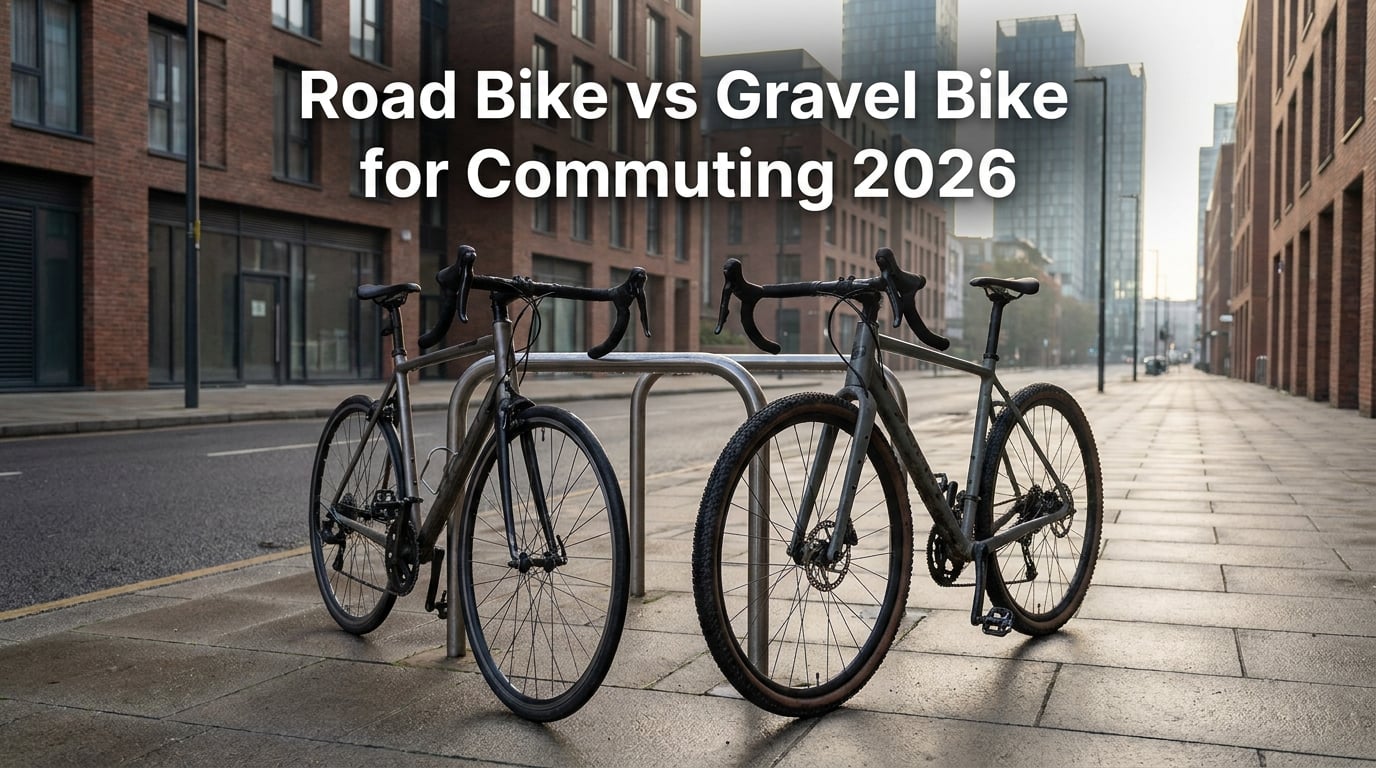
If you are staring at two bikes in a shop and wondering which one will survive your daily ride to work, you are in the right place. The road bike vs gravel bike for daily commuting question is one of the most debated topics in bike commuting forums, and for good reason. Both bikes look similar at a glance, both use drop handlebars, and both can absolutely get you to the office. The differences show up in the details that matter every single day: how fast you get there, how beat up you feel, and whether the bike shrugs off a pothole or sends you to the repair shop.
The short answer: a gravel bike wins for most daily commuters because it handles rough pavement, wet weather, and mixed terrain without complaint. A road bike wins if your route is mostly smooth, dedicated cycle paths and every minute of your commute matters. Road.cc testing found the road bike was only about 1.24 kph faster than the gravel bike on the same route, saving roughly five minutes on an hour-long commute. That gap is real but small, and it comes with tradeoffs.
I have pulled together data from road.cc’s speed tests, Reddit commuter threads, and essential tools to carry on your commute to give you a clear, practical breakdown. By the end of this guide you will know exactly which bike fits your route, your roads, and your riding style.
Table of Contents
Road Bike vs Gravel Bike for Daily Commuting: The Core Differences
Both road and gravel bikes share the same drop-bar DNA, but they are built for different jobs. Understanding these core differences is the foundation of the road bike vs gravel bike for daily commuting decision.
Tires and clearance: Road bikes typically run tires from 25mm to 32mm wide. Gravel bikes are designed around wider rubber, with tire clearance up to 48mm or even larger. That extra width is not just for looks. Wider tires run at lower pressure, which means they absorb road vibration, roll over cracks and debris without deflecting, and give you a noticeably smoother ride on beat-up city streets.
Frame geometry: A road bike puts you in a more aggressive, aerodynamic position with a lower front end and steeper head tube angle. A gravel bike uses a more relaxed geometry with a taller head tube and longer wheelbase. The result: the gravel bike feels more stable and less twitchy at low speeds, while the road bike feels snappy and responsive when you stand on the pedals.
Handlebars: Both use drop handlebars, but gravel bars are typically wider with a flared drop section. The wider flare gives you more control on rough surfaces and in traffic. Road bars are narrower, which helps with aerodynamics but can feel twitchy when you are dodging potholes at 20 kph.
Gearing: Road bikes come with higher gearing, often a 53/39 or 50/34 chainring paired with an 11-28 or 11-30 cassette. Gravel bikes use lower gearing, frequently a 48/32 or 46/30 chainring with a wider 11-34 or 11-36 cassette. Lower gearing matters if your commute includes hills, headwinds, or a loaded bag. You will spin easier up climbs instead of grinding.
Brakes: Almost all modern gravel bikes come with disc brakes, and the same is now true for road bikes at most price points. Disc brakes are the standard for a reason. They stop you reliably in wet weather, which is exactly what a daily commuter needs.
Speed: How Much Time Each Bike Actually Costs You
Speed is the number one reason people lean toward a road bike for commuting. The bike looks fast, the tires look fast, and the riding position is aerodynamic. But the actual numbers tell a more nuanced story.
Road.cc ran a controlled test comparing a road bike and a gravel bike on the same 16-kilometer commute route. The road bike averaged 1.24 kph faster than the gravel bike across multiple runs. On an hour-long commute, that translated to roughly five minutes saved.
Five minutes each way is ten minutes a day, which adds up. But context matters. That speed gap shrinks when the road surface is rough, when you are carrying a loaded bag, or when you hit stop-and-go traffic. In those conditions the gravel bike’s wider tires and stable geometry actually keep your speed more consistent.
The speed difference comes from three factors. First, narrower road tires at higher pressure have lower rolling resistance on smooth pavement. Second, the road bike’s aerodynamic position reduces drag at speeds above 25 kph. Third, road bikes are typically lighter, which helps on climbs and accelerations.
Here is the practical takeaway. If your commute is 10 kilometers or less on smooth roads, the speed difference is negligible and you will not notice it. If you are riding 35 kilometers round trip on smooth dedicated cycle paths like the Reddit commuter who sparked this whole debate, those five minutes each way add up to real time saved over a year.
You can also narrow the gap. Swapping the gravel bike’s stock knobby tires for a slick road tire like a 32mm or 38mm file tread dramatically reduces rolling resistance. Many commuters keep two wheelsets, one with road tires for dry commutes and one with wider rubber for rough or wet days. That single upgrade can close most of the speed gap while keeping the gravel bike’s comfort and versatility.
Comfort and Stability on Rough City Roads
Comfort is where the gravel bike pulls ahead, and it pulls ahead hard. City roads are rarely as smooth as a freshly laid bike path. You deal with cracked asphalt, sunken drain covers, railroad tracks, construction zones, and the dreaded surprise pothole.
Wider tires at lower pressure are the single biggest comfort upgrade you can have on a commuter bike. A 40mm gravel tire running at 45 psi absorbs road buzz that a 25mm road tire at 90 psi transmits straight into your hands, feet, and lower back. Over a 30-minute commute, that vibration difference is the gap between arriving fresh and arriving rattled.
The gravel bike’s relaxed frame geometry adds to that comfort. A longer wheelbase and slacker head tube angle mean the bike absorbs impacts rather than chattering through them. The riding position is more upright, which takes weight off your hands and reduces neck and shoulder fatigue.
Forum commuters consistently report that road bikes feel fragile on rough roads. One Reddit user with a 35km commute specifically worried about pothole damage to lightweight road wheels. That concern is valid. Narrow road tires at high pressure do not absorb impacts well, and a hard hit on a sharp-edged pothole can pinch flat a tube or even dent a rim.
If your daily route includes any stretch of rough chip seal, broken pavement, or patched-up road surface, the gravel bike is simply the more comfortable and more durable choice. Your body and your wheels will thank you.
Terrain Versatility and Mixed-Surface Commutes
Not every commute is 100 percent paved. Plenty of riders deal with a canal path section, a stretch of dirt or gravel, a park cut-through, or a construction detour that sends you across a mess of broken ground. This is the gravel bike’s home territory.
A gravel bike with 40mm or wider tires handles packed gravel, dirt, grass, and light singletrack without blinking. You can take a detour through a park, cut across a canal towpath, or bypass a traffic jam via a gravel shortcut. None of that requires thinking twice about whether your bike can handle it.
A road bike on the same surfaces is a white-knuckle experience. Narrow tires sink into loose gravel, slide on wet dirt, and offer almost no cushion on rocky sections. You can ride a road bike across a short gravel stretch if you keep your weight back and stay loose, but it is not fun and it is not fast.
This versatility is exactly why experienced commuters on Reddit and in bike forums consistently recommend the gravel bike even for riders whose commute is mostly smooth. The bike gives you options. If you want to extend your commute into a longer weekend ride on tips for riding mixed terrain or take a different route home through a park, the gravel bike says yes. The road bike says no.
For riders who genuinely never leave paved surfaces and never plan to, this versatility advantage matters less. But for everyone else, it is a significant quality-of-life factor that compounds over months and years of daily riding.
Weather Performance and Wet-Road Confidence
Commuting means riding in weather you did not choose. If you commit to biking to work, you will eventually ride in rain, on wet leaves, through standing water, and across painted road lines that turn into ice rats when wet.
Disc brakes, now standard on both road and gravel bikes, are the most important wet-weather upgrade. They provide consistent stopping power regardless of conditions. Reddit commuters consistently emphasize that disc brakes are invaluable in rain, and they are right. If you are buying either bike type new, make sure it has disc brakes.
Beyond brakes, the gravel bike has a clear wet-weather edge. Wider tires at lower pressure put more rubber in contact with the road, which means more grip on wet surfaces. A 40mm tire at 40 psi corners confidently in conditions where a 25mm tire at 90 psi feels sketchy.
Tire tread also matters. Gravel tires typically have a file tread or light knobby pattern that sheds water and bites into wet surfaces. Road slicks are fast on dry pavement but offer less grip the moment things get greasy.
Fender mounts are another practical consideration. Many gravel bikes include fender mounts, and the extra tire clearance means you can run full-coverage fenders without rub. Road bikes, especially race-oriented models, often skip fender mounts entirely or only support minimal clip-on fenders. If you plan to commute through wet seasons, fenders keep you and your drivetrain dramatically cleaner.
Carrying Gear and Practical Commuting Setup
A commuter bike needs to carry stuff. Lunch, change of clothes, laptop, tools, rain jacket. How each bike handles that load matters every single day.
Gravel bikes are generally better set up for carrying gear. Many models include rack mounts, fender mounts, and multiple bottle cage mounts. You can run a rear rack with panniers, frame bags, or a handlebar bag without aftermarket hacks. The bike’s relaxed geometry and wider tires also handle the extra weight of a loaded bag more gracefully.
Road bikes, especially those built for racing, often omit rack mounts entirely. You are limited to a backpack, a seat pack, or a frame bag. A backpack works fine for light loads but gets sweaty and uncomfortable on longer or hotter commutes. For a 35km round trip in summer, you will feel every gram on your back.
The two-wheelset strategy deserves a mention here because it solves multiple problems at once. Buy a second wheelset with road tires for fast dry commutes and keep the stock wheels with wider rubber for wet days and rough surfaces. Swapping wheels takes under two minutes with thru-axles and gives you two bikes in one. Veteran commuters on Reddit repeatedly call this one of the smartest investments you can make.
Whatever bike you choose, you also need essential tools to carry on your commute. At minimum: a spare tube, tire levers, a mini-pump or CO2 inflator, a multi-tool, and a patch kit. Tubeless tire setups can save you from pinch flats but require a tubeless repair plug kit for larger cuts.
Maintenance and Long-Term Ownership Costs
Both bike types need regular maintenance, but the gravel bike tends to be slightly more forgiving in daily use. Wider tires are less prone to pinch flats, and running them tubeless eliminates pinch flats entirely. Disc brakes on both bikes need periodic pad checks and rotor inspection, especially in wet weather when grit grinds pads down faster.
Drivetrain wear is similar across both bikes. Expect to replace your chain every 2,000 to 3,000 kilometers of commuting, and your cassette every other chain replacement. Wet weather accelerates this wear, so a clean and lube routine every week or two keeps your drivetrain running smoothly and quietly.
Road bike wheels can be more expensive to repair or replace if you damage them. Lightweight road rims are built for speed, not for absorbing pothole strikes. A hard hit can mean a trip to the wheelbuilder or a new wheelset. Gravel wheels are typically heavier and sturdier, designed to take abuse on rough surfaces.
Tubeless tires add a small maintenance overhead on both bikes. You need to top up sealant every few months and replace it fully a couple of times a year. The tradeoff is far fewer flats on the road, which is worth a lot when you are trying to get to work on time.
How to Choose: A Decision Framework
By now you have the full picture on the road bike vs gravel bike for daily commuting debate. Here is a straightforward decision framework to help you pick the right bike for your specific situation.
Choose a road bike if:
Your commute is almost entirely on smooth, paved roads or dedicated cycle paths. You are covering long distances (20km or more each way) and every minute matters. You have no interest in riding off-road or on mixed surfaces. You prioritize speed, lightweight feel, and aerodynamic efficiency over versatility.
Choose a gravel bike if:
Your commute includes any rough pavement, potholes, or mixed-surface sections. You ride year-round in all weather conditions. You want to use the same bike for weekend adventures, gravel rides, or bikepacking. You value comfort on long rides. You need to carry gear on the bike rather than your back.
Consider the hybrid option: Many commuters land on the gravel bike and then add a second road wheelset. This gives you the comfort and versatility of the gravel frame with the speed of road tires when conditions allow. It is the one-bike solution that genuinely covers almost every commuting scenario.
Think about your commute distance: Short commutes under 10km make the speed difference irrelevant. Either bike will get you there in about the same time. Medium commutes of 10 to 20km start to reward the road bike’s efficiency if the roads are smooth. Long commutes over 20km reward whichever bike is more comfortable, because fatigue becomes the limiting factor.
Audit your roads: Ride your commute route and pay attention to surface quality. If you spot chip seal, broken patches, gravel sections, or recurring potholes, the gravel bike wins. If it is pristine tarmac the entire way, the road bike’s speed advantage is yours to claim.
FAQ’s
Is a road bike or gravel bike better for commuting?
For most commuters a gravel bike is the better choice because it handles rough roads, wet weather, and mixed terrain with more comfort and stability. A road bike wins if your route is almost entirely smooth pavement and every minute of speed matters. The average speed difference is only about 1.24 kph.
Which type of bike is best for daily commute?
The best daily commuter bike depends on your route. Gravel bikes suit most commuters thanks to wider tires, relaxed geometry, and rack mounts. Road bikes suit riders with long, smooth commutes who prioritize speed. Hybrid bikes are another strong option if you prefer flat handlebars and an upright riding position.
Is a hybrid bike better than a road bike for commuting?
A hybrid bike can be better than a road bike for short urban commutes because the flat handlebars and upright position offer better visibility in traffic and easier low-speed handling. Road bikes are faster on open stretches but less practical in stop-and-go city riding.
Are gravel bikes good for everyday use?
Yes, gravel bikes are excellent for everyday use. They handle pavement comfortably, tackle rough roads without complaint, work well in wet weather with disc brakes and wider tires, and often include mounts for racks and fenders. Many riders use one gravel bike as their daily commuter, weekend explorer, and light touring rig.
Conclusion
The road bike vs gravel bike for daily commuting debate comes down to one question: what does your actual commute look like? If it is long, smooth, and fast, a road bike gives you every minute back. If it includes rough pavement, wet weather, mixed surfaces, or cargo, a gravel bike is the more comfortable and more versatile choice for the daily grind.
For most riders, the gravel bike’s all-condition capability wins out over the road bike’s small speed edge. Add a second wheelset with road tires and you effectively own two bikes in one. Whichever you choose, invest in good disc brakes, a solid lock, and the tools to handle the inevitable flat. Your future commuting self will thank you.