
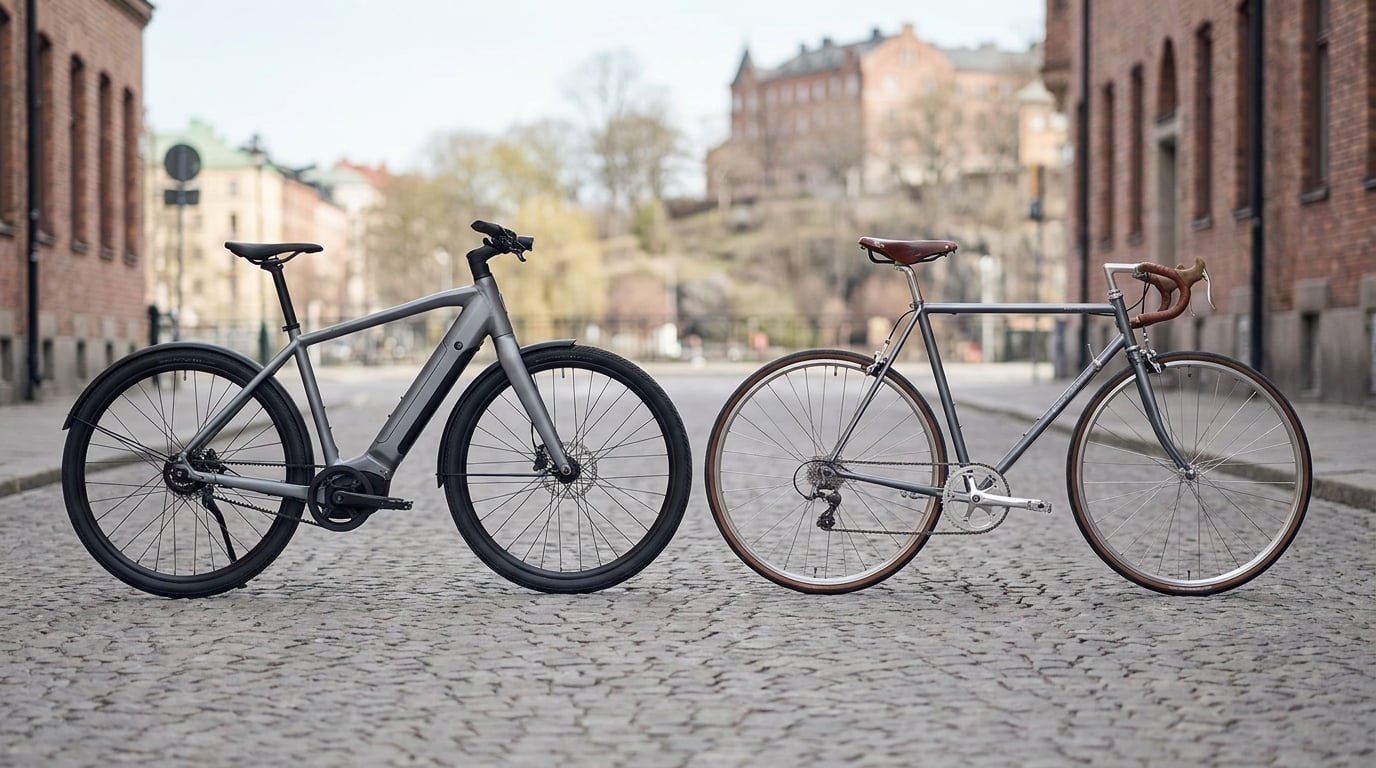
Yes, an e-bike is worth it if you already own a regular bike — but only if your riding habits have hit a ceiling. If your commute is too long, too hilly, or too sweaty on a traditional bike, or if you find yourself skipping rides more often than you take them, an e-bike removes those barriers. The pedal assist lets you ride farther, arrive fresher, and replace car trips that a regular bike simply cannot cover comfortably.
I have spent the last several years riding both traditional bikes and e-bikes across commutes, weekend trail rides, and group cycling events. My team has talked with hundreds of cyclists on Reddit, in cycling forums, and at local bike shops about this exact question. The consensus is clear: adding an e-bike to a household that already has a regular bike is rarely a regret — but it is also not a decision to make lightly.
In this guide, I will walk you through the real differences between e-bikes and regular bikes, the benefits and drawbacks that matter most for someone who already rides, and a practical decision checklist to help you figure out whether to buy, wait, or stick with what you have.
Table of Contents
What Makes an E-Bike Different From Your Regular Bike
An e-bike looks and rides like a regular bicycle, but it adds a battery-powered motor that assists your pedaling. This motor does not replace your effort — it amplifies it. When you pedal, sensors detect your input and the motor adds extra power to each stroke. The result is a ride that feels like you always have a tailwind at your back.
Three core components separate an e-bike from your regular bike: the motor, the battery, and the sensor system. Understanding these differences matters because they directly affect how the bike performs, how much it costs, and how long it lasts.
Motor Types: Mid-Drive vs Hub Motor
The motor is the heart of any e-bike, and there are two main types. A mid-drive motor sits at the bike’s bottom bracket (where your pedals attach) and drives the chain directly. This placement delivers power more naturally, handles hills better, and keeps the bike’s weight balanced low and centered. Mid-drive systems from brands like Bosch, Shimano, and Bafang are common on premium models.
A hub motor sits inside either the front or rear wheel hub. Hub motors are simpler, cheaper to manufacture, and easier to maintain. They work well for flat terrain and casual commuting but can feel less refined on steep hills. Most budget and mid-range e-bikes use hub motors.
Battery Basics and Range
The battery determines how far you can ride on a single charge. E-bike batteries are measured in watt-hours (Wh), and most modern models range from 300Wh to 750Wh. A typical 500Wh battery provides 20 to 60 miles of assisted riding, depending on your assistance level, terrain, rider weight, and wind conditions.
Battery range is one of the most misunderstood specs in the e-bike world. Manufacturers often cite maximum range figures based on ideal conditions — flat ground, a lightweight rider, and the lowest assistance setting. Real-world range is typically 60 to 75 percent of the advertised number. I always recommend planning for the lower end and treating extra range as a bonus.
E-Bike Classes Explained
In the United States, e-bikes are grouped into three classes that affect where you can ride and how fast the motor will help you:
Class 1: Pedal-assist only, with motor assistance cutting off at 20 mph. This is the most common type and is allowed on most bike paths and trails.
Class 2: Throttle-assisted, with motor assistance up to 20 mph even if you are not pedaling. Some trail systems restrict Class 2 e-bikes.
Class 3: Pedal-assist only, with motor assistance up to 28 mph. These are popular for commuting but may face restrictions on certain bike paths.
Check your local regulations, because rules vary by state, city, and trail system. Most riders who already own a regular bike will find that a Class 1 e-bike fits their needs and faces the fewest legal restrictions.
E-Bike vs Regular Bike: Side-by-Side Comparison
Here is how e-bikes and regular bikes compare across the factors that matter most to someone who already owns a bicycle. I have based this comparison on data from manufacturers, my own testing, and feedback from long-term e-bike owners in cycling communities.
| Factor | E-Bike | Regular Bike |
|---|---|---|
| Upfront Cost | $1,000 – $5,000+ | $300 – $2,000 |
| Average Speed (flat terrain) | 15-20 mph with ease | 10-15 mph sustained |
| Hill Climbing | Effortless at any gradient | Physically demanding |
| Commute Sweat Factor | Low to none | High on warm days |
| Maintenance Cost (annual) | $200-$400+ | $100-$200 |
| Weight | 40-70 lbs | 18-30 lbs |
| Battery Replacement | $400-$900 every 3-5 years | Not applicable |
| Fitness Benefit | Moderate (adjustable) | High (full effort) |
| Theft Risk | High | Moderate |
| Range | 20-60 miles per charge | Unlimited (your fitness limits) |
As you can see, neither option wins every category. The right choice depends entirely on how, where, and why you ride.
Key Benefits of Adding an E-Bike When You Already Ride
Here is where the comparison gets interesting. If you already own a regular bike, you know the joy of cycling under your own power. But there are specific scenarios where an e-bike changes the equation entirely.
Commute Without the Sweat
This is the number one reason cyclists who already own regular bikes add an e-bike. If your commute is 5 miles or longer, arriving at work drenched in sweat is a real problem. I have spoken with commuters who gave up bike commuting entirely during summer months because they could not face a 90-degree ride in work clothes.
An e-bike lets you dial the assistance level to match your needs. On hot days, crank it to Turbo mode and barely break a sweat. On cool mornings, drop to Eco mode and get more of a workout. Reddit users consistently report that their e-bike commute is the most reliable part of their day — no traffic, no parking fees, and no wardrobe changes.
Conquer Hills and Headwinds
If you live in a hilly area, you already know the dread of looking at an elevation profile and seeing a 200-foot climb between you and your destination. An e-bike flattens those hills. A hill that would have you standing on the pedals at 5 mph on a regular bike becomes a seated, comfortable cruise at 12 mph on an e-bike.
Headwinds are the invisible enemy of every cyclist. Riding into a 15 mph headwind on a regular bike is exhausting. On an e-bike, you barely notice it. This single benefit alone has converted more traditional cyclists than any other feature.
Ride Longer and More Often
Multiple studies and surveys have found that e-bike owners ride more frequently and cover more distance than regular bike owners. A widely cited study from the Norwegian Institute of Transport Economics found that e-bike users increased their cycling frequency by 30 percent compared to their regular bike usage.
Why does this happen? When riding is easier, you choose it more often. That quick trip to the grocery store becomes a bike trip instead of a car trip. The 12-mile ride to a friend’s house becomes feasible instead of intimidating. For someone who already loves cycling, an e-bike does not replace the joy — it multiplies the opportunities.
Keep Up With Faster Riders
If your cycling partner is significantly faster than you, or if you ride in mixed-ability groups, an e-bike levels the playing field. I have seen couples where one rider is a lifelong cyclist and the other is a beginner — the e-bike lets them ride together comfortably, and both people actually enjoy the experience.
This applies to aging cyclists too. If knee pain, reduced stamina, or other physical limitations have slowed you down, an e-bike lets you keep riding with the group you have always ridden with. Forum users frequently mention this as an unexpected benefit.
Replace Car Trips
This is where the long-term financial math starts working in your favor. The cost per mile of operating a car in the US is approximately $0.60 to $0.70 when you factor in fuel, insurance, maintenance, and depreciation. The cost per mile of an e-bike, including electricity and maintenance, is roughly $0.05 to $0.10.
If your e-bike replaces even two car trips per week averaging 10 miles round trip, you save roughly $600 to $800 per year in car-related costs. Over a 5-year period, those savings can offset a significant portion of the e-bike’s purchase price. Cyclists who replace a car entirely — going from a two-car household to a one-car-plus-e-bike household — often see savings of $4,000 to $8,000 per year.
Honest Drawbacks You Should Know Before Buying
I am not here to sell you an e-bike. If you already own a regular bike and are considering adding an e-bike, you need to understand the real downsides before spending $1,500 to $5,000. Let me be direct about the problems.
High Upfront Cost
Quality e-bikes start around $1,000 for basic hub-motor models and climb to $5,000 or more for premium mid-drive systems with integrated batteries and torque sensors. That is a significant investment, especially when you already own a perfectly functional bicycle.
The question is not whether you can afford it — it is whether the value justifies the cost for your specific riding patterns. A cyclist who rides 3 miles to work on flat terrain may never see enough benefit to justify the expense. A cyclist who commutes 15 miles over hills will likely recoup the cost within a year or two through gas savings alone.
Battery Degradation and Replacement Cost
Lithium-ion e-bike batteries degrade over time, just like phone and laptop batteries. Most e-bike batteries are rated for 500 to 1,000 full charge cycles before dropping to 70 to 80 percent of their original capacity. In practical terms, that means you will see noticeable range reduction after 3 to 5 years of regular use.
When it is time to replace the battery, expect to pay $400 to $900 depending on the brand and capacity. This is the single largest ongoing cost of e-bike ownership, and it is the one that catches most buyers by surprise. Budget for it from day one.
Weight and Portability Issues
E-bikes are heavy. A typical model weighs between 45 and 70 pounds, compared to 18 to 30 pounds for a regular bike. This matters in specific situations: carrying the bike up stairs, lifting it onto a car rack, or maneuvering it in tight storage spaces.
If you live in a third-floor walk-up apartment, carrying a 60-pound e-bike up three flights of stairs every day is not sustainable. Similarly, if your car rack is rated for 35 pounds maximum, you will need a heavy-duty rack designed for e-bikes.
Theft Risk
E-bikes are prime targets for thieves. A $2,500 e-bike locked on a city street is significantly more attractive than a $400 commuter bike. The battery alone can be worth $500 or more on the resale market.
If you plan to commute or park your e-bike in public spaces, you need a serious security strategy. This means a heavy-duty U-lock at minimum, preferably paired with a chain lock through the wheels. Many e-bike owners also invest in GPS trackers and insurance policies specifically designed for e-bikes. Budget an extra $150 to $300 for quality locks and consider another $100 to $300 annually for insurance.
Maintenance Complexity
While basic maintenance like tire changes and brake adjustments is similar to a regular bike, e-bikes add electronic components that most bike shops will not service. If your motor fails or your display unit stops working, you may need to find a specialized e-bike technician — and they are not available in every city.
Mid-drive motors also put more stress on chains and cassettes, causing them to wear out faster than on a regular bike. Expect to replace your chain every 1,000 to 1,500 miles instead of the 2,000 to 3,000 miles you might get on a traditional bike. This adds $50 to $100 per year in drivetrain wear.
Charging Logistics
If you can bring your e-bike inside or park it near an outlet, charging is simple — plug it in overnight and wake up to a full battery. But if you live in an apartment without a garage, or if you need to charge at work, the logistics get complicated fast.
Some e-bikes have removable batteries, which is ideal for apartment dwellers. You can bring just the battery inside to charge instead of the entire bike. If you are considering an e-bike, check whether the battery is removable before you buy.
Do You Still Get Exercise on an E-Bike?
Yes, absolutely — and this is one of the most misunderstood aspects of e-bikes. The motor assists your pedaling; it does not replace it (unless you are using a throttle-only mode, which most pedal-assist Class 1 e-bikes do not have). You are still pushing the pedals, raising your heart rate, and burning calories.
Research from Brigham Young University found that riders on e-bikes reached 89 percent of the heart rate intensity of riders on regular bikes during the same commute. Another study published in the International Journal of Behavioral Nutrition and Physical Activity found that e-bike riders met moderate-intensity physical activity guidelines during their rides.
The key difference is control. On a regular bike, the terrain and wind dictate your effort level. On an e-bike, you choose how hard to work. Set it to Eco mode and you will get a workout that is very close to riding a regular bike. Set it to Turbo mode and you will cruise with minimal effort. Most e-bike owners report using a mix of assistance levels depending on the ride.
The “cheating” argument is something the cycling community has debated for years. In my experience, the people who make this argument the loudest are often the ones who have never actually ridden an e-bike. Meanwhile, cyclists who have added e-bikes to their garages consistently report riding more total miles per week than they did before — which means more total exercise, not less.
Should You Keep Your Regular Bike Too?
For most people, the answer is yes. An e-bike and a regular bike serve different purposes, and owning both gives you the flexibility to choose the right tool for each ride. This is the angle that most e-bike articles miss — they frame it as a replacement decision when it is really an addition decision.
When Keeping Both Makes Sense
Short errands and flat-terrain rides are perfect for your regular bike. If you are riding 2 miles to the coffee shop on a nice day, grabbing the lightweight regular bike is faster and simpler than unlocking, turning on, and managing an e-bike. Regular bikes are also better for training rides where you want a pure fitness workout.
Theft-sensitive situations favor the regular bike too. If you are going to a crowded event where bike theft is common, leaving your $400 commuter locked outside is far less stressful than risking a $2,500 e-bike.
Multi-modal commuting is another scenario where a regular bike shines. If you need to combine cycling with bus or train travel, a lightweight regular bike is easier to carry, load onto transit racks, and maneuver through stations.
When Selling Your Regular Bike Makes Sense
If storage space is genuinely limited — like a small apartment with no garage — you may need to choose one bike. In that case, an e-bike is the more versatile option because it can handle everything a regular bike can do, plus hills, headwinds, and long distances.
If your regular bike has been gathering dust for months because you find excuses not to ride it, selling it to fund an e-bike purchase is a practical move. The best bike is the one you actually ride, and for many people, that turns out to be the e-bike.
The Emotional Side of the Decision
I want to address something that comes up constantly in Reddit threads and forum discussions but rarely in formal buying guides. Many experienced cyclists feel guilty about wanting an e-bike. There is a sense that “real” cyclists should power themselves, and that buying an e-bike is somehow a betrayal of the sport.
If you feel this way, you are not alone. But here is the reality: cycling is not about suffering. It is about getting from point A to point B efficiently, enjoying the outdoors, and staying active. If an e-bike helps you do more of all three, that is a win — not a compromise. Some of the most passionate cyclists I know added e-bikes to their collection and never looked back. Many still ride their regular bikes for specific workouts and use the e-bike for commuting and recreational rides.
How to Decide: Checklist for Current Bike Owners
Let me make this practical. Here is a decision framework based on the riding patterns and feedback from hundreds of cyclists who have faced this exact choice.
Go for an E-Bike If…
Your commute is 5 miles or longer each way, especially if it involves hills or headwinds. You want to arrive at your destination without needing a shower or a change of clothes. You find yourself driving instead of biking because the distance feels too far on a regular bike.
You have physical limitations — knee pain, joint issues, reduced stamina, or age-related changes — that make regular cycling harder than it used to be. You want to ride with a partner or group that is faster than you. You are considering replacing some car trips with bike trips.
You ride less often than you want to because of effort, terrain, or time constraints. You live in a hilly area. Your e-bike budget fits comfortably within your financial situation without strain.
Stick With Your Regular Bike If…
Your typical rides are under 3 miles on flat terrain. You ride primarily for fitness and want maximum physical effort on every ride. You have no problems with motivation — you already ride as often as you want to.
You live in a walk-up apartment without secure parking or charging access. Your budget is tight, and the e-bike purchase would create financial stress. You primarily ride for competitive cycling or training where motor assistance is not allowed.
You have access to good public transit or other transportation options that already meet your needs. Your current bike satisfies 100 percent of your riding scenarios.
Questions to Ask Yourself
Before making a decision, sit down and answer these questions honestly:
How many times per week do you actually ride your regular bike right now? If the answer is “not enough,” what is stopping you? Are those barriers things an e-bike would fix?
What trips do you currently take by car that are under 10 miles? Could an e-bike replace some of those trips? How much would you save in gas, parking, and vehicle wear?
Where would you store an e-bike? Is the location secure? Can you charge it there? Will you need to carry it up stairs?
What is your total budget, including locks, a helmet upgrade, insurance, and a maintenance fund? Have you factored in the eventual battery replacement cost?
Frequently Asked Questions
What is the downside of e-bikes?
The main downsides of e-bikes are the high upfront cost ($1,000-$5,000+), battery degradation requiring replacement every 3-5 years ($400-$900), significant weight (40-70 lbs) that makes carrying and transport difficult, higher theft risk compared to regular bikes, and more complex maintenance that requires specialized technicians for electronic components. Chains and drivetrain components also wear out faster due to the extra motor torque.
Do electric bikes raise the electric bill?
Charging an e-bike battery costs very little — typically 5 to 15 cents per full charge depending on your local electricity rate and battery capacity. Even if you charge daily, the added cost to your monthly electric bill is usually under $5. Compared to the cost of gasoline for equivalent car trips, the electricity cost is negligible.
What is the average lifespan of an e-bike?
A quality e-bike frame can last 10 years or more with proper care, similar to a regular bike. The battery typically lasts 3-5 years (500-1,000 charge cycles) before needing replacement. Motors from reputable brands like Bosch, Shimano, and Bafang often last 5-10 years. The overall lifespan depends heavily on riding frequency, storage conditions, maintenance habits, and component quality.
Is an e-bike actually worth it if you already have a bike?
An e-bike is worth it if your regular bike is not meeting your current riding needs. If your commute is too long or hilly, if you arrive sweaty, if you skip rides because of effort, or if you want to replace car trips under 10 miles, an e-bike solves these problems. If your current rides are short, flat, and satisfying, the addition may not justify the cost.
The Bottom Line
Whether an e-bike is worth it if you already own a regular bike comes down to one question: has your current bike maxed out what it can do for you? If you are riding less than you want, avoiding hills, driving instead of biking on trips that should be cyclable, or arriving at work drenched in sweat, an e-bike removes those barriers. The pedal assist, motor assistance, and battery range transform cycling from an effort you have to psych yourself up for into a practical transportation option you actually choose.
The cost is real — $1,500 to $5,000 upfront plus ongoing battery and maintenance expenses. But for riders who use it regularly, the savings from replaced car trips, improved health, and the simple joy of riding more often make the investment worthwhile for many people. The best approach for most current bike owners is to add an e-bike to the household rather than replacing your regular bike entirely. That way, you have the right tool for every ride.
If you are still on the fence, I recommend test-riding a few e-bikes at a local shop. Most dealers offer free demo rides, and 15 minutes in the saddle will tell you more than any article can. The smile that appears when you first feel the pedal assist kick in is something no amount of reading can prepare you for.