
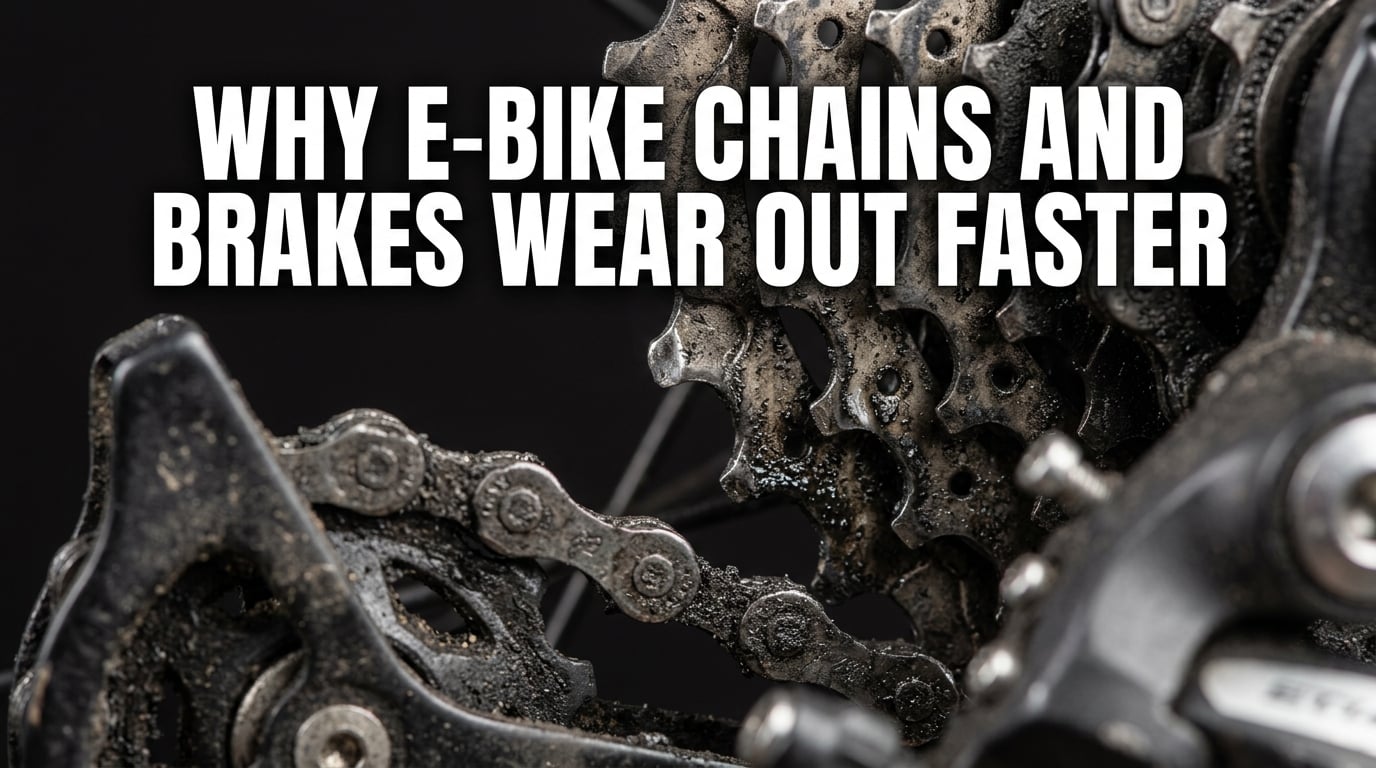
If you have owned an e-bike for more than a season, you probably noticed something frustrating. Your chain looks ragged after 1,500 miles. Your brake pads are down to metal when your friend’s acoustic bike still has plenty of life. Why e-bikes wear out chains and brakes faster comes down to three forces working against your components: extra weight, motor torque, and higher average speeds.
I have been wrenching on e-bikes for years, and I see the same pattern at every shop visit. Riders come in confused about why their drivetrain looks twice as old as their mileage suggests. The answer is not a defect or bad luck. It is physics. An e-bike typically weighs 50 to 70 pounds, carries a motor that cranks out 40 to 90 Nm of torque, and sustains speeds of 20 to 28 mph that regular cyclists only hit on downhills.
That combination places forces on chains, cassettes, brake pads, and rotors that regular bicycle components were never designed to handle. A conventional bike chain might last 2,000 to 3,000 miles under a human rider. The same chain on a mid-drive e-bike can hit its wear limit in 500 to 1,500 miles. Brake pads follow the same story.
In this guide, I will break down exactly why this happens, how your motor type changes the math, which riding habits secretly destroy your components, and what you can do to double or triple your part life. Whether you ride a cargo hauler, a fat-tire commuter, or a Class 3 speed pedelec, this information will save you money and keep you safer on the road.
Table of Contents
Why E-Bikes Wear Out Chains and Brakes Faster: The Core Causes
Three main factors explain why e-bikes wear out chains and brakes faster than regular bicycles. Every component on your bike is dealing with more stress than it would on an acoustic bike, and that stress adds up mile after mile.
The first factor is weight. A typical e-bike weighs 50 to 70 pounds compared to 15 to 25 pounds for a standard bicycle. Add a 180-pound rider, a backpack, and maybe some groceries, and your drivetrain and brakes are managing 250 to 300 pounds of total mass. Every acceleration, every hill climb, and every stop puts more load on the chain, the pads, and the rotors.
The second factor is torque. A fit cyclist produces roughly 100 to 200 watts of sustained power and maybe 250 Nm of peak torque at the crank for short bursts. An e-bike motor delivers 250 to 750 watts continuously and up to 90 Nm of torque at the motor, which multiplies through the drivetrain. That torque passes directly through your chain pins, rollers, cassette teeth, and chainring on a mid-drive system.
The third factor is speed. E-bikes sustain 20 to 28 mph on flat ground, which is nearly double the average speed of a typical commuter on a regular bike. Higher speeds mean harder braking events, more kinetic energy to dissipate, and more friction heat generated at every stop sign and traffic light.
Factor 1: Weight and Load
Weight is the most obvious reason e-bike components age faster, but the numbers still surprise most riders. A 65-pound e-bike is roughly three times heavier than a 20-pound road bike. That extra mass does not just sit there passively. It actively increases the load on every moving part.
When you accelerate from a stop, your chain has to transmit enough force to move the combined weight of bike, rider, and cargo. A heavier total mass means you need more chain tension to achieve the same acceleration. More tension means more pressure on the small contact points between chain pins, rollers, and sprocket teeth.
This is especially true for cargo e-bikes and fat-tire models. I have seen cargo bikes carrying 100 pounds of kids and gear that go through chains in 800 miles. The chain is not failing because it is defective. It is failing because it is working three times harder than the same chain would on a lightweight commuter.
Brakes feel the weight penalty even more directly. Stopping a 300-pound combined mass from 20 mph requires roughly three times the braking force of stopping a 150-pound setup from the same speed. All that energy converts to heat at the brake pad and rotor interface. More heat means faster pad compound breakdown and quicker rotor wear.
Hilly terrain compounds the problem. Climbing a 6 percent grade with a heavy e-bike demands maximum torque from the motor, which means maximum stress on the chain. Descending that same grade requires sustained braking, which heats rotors to temperatures that can glaze pads and warp rotors if you drag the brakes too long.
Factor 2: Torque and Motor Power
Torque is the hidden killer of e-bike drivetrains. When a motor delivers 60, 75, or 90 Nm of torque, that rotational force travels through your chain, cassette, and chainring before it ever reaches the rear wheel. The chain essentially becomes a high-stress power transmission belt, not just a pedaling aid.
To put this in perspective, a strong recreational cyclist might produce 15 to 25 Nm of torque at the crank during normal riding. A Bosch Performance Line CX motor delivers 85 Nm. A Bafang M620 can hit 160 Nm. Even at moderate assist levels, the motor is adding two to five times the torque a human alone would generate.
Chain pins are the weakest link in this system. Each pin is a small steel cylinder about 2 millimeters in diameter that holds the inner and outer chain plates together. Under high torque loads, those pins experience immense shear force. Over thousands of rotations, the pin surfaces wear down, the bushings deform, and the effective distance between pins increases.
That increase in pin-to-pin distance is what mechanics call chain stretch. The chain does not actually stretch like a rubber band. The pins and rollers wear down, creating slack that makes the chain appear longer. On an e-bike, this wear happens two to four times faster than on a regular bike because the torque loads are dramatically higher.
Roller wear follows the same pattern. The rollers are the cylindrical pieces that contact the cassette teeth. Under high torque, the contact pressure between roller and tooth increases, causing the roller to wear flat spots and the teeth to hook. This is why a worn e-bike cassette often develops shark-fin-shaped teeth that grab the chain and cause skipping under load.
Factor 3: Higher Average Speeds
Speed is the third factor, and it hits your brakes harder than your chain. When you ride an e-bike at 20 to 28 mph, you carry significantly more kinetic energy than a cyclist averaging 12 to 15 mph. Kinetic energy increases with the square of velocity, which means doubling your speed quadruples the energy your brakes must dissipate.
A rider on a regular bike going 15 mph carries about 3,400 joules of kinetic energy. The same rider on a Class 3 e-bike going 28 mph carries roughly 11,800 joules. Your brake pads and rotors have to convert all that energy into heat every time you slow down or stop. That is more than three times the thermal load per braking event.
Stop-and-go urban riding is the worst scenario. A commuter hitting 20 red lights on a 10-mile ride generates 20 high-energy braking events. Each event heats the pads and rotor, and each cycle of heating and cooling breaks down the pad compound faster. Organic pads, which are softer and quieter, can wear out in 300 to 500 miles under these conditions.
Sustained high-speed descents create a different problem. Instead of repeated short braking events, you get long continuous drag braking that can push rotor temperatures past 400 degrees Fahrenheit. At those temperatures, organic pad compound can glaze over, reducing braking effectiveness even though the pad still has material left. Sintered metal pads handle heat better but wear rotors faster in exchange.
Higher cruising speeds also increase chain speed. At 28 mph in a high gear, the chain is moving over the cassette and chainring at a faster linear speed than it would at 15 mph. Faster chain speed means more friction cycles per mile, which accelerates pin, roller, and tooth wear even when the torque load is moderate.
Mid-Drive vs Hub Motor: Why Your Motor Type Matters
Your motor type dramatically affects how fast your chain wears out. This is one of the most misunderstood aspects of e-bike ownership, and the difference between mid-drive and hub motors is significant enough to change your maintenance budget.
A mid-drive motor mounts at the bottom bracket and drives the chain directly. Every watt of motor power flows through the chainring, chain, cassette, and rear hub. This means the drivetrain handles the combined torque of the motor plus the rider. Mid-drive systems like Bosch, Shimano STEPS, Brose, and Yamaha all route power this way because it allows the motor to use the bike’s gears for efficiency.
The trade-off is accelerated wear. On a mid-drive e-bike, chains commonly need replacement at 1,000 to 1,500 miles. Some aggressive riders in hilly areas report chains hitting the 0.5 percent wear mark at 500 to 700 miles. Cassettes typically last through two or three chain replacements before the teeth become too hooked to accept a fresh chain smoothly.
A hub motor, by contrast, drives the rear wheel directly. The motor sits inside the hub shell and applies torque to the wheel independent of the chain and gears. The chain only carries the rider’s pedaling force, not the motor’s output. This means hub motor bikes see chain wear rates much closer to regular bicycles.
Hub motor riders routinely report 2,000 to 3,000 miles on a single chain. The drivetrain lasts longer because it is not dealing with 85 Nm of motor torque on every pedal stroke. However, hub motors add unsprung weight to the rear wheel, which can increase spoke stress and make rear wheel service more complicated.
The real question is not which motor is better. It is which trade-off fits your riding. If you want maximum climbing efficiency and natural feel, a mid-drive will serve you well, but you need to budget for more frequent chain and cassette replacements. If you want lower maintenance costs and your terrain is mostly flat, a hub motor will treat your drivetrain much more gently.
Forum data backs this up. Riders on the Electric Bike Review forums consistently report that mid-drive bikes in hilly areas consume chains at two to three times the rate of hub motor bikes on similar routes. One user documented going through three chains and one cassette in 4,000 miles on a Bosch-powered cargo bike, while another reported a single chain lasting 2,500 miles on a Bafang hub motor commuter over the same period.
Why E-Bike Chains Wear Out Faster (Deep Dive)
Chain wear is the number one maintenance complaint I hear from e-bike owners. The good news is that understanding the mechanism makes it much easier to slow down the process and catch problems before they cascade into expensive cassette and chainring replacements.
First, let me clear up a common misconception. Chain stretch is not actually stretching. Your chain does not elongate like a rubber band under tension. What happens is that the pins and rollers wear down at their contact points. As the steel wears, the gap between pins increases, and the chain’s effective pitch gets longer. A chain checker tool measures this increased pitch as a percentage. Once the chain reaches 0.5 percent elongation, it needs replacement.
On a regular bike, a chain might reach 0.5 percent wear at 2,000 to 3,000 miles. On an e-bike, especially a mid-drive, you can hit that threshold at 500 to 1,500 miles. The 0.5 percent threshold is critical because beyond that point, the elongated chain starts wearing the cassette and chainring teeth to match its new pitch. Replace the chain at 0.5 percent and your cassette will survive through multiple chains. Wait until 0.75 percent or 1 percent, and you will need a chain and cassette together.
Warning Signs of Chain Wear
Catching chain wear early saves you money. Here are the symptoms I look for, in order of severity:
1. Black, gritty chain. When your chain looks like it was dipped in graphite, it is full of metal shavings mixed with lubricant. This abrasive paste accelerates pin and roller wear every time you pedal.
2. Chain noise under load. A healthy chain is nearly silent. If you hear grinding, clicking, or a metallic chirping noise when the motor kicks in, the chain is likely worn enough that it is no longer meshing cleanly with the cassette teeth.
3. Skipping under torque. When you feel the chain jump a tooth under motor load, especially on a hill or hard acceleration, the chain has elongated enough that the cassette teeth can no longer hold it securely. This is dangerous because it can happen mid-intersection.
4. Visible chain elongation on the chainring. If you shift to the largest chainring and look down while back-pedaling, a worn chain will rise off the teeth at the front of the ring instead of settling cleanly into each tooth gap.
The 0.5 Percent Rule and Chain Checkers
The 0.5 percent wear threshold is the gold standard for e-bike chain replacement. This is tighter than the 0.75 percent threshold many riders use for regular bikes, and there is a good reason for the stricter limit. E-bike chains operate under higher torque, so even a small amount of elongation causes proportionally more damage to cassettes and chainrings.
To measure chain wear, use a dedicated chain checker tool. The Park Tool CC-2 and the Shimano TL-CN42 are the two most trusted options in the bike community. The Park Tool gives a numeric readout, while the Shimano tool is a go-no-go gauge designed specifically for Shimano 12-speed chains. Either tool takes 30 seconds to use and can save you hundreds of dollars in cascading drivetrain wear.
I recommend checking your chain every 500 miles. If you ride daily, that means a check every three to four weeks. If the chain is at 0.5 percent, replace it immediately. If it is between 0.25 and 0.5 percent, note the reading and check again in 200 miles. Keeping a simple log of readings and dates takes the guesswork out of maintenance scheduling.
Why E-Bike Brakes Wear Out Faster (Deep Dive)
Brake wear on e-bikes follows the same physics as chain wear but with a different mechanism. Instead of metal-on-metal friction at the chain pins, you have pad-on-rotor friction at the brake caliper. The energy story is the same: more mass and more speed mean more kinetic energy that your brakes must convert to heat at every stop.
Most e-bikes use hydraulic disc brakes, and for good reason. Rim brakes simply cannot handle the thermal load that a 300-pound combined mass generates during repeated stops from 20-plus mph. Hydraulic discs provide more stopping power, better heat dissipation, and more consistent lever feel than mechanical discs or rim brakes. But even with good disc brakes, pads wear out fast.
Organic brake pads typically last 300 to 800 miles on an e-bike in urban riding. They are quieter and provide better bite when cold, but they wear quickly and can glaze under heavy heat. Sintered metal pads last longer, often 800 to 1,500 miles, and handle high temperatures better. The trade-off is that they are noisier, especially when wet, and they wear rotors faster because the metal compound is harder on the steel disc.
For most e-bike commuters, I recommend sintered pads on the rear and organic on the front. The rear brake does more drag braking in traffic and benefits from sintered durability. The front brake provides primary stopping power and benefits from the strong initial bite of organic compound. If you ride steep descents regularly, go sintered on both ends.
Warning Signs of Brake Wear
Brake problems develop gradually, so regular inspection matters. Here is what to watch for:
1. Squealing or howling. Loud brakes usually mean the pads are contaminated with oil or have glazed from overheating. Contaminated pads need replacement because the oil cannot be fully cleaned out. Glazed pads can sometimes be sanded, but replacement is more reliable.
2. Spongy or soft lever feel. If your brake lever pulls closer to the grip than usual or feels mushy, you likely have air in the hydraulic system. This requires a brake bleed, which is best done by a shop if you are not experienced with hydraulic systems.
3. Increased stopping distance. If you notice that intersections feel shorter than they used to, your pads may be worn thin. Check pad thickness visually through the caliper window. Most pads have a usable thickness of about 2.5 to 3 millimeters. Below 1 millimeter, you are riding on the backing plate.
4. Pulsing lever. A lever that pulses rhythmically indicates a warped rotor. Rotors can warp from heat, impact, or simply age. Minor warps can be trued with a rotor tool, but severe warping requires replacement.
5. Visual pad inspection. Remove the wheel and look at the pads from the top of the caliper. If the pad material is thinner than a dime, replace both pads immediately. Never replace just one pad. Always do them in pairs.
Riding Habits That Destroy Chains and Brakes
Not all chain and brake wear comes from physics. Many riders unknowingly destroy components through habits that seem normal but dramatically shorten part life. Here are the most common mistakes I see, and how to fix them.
Riding in High Gears at Low Cadence
This is the single most damaging riding habit on an e-bike. When you mash a hard gear at 50 RPM instead of spinning an easier gear at 80 RPM, you are sending torque spikes through the chain with every pedal stroke. The motor amplifies these spikes because it also delivers maximum torque at low cadence.
A rider pedaling at 80 RPM spreads the workload across more chain link rotations per minute, reducing peak force on any individual pin or roller. A rider at 50 RPM concentrates the same power into fewer, harder rotations. The result is that low-cadence riding can cut chain life in half compared to proper spinning technique.
The fix is simple. Shift to easier gears and aim for a cadence of 75 to 90 RPM. Your motor will actually run more efficiently at higher cadence, and your knees will thank you too. If you have a cadence sensor on your display, use it to build the habit.
Shifting Under Full Motor Power
Shifting while the motor is delivering full torque is like shifting your car’s transmission at wide-open throttle. The chain is under maximum tension when you try to lift it off one cog and drop it onto another. The result is bent chain links, gouged cassette teeth, and occasionally a snapped chain.
The fix is to momentarily ease off the pedals when you shift. On an e-bike, this means briefly soft-pedaling so the motor reduces torque while the chain moves between gears. It takes half a second and adds years to your drivetrain. Some modern e-bike systems have shift-sensing technology that cuts motor power automatically during shifts, but many budget and mid-range bikes do not have this feature.
Using the Wrong Degreaser
This one catches riders by surprise. Using harsh solvents like gasoline, brake cleaner, or industrial degreasers on your chain strips out the factory lubricant that sits between the pins and rollers. Once that internal lube is gone, you cannot replace it with surface chain lube. The chain runs dry internally and wears out in a fraction of the normal time.
Use a dedicated bicycle chain degreaser instead. Citrus-based degreasers and biodegradable chain cleaners remove surface grime without penetrating and destroying the internal pin lubrication. Apply the degreaser to a rag, wipe the chain down, and re-lubricate after the chain is dry. Never soak a chain in solvent overnight, and never use a gasoline bath, which one forum user admitted to doing before his chain failed at 300 miles.
Over-Lubricating the Chain
More lube is not better. When you apply so much lubricant that it drips off the chain, the excess becomes a magnet for dirt, sand, and road grit. That abrasive mixture turns into a black grinding paste that wears pins and rollers faster than a dry chain would.
The correct technique is to apply one drop of lube per roller, back-pedal the chain for 30 seconds to distribute it, then wipe the entire chain with a clean rag until the exterior is nearly dry. The lube that matters is inside the rollers, not on the outside plates. A properly lubed chain should look clean and slightly shiny, not wet and dripping.
High-Pressure Washers
Never use a pressure washer on your e-bike. The concentrated jet can force water past bearing seals, flush grease out of hubs and bottom brackets, and push contaminants into places they cannot escape. I have seen pressure-washed bikes come into the shop with seized bearings after a single aggressive wash.
Use a bucket of soapy water, a soft brush, and a low-pressure hose rinse instead. Pay special attention to the chain and cassette area, where grit accumulates fastest. Dry the chain thoroughly and re-lubricate after every wash.
New Chain on a Worn Cassette
If you let your chain wear past 0.75 percent before replacing it, the cassette teeth will have worn to match the elongated chain. When you install a fresh chain on that worn cassette, the new chain will skip and jump under load because the tooth profiles no longer match the new chain’s pitch.
This is why the 0.5 percent replacement rule matters so much. Replace the chain early, and your cassette will last through three or four chains. Replace it late, and you are buying a chain and cassette together, which costs three to four times as much.
How to Extend E-Bike Chain and Brake Life
Now for the good news. With the right habits and a simple maintenance schedule, you can double or even triple the life of your chains and brake pads. Here is the routine I recommend to every e-bike owner.
Every 100 Miles: Clean and Lube the Chain
Wipe the chain down with a clean rag to remove surface grime. Apply one drop of quality bicycle chain lubricant per roller. Back-pedal for 30 seconds, then wipe the chain dry. This takes five minutes and is the single most impactful maintenance habit you can develop.
Choose your lubricant based on riding conditions. Dry lube works well in dusty, dry climates but washes off quickly in rain. Wet lube sticks around in wet conditions but attracts more grime. Wax-based lubes offer the cleanest running but require more frequent application.
Every 500 Miles: Check Chain Wear
Use a chain checker tool to measure elongation. If the reading is at or past 0.5 percent, replace the chain immediately. If it is between 0.25 and 0.5 percent, log the reading and check again in 200 miles. Keeping a simple spreadsheet of mileage and readings takes the guesswork out of the process.
This is also a good interval to inspect brake pads. Look through the caliper window and check pad thickness. Replace pads when the friction material is down to about 1 millimeter. Inspect rotors for scoring, glazing, or warping.
Every 1,000 Miles: Deep Clean and Inspect
Remove the rear wheel and clean the cassette thoroughly with a brush and degreaser. Inspect cassette teeth for hooking or shark-fin profiles. Check the chainring teeth the same way. Look at jockey wheels on the rear derailleur for wear or binding.
Inspect brake rotors for thickness. Most rotors start at 1.8 to 2.0 millimeters thick. Replace them when they reach 1.5 millimeters, as thinner rotors cannot dissipate heat effectively and can warp or crack. Check brake lines for kinks, leaks, or bulging.
Riding Habits That Add Miles
Beyond the maintenance schedule, a few riding habits make a massive difference. Maintain a cadence of 75 to 90 RPM instead of mashing hard gears. Ease off the pedals when shifting. Avoid prolonged drag braking on descents by alternating front and rear brakes to distribute heat. Anticipate stops early and brake gradually rather than grabbing a handful of lever at the last moment.
One forum user I came across reported 3,000 miles on a single chain with zero measurable wear. His secret was not a magic chain or lubricant. He simply maintained a high cadence, shifted under light load, and cleaned his chain every 100 miles. Good habits beat expensive components every time.
E-Bike vs Regular Bike Component Lifespan
Here is a quick comparison to put the wear difference in perspective. These ranges are based on typical riding conditions and average maintenance habits.
Chain: Regular bike 2,000 to 3,000 miles. E-bike (hub motor) 1,500 to 3,000 miles. E-bike (mid-drive) 500 to 1,500 miles.
Cassette: Regular bike 6,000 to 10,000 miles. E-bike (hub motor) 4,000 to 8,000 miles. E-bike (mid-drive) 2,000 to 5,000 miles.
Brake pads (organic): Regular bike 1,500 to 3,000 miles. E-bike 300 to 800 miles.
Brake pads (sintered): Regular bike 3,000 to 5,000 miles. E-bike 800 to 1,500 miles.
Brake rotors: Regular bike 8,000 to 15,000 miles. E-bike 4,000 to 8,000 miles.
Chainring: Regular bike 10,000 to 15,000 miles. E-bike (hub motor) 8,000 to 12,000 miles. E-bike (mid-drive) 4,000 to 8,000 miles.
These numbers assume regular cleaning and lubrication. Neglected components will fail faster across the board, and well-maintained components can exceed these ranges significantly.
FAQ’s
How long should a chain last on an electric bike?
An e-bike chain typically lasts 1,000 to 3,000 miles depending on motor type and riding habits. Mid-drive motors wear chains faster, often requiring replacement at 500 to 1,500 miles. Hub motor bikes see chain life closer to 2,000 to 3,000 miles. Check chain wear every 500 miles using a chain checker tool and replace at 0.5 percent elongation.
What are the biggest problems with e-bikes?
The biggest maintenance problems with e-bikes are accelerated chain and brake wear, battery degradation over time, and the higher cost of replacement parts. Chains and brake pads wear out two to four times faster than on regular bikes due to the added weight, motor torque, and higher average speeds. Regular preventive maintenance addresses most of these issues before they become expensive.
What is the lifespan of an e-bike?
An e-bike frame and motor can last 5 to 10 years or more with proper care. The battery typically lasts 3 to 5 years or 500 to 1,000 charge cycles before significant capacity loss. Wear components like chains, brake pads, cassettes, and tires need regular replacement throughout the bike’s life. With consistent maintenance, a quality e-bike can provide 10,000 to 20,000 miles of reliable service.
How to make eBike brakes better?
To improve e-bike braking performance, use sintered metal pads for better heat resistance on long descents, keep rotors clean with isopropyl alcohol, bed in new pads properly with repeated moderate stops from 15 mph, and ensure the hydraulic system is bled regularly to remove air bubbles. Upgrading to larger 203mm rotors also improves heat dissipation and stopping power for heavier e-bikes.
How much chain stretch is acceptable?
For e-bikes, the acceptable chain wear limit is 0.5 percent elongation. At this point, replace the chain immediately to prevent cassette and chainring damage. Regular bikes can sometimes go to 0.75 percent, but e-bikes operate under higher torque and should use the stricter 0.5 percent threshold. Use a chain checker tool like the Park Tool CC-2 or Shimano TL-CN42 every 500 miles.
What are the symptoms of a stretched bike chain?
The main symptoms of chain wear are skipping under load, especially during hard pedaling or motor acceleration, grinding or clicking noises from the drivetrain, a black gritty appearance from metal shavings mixed with lubricant, and the chain lifting off the chainring teeth when back-pedaling. Use a chain checker tool to confirm wear, and replace the chain at 0.5 percent elongation.
Is WD-40 ok to use on bike chains?
Standard WD-40 is a solvent and water displacer, not a chain lubricant. It will strip existing lubricant from the chain and leave it dry, accelerating wear. Use a dedicated bicycle chain lubricant instead. WD-40 does make a bike-specific line of products including chain lube, which is acceptable. Never use WD-40 or other solvents to clean a chain, as they penetrate and destroy the internal pin lubrication.
Conclusion
Understanding why e-bikes wear out chains and brakes faster comes down to three forces: extra weight, motor torque, and higher speeds. Your motor type matters too, with mid-drive systems routing all that motor power through the chain and accelerating wear compared to hub motors that bypass the drivetrain.
The most important takeaway is that you have significant control over how fast your components wear. Maintaining a proper cadence of 75 to 90 RPM, easing off when you shift, cleaning and lubricating every 100 miles, and checking chain wear at 0.5 percent every 500 miles can double your chain life. Choosing the right brake pad compound for your terrain and inspecting pads regularly keeps your stopping power reliable.
Treat your e-bike drivetrain and brakes as wear items, not lifetime components. Budget for chain replacements, keep a chain checker in your tool kit, and learn the warning signs before they leave you stranded. A few minutes of preventive maintenance each week will save you hundreds of dollars and keep every ride smooth and safe.