
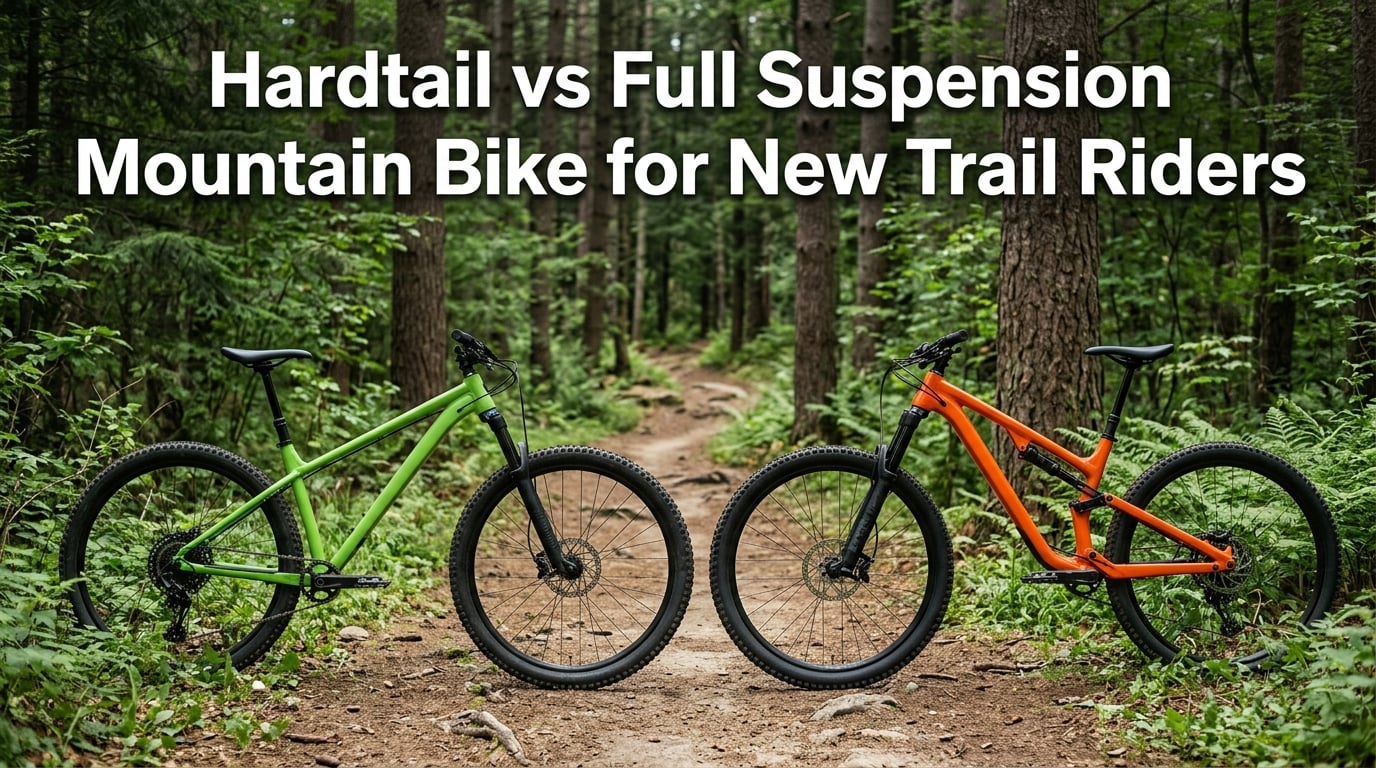
Choosing your first real mountain bike is one of the biggest decisions you will make as a new rider. The hardtail vs full suspension mountain bike debate is the question that comes up in every forum, every bike shop, and every group ride conversation. I have spent years watching beginners agonize over this choice, and the answer is rarely as simple as “full suspension is better.”
Here is what matters: the right bike depends on your trails, your budget, your fitness, and what kind of rider you want to become. A hardtail mountain bike has only a front suspension fork with a rigid rear frame, while a full suspension mountain bike adds a rear shock to absorb impacts from both wheels. That single difference changes everything about how the bike rides, how much it costs, and how quickly you develop as a trail rider.
In this guide, I will break down exactly what separates these two bike types so you can make a confident decision. Whether you are eyeing smooth cross-country singletrack or chunky technical descents, you will know which suspension setup fits your situation by the end. If you are also curious about how hardtail mountain bikes work for bikepacking and multi-day adventures, that versatility is worth considering too.
Our team compared the top resources, forum discussions from r/MTB and r/Hardtailgang, and real rider experiences to build this guide specifically for new trail riders. Let’s get into it.
Table of Contents
Quick Answer: Hardtail vs Full Suspension Mountain Bike at a Glance
The difference between a hardtail and a full suspension mountain bike comes down to rear suspension. A hardtail has a front suspension fork only, making it lighter, cheaper, and more efficient on smooth terrain and climbs. A full suspension bike adds a rear shock absorber, giving you more control, comfort, and traction on rough, technical trails but at a higher cost and weight.
For most new trail riders on a budget under $1,500, a quality hardtail is the smarter starting point. It teaches fundamental bike handling skills that transfer directly to full suspension bikes later. If your local trails are rocky, root-filled, or steep, and you have $2,000+ to spend, a full suspension bike will give you more confidence and fewer beat-up days.
Here is a quick summary of how the two compare across the categories that matter most to beginners:
- Price: Hardtails cost significantly less for the same component quality. You get better parts per dollar.
- Weight: Hardtails are typically 2 to 4 pounds lighter than comparable full suspension bikes.
- Climbing: Hardtails pedal more efficiently on smooth climbs. Full suspension bikes can bob but modern designs minimize this.
- Descending: Full suspension wins here with better traction, control, and comfort on rough descents.
- Maintenance: Hardtails have fewer moving parts, meaning lower upkeep costs and simpler servicing.
- Skill building: Hardtails force you to learn proper line choice and body positioning. Skills transfer to full suspension.
- Confidence: Full suspension forgives mistakes. Hardtails punish poor technique but make you a better rider faster.
If you want the short version: hardtail for budget, fitness, and skill development. Full suspension for comfort, confidence, and technical terrain. Now let’s dig into the details.
What Is a Hardtail Mountain Bike?
A hardtail mountain bike is a bike with suspension in the front fork only and a rigid rear frame. The front suspension fork typically offers 100mm to 140mm of travel, absorbing impacts from the front wheel as you ride over bumps, rocks, and roots. The rear of the bike has no shock absorber, which is where the name “hardtail” comes from. The back end feels every bump the trail throws at it.
Hardtails are the traditional choice for cross-country riding, bikepacking, and entry-level trail riding. They are simpler machines with fewer pivots, bearings, and moving parts compared to full suspension bikes. This simplicity translates to lower cost, lighter weight, and easier maintenance.
Modern hardtails benefit from improved frame geometry that makes them far more capable than hardtails from a decade ago. Slack head angles, shorter chainstays, and longer reach measurements give today’s hardtails surprising confidence on descents. You are not riding a twitchy, nervous bike. A well-designed modern hardtail can handle genuine trail riding.
Most hardtails use 29-inch wheels, though some models still offer 27.5-inch options. The larger 29er wheels roll over obstacles more easily, which partially compensates for the lack of rear suspension. Many riders also run slightly lower tire pressure on the rear to add grip and cushion on a hardtail.
Pros of Hardtail Mountain Bikes
- Lower cost: You get better components for the same budget. A $1,000 hardtail often has nicer drivetrain and brakes than a $1,000 full suspension bike.
- Lighter weight: Without a rear shock, linkage, and extra frame reinforcement, hardtails are noticeably lighter. This makes climbing and acceleration easier.
- Efficient pedaling: Every watt of power goes directly to the rear wheel with no suspension bob. Hardtails sprint and climb efficiently.
- Low maintenance: No rear pivots to service, no rear shock to tune or rebuild. Basic upkeep is straightforward and affordable.
- Skill development: Hardtails teach you to pick good lines, use your legs as suspension, and read the trail. These fundamentals make you a better rider on any bike.
- Versatility: Hardtails work well for trail riding, commuting, bikepacking, and fitness riding. One bike can do many things.
Cons of Hardtail Mountain Bikes
- Rough on technical terrain: Without rear suspension, rocky and root-filled trails transmit every impact to your body. Long rides on rough terrain can be fatiguing.
- Less traction on descents: The rear wheel bounces over bumps rather than tracking the ground, reducing grip on technical climbs and descents.
- Punishes mistakes: Bad line choices hurt more on a hardtail. You feel every error, which can be discouraging for some beginners.
- Less confidence-inspiring: New riders may feel nervous on steep or chunky descents without the safety net of rear suspension.
What Is a Full Suspension Mountain Bike?
A full suspension mountain bike has both front and rear suspension. The front suspension fork works the same as on a hardtail, absorbing impacts from the front wheel. The rear suspension uses a shock absorber connected to a linkage system that allows the rear wheel to move independently of the frame, absorbing impacts from the back wheel.
Full suspension bikes are categorized by their suspension travel, which is the total distance the suspension can compress. Cross-country full suspension bikes typically have 100mm to 120mm of travel. Trail bikes run 130mm to 150mm. Enduro bikes use 150mm to 180mm. Downhill bikes can have 200mm or more. For new trail riders, a trail bike with 130mm to 150mm of travel is the sweet spot.
The rear suspension does more than just absorb bumps. It keeps the rear wheel pressed against the ground over rough terrain, maintaining traction where a hardtail’s rear wheel would skip and bounce. This translates to better climbing grip on technical surfaces and far more control on descents.
Modern full suspension designs use sophisticated linkage systems that minimize pedaling inefficiency. Features like anti-squat geometry and lockout switches let you firm up the suspension for smooth climbs and open it up for descents. The gap between hardtail and full suspension climbing efficiency is much smaller than it used to be.
Pros of Full Suspension Mountain Bikes
- Superior traction: The rear wheel stays in contact with the ground over rough terrain, giving you grip when you need it most on technical climbs and descents.
- More control and confidence: The suspension absorbs mistakes and rough lines, giving new riders a wider margin for error on the trail.
- Reduced fatigue: Your body absorbs fewer impacts, meaning you can ride longer and recover faster. This is especially noticeable on all-day rides.
- Better on technical terrain: Rock gardens, root lattices, and steep descents are all more manageable with rear suspension keeping the bike composed.
- Faster on rough descents: The suspension lets you carry speed through rough sections that would slow down or buck a hardtail rider.
- More fun factor: Many riders simply find full suspension bikes more enjoyable on technical trails, which keeps them coming back to ride more.
Cons of Full Suspension Mountain Bikes
- Higher cost: Full suspension bikes are significantly more expensive. A decent entry-level full suspension bike starts around $1,800 to $2,000, compared to $600 to $900 for a comparable hardtail.
- Heavier weight: The rear shock, linkage, and reinforced frame add weight. Budget full suspension bikes can be heavy enough to feel sluggish on climbs.
- More maintenance: Rear pivots need periodic servicing, and rear shocks require regular maintenance and occasional rebuilds. This adds to long-term ownership costs.
- More complex to set up: Getting the suspension dialed in requires understanding sag, rebound, and compression settings. It can overwhelm new riders.
- Lower component spec for the same price: At any given price point, a full suspension bike will have lower-quality drivetrain, brakes, and fork than a hardtail.
Hardtail vs Full Suspension Mountain Bike: Head-to-Head Comparison
Now let’s compare hardtail vs full suspension mountain bike performance across the categories that new trail riders care about most. These are the differences you will feel on the trail, not just numbers on a spec sheet.
Climbing Performance
Hardtails are the traditional climbing kings. With no rear suspension to absorb pedaling energy, every bit of power you put through the pedals translates directly into forward motion. On smooth fire roads and graded climbs, a hardtail is noticeably more efficient. You will arrive at the top feeling fresher and faster.
Full suspension bikes have closed this gap dramatically. Modern suspension designs with high anti-squat values resist pedaling bob, meaning the suspension stays relatively firm when you are pedaling on smooth terrain. On technical climbs with rocks and roots, full suspension bikes actually climb better because the rear wheel maintains traction where a hardtail would spin out or bounce.
The verdict: hardtails win on smooth climbs, full suspension wins on technical climbs. If your local trails are smooth and graded, a hardtail is the better climber. If your climbs are rocky, rooty, or steep with loose surfaces, full suspension gives you more grip.
Descending Performance
This is where full suspension mountain bikes shine. The rear suspension keeps the bike composed and predictable on rough descents. You can hit rock gardens faster, carry speed through root sections, and stay in control when the trail gets steep and chunky. The suspension absorbs the hits that would rattle you on a hardtail, letting you focus on line choice and momentum.
Hardtails can absolutely descend technical terrain. Riders in r/Hardtailgang regularly prove this. But descending a hardtail requires more active riding. You use your legs and arms as suspension, shift your weight back on steep sections, and pick lines more carefully. A hardtail rewards good technique and punishes bad technique.
The verdict: full suspension wins on descents, especially for new riders. The extra margin for error builds confidence, and confidence makes you a faster, safer descender. Hardtails are capable but demand more skill.
Weight Differences
Hardtails are lighter, plain and simple. A typical entry-level hardtail weighs 28 to 31 pounds. A comparable entry-level full suspension bike weighs 31 to 35 pounds. That 3 to 4 pound difference is noticeable on climbs, when lifting the bike over obstacles, and during acceleration.
At higher price points, both bike types get lighter. But the weight gap remains because full suspension always requires the extra hardware of a rear shock, linkage system, and reinforced frame. Budget full suspension bikes can be heavy enough to feel sluggish, which is frustrating for new riders who are still building fitness.
Comfort and Fatigue
Full suspension bikes are simply more comfortable on rough trails. The rear suspension absorbs the constant chatter of small bumps that wear you down over a long ride. Your hands, feet, and lower back take less abuse, meaning you can ride longer and feel better the next day.
Hardtails transmit every trail imperfection to your body. On smooth trails, this is not a problem. On rough trails, especially on long rides, the constant pounding adds up. Many new riders underestimate how physically demanding a hardtail can be on rough terrain until they experience it firsthand.
Traction and Control
Full suspension bikes maintain traction better in almost all conditions. The rear suspension keeps the tire pressed against the ground over rough terrain, preventing the wheel from skipping and sliding. This matters on technical climbs where a bouncing rear wheel spins out, and on off-camber descents where grip is the difference between staying on the trail and sliding off it.
Hardtails can match full suspension traction on smooth terrain where the rear wheel naturally stays planted. On rough terrain, the rigid rear end causes the wheel to leave the ground momentarily on each bump, reducing grip. Experienced hardtail riders compensate with body position and technique, but this takes time to develop.
For New Trail Riders: Which Should You Choose?
This is the question that brings you here. The hardtail vs full suspension mountain bike decision for new trail riders comes down to a few honest questions you need to ask yourself.
What is your budget? If you are spending under $1,500, a hardtail gives you much better value. You will get a lighter bike with better components. A full suspension bike at that price will be heavy with low-end parts. If you can spend $2,000 or more, full suspension becomes a realistic option with decent component quality.
What are your local trails like? This is the most important factor that no one talks about enough. If your local trails are smooth flow trails with manicured surfaces, a hardtail is perfect. If your trails are rocky, root-filled, and technical, full suspension will make your early rides far more enjoyable and less intimidating.
How do you learn best? Some riders thrive when challenged. They want to earn their skills through difficulty, and a hardtail gives them that. Other riders want to build confidence through positive experiences, and the forgiveness of full suspension helps them progress without getting discouraged.
What is your fitness level? Hardtails are lighter and more efficient, which helps if you are still building cycling fitness. Full suspension bikes absorb more energy on smooth terrain, which can make climbs feel harder for an out-of-shape beginner. But on rough terrain, full suspension reduces the physical pounding that can exhaust a new rider.
What kind of rider do you want to become? If you see yourself racing cross-country or doing endurance rides, a hardtail aligns with those goals. If you dream of riding steep technical descents and hitting natural features, full suspension is the better long-term investment.
For most new trail riders, I recommend starting on a hardtail unless your local trails are genuinely technical and your budget allows for a quality full suspension bike. The skills you learn on a hardtail, from line selection to body positioning, will make you a better rider on any bike you ride in the future. If you want to explore trail riding on hardtail bikes for multi-day trips, that versatility adds even more value to your first bike purchase.
How Terrain and Riding Style Should Drive Your Decision
Terrain is the single most under-discussed factor in the hardtail vs full suspension debate. The bike that is perfect for Arizona desert singletrack might be miserable on Pacific Northwest root lattices. Let me break this down by terrain type and riding style.
Smooth Flow Trails
If your local trails are machine-built flow trails with berms, rollers, and smooth surfaces, a hardtail is an excellent choice. You do not need rear suspension for terrain that is already smooth. A hardtail will be faster, lighter, and more fun on flow trails because you can sprint out of corners and pump the rollers efficiently.
Rocky and Technical Trails
Rock gardens, chunky descents, and technical climbs are where full suspension earns its keep. The rear suspension keeps the bike tracking straight and controlled when the trail is trying to throw you around. New riders on rocky terrain benefit enormously from the confidence that full suspension provides.
That said, many riders learn on hardtails in rocky terrain and develop excellent skills. The r/Hardtailgang community is full of riders who ride genuinely technical trails on hardtails. It just takes more commitment and willingness to get bounced around while you learn.
Root-Filled Forest Trails
Roots are sneaky. They do not look as intimidating as rocks, but a web of wet roots can be more challenging than a rock garden. Full suspension helps enormously here because the rear wheel tracks through roots instead of deflecting off them. Hardtails can handle roots, but wet roots on a hardtail demand precise line choice and body english.
Steep Climbs and Descents
For steep technical climbs, full suspension maintains rear wheel traction where a hardtail would spin out. For steep descents, full suspension keeps the bike composed and allows you to brake later and carry more speed. If your trails involve significant elevation change with technical features, full suspension gives you a real advantage.
Cross-Country and Endurance
For long-distance cross-country riding and endurance events, hardtails remain the top choice for many riders. The pedaling efficiency and lighter weight add up over hours of riding. Most XC racers still ride hardtails for shorter races, though full suspension XC bikes are increasingly common.
Riding Style Summary
Match your bike to your riding: hardtails for cross-country, smooth trails, bikepacking, and skill building. Full suspension for technical trail riding, enduro-style riding, and riders who prioritize confidence and comfort on rough terrain. Trail difficulty matters more than bike type when it comes to having fun.
Budget and Long-Term Cost of Ownership
Budget is the reality check in the hardtail vs full suspension mountain bike decision. Let me break down the true cost of ownership for each type, because the sticker price is only part of the story.
Initial Purchase Price
A quality entry-level hardtail costs between $600 and $1,200. At this price, you get a decent suspension fork, reliable drivetrain, and hydraulic disc brakes. Spend $1,200 to $2,000 on a hardtail and you get into very capable trail-ready machines with air forks, tubeless-ready wheels, and modern geometry.
A decent entry-level full suspension bike starts around $1,800 to $2,200. At this price, you are making compromises on component quality to afford the rear suspension. A genuinely good full suspension trail bike with quality components typically costs $2,500 to $3,500. Budget recommendations from the MTB community suggest $500 to $2,000 for beginners, which firmly puts hardtails in reach.
Maintenance Costs Over Time
This is where hardtails pull ahead significantly. Hardtails have a front fork that needs periodic service and basic drivetrain maintenance. That is it. A front fork service costs roughly $50 to $100 per year if you are not doing it yourself.
Full suspension bikes have all of that plus rear suspension maintenance. Rear shocks need periodic rebuilding ($75 to $150). Rear pivot bearings need replacement every 1 to 2 years ($50 to $120 in parts, more at a shop). The linkage system has moving parts that wear and need attention. Over five years of ownership, a full suspension bike can cost $500 to $800 more in maintenance than a hardtail.
Component Quality per Dollar
At every price point, a hardtail gives you better components than a full suspension bike. The rear suspension system adds $400 to $800 to the manufacturing cost, which means that money comes out of the drivetrain, brakes, wheels, and fork budget.
A $1,500 hardtail might come with a SRAM NX Eagle 12-speed drivetrain, Shimano hydraulic brakes, and a RockShox air fork. A $1,500 full suspension bike might come with a 9-speed drivetrain, mechanical disc brakes, and a coil spring fork. The riding experience difference is enormous.
Long-Term Ownership Analysis
Think about your first bike as a 3 to 5 year investment. A hardtail will cost less upfront, less to maintain, and hold its value reasonably well. If you decide mountain biking is not for you, a hardtail is easier to sell and works as a commuter or fitness bike.
A full suspension bike costs more upfront and more to maintain, but if you are committed to the sport and ride technical terrain regularly, the investment pays off in enjoyment and capability. Many riders buy a hardtail first, develop their skills and fitness, then upgrade to a full suspension bike after a season or two. This is a smart path that lets you appreciate both bike types.
Why Starting on a Hardtail Builds Better Skills
This is the perspective that no competitor in the search results covers, but it is one of the most important factors for new trail riders. The community consensus on r/MTB and mountain biking forums is strong: starting on a hardtail makes you a better rider faster.
Here is why. A hardtail forces you to develop fundamental skills that a full suspension bike lets you skip. Without rear suspension to save you, you must learn to read the trail and pick smooth lines. You must learn to use your legs as suspension, absorbing bumps with bent knees and hips. You must learn proper body positioning for descents because the bike will not cover for your mistakes.
Riders on forums put it bluntly: riding a hardtail is “MTB in hard mode” where all mistakes are punished. But that difficulty is exactly what builds skill. When you eventually transition to a full suspension bike, the skills you developed on the hardtail transfer directly. You will already know how to pick lines, position your body, and handle rough terrain.
The reverse is not true. Riders who start on full suspension bikes often develop lazy habits. They rely on the suspension to absorb mistakes rather than learning proper technique. When these riders try a hardtail, they struggle because they never learned the fundamentals. Forum riders consistently note that hardtail technique transfers to full suspension, not the other way around.
This does not mean every beginner must start on a hardtail. If your terrain is genuinely technical and you can afford a quality full suspension bike, you will still develop as a rider. But understand that the hardtail path builds a stronger foundation, and that foundation will make you faster and more confident on any bike you ride in the future.
Another skill benefit: hardtails teach you momentum management. Because the rear wheel bounces over obstacles, you learn to carry speed through rough sections rather than relying on suspension to smooth things out. This makes you a smoother, faster rider on any bike.
Physical Fitness Considerations New Riders Overlook
No competitor talks about this, and it matters more than you might think. The physical demands of hardtail and full suspension riding are different, and your fitness level should influence your decision.
Hardtails require more active riding. Without rear suspension, your body becomes the shock absorber. Your legs, arms, and core work constantly to absorb impacts and maintain balance on rough terrain. This is a workout. For riders who are already fit or want to use mountain biking as a fitness builder, this is a positive. For riders who are deconditioned or carrying extra weight, a hardtail on rough trails can be exhausting and discouraging.
Full suspension bikes reduce the physical demands of rough trail riding. The suspension does much of the impact absorption, letting your body work less on the descents. This means you can ride longer, recover faster between rides, and potentially ride more frequently. For riders who are building fitness or have physical limitations, this is a meaningful advantage.
On climbs, the weight difference matters. A lighter hardtail is easier to get up hills, especially for riders still building leg strength and cardiovascular fitness. A heavier full suspension bike makes every climb harder, though modern suspension designs minimize pedaling inefficiency on smooth surfaces.
Think about it this way: a hardtail gives you a harder workout on descents but an easier time on climbs. A full suspension gives you an easier time on descents but a harder time on climbs due to weight. Your fitness strengths and weaknesses should factor into this decision.
Common Myths About Hardtail vs Full Suspension Bikes
Let me clear up some misconceptions that float around bike shops, forums, and group rides. These myths can lead new riders astray.
Myth 1: Full Suspension Is Always Better
Not true. A cheap full suspension bike with poor components and a mediocre rear shock can ride worse than a quality hardtail at the same price. Forum riders consistently warn that a low-end full suspension bike may not actually be better than a quality hardtail. The rear suspension on budget bikes can feel mushy, add weight without benefit, and require more maintenance than the components are worth.
Myth 2: Hardtails Cannot Handle Technical Trails
Also false. The r/Hardtailgang community is proof that hardtails can handle remarkably technical terrain with skilled riders. Modern hardtail geometry with slack head angles and short chainstays makes them far more capable than older designs. You can ride black diamond trails on a hardtail. It just requires more skill and commitment.
Myth 3: Beginners Need Full Suspension for Safety
This is a well-meaning but misleading claim. Full suspension does provide more margin for error, which can help beginners feel safer. But safety on a mountain bike comes primarily from riding within your ability, learning proper technique, and wearing protective gear. A beginner on a hardtail riding within their skill level is safer than a beginner on a full suspension bike attempting trails beyond their ability.
Myth 4: You Will Outgrow a Hardtail Quickly
Not necessarily. Many experienced riders keep hardtails in their quiver alongside full suspension bikes. Hardtails are excellent for fitness rides, bikepacking, commuting, and skill sessions. Even pro riders spend time on hardtails to sharpen their technique. A good hardtail is a bike you can enjoy for years, not just a stepping stone.
Myth 5: More Suspension Travel Is Always Better
More travel is not automatically better for every rider. A 130mm trail bike is more versatile and efficient for most trail riding than a 170mm enduro bike. More travel adds weight, makes climbing less efficient, and can make the bike feel sluggish on smoother trails. Match your suspension travel to your terrain, not to a “bigger is better” mentality.
FAQ’s
What is the difference between hardtail and full suspension mountain bikes?
A hardtail mountain bike has a front suspension fork only, with a rigid rear frame. A full suspension mountain bike has both a front suspension fork and a rear shock absorber. The rear suspension on a full suspension bike absorbs impacts from the back wheel, improving traction and control on rough terrain. Hardtails are lighter, cheaper, and more efficient on smooth trails, while full suspension bikes offer more comfort and confidence on technical terrain.
Should a beginner buy a hardtail or full suspension bike?
Most beginners should start on a hardtail unless their budget exceeds $2,000 and their local trails are genuinely technical. Hardtails are cheaper, lighter, and easier to maintain, and they build fundamental skills that transfer to full suspension bikes later. A quality hardtail under $1,500 will have better components than a full suspension bike at the same price, giving new riders a better overall experience while they develop technique.
Which is better for trail riding: hardtail or full suspension?
It depends on the terrain. For smooth flow trails and cross-country riding, a hardtail is lighter, faster, and more efficient. For rocky, root-filled, or steep technical trails, full suspension provides better traction, control, and confidence. If your local trails are rough and technical, full suspension will make trail riding more enjoyable. If your trails are smooth, a hardtail is the better choice.
Is a full suspension bike worth it for a beginner?
A full suspension bike is worth it for a beginner if you can spend $2,000 or more and your local trails are technical. The rear suspension provides comfort, confidence, and traction that help new riders enjoy technical terrain. However, if your budget is under $1,500, a quality hardtail offers better value and components. Many riders start on a hardtail and upgrade to full suspension after a season or two.
What are the pros and cons of hardtail vs full suspension?
Hardtail pros: lower cost, lighter weight, efficient pedaling, low maintenance, and better skill development. Hardtail cons: harsh on rough terrain, less traction on technical descents, and punishes mistakes. Full suspension pros: superior traction, more control and confidence, reduced fatigue, and better on technical terrain. Full suspension cons: higher cost, heavier weight, more maintenance, and lower component quality per dollar spent.
Conclusion: Making Your Hardtail vs Full Suspension Decision
The hardtail vs full suspension mountain bike choice for new trail riders does not have a single right answer. It has the right answer for you, based on your budget, your trails, your fitness, and your goals. Here is my distilled advice after analyzing the competition, forum wisdom, and real rider experiences.
Start on a hardtail if your budget is under $1,500, your local trails are mostly smooth, or you want to build strong fundamental skills. A quality hardtail at this price will outperform a full suspension bike with similar spending, and the skills you develop will make you better on any future bike. You can always upgrade to full suspension after a season or two of riding.
Go with full suspension if your budget is $2,000 or more, your trails are genuinely rocky and technical, or you know that comfort and confidence will keep you riding. There is no shame in choosing the bike that makes you want to get out and ride more often.
Whichever you choose, the most important thing is to start riding. The best bike is the one you are actually out on the trails with, learning, improving, and having fun. Your first mountain bike is just the beginning of the journey.