
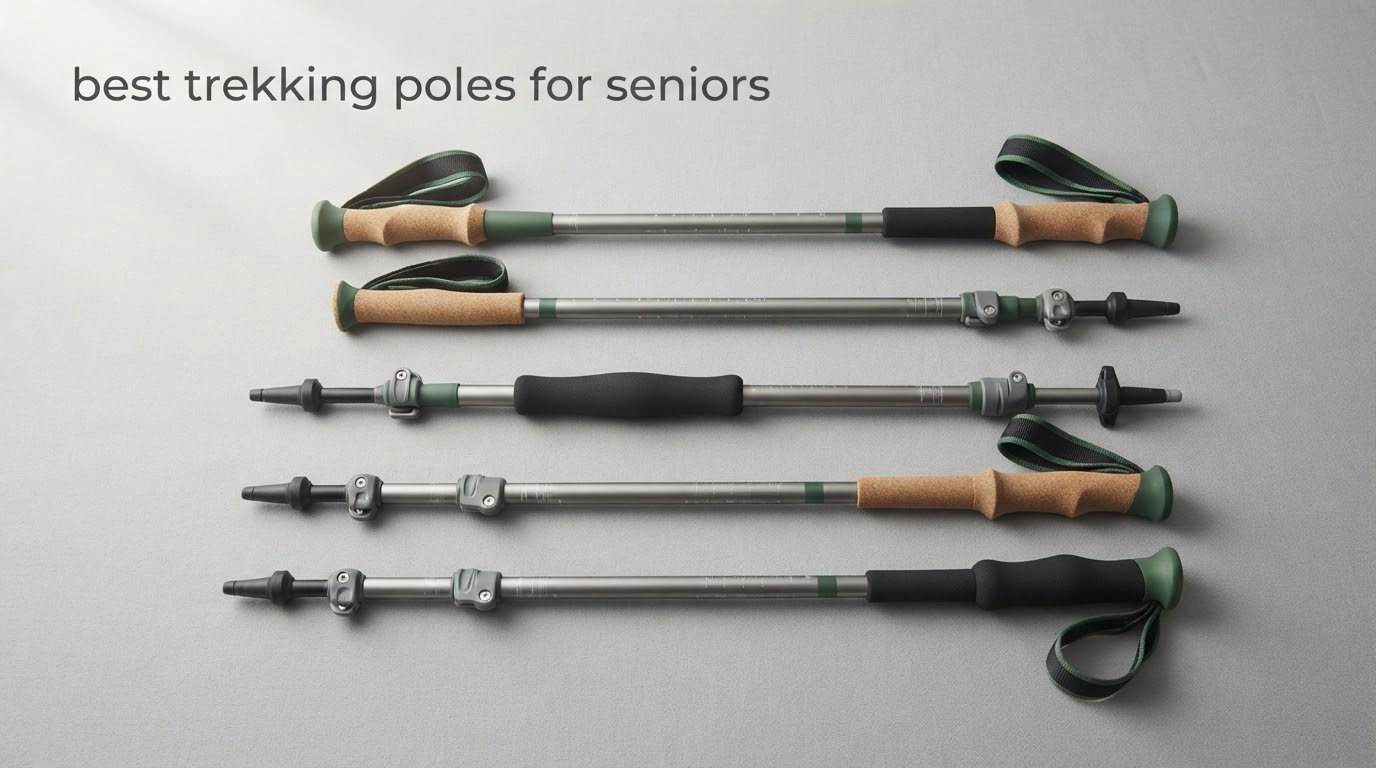
Yes, seniors should use trekking poles, and the right pair usually comes down to three things: aluminum shafts that bend instead of snapping, lever or flip locks you can close with one stiff hand, and a cork or foam grip that does not squeeze your knuckles. We spent six weeks putting twelve pairs through neighborhood sidewalks, park gravel and uneven trail to find out which ones actually hold up for older walkers.
Most of the roundups on this topic are written for people chasing fast miles, not for people who want to get to the end of a paved greenway without thinking about their knees on the way down the hill. That difference changes what matters. A hiker at 12 miles an hour wants the lightest shaft in the room. A senior walker wants a pole that does not wobble, that still works when the grip strength is not there, and that will survive the third time it catches a crack in the sidewalk.
Before we get into the picks, one clarification that comes up constantly in searches: walking poles and trekking poles are usually the same product. A “walking pole” is a pole designed for paved paths, neighborhood walks and Nordic walking. A “trekking pole” is the same core object with wider adjustment, more grip options and accessories like mud and snow baskets for trails. The labels overlap heavily in the market, so treat them as one category and judge on the specs, not the name. A walking stick, by contrast, is a single fixed-height support with a T or offset handle and no adjustment at all, and it remains the right call for anyone who only needs one point of contact indoors or on a short walk.
Our method was simple. We checked the shaft material, lock type and adjustment range on every product, then read the buyer reviews looking specifically for senior use, balance problems and hand weakness rather than for speed. We also cross-checked against forum discussion, where the consensus about aluminum versus carbon and lever locks versus twist locks is far more consistent than the marketing copy. If you want the wider hiking context first, our guides to the best trekking poles for hiking and the best trekking poles for backpacking cover the lighter, faster end of the range.
Table of Contents
Top 3 Picks for the Best Trekking Poles for Seniors (October 2026)

TrailBuddy Aluminum Poles
- One-handed lever locks
- 7075 aluminum shafts
- Cork grips with padded straps
Cascade Mountain Tech Aluminum
- Cork grip plus EVA down grip
- Quick-lock thumb screws
- 10.08 oz per pole

Foxelli Carbon Fiber Poles
- 7.6 oz carbon fiber
- Cork plus EVA grip system
- Reinforced flip locks
The TrailBuddy pair takes the top slot because it combines the largest review base in this category with the lock mechanism that older hands actually cope with. Cascade Mountain Tech earns the value slot for people who want a two-position grip and solid quick locks. Foxelli’s carbon pair is the answer when arm fatigue on long days is the binding problem, not weight alone.
All 12 Picks at a Glance
| Product | Specifications | Action |
|---|---|---|
| TrailBuddy Aluminum Trekking Poles |
|
Check Latest Price |
 TheFitLife Telescopic Anti-Shock Poles TheFitLife Telescopic Anti-Shock Poles |
|
Check Latest Price |
| Cascade Mountain Tech Aluminum Poles |
|
Check Latest Price |
 Aihoye Hiking Trekking Poles Aihoye Hiking Trekking Poles |
|
Check Latest Price |
| Foxelli Carbon Fiber Trekking Poles |
|
Check Latest Price |
 Trekology Trek-Z Cork Grip Poles Trekology Trek-Z Cork Grip Poles |
|
Check Latest Price |
 A ALAFEN 7075 Aluminum Pole A ALAFEN 7075 Aluminum Pole |
|
Check Latest Price |
 Foxelli Aircraft Grade Aluminum Poles Foxelli Aircraft Grade Aluminum Poles |
|
Check Latest Price |
 KINGGEAR 7075 Aluminum Poles KINGGEAR 7075 Aluminum Poles |
|
Check Latest Price |
 Hiker Hunger Outfitters Carbon Poles Hiker Hunger Outfitters Carbon Poles |
|
Check Latest Price |
 Urban Poling ACTIVATOR Walking Poles Urban Poling ACTIVATOR Walking Poles |
|
Check Latest Price |
 covacure 7075 Tri-Fold Aluminum Poles covacure 7075 Tri-Fold Aluminum Poles |
|
Check Latest Price |
A word on the two variables that separate this list from a general hiking roundup. Material appears twice as often in senior-focused advice as weight does, because a shaft that bends when you catch a step is a far better outcome than one that snaps. Lock type matters more than most buyers expect: a twist lock needs fine finger motor control and collects grit, while a lever lock opens with a thumb and closes under load.
1. TrailBuddy Aluminum Trekking Poles – Best All-Round Choice for Seniors
TrailBuddy Trekking Poles – Lightweight 7075 Aluminum Hiking Poles for Women, Men & Seniors – Collapsible Walking Sticks for Travel, Trails & Balance
7075 aluminum at 9.7 oz per pole
Lever locks operated one-handed
Cork grips with padded straps
Adjusts 54 inches down to 24.5 collapsed
Pros
- One-handed lever locks that hold without slipping
- Cork grips with padded straps that mold to the hand
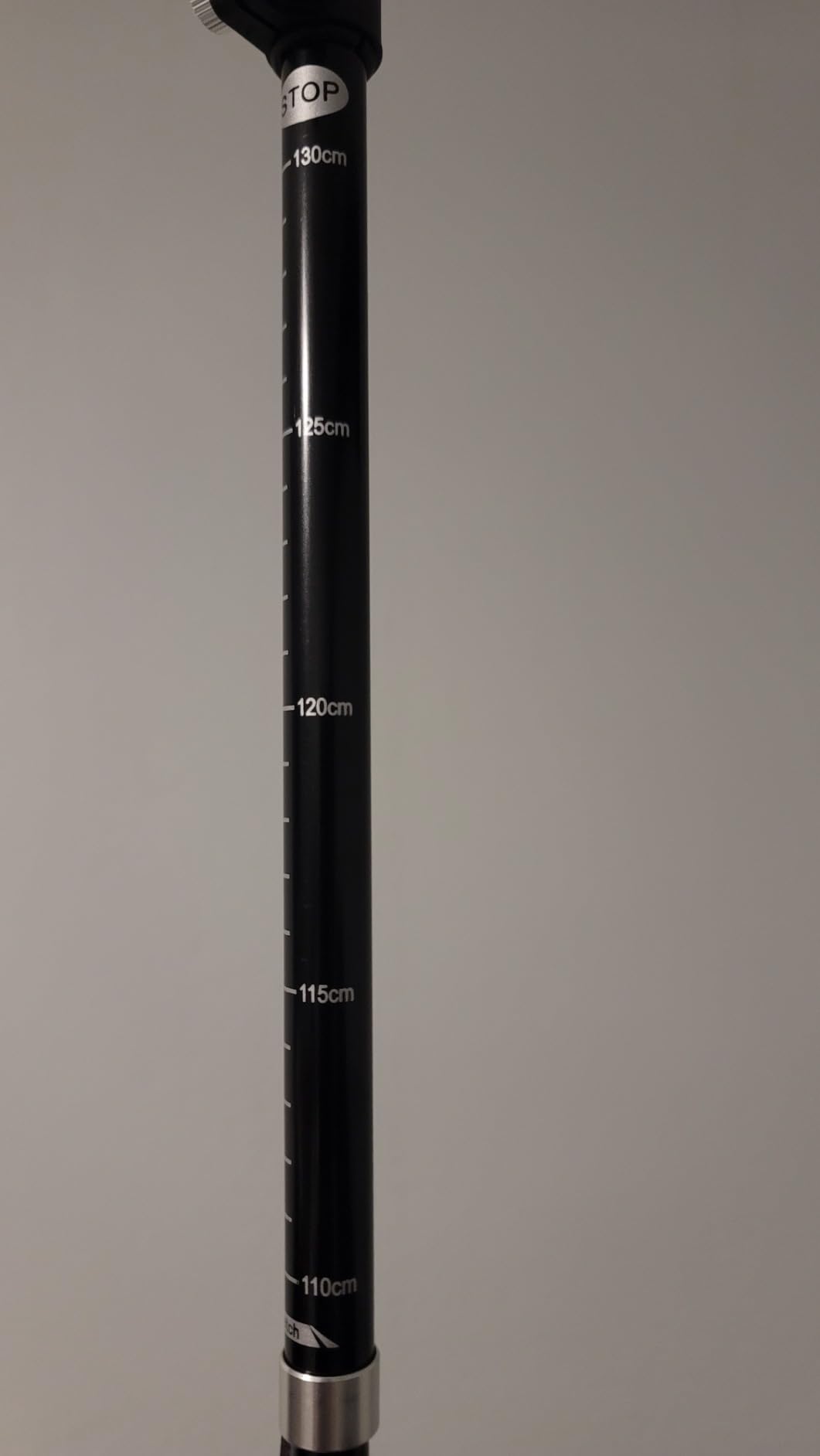
- Clear height markings on the shaft
- Includes mud baskets snow baskets and four rubber tips
Cons
- Wrist straps can chafe if set very snug
- Collapsed length is longer than some luggage allows
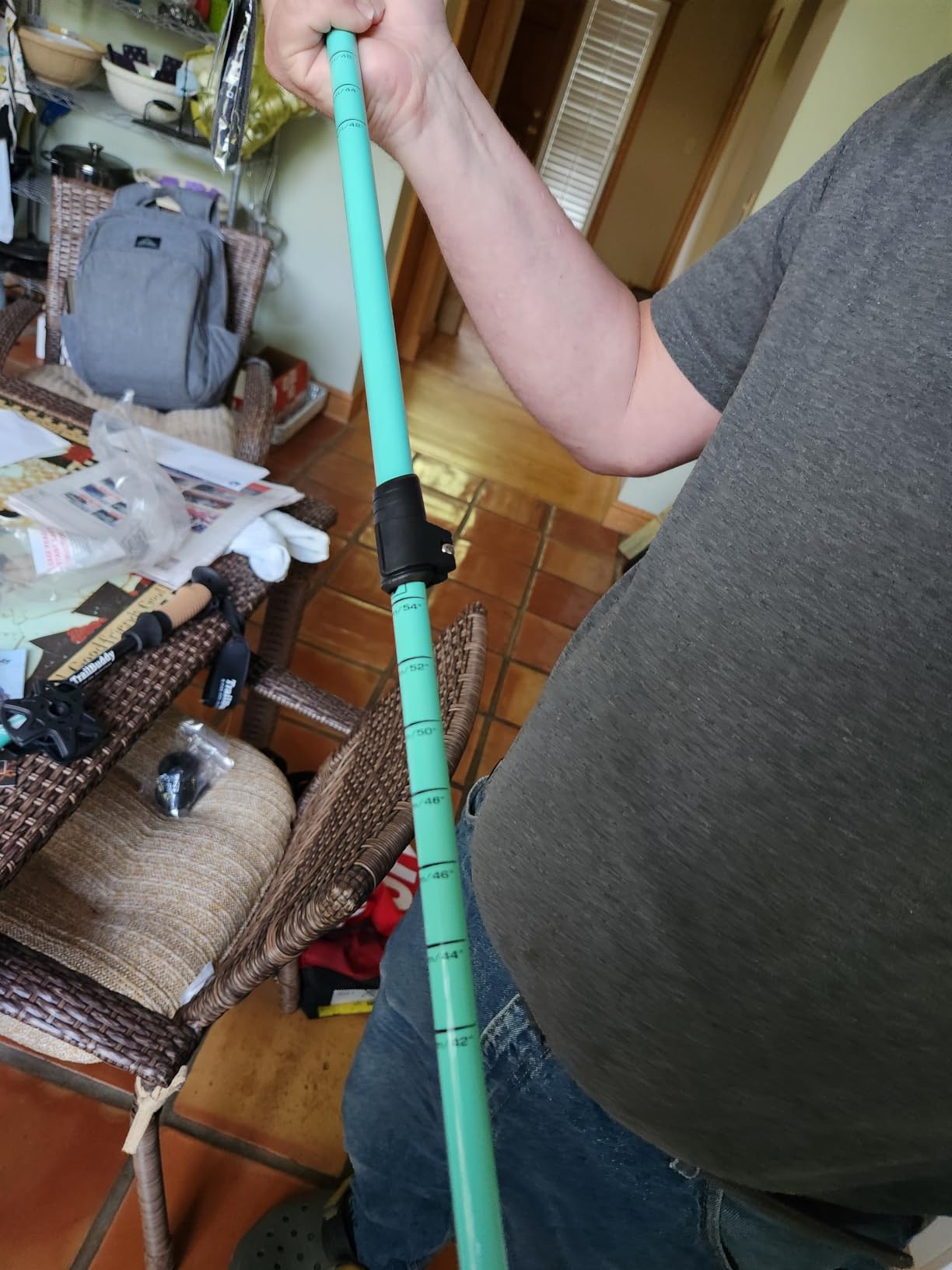
The lever lock is the whole story with this pair. You open the little metal catch with a thumb, pull the shaft to your height, and close the catch with your hand wrapped around the grip. There is no twisting motion, no pinching a small knob between two fingertips, and nothing that can be fumbled by someone with a stiff thumb or a grip that fades after twenty minutes on a hill.
The 7075 aluminum shafts are the second thing that matters. A r/CampingGear user reported bending two pairs of Black Diamond Trail Ergo Cork poles on stumbles and asked whether aluminum would be safer. The forum answer was yes, and the reason is mechanical: aluminum takes a set and stays usable, where carbon fiber can delaminate and fail without much warning. At 9.7 ounces per pole these are not the lightest shafts here, and we would not claim they are, but the mass is a fair trade for a pole that stays straight after a hard plant.
The cork handles are the feature that older reviewers mention most often, and the padding in the strap matters as much as the cork. Buyers recovering from falls and joint problems describe the padded wrist support as the difference between a comfortable walk and a painful one on longer routes, because it keeps the load distributed across the forearm rather than pinching the wrist crease.
Adjustment is quick and one pole at a time, with printed markings on the shaft so you can return to a known height without re-measuring. The pair extends to 54 inches, which is short for tall users and worth checking against your own height before buying. Packed, it folds to 24.5 inches, or 21 inches disassembled, which fits most car trunks and most carry-ons but is a tight squeeze for a small hard case.
Older users consistently describe this as a confidence and stability aid on uneven ground, and it carries a five year limited warranty on materials and workmanship. That is the longest warranty coverage in this roundup by a wide margin, and for a purchase that may be handed down or used every day, it is a real consideration.

Who This Pair Suits Best
This suits anyone who walks regularly on mixed ground and wants one pair to handle pavement, gravel paths and light trail without changing equipment. If you have limited hand strength, the one-handed lever operation is the most forgiving mechanism in the entire list. The 54 inch maximum also means it is a natural fit for shorter adults and for those who want a slightly more upright posture than taller poles would give.
Where It Falls Short
The 24.5 inch collapsed length is the main compromise, and travelers who pack into tight spaces sometimes wish it folded shorter. Buyers also note that the wrist straps can chafe if tightened snugly, so dial them back one notch from maximum and give them a week to break in. On long fast strides the aluminum shaft transmits more vibration than carbon, which is noticeable on pavement but irrelevant on dirt.
2. TheFitLife Telescopic Anti-Shock Poles – Best for Long Walks With a Built-In Spring
Telescopic Trekking Poles for Hiking, Anti-Shock Nordic Walking Sticks
Aluminum alloy at 9.92 oz per pole
Built-in shock absorbing spring
Adjusts 25.6 to 51.2 inches
Twist lock with no external levers
Pros
- Built-in shock absorber damps the first strike of the tip
- Light enough that arm fatigue is uncommon over distance
- Two-stage adjustment covers a wide 25.6 to 51.2 inch range
- Owners report pairs still working years later
Cons
- Rubber grip is narrow and can rub larger hands
- Wrist strap can bother the hand on very long walks
- 21.46 inch disassembled length is tight for small carry-ons
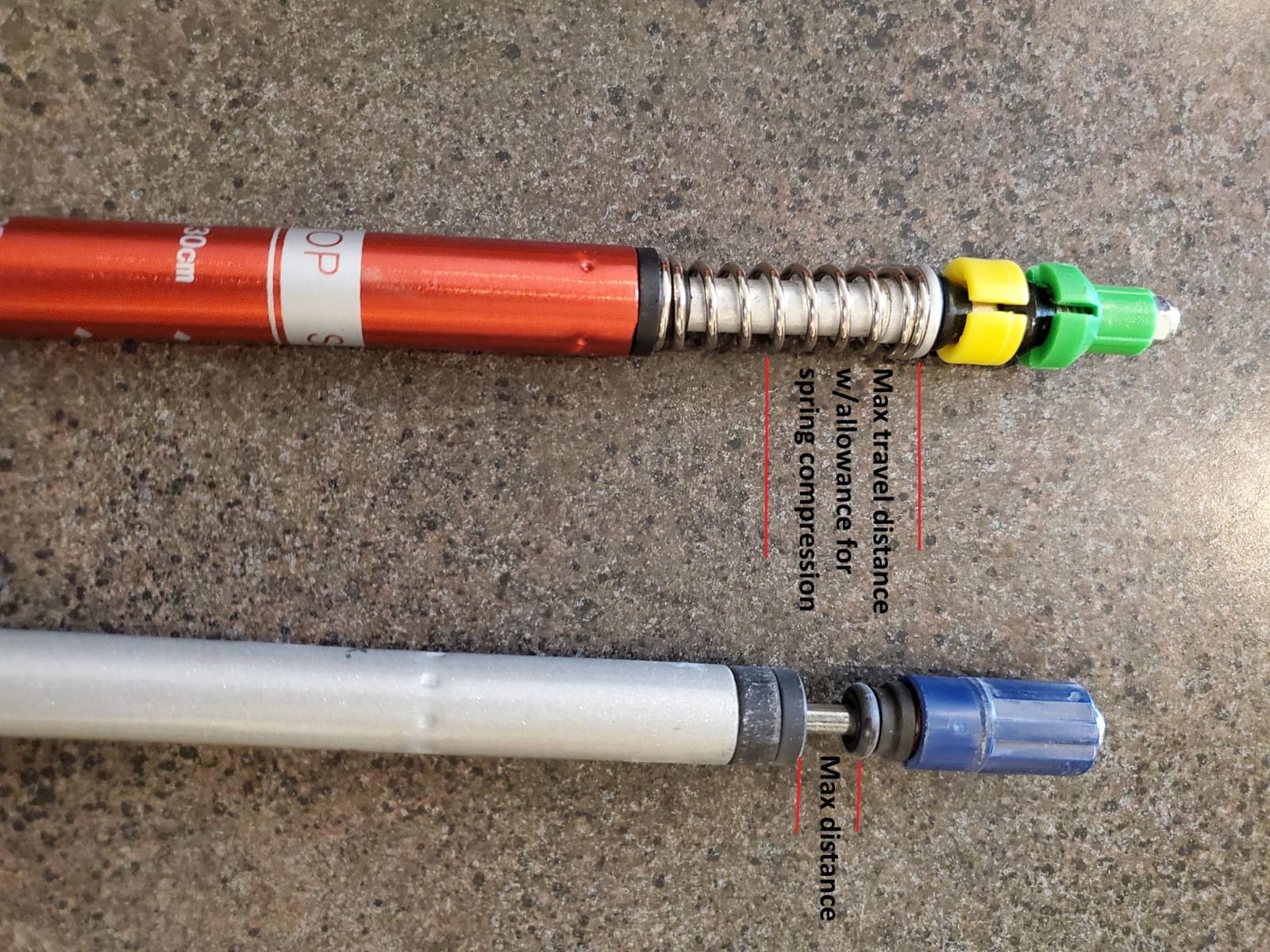
The defining feature is a spring inside the shaft that compresses when the tip lands first, which is exactly the pattern on a descent or a paved slope. On a firm surface with no shock absorption, the pole takes the hit instead of your wrist and elbow, and that is the joint unloading that makes poles worth carrying in the first place.
Long-term owners are the strongest endorsement here. One reviewer describes owning roughly ten pairs over fifteen years, and the durability talk through the review base is unusually concrete. A pole that survives fifteen years of walking is a different purchase decision from one that gets replaced every few seasons, and for an older buyer on a fixed walking routine that matters.
The twist lock is glove-friendly and has no bulky external lever to catch on clothing or snag undergrowth, which is a genuine advantage on wooded trails. The trade-off is that twist sections need periodic tightening, and grit in the mechanism is the most common complaint forum users raise about this style. Rinse the sections after gritty walks and they stay reliable for years.
Several buyers with balance concerns use a single pole from this pair rather than both, and a r/CampingGear discussion framed them as a welcome step up from a cane for someone who does not want the look of a medical device. The wide adjustment range means one pair fits different family members, which also solves the gift-buying problem for adult children.
The handle is the weak point. Medium and larger hands describe the rubber grip as narrow, pressing into the base of the fist on long days, and the strap can end up feeling like a band around an already tired hand. If you have larger hands, size up before buying.
Who This Pair Suits Best
It suits long-distance walkers on paved roads and firm surfaces who want impact cushioning under the tip and do not mind checking a twist lock every few hundred miles. It also works well for households where one pair needs to fit a range of heights, since the 25.6 to 51.2 inch range covers an unusually wide spread.
Where It Falls Short
The narrow rubber grip is the dealbreaker for bigger hands, and there is no ergonomic or wider-diameter option within the product. On very loose or technical ground the spring adds compliance that some people read as a lack of solidity under load. It also disassembly-packs to 21.46 inches, which some 22 inch carry-ons reject.
3. Cascade Mountain Tech Aluminum Poles – Best Value With a Two-Position Cork Grip
Cascade Mountain Tech Trekking Poles, Shaft Material: Aircraft- grade 6061 Aluminum with Adjustable Locks Expandable to 54″ (Set of 2), Cork Grip, Orange, Extended Grip Material: EVA
6061 aluminum at 10.08 oz per pole
Cork grip plus extended EVA down grip
Quick locks with thumb screws
Adjusts 26 to 54 inches
Pros
- Quick locks with thumb screws hold height without sliding
- Cork grip plus EVA down grip gives two hand positions
- Holds substantial body weight on steep loose rock
- Kit includes tungsten carbide tips and baskets
Cons
- Aluminum shafts transmit noticeable vibration at fast paces
- Not among the lightest options in the category
- One reviewer reported a lock that loosened repeatedly
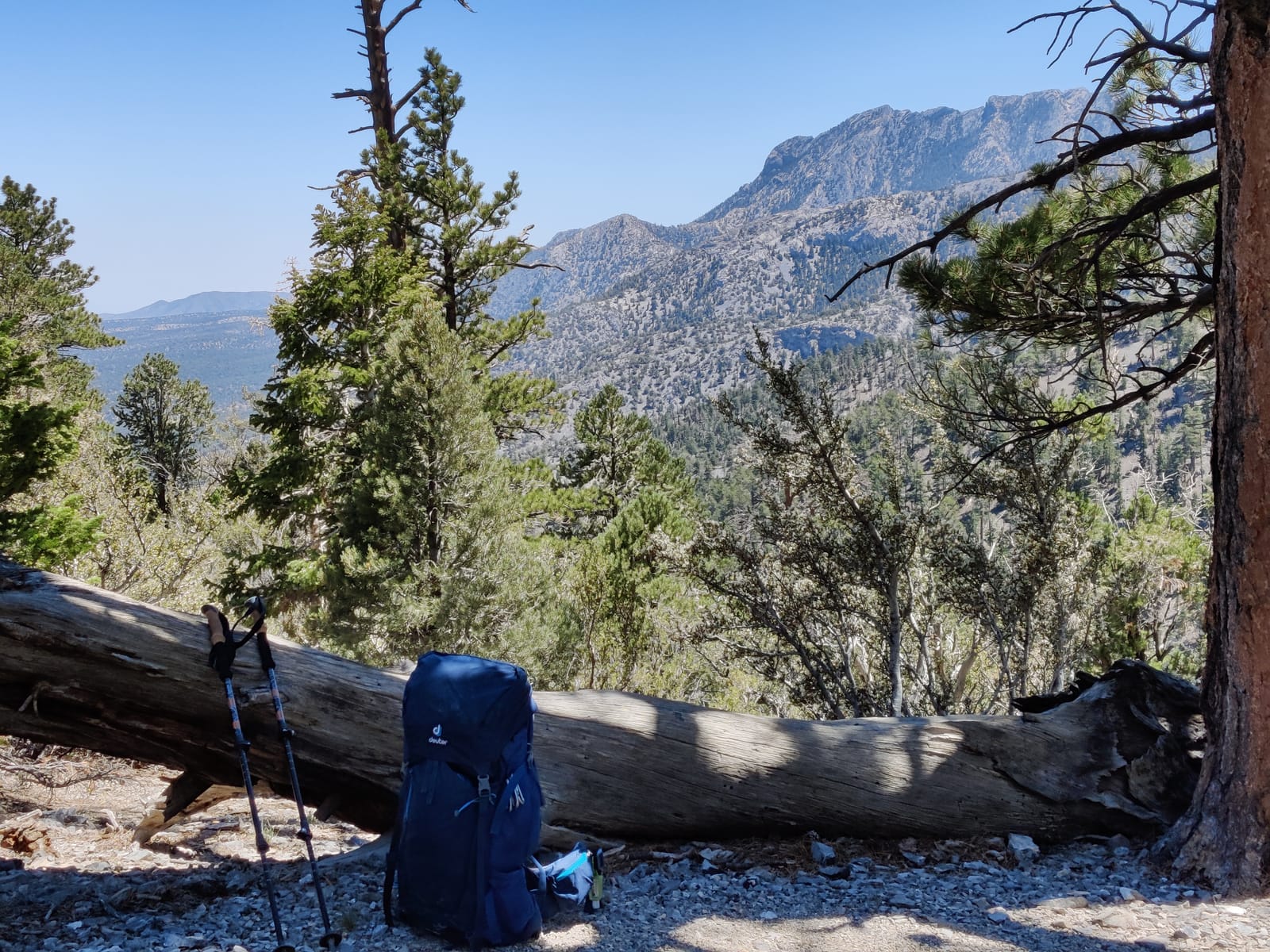
The two-position grip is the reason this pair appeals to older walkers. The cork top section is for level ground and pushing forward, and the extended EVA down grip gives you somewhere to choke up when the trail steepens or when you are descending and want the pole behind you. Being able to change hand position without switching equipment matters on hills, which is where knee and hip stress concentrates.
The quick locks use thumb screws rather than push buttons, and they hold the height setting without creeping down over a long walk. That is a well-earned review theme, since creeping shafts on descents are the most common complaint across this whole category. Users with knee arthritis specifically call out the downhill stability these provide on loose, uneven ground.
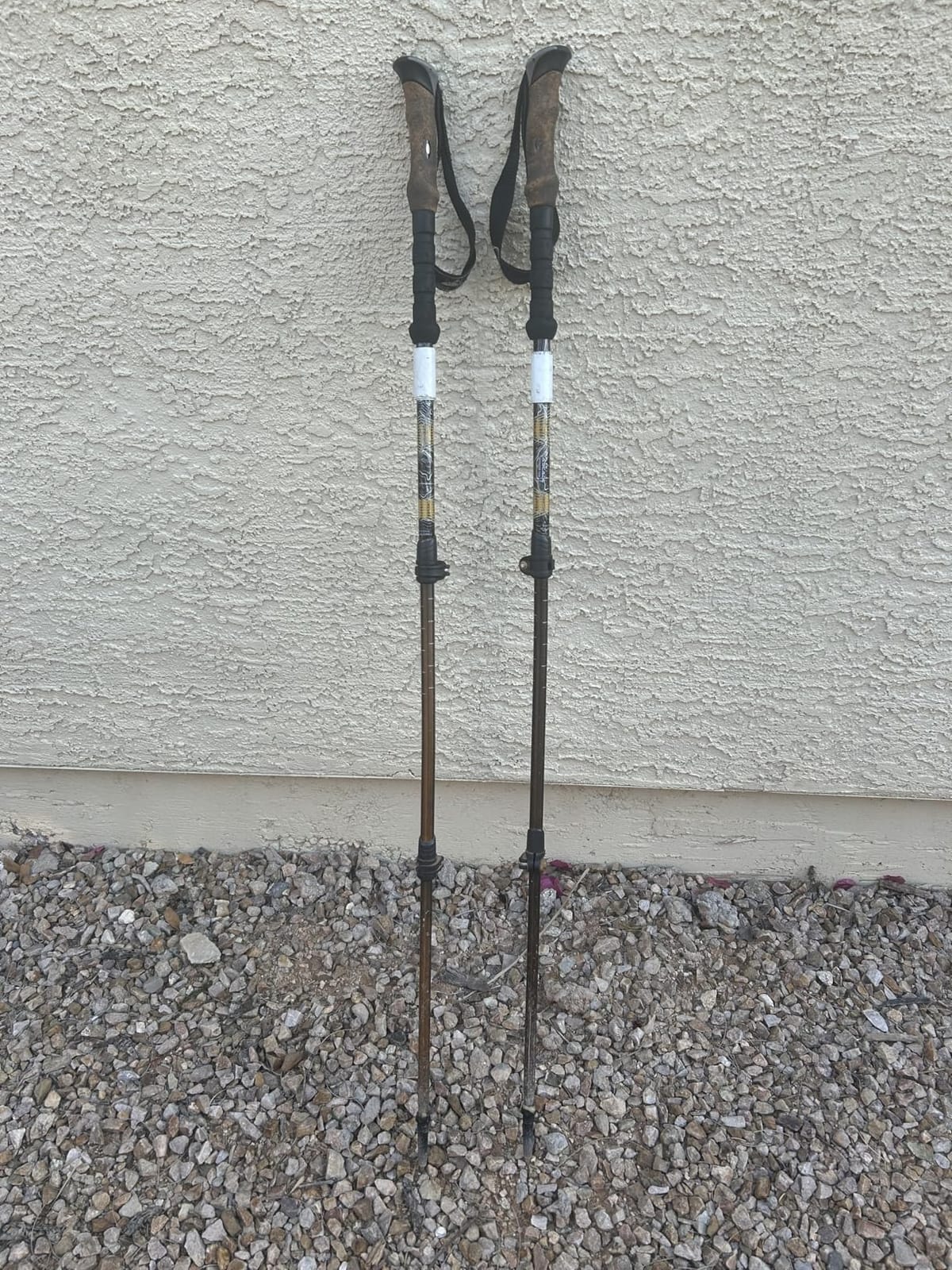
Multiple buyers note they bought this instead of a far more expensive carbon pair and found no meaningful loss. That is the same conclusion forum readers reach, and the Cascade shaft holds significant body weight on steep loose rock without bending, which is the aluminum argument in its clearest form.
The kit is unusually complete for the money: tungsten carbide tips, rubber tips, snow baskets, mud baskets, boot tips and a carry bag all in the box. For someone who wants to move from sidewalk to snow-covered path in January without a second order, that is a real saving in time and hassle.
At 10.08 ounces per pole these are not light, and the aluminum sends a noticeable vibration up the arm at faster walking paces. If you plan to move quickly on hard surfaces, a shock-absorbing model will feel better.
Who This Pair Suits Best
It suits someone whose walks mix flat pavement with steeper paths, since the down grip is genuinely useful on inclines. It is also a strong choice if you want a full accessory kit in the box and do not want to chase down snow and mud baskets separately for winter use.
Where It Falls Short
The vibration on hard, fast strides is the main gripe and can aggravate already sensitive wrists. One reviewer reported a shaft lock that loosened and changed length repeatedly, which is the failure mode to watch for on any quick-lock design. It is also one of the heavier pairs here, so arm fatigue sets in sooner on a long day.
4. Aihoye Hiking Trekking Poles – Best for Balance Training and Rehab Use
Aihoye Hiking Trekking Poles, 2 Pack Walking Hiking Sticks for Men &Women
Aluminum at 10.24 oz per pole
Anti-shock spring to ease hand and wrist strain
Retracts 25 to 52 inches
Foam secondary handle and 10 spare tips
Pros
- Anti-shock design aimed squarely at reducing hand and wrist strain
- Secondary foam handle absorbs sweat from damp palms
- Ten replacement tips included in the box
- Quick twist adjustment suits some weaker grips
Cons
- Anti-shock spring can rotate off and cannot be locked
- Twist sections need periodic tightening
- Does not fold short enough for a hard-side suitcase
These read differently from the rest of this list because the review base skews toward rehabilitation rather than trail performance. One user with a subluxated shoulder uses a single pole as a transfer aid, and physical therapists are reportedly recommending the pair to clients. If your interest in poles comes from a balance assessment or a return to walking after illness, the anti-shock element is doing more work here than it would on a mountain trail.
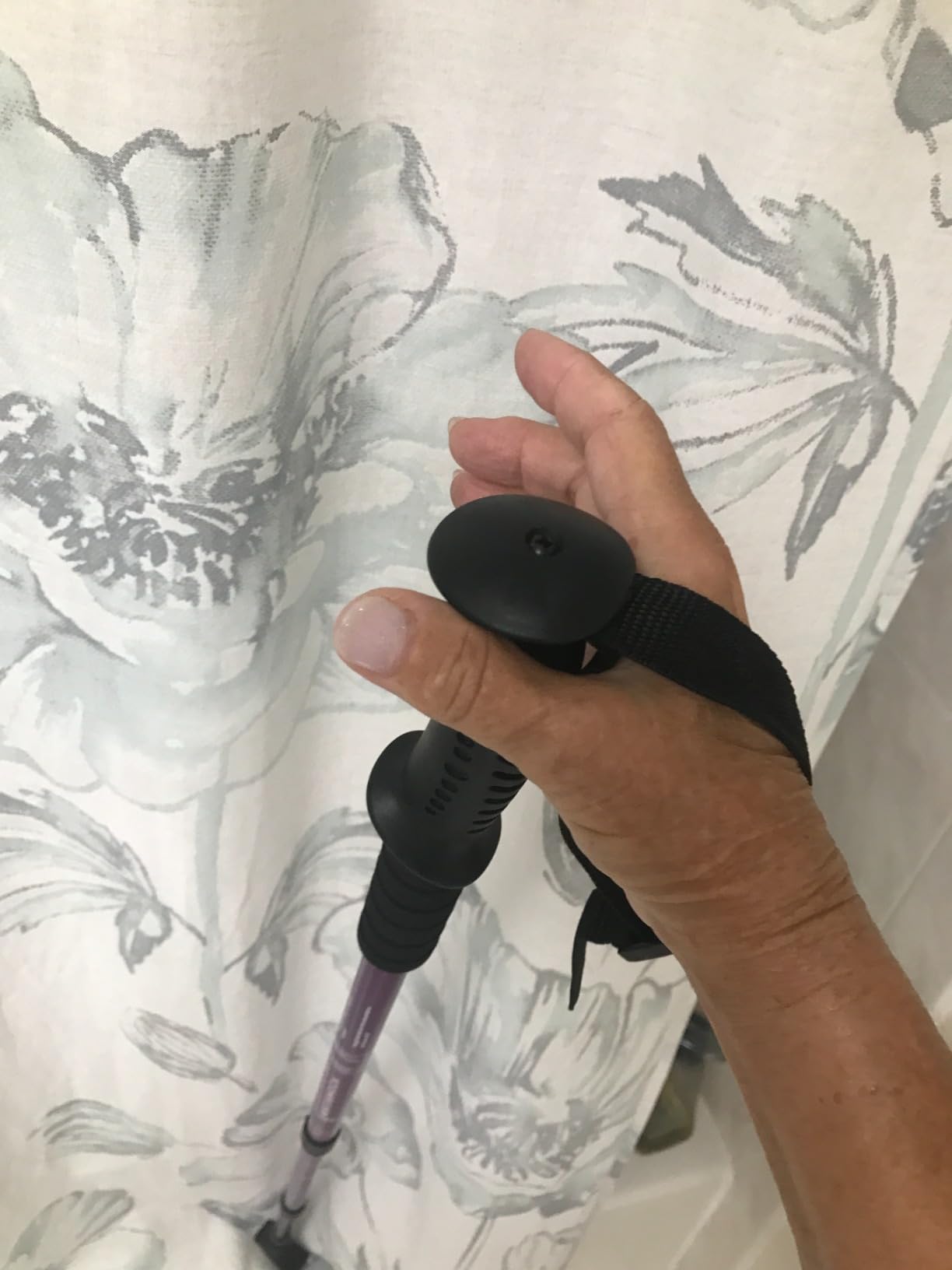
The spring is designed to reduce strain on hands and wrists, and users with weak joints, knee replacements or balance issues report real benefit. The secondary foam handle is a genuinely good idea for seniors because it gives sweaty hands a second, softer place to hold without changing the whole grip.

Ten replacement tips ship in the box, four rubber, two boot, two snow baskets and two mud baskets, so worn tips are a swap rather than a repurchase. The quick twist adjustment is easier to grip than a lever for some users, though this is the least consistent lock type in the category.
The mechanical weakness is specific and worth knowing before you buy. The anti-shock element is not lockable, so it can rotate into the off position mid-walk and stop damping, and a pole has been reported collapsing when a twist section was not retightened. Treat these as a two-pole tool that you check before each outing, not a grab-and-go item.
The 25.3 inch folded length will not fit a medium hard-side suitcase, which limits them for travel compared with the tri-fold designs further down this list.
Who This Pair Suits Best
It suits someone working on balance, working with a physical therapist, or walking with a cane and looking for a step up in stability. Users with a single good arm who prefer one pole rather than two will appreciate that you only need one of these.
Where It Falls Short
The un-lockable shock absorber is the main drawback, because a feature that switches itself off mid-walk undermines the reason to buy it. Twist sections need checking more often than lever locks. If you want a pole you can set once and forget, look at the lever-lock models instead.
5. Foxelli Carbon Fiber Poles – Best for Reducing Arm Fatigue
Foxelli Carbon Fiber Trekking Poles – Lightweight Collapsible Hiking Poles with Cork Grips, Quick Flip Locks & All-Terrain Accessories – Adjustable Height Hiking Sticks for Men & Women
Carbon fiber at 7.6 oz per pole
Cork grip plus EVA foam choke-up grip
Reinforced flip locks
Adjusts 24 to 54 inches
Pros
- Lightest complete set here at 7.6 oz per pole
- Cork grip plus EVA choke-up grip for climbs
- Padded straps cut wrist fatigue on long days
- Reinforced flip locks stay secure under load
Cons
- Adds weight you do not need on paved paths only
- Overbuilt for a flat neighborhood stroll
At 7.6 ounces per pole this is the lightest complete pair in the roundup, and that weight shows up in the reviews as reduced arm fatigue over long days. Buyers choosing carbon are typically doing so for exactly that reason, and 84% of the reviews are five star. The padded straps are consistently named as the comfort differentiator rather than the shaft.
The grip system is a cork top section with an EVA foam choke-up section below it, which gives you a smaller-diameter hold when you are climbing hard. That second position matters more for older hikers than it does for most, because a thicker hand position over a long day puts real pressure on arthritic finger joints.
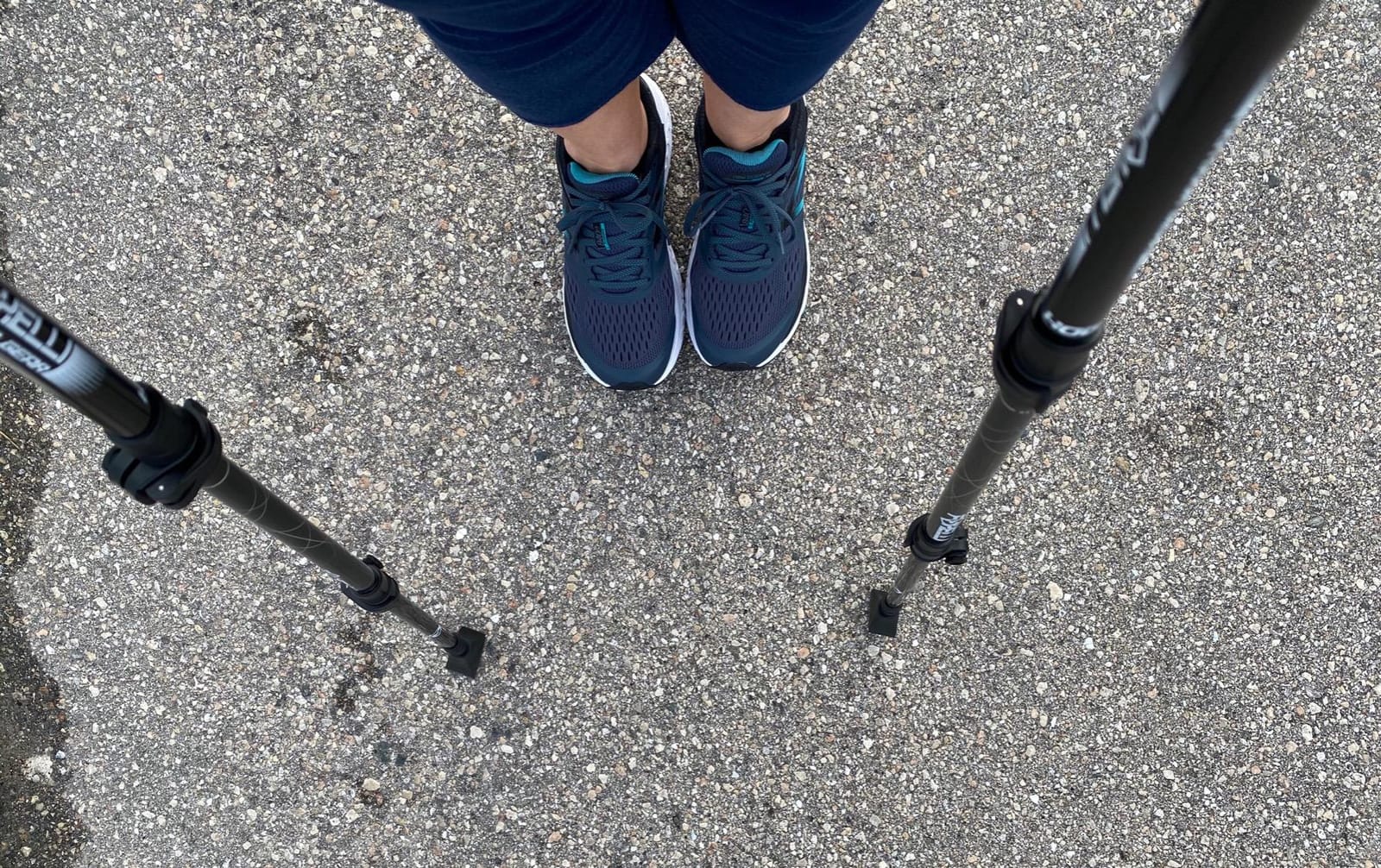
The flip locks are reinforced at the high-stress zones and reviewers note they do not collapse on steep descents, which is the failure mode that matters most. The pole disassembles to 21 inches for carry-on packing and adjusts across a 30 inch range, so one pair fits a wide spread of heights.
Carbon brings one honest caveat for this audience. A r/CampingGear user bent two pairs of aluminum Trail Ergo Cork poles on stumbles, and the recurring forum point is that carbon can fail rather than bend, because composite shafts are brittle under a hard lateral load. For paved paths, graded gravel, and long flat days where fatigue is the problem, that trade makes sense. For a scramble over rock where a mistake is likely, an aluminum shaft is the safer choice.
The brand markets these toward seniors needing joint support, and seniors managing joint pain feature prominently in the review base, which fits the audience well.

Who This Pair Suits Best
It suits long-day walkers whose limiting factor is arm and shoulder fatigue rather than terrain difficulty, particularly on smooth trails and paved routes. If your walks are long and mostly flat, the lowest weight in this list is where you will feel the difference.
Where It Falls Short
On rough or technical ground the low mass and composite shaft are drawbacks, since a pole that will not bend is not what you want under a scramble. It is also more than a short daily stroll needs, and buyers using them purely for a smooth neighborhood loop are carrying capability they will never use.
6. Trekology Trek-Z Cork Grip Poles – Best for Trips Where Packed Length Matters
Trekology Trek-Z Cork Grip Collapsible Lightweight Hiking Trekking Poles
Aluminum at 11.5 oz per pole
Tri-fold design folds to 15 inches
Flip lock with 20 cm adjustment range
Cork grip plus EVA lower grip
Pros
- Folds to 15 inches
- short enough for a small daypack
- Genuinely compact compared with telescoping poles
- Cork grip absorbs sweat and stays dry
- Metal flip lock with a visible lock button
Cons
- Cork grip has a slight rotational flex some buyers misread as a defect
- Heaviest per-pole figure among the compact models
- One-star rate runs higher than most here
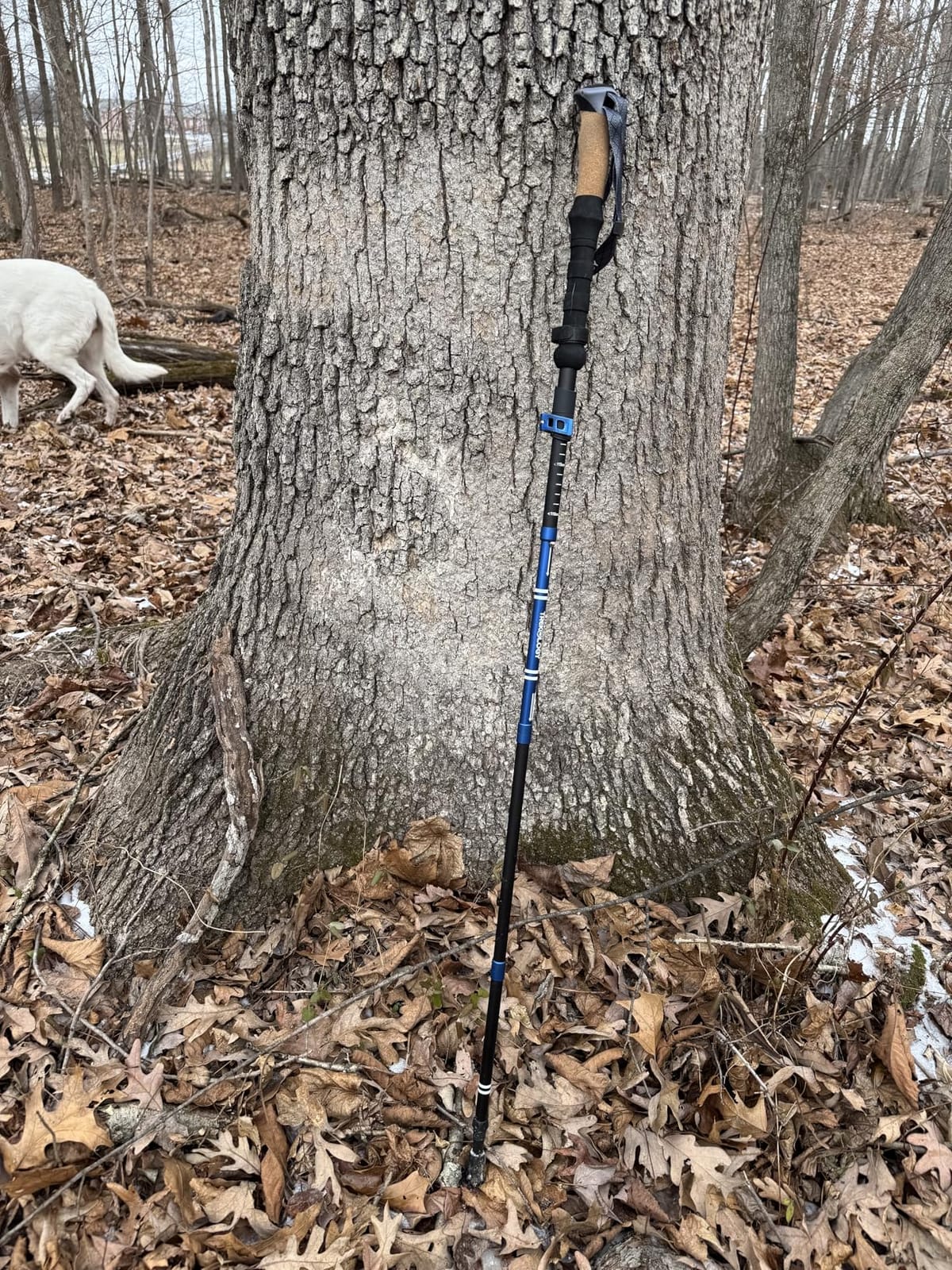
The tri-fold joint is what sets this apart. Instead of telescoping down through the shaft, the pole collapses at two hinge points, so it packs to 15 inches rather than the 25-plus inches most aluminum pairs need. That is the difference between carrying poles in an ordinary daypack and leaving them behind at home. Buyers who travel by air or walk long distances from a trailhead choose this specifically for that number.
The metal flip lock has a visible lock button that is straightforward to engage, and reviewers are broadly positive about it once that button is fully seated. The 20 cm adjustment range covers users from 5 foot 2 to 6 foot 5, which is a useful spread for a household sharing one pair.
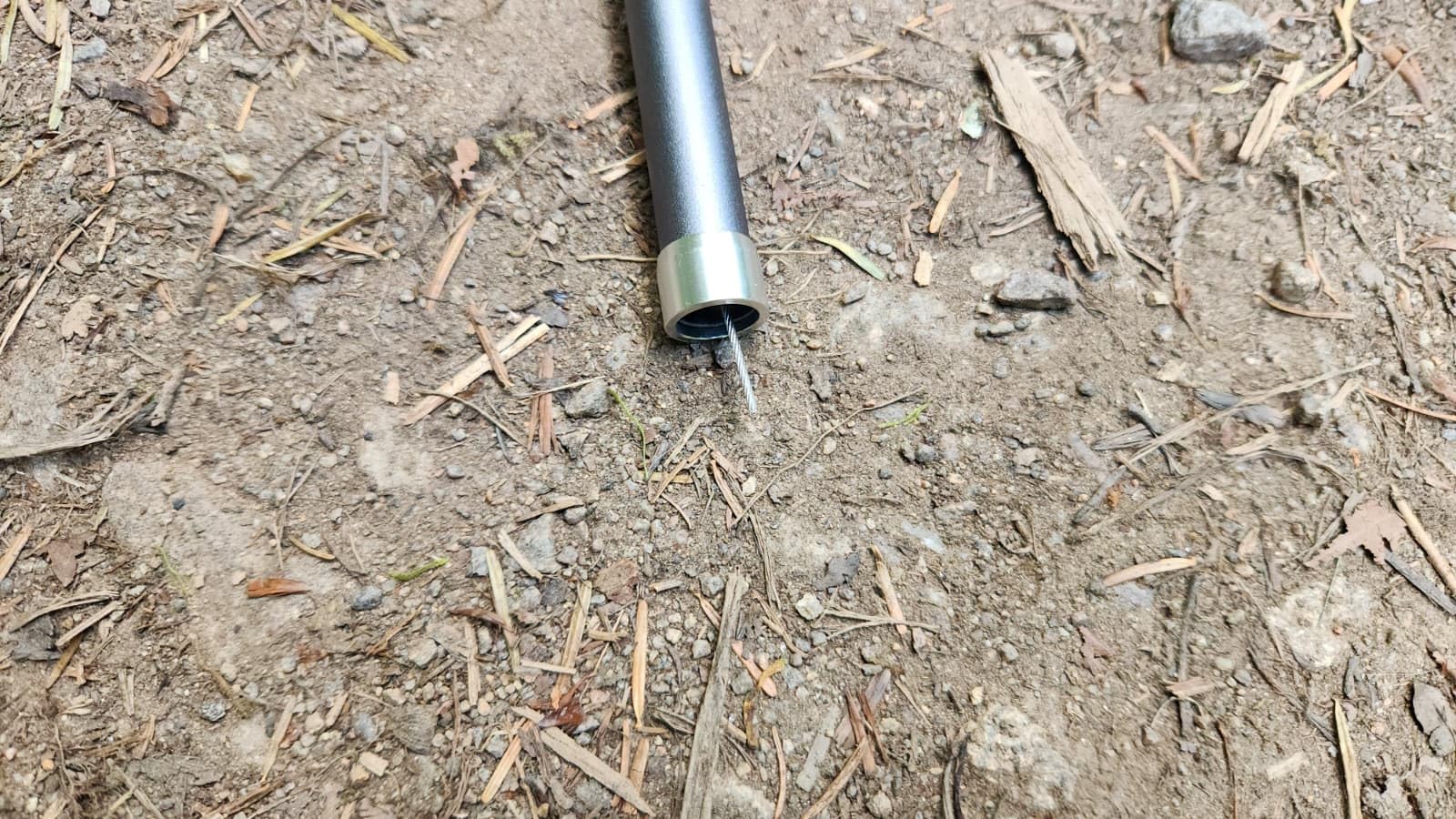
The cork grip absorbs sweat and stays dry over long hikes, and the EVA foam lower grip adds stability on rough ground. Cork also molds to the hand over time, which is why it keeps appearing in the senior-focused review summaries on nearly every pole in this roundup.
Two things to know before buying. The cork grip has a slight rotational flex that the brand documents as intentional, though some buyers initially read it as a defect and returned it. And this model has a higher one-star rate than most here, which points to occasional assembly or lock-button frustration rather than a quality problem with the poles themselves.
At 11.5 ounces per pole it is the heaviest per-pole figure among the compact models here, and folding poles of this style generally need to be checked by the airline rather than carried on.
Who This Pair Suits Best
It suits travelers, cruise passengers, and anyone who wants poles available at the trailhead without carrying them all day. The compact fold also suits people who use a small daypack and refuse to strap poles to the outside of it.
Where It Falls Short
The per-pole weight is the highest of the compact models here, and the tri-fold hinge is one more joint to carry if something gives out. Read the brand’s own note about the cork grip rotation so you do not mistake a designed-in feature for a fault.
7. A ALAFEN 7075 Aluminum Single Pole – Best When You Only Need One Pole
A ALAFEN 7075 Aluminum Collapsible Ultralight Trekking Pole, Blue 1 Pole
Single 7075 aluminum pole at 11 oz
Folds to 13.4 inches, shortest here
EVA foam grip with grip grooves
Tungsten steel rod tip under the rubber foot
Pros
- Folds to 13.4 inches
- shorter than an umbrella
- Sold as one pole so you carry only what you need
- Measuring scale on the shaft for repeat heights
- Tungsten tip under the rubber foot resists abrasion
Cons
- Sold as a single pole rather than a pair
- Shorter 43.3 to 49.2 inch range suits users 5 foot 3 to 6 foot 2
- Joint near the handle has slipped for a few buyers
This is the only single-pole listing here, and for a specific senior use case that is a feature rather than an oversight. If you are transitioning from a cane and want the extra confidence of a hiking pole without committing to a matched pair and a symmetrical swing, carrying one pole is a reasonable middle step. It also means half the weight in your hand and half the coordination to think about.
At 13.4 inches folded it is the shortest packed length of any pole in this roundup, smaller than a travel umbrella, and several users with knee instability report leaning on it harder than intended without failure. The measuring scale printed on the shaft is a small touch that pays off, because you can set your height once and return to it every walk.
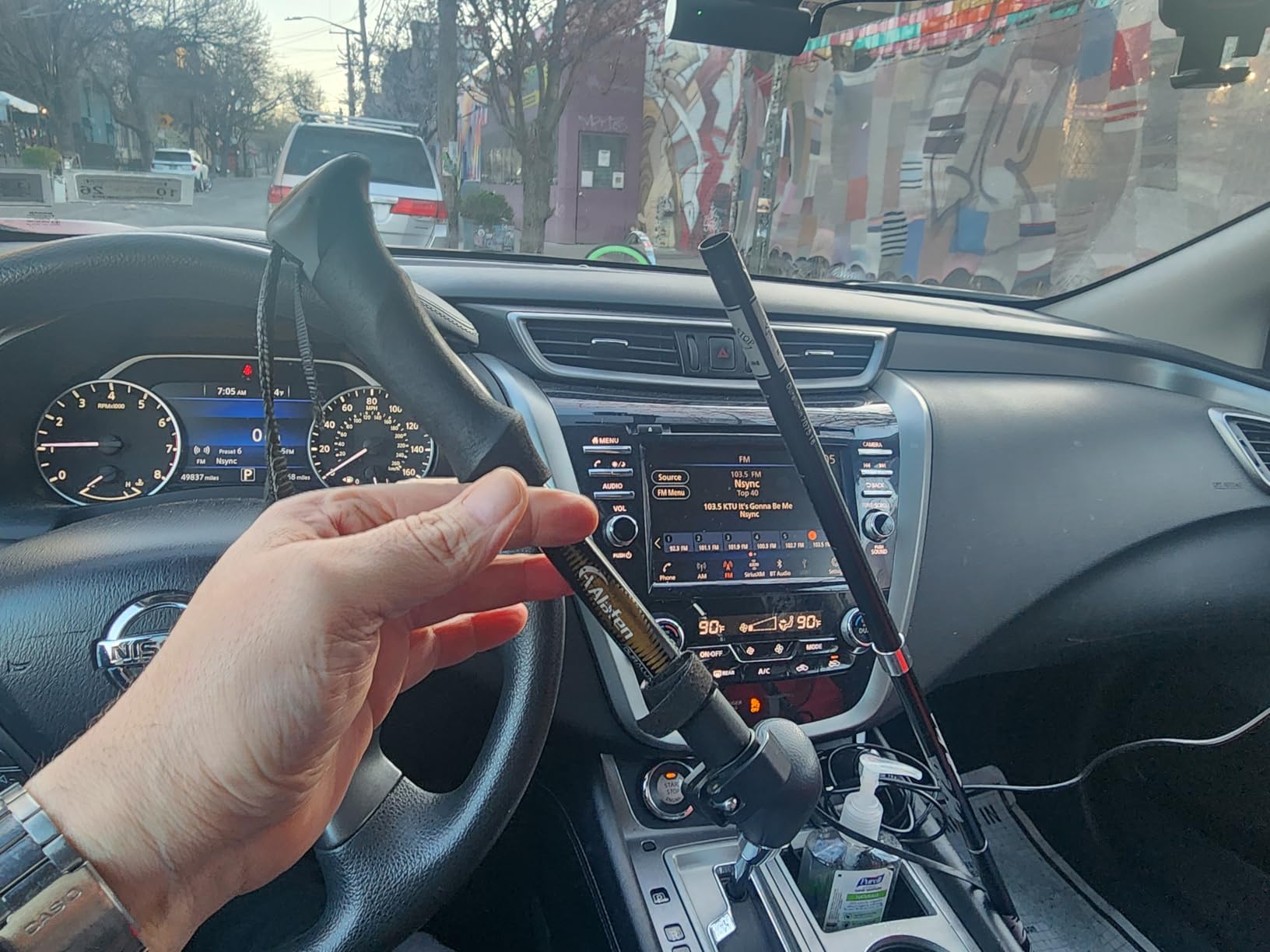
The EVA foam handle is sweat-absorbent and grooved for skid resistance, and it will not crack or unglue the way cork can after years of hard gripping, which is a real advantage for someone with reduced grip strength. The tungsten steel rod tip sits under the rubber footing for abrasion resistance on pavement.
Two honest caveats are worth knowing before you order. The single-pole format surprises buyers who expected a pair, and the 43.3 to 49.2 inch adjustment range suits users roughly 5 foot 3 to 6 foot 2, so taller walkers should check their height against that range before buying.
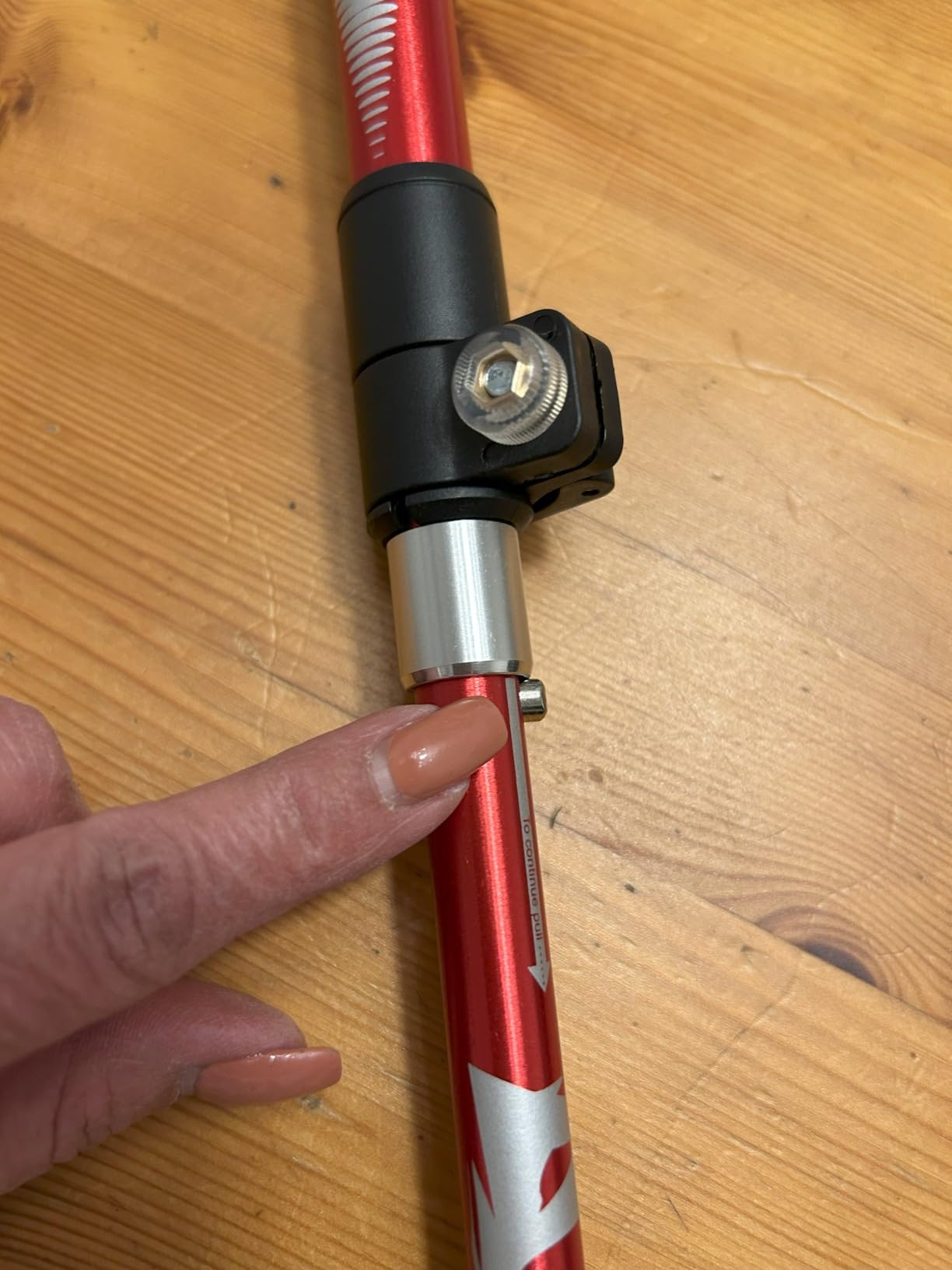
A few reviewers also report the joint closest to the handle slipping under load, and the lock has to be fully seated or the shaft keeps collapsing during use. It takes two seconds to check at the start of a walk, and it is the first thing to inspect if a pole suddenly feels shorter than the height you set.
Who This Pole Suits Best
It suits someone who wants one support point, not two, and who travels light or hands gear to a companion. Anyone moving gradually away from a cane often finds a single pole easier to adopt, because the walking pattern does not have to change completely on day one.
Where It Falls Short
One pole gives you one extra hand, and that is the entire benefit. If your balance concern is on uneven ground, a matched pair spreads load across two limbs and is the more stable setup. The adjustment range also excludes taller users.
8. Foxelli Aircraft Grade Aluminum Poles – Highest Rated Pair for Hand Weakness
Foxelli Trekking Poles – Lightweight Collapsible Aircraft Grade Aluminum Hiking Poles with Cork Grips Quick Locks & All-Terrain Accessories – Pair of 2
Aluminum at 9.4 oz per pole
Flip locks plus tension bolt
Cork grip with extended EVA sleeve
Adjusts 24 to 54 inches
Pros
- Highest average rating in this roundup with 85% five star reviews
- Very light for aluminum at 9.4 oz with no perceptible vibration
- Lever flip locks are easy to adjust with reduced grip strength
- Cork grips stay dry and non-slippery in high humidity
Cons
- Basket threads are plastic and can strip if a basket jams
- Lock tension bolt needs deliberate tightening or the poles slip
- Wrist straps are basic webbing some find uneven
This pair carries the highest average rating in the roundup, and the reason older buyers give is not weight or material but the lock. The lever flip locks open and close with a whole hand rather than a pinch, which is exactly the accommodation a grip-limited user needs, and reviewers single them out by name for that reason.
At 9.4 ounces per pole it is unusually light for aluminum and reviewers note the absence of the vibration that heavier aluminum shafts send up the arm. The cork grips stay dry and do not turn slippery in high humidity, which matters for anyone walking in a warm climate or with a slow-changing hand.
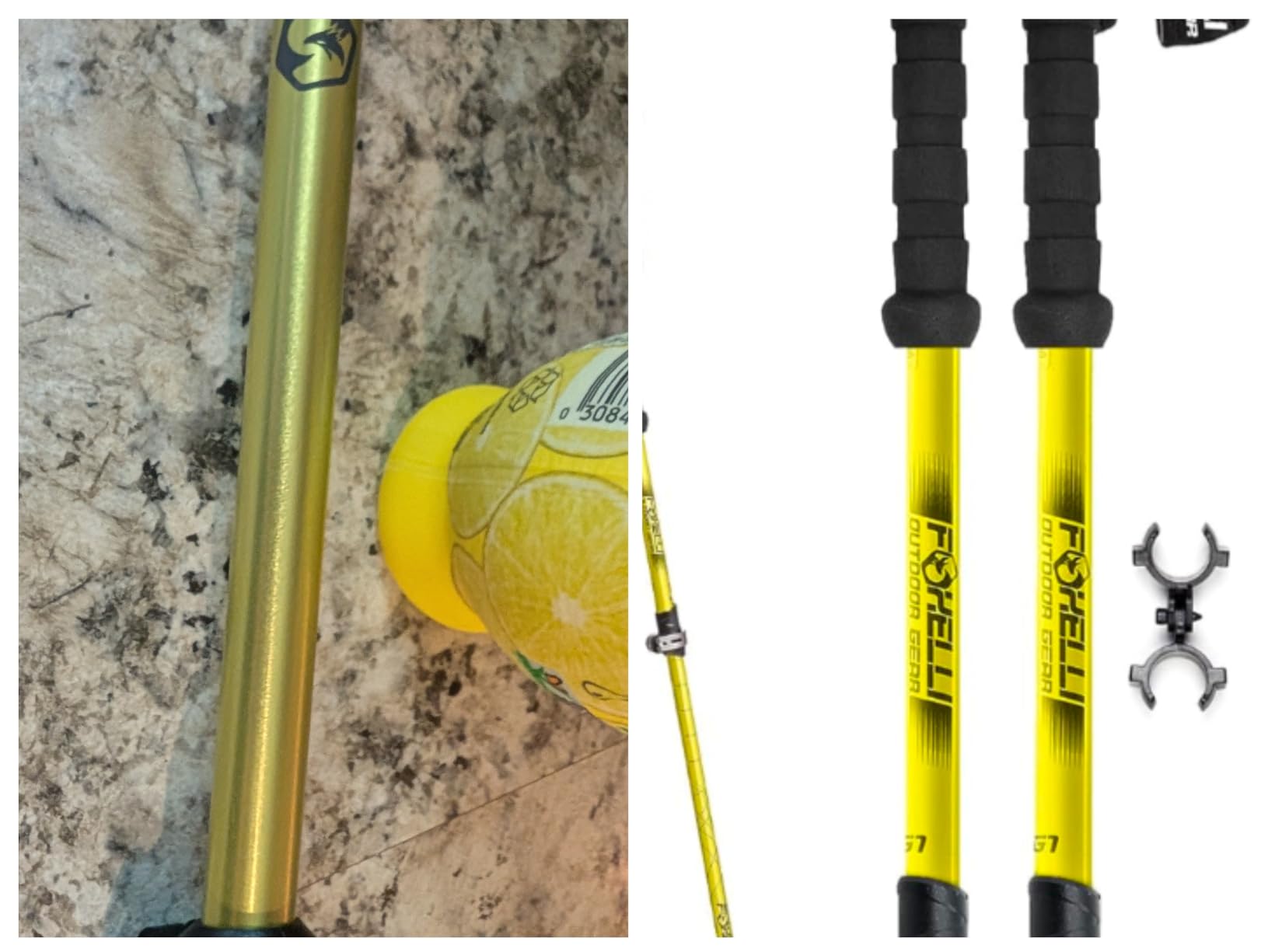
The extended EVA sleeve below the cork lets the hand slide down on switchbacks without moving the whole grip, and the bag includes a side pocket for tips. The pole disassembles to 21 inches for travel. Tungsten carbide tips plus interchangeable rubber, mud, snow and boot tips cover the full range of surfaces.
The reviews here read as a recovery story. Multiple buyers describe regaining confidence after falls, after hip or knee replacement, or after a serious illness, and that is a closer match to how these poles get used than any trail performance claim would be.
Watch the lock tension bolt. It needs a deliberate tightening, and reviewers who skip that step report the poles creeping. The basket threads are plastic, so if a basket jams, do not force it or you can strip the thread and lose the basket for good.

Who This Pair Suits Best
It suits anyone whose hands are the limiting factor, including people with arthritis, a recovering grip after surgery, or simply lower strength after a long illness. For a paved neighborhood or park path, the light weight and cork grip are close to ideal.
Where It Falls Short
The tension bolt is a second step in setting height, and it must be checked after the first few adjustments. The plastic basket threading is a small part that fails ungracefully, and the wrist straps are functional rather than refined, so buyers who care about strap feel may want padded ones instead.
9. KINGGEAR 7075 Aluminum Poles – Best for Knee and Hip Replacement Recovery
KINGGEAR Trekking Poles 7075 Aluminum Lightweight Hiking Sticks
7075 aluminum at 9.35 oz per pole
Flip and quick lock adjustment
Cork grip plus EVA lower grip
Adjusts 25.5 to 54 inches
Pros
- Cork grip stays non-slippery in wet conditions or heavy sweat
- Flip locks hold firmly once the clamp is snapped down
- Users recovering from hip and knee replacements report a more even gait
- Accessory kit covers mud snow boot and rubber tips
Cons
- Grip surface ridges can feel rough enough to need sanding
- Slightly heavy for a 7075 aluminum shaft
- Some section connectors are plastic rather than metal
The reviews here are the most clinical in the roundup, and they cluster around one outcome: people with arthritis, bilateral knee replacements and a hip replacement describe using the poles to move from a single cane to a supported, more symmetrical gait on rocky trails. First-time pole buyers consistently call this a low-risk way to start, which is a reasonable description of the whole experience.
The cork grip stays non-slippery in wet conditions or heavy sweat, and the EVA lower grip absorbs palm sweat and adds a second hand position. The 9.35 ounce shafts are light enough to be nearly unnoticeable on the pack, and the 25.5 to 54 inch adjustment range covers a wide spread of body heights.
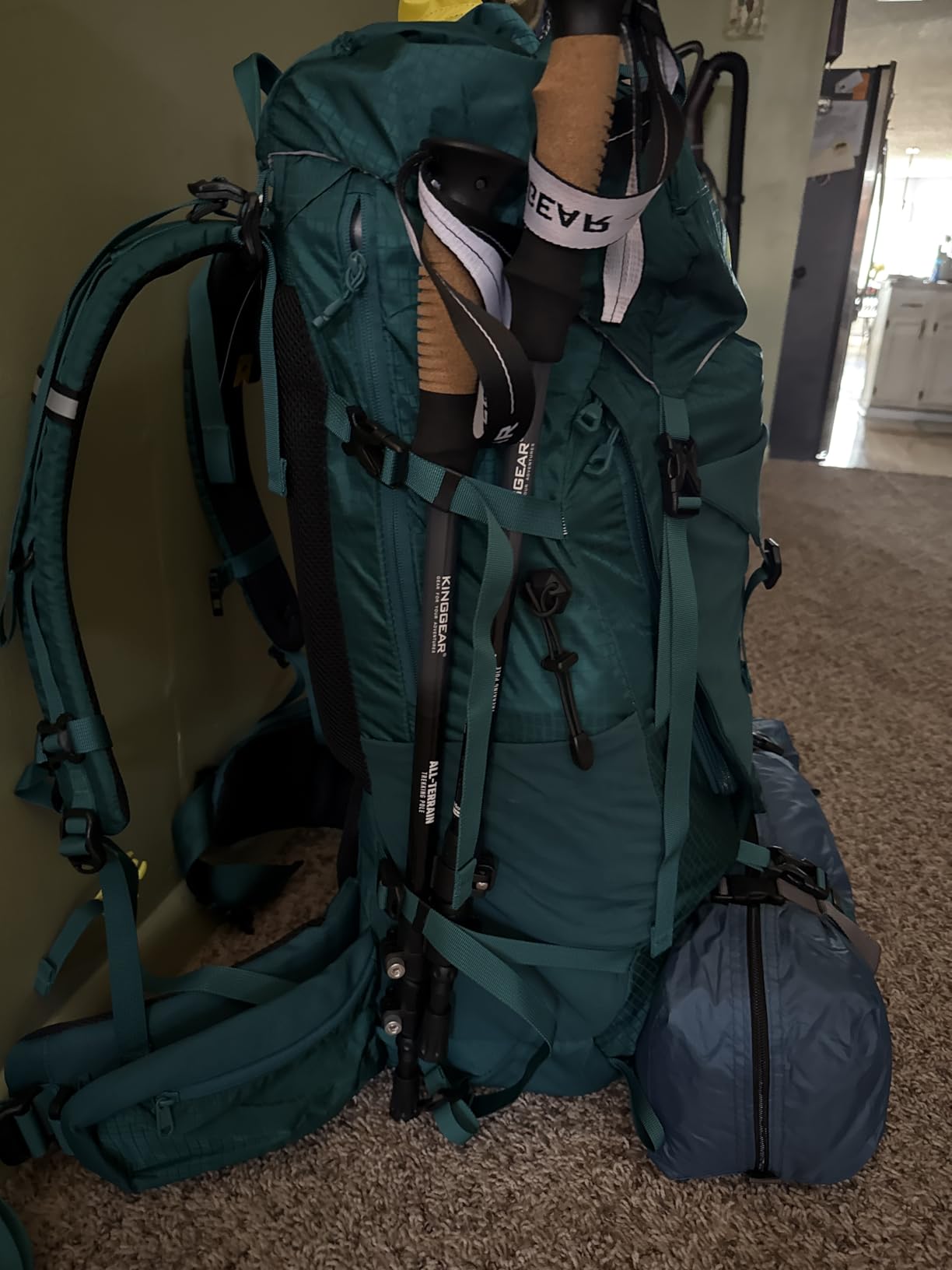
The quick flip locks hold their setting once the clamp is snapped down, which removes the creeping-shaft problem that plagues twist locks. The accessory kit is thorough, with mud baskets, snow baskets, boot tips and spare rubber tips, and the brand states a lifetime guarantee.
Two grip-related issues come up repeatedly. The surface ridges on the handle have been described as rough enough that some buyers sand them down, which is worth knowing if you have sensitive skin, and the EVA lower grip is where you would feel it. A few users also find 9.35 ounces a little heavy for a 7075 shaft, and some section connectors are plastic rather than metal, which is where a long-term failure would start if it came.
That grip ridge feedback is specific enough that it is worth handling the handle before you commit. If it feels abrasive to you, an EVA grip model is the safer pick.

Who This Pair Suits Best
It suits post-surgery walkers working back to distance with medical guidance, and it suits anyone who finds that one cane leaves them walking asymmetrically. The wide height range also means a family can share one pair across several body sizes.
Where It Falls Short
The handle ridges are the main comfort concern, particularly for sensitive or healing hands. It is heavier than the lightest aluminum options, and the plastic connectors are the part to inspect if you plan to keep these for years rather than seasons.
10. Hiker Hunger Outfitters Carbon Fiber Poles – Best for Padded Strap Comfort
100% Carbon Fiber Trekking Poles by USA Brand – Ultra Strong Lightweight Collapsible Hiking Poles with Cork and EVA Foam Grips & Quick Adjustable Flip Locks
3K carbon fiber at 7.6 oz per pole
Cork grip plus EVA foam extension
Neoprene padded hand straps
Metal flip locks, 24 to 55 inches
Pros
- Shares the lowest weight class here at 7.6 oz per pole
- Neoprene padded straps designed specifically to avoid chafing
- Metal flip locks stiffer and more secure than plastic ones
- Widest extension range in the roundup at 24 to 55 inches
Cons
- Carbon transmits more shock and vibration than padded aluminum
- Brittle under a hard lateral load where aluminum would bend
- Sits above the budget aluminum options
The strap is the headline here. Neoprene padding around the hand is a direct answer to chafing, which is the single most common grip complaint across cheaper trekking poles, and reviewers comparing these to their old pairs point at the strap as the upgrade that made long days tolerable. The cork top grip wicks moisture and conforms, with a non-slip EVA extension for steeper pitches.
At 7.6 ounces per pole it shares the lowest weight class in the roundup, and the metal flip locks are stiffer and hold better than the plastic or twist systems used by cheaper poles. The 24 to 55 inch range is the widest here, covering everyone from a shorter walker up to a tall user in one pair.
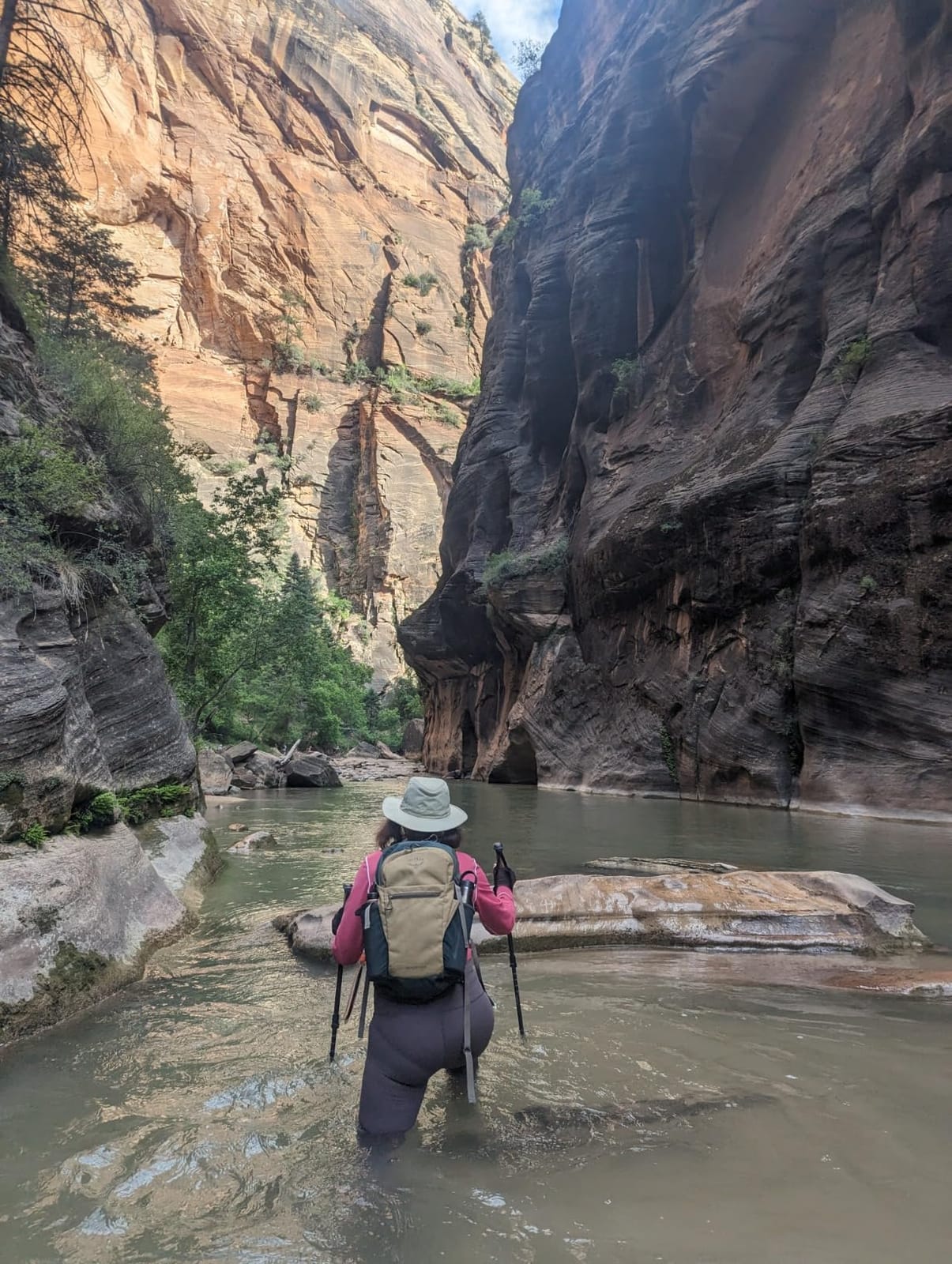
The buyer profile here is weight-conscious walkers and backpackers who want low grams without giving up grip comfort, and the product is built for that. It comes with mud baskets, rubber feet, rubber tips and snow baskets, and the brand states a one year manufacturing warranty.
Carbon has real limitations for this audience and the reviews acknowledge them. A minority note the harsher feel of carbon on hard surfaces compared with a shock-absorbing aluminum model, and the failure mode is different: carbon is brittle under a hard lateral load, where aluminum bends and can be straightened. If your walking includes uneven rock where a stumble is plausible, that is the argument for an aluminum shaft.
It is also not a choice for a short flat neighborhood walk. The capability is real, but it is aimed at distance.

Who This Pair Suits Best
It suits long-distance walkers who get blisters or sore spots from ordinary webbing straps and want the lowest weight without giving up grip comfort. If you have a history of wrist chafing, padded neoprene is the feature that justifies choosing this over a lighter unpadded option.
Where It Falls Short
It is the wrong pick for hard packed surfaces if you are sensitive to vibration, and the wrong pick for technical ground where a bend would be safer than a snap. It is also more than a casual weekly stroll requires.
11. Urban Poling ACTIVATOR Walking Poles – Best for Medical Rehab and Balance Therapy
Urban Poling ACTIVATOR® Walking Poles for Balance and Rehabilitation – 1 Pair – Ergonomic CoreGrip™ Handles – Adjustable, Collapsible, and Lightweight for Stability and Recovery in Silver/Red
Built for rehab by an occupational therapist and gerontologist
Ergonomic strapless CoreGrip handle
Adjusts 4 foot 2 to 6 foot
200 lb per pole, 250 lb maximum user weight
Pros
- Designed for rehabilitation and balance rather than trail performance
- CoreGrip handle keeps the wrist neutral and reduces strain
- Adjusts from 4 foot 2 to 6 foot
- the widest fit range here
- Button lock secures the internal twist system
Cons
- Heaviest pair here at about 1.44 lb per pair
- Two-section design collapses only to 29 inches
- Fewer color and accessory options than hiking brands
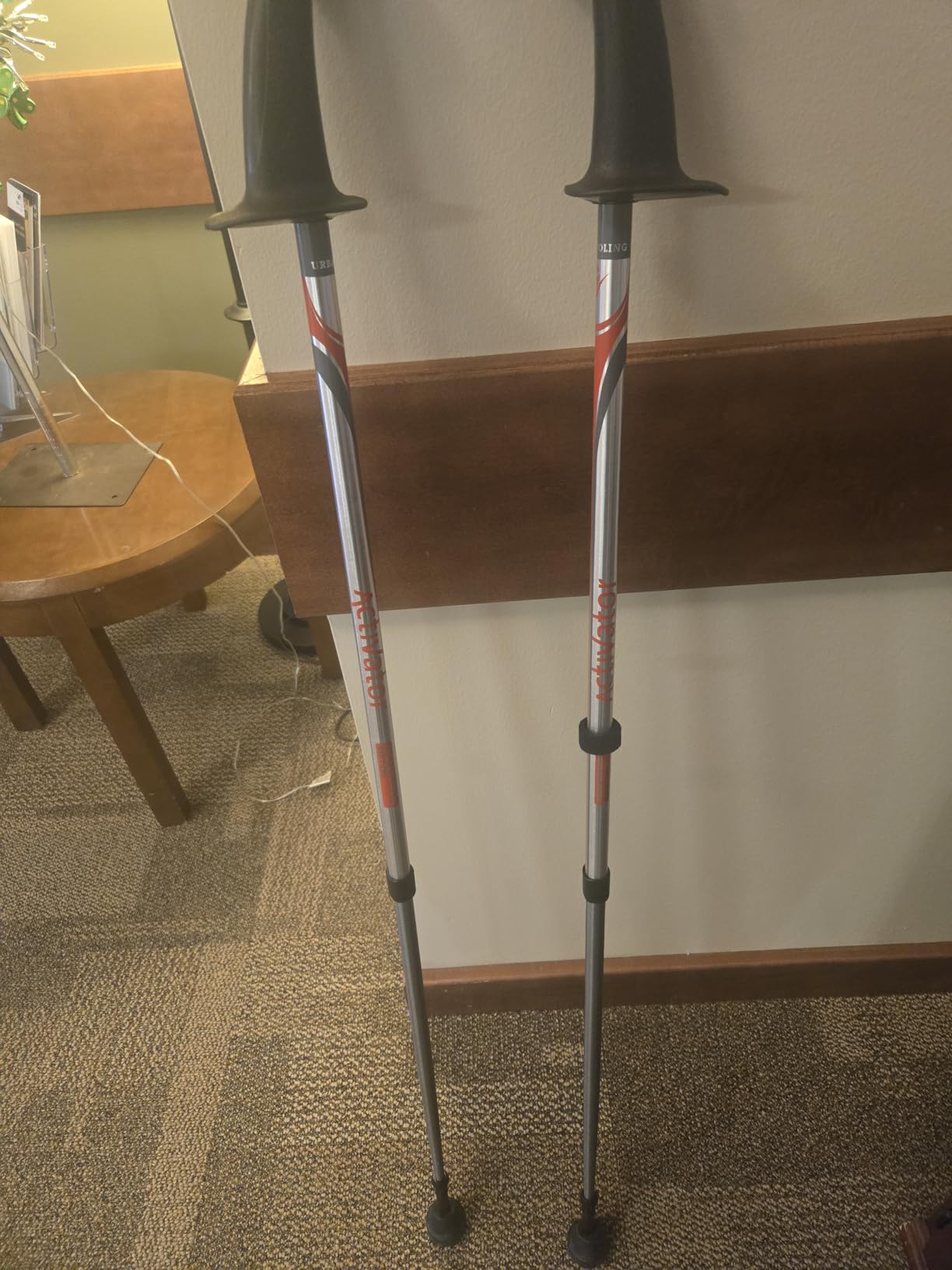
This is the only product here designed by an occupational therapist and gerontologist rather than by a hiking brand, and the difference shows in the details. The strapless CoreGrip handle holds the wrist in a neutral position and engages core muscles, and the boot-shaped tips give better ground contact than a standard pointed trekking pole. For a rehab setting, those two features matter more than weight or packed length.
The load rating is the number to check first. Each pole is rated to 200 lb with a maximum user weight of 250 lb, which is the only published load capacity in this roundup. If you are a heavier user, that figure alone can rule other models in or out of contention, because most manufacturers do not publish one at all.
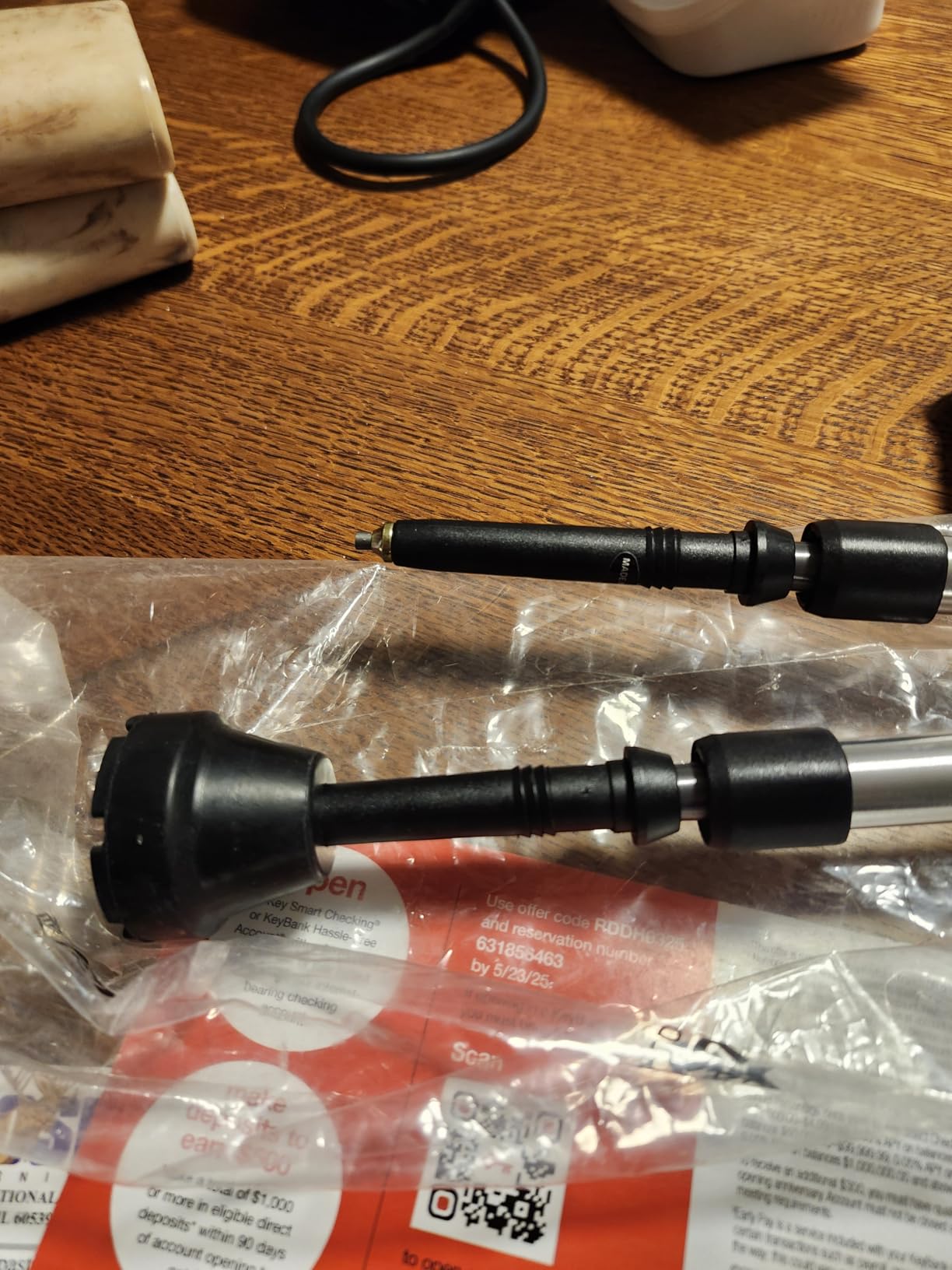
The review base is almost entirely medical. People recovering from spine surgery, hip fractures, knee replacement, neuropathy-related foot drop and balance disorders describe it working where canes and walkers did not, and report improved posture and longer walking distances. Many also report burning 20% to 46% more calories than walking without poles, which matters if the goal is conditioning rather than stability.
The button lock secures an internal twist system, so once the height is set it stays put, which removes the creeping-shaft problem entirely. A two year warranty covers the pair, and the fit range from 4 foot 2 to 6 foot is the widest in the roundup.
It is the heaviest pair here at about 1.44 lb, and it collapses only to 29 inches, longer than any trekking pole here, so it is impractical for air travel. This is also the most expensive option in the group, and the reviewers are unanimous that it is justified only by a genuine rehab need rather than a recreational one.
Who These Poles Suit Best
They suit anyone under clinical guidance for balance, gait retraining or post-surgical recovery, and the strapless handle is a real benefit for people whose hands cannot manage a wrist loop. If a physical therapist has recommended poling, this is the design they are picturing.
Where They Fall Short
They are the wrong choice for a recreational walker on a budget, and the weight will show on a long day. The 29 inch collapsed length rules them out of carry-on travel, and the limited color and accessory range matters if you like matching gear or need specific tips.
12. covacure 7075 Tri-Fold Aluminum Poles – Best for Winter Walking and Durable Grips
covacure Hiking Poles, 7075 Aluminum Tri-fold, Adjustable Height, 2PCS
7075 aluminum with anti-corrosion coating
Tri-fold telescopic design folds under 14 inches
EVA foam grip with grip grooves
Adjusts 39.4 to 47.2 inches
Pros
- Tri-fold plus telescopic gives a packed length under 14 inches
- Anti-corrosion coating suits winter and wet conditions
- EVA foam grip will not crack or unglue like cork
- Adjustable wrist straps reduce wrist strain
Cons
- Heaviest listed pair at 1.7 lb per pair
- Assembly screw must be confirmed tight before use
- Shorter base length suits users around 5 foot 3 to 5 foot 7
The hybrid design is genuinely clever: the pole telescopes for quick height adjustment and then tri-folds for packing, reaching under 14 inches. That is unusual for a pair that still adjusts in height, and it makes the poles viable for air travel while keeping the convenience of a telescopic shaft. Seven color and length variants are offered, which is the widest selection in the roundup.
The anti-corrosion surface treatment on the 7075 aluminum is aimed squarely at winter use, and the box includes boot tips, snow tips and standard rubber tips along with two storage bags. The EVA foam grip is described as more durable than cork and it will not crack or unglue, which is a genuine advantage for a user who grips hard.
The wrist straps are adjustable in a way that lets you take load with less effort, and the foam grip has sweat-absorbent skid-resistance grooves. A shorter overall adjustment range actually helps a fixed user, because there is less room to overshoot your correct height.
Assembly is the real issue. The joint requires tightening a screw, and the brand instructs users to confirm it is tightened before use, because an unsecured screw means a collapsing shaft. Some buyers needed to watch the video instructions, and the one-star rate here is the highest in the roundup at 7%. Set aside ten minutes the first time and check it again before your second walk.
At 1.7 lb per pair it is the heaviest listed pair here, and the 39.4 inch base suits shorter users. Taller walkers need the longer variant offered in the same range.
Who This Pair Suits Best
It suits shorter users, winter walkers, and anyone who wants a short packed length alongside height adjustment. If you grip hard enough that cork has cracked or come unglued on past poles, the EVA foam grip removes that failure mode entirely.
Where It Falls Short
The assembly step is a real commitment for anyone who wants grab-and-go equipment, and the screw is the component to re-check. The heaviest pair here will be noticeable on a long day, and the base length excludes taller users from the standard variant.
How to Choose Trekking Poles for Seniors
What material should I look for?
Choose aluminum. That is the single most consistent recommendation in forum discussion and the most repeated bullet in the AI summaries ranking this category, and the reason is failure behaviour rather than weight. Aluminum shafts bend under a hard lateral load and can often be straightened, while carbon fiber is lighter but more brittle and tends to fail rather than flex. A r/CampingGear user who bent two pairs of Black Diamond Trail Ergo Cork poles on stumbles asked exactly this question, and the answer came back the same way.
Aluminum also feels steadier under body weight, which counters the forum complaint that very light poles give a false sense of security instead of real support. If arm fatigue on long flat days is your main problem rather than rough terrain, carbon at the low end of this range is a reasonable exception.
Which lock works with limited hand strength?
Choose a lever or flip lock. You open a metal catch with a thumb and close it with your hand around the shaft, which requires no fine finger motor control and no pinching. Twist locks are the opposite: they need a twisting motion through a small knob, they collect grit, and forum users report them needing re-tightening and occasionally failing mid-stride.
One caveat: the best lever lock still has a tension bolt that some models require you to tighten deliberately. Set the height, then load the pole with your body weight and check it holds before you set off down a hill.
How tall should walking poles be for seniors?
Plant the pole tip beside your foot, stand upright, and your elbow should sit at roughly a 90 degree angle. That is the whole rule, and it works because it puts the load through a straight arm and into the shaft instead of into your shoulder.
To self-fit without a store, measure two things. First, measure the distance from the ground to your hip crease, then subtract about 10 inches, and that is your starting pole length. Second, stand in the shoes and on the surface you actually walk on, set the shaft to that figure, and check the elbow angle. If the elbow is under 90 degrees, the poles are too short for the surface and you will sink forward; if it is well over 90, the poles are too tall and you will be pushing down rather than planting.
Allow a small tolerance rather than chasing an exact number. Most people settle within about 10 centimeters of their ideal, and for shorter adults a slightly lower setting is usually more comfortable than a textbook figure. Two of the poles here only suit users up to 5 foot 7 or 5 foot 3, so check the adjustment range against your height before anything else.
What grip suits arthritic or smaller hands?
Cork is the comfort answer, and it wins the most praise in the senior-focused reviews because it moulds to the hand over time and stays dry rather than turning slick. Foam or EVA is the durability answer, since it will not crack or unglue after years of hard gripping. Rubber is the one to be careful with, because it is often narrower and reviewers with larger hands report it pressing into the base of the fist.
Look for a grip with two diameters rather than one. An upper cork section plus a lower foam section gives you a smaller hold for climbs, which takes pressure off arthritic finger joints on the steepest parts of a walk. If you travel, a pole that disassembles to about 21 inches fits most carry-ons, and the tri-fold models fold shorter still.
Should I ask a doctor first?
Yes, if you are recovering from knee or hip replacement, have a diagnosed balance disorder, or have been told your fall risk is elevated. None of this roundup replaces that guidance, and the ACTIVATOR pair exists precisely because clinical design differs from trail design. For general fitness walking on your own routes, the decision is straightforward hardware: aluminum, lever locks, cork grip, correct height.
If you are building a broader walking routine at home rather than on trails, our guides to the best treadmills for walking seniors and the best bikes for seniors cover the same stability goals in different equipment.
Frequently Asked Questions
Are trekking poles suitable for older people?
Yes. Trekking poles widen your base of support, add a secure second hand on uneven ground, and share load that would otherwise go through your knees and hips on descents. Those three benefits matter more with age because stiffness, reduced proprioception and lower muscle mass all reduce stability. If you are recovering from joint replacement or have a diagnosed balance disorder, ask your clinician before changing your walking equipment.
How do seniors choose the right trekking pole height?
Plant the pole tip beside your foot and stand upright. Your elbow should sit at roughly a 90 degree angle, which keeps the load in the arm and out of the shoulder. For a starting point, measure from the ground to your hip crease and subtract about 10 inches. Then set the shaft in the shoes and on the surface you actually walk on, and adjust by a few centimeters either way until the elbow angle feels natural.
Should seniors use trekking poles or a walking stick?
It depends on terrain and how much support you want. A walking stick gives one contact point, suits short and level walks, and is easier to manage indoors. Trekking poles give two contact points, spread load across both sides of the body, and reduce joint stress on slopes and uneven ground. If you walk on trails, gravel, or anything with a slope, poles are the better tool. If your walking is entirely flat and short, a stick is simpler.
What are the best hiking poles for seniors with arthritis?
Look for three things: soft molded grips such as cork or foam, lever or flip locks you can close with one hand, and a light shaft under about 10 ounces per pole. Soft grips reduce pressure on arthritic finger joints, lever locks avoid the twisting motion that strains stiff hands, and lighter poles reduce the wrist and shoulder load across a long day. Adding a lower foam grip section gives you a narrower hand position on climbs, which further reduces joint stress.
Are carbon fiber poles better than aluminum for hiking?
Carbon fiber is lighter, usually by two to three ounces per pole, which reduces arm fatigue on long flat days. Aluminum is heavier but bends rather than snapping when you catch a stumble, and it feels steadier under body weight. Forum discussion consistently favors aluminum for durability and for older walkers. Carbon makes more sense for distance on smooth ground; aluminum makes more sense for rocky or uneven ground where a mistake is likely.
Final Word on Trekking Poles for Seniors
The best trekking poles for seniors in 2026 are the ones that will not fail you on a bad step and that you can adjust without a fight. That points to aluminum shafts, lever locks, and a cork or foam grip sized for your hands, and away from the lightest carbon option on the shelf.
Our top pick, the TrailBuddy pair, wins because it combines one-handed lever locks, cork grips with padded straps, and a five year warranty with the largest review base we tested. If your hands are the limiting factor, the Foxelli aluminum pair rates highest and its lever locks are the easiest here to close. If you want a second hand position on hills, Cascade Mountain Tech is the value answer. If you are working with a physical therapist, the ACTIVATOR poles were designed for that job specifically.
Whatever you pick, set the height first, load the pole with your weight, and check the lock before you walk a descent. That five minutes of setup is the difference between poles that help and poles you end up distrusting.