
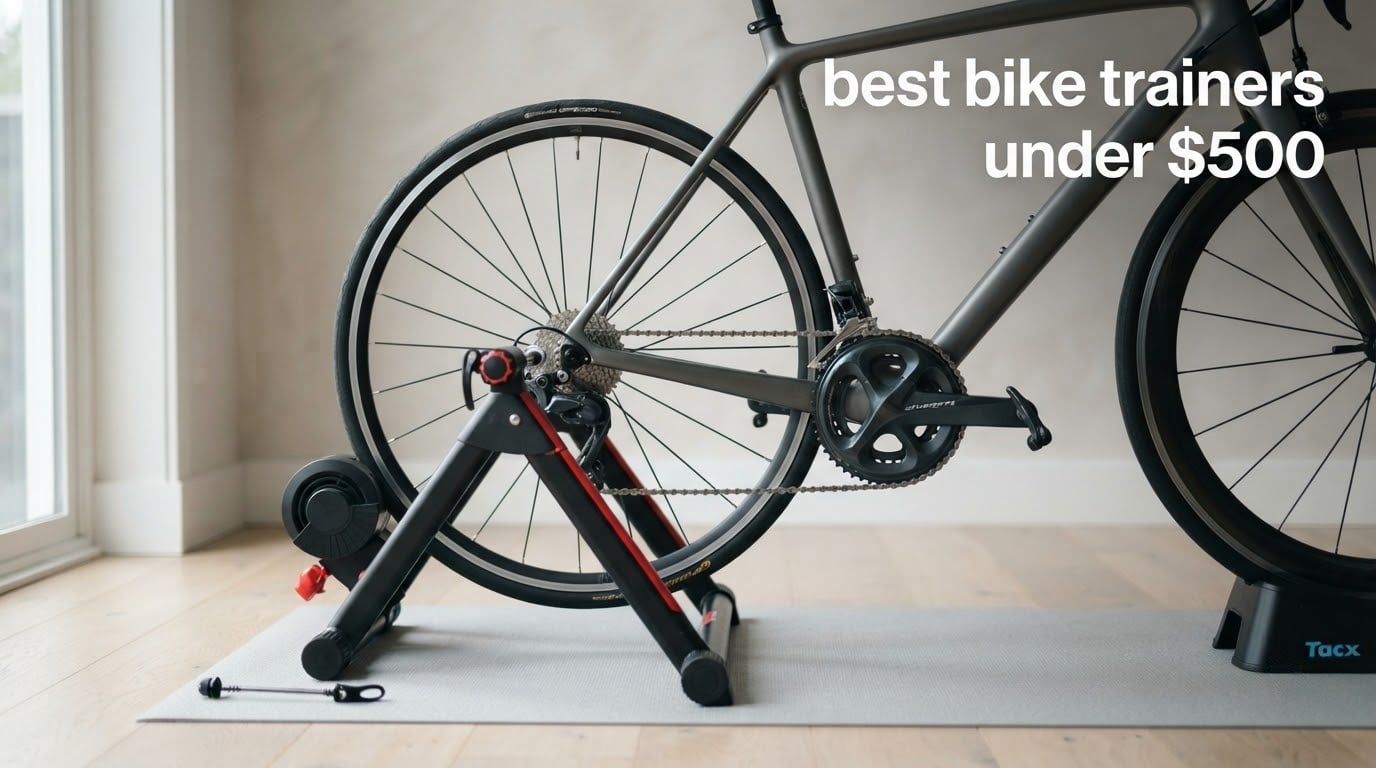
A bike trainer clamps your bike to a stand so you can ride it indoors, holding the rear wheel or the cassette in place while magnets, fluid or an electromagnetic unit create the load. It is the most economical way to keep your winter training, and if you have ever looked at the market in 2026 you have probably noticed something strange: below 500 dollars, you are choosing a wheel-on stand, and that decision is simpler than most roundups make it sound.
That is what this guide is built around. Every trainer we list here attaches to your rear wheel and leaves the wheel on the bike, which means no drivetrain disassembly, no cassette swap and a much smaller box. What you trade away is the silent, motor-driven power accuracy of a direct-drive turbo, and the honest answer is that at this budget most riders never miss it.
We worked through 10 stands, compared the resistance mechanisms, wheel fit, axle hardware, noise ratings, weight limits and warranty terms, and read the owner reviews behind each rating. The best bike trainers under 500 dollars in this lineup fall into three clear groups: cheap magnetic stands for riders who just want to pedal, fluid and folding stands for riders who care about noise and storage, and two app-connected Saris trainers for anyone following a power-based plan or riding Zwift.
One thing to clear up before we start, because the search results for this query are full of confusion. A fitness bike is an exercise bike with its own crank and pedals, and it is a different product entirely. A 500 dollar fitness bike is not a 500 dollar trainer. If you want to ride your own bike, you need a trainer stand, and that is what this guide covers.
Table of Contents
Top 3 Picks for the Best Bike Trainers Under $500 (October 2026)
BalanceFrom Magnetic Stand
- Magnetic resistance with 8 levels
- Handlebar resistance controller
- Front wheel riser block included
- 330 lb max load

Sportneer Magnetic Stand
- 6 magnetic resistance levels
- Quick release lever clamp
- Quick release skewer included
- 300 lb load capacity
FDW Magnetic Bike Trainer
- 5 resistance levels
- Noise reduction wheel
- Folds flat for storage
- 300 lb load capacity
Best all-round: BalanceFrom magnetic stand. It carries the largest owner base of anything in this roundup, folds away in seconds and includes the front riser block that most competitors make you buy separately. It is the trainer we would put in a spare room first.
Best value: Sportneer magnetic stand. Heavier and more rigid than the cheaper options, with a press-down clamp that makes swapping bikes fast once you have dialled the axle in. Owners widely describe it as the best budget magnetic trainer they have owned, and the stability reports are consistent.
Budget pick: FDW magnetic stand. The entry point here that still gives you a noise-reduction wheel, a fold-flat frame and a stated 300 lb rating. It does the job for casual winter use, and it does not pretend to do more.
If you want the full field rather than the shortlist, our [magnetic bike trainer roundup](https://betterbike.org/best-magnetic-bike-trainers/) covers the budget stands in more depth, and our [indoor cycling trainer guide](https://betterbike.org/best-bikes-trainers-for-indoor-cycling/) covers what to do once the trainer is set up.
All 10 trainers at a glance
| Product | Specifications | Action |
|---|---|---|
| BalanceFrom Magnetic Bike Trainer Stand |
|
Check Latest Price |
| Sportneer Magnetic Indoor Cycling Trainer |
|
Check Latest Price |
| FDW Magnetic Bike Trainer Stand |
|
Check Latest Price |
 Yaheetech Magnetic Steel Bike Trainer Yaheetech Magnetic Steel Bike Trainer |
|
Check Latest Price |
 Alpcour Foldable Magnetic Trainer Alpcour Foldable Magnetic Trainer |
|
Check Latest Price |
 Sportneer Fluid Resistance Trainer Sportneer Fluid Resistance Trainer |
|
Check Latest Price |
 CXWXC Magnetic Stationary Stand CXWXC Magnetic Stationary Stand |
|
Check Latest Price |
 Saris M2 Smart Indoor Trainer Saris M2 Smart Indoor Trainer |
|
Check Latest Price |
 FDW Carbon Steel Magnetic Stand FDW Carbon Steel Magnetic Stand |
|
Check Latest Price |
 Saris Fluid2 Smart Equipped Saris Fluid2 Smart Equipped |
|
Check Latest Price |
Two numbers on that table are worth reading twice. The 250 lb load capacity on the Alpcour is the lowest rating in the set and rules out heavier riders, and the 265 lb on the Yaheetech is only just above it. A weight of 7.3 lb, on the Saris Fluid2, is less than half the 17.6 lb of the FDW steel stand, and that difference decides where the trainer lives in a small flat.
How we picked: method and honest limits
We compared all 10 stands on the things that actually change the riding experience: how the resistance steps, what the noise figure is and under what conditions, whether the axle fit is quick release or needs an adapter, what the stated rider weight limit is, how the trainer stores, and what the warranty covers. Where owner reviews repeatedly raised the same complaint, we treated that as part of the product rather than a footnote.
Here is what we did not do. We did not measure power output against a crank power meter, so we make no accuracy claims beyond what the manufacturers state. We did not run a decibel meter at a fixed cadence, so every noise figure quoted below is the manufacturer’s own figure at the speed or setting they specify. And we did not log hundreds of hours on each stand, so our judgement of ride feel is a reading of owner descriptions rather than a first-hand measurement.
What we did do was cross-check the specification data against what owners in the reviews actually report, which is where the useful surprises live. A trainer that lists a noise-reduction wheel is not quiet if you run knobby tires on it. A trainer that lists a 330 lb capacity is not a good choice for a rider who stands up to climb if the base is narrow. Those are the trade-offs we are writing around.
1. BalanceFrom magnetic trainer stand – best all-round wheel-on
BalanceFrom Bike Trainer Stand Steel Bicycle Exercise Magnetic Stand with Front Wheel Riser Block
Magnetic resistance with 8 levels
Alloy steel frame
8 kg
330 lb load capacity
2 year warranty
Pros
- Very easy to assemble with one bolt and all hardware included
- Sturdy wide base gives a stable wobble-free ride
- Front wheel riser block included so the bike sits level
- Folds for compact storage and light enough to move between rooms
- Handlebar dial plus bike derailleurs give usable resistance variation
Cons
- Noticeable droning noise especially with knobby tires
- Roller tension must be fine tuned each time the bike is mounted
- Some examples arrived without the front riser block
- Pictorial only instructions confuse first time assemblers
This is the stand we kept coming back to. It carries 14k+ owner reviews at a 4.2 average, and that combination of volume and rating is the reason it tops the list rather than any single headline specification. The frame is alloy steel, the base is wide with rubber feet, and it weighs 8 kg, which is light enough to carry between rooms without it feeling like a chore.
Assembly is genuinely the easiest here. A single bolt attaches the resistance unit to the frame and all the hardware is in the box, so you are pedalling the same afternoon you open the box. The quick release clamp means taking the bike off takes seconds, which matters if you share a trainer with a partner or swap between a road and a mountain bike.
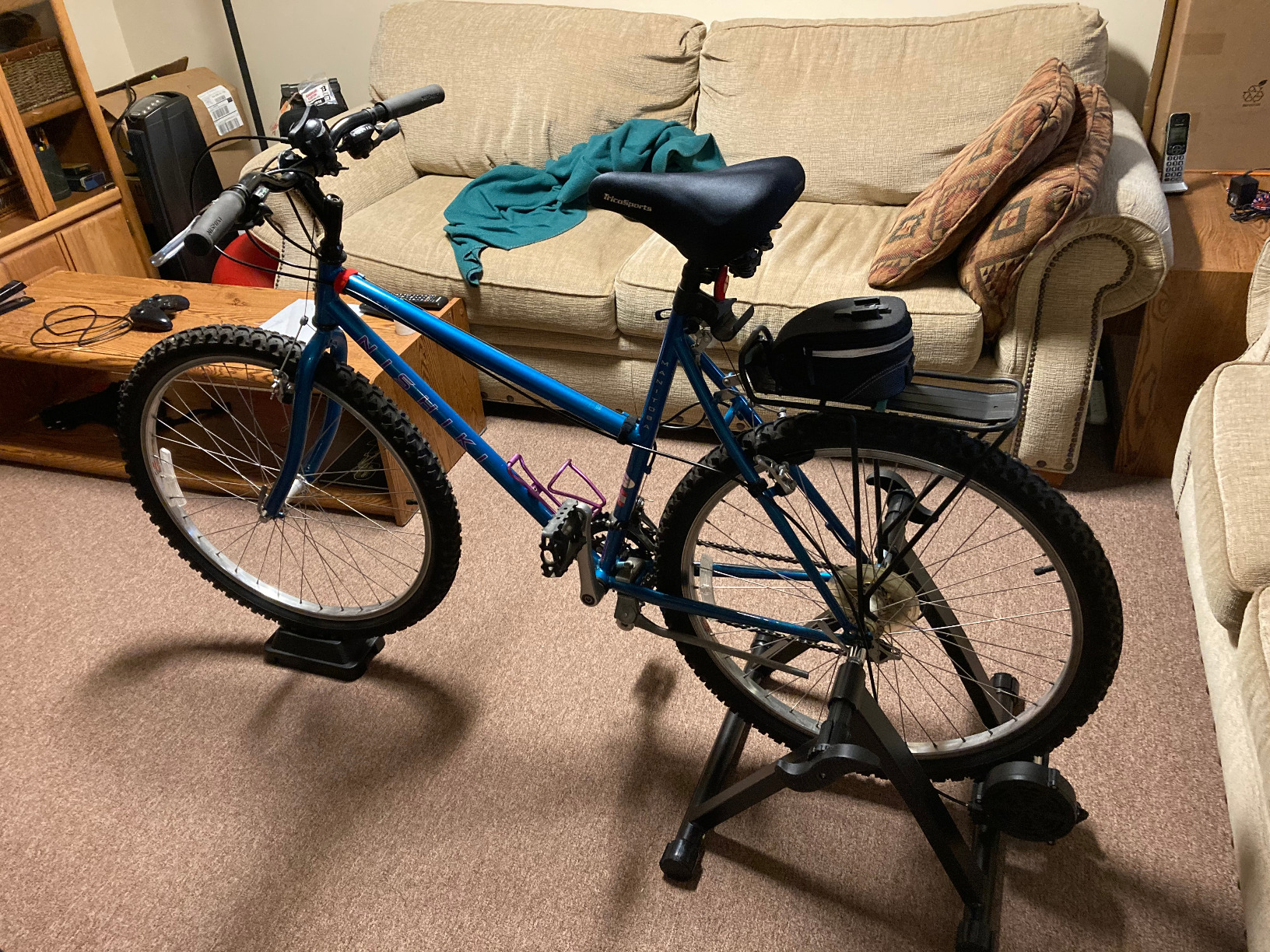
The 8 magnetic levels are spaced well enough that the handlebar dial plus your own derailleurs give real variation across a long ride. You can feel the resistance step up rather than just snapping between two states, and at the top of the range the magnets pull hard enough to simulate a proper climb at a believable gear.
The honest weakness is noise. Owners consistently describe a drone under load, and the fix is the tire rather than the trainer. Swap a knobby mountain bike tire for a slick road tire and the character changes completely. Roller tension also needs re-checking after every mount, which is a thirty-second job once you know what you are doing.
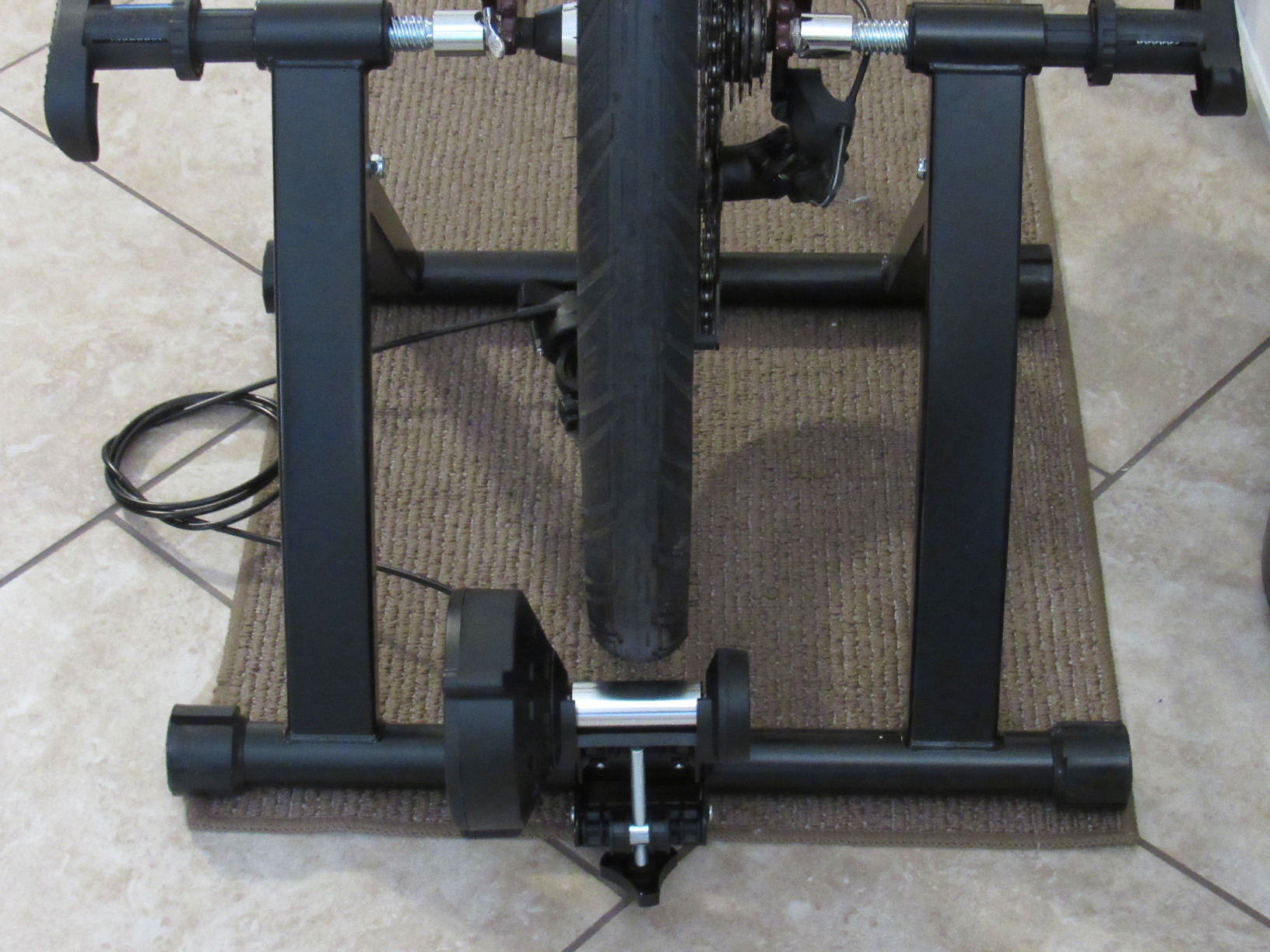
Check the riser block is actually in the box
Without the front wheel riser, the bike sits nose-down, your bars are too low and every interval feels like a wrist problem. A minority of owners report their example arriving without the block named in the listing, so open the box before you throw the packaging away.
The 330 lb load rating is one of the higher figures in this roundup, and the wide base stays planted when you stand up. If you ride a heavier bike or you like out-of-the-saddle work, that combination is the reason this is the one to buy.
Where it is the wrong choice
Skip it if noise is the deciding factor in your home. A magnetic stand at speed is inherently louder than fluid, and no amount of assembly care changes that. Our [trainers for apartments guide](https://betterbike.org/best-indoor-bike-trainers-for-apartments/) covers the quieter options in detail.
It is also the wrong tool if you follow a structured power plan, because there is no controllable resistance and no ERG mode. You are choosing your own load each session. That is fine for a rider who wants to stay warm and watch something on the television, and useless for a rider chasing a five-minute interval target.
2. Sportneer magnetic indoor cycling trainer – best value
Sportneer Bike Trainer – Magnetic Indoor Cycling Trainer Stand for 26-28″ & 700C Wheels, 6 Resistance Levels Stationary Bike Stand with Quick Release Lever & Front Wheel Riser Block Black
6 level magnetic resistance
Alloy steel frame
19.3 lb
300 lb load capacity
1 year warranty
Pros
- Solid heavy construction stays stable even standing up
- Six clearly distinct magnetic resistance levels
- Press-down lever clamp makes bike changes fast once set
- Very quiet with smooth road tires
- Front riser block and spare quick release skewer included
Cons
- Getting the bike into the rear holder is fiddly at first
- Axle alignment is hard and a fumbled clamp can stress the derailleur arm
- Roller tension must be set precisely to avoid noise and tire wear
- Will not work with internal gear hubs
- Small roller setting peg falls out when dismantled
This is the trainer we would hand to someone who wants to stand up and sprint without worrying about whether the frame will rock. At 19.3 lb it is one of the heavier stands in the roundup, and that mass is the feature. Owners report it stays planted even for riders around 200 lb pushing out of the saddle.
The magnetic unit is described as reducing friction for a smoother and quieter spin than most budget stands. There is no mechanical noise from the magnet assembly itself, so what you hear is tire on roller and nothing else. On smooth road tires owners call it a light vibration rather than a drone.
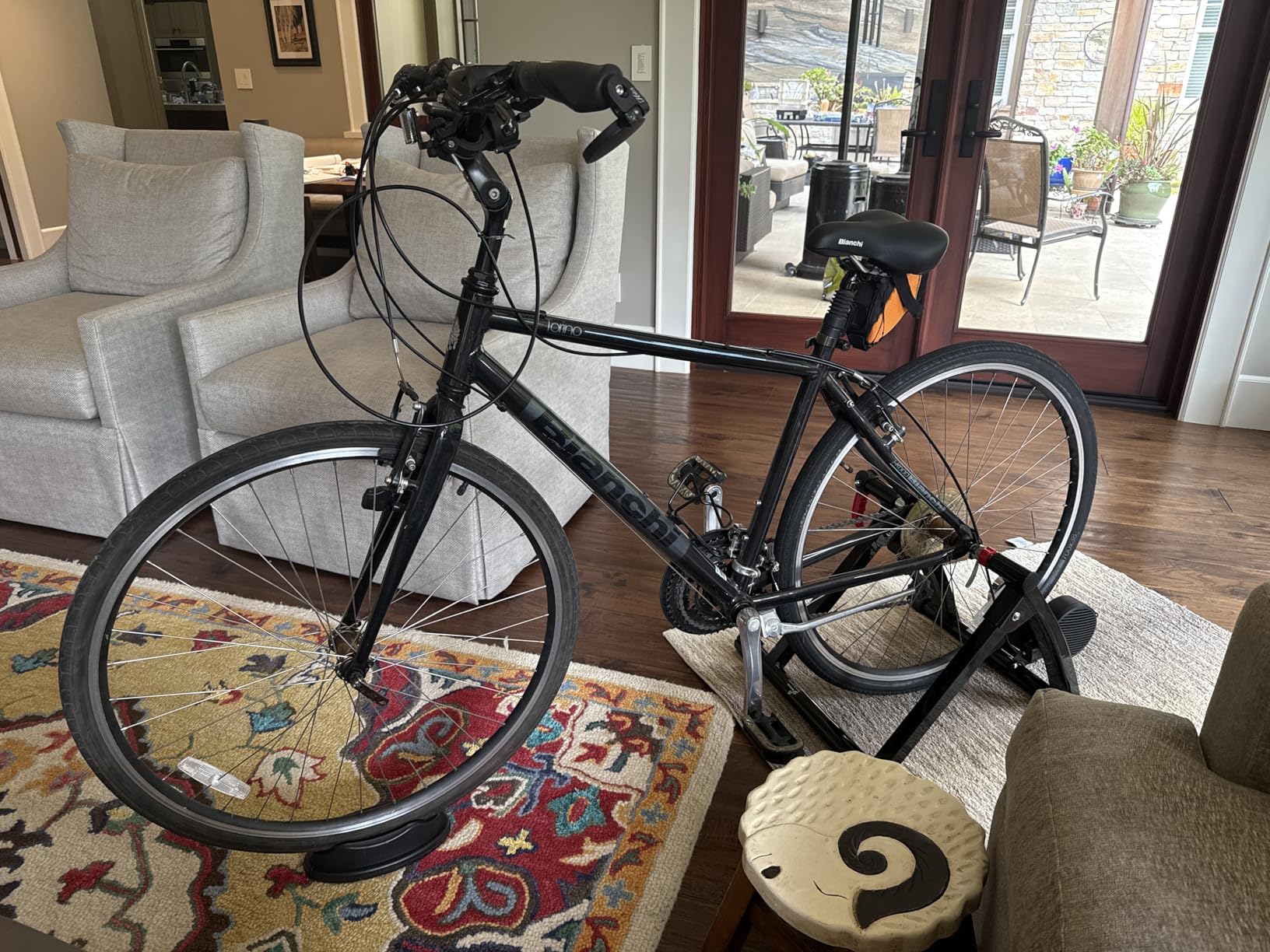
Six resistance levels switch from the bar-mounted remote, which is enough to find a workable setting for a flat recovery spin and a hard climb without riding the same gear at both, though the BalanceFrom gives you two extra levels to play with. Five adjustable anti-slip rubber feet let you level the base on a floor that is not quite flat.
Customer support is worth mentioning because it appears in the reviews repeatedly. Owners report responses within 24 hours and replacement parts provided, including a replacement after a roller bearing failure. A one year warranty is shorter than the BalanceFrom, but the backup is clearly real.
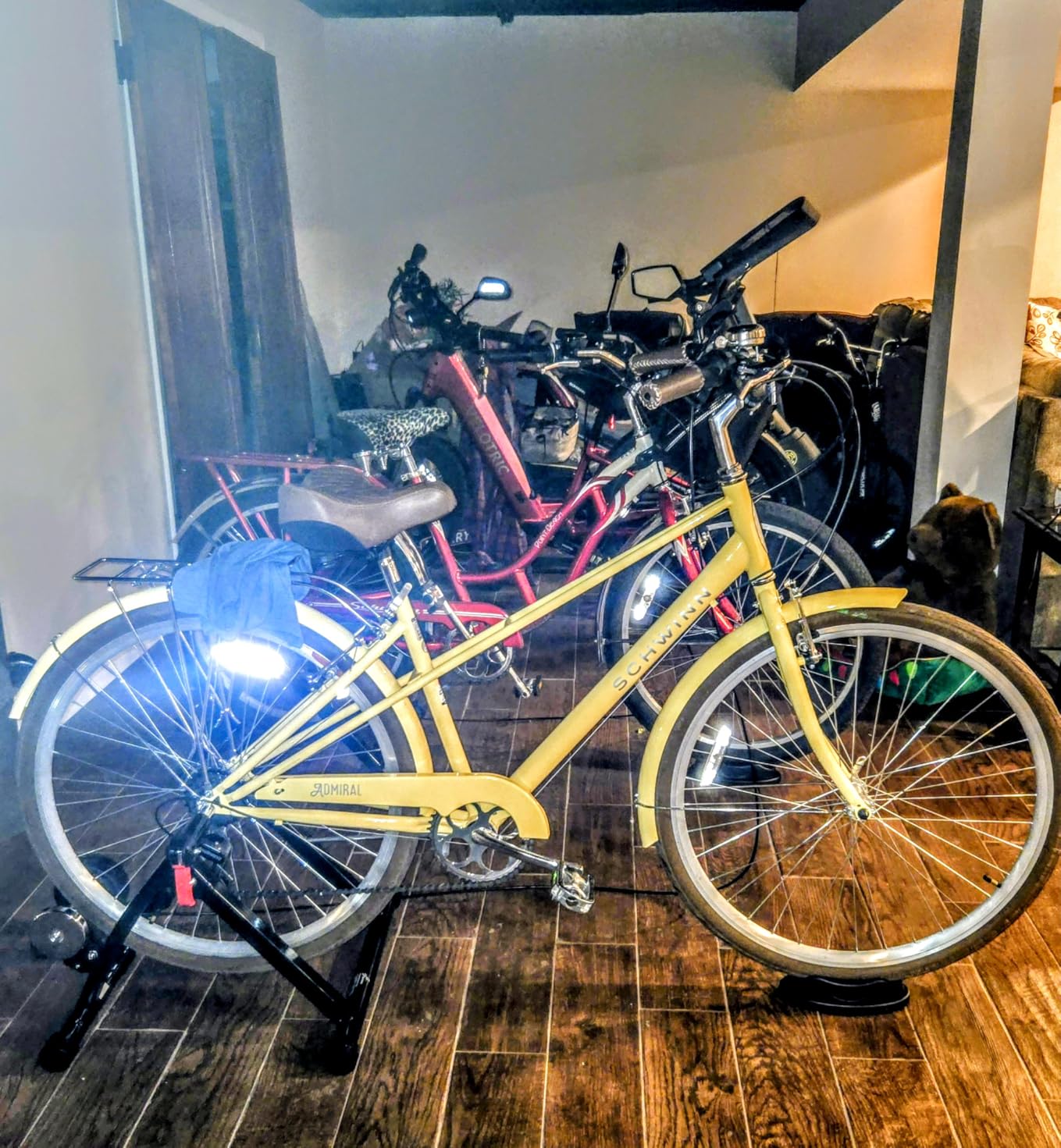
The mounting is the thing to practice
Aligning and tightening the axle inside the clamp takes getting used to, and a few owners report a fumbled clamp putting stress on the rear derailleur arm. Slow down for the first two mounts, and treat the skewer as something to hold rather than something to force.
It includes a quick release skewer, and thru-axle bikes need the separate thru-axle version of this stand. If your bike has a 12 mm axle and you do not buy that variant, the trainer simply will not fit. Check your axle before you order.
Where it is the wrong choice
It will not work with an internal gear hub, because the axle design has nothing to clamp onto. If you ride a city bike or a commuter with a Nexus hub, rule this one out and look at a model with a standard QR mount.
Roller tension is critical and unforgiving. Too tight and you get excess noise, tire wear and a hot roller partway through a long ride. Too loose and the wheel slips under a hard effort. Budget a few minutes to get it right and re-check it whenever the bike comes off.
3. FDW magnetic bike trainer stand – budget pick
FDW Magnetic Bike Trainer Stand for Indoor Riding, Steel Bicycle Exercise Training Stand with Noise Reduction Wheel,Stationary Bike Resistance Trainer for Road & Mountain Bikes
5 magnetic resistance levels
Steel frame
17.6 lb
300 lb load capacity
90 day warranty
Pros
- Low entry price with a steel frame
- Quick 15 minute assembly with few parts
- Folds flat for a corner or a car trunk
- Noticeably quieter at the lower resistance settings
- Handles up to 300 lb of rider weight
Cons
- Only 5 resistance settings with a narrower range
- Heavy steel frame is awkward to move between rooms
- Warranty is only 90 days
- Narrower wheel size range than 26-29 inch trainers
- Minimal instructions with a lot of filler text
This is the stand to buy when the purchase has to stay as cheap as possible. It sits among the lowest prices in the roundup and it is still a steel frame with a noise-reduction wheel, a 300 lb rating and a fold-flat frame. For a rider who wants to ride indoors four months of the year and nothing more complicated, that is enough trainer.
Assembly takes about 15 minutes with few parts, and the five resistance levels step from a flat-road feel up to a climb. The step spacing is narrower than the stands above it, which is the real limitation: you have less room to fine-tune a session than the name suggests.
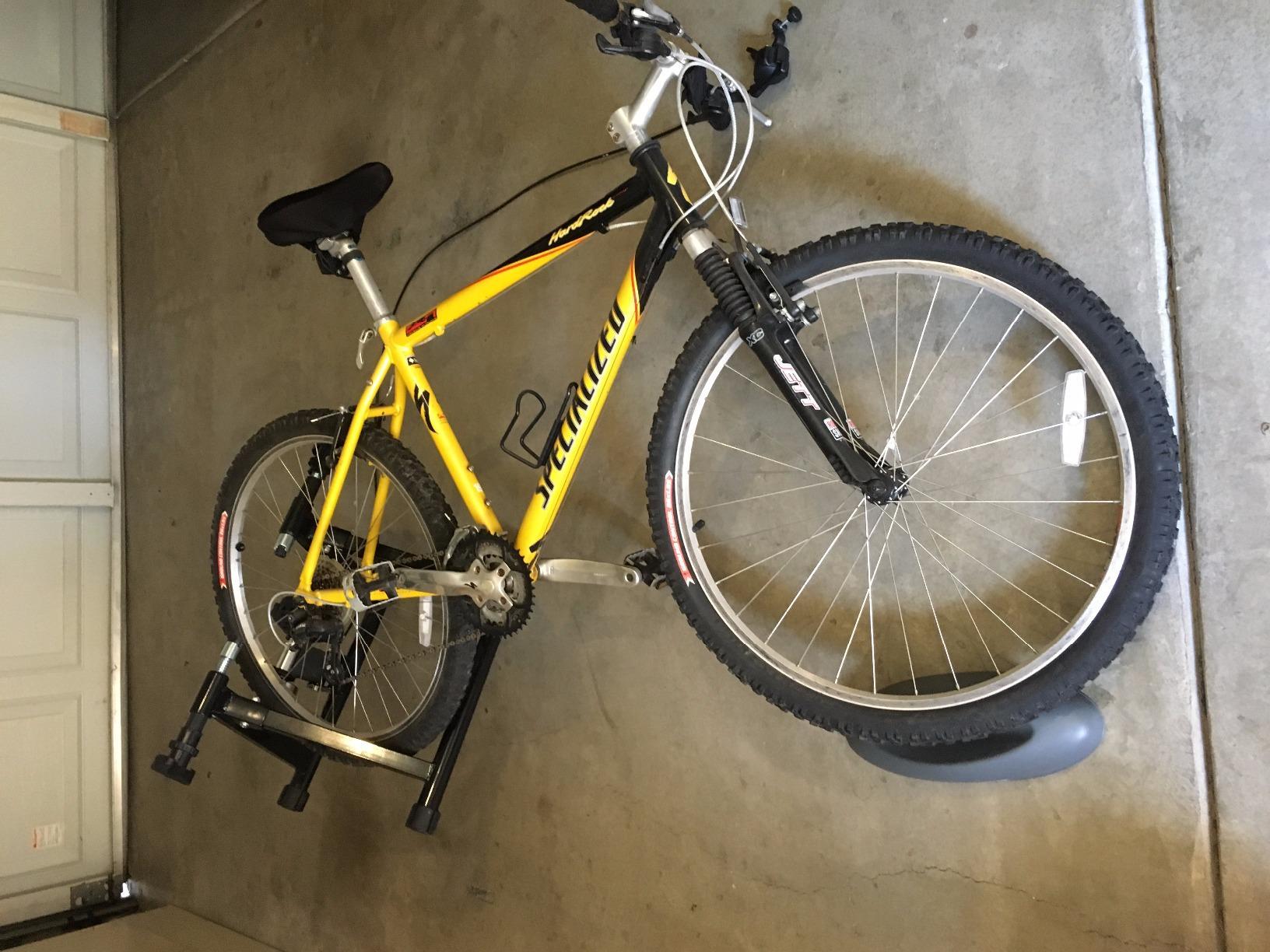
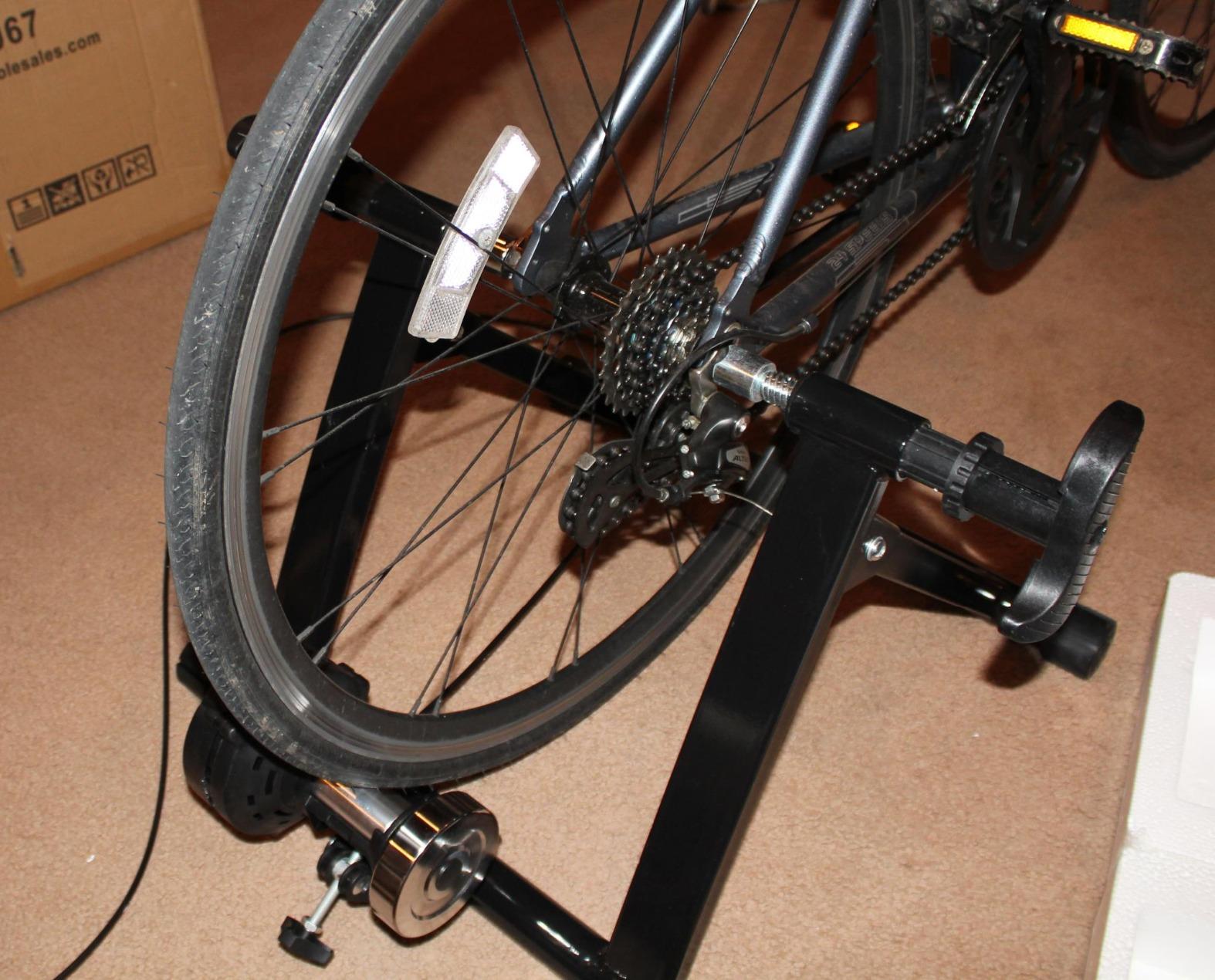
The noise-reduction wheel keeps it under 60 decibels at the lowest setting, and owners confirm it is noticeably quieter there. That is the honest framing, because the figure applies at low resistance and the character changes when you load it up for a steep simulated climb.
Wheel adjustment is listed from 66 cm to 700C, which on this listing reads as a narrower band than the 26-29 inch trainers further down. It folds for a corner or a car boot, and the frame is adjustable for wheel sizes across that range.
Check the warranty before you rely on it
Ninety days is short, and it is the main reason this lands below the BalanceFrom and Sportneer stands despite a similar rating. If the roller or the lock levers are going to fail, a 90 day window means you find out fast and have to start again.
It is also a heavy steel frame at 17.6 lb for a trainer that folds, which is more than most of the stands here. That weight is the price of the steel, and it is why we would not choose this one for a small flat where you have to move it between rooms regularly.
Where it is the wrong choice
Skip it if your sessions are long and your resistance is high, because the narrow range and the tire noise combine badly in that use. Riders who want to watch television and stay warm are the ideal case. Anyone doing repeats is not.
The instructions are minimal and reviewers note the amount of filler text in them. Budget an extra ten minutes and have a video ready, because the pictures alone left a few first-timers guessing.
4. Yaheetech magnetic steel bike trainer – quiet and level for small rooms
Yaheetech Magnetic Steel Bike Trainer Stand for Indoor Riding, 26-28in/700C
Magnetic resistance
13.8 lb
265 lb load capacity
Quick release skewer included
Pros
- Very quiet magnetic operation with slick tires
- Rotatable leveling feet caps handle uneven floors
- Lighter than most steel trainers at 13.8 lb
- Shock absorbing mounting fittings dampen resonance
- Good value for a quiet simple stand
Cons
- Quick release axles only with no thru-axle adapter included
- Load capacity is 265 lb which is low for the roundup
- No handlebar resistance remote so changes come from roller tension and gears
- Wheel compatibility tops out at 28 inch and 700C
Quiet is the word owners use most for this one, and the reason is structural rather than clever. The magnetic unit adds no mechanical noise of its own, so the only sound is tire against roller, and slick tires plus a carpet largely remove that too. At 13.8 lb it is also one of the lighter steel stands here, which matters when you are carrying it up a flight of stairs.
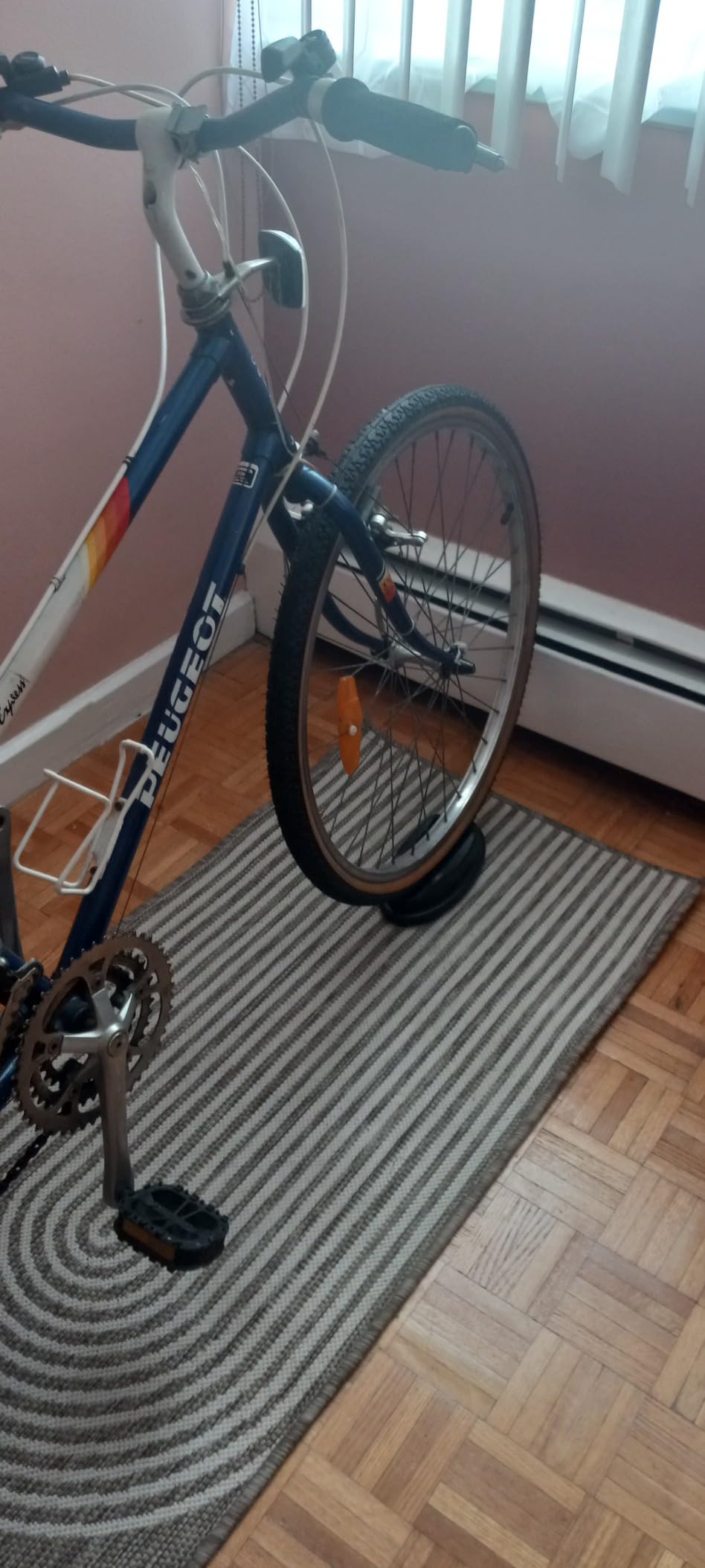
The rotatable leveling feet caps with varied-thickness teeth are a small detail that solves a real problem. Apartment floors and older timber floors are rarely flat, and a trainer that rocks is both unpleasant and loud. These let you level the base properly rather than shimming it with cardboard.
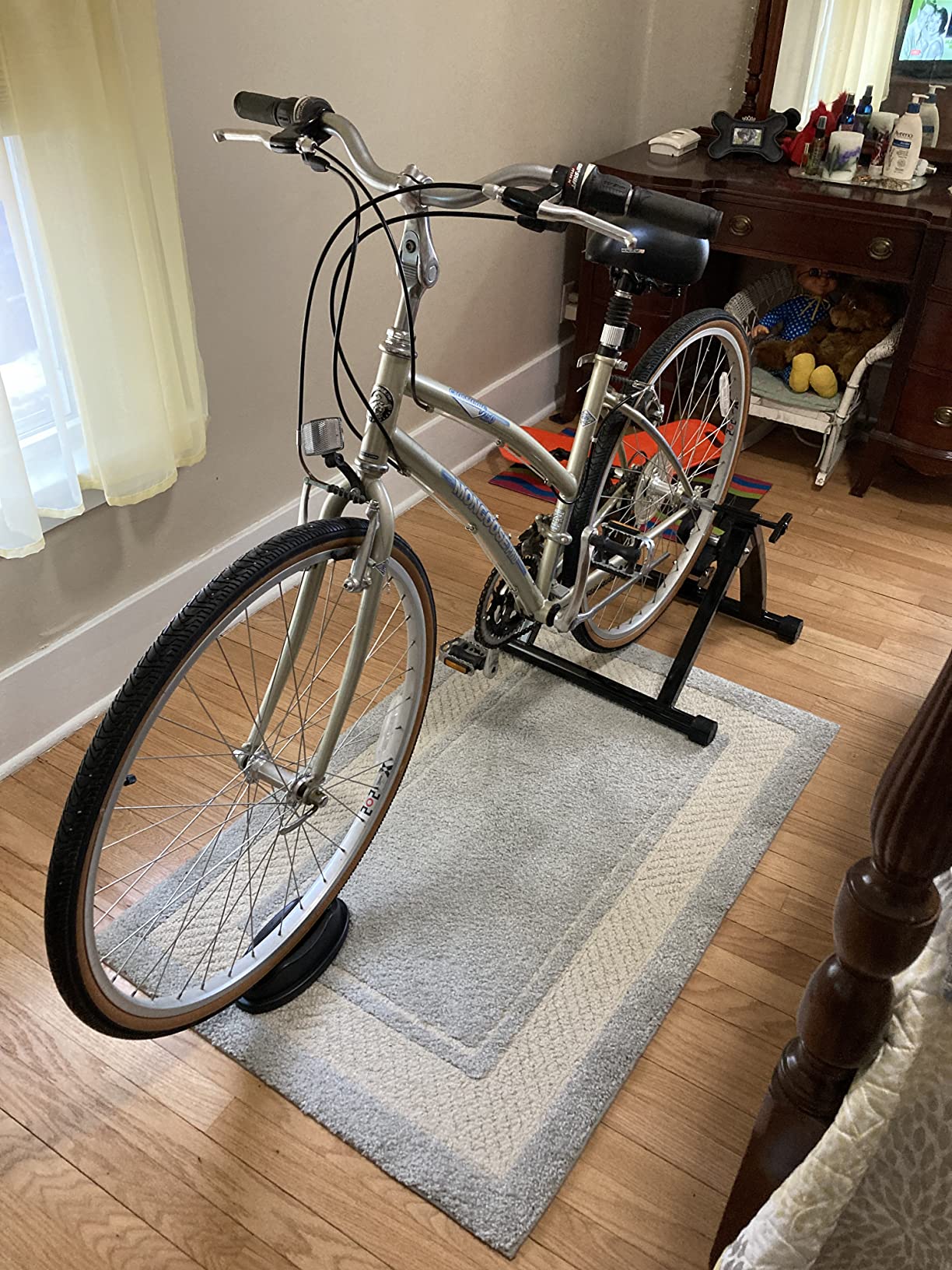
The shock-absorbing plastic in the universal mounting fittings buffers resonance from the frame, which is another quiet-focused design choice. Manufacturers of budget stands rarely think about vibration paths, and this one clearly did.
Resistance changes come from the roller tension and your bike gears, because there is no handlebar remote. That is a genuine step down in session control compared with the BalanceFrom or Sportneer magnetic stands, and it is the price of the lower weight and the quieter running.
Two specifications decide this one for you
The 265 lb load capacity is at the low end of the roundup, so check your own weight plus your bike before you commit. If you are near that line, the magnet will not be the limiting factor but the frame rating is what you are trusting.
Fitment is quick release only. The listing states that a thru-axle adapter is not included, so a 12 mm thru-axle bike needs a separate purchase. Wheel compatibility tops out at 28 inch and 700C, which excludes 29 inch mountain bike wheels.
Where it is the wrong choice
It is the wrong pick for a rider who wants mid-ride resistance control without getting off the pedals. Two dials, one at the trainer and one on the frame, is workable but slower than a bar-mounted remote.
It is also the wrong pick for larger wheels and heavier riders. If either applies, our [magnetic trainer comparisons](https://betterbike.org/best-magnetic-bike-trainers/) break down the load ratings and fit across the whole budget category.
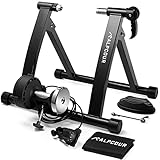
5. Alpcour foldable magnetic trainer – best for small spaces
Alpcour Bike Trainer Stand for Indoor Riding – Portable Foldable Magnetic Stainless Steel Indoor Trainer, Noise Reduction, 6 Resistance Settings & Bag – Stationary Exercise for Road & Mountain Bikes
Stainless steel frame
6 resistance levels
Foldable with carry bag
250 lb load capacity
Pros
- Stainless steel build owners describe as the sturdiest stand they have used
- Handlebar cable controller changes resistance without dismounting
- Folds down small and includes a carry bag
- Simple assembly of essentially one bolt and one cable
- Strong magnetic resistance at the higher settings
Cons
- Loud with knobby tires so a slick trainer tire is essential
- Skewer swap required and the clamp can seize on the skewer nut
- Narrower base legs can rock when standing up to climb
- Handlebar clamp is small and awkward on some bars
- Instructions do not show clearly which side the flywheel goes on
This is the one to buy if the trainer has to disappear into a cupboard between sessions. The frame folds down small, it comes with a free carry bag, and the whole point of the design is that a single person can move it without asking for help. The stainless steel construction is what owners praise most, describing it as the sturdiest stand they have used.
The handlebar-mounted cable controller is a real feature in this category. Most budget stands either put the adjustment on the frame or leave you to guess; this one changes six levels from the bars without dismounting, which makes a properly structured session possible even on a magnetic unit.
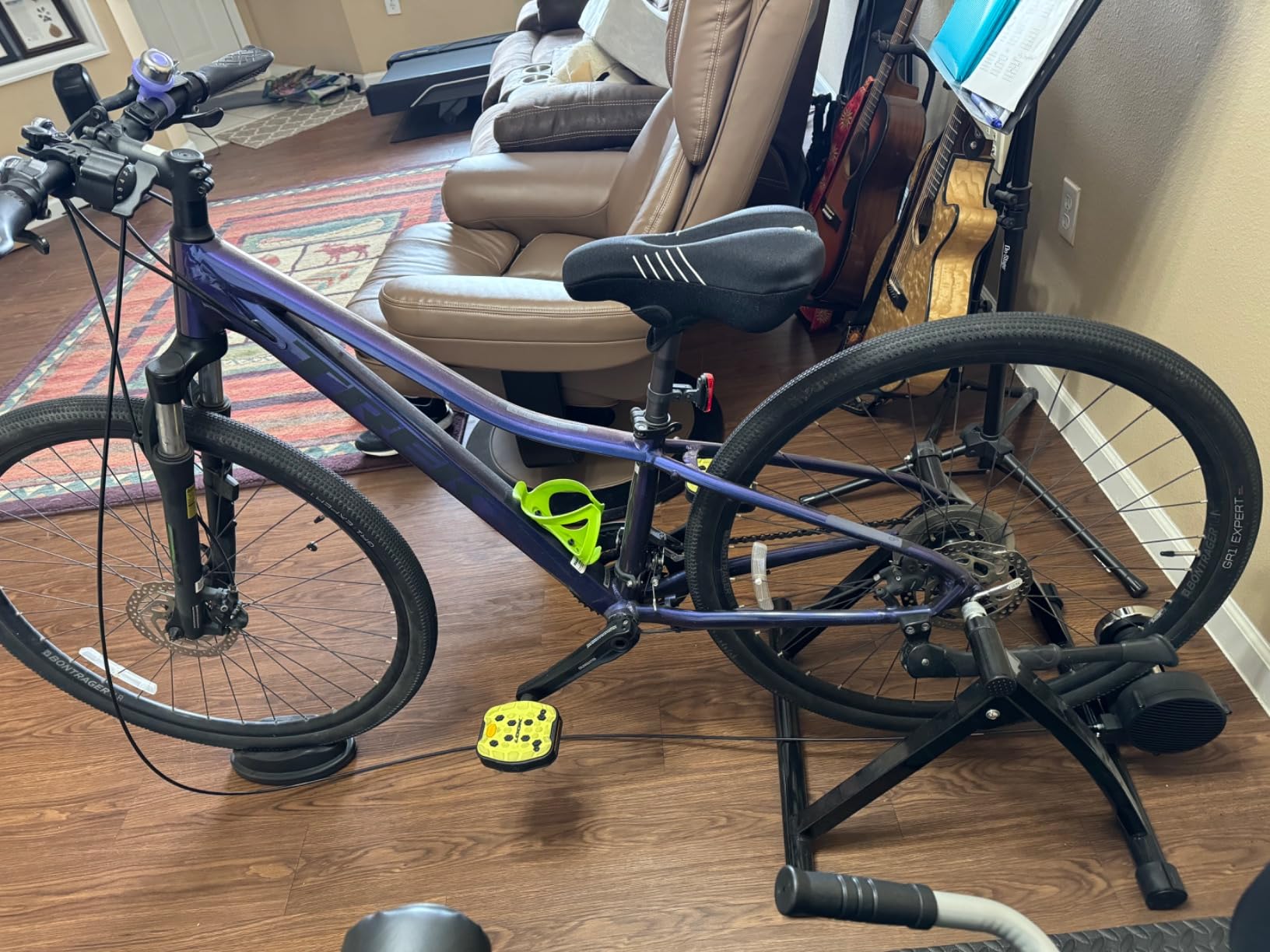
Assembly is close to one bolt and unwinding the resistance cable, and the quick lever release means no tools for mounting the bike afterward. The front wheel riser block and anti-slip rubber pads are both included, which is where a lot of budget stands cut corners.
At the higher magnetic settings the resistance is genuinely strong, enough to feel like a steep climb rather than a suggestion of one. The 250 lb load capacity is below the 300 and 330 lb figures on several stands here, so heavier riders should look at those instead.
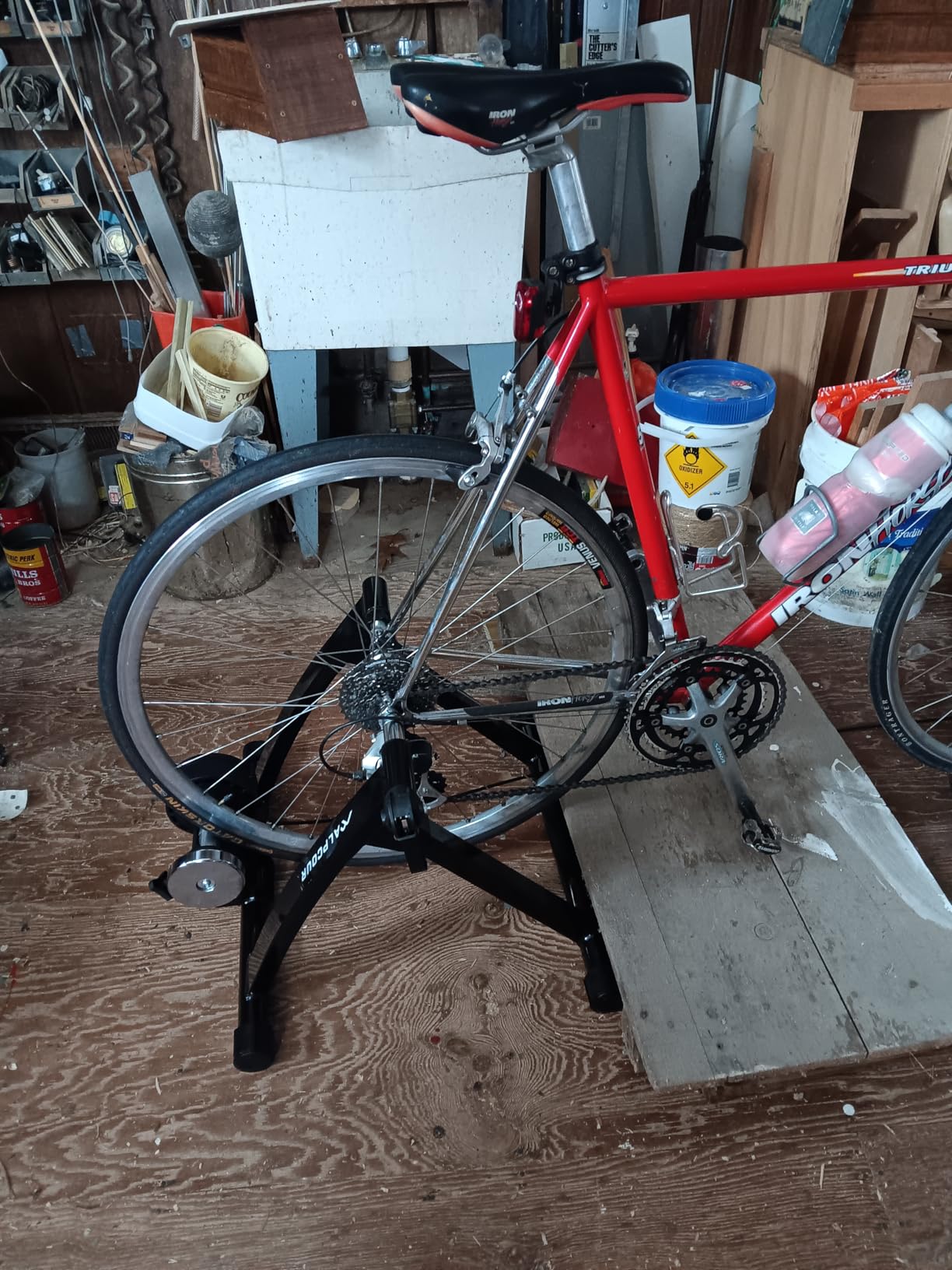
Fit it to a slick tire and it transforms
The most consistent complaint is noise with knobby mountain bike tires, and the fix owners recommend is the obvious one: mount a slick trainer tire. On a slick tire this stand is a different product acoustically, and the tire costs a fraction of what you would spend on a new trainer to fix the noise.
The skewer swap is the other thing to prepare for. The clamp can seize on the skewer nut, and several owners ended up needing Vise-Grips to release it. Treat the skewer as part of the kit, do not rely on the original nut, and you will not have a problem.
Where it is the wrong choice
The base legs are narrower than some competitors, so the unit can rock if you stand up to climb hard. If your training is mostly seated, you will not notice it. If you are a heavier rider who sprints out of the saddle, pick a wider base instead.
The handlebar clamp is small and awkward to fit on some bar shapes, and the instructions do not clearly show which side the flywheel goes on. Both are five-minute problems if you have assembled anything before, and real problems if you have not.
6. Sportneer fluid resistance trainer – smoothest road feel
Sportneer Fluid Indoor Bike Trainer Stand – Indoor Riding Cycling Exercise Stationary Bicycle Stands Trainers with Noise Reduction Wheel for Road Bike Black 21.3 x 7.9 x 25.2″
Fluid resistance unit
Alloy steel frame
24.3 lb
Fits 26-29 inch and 700C
320 lb load capacity
Pros
- Fluid resistance gives a smooth road-like feel compared with magnetic units
- Noticeably quieter than expected on smooth road tires
- Wide wheel compatibility at 26-29 inch plus 700C
- Sturdy stable frame with dual bike locking
- Folds flat for storage between sessions
Cons
- Instructions are sparse and rely on small photos
- Front legs cannot fully lock on 29 inch wheels
- Rough hole in the resistance wheel can cut very large tires
- Some examples arrived seized up and noisy
- Thru-axle bikes need a separately purchased thru-axle
Fluid resistance is the mechanical difference in this roundup. Instead of a magnet pulling against a steel wheel in discrete steps, a viscous fluid unit gives resistance that rises smoothly as the flywheel spins faster. Owners describe the ride feel as noticeably closer to riding outdoors, and the transition between resistance levels is gradual rather than abrupt.
It is also quieter than most budget magnetic stands on smooth road tires, which is why the fluid category is the usual answer for anyone worried about a downstairs neighbour. Our [guide to trainers for apartments](https://betterbike.org/best-indoor-bike-trainers-for-apartments/) goes deeper on the acoustic side.
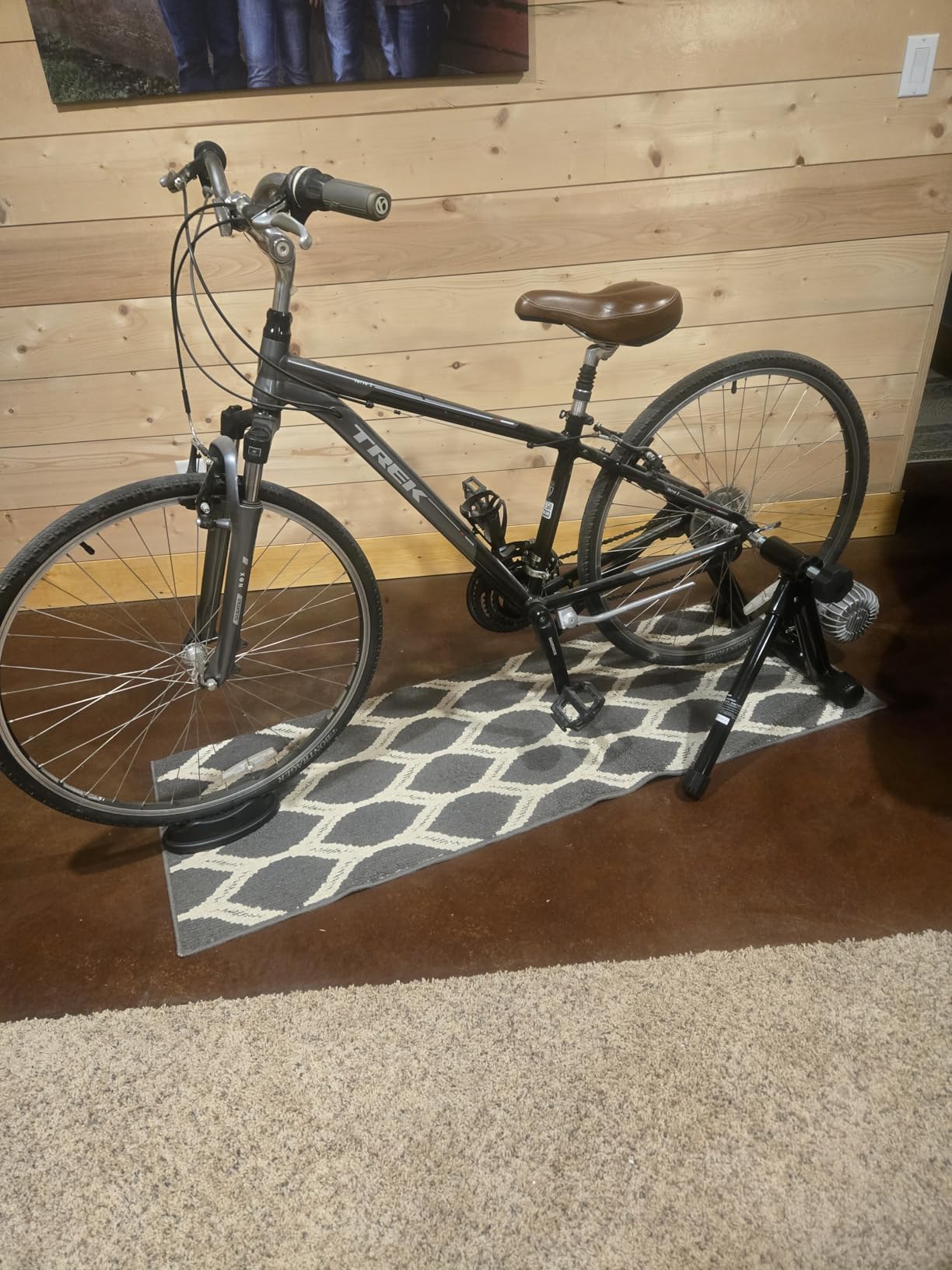
This is among the widest wheel compatibility in the roundup at 26-29 inch plus 700C, folding down to roughly 24 by 8 by 25 inches, and the stated rider rating is 320 lb. The dual locking system plus the extra wide frame and the front riser block are there specifically to kill wobble, and owners confirm the bike sits still.
Tool-free assembly is a genuine advantage over stands that need an Allen key every time. Folding flat between sessions matters in a small room, and at 24.3 lb it is one of the heaviest stands here, so folding does not mean carrying it up stairs alone.
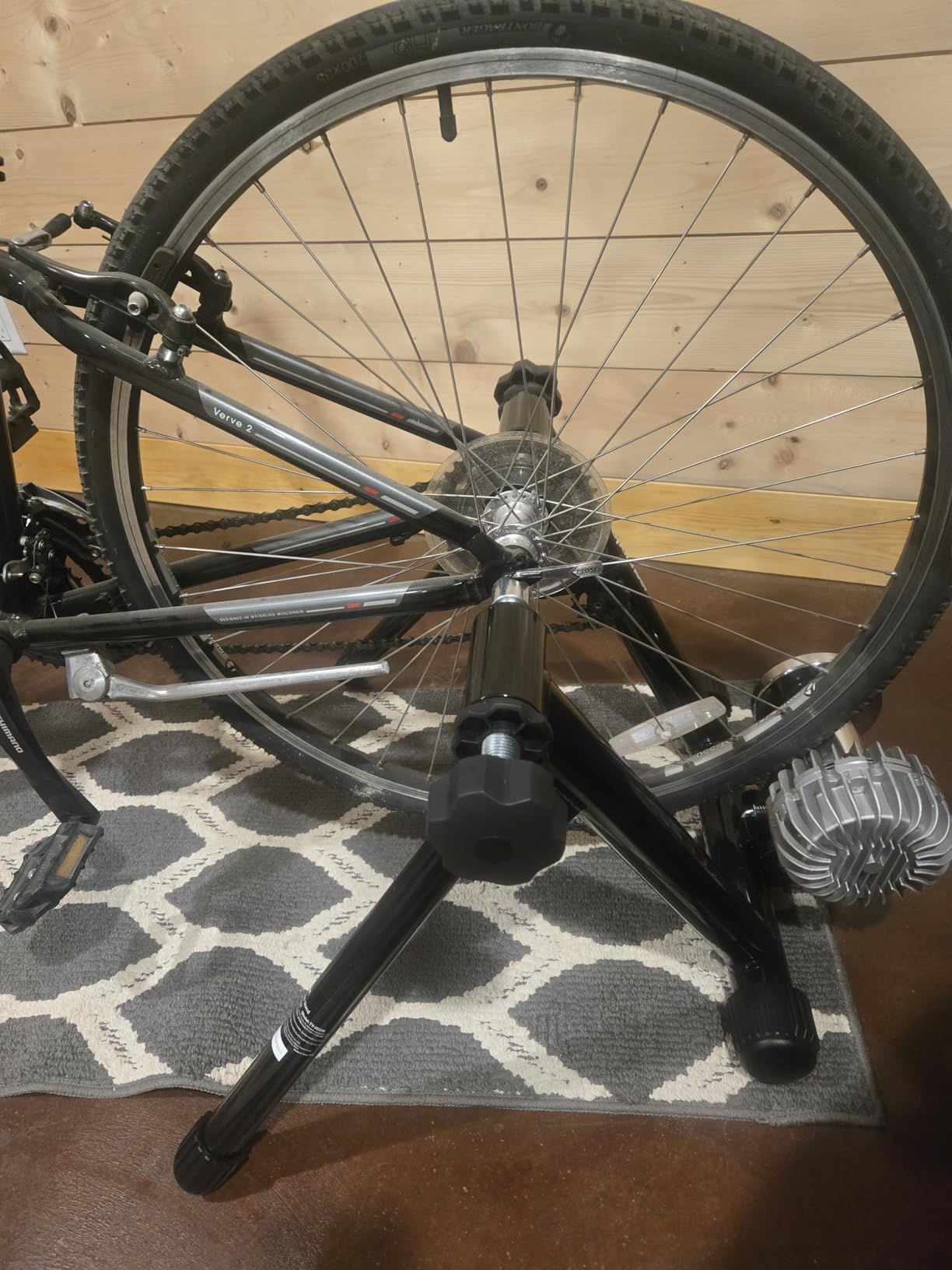
Two fitment details that catch people out
The front legs cannot fully lock on 29 inch wheels, so check tire clearance if you plan to run the stand on a soft mat. The mat is a good idea anyway, but a wheel that cannot clamp properly is a safety problem, not a comfort one.
There is also a rough hole at the center of the resistance wheel that can cut very large tires. It is not an issue on standard road or trail widths, but if you run a plus-size tire, look at it before your first long ride.
Where it is the wrong choice
Thru-axle bikes need a separately purchased thru-axle, and the quick release skewer in the box will not do the job. That is an extra purchase and an extra step, so confirm your axle type first. It also folds to a shape that stores but does not travel as neatly as the Alpcour in its bag.
The instructions are sparse and lean on small photos, so give yourself time. Sportneer’s after-sales support is a genuine strength here and appears repeatedly in reviews, including a replacement unit for a noisy first example.
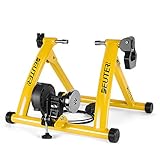
7. CXWXC magnetic stationary stand – best for 29 inch wheels
Bike Trainer, Magnetic Bicycle Stationary Stand for Indoor Exercise Riding, 26-29″ & 700C Wheels, Quick Release Skewer & Front Wheel Riser Block Included
6 magnetic resistance levels
Pyramid frame structure
Fits 26-29 inch and 700C
330 lb load capacity
Pros
- Best average rating in the roundup at 4.5 stars
- Pyramid frame shape gives good stability for the price
- Folds in about a minute with a simple quick clamp
- Handlebar controller switches 6 levels easily
- Wide fit at 26-29 inch plus 700C with a thru-axle variant available
Cons
- Noisy and resonant with knobby MTB tires
- Listings show a mismatched frame material of plastic versus alloy steel
- Little documented detail on weight or folded dimensions
- Generic unbranded product with sparse specification data
This stand has the highest average rating in the group at 4.5 stars, and the reason is the pyramid frame. A wide base tapering to a narrow top gives lateral stiffness that flat-legged stands cannot match, and it is why owners report solid stability for the money. The 330 lb rating is among the higher figures here.
Setup takes about a minute. The frame folds with a quick clamp and no tools, and the handlebar drive-by-wire controller handles 6 resistance levels. In practice that is a fast bike-in, bike-out cycle, which is the feature that matters most for a shared trainer.
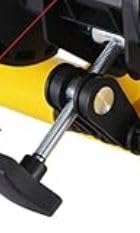
The polished roller is designed to minimize vibration, and with smooth tires on carpet the unit is quiet for a magnetic stand. That recommendation appears in the product documentation itself rather than only in reviews, which is a good sign the manufacturer understands the acoustics.
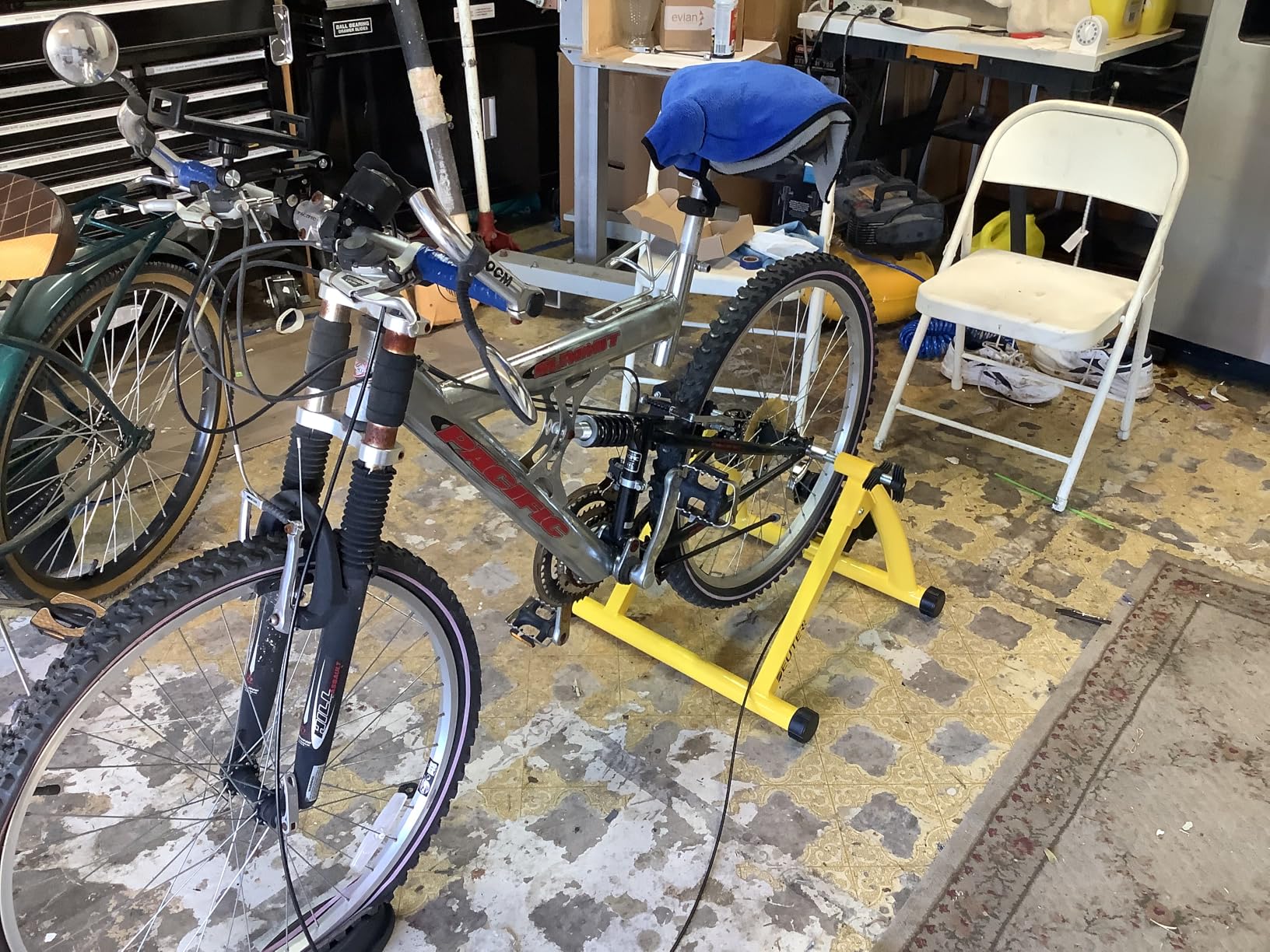
Fit runs 26-29 inch including 700C, and a thru-axle variant exists. That matters more than it sounds, because most budget stands are quick release only and quietly exclude anyone on a modern thru-axle bike.
Ask about the specification data before you buy
This is an unbranded product and the listing is thin. The frame material is shown inconsistently as plastic in one field and alloy steel in another, and weight and folded dimensions are simply not listed. If those numbers matter to your storage plan, contact the seller and get an answer before committing.
On a product with under 1,000 reviews, that is not a reason to skip it. It is a reason to know what you are getting. The 4.5 average across those reviews is genuine, and the stability reports are consistent.
Where it is the wrong choice
Knobby mountain bike tires make it loud and resonant, and the documentation recommends smooth tires or carpet to fix it. If your only bike is a trail bike and you will not change the tire, pick a fluid unit instead.
It also offers nothing to an app-driven rider beyond the resistance levels, since there is no connectivity of any kind. If you want your training data in Zwift or TrainerRoad, this is not the product.
8. Saris M2 smart indoor trainer – best for Zwift
Saris M2 Smart Indoor Bike Trainer, Compatible with Zwift App, Black, Made in the USA
Electromagnetic resistance +/- 5 percent
ANT+ FE-C and Bluetooth
Zwift certified
20 lb, 300 lb capacity
Pros
- Electromagnetic resistance gives consistent app controlled workouts within 5 percent
- Dual ANT+ FE-C and Bluetooth works with Zwift and Rouvy
- Zwift certified with a month of Rouvy included
- Wheel-on design so no wheel removal or drivetrain work
- Limited lifetime warranty
Cons
- Noticeably higher one-star rate at 13 percent
- 69 dB at 20 mph is louder than the fluid trainers
- Louder electromagnetic unit adds little if you do not train with apps
- No handlebar resistance control unit in the base package
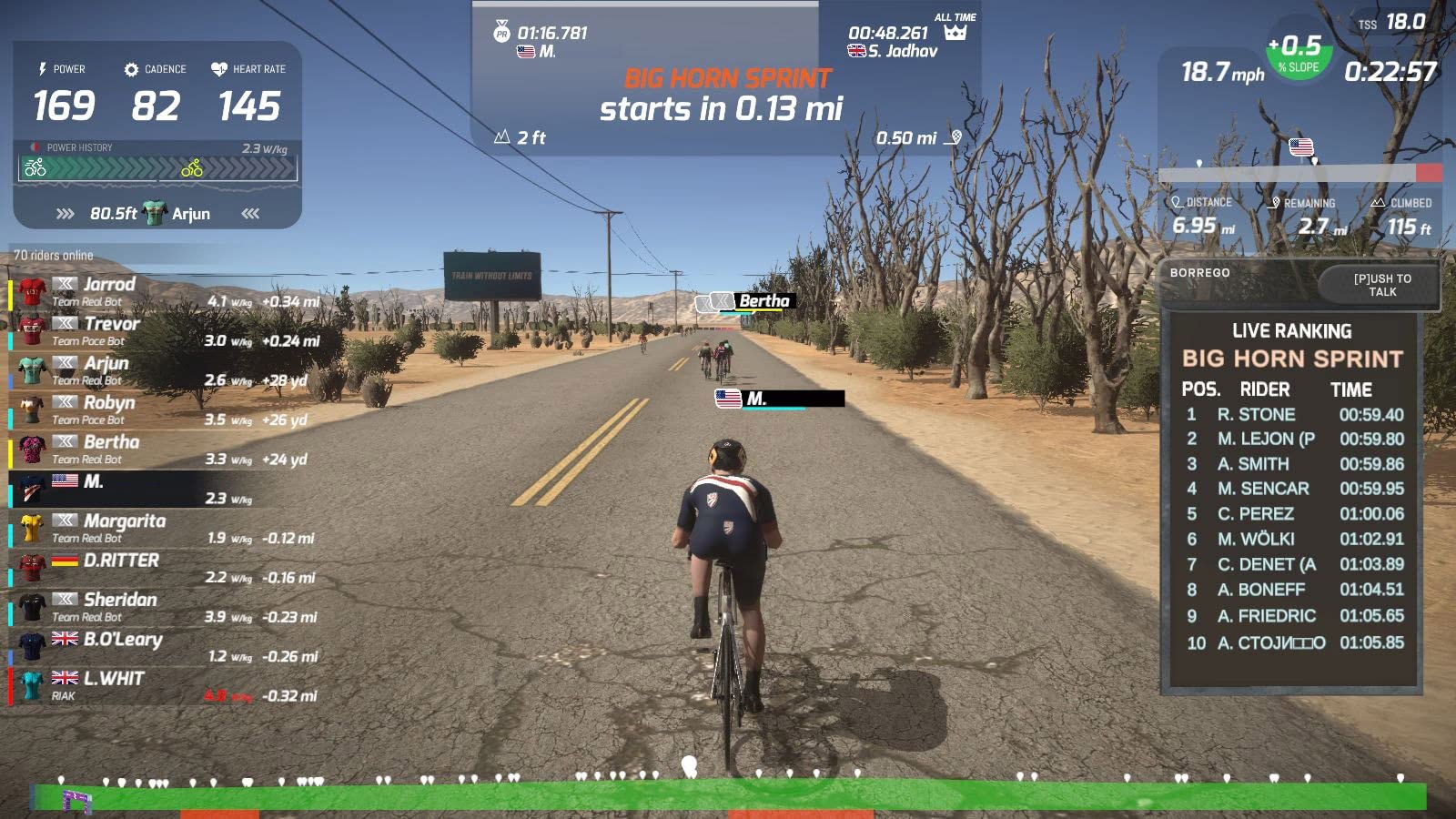
This is the only trainer in the roundup with true controllable resistance, and that single fact changes what you can do with it. Electromagnetic resistance is set by software rather than by moving a magnet, so the unit holds a target wattage within 5 percent and responds to ERG mode requests from your training app. If you follow a power-based plan, nothing else on this list does that.
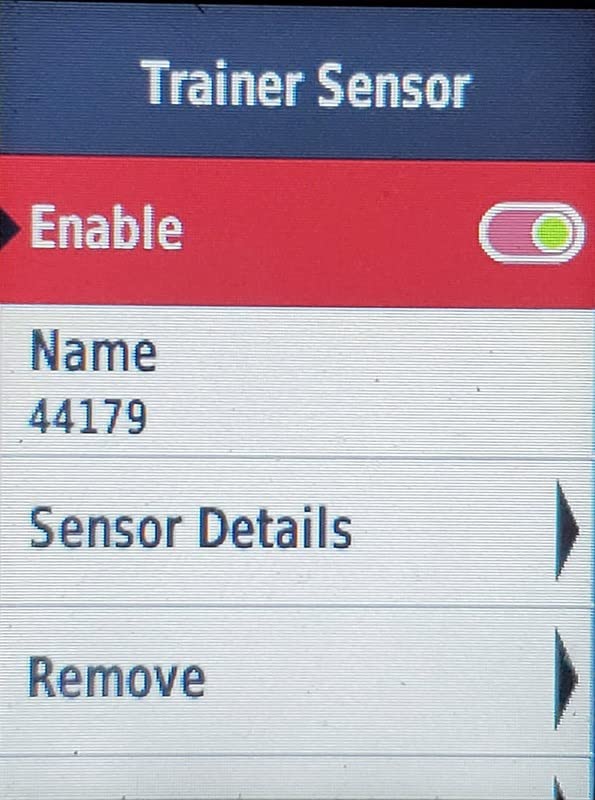
Connectivity is dual ANT+ FE-C and Bluetooth, it is Zwift certified, and a month of Rouvy is included. Pairing is fast in practice. Owners using Zwift or Rouvy praise the accurate, repeatable resistance and the quick Bluetooth and ANT+ setup in the same breath.
The wheel-on design means the rear wheel stays on and you never touch the drivetrain, which is a real advantage in an apartment where a cassette swap is a hassle. A steel quick release skewer is included for common road and mountain frames.
The limited lifetime warranty is among the longest in the roundup. That matters on a product with a motor in it, and it partly offsets the fact that the rating here is lower than several cheaper stands.
Noise is the trade you make for ERG mode
The stated 69 dB at 20 mph is louder than the fluid trainers in this roundup, and it is an electronic unit so the fan and the motor are always present. If you live in a flat with a downstairs neighbour, read our [winter training guide](https://betterbike.org/best-bikes-trainers-for-winter-training/) on placement before you commit.
The one-star rate is 13 percent here, which is higher than any magnetic stand on the list. Owners without an app-driven workflow find the premium hard to justify, and the quality and noise complaints are more common on this unit than on the cheap stands.
Where it is the wrong choice
If you intend to watch television and stay warm rather than train by numbers, this trainer does not earn its cost. You are paying for controllable resistance you will never use. Riders on a structured plan or racing on Zwift are the exact audience it was built for.
There is also no handlebar resistance control in the base package, so manual overrides happen in the app rather than at the bars. Thru-axle riders should also check what hardware they need before ordering, since only the quick release skewer is in the box.
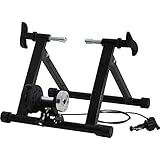
9. FDW carbon steel magnetic stand – best simple starter
Bike Trainer Stand for Indoor Riding, Bicycle Exercise Training Stand with Magnetic Flywheel,Noise Reduction,5Resistance Settings Stationary Bike Resistance for Road
5 magnetic resistance levels
Carbon steel frame
300 lb load capacity
Folds for storage
Pros
- Low entry price with 5 usable resistance levels
- Sturdy and stable once assembled across a range of rider sizes
- Folds down for a car boot or a room corner
- Simple adjustments that are easy to make
Cons
- Very thin or missing instructions and several owners needed an assembly video
- Moderate squeak from the rear tire that is annoying indoors
- Loose lock levers and a cheap plastic roller housing on some examples
- Only a 90 day warranty
This listing shares its price and 5-level magnetic design with the other FDW stand in this roundup, so the honest way to tell them apart is by the documented build detail. This one is listed in carbon steel with a 300 lb rating and a noise-reduction flywheel.
Owners split more sharply on this listing than on any other here. A large group describes it as a great first trainer that gets someone back into shape after a winter off the bike, and that is exactly the right use for it. The 5 levels run from flat road to climb, and the adjustments are simple to make once it is assembled.
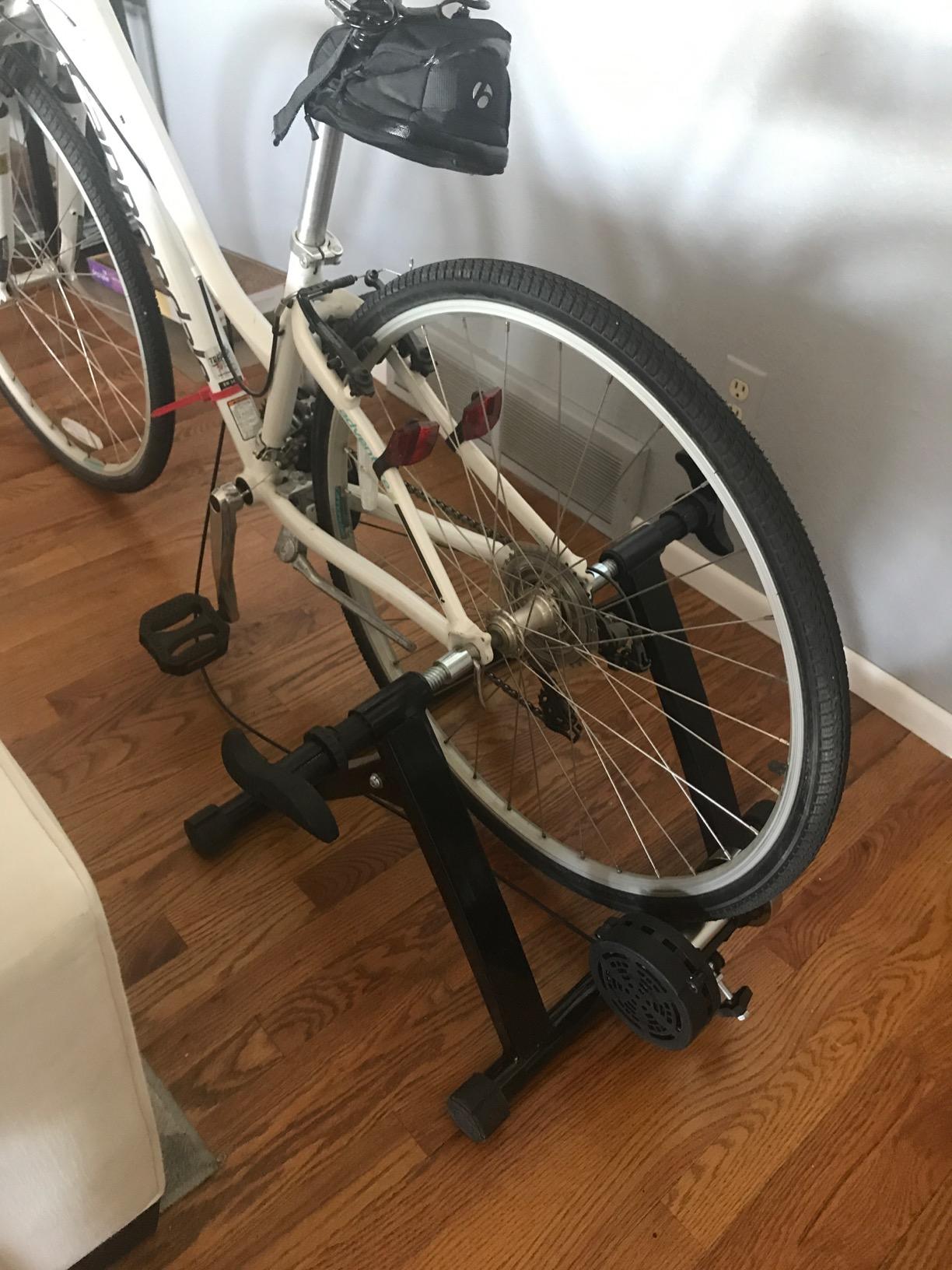
There is a noise-reduction flywheel that keeps the unit under 60 decibels at the lowest setting. As with the other FDW stand, that figure applies at low resistance, and owners still report a moderate squeak from the rear tire that is annoying indoors.
The frame folds for a corner or a car boot, and assembly takes about 15 minutes with few parts. That combination means you can store it out of the way and still get it out for an evening session without much fuss.
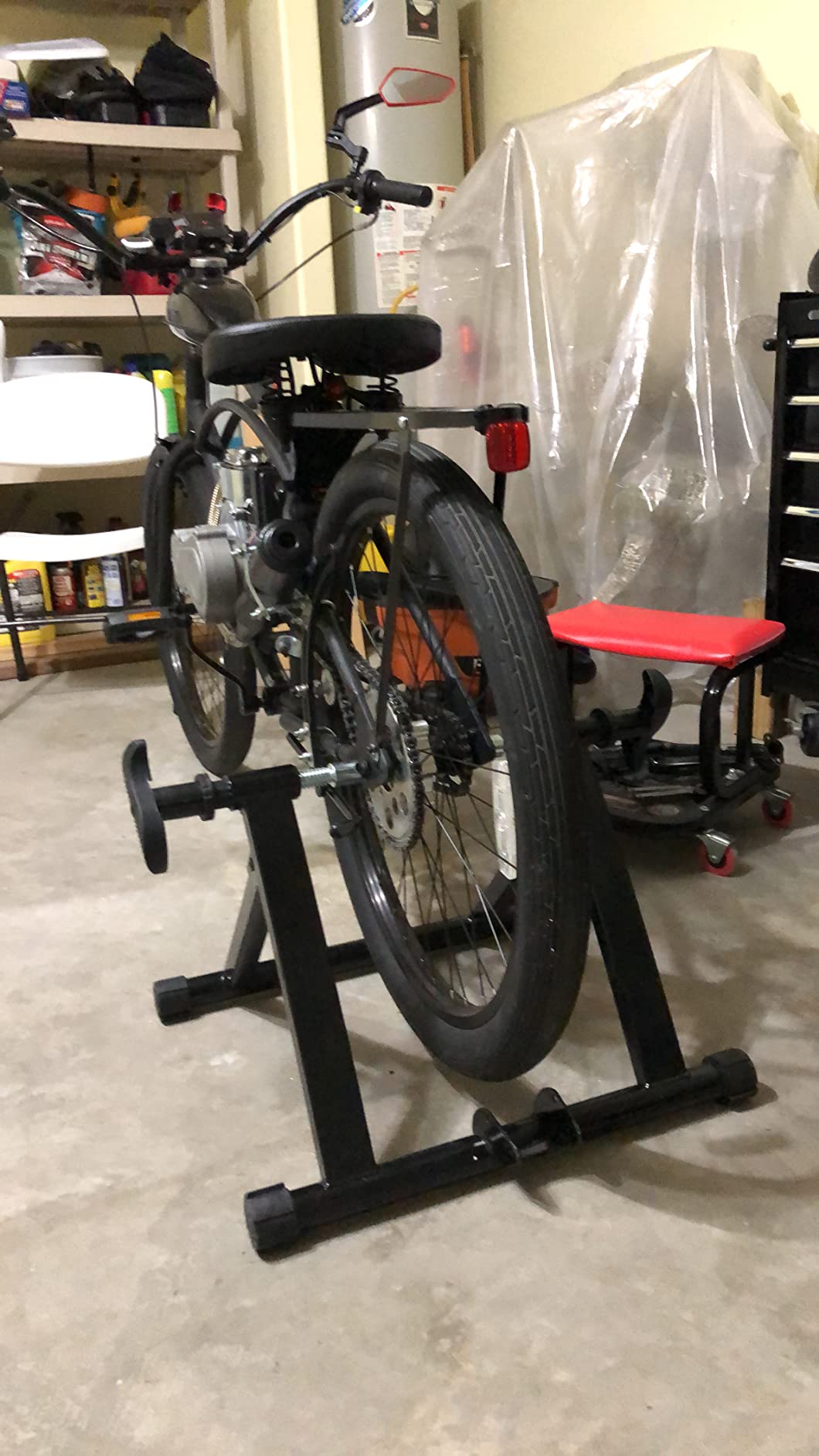
Check the assembly hardware before your first ride
Owners report loose lock levers and a cheap plastic roller housing on some examples, plus one report of a mis-installed shift cable. None of those are design flaws, but all of them are assembly checks worth ten minutes of your time before you turn the resistance up.
Instructions are the universal complaint. Several owners had to find an assembly video to get started. Have one open on your phone before you unpack the box and you will avoid the whole problem.
Where it is the wrong choice
At five levels with no handlebar remote, this is a trainer for steady-state riding. It is the wrong tool for intervals, and it is not quiet enough for a downstairs neighbour who complains about the squeak.
The 90 day warranty is among the shortest here. If you buy it, test it properly inside that window, because a failure after three months means replacing it rather than repairing it.
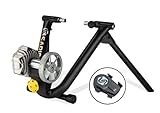
10. Saris Fluid2 Smart Equipped – best smart fluid trainer
Saris Fluid2 Smart Equipped Indoor Bike Trainer, Includes Speed Sensor, Made in The USA
Progressive fluid resistance
Speed and cadence sensor included
7.3 lb
Limited lifetime warranty
Pros
- Progressive fluid resistance with the widest road-like range in this roundup
- Soft whirring sound owners say you can watch television over
- Light at 7.3 lb and folds flat for travel and small apartments
- The wheel stays on the bike and no drivetrain changes are needed
- Speed and cadence sensor pairs quickly with Zwift and Rouvy
Cons
- Assembly can be very difficult with some examples needing a mallet
- Reports of globby misaligned welds and poor finish quality
- A few examples arrived with an incomplete sensor
- Cheap front wheel riser leaves riders leaning forward with sore wrists
- Thru-axle bikes require a separate adapter
This is the bridge between the two halves of this roundup. It is a fluid trainer, so the resistance is smooth, progressive and quiet, and it includes a speed and cadence sensor so your ride still shows up in Zwift, Rouvy and the other indoor cycling apps. One month of Rouvy is included. It is not ERG mode, but your power and cadence data appears in the app either way.
The resistance range is the widest of the fluid options here and owners single out the road-like feel. The sound is described as a soft whir you can watch television over without turning the volume up, which is the single most-quoted benefit in the reviews.
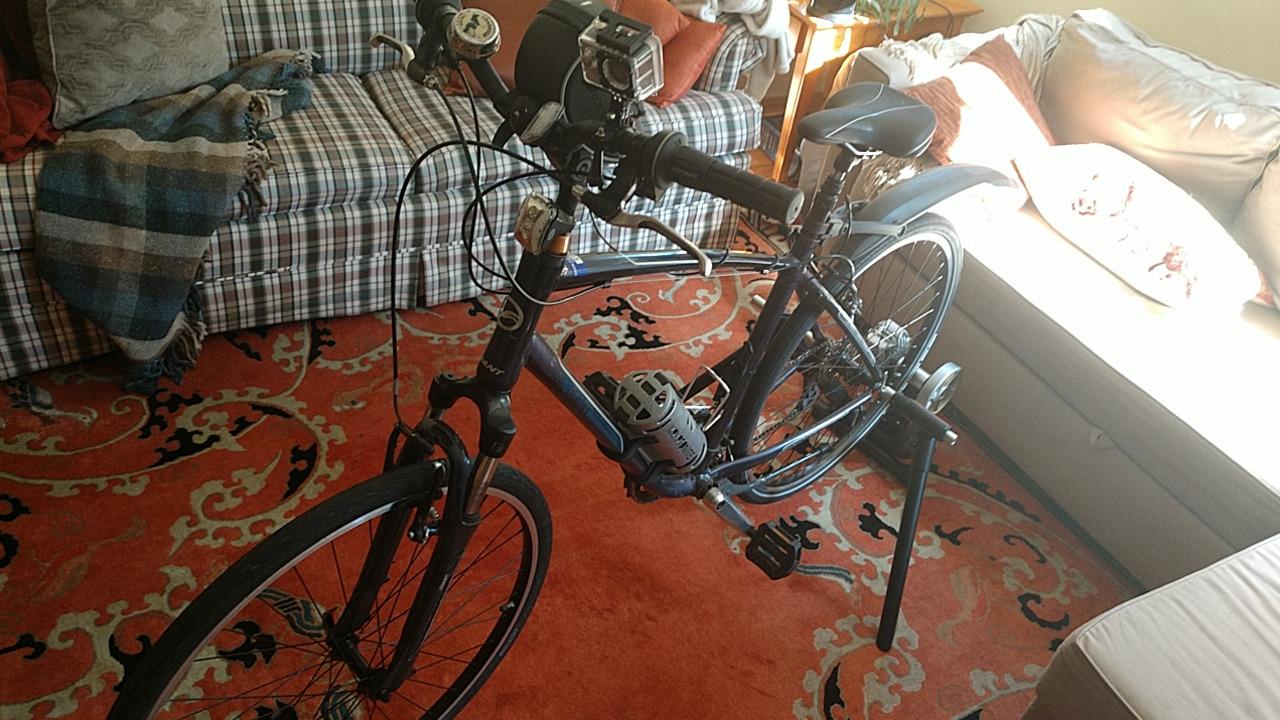
At 7.3 lb it is one of the lightest trainers in the roundup, it folds flat, and it packs small enough for a hotel room on a work trip. The wheel-on design means the wheel stays on the bike and no drivetrain changes are needed, and the leveling block and cooling airflow system are built in.
Long-term owners report hundreds of miles with no fluid leaks, and the limited lifetime warranty covers the unit. For a rider who wants fluid feel plus app data but does not need ERG mode, nothing else in this category does both.
Budget real time for assembly
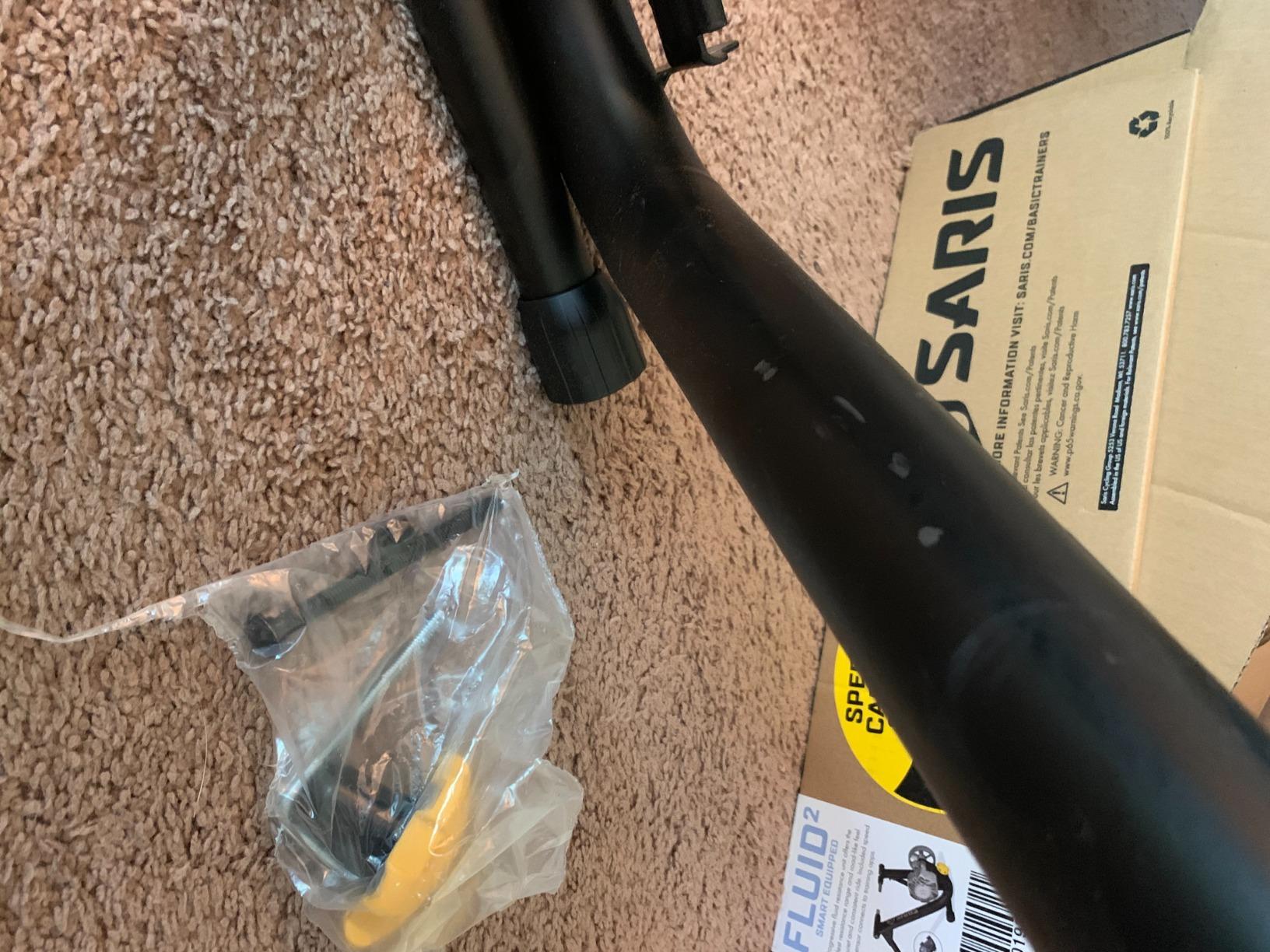
Assembly is the dominant complaint. Multiple reviewers needed a mallet to seat the action and the frame bolts together, and a few returned the unit over poor weld finishing. The quick release skewer is included, but the fit of the frame itself is the hard part.
A few examples also arrived with an incomplete speed and cadence sensor, which matters because the sensor is the reason to buy this model over a plain fluid stand. Open the box and confirm it is complete before you assemble anything.
Where it is the wrong choice
The cheap front wheel riser is a real ergonomic problem. Owners report leaning forward and ending up with sore wrists after long sessions. It is fixable with a better riser block, but that is another purchase on a trainer you chose for value.
Thru-axle bikes need a separately sold adapter in 142×12 mm or 148×12 mm. If you ride a modern Boost or thru-axle road bike, factor that into the decision. Our [fluid trainer guide](https://betterbike.org/best-fluid-bike-trainers/) compares the fitment across the category.
Direct drive vs wheel-on: why every trainer here is wheel-on
A direct-drive trainer replaces your cassette with the trainer’s own body, driven by a motor, and reports power by measuring torque and cadence. It is quieter, more accurate and holds a target wattage without any help from you. It is also the reason none of the trainers in this roundup are direct drive, because at this budget a direct-drive unit is out of reach.
What you get instead is a wheel-on stand. A magnet, a fluid or an electromagnetic unit acts on your rear wheel, and control happens through your own legs and your gearing. The trade is real but narrower than the marketing suggests: you lose automatic resistance control, and you gain a much smaller box, no drivetrain disassembly and a far lower outlay.
The one exception in this list is the Saris M2. It is still wheel-on, but its resistance is electronically controlled, which recovers the ERG mode and repeatable power sessions that a direct drive would give you. That is the closest thing under 500 dollars to the direct-drive experience, and it is why it is our smart pick.
When wheel-on is genuinely the right answer
Riders on internal gear hubs, bikes with hydraulic or electronic shifting and anyone who does not want to swap a cassette will find wheel-on easier rather than a compromise. So will anyone whose bike lives on a hook in a hallway and gets carried to a trainer in the living room three times a week.
Riders chasing a virtual climb with a gradient target should note that no wheel-on unit in this roundup simulates gradient properly, apart from the M2 through ERG mode. If downhill simulated riding matters to you, that is a reason to save for a direct drive.
Smart vs basic: what app connectivity actually gets you
A basic trainer adds load and nothing else. You pick the resistance and stay there. A smart trainer connects over ANT+ FE-C or Bluetooth and adds controllable resistance, ERG mode and structured power workouts. Only two products in this roundup are genuinely smart: the Saris M2 and the Saris Fluid2 Smart Equipped.
They deliver different things. The M2 gives electronically controlled resistance within 5 percent, ERG mode and Zwift certification, so your app can change the load for you mid-session. The Fluid2 gives smooth fluid resistance plus a speed and cadence sensor, so your power and cadence land in the app but the load does not change on its own.
Match the trainer to the training, not the trend
If you follow a structured plan with power targets, follow sessions or race on Zwift, the M2 is the trainer that supports it. If you mostly ride steady state, watch something on the television and want the smoothest, quietest ride, the Fluid2 gives you better mechanics for less money.
If you are somewhere in between, a bar-mounted remote on a magnetic stand is enough. You can run your own intervals by shifting into a harder gear and raising the magnet, and you keep the option to add a cadence sensor later for a few pounds.
Noise and apartment living: the quietest trainers under 500 dollars
Noise in a trainer is tire against roller plus whatever the resistance unit itself makes. The numbers below are the manufacturers’ own figures, at the speed or setting each one specifies, so compare them with that caveat in mind. Only the FDW stands publish a figure at the lowest setting, which is where they are quietest.
FDW stands: under 60 decibels at the lowest resistance setting.
Saris M2 and Saris Fluid2: 69 decibels at 20 mph, with a motor or fan running in the M2.
Magnetic stands generally: no figure published, but owners consistently describe a drone that is louder with knobby tires and quieter with slick tires on carpet.
Fluid stands generally: no figure published, but owners describe a hum rather than a roar, which is why fluid is the default recommendation for shared walls.
The practical ranking is simpler than the numbers suggest. If you live under someone, fluid beats magnetic. Within fluid, a slick tire and a mat beat a knobby tire and bare boards. And the biggest single improvement for almost any budget trainer is a slick trainer tire, which costs a fraction of the trainer itself.
Rider weight also drives the sound up. A 300 lb rider spinning a wheel on a roller produces more resonance than a 70 kg rider in the same gear, and a trainer with shock-absorbing fittings handles that better than one without. The Yaheetech, with its damped universal mounts, is the one to look at if you are heavier and noise-sensitive.
What it really costs to own: the add-on budget
The price on the box is the smallest part of owning a trainer. These are the extras that under 500 dollar buyers routinely forget, and each one is cheap on its own but adds up fast.
A thru-axle adapter, if you need one. The Sportneer magnetic, Yaheetech, Sportneer fluid and Saris Fluid2 all include a quick release skewer only. Check your axle type first. Without the right adapter the trainer simply will not take your bike.
A slick trainer tire. The single biggest improvement to noise and to how smooth the ride feels. It is the one accessory we would tell every buyer to get.
A floor mat. A thick mat protects the floor, dampens vibration and gives a leveling surface. It matters most on wood and in flats where downstairs neighbours are a concern.
A cadence or speed sensor, if your trainer does not have one. A basic magnetic stand with a handlebar remote gives you no app data at all until you add one.
A fan. Every trainer heats the air in the room, especially the fluid and electromagnetic units. A cheap fan makes the difference between training and overheating in summer.
A bike riser block, if yours did not include one. Several stands in this roundup do include it, and the ones that do not leave you riding nose-down with sore wrists.
None of that is a reason not to buy at this budget. It is a reason to buy from a list that says what is in the box, which is why every specification in this guide spells out the included skewer and riser block.
How to choose a bike trainer under 500 dollars
Start with the question that decides everything else: do you train by numbers or do you just want to ride? If you follow a power plan or race on Zwift, start with the Saris M2 and stop reading. If you want to stay warm and watch television, the rest of this list is in play and you can spend the difference on a slick tire and a mat.
Second, check your axle. Quick release is the default across this category and cheap stands assume it. A 12 mm thru-axle bike needs an adapter or a specific variant, and the CXWXC and the Sportneer thru-axle version are the two here that address it directly.
Third, check the wheel size. A 29 inch mountain bike or a plus-size tire will not fit every stand. The Sportneer fluid and the CXWXC both cover 26-29 inch plus 700C, which is the broadest range in the roundup, and the Yaheetech stops at 28 inch.
Fourth, check the load capacity against your own weight and your bike’s. The range here runs from 250 lb on the Alpcour to 330 lb on the BalanceFrom and CXWXC. Nobody weighs a trainer wrong, but people are surprised by it.
What each price band buys
Under 100 dollars you get a steel magnetic stand with 5 or 6 levels, a fold-flat frame and a 1 year or 90 day warranty. This is the right band for a first trainer, a second trainer for a spare room, or a rider who wants a trainer for four months of the year.
Between 100 and 200 dollars you get better materials, a carry bag, wider wheel compatibility and the first app-connected options. The Alpcour, the Sportneer fluid, the CXWXC and both Saris models all sit in or around this band, and it is the sweet spot for a rider who will use their trainer regularly.
Above 200 dollars and under 500 dollars, the real choice is the Saris M2 for controllable resistance, or a better mechanical stand with a lighter frame and wider fit. Very little else in this band changes the fundamental experience, which is the honest limit of a 500 dollar ceiling.
What 500 dollars does not buy you is worth saying plainly. Direct-drive trainers from Wahoo, Garmin and Elite sit well above this ceiling, and with them come the accuracy, the silence, the gradient simulation and the auto-calibration that people mean when they talk about the best trainers. Nothing in this roundup simulates a descent. If that matters, save up.
One more thing before you order
Check the floor. A trainer is only as stable as the surface under it, and levelling feet matter more on old timber floors than any specification on the box. The Yaheetech has rotatable levelling feet caps with varied thickness teeth, which is the simplest fix for an uneven floor in this roundup.
And think about the bike swap. If more than one person will use the trainer, or if you will swap between a road and a mountain bike, a quick release clamp saves you minutes every session. The press-down lever on the Sportneer magnetic and the folding quick clamp on the CXWXC are the two that reviewers single out for this.
Frequently Asked Questions
What is the best affordable indoor bike trainer?
The BalanceFrom magnetic stand is the best affordable trainer under 500 dollars, and also the most proven. It carries 14k+ owner reviews at a 4.2 average, folds away in about 8 kg, includes the front wheel riser block that rivals sell separately, and has a 330 lb load capacity. Riders who want controllable resistance should look at the Saris M2 instead, which is more expensive but the only trainer on this list with ERG mode.
What is the best budget bike trainer?
For the lowest sensible entry point, the FDW magnetic stand gives you a steel frame, 5 resistance levels, a noise-reduction wheel under 60 decibels at the lowest setting, a 300 lb rating and a fold-flat frame. Its main limits are the narrow resistance range, a heavy 17.6 lb frame and a 90 day warranty, so it suits casual winter use rather than structured training.
What is the best cheap smart bike trainer?
The Saris M2 is the best cheap smart trainer under 500 dollars. It is the only trainer in this roundup with electronically controlled electromagnetic resistance accurate within 5 percent, dual ANT+ FE-C and Bluetooth connectivity, Zwift certification and a limited lifetime warranty. The Saris Fluid2 Smart Equipped is the cheaper alternative if you want fluid smoothness plus app data without ERG mode.
Are fluid or magnetic trainers better?
Fluid is better if noise matters, because the viscous unit rises smoothly with flywheel speed and owners describe a hum rather than a roar. Magnetic is better if you want a low price, a light frame or a bar-mounted resistance remote. Fluid also feels closer to riding outdoors. If you live in an apartment, our trainers for apartments guide covers the acoustic detail in full.
What is the quietest indoor bike trainer available?
Within this price band the fluid trainers are the quietest, because the resistance is produced by a viscous unit rather than a magnet snapping against a steel wheel. The manufacturers’ published figures are under 60 decibels at the lowest setting for the FDW stands and 69 decibels at 20 mph for both Saris models. Tire choice matters more than the trainer, so fit a slick trainer tire and use a mat.
Should I get Zwift Cog or cassette?
At this budget most of these are wheel-on stands, so the choice is a quick release skewer or a thru-axle, not a cassette. A cassette question only applies once you move to a direct-drive trainer. What you should budget for here is the axle adapter if your bike has a 12 mm thru-axle, a slick trainer tire, a floor mat and a fan, since several stands here include a quick release skewer only.
What is the most realistic bike trainer?
The most realistic trainer under 500 dollars is the Sportneer fluid resistance unit, because fluid resistance rises progressively with flywheel speed rather than stepping between fixed levels, which owners describe as the closest feel to riding outdoors. Be aware that no wheel-on trainer in this roundup simulates downhill gradient properly, and direct-drive trainers that do sit above this price ceiling.
Final verdict
Buy the BalanceFrom magnetic stand if you want the safest default: the largest owner base, an easy assembly, a folding frame, a 330 lb rating and the front riser block included. Buy the Sportneer magnetic stand instead if you ride out of the saddle often and want a rigid base and a fast bike swap.
Buy the Sportneer fluid unit if noise decides it, the Alpcour if storage does, and the Saris M2 if you train by numbers. Save your extra money for a slick trainer tire, a mat and a fan, because those three matter more to your experience than the gap between two budget stands. That is the whole guide to the best bike trainers under 500 dollars in 2026: pick the drive type that matches your training, check your axle, and ignore the wattage figures on the box.