
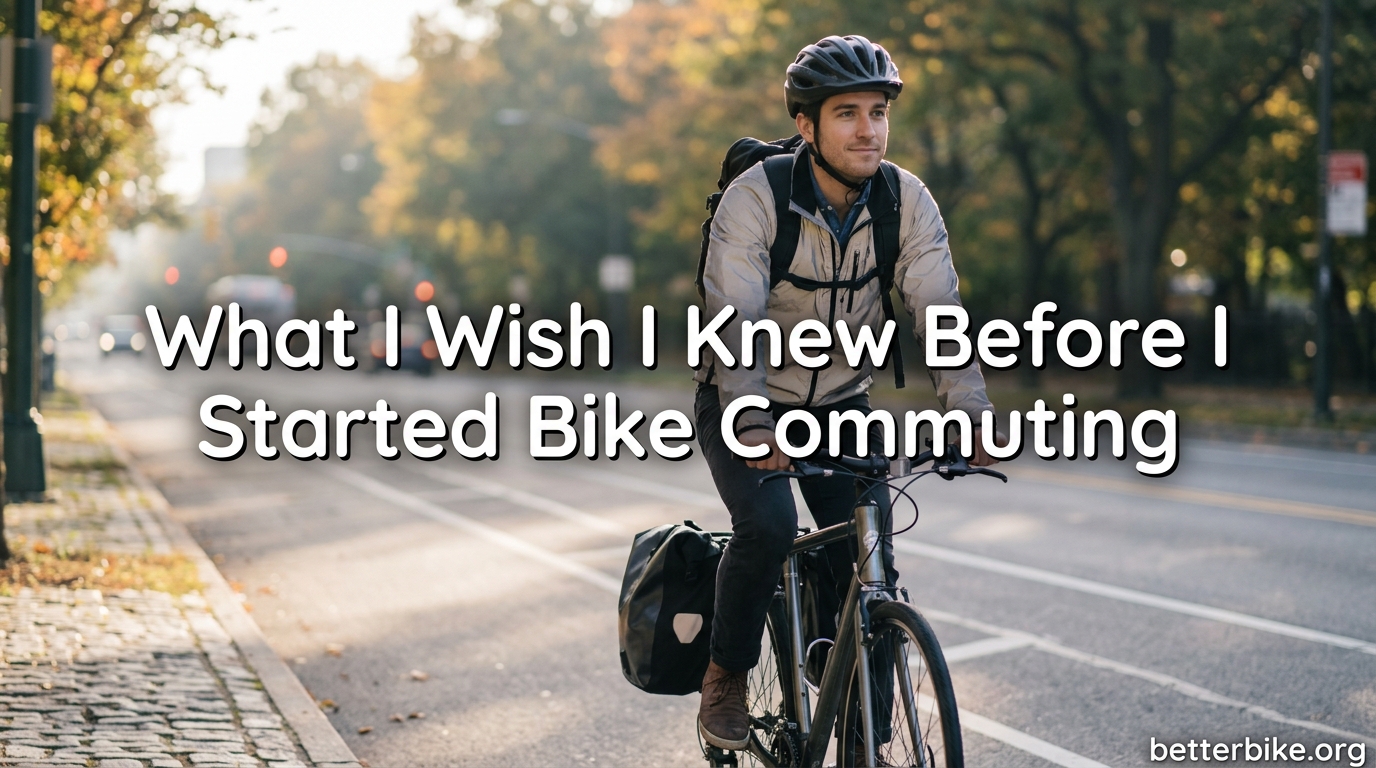
I made every mistake in the book my first year of bike commuting. I bought gear I didn’t need, skipped gear I desperately did need, sweated through dress shirts, got caught in storms, and once cried at the side of a road with a flat tire I had no idea how to fix.
That was 12 years and roughly 14,000 commuting miles ago. These days I ride to work most days with the kind of quiet confidence I didn’t know was possible back then, and I want to hand you everything I learned the hard way. This is the guide I wish someone had slipped me on day one: the real, unglamorous, sometimes embarrassing lessons that turn bike commuting from a stressful experiment into one of the best parts of your week.
If you are considering bike commuting, or you have tried it and bounced off, this is for you. I am not going to lecture you about saving the planet or becoming a Lycra-clad athlete. I am going to tell you what I wish I knew before I started bike commuting, so your learning curve is shorter and gentler than mine was.
Table of Contents
The bike you already own is probably the right bike to start with
This was lesson number one and I wish I had learned it sooner. You do not need a “commuter bike.” Whatever bike is sitting in your garage, your hallway, or your friend’s spare room is almost certainly a fine place to start. Road bike, hybrid, mountain bike, the clunky thing your uncle gave you in 2014 – they all work. A bike you actually own and will ride tomorrow is worth more than the perfect bike still sitting in a shop window.
If the bike has been sitting for a while, take it to your local shop and ask for a tune-up. A new rider on a freshly serviced used bike will have a better time than a new rider on a neglected $1,200 brand-new bike. Budget around $400 to $600 for a solid entry-level hybrid if you do need to buy something. That is the sweet spot where quality and value meet.
Once you have a few months and a few hundred miles under your belt, you will start to notice what you actually want. Maybe you want a bike with drop bars for speed. Maybe you want an e-bike for the hills. Maybe you want a steel frame that absorbs road buzz. Let your body tell you. Do not let a sales clerk tell you.
Assume you are invisible – the mindset that will save your life
If I could send one piece of advice back in time to new-me, this would be it. The single most important skill in bike commuting is not pedaling harder, taking the lane, or dressing bright. It is learning to ride as if no driver can see you.
I know that sounds dramatic. It is not. Drivers are distracted, tired, blinded by morning sun, talking to passengers, fiddling with phones. Even the best, most conscientious drivers miss cyclists. Once you internalize this, your riding changes. You stop trusting that turn signal. You stop trusting that the driver braking at the stop sign has actually seen you. You ride with the assumption that you are a ghost, and you make every decision accordingly.
In practice, this means making eye contact at intersections whenever possible. It means never filtering up the right side of a turning truck. It means taking the full lane on narrow roads instead of hugging the curb where cars try to squeeze past. It means riding predictably, signaling clearly, and never making sudden moves. Defensive riding is not paranoid. It is the difference between a long, joyful cycling life and a single bad day that ends your commute forever.
Wear a helmet, run bright lights day and night, add reflectors, and still assume nobody sees you. The redundancy is the point.
Don’t just replicate your car route – ride smarter, not harder
My second week of bike commuting, I rode my car route. Out along the main road, through three sets of traffic lights, past the gas station, into the industrial park. It was miserable. The shoulder disappeared, the lights had no sensors for bikes, and I arrived at work more stressed than when I drove.
Then a coworker mentioned she took the greenway. The route was 30% longer in distance, 15% shorter in time, and roughly 800% more pleasant. Quiet residential streets, a paved path along the creek, no cars. I never went back to the main road.
Use cycling-specific mapping like Google Maps bike layer, Komoot, or Ride with GPS to find quiet streets and dedicated bike infrastructure in your area. Look for neighborhood shortcuts, cut-through paths, and rail trails. The best bike commuting route is almost never the fastest car route. It is the route that respects the fact that you are smaller, slower, and more exposed than a car.
Do a dry run on a weekend morning when traffic is light. Try two or three options. Pick the one that feels safe and pleasant, not the one that shaves 90 seconds off your time. The 90 seconds are not worth it. The pleasant route is the one you will still be riding in five years.
Fenders, lights, and a real lock – the gear that actually matters
I spent my first month obsessing over which saddle to buy. I should have spent that energy on three boring, unsexy items: full-length fenders (also called mudguards), bright lights, and a serious lock.
Fenders are the single biggest comfort upgrade you can make. Without them, every wet road sprays dirty water up your back, down your legs, and into your face. You will arrive at work looking like you crawled through a puddle. Full-length fenders – the kind that wrap almost to the ground – keep you and your work clothes clean. They are not glamorous. They are transformative.
Lights are non-negotiable. A white light up front, a red light in back, and not those little be-button-battery keychain things. Real rechargeable LED lights that you can see from 500 feet away. Run them in flashing mode during the day – yes, even in daylight. Studies from places like the University of Bath have shown daytime running lights reduce collision risk significantly. The same goes for reflective strips on your clothing, your bag, and your bike.
Your lock deserves a real budget. A cheap cable lock will get you a stolen bike within a week in most cities. Spend the money on a quality U-lock or a heavy chain lock, and learn to use it properly. The frame, the rear wheel, and ideally something solid like a bike rack – all locked with one pass through. For a deeper look at choosing and using a lock, our guide on how to properly lock your bike walks through the options. If your bike has quick-release wheels, this guide on locking bikes with quick-release wheels is worth reading before your first week is up.
After those three things, consider a rear rack and a pair of panniers. Backpacks work, but they make your back sweaty and shift your balance. Panniers hang off the rack, keep weight low and centered, and free your shoulders and back. Our pannier vs backpack comparison breaks down when each makes sense.
Dress for your arrival, not your ride
For my first office job commute, I wore a button-down shirt and slacks and rode 5 miles. I arrived looking like I had just completed an Ironman. Sweat through the shirt, helmet hair, deodorant failing. My boss took one look and suggested I “consider driving.”
The lesson: dress for how you want to look when you arrive, not how you want to feel while riding. There are a few ways to do this.
The simplest is to ride in your work clothes if your commute is short (under 3 miles or so) and the weather is mild. Ride easy, take it slow, accept the gentle sweat. The second is to keep a change of clothes at the office. A little drawer, a small locker, a garment bag behind your desk – it all works. Bring clothes in on Monday, take them home Friday. This is what most regular commuters do, and the laundry logistics solve themselves fast.
For longer commutes, think in layers. A moisture-wicking base layer moves sweat off your skin. A mid layer keeps you warm. A wind or rain shell on top. Avoid cotton if you can – it stays wet and cold. For cold weather, gloves matter more than you think, as do warm socks and a neck gaiter. For warm weather, a light, breathable, light-colored long-sleeve shirt protects you from the sun without cooking you.
The real trick is controlling effort. The harder you pedal, the more you sweat. If you have hills on your route, drop into an easy gear and spin. Arrive a little slower and a lot drier.
Learn to fix a flat before you need to fix a flat
Six months into bike commuting, I got a flat tire two miles from work. I had no pump, no spare tube, no tire levers, and no idea what to do. I walked the bike to a gas station, called a cab, and sheepishly rolled the bike into the back seat. The cab driver charged me $25 plus a look I still think about.
That afternoon I bought a basic repair kit: a mini pump, a spare tube, tire levers, a multi-tool, and a small patch kit. I went home, watched a 10-minute YouTube video, and practiced changing a tube in my living room. Twenty minutes later I could do it with my eyes closed. I have not paid for a cab to rescue my bike since.
Every bike commuter should be able to fix a flat. It is the bicycle equivalent of knowing how to change a tire on a car. Carry what you need, practice once at home in your pajamas, and the next time you get a puncture at mile 7 of a 10-mile commute, you will be back on the road in 15 minutes. Our full breakdown on what to carry for bike repairs covers the rest of the kit too – chain breaker, patch kit, the works.
Beyond flats, learn the basics: how to check tire pressure (a firm tire prevents most flats in the first place), how to lube your chain every few weeks, and how to check your brakes before every ride. A bike in good working order is a bike that keeps showing up. If the bike sits broken in the garage for two weeks, the habit breaks with it.
You don’t have to do it every day – give yourself permission to be human
The biggest mistake I see new bike commuters make is treating it like an all-or-nothing commitment. They decide they are “a bike commuter,” then they drive three days in a row when life gets complicated, and they feel like they have failed.
That is the wrong frame. You are not becoming a different person. You are adding an option to your transportation menu. Some weeks I ride five days. Some weeks I ride two. Some weeks I ride zero, because I am sick, or the weather is biblical, or my partner needs the car. The bike is still there. The helmet is still on the hook. I do not have to earn my identity back.
This is also why backup plans matter. Always carry your phone, a credit card or transit card, and a basic idea of how you would get home if the bike broke down. A friend with a car, a bus route, a rideshare app – just know your exit. Knowing you have one is what gives you the courage to start.
Start with one day a week. Pick a day that tends to have good weather and a flexible schedule. Add days as it feels right. The goal is not perfection. The goal is a habit that survives contact with real life.
The unexpected gifts that nobody warned me about
Nobody told me bike commuting would change my life. I expected exercise, maybe a bit of money saved. What I got was a quiet, slow relationship with my city that I did not know I was missing.
You start noticing things from a bike that you cannot see from a car. The bakery that opens at 6 a.m. The mural on the side of the post office. The way the light changes over the river at 7:15 in October. You learn the rhythms of your neighborhood – the garbage truck on Tuesdays, the school rush on weekday mornings, the empty quiet of Saturday sunrise.
You meet people too. The older man who waves at the same intersection every morning. The courier who tips their helmet. The coworker who started riding after seeing you. There is a community of people out there doing the same slightly weird, deeply satisfying thing, and you start to feel part of it.
Most of all, you get a small daily victory. Show up, ride, arrive. The endorphins are real, the stress relief is real, and the strange sense of capability – I biked here, I biked home, in any weather – is real. After a year of bike commuting, you are not the same person who started. You are calmer, fitter, and a little prouder of yourself.
Frequently asked questions about starting bike commuting
How far is too far to bike commute?
For most beginners, 5 miles each way is a comfortable starting distance. More experienced commuters happily ride 10 to 15 miles each way, especially with an e-bike on hilly terrain. The right distance is the one you can ride three days a week without it feeling like a punishment. Start shorter than you think you need to.
What is the 80% rule in cycling?
The 80% rule suggests riding at about 80% of your maximum effort most of the time, with the remaining 20% reserved for harder efforts. For commuters, this translates to riding at a conversational pace – easy enough to chat, soft enough to arrive without needing a shower. It is a useful target that prevents over-exertion on a daily ride.
What do I do if I get a flat tire on my commute?
Carry a spare tube, tire levers, a mini pump, and a multi-tool. Practice changing a tube at home before you need to do it on the road. Most roadside flat repairs take 10 to 15 minutes once you have done it twice. If you cannot fix it, walk the bike to a transit stop, call a rideshare, or have a backup plan ready.
Is bike commuting safe in the city?
Bike commuting is statistically safer than many people assume, especially when you follow defensive riding practices. Ride predictably, signal clearly, run lights day and night, wear a helmet, and assume drivers cannot see you. Choose quieter routes with bike infrastructure whenever possible. The biggest safety gains come from how you ride, not from the city you ride in.
Your first ride is the only one that matters
If I could summarize everything I wish I knew before I started bike commuting in one sentence, it would be this: stop researching and ride the bike you already have to the place you already go. That is the entire journey in miniature. The gear, the routes, the habits, the small triumphs – they all grow out of that one ride.
It will not be perfect. You will sweat. You will forget something. You will get caught in a headwind and question every decision that led you here. And then, a few weeks in, you will have a morning where the air is cool, the light is golden, the bakery smells like bread, and you will coast up to your office feeling more awake and more alive than you have felt in months. That is when you will know.
Welcome to the club. We are glad you are here.