
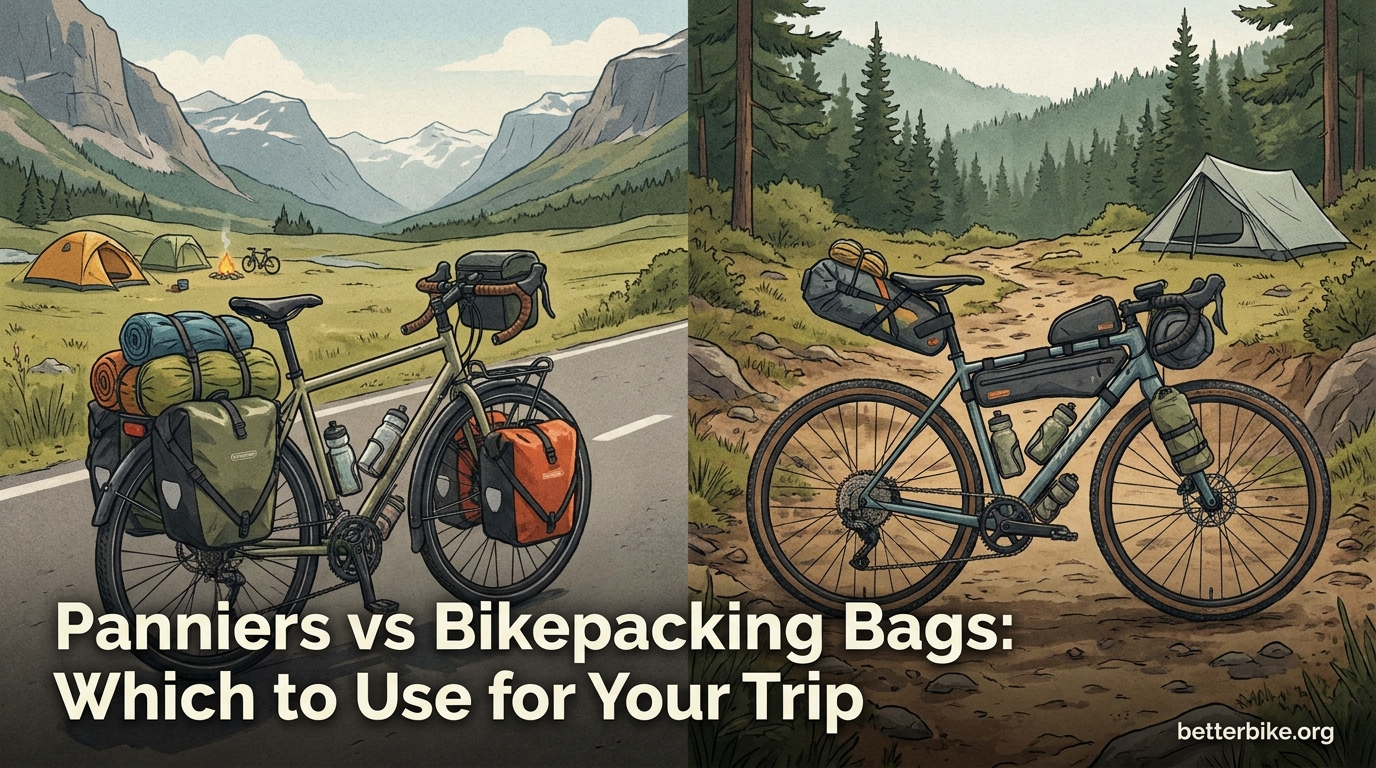
Planning a bike trip in 2026 and stuck on the panniers vs bikepacking bags question? You are not alone. This is one of the most debated topics in the bike touring and bikepacking world, and the answer genuinely depends on where you ride, how much you carry, and what bike you own.
I have spent years watching riders on Reddit’s r/bicycletouring and r/bikepacking argue this exact question. One rider logged 56,000 km around the world on a classic four-pannier setup. Another swapped to a seat bag, frame pack, and handlebar roll and never looked back. Both were right for their trips.
In this guide to panniers vs bikepacking bags, I will break down what each system is, how they compare on weight, capacity, cost, handling, and weather, and give you a 60-second decision helper so you can stop researching and start riding. I will also cover the gaps most guides skip, including dropper post compatibility, small frame sizes, water carrying for remote routes, and seasonal weather considerations.
Table of Contents
Quick Summary: Choose in 60 Seconds
Here is the short version before we go deep. Use this as a quick reference, then read on for the reasoning.
Choose panniers if: you are riding paved or gravel roads, carrying heavy loads, touring for weeks or months, need lots of water capacity, want easy on-and-off packing, or your bike has rack mounts.
Choose bikepacking bags if: you are riding singletrack or technical terrain, want light and nimble handling, doing overnight or weekend trips, riding a bike without rack mounts, or need to carry your bike over obstacles regularly.
Choose a hybrid setup if: you want the best of both, like a rear rack with panniers paired with a frame bag for snacks and tools. Many experienced riders end up here.
Still unsure? The decision framework section below walks you through it step by step.
What Are Panniers?
Panniers are bags that mount onto cargo racks bolted to your bike’s frame, fork, or seat post. The rack stays on the bike; the bags clip on and off using hooks, straps, or systems like the Rixen and Kaul Modul. This is the classic loaded touring setup that has carried riders across continents for decades.
Panniers come in three main styles. The traditional four-pannier setup uses two front and two rear bags, giving the most capacity and a balanced 50/50 weight split front to rear. This is what long-haul tourists use for months-long trips where they carry cooking gear, cold weather clothing, food, and water.
The two-pannier setup uses just rear bags on a rear rack. It is simpler, lighter, and works well for commuting, credit-card touring, and shorter trips. You lose the front weight distribution, but most riders find it plenty stable for paved roads.
Bikepacking-style panniers are a newer category. These are slim, narrow-profile panniers like the Ortlieb Sport-Roller or the Apidura Mountain Pack that pair with a lightweight rack but maintain a tighter silhouette. They bridge the gap between traditional panniers and full bikepacking setups.
Most panniers are fully waterproof (think Ortlieb Back-Rollers) or come with rain covers. They typically range from 20 to 50 liters per pair and clip off in seconds so you can carry them into a tent or cafe.
What Are Bikepacking Bags?
Bikepacking bags attach directly to the bike frame using hook-and-loop straps, Voile straps, or cam buckles. There is no rack involved. This is the rackless system, and it keeps your gear compressed tight against the bike for better handling on rough terrain.
A full bikepacking kit typically uses four main bags. The frame bag fits inside the main triangle of your frame and is great for dense, heavy items like food, water, tools, and a stove. The seat pack straps behind your saddle and holds bulky, soft items like a sleeping bag, tent, and spare clothing. The handlebar roll mounts to your bars and usually carries shelter and a sleeping pad. Fork bags or accessory cages strap to your fork legs for extra water, food, or fuel.
Bikepacking bags come in capacities from about 5 liters for a small fork bag to 14 liters for a large seat pack. A complete setup usually totals 30 to 50 liters of capacity, similar to a pannier setup, but distributed more tightly against the bike.
The trade-off is packing organization. Bikepacking bags are harder to pack and unpack than panniers because they are long tubes, not boxes. Getting to something at the bottom of a seat pack means pulling everything out.
Panniers vs Bikepacking Bags: Head-to-Head Comparison
Let’s get into the actual differences. Here is how panniers vs bikepacking bags compare on the metrics that matter.
Weight
Bikepacking bags win on weight. A complete bikepacking setup typically weighs 2.5 to 4 kg for the bags themselves, while a four-pannier setup with racks easily hits 4 to 6 kg before you add any gear. The racks alone add 700 g to 1.2 kg, and traditional panniers are heavier per liter than the soft bags.
Weight also matters in where it sits. Bikepacking bags keep weight centralized on the frame, which is why bikepacking bikes handle better on technical terrain. Panniers hang weight low and off the sides, which can feel planted on pavement but ponderous on singletrack.
Capacity
Panniers win on raw capacity. A four-pannier setup gives you 60 to 100 liters depending on bag size. That is enough for a full kitchen, weeks of food, and serious water hauling. One forum user noted they needed 12+ liters of water capacity for desert sections in Sudan, and panniers made that possible.
Bikepacking bags max out around 50 liters for a complete kit, and that requires careful packing. The temptation to overpack with panniers is real, but if you genuinely need the space, panniers are the answer.
Handling and Stability
This is where the debate gets heated. Bikepacking bags keep weight close to the bike’s centerline, so the bike handles more like it does unloaded. You can pick your way through rock gardens, lean into corners, and lift the bike over fences without bags swinging wide.
Panniers hang off racks and stick out to the sides, which creates more aerodynamic drag. Testing by CyclingAbout showed panniers are measurably slower at touring speeds because of this drag. On smooth roads, the handling penalty is minor. On singletrack, rear panniers can catch on trailside vegetation and make hike-a-bike sections awkward.
Cost
Both systems can run from budget to premium, but bikepacking bags tend to be more expensive per liter of capacity. A full high-end bikepacking kit from brands like Apidura, Revelate Designs, or Restrap can easily cost more than a complete Ortlieb four-pannier setup with racks.
Budget bikepacking exists, though. Cheap dry bags strapped to the frame with Voile straps work surprisingly well. Budget panniers are also widely available. On the whole, panniers offer more capacity per dollar, while bikepacking bags offer more handling performance per dollar.
Weather and Waterproofing
Most quality panniers are fully waterproof by design, using welded seams and roll-top closures. Ortlieb is the gold standard. When you arrive at camp in a downpour, your gear is dry.
Bikepacking bags vary. Some are fully waterproof (dry-bag construction), while others are water-resistant and require internal dry bags for true weather protection. A roll-top seat pack with waterproof fabric handles rain well, but a stitched frame bag may soak through on a long, wet day. Always check the construction before assuming weather protection.
For winter riding, panniers are easier to access with gloves on. Clip them off and carry them inside. Bikepacking bags require more fussing with straps and buckles when your fingers are cold.
Packing and Unpacking
Panniers are the clear winner for daily convenience. Clip them off, carry them into your tent or hostel, and you have two tidy bags to unpack. Everything is visible and accessible.
Bikepacking bags are fiddly. Seat packs in particular require careful compression and repacking each time you open them. Frame bags are easier since they have zippers, but you still crouch down to access them. This matters more on short trips with frequent stops than on long tours where you pack once a day.
Terrain Suitability: Which Setup Wins Where
Terrain is the single biggest factor in the panniers vs bikepacking bags decision. Here is how to match your system to your route.
Paved Roads and Long-Distance Touring
Panniers are the default choice here. They carry more, pack easier, and the handling penalty is negligible on smooth tarmac. Classic touring routes like the TransAm, EuroVelo, or round-the-world expeditions are pannier territory.
The 56,000 km rider mentioned earlier used four panniers the entire way. For months-long tours with varied weather, food resupplies, and gear for every condition, panniers make life easier.
Gravel and Dirt Roads
Both systems work here. Gravel is the crossover zone. If your gravel route is mostly smooth doubletrack, panniers handle fine. If it includes rough, rocky sections or steep hike-a-bike pitches, bikepacking bags start to win.
The Great Divide Mountain Bike Route is a good test case. Riders complete it on both systems. Pannier riders value the capacity for food and water on remote stretches. Bikepacking riders value the handling on the rougher sections.
Singletrack and Technical Terrain
Bikepacking bags are the clear winner. This is what they were designed for. The narrow profile lets you squeeze between trees, the central weight keeps the bike maneuverable, and there are no racks to bend when you crash or set the bike down on rocks.
Rear panniers on singletrack are a known pain point. They catch on brush, shift the bike’s balance, and make technical climbing harder. If your trip involves any meaningful singletrack, go with bikepacking bags.
Hike-a-Bike Sections
If you will be carrying your bike over fences, up steep trails, or across rivers, bikepacking bags are dramatically better. The bike stays narrow and the weight stays balanced. Panniers stick out and catch on everything.
Choosing Your Setup: A Decision Framework
Let’s turn this into a practical decision. Work through these questions in order.
Step 1: What terrain will you ride most? If it is mostly paved or smooth gravel, lean panniers. If it includes singletrack or technical off-road, lean bikepacking. Mixed terrain? Consider a hybrid.
Step 2: How long is your trip? Overnight and weekend trips work great with bikepacking bags. Multi-week or multi-month tours usually benefit from pannier capacity. Two to seven days is the crossover zone where either works.
Step 3: Does your bike have rack mounts? If yes, panniers are easy. If not, you need a seatpost rack (limited capacity) or bikepacking bags. Many modern gravel and mountain bikes have no rack mounts, which pushes you toward bikepacking.
Step 4: How much water do you need to carry? Desert routes with long resupply gaps may require 8 to 12 liters of water. Panniers handle this more easily. Bikepacking setups can carry water in frame bags and fork cages, but capacity is tighter.
Step 5: Do you have a dropper post? This is a compatibility issue many guides gloss over. Most seat packs need 15 to 20 cm of exposed seatpost to mount securely. A dropper post at full drop may not give enough post for a seat pack. Solutions include using a dropper-compatible seat pack (like the Revelate Terrapin) or running the dropper at a higher travel position. Panniers have no dropper conflict since they mount to racks, not the seatpost.
Step 6: Are you a smaller rider? Small frames (XS or S) have less room inside the main triangle for a frame bag. A 29er with a small frame may only fit a tiny frame bag or none at all. In this case, panniers or a seat-pack-plus-handlebar-roll setup may work better than a full bikepacking kit. Test fit before buying.
Step 7: What is your budget? Panniers give more capacity per dollar. Bikepacking bags give better handling per dollar. Decide which matters more for your trip.
Hybrid Setups: The Middle Way
Many experienced riders do not pick a side. They run hybrid setups that combine panniers and bikepacking bags to suit their specific trip.
A common hybrid is a rear rack with two rear panniers, paired with a frame bag for snacks and tools and a handlebar roll for shelter. This gives you the easy packing of panniers for daily-use items plus the centralized weight of a frame bag for dense gear.
Another popular hybrid uses bikepacking bags in front (handlebar roll, fork bags, frame bag) and a rack with a single pannier or trunk bag in back. This keeps the front light for technical steering while giving you a roomy, easy-access bag for camp gear.
The reverse works too: a front low-rider rack with two small front panniers, plus a seat pack and frame bag in back. This preserves rear wheel tracking on technical terrain while giving you front capacity for food and water.
Reddit users regularly report running exactly these kinds of mixed setups. One rider noted they run small panniers alongside a frame bag, fork bags, and a bar roll, and found it ideal for trips that mix road and off-road sections.
Minimalist racks are worth a mention here. Products like the Tubus Fly rack or the Oveja Negra Pack Rack are lighter and lower-profile than traditional touring racks, and they pair well with bikepacking-style panniers for a hybrid that does not look or feel like a full touring rig.
Panniers vs Bikepacking Bags for Specific Trips
Long-Distance Touring (Weeks to Months)
Panniers usually win. You need capacity for varied conditions, easy packing for daily camp setup, and the ability to haul food for long resupply gaps. The handling penalty matters less when you are grinding out centuries on pavement.
Off-Road Bikepacking Races and Events
Bikepacking bags are the standard. Races like the Tour Divide, Silk Road Mountain Race, and similar events favor the lighter, more central load. Most finishers run full bikepacking kits.
Commuting
Panniers win for commuting. You want a bag that clips off in two seconds so you can carry it into the office. A single rear pannier with a shoulder strap is hard to beat. A backpack works too but causes sweaty back syndrome that bike luggage avoids entirely.
Overnight and Weekend Trips
Bikepacking bags shine here. The lighter load and simpler setup are perfect for one or two nights out. If your bike lacks rack mounts, bikepacking bags are the obvious answer.
Bike Travel in Remote Regions
This depends on water and food resupply gaps. Remote desert, mountain, or outback routes often require large water capacity. Panniers handle this better. For remote routes where you carry everything but water is available, bikepacking bags keep the bike manageable on rough tracks.
Step-by-Step: Converting From Panniers to Bikepacking Bags
If you currently tour with panniers and want to try bikepacking, here is a practical conversion path.
Step 1: Start with a seat pack. This is the single biggest capacity bag in a bikepacking kit and the easiest to add to an existing setup. Try it on its own for a weekend trip while keeping your panniers for the rest of your gear.
Step 2: Add a frame bag. Even a half-frame bag that leaves room for water bottles gives you centralized storage for heavy items. Move your tools, food, and stove out of the panniers into the frame bag.
Step 3: Add a handlebar roll or harness. Move your shelter and sleeping bag up front. At this point, you may be able to drop the rear panniers entirely for short trips.
Step 4: Add fork bags or accessory cages. These give you extra water and food capacity for longer trips without going back to a rack.
Step 5: Test before a big trip. Never debut a new luggage system on a long tour. Shake it down on a weekend trip first to learn how it packs, how it handles, and what rattles.
Should I use panniers for bikepacking?
You can use panniers for bikepacking, especially bikepacking-style slim panniers on light racks, but for technical singletrack and hike-a-bike terrain, full bikepacking bags handle much better. Panniers work well for bikepacking routes that are mostly gravel and dirt roads.
What is better, panniers or bikepacking bags?
Neither is universally better. Panniers are better for heavy loads, long tours, paved and gravel roads, and easy packing. Bikepacking bags are better for technical terrain, lighter loads, bikes without rack mounts, and trips where handling matters.
Which is lighter, panniers or bikepacking bags?
Bikepacking bags are lighter. A complete bikepacking kit weighs roughly 2.5 to 4 kg, while a four-pannier setup with racks weighs 4 to 6 kg before any gear is added. The racks alone account for 700 g to 1.2 kg.
Can you use panniers and bikepacking bags together?
Yes, and many experienced riders do. Common hybrid setups include a rear rack with panniers paired with a frame bag, or a front low-rider rack with small panniers combined with a seat pack and handlebar roll. Hybrids work well for mixed-terrain trips.
What to use instead of panniers?
Alternatives to panniers include frame bags, seat packs, handlebar rolls, fork bags, accessory cages, cargo cages, handlebar harnesses, and even bikepacking trailers. A combination of these bags forms a full bikepacking setup.
Do bikepacking bags fit small frames?
Some do, but small frames (XS or S) and 29er wheels limit frame bag room. Look for half-frame bags that leave space for water bottles, or skip the frame bag and rely on a seat pack and handlebar roll. Always test fit before buying.
Can I use a seat pack with a dropper post?
It is tricky. Most seat packs need 15 to 20 cm of exposed seatpost to mount securely. With a dropper at full drop, there may not be enough post. Use a dropper-compatible seat pack, run the dropper higher, or switch to a rack and panniers for the rear.
Conclusion: Making the Panniers vs Bikepacking Bags Call
The panniers vs bikepacking bags debate has no universal winner because the right answer depends on your trip. Match your luggage to your terrain, your bike, and your load, and you will be happy with either system.
If you remember one thing from this guide, make it this: panniers for capacity and convenience on road-heavy tours, bikepacking bags for handling and weight on off-road trips, and a hybrid setup when your trip mixes both. Pick the system that fits your next adventure, ride it, and refine from there.
Whatever you choose, test your setup on a short trip before committing to a long one. The best luggage system is the one you have actually practiced with.