
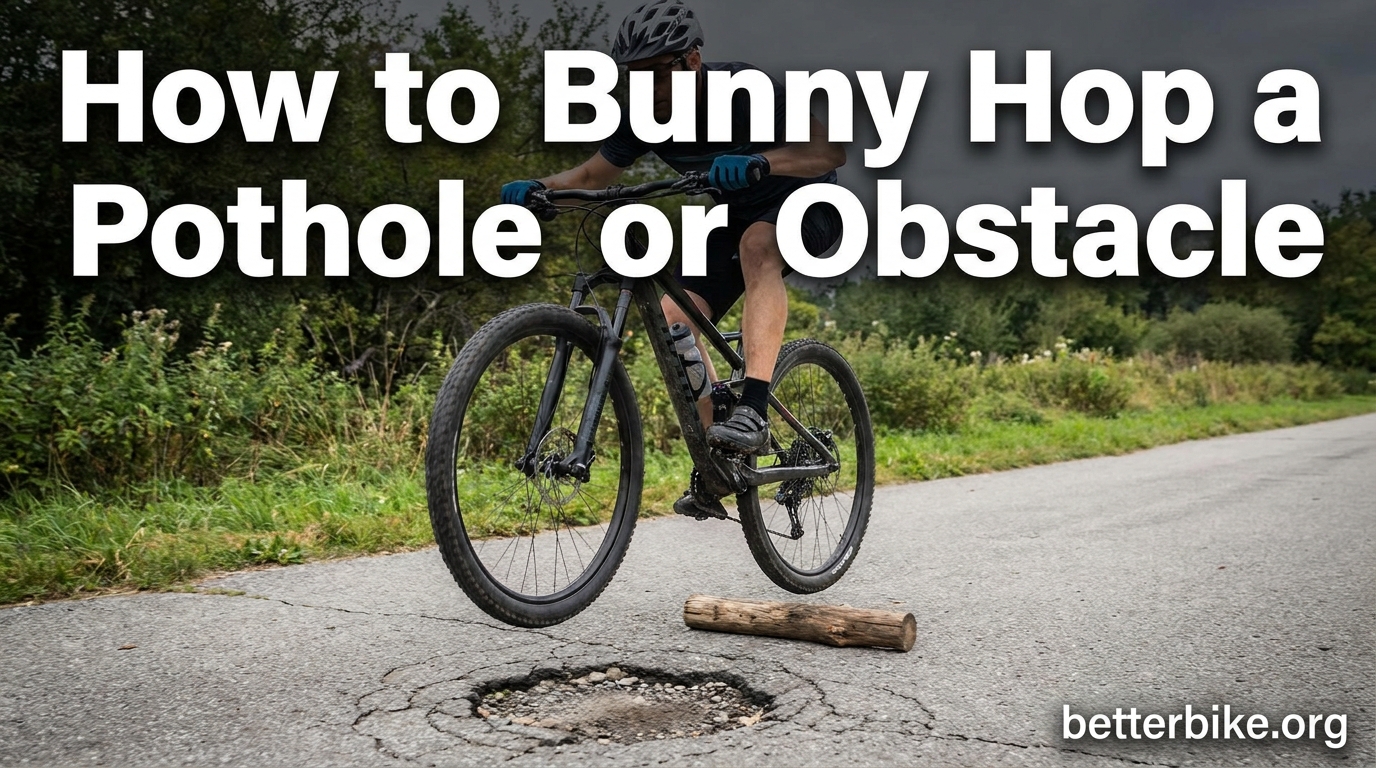
You’re cruising down your usual route when a pothole the size of a dinner plate appears 10 feet ahead. A car is right behind you, and a parked truck is on your left. Swerving isn’t an option. This is exactly the moment when knowing how to bunny hop a pothole or obstacle keeps you safe.
I learned this the hard way on a fast descent in 2024. I hit a hidden pothole at 22 mph and pinch-flatted both tires. That expensive lesson sent me to my driveway for a month of practice. The bunny hop is the single most useful bike handling skill I’ve ever developed, and it’s not even close.
In this guide, I’ll walk you through exactly how to bunny hop a pothole or obstacle. You’ll get a 5-step technique, practice drills that work, and a list of mistakes I see beginners make over and over. No fluff. Just the stuff that actually works.
Table of Contents
Table of Contents
Quick Answer: How to Bunny Hop a Pothole
To bunny hop a pothole, ride toward it at roughly 10 mph with your pedals level, crouch into a coiled stance, spring upward while pulling the handlebars toward your chest to lift the front wheel, then scoop your feet backward to lift the rear wheel. Land with both wheels touching down at the same time and your knees and elbows bent to absorb the impact.
That is the full answer in 60 seconds. The rest of this guide breaks each piece down so you can practice it on a grass field this weekend and feel confident the next time a pothole shows up in your lane.
TL;DR – The 5 steps to bunny hop a pothole or obstacle:
- Approach at 10 mph with pedals level (crankarms horizontal)
- Crouch out of the saddle into a coiled, balanced stance
- Spring upward and shove the bars toward your chest to pop the front wheel
- Scoop your feet back to lift the rear wheel under you
- Land soft with both wheels down together, knees and elbows bent
What Is a Bunny Hop? English vs American Styles Explained
A bunny hop is a cycling technique that lifts both wheels of your bike off the ground at the same time. It lets you clear potholes, curbs, railroad tracks, and trail obstacles without swerving or stopping. Two main styles exist, and you’ll see serious disagreement online about which is “correct.”
The American bunny hop, also called the J-Hop, pulls the front wheel up first using a sharp pull on the handlebars, then lifts the rear wheel. It looks dramatic and is what BMX riders use for big air. The English bunny hop lifts both wheels more simultaneously by combining a body lift with a “scoop” of the pedals, which is what most road and mountain bikers use for clearing obstacles in a line.
For pothole avoidance on a road or commuter bike, the English technique is almost always what you want. It’s smoother, more controlled, and easier on your body. The J-Hop shines on dirt jumps and BMX tracks where maximum height matters more than cadence.
English vs American Bunny Hop Comparison
| Feature | English Bunny Hop | American Bunny Hop (J-Hop) |
|---|---|---|
| Wheel order | Both wheels lift together | Front wheel first, rear second |
| Best for | Potholes, curbs, urban riding | BMX, dirt jumps, tricks |
| Body motion | Coiled crouch, smooth upward spring | Snake-like, aggressive pull |
| Learning curve | Moderate | Steeper |
| Rear wheel lift method | Foot scoop backward | Body jump and tuck |
| Best bike type | Road, gravel, MTB, commuter | BMX, jump MTB |
For the rest of this guide, I’ll focus on the English bunny hop, since that is the technique you need to clear a pothole while moving at speed in traffic.
Step-by-Step Bunny Hop Technique for Potholes and Obstacles
Here is the exact 5-step technique I teach my riding friends. Take it slow at first, on grass, before you try it in traffic.
Step 1: Approach at the Right Speed With Pedals Level
Ride toward your target obstacle at roughly 10 mph (16 kph). Slower than that and you will not have enough forward momentum to clear it. Faster than that and the landing gets harsh.
Stop pedaling 2-3 bike lengths before the obstacle and rotate your cranks until they are perfectly horizontal. Your pedals should be level, with one foot forward and one foot back, not at 12 and 6 o’clock.
Step 2: Crouch Into a Coiled, Balanced Stance
Stand up out of the saddle and crouch low over the bike. Bend your knees deeply, hinge forward slightly at the hips, and bring your weight back so it sits between the wheels, not over the handlebars. Grip the bars firmly but not death-tight. This coiled stance is where all your power comes from.
Your elbows should be wide, like you are ready to absorb a punch. This is the position you compress from to launch upward.
Step 3: Spring Upward and Shove the Bars to Pop the Front Wheel
From the crouch, explode upward by straightening your legs. At the same time, shove the handlebars forward and up toward your chest. The combination of body lift and bar push is what pops the front wheel off the ground.
Think “jumping off the bike and pulling the bike up under you” rather than “lifting the bike up off the ground.” That mental flip is the single biggest breakthrough most riders report.
Step 4: Scoop Your Feet Backward to Lift the Rear Wheel
The instant your front wheel is up, sweep both feet backward in a scooping motion, as if you are trying to scrape something off the bottom of your shoes. This scooping action drives the pedals and rear wheel upward under your body.
If you are using flat pedals, this is where flat pedals win. You can sweep freely. On clipless pedals, you have to lift with your hips and use a quick foot flick, which is harder to learn.
Step 5: Land Soft With Both Wheels Down Together
Hover for a split second at the peak of your hop, then let the bike drop back to the ground. Aim to land with both wheels touching at the same instant. Absorb the landing with deeply bent knees and elbows. This shock absorption is what protects your rims from hard impacts and prevents pinch flats.
If only the front wheel lands first, the impact jars through your arms and risks a pinch flat. If only the rear lands first, you can loop out and crash. Same-time landing is the goal.
Best Approach Speed and Body Position
About 10 mph is the sweet spot for most road and commuter cyclists. Going slower means you will not generate enough lift, and going much faster makes precise timing much harder. Mountain bikers on rough terrain often hop at 8-15 mph depending on the obstacle.
Your weight should sit centered between the two wheels as you approach, then shift very slightly back during the crouch phase. Many beginners keep too much weight on the handlebars, which makes the rear wheel feel glued to the ground. Try unweighting the bars by hovering over the saddle for a second before you crouch.
Out of the saddle is non-negotiable. You cannot bunny hop from a seated position. The power has to come from your legs extending, and that requires standing.
Practice Drills That Actually Work
Most riders fail at bunny hopping because they try it in traffic on day one. Don’t be that rider. The 30 days I spent in a grass field made the difference between a sketchy wobble and a clean, repeatable hop.
Drill 1: Static Hop on Grass (Days 1-3)
Find a soft grassy field. Walk next to your bike while straddling it. Practice the crouch-and-spring motion without rolling. Get used to the timing of pushing the bars and scooping the feet. This builds the muscle pattern without any pressure.
Drill 2: Rolling Hop on Grass (Days 4-10)
Pedal slowly across the grass. Crouch, hop, and try to land both wheels together. Don’t worry about height. Just aim for the timing. Repeat 10-15 times per session.
Drill 3: Rolled Towel in a Parking Lot (Days 10-20)
Lay a rolled-up towel across a parking lot. Approach at 8-10 mph and try to hop over it. A towel is forgiving if you clip it but still gives a clear visual target. Many road bike coaches use this drill because it teaches commitment without the consequence of a curb.
Drill 4: Paint Line or Crack in the Road (Days 20-30)
Once grass and towel hops feel consistent, move to a quiet street. Look for a painted parking line or a small crack. Try to clear it. The gap between the lines is your real-world target height, since most potholes and small curbs sit at about that level.
Common Bunny Hop Mistakes to Avoid
I’ve watched dozens of riders try to learn this move. Here are the mistakes that hold people back the longest.
Pulling up with the arms instead of pushing the bars. The handlebar shove is forward and up, not straight back. Pulling straight back just gets you punched in the gut by your own bars.
Pedals in the wrong position. If your cranks are vertical (one pedal at 12, one at 6), you lose the foot-scoop leverage. Always set up with pedals level.
Keeping weight on the handlebars. Weight on the bars means the rear wheel stays glued to the ground. Shift back, crouch, and let the bike come up to you.
Trying to hop too high too soon. A 2-inch hop is enough to clear a paint line. You don’t need 12 inches. Start small.
Not absorbing the landing. Stiff arms and legs turn every hop into a jolt. Bent elbows and knees are your suspension.
Practicing only in clipless pedals. Flat pedals are the universal recommendation for learning. You can pull and adjust your feet freely.
When NOT to Bunny Hop a Pothole or Obstacle
Bunny hopping is not always the right move. Here are times when you should steer around, brake, or just roll through instead.
High curbs over 6 inches. A road bike with 25mm tires cannot hop a tall curb without serious risk of bending a rim. I have personally seen a rider bend a rear rim hopping an 18-inch curb. Walk that one or find a ramp.
Wet metal, painted lines, or oily surfaces. If your tires are likely to slip on takeoff or landing, hop somewhere else. A slick pothole with wet leaves is a recipe for a low-side crash.
Heavy traffic with no escape. If a car is right on your wheel, an unexpected hop that goes wrong can put you under it. Sometimes the safest move is to roll through the pothole slowly, or hit it straight on so the impact is controlled.
Unknown depth potholes. If you cannot see the bottom, do not hop. A deep pothole has a sharp inside edge that can collapse a wheel on impact, no matter how high you hop.
Loaded touring or cargo bikes. The added weight changes your center of gravity dramatically. Hopping a touring bike with 30 pounds of gear is a different skill, and not one to test in traffic.
Safety and Equipment Tips for Bunny Hopping
Always wear a helmet when practicing. Gloves help too, since your hands take the brunt of a botched landing. Flat pedals are the universal teaching recommendation, both because they let you bail easily and because the foot-scoop motion is much harder in clipless pedals.
One of the underrated benefits of bunny hopping is that it actually prevents pinch flats. Hitting a sharp pothole edge directly can pinch the inner tube between rim and tire, causing an instant flat. A clean hop gets both wheels over the edge with the tube protected by your landing geometry. Many commuters have found that regular hopping on rough roads reduces flat repairs noticeably.
Check your tire pressure before a busy week of commuting. A slightly under-inflated tire absorbs hop landings better and resists pinch flats more than a rock-hard 110 psi road tire.
Frequently Asked Questions About Bunny Hopping
How to bunny hop a curb?
To bunny hop a curb, approach at 8-10 mph with pedals level, crouch out of the saddle, spring upward while pushing the bars toward your chest, then scoop your feet back to lift the rear wheel. Aim to clear the curb with both wheels landing together on the sidewalk or street beyond. Practice on grass first, since curb height varies and a misjudged hop can damage your rims.
What are common mistakes when bunny hopping?
The most common mistakes are keeping weight on the handlebars, having pedals in the wrong position (vertical instead of level), trying to hop too high too soon, and landing with the front wheel first. Stiff arms and legs also make landings harsh and can cause pinch flats. Practice on grass and aim for a low 2-inch hop before working on clearing real obstacles.
What are the basic steps for bunny hopping?
The 5 basic steps are: (1) approach at 10 mph with pedals level, (2) crouch out of the saddle into a coiled stance, (3) spring upward and shove the bars to pop the front wheel, (4) scoop your feet backward to lift the rear wheel, and (5) land softly with both wheels touching down at the same time. Practice each step separately on grass before combining them.
Does bunny hopping damage a road bike?
Bunny hopping is generally safe for road bikes when done correctly with bent elbows and knees to absorb the landing. The real risk comes from hopping tall curbs (over 6 inches) or landing hard with the front wheel first, which can bend a rim. In most cases, a clean hop puts less stress on your tubes and rims than hitting a sharp pothole directly, and it prevents pinch flats.
What is the best speed for bunny hopping?
About 10 mph (16 kph) is the best speed for bunny hopping a pothole or small obstacle for most riders. Slower than that and you will not generate enough lift. Much faster and the timing becomes hard to control. Mountain bikers often hop at 8-15 mph depending on terrain, and BMX riders hop from a standstill or slow roll to maximize height.
Should I use flat pedals or clipless pedals to learn bunny hopping?
Flat pedals are strongly recommended for learning to bunny hop. They let you sweep your feet back freely to lift the rear wheel, and you can put a foot down instantly if a hop goes wrong. Clipless pedals lock your foot in place, which makes the rear-wheel scoop much harder to learn and increases the risk of a fall while you are still building the timing. Once the motion is dialed in, you can relearn the technique in clipless pedals.
How long does it take to learn to bunny hop?
Most riders can learn a basic 2-inch bunny hop within 2-4 weeks of grass practice, doing 15-20 minutes per session. A clean, confident hop over real obstacles like potholes and small curbs usually takes 1-3 months of regular practice. Riders with a mountain bike or BMX background often pick it up faster because they already have good bike-body separation skills.
Final Thoughts on How to Bunny Hop a Pothole or Obstacle
Learning how to bunny hop a pothole or obstacle is one of the highest-value skills a cyclist can develop. It turns scary road hazards into minor speed bumps in your line. It also makes you a more confident, fluid rider in every other situation, from trail rides to fast group rides.
Start on grass this week. Get the crouch-and-spring motion down. Move to a rolled towel in a parking lot. Then, when the next pothole shows up in your lane with a car on your wheel, you’ll rise right over it. That’s the goal, and it’s a real one. If I learned it at 40 after decades off a bike, you can learn it too.