
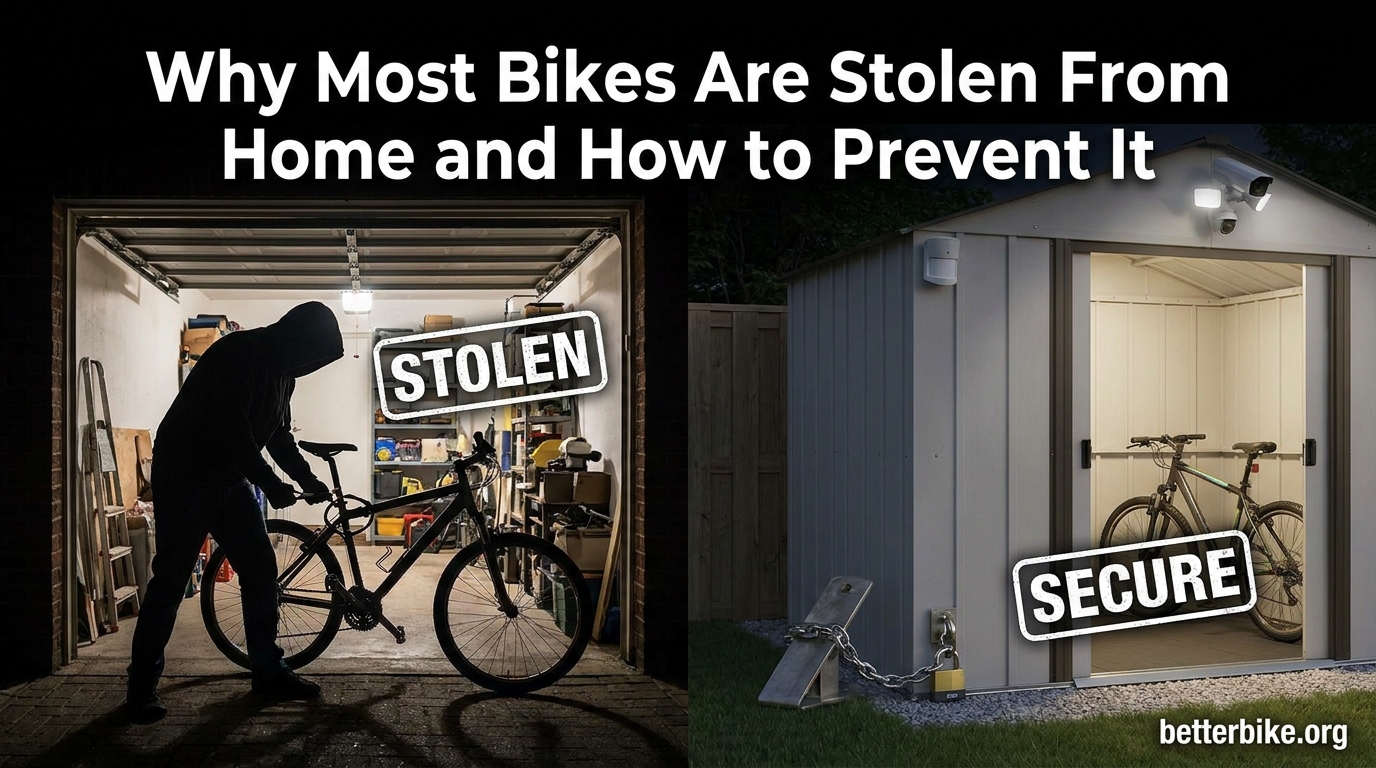
When I first started researching bike theft, I assumed most bikes disappeared from public racks and train stations. The data told a completely different story. The single most common place a bike gets stolen is the owner’s own home, and the gap between home thefts and public thefts is wider than most cyclists realize.
We’ve spent weeks reviewing police reports, insurance data, and forum threads from r/cycling, r/bikecommuting, and r/ebikes to put together this complete guide on bike theft home prevention. You’ll learn why your garage, shed, or apartment hallway is the riskiest place to keep a bike, what thieves actually do when they target a home, and the specific steps that make a real difference.
If you only read one section, jump to How to Prevent Bike Theft at Home: Essential Strategies. That’s where the practical security upgrades live.
Table of Contents
Why Most Bikes Are Stolen From Home (Not Public Places)
Bike theft happens at home more often than anywhere else. The official statistics from police forces and cycling organizations consistently show that the majority of stolen bicycles were taken from the owner’s driveway, garage, shed, yard, or apartment hallway, not from a busy city center or train station rack.
The home theft statistic that surprises most cyclists
Surveys from cycling advocacy groups and recovered-bike registries in the UK, US, Canada, and Australia all converge on the same finding. Between half and two-thirds of stolen bikes were locked, stored, or simply kept at the owner’s residence when they disappeared. One large insurer reported that 63% of bicycle theft claims originated from the cyclist’s home address.
The pattern is consistent across urban and suburban areas. It holds for cheap bikes, expensive bikes, road bikes, mountain bikes, and e-bikes. Where the bike is parked matters far more than how fancy the bike is when considering risk of theft from home.
Why thieves target residential properties
Thieves choose homes because homes are easier. A residential garage door is often weaker than a commercial bike cage. A garden shed has thin walls, a basic padlock, and rarely any cameras. A bike left on a porch or in a yard is unmonitored for hours every day.
Forum threads and police interviews reveal another reason: casing is simpler. A thief can walk down a street at 2 AM, check which garages have weak locks, which sheds only have a hasp and a cheap padlock, and which bikes are chained to flimsy fence posts. Public bike racks in city centers are watched by passersby and CCTV. Backyard fences and side gates are not.
The false sense of security problem
The biggest reason home thefts happen is psychological. People lock their bike carefully in public, then leave it unsecured, or secured with a toy cable lock, at home. The reasoning goes, “It’s in my garage, who would steal it?”
The data says thieves absolutely will. They look for easy targets and a garage door that closes with a tug, or a shed that opens with a screwdriver, qualifies as easy. Once inside, even a quality lock is often missing entirely because the owner assumed the locked building itself was protection enough.
Common Home Bike Theft Methods and Vulnerabilities
Understanding how thieves actually steal bikes from homes is the first step to stopping them. Our team reviewed dozens of real theft reports to map the most common methods thieves use at residential properties.
Garage and shed break-in methods
The most common garage break-in involves prying open the overhead door or forcing a side entry door. Thieves use a flat pry bar on cheap door frames, cut padlock hasps with bolt cutters, or simply pop a weak lock with a screwdriver. Reddit users in r/homeimprovement and r/bikecommuting regularly share stories of garage break-ins where the only evidence was a bent door frame and an empty bike hook.
Shed thefts follow a similar pattern but are even faster. A basic hasp and padlock can be defeated in under 30 seconds with a small crowbar or even a strong kick. Once inside the shed, the bike is usually unchained because the owner assumed the shed itself was the security. Thieves simply roll or carry the bike out.
The cheap lock trap
Even when owners do lock their bikes inside a garage or shed, the lock is often the weak point. Cable locks under $20, combination locks, and thin chain locks all fail quickly against basic bolt cutters. Anglers and thieves both know that 4mm cable can be snapped in a single cut, and a 6mm cable takes only a few seconds.
Reddit threads are full of posts from cyclists who lost bikes to “locked” garages where the thief simply cut the cable lock and walked away. The lesson here is straightforward: a cheap lock inside a garage is no lock at all.
Quick-release wheel and seat theft
Thieves don’t always take the whole bike. Quick-release skewers on wheels and seats are designed for fast removal by the owner, which means a thief with a 5mm allen key can walk away with a $400 wheelset in seconds. This is a common apartment hallway and bike-room theft, and it happens at home too.
Replacing quick-release skewers with security skewers (also called locking skewers or anti-theft skewers) costs around $20 and stops these component thefts cold. This is one of the cheapest bike theft prevention upgrades available.
Apartment building theft patterns
Apartment dwellers face a unique version of home theft. Many buildings have basement bike rooms, ground-floor storage cages, or shared hallways where bikes are kept. These spaces often have flimsy doors, broken intercoms, or no cameras, exactly the conditions opportunistic thieves prefer.
For apartment dwellers, the same rules apply: lock the bike inside the storage area as if it were parked on a public street. A heavy U-lock, even inside a supposedly secure room, is the baseline.
How to Prevent Bike Theft at Home: Essential Strategies
Now that we’ve covered why home is the highest-risk location, let’s walk through the prevention strategies that actually work. I rank these from cheapest and easiest to more involved upgrades.
Upgrade your home storage location
The single most effective change is also the simplest: bring the bike inside the house. If you have space in a hallway, closet, or living area, an indoor bike is a bike that cannot be stolen by anyone except a burglar who breaks into your home. Most police reports show that bike theft is overwhelmingly opportunistic, not part of a planned burglary.
For those without indoor space, the next-best option is a garage with a solid-core door, a quality deadbolt, and ideally a visible security camera facing the door. A thief casing the neighborhood will move on to a shed with a hasp and padlock.
Anchor your bike with a ground anchor
A ground anchor is a steel loop bolted into concrete, brick, or a heavy timber beam. You lock your bike to the anchor just as you would lock it to a public rack, except the anchor is permanently fixed in your garage or shed. Combined with a Sold Secure Gold U-lock, this setup is nearly impossible to defeat quickly.
Ground anchors cost between $30 and $80 and take 30 minutes to install with a hammer drill. For cyclists with expensive road bikes, e-bikes, or mountain bikes, this is the single best home security upgrade.
Use multiple lock layers
Two locks take longer to defeat than one. The “second lock” rule is especially useful in garages and sheds because it doubles the tool time a thief needs to spend inside, which dramatically increases their risk of being seen or heard.
Pair a Sold Secure Gold U-lock with a heavy chain or a second U-lock. Lock the frame to the anchor with the primary lock, and lock the rear wheel (which is harder to remove than the front) to the frame with the secondary lock. This prevents the “wheel-only” theft as well as the whole-bike theft.
Install visible deterrents
Cameras, motion-activated lights, and alarm stickers work even when they aren’t real, but real is better. A $40 Wi-Fi camera pointed at the garage or shed door is enough to make most thieves pick a different house.
If a full camera system feels like overkill, even a fake camera with a blinking LED has some deterrent effect. The goal is to make your home look harder than the neighbor’s home. Thieves are picking the path of least resistance.
Choosing the Right Bike Lock for Home Use
The lock you use at home matters as much as the lock you use in public. Many cyclists mistakenly keep their best lock for commuting and use a weaker lock at home. This is backwards logic: a thief who breaks into your garage already has tools and time, so they need to face your strongest lock.
Understanding Sold Secure ratings
Sold Secure is the UK-based independent testing body that rates bike locks based on real-world attack resistance. Their ratings range from Bronze (entry-level security, slow attacks only) to Silver (good protection against common attacks) to Gold (the highest standard, resistant to angle grinders for several minutes).
For home storage, a Sold Secure Gold lock is the right starting point. Gold-rated locks are tested against bolt cutters, crowbars, and angle grinders. No lock is truly angle-grinder-proof, but Gold locks buy you minutes, and minutes are what deters thieves.
U-locks vs D-locks vs chains vs cables
The four main lock types serve different purposes, and each has clear strengths and weaknesses.
U-locks (also called D-locks) are the gold standard for bike security. They resist bolt cutters well, fit in tight spaces, and are rated up to Sold Secure Gold. The downside is limited internal diameter, so locking bulky frames or to thick objects can be tricky.
Chain locks with hardened steel links are the next tier down. They offer more flexibility than U-locks for unusual anchor points, but quality chains are heavy and expensive. A Sold Secure Gold chain is a serious investment.
Cable locks are lightweight and convenient, but most are defeated by basic bolt cutters in seconds. Reserve cable locks for very low-risk situations like a quick coffee stop, never for overnight or home storage.
Frame locks mount permanently to the bike and lock the rear wheel to the frame. They’re great as a secondary lock but not enough on their own because a thief can simply carry the bike away.
Where cheap cable locks fail
A $10 cable lock from a big-box store will stop an opportunistic grab-and-run. It will not stop anyone with bolt cutters, which every bike thief owns. The cheapest Sold Secure Bronze lock costs around $40 and is several orders of magnitude stronger. Skipping that upgrade to save $30 is one of the most expensive mistakes a cyclist can make.
Beyond Locks: Tracking, Registration, and Insurance
Locks are the first line of defense, but they aren’t the whole answer. A complete bike theft home prevention plan includes tracking, registration, and insurance so that if the worst happens, you have options.
Register your bike’s serial number
Every bike has a serial number stamped into the frame, usually under the bottom bracket. Write it down, photograph it, and register the bike with a national registry. In the US, BikeIndex and Project 529 are the two largest free services. In the UK, BikeRegister and Immobilise are the standard options.
Registration does two things. First, it gives police a way to return your bike if it’s recovered. Second, it creates a verifiable record of ownership, which makes insurance claims dramatically smoother.
GPS trackers and AirTags for bikes
Hidden GPS trackers have become a genuine recovery tool. Dedicated bike trackers like the Invoxia GPS Tracker and the Knog Scout run on rechargeable batteries and report the bike’s location to your phone. Apple AirTags and Tile trackers work differently: they rely on nearby smartphones to relay location, so they’re most useful in dense urban areas.
Reddit threads on r/cycling and r/ebikes include multiple stories of cyclists recovering stolen bikes because they had hidden an AirTag in the seatpost or handlebar end. A $30 AirTag tucked inside the frame is cheap insurance for a $2,000 bike.
Home and bike insurance considerations
Standard home or renters insurance often covers bike theft, but the coverage limits are sometimes surprisingly low. Many policies cap bike coverage at $1,000 to $2,000 unless the bike is specifically scheduled as a rider. E-bikes in particular often need a separate policy because their value can exceed standard limits.
Read your policy, photograph your bike, save receipts, and consider a dedicated bike insurance policy through providers like Velosurance or Markel if you own an expensive bike. Insurance won’t prevent theft, but it prevents theft from becoming a financial disaster.
What to Do If Your Bike Is Stolen From Home
If you discover a bike theft at home, the steps you take in the first 24 hours have an outsized impact on whether you ever see the bike again.
File a police report immediately
Call the non-emergency line or file an online report the same day. Provide the serial number, photographs, and any tracker data. Police forces are more likely to flag recovered bikes when they have a matching serial number in the system, even if they can’t dedicate resources to a single theft case.
Alert community networks
Post clear photos and the serial number to local cycling groups on Facebook, Nextdoor, and Reddit. Many recovered bikes are spotted by community members who recognize them. The faster you post, the better your odds. Thieves move bikes quickly, often within hours.
Use trackers and registries to aid recovery
If you had a GPS tracker or AirTag on the bike, share the location data with police (don’t confront the thief yourself). Registry services like BikeIndex let you mark a bike as stolen, which alerts pawn shops, bike shops, and other users if your bike surfaces.
Recovery rates for stolen bikes are low overall, but they are dramatically higher for bikes that were registered, tracked, and whose owners actively networked with the cycling community. A few hours of effort can be the difference between getting your bike back and buying a replacement.
How to prevent bikes from getting stolen?
Prevent bike theft by storing the bike indoors when possible, locking it to a ground anchor with a Sold Secure Gold U-lock inside any garage or shed, registering the serial number with BikeIndex or Project 529, and hiding a GPS tracker or AirTag in the frame. Add a visible security camera and motion light to deter thieves before they approach.
How do most bikes get stolen?
Most bikes are stolen by thieves who cut cheap cable locks with bolt cutters, pry open garage or shed doors, or simply carry unanchored bikes away. Quick-release wheels and seats are also common targets because they can be removed in seconds with a basic allen key.
Where do bikes get stolen the most?
The majority of stolen bikes are taken from the owner’s home, including garages, sheds, driveways, yards, and apartment storage rooms. Statistics from police and insurers consistently show that 50% to 65% of bike thefts happen at residential properties rather than on public streets.
Does home insurance cover stolen bikes?
Most home and renters insurance policies cover bike theft, but the default coverage limit is often $1,000 to $2,000. Expensive bikes, e-bikes, and high-value components usually require a scheduled rider on the policy or a separate bike insurance policy through a specialist provider.
Final Thoughts on Preventing Bike Theft at Home
Most cyclists worry about the wrong location. The train station rack with the broken camera is far less risky than the garage with the hasp and padlock. Bike theft home prevention starts with this mental shift: treat your home like the highest-risk environment for your bike, because the data says it is.
Bring the bike indoors if you can. Install a ground anchor and a Sold Secure Gold lock if you can’t. Register the serial number, drop in a hidden tracker, and review your insurance. These five steps take a single weekend and dramatically reduce your chances of joining the unlucky majority of cyclists who lose their bike to a home theft in 2026.
If you found this guide useful, share it with a friend who parks their bike in the garage every night. They probably think that lock is doing more work than it actually is.