
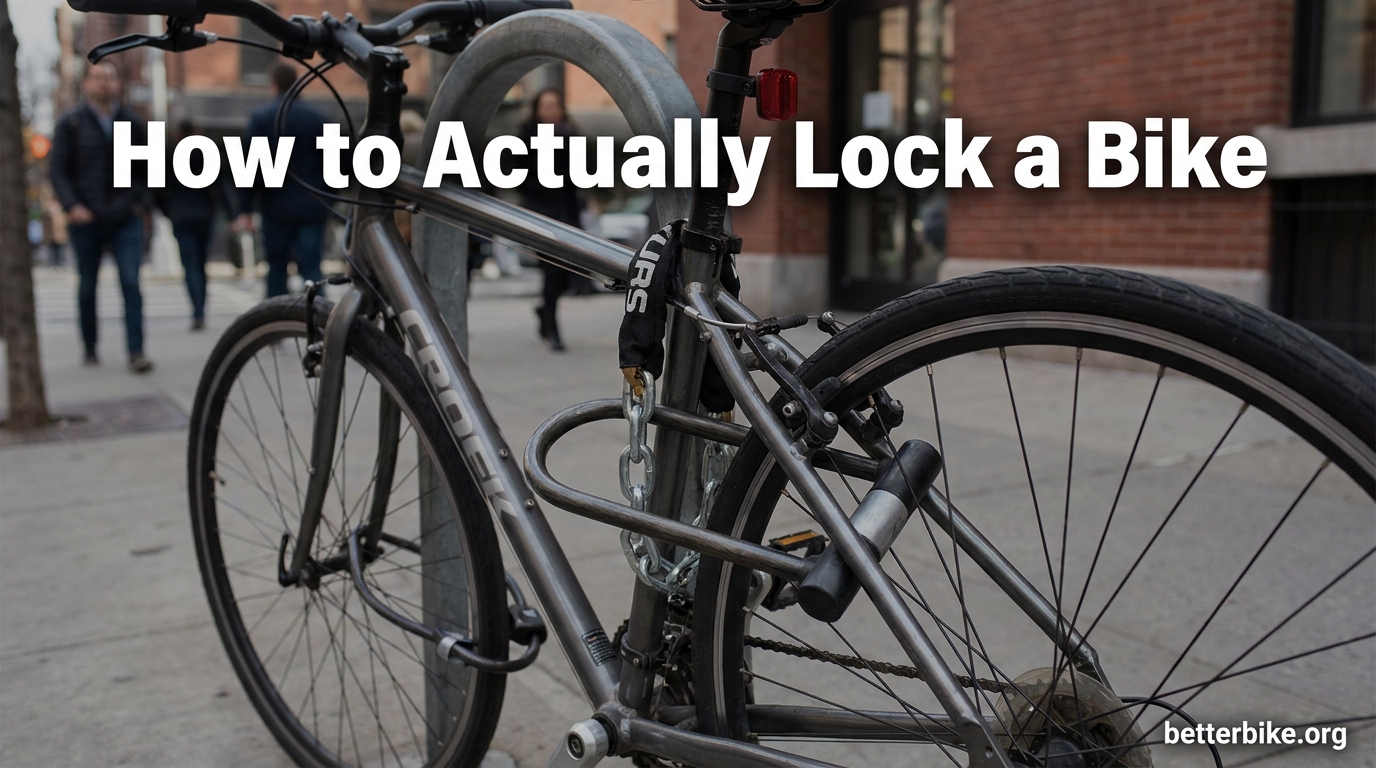
Every cyclist faces the same moment: you arrive at your destination, lean your bike against a rack, and wonder whether your lock is good enough. If you have ever stood on a sidewalk turning your U-lock over in your hands while a chain lock rattles in your bag, you already know that the choice between a U-lock, a chain, and a cable is not just about preference. It is about how to actually lock a bike so it stays yours.
This guide breaks down U-lock vs chain vs cable once and for all. We cover how each lock type works, what thieves can and cannot defeat, and the exact technique you should use every single time you park. Whether you commute daily, ride an e-bike, or just need something for quick errands, you will leave knowing which lock fits your life and how to use it correctly.
Bike theft is not a rare event in most cities. A determined thief with an angle grinder can cut through almost anything in under 60 seconds, but the vast majority of stolen bikes are taken with cheap bolt cutters in under 10. That gap between the worst-case scenario and the typical theft is where your lock choice and locking technique actually matter.
Here is what you will learn: the real differences between U-locks, chain locks, and cable locks, how to read security ratings like Sold Secure and ART, the step-by-step method for locking your bike properly, common mistakes that get bikes stolen, and exactly which lock to pick based on where and how you ride.
Table of Contents
Quick Summary: U-Lock vs Chain vs Cable
If you only have 30 seconds, here is the short version. U-locks offer the best security-to-weight ratio and are the top choice for daily commuters in most cities. Chain locks provide maximum flexibility and can wrap around thick posts that U-locks cannot reach, but they are heavy. Cable locks are convenient and lightweight, but they are not real security on their own and should only be used as a secondary lock or in very low-risk situations.
For most riders in most situations, the answer to how to actually lock a bike is a U-lock securing the frame and rear wheel to a fixed object, paired with a cable or second lock for the front wheel. That combination stops opportunistic thieves and slows down determined ones.
The biggest mistake cyclists make is buying one good lock and using it wrong. A U-lock through only the front wheel leaves your entire frame free. A cable wrapped around a signpost that can be lifted over the top is not a lock at all. Technique matters as much as the tool.
U-Locks: The Gold Standard for Bike Security
U-locks, also called D-locks in the UK and Europe, are rigid locks shaped like a U or D. They consist of a hardened steel shackle and a locking crossbar that clips onto both ends. The design is simple, and that simplicity is exactly what makes them so resistant to attack.
How U-Locks Work
The shackle on a quality U-lock is made from hardened steel, typically 13mm to 18mm thick. That thickness matters because standard bolt cutters, the tool most bike thieves carry, struggle to get a clean bite on anything over 12mm. A 16mm or 18mm shackle is effectively bolt-cutter proof under normal conditions.
The locking mechanism lives in the crossbar. Better U-locks use a double-locking design, meaning the shackle is held at both ends. A thief cannot pop one side and pull it free. They have to cut through the shackle itself, usually with an angle grinder or a car jack if there is enough space inside the U.
That internal space is the weakness. The more room inside the U, the easier it is for a thief to use a leverage attack, wedging a long pipe or car jack inside and forcing the shackle apart. This is why proper locking technique, which keeps the U tight against the frame and rack, is so important.
U-Lock Pros
U-locks deliver the highest security per pound of any lock type. A quality U-lock weighing around 2 to 3 pounds can resist bolt cutters, hand tools, and most hand-held power tools for long enough to make theft unattractive in a public setting.
They are also relatively easy to carry. Most U-locks ship with a frame-mounted bracket that clips the lock to your bike while you ride, or they fit snugly in a bag or basket. Compared to a chain lock of equal security, a U-lock is roughly half the weight.
U-locks are the most tested and certified lock type. You will find plenty of models with Sold Secure Diamond or Gold ratings, which is the level most insurers require in high-theft areas. That certification is not marketing fluff. It means the lock survived timed attacks with a defined set of tools.
U-Lock Cons
The rigidity that makes U-locks secure also makes them inflexible. If you need to lock to a thick lamp post, a wide tree, or an awkwardly shaped rack, the U might not fit. You are limited to objects that fit inside the shackle opening, which is usually around 4 inches by 9 inches on standard models.
Carrying a U-lock takes planning. Smaller U-locks are lighter and more secure because they leave less room for leverage attacks, but they are harder to fit around both a wheel and a frame simultaneously. Larger U-locks solve the fit problem but trade away some security and add weight.
U-locks can also damage your frame if they bounce against it while riding. A protective coating on the shackle helps, but over time the paint on your bike can still chip. Many commuters wrap their lock in an old inner tube or use a dedicated sleeve.
Best U-Lock Use Cases
U-locks shine for daily commuters who park at the same racks regularly and want maximum security without lugging a chain around. They are ideal for urban environments where you lock to standard bike racks, signposts, or parking meters that fit inside the shackle.
If you ride a standard road, hybrid, or commuter bike and park in medium-to-high theft areas, a U-lock is almost always the right primary lock. Pair it with a cable for your front wheel and you have a setup that handles 90 percent of real-world theft scenarios.
U-locks are also the go-to for anyone whose bike insurance requires a specific security rating. Most policies specify Sold Secure Gold or Diamond, and U-locks offer the widest range of options at those levels.
Chain Locks: Maximum Flexibility, Maximum Weight
Chain locks are exactly what they sound like: a length of hardened steel chain links with a padlock or integrated locking mechanism. They trade the rigid security of a U-lock for the ability to wrap around almost anything.
How Chain Locks Work
A chain lock’s security comes from two things: the hardness of the links and the strength of the padlock. The best chains use through-hardened or boron steel links measuring 9mm to 14mm thick. At 9mm, a chain resists medium bolt cutters. At 12mm or thicker, hand-held bolt cutters cannot get through, and a thief needs a power tool.
The padlock is often the weakest link, literally. A chain is only as secure as its lock, so quality chains pair their links with a matched, hardened padlock designed to resist picking, drilling, and shackle cutting. Budget chains often fail because they use a cheap padlock on expensive links.
Because chains are flexible, they can wrap around thick posts, trees, railings, and oddly shaped racks that a U-lock cannot handle. A typical quality chain is 3 to 3.5 feet long, which is enough to capture both wheels and the frame in many configurations.
Chain Lock Pros
Flexibility is the headline benefit. A chain will reach objects a U-lock simply cannot, which matters in cities where proper bike racks are rare and you end up locking to whatever is bolted down. If you regularly park at signposts, lamp standards, scaffolding, or street furniture, a chain removes the fit anxiety entirely.
Chains resist leverage attacks better than U-locks. There is no rigid shape for a thief to wedge a jack into, and trying to pry apart individual chain links with hand tools is slow and noisy. This is why many high-security chain locks earn Sold Secure Diamond ratings.
A chain can often secure both wheels and the frame in a single pass, eliminating the need for a second lock. For riders who want one lock that does everything, a long chain paired with a strong padlock is a complete security solution.
Chain Lock Cons
Weight is the trade-off. A chain that offers U-lock-equivalent security typically weighs twice as much, often 4 to 7 pounds. That weight is noticeable on a long ride and awkward to carry. Chains do not mount cleanly to most bike frames, so you end up wrapping them around your seatpost, stuffing them in a pannier, or wearing them around your waist or shoulder like a Hiplok.
Chains rattle. Without a fabric sleeve or cover, the metal links bang against each other and against your bike frame, which is both annoying and potentially damaging. Most quality chains come with a sewn fabric sleeve that dampens noise and protects your paint, but budget chains often skip this.
Cost is another factor. A good chain with a matched padlock is often more expensive than a U-lock at the same security level. You are paying for more steel and a separate locking mechanism, and budget chains cut corners on both.
Best Chain Lock Use Cases
Chain locks are the top pick for high-theft areas where security is non-negotiable and you accept the weight. If you park overnight on a street, at a train station for 12 hours, or in a city known for organized bike theft rings, a thick chain is worth every ounce.
They are also excellent for e-bikes and cargo bikes, which often have frames too thick or oddly shaped for standard U-locks. A chain wraps around large tubing easily and can capture a battery-secured frame plus both wheels in one pass.
For stationary or semi-stationary use, like locking your bike in a garage or shed where the chain lives permanently, weight stops mattering. Many riders keep a heavy chain at work or at home and use a lighter U-lock for short stops elsewhere.
Chains also win when you cannot predict what you will be locking to. If your route takes you past a mix of racks, signposts, and random street furniture, a chain guarantees you will always find something to wrap around.
Cable Locks: Lightweight Convenience, Low Security
Cable locks are long, flexible strands of braided steel cable housed in a plastic or vinyl coating, usually with a built-in key or combination lock. They are the lightest and most convenient bike lock type, and also the least secure.
How Cable Locks Work
A cable lock’s core is a bundle of thin steel wires, often 8 to 15 strands, braided together and sheathed in plastic. The locking mechanism is usually integrated at one end, with the other end looping back into the lock body or a separate padlock.
The flexibility comes from using many thin wires instead of one thick piece of steel. This is great for wrapping around awkward objects, but it is also the fundamental weakness. Those thin wires are vulnerable to bolt cutters, and even a determined thief with basic wire snips can work through a cable in under a minute.
Thicker cables, around 15mm to 20mm in overall diameter, slow down casual theft. But no cable lock on the market resists a real bolt cutter attack. This is not a limitation of cheap cables versus expensive ones. It is a function of how cables are built.
Why Cable Locks Still Matter
It is easy to dismiss cable locks as security theater, and in isolation, they mostly are. But cables have a legitimate role in a layered locking strategy. The most common and effective use is as a secondary lock alongside a U-lock or chain.
Here is the classic setup: your U-lock secures your rear wheel and frame to a rack. A cable loops through your front wheel, runs through the U-lock, and closes on itself. Now a thief cannot walk away with your front wheel without defeating the U-lock first, which is the hard part.
Cables are also useful for very low-risk situations. If you are popping into a shop for two minutes in a small town, or locking your bike inside a fenced yard at a house party, a cable provides enough deterrence to keep honest people honest.
Cable Lock Pros
Cables are incredibly light. A 4-foot cable weighs under a pound and coils small enough to fit in a jersey pocket or tuck into a bag corner. No other lock type comes close on portability.
They are endlessly flexible. A cable can wrap around a tree trunk, thread through a wheel and frame, and reach objects no U-lock could touch. For awkward locking spots, nothing beats a cable’s reach.
Cables are inexpensive. A decent cable lock costs a fraction of what a quality U-lock or chain costs, which makes them an easy add-on even if you already own a primary lock.
They are also genuinely useful for securing accessories. Loop a cable through your saddle rails and frame to stop seat theft, or thread one through your helmet chin strap when you park.
Cable Lock Cons
The security is minimal. A cable lock alone will not stop a thief with bolt cutters, and anyone determined enough to bring tools to a bike rack will defeat a cable in seconds. Using a cable as your only lock in any urban area is a near-guaranteed way to lose your bike eventually.
Cables can be cut quietly. Unlike an angle grinder attack on a U-lock, which sparks and screams, cutting a cable with bolt cutters is a fast, quiet operation. Thieves know this, and bikes locked with only a cable are targeted precisely because they are easy wins.
The integrated locks on budget cables are often as weak as the cable itself. Cheap combination dials can be bypassed, and flimsy key cylinders can be picked or drilled. Even if the cable were stronger, the lock body would still fail.
Best Cable Lock Use Cases
Use a cable as a secondary lock, not a primary one. Pair it with a U-lock or chain to protect your front wheel, seat, or accessories while your main lock handles the frame.
Cables work for rural and suburban low-theft environments where the goal is casual deterrence rather than real security. If your bike is visible through a coffee shop window and you are gone for three minutes, a cable says “locked” to passersby.
They are also a reasonable choice for indoor or semi-indoor use, like locking your bike to a rack inside an office parking garage where building security controls access. The cable keeps coworkers from accidentally rolling off on your bike without pretending to stop a real thief.
Side-by-Side Comparison: U-Lock vs Chain vs Cable
Here is how the three lock types stack up across the factors that actually matter when you are deciding how to lock your bike. These are general ranges based on quality models from reputable brands. Specific products vary.
Security level: U-lock and chain are roughly tied at the top when both use thick hardened steel. Cable is clearly the weakest by a wide margin. A thick U-lock or 12mm+ chain resists bolt cutters; no cable does.
Weight: Cable is lightest at under 1 pound. U-locks sit in the middle at 2 to 3 pounds. Chains are heaviest at 4 to 7 pounds for security-equivalent models.
Flexibility: Chains and cables win, wrapping around thick and awkward objects. U-locks are limited to objects that fit inside the shackle opening.
Resistance to bolt cutters: U-locks with 16mm+ shackles and chains with 12mm+ links resist hand bolt cutters. Cables of any thickness do not.
Resistance to angle grinders: No portable lock fully stops an angle grinder. U-locks and thick chains buy you 30 to 90 seconds of delay. Cables fall almost instantly.
Resistance to leverage attacks: Chains are best because there is no rigid shape to lever against. U-locks are vulnerable if there is empty space inside the shackle. Cables cannot be levered but can be cut instead.
Portability while riding: Cables coil into almost nothing. U-locks mount on a frame bracket or fit in a bag. Chains are the hardest to carry and often require a bag, basket, or wearable holster.
Price: Cables are cheapest. U-locks sit in the middle. Quality chains with matched padlocks are typically the most expensive per unit of security.
Best as: U-locks are the best all-around primary lock for most commuters. Chains are best for maximum security and awkward objects. Cables are best as secondary locks for wheels and accessories.
How to Actually Lock a Bike (Step-by-Step)
Knowing your lock types is only half the battle. The other half is technique. A mediocre U-lock used correctly protects a bike better than a top-rated lock used carelessly. Here is exactly how to lock a bike so it stays where you left it.
The Sheldon Brown Method
The most widely recommended locking technique comes from the late Sheldon Brown, a legendary bicycle mechanic. His method captures the rear wheel inside the rear triangle of the frame and locks it to a fixed object with a U-lock. Because the wheel and frame overlap inside the triangle, a thief cannot remove the wheel without also defeating the lock.
This works because you do not need to capture the frame tube directly. The rear wheel is structurally part of the bike once it is in the dropouts, and the rear triangle prevents the wheel from being slid out while the U-lock holds it to the rack. It is fast, compact, and uses a smaller U-lock than you might think.
The Sheldon Brown method is not perfect for every rack, but it is the single best starting point for learning how to actually lock a bike. Once you understand it, you can adapt the principle to almost any parking situation.
Step-by-Step Locking Technique
Follow these steps every time you lock up. The sequence matters because each step removes one more option for a thief.
Step 1: Choose an immovable object. Lock only to something bolted to the ground or permanently fixed. A bike rack embedded in concrete is ideal. A signpost works only if the sign itself cannot be unbolted and lifted over the top of your bike. Avoid chain-link fences, wooden posts, and anything that can be cut or lifted.
Step 2: Position the bike. Stand your bike parallel to the rack or post. Position it so the rear wheel sits close to the object you are locking to. The closer everything is, the less room a thief has to insert tools.
Step 3: Lock the rear wheel and frame to the object. Place your U-lock around the rear wheel, inside the rear triangle of the frame, and around the rack or post. Keep the U-lock as tight as possible. Minimize the empty space inside the U to prevent leverage attacks. The lock should barely clear the wheel, frame, and rack.
Step 4: Secure the front wheel. If your front wheel has a quick-release skewer, it can be stolen in seconds. Run a cable through the front wheel, through the U-lock body, and close the cable. If you have a second U-lock or chain, use that instead for higher security. Alternatively, replace your quick-release skewers with locking skewers that require a special key to remove.
Step 5: Remove or secure accessories. Take your lights, computer, and any bag with you. If your seat has a quick-release clamp, either take it inside or secure it with a secondary cable. Accessories are easy targets of opportunity.
Step 6: Check the lock before you walk away. Tug the lock hard. Make sure it is actually closed and engaged. A surprising number of thefts happen because the rider thought they locked up but left the crossbar unclicked.
Step 7: Note your surroundings. Park in well-lit, high-foot-traffic areas when possible. A thief is far less likely to attack a lock with an angle grinder when dozens of people are walking by. Location is a security layer that costs nothing.
Combining Lock Types: The Double-Lock Strategy
Using two locks is one of the most effective theft deterrents available, and it costs less than you might think. The principle is simple: a thief carrying one tool for one lock type is stopped by a second lock of a different type.
The most common and effective combination is a U-lock for the frame and rear wheel, paired with a cable for the front wheel. The U-lock does the heavy lifting on security, and the cable extends protection to the front wheel without adding meaningful weight or cost.
For higher-risk areas, use two different primary locks. A U-lock plus a chain, or a U-lock plus a folding lock, forces a thief to carry two different power tools. Most opportunistic thieves carry one tool and move on when they see a second lock.
This is not paranoia. Bike forums are full of stories from riders whose bikes survived a theft attempt because the thief defeated one lock and gave up on the second. The double-lock strategy works because it changes the math of the crime. More time, more tools, more risk.
Common Locking Mistakes to Avoid
Even cyclists who own good locks make these errors. Each one turns a secure lock into a liability.
Mistake 1: Locking only the front wheel. A front wheel is removable in seconds. If your U-lock captures only the front wheel and the rack, a thief unscrews the wheel and walks off with the rest of your bike. Always lock the frame or the rear wheel inside the frame triangle.
Mistake 2: Locking to a removable object. Signposts can be unbolted. Chain-link fences can be cut. Small trees can be sawed. If the object is not permanent, your lock is useless. Test the object before trusting it.
Mistake 3: Leaving too much space in the U-lock. A U-lock with the rack, frame, and wheel rattling around inside it is a leverage attack waiting to happen. A thief inserts a car jack or long pipe and pops the shackle. Keep the lock tight against everything inside it.
Mistake 4: Locking the top tube only. Locking the top tube to a rack means a thief can sometimes twist or hammer the lock off by rotating the bike. Lock the wheel inside the frame triangle instead, which is structurally protected by the rear stays.
Mistake 5: Using a cable as your only lock in a city. We covered why cables are weak. In any urban area, a cable alone is an invitation. Thieves specifically scan for bikes locked with only a cable because they know it is a fast, quiet job.
Mistake 6: Parking in isolated spots. A back alley with no foot traffic gives a thief unlimited time to work. Even the best lock can be defeated eventually with power tools. Choose busy, visible locations.
Choosing the Right Lock for Your Situation
There is no single best bike lock. There is only the best lock for where you live, what you ride, and how long you park. Here is how to choose based on your actual situation.
Security Ratings Explained
Security ratings cut through marketing claims and tell you what a lock actually survived in controlled testing. Two systems matter most: Sold Secure and ART.
Sold Secure is a UK-based testing organization that rates locks on a scale from Bronze to Silver to Gold to Diamond. Bronze means the lock resisted basic hand tools for a short time. Gold means it survived a longer attack with a defined tool set including some power tools. Diamond, the newest and highest tier, means the lock withstood a prolonged attack with a broader, more aggressive tool set including angle grinders.
ART is a Dutch certification used widely across Europe. ART awards 1 to 5 stars, with 2 or 3 stars being the minimum many insurers require for urban coverage. ART testing is similar in spirit to Sold Secure but uses different tools and time thresholds.
For practical purposes: if you park in a high-theft city, look for Sold Secure Gold or Diamond, or ART 3 or higher. If your bike insurance has a lock requirement, read it carefully. Many UK and European policies will not pay out unless you used a lock with a specific rating, and they may ask for proof of purchase.
By Scenario: Which Lock to Pick
Short errands in low-to-medium theft areas: A U-lock through the rear wheel and frame is plenty. Add a cable for the front wheel if it has quick-release.
Daily commuting in a high-theft city: A Sold Secure Diamond U-lock plus a cable for the front wheel. Or a U-lock plus a second smaller U-lock or folding lock. Two different lock types force a thief to carry two tools.
Overnight street parking: A thick chain lock (12mm+ links) with a matched padlock, ideally paired with a U-lock. Overnight is when organized thieves with power tools work. You need maximum delay time.
Train station all-day parking: Same as overnight. These are high-risk environments because the bike is unattended for many hours and stations are frequent theft targets. Use your strongest lock setup.
Quick stops in rural areas: A single U-lock or even a thick cable is sufficient. The threat model is different. Opportunistic theft is the main risk, not organized crews with grinders.
Office or home garage: Depends on access control. If the garage is secure and access-controlled, a lighter lock is fine. If it is shared or public, treat it like street parking.
E-Bike and Fat Bike Considerations
E-bikes and fat bikes create locking challenges that standard bikes do not. Their frames are often thicker, their wheels are wider, and their value is higher, making them bigger theft targets.
Many e-bikes have frames with integrated batteries that sit inside thick downtubes. A standard U-lock may not fit around the downtube plus a rack plus the wheel. Measure your frame and rack before buying. A chain lock often solves this because it wraps around large tubing without fit issues.
Fat bikes with 4-inch-plus tires add another problem. The wheels are wide enough that a standard U-lock may not capture the wheel and frame together. You may need an extra-wide U-lock or a chain long enough to go around the tire and frame in a single loop.
E-bike motors and batteries are themselves theft targets. Some e-bikes have removable batteries that you can take with you. If yours does, remove it when parking in high-risk areas. A bike without its battery is worth less and is less attractive to thieves.
Because e-bikes are valuable, consider investing in the strongest lock setup you can carry. A Sold Secure Diamond U-lock plus a heavy chain is not overkill for a bike worth thousands of dollars. The lock is cheap insurance relative to the bike.
Frequently Asked Questions
Are U-locks better than chain locks for bikes?
U-locks and chain locks offer similar peak security when both use hardened steel, but U-locks win for most riders because they deliver that security at roughly half the weight. Chains are better when you need to lock to thick or awkward objects that a U-lock cannot fit around. For daily commuting on a standard bike, a U-lock is usually the better choice.
How to properly lock a bike with a U lock and cable?
Lock the U-lock around the rear wheel inside the rear frame triangle and around an immovable object like a bike rack. Then run a cable through the front wheel, pass it through the U-lock body, and close it. This secures the frame and rear wheel with the U-lock and protects the front wheel with the cable. Keep the U-lock tight to prevent leverage attacks.
Is cable or chain better for bike lock?
Chain locks are significantly better for actual security because hardened steel chain links resist bolt cutters, while cable locks can be cut with basic bolt cutters in seconds. Cables are better only as lightweight secondary locks for wheels and accessories, or in very low-risk situations. Never use a cable as your only primary lock in an urban area.
What is the difference between cable lock and U-lock bike?
A U-lock is a rigid U-shaped hardened steel shackle with a locking crossbar that resists bolt cutters and hand tools. A cable lock is a flexible bundle of thin braided steel wires in a plastic coating that can be cut quickly with bolt cutters. U-locks are far more secure but less flexible in what they can wrap around. Cables are light and convenient but offer minimal security on their own.
What type of bike lock is most secure?
The most secure portable bike locks are Sold Secure Diamond rated U-locks and thick hardened steel chain locks with 12mm or thicker links and matched padlocks. No portable lock is angle-grinder proof, but these types delay a determined thief longest. For maximum security, use two different lock types together so a thief needs two different tools to defeat both.
Final Thoughts on Locking Your Bike
Understanding U-lock vs chain vs cable and how to actually lock a bike comes down to matching the right tool to your situation and using it correctly every time. U-locks are the best all-around choice for most commuters. Chains offer maximum security and flexibility for high-risk scenarios and oversized bikes. Cables are a useful secondary lock, not a primary one.
The lock you buy matters, but the technique you use matters just as much. Lock the rear wheel inside the frame triangle to an immovable object. Keep the U tight. Protect your front wheel with a cable or a second lock. Park where people can see your bike. Those habits, repeated every single time, are what actually prevent theft.
Start with one quality U-lock and a cable, then add a second primary lock if you regularly park in high-theft areas. Your bike is worth the few extra seconds it takes to lock it properly.