
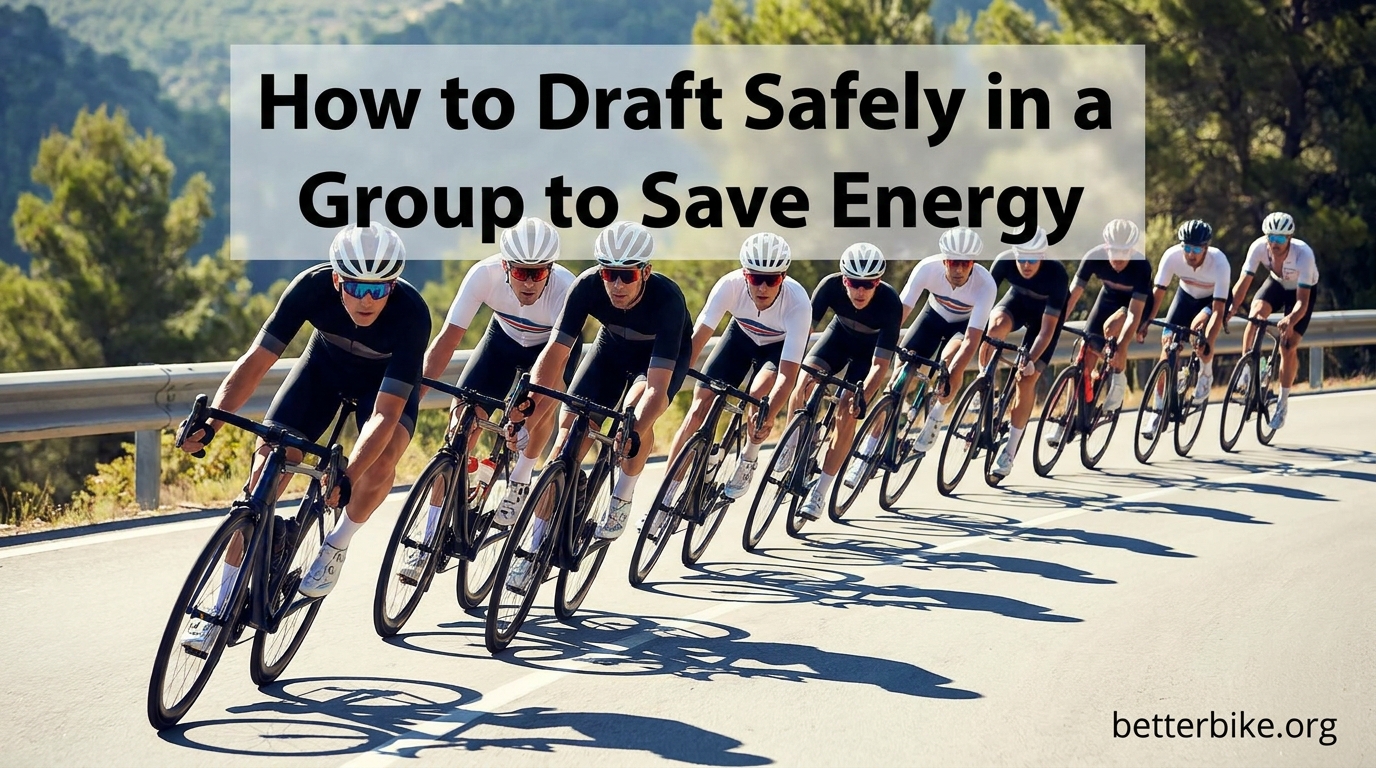
If you have ever watched a pro peloton glide past at 28 mph and wondered how those riders sustain that pace for hours, the answer is not superhuman fitness. The answer is drafting. Learning how to draft safely in a group to save energy is the single biggest technique upgrade available to a recreational cyclist, and it costs nothing but practice.
Research consistently shows that riding in the slipstream of another cyclist can cut your energy output by 20 to 40 percent. That is the equivalent of suddenly being several watts stronger, without touching your training plan. For context, that same drag reduction from aero equipment would cost hundreds or thousands of dollars.
I remember the first group ride I joined. I sat third wheel, absolutely certain I was about to clip the rider ahead, for the first 20 minutes. By the end of that ride, I was hooked. I had covered 45 miles at a pace I could never have held alone, and I finished feeling fresher than I do after a 30-mile solo effort. That is the power of drafting done right.
This guide walks through everything from the basic physics of the slipstream to advanced paceline rotations, plus the safety habits that keep you upright and welcome in any group. Whether you are prepping for your first no-drop ride or trying to stop getting dropped at the end of centuries, the techniques below will change how you ride.
Table of Contents
What Is Drafting in Cycling?
Drafting in cycling is the practice of riding closely behind another rider so they push through the air first, leaving a pocket of lower-pressure, calmer air for you to ride in. That calmer pocket is called the slipstream, or sometimes the wind shadow. By sitting in it, you face far less aerodynamic drag, which means you produce less power to hold the same speed.
Think of it like swimming behind a boat. The boat displaces the water and creates a wake of disturbed, slower-moving water behind it. A cyclist does the same thing with air. The lead rider punches a hole in the wind, and that hole stays open for roughly a bike length or two before the air collapses back together.
The physics are worth understanding because they explain why positioning matters so much. Aerodynamic drag increases with the square of your speed, which means fighting the wind at 22 mph is roughly twice as hard as at 15 mph. The faster the group moves, the bigger the benefit of tucking in behind someone. At casual cruising speeds, drafting helps. At race pace, it is the entire strategy.
One common misconception: drafting is not “free speed” you are stealing. It is the foundational mechanic that makes group riding possible at all. Without it, a peloton would simply be a line of riders all doing identical solo efforts. The etiquette around taking turns at the front exists precisely because everyone in the group benefits from shared work.
How Much Energy Does Drafting Actually Save?
Studies and real-world power meter data put the energy savings from drafting in the 20 to 40 percent range, depending on speed, wheel gap, and how many riders are in front of you. The commonly cited figure is that a single rider in front of you saves you roughly 30 percent at typical road cycling speeds.
Here is the breakdown that matters in practice. Behind one rider, expect 20 to 30 percent savings. Two riders up, around 30 to 35 percent. Deep inside a large peloton, savings can reach 40 percent or more, because the air has been churned by a dozen bodies before it reaches you.
What does that feel like? On a flat road holding 20 mph solo might cost you 220 watts. Tucked into a paceline at the same speed, you might be doing 150 watts. That 70-watt discount is enormous over a two-hour ride. It is the difference between finishing strong and getting shelled in the final five miles.
The savings also compound with speed. At 15 mph the slipstream helps a little. At 25 mph it is transformative. This is why breakaways in pro racing almost never succeed alone, and why your local group ride suddenly feels easy when you finally commit to sitting on a wheel instead of rolling along in the wind.
There is a catch, though. Those savings only materialize if you are positioned correctly, communicating well, and riding predictably. A bad drafting position saves you almost nothing while adding crash risk. Technique matters more than gear.
Finding the Sweet Zone: Where to Position Your Wheel
The sweet zone is the small patch of calmer air directly behind the rider in front of you. Hit it, and the ride feels effortless. Miss it, and you are working hard for no benefit. Finding it consistently is the core skill of group riding.
The ideal drafting distance is roughly 6 to 12 inches behind the rear wheel ahead of you, for experienced riders. That gap is close enough to capture most of the slipstream benefit, while leaving just enough room to react if the rider ahead slows. Beginners should start at one to two wheel lengths back, then gradually close the gap as confidence builds.
Where you position laterally matters too. You do not want to be perfectly centered every time. In a crosswind, the slipstream shifts downwind, so the sweet zone moves to the side. Riders form an echelon, a staggered diagonal line, to keep pulling that shifted air pocket. In a headwind, you sit tight and centered. Reading the wind direction is a learned skill, and it is one of the things that separates experienced group riders from people who just happen to be in a group.
The term “wheel suck” gets thrown around, sometimes affectionately, sometimes as an insult. Technically it just means a rider who sits in the draft without taking a turn at the front. Sitting on a wheel is not inherently bad. Refusing to ever contribute when you are able is.
For your first few group rides, do not worry about the absolute perfect position. Focus on holding a steady gap, looking ahead rather than staring at the tire in front of you, and keeping your upper body relaxed. Tension makes you twitchy, and twitchy riders make the whole group nervous.
One habit that will transform your drafting almost immediately: look past the rider in front of you, not at their wheel. Your peripheral vision is excellent at managing the gap. Your central vision should be reading the road two or three riders up, so you can anticipate surges, slows, and obstacles before they reach you.
Overcoming the Fear of Riding Close to Others
The biggest barrier to drafting well is not physical. It is psychological. Riding six inches behind a stranger’s rear wheel at 22 mph feels genuinely scary the first time, and forum threads across Reddit, BikeForums, and Facebook cycling groups confirm that almost every new group rider feels it.
That fear is normal and rational. You are trusting someone you may not know with your safety. The good news is that the fear fades fast with controlled exposure. Most riders report that after three or four group rides, the close-quarters riding starts to feel natural, even boring.
Here is how to manage the anxiety in the meantime. Start on a no-drop ride, not a hammerfest. Tell the ride leader you are new and ask to be placed near the back where the pace is steadiest. Ask the rider ahead of you if it is okay to sit on their wheel. Most experienced cyclists are happy to have a clean, communicative rider behind them, and asking permission is universally respected.
If you are nervous about a specific rider, you do not have to draft them. It is entirely acceptable to drift back through the group and find someone whose pedaling looks smooth and predictable. Smooth riders make safe wheels to follow. Jerky, surging riders are the ones who cause crashes.
Permission-based drafting is worth calling out explicitly. Sitting on the wheel of a stranger who has not agreed to it is bad etiquette, full stop. On shared paths, group rides, and especially behind riders you do not know, a quick “mind if I sit on your wheel?” goes a long way. Some riders prefer to ride alone for training reasons, and that is their call.
Paceline Formations: Single, Double, and Rotating
A paceline is an organized line of riders taking turns at the front, then peeling off to recover in the draft. It is the structure that turns a bunch of cyclists into a faster, more efficient unit. There are three main formations, each with its own use case.
Single Paceline
The single paceline is the simplest formation and the one every group rider learns first. Riders line up single file, the leader pulls for a set duration, then swings off to one side and drifts to the back of the line. The next rider takes over, and the cycle repeats.
Single pacelines work well for smaller groups, narrower roads, and riders still learning the rhythm. The downside is efficiency. With only one line, the recovering rider has to spend time in the wind riding from the front back to the rear of the group.
Double Paceline
A double paceline runs two abreast, with both front riders pulling together, then peeling off on opposite sides. The line shifts up, and a new pair takes the front. This formation doubles the number of riders shielded from the wind at any given moment.
Double pacelines are great for larger groups on wide roads. They are also friendlier for conversation, which is part of why club rides favor them on social spins. They do require more road width and tighter coordination, since four riders are involved in each rotation rather than two.
Rotating Paceline (Through-and-Off)
The rotating paceline, also called through-and-off, is the most efficient and the most demanding. Two lines form, a fast line and a slow line. The lead rider in the fast line peels off into the slow line immediately, and the slow line continuously drifts backward. Riders in the fast line are always moving up; riders in the slow line are always moving back.
This is the formation you see in breakaways during pro races. It keeps a high, steady pace because no one is ever stuck at the front for long. Pulls can be as short as a few seconds. Rotating pacelines demand confidence, smooth pedaling, and tight communication. They are not beginner formations.
How do you know which one to use? Match the formation to the group, the road, and the goal. Five friends on a social ride, single paceline. Twenty-strong club run on a wide arterial, double paceline. Race breakaway or hard training session with strong riders, rotating paceline. When in doubt, ask what the group is running before you join the line.
Taking Your Turn at the Front: Pulling Etiquette
Taking a pull means spending time at the front of the paceline breaking the wind for everyone behind you. It is the work that earns you the right to recover in the draft. Done well, your pull is smooth, predictable, and the right length. Done badly, it shatters the group’s rhythm.
How long should a pull last? For most recreational pacelines, 30 seconds to two minutes is the sweet spot. Shorter pulls keep the pace high and the group fresh. Longer pulls suit smaller groups or steady climbs. The key is consistency. If everyone else is doing one-minute pulls and you grind out a five-minute turn, you have just made the group wait for you, and you have probably gone too hard and will struggle to latch back on after pulling off.
When you reach the front, do not accelerate. This is the single most common pulling mistake. The temptation is to “show what you have got,” but a surge at the front ripples back through the line like a shockwave. By the time it reaches the last rider, the accordion effect has them sprinting just to hold the wheel. Maintain the same speed the previous leader held. Check your bike computer if you need to.
When your pull is done, signal your intent. A flick of the elbow, a wave of the hand, or a quick verbal “pulling off” tells the rider behind you that the front is theirs. Then drift smoothly to the side. Do not swerve. Do not brake. Just ease off the power and let your bike coast to the side, then soft-pedal to the back of the line.
What if you are cooked and cannot take a pull? Skipping pulls is allowed, even smart, if you are genuinely struggling. The polite way to do it is to drift to the back of the line before you reach the front, or to take a very short pull, a few pedal strokes, and immediately swing off. A quick “I am done, going to sit in” to the rider near you keeps everyone informed. What is not acceptable is sitting second wheel all ride, pretending you do not notice the rotation coming.
Group Communication: Hand Signals and Verbal Cues
Communication is what keeps a group ride safe. The lead riders see hazards first, and it is their job to pass that information down the line. Every rider has responsibility to repeat signals so the message reaches the back.
Essential Hand Signals
Pointing at the road surface means there is a hazard: pothole, grate, debris, or rough patch. Point with the hand on the side where the hazard sits. A sweeping motion toward the curb means the whole group needs to move right, usually for a parked car or road narrowing.
A flat palm held behind the back, like a stop sign, means slowing down. This gives riders behind warning before they feel the pace drop. A raised hand above the head usually signals a full stop, a light, or a major obstacle. An elbow flick, as mentioned above, indicates the rider is pulling off and the front is yours.
A shake of the hand or a circling finger sometimes indicates a surface issue like gravel or wet paint. Learn the local conventions on your first ride by watching the riders around you. Different regions and clubs use slightly different vocabularies.
Essential Verbal Cues
“Hole” means a pothole. “Glass” means debris on the road. “Gravel” warns of loose surface, often in corners. “Car up” means a vehicle approaching from the front on a narrow lane. “Car back” means a vehicle approaching from behind and the group may need to single up.
“Slowing” or “stopping” should be called out early and loudly enough for the back of the group to hear. “Rolling” or “clear” indicates the group is moving again or an intersection is safe. “Easy” is the universal call to back off the pace, usually when the group is strung out and someone is in trouble.
“On your wheel” lets a rider know you are behind them, so they do not swing unexpectedly. “Through and off” confirms a rotating paceline is in effect. “Single up” or “double up” tells the group to change formation.
The accordion effect is worth understanding here. When the lead rider slows even slightly, the rider behind has to brake a little harder to avoid overlapping, the next rider a little harder still. By the back of a 15-rider line, a 1 mph slowdown at the front becomes a near-stop. Smooth pedaling and early communication prevent this. Abrupt braking causes it.
Common Drafting Mistakes and How to Avoid Them
Most crashes in group rides come from a small set of repeatable mistakes. Avoid these and your group-riding career will be long and upright.
Overlapping wheels is the single most dangerous habit. If your front wheel sticks out beside the rear wheel of the rider ahead, any sideways movement by them takes out your front wheel and you go down instantly, often taking several riders behind you with you. Stay directly behind, or leave a clear gap. Never overlap unless you are deliberately riding two abreast in a double paceline.
Surging off the front. When your turn at the front ends, ease off smoothly. Do not sprint away from the line. Surges create gaps that force the rider behind to close them, which wastes energy and breaks the rhythm. The best paceline riders are boring to watch. Steady, smooth, repeatable.
Half-wheeling is when you ride with your front wheel half a wheel ahead of the rider beside you in a double paceline. It pushes the pace up because the other rider has to keep matching you, and it makes the whole group ride harder than intended. Ride handlebar to handlebar when two abreast.
Abrupt braking. In a paceline, sudden braking ripples backward instantly. Instead of grabbing a fistful of brake, sit up slightly to catch more wind, soft-pedal, or feather the brakes gently while calling out “slowing.” Save the hard braking for genuine emergencies.
Staring at the wheel in front of you. When you fixate on the tire ahead, you lose all sense of what is happening up the road. You also stop steering smoothly. Look ahead, two or three riders up. Your peripheral vision tracks the wheel. This is the single most important visual habit in group riding.
Not communicating. If you see a hazard, call it out and point. If you are struggling, say so. If you are pulling off, signal it. Silent riders are dangerous riders in a group context. You do not need to narrate everything, but critical information should always travel down the line.
Skipping pulls silently. Drifting to the back because you are cooked is fine. Doing it without saying anything, then lurking at second wheel the entire ride, is the behavior that gets riders uninvited from the next group text. Communication covers a multitude of fitness sins.
When There Is No Group: Solo Drafting Alternatives
What if you cannot find a group, or you prefer riding alone? You can still use drafting principles to save energy, just in different forms.
The most accessible solo technique is the tuck position. Drop your elbows, lower your torso closer to the top tube, and bring your knees in against the frame. This reduces your frontal area significantly, often saving 15 to 25 watts at speed. It is not as effective as sitting on a wheel, but it is free and always available.
Terrain can also offer a form of natural drafting. Riding in the lee of hedgerows, embankments, or buildings provides brief shelter from crosswinds. On long exposed stretches, even a slight dip in the road can shield you from a headwind. None of this replaces a real slipstream, but every watt counts on a solo ride.
Here is the honest cost comparison. A deep-section front wheel, aero helmet, and skinsuit together might save you 30 to 40 watts at race speed and cost well over a thousand dollars. A good drafting position in a group saves you the same amount, or more, and costs nothing but attention to technique. If your goal is going faster for less money, learn to draft before you buy aero gear.
One more solo option worth mentioning: virtual training. Watching pro race footage, what some riders call “couch training,” trains your eye to read pack movements, anticipate surges, and understand positioning. It will not replace saddle time, but it is a surprisingly useful complement, especially in the off-season.
How close should I ride when drafting another cyclist?
Experienced riders draft 6 to 12 inches behind the rear wheel ahead. Beginners should start at one to two wheel lengths back and close the gap gradually as confidence and bike handling skills improve.
How much energy does drafting actually save?
Drafting behind a single cyclist saves roughly 20 to 30 percent of energy output at road cycling speeds. Inside a large peloton, savings can reach 40 percent or more because multiple riders have churned the air ahead of you.
Is it rude to draft behind a stranger without asking?
Yes. Sitting on the wheel of a rider who has not agreed to it is poor etiquette, especially on shared paths and training routes. A quick ‘mind if I sit on your wheel?’ is universally appreciated and some riders prefer to ride alone for their own training reasons.
What is the 80% rule in cycling?
The 80% rule in cycling is a training guideline suggesting that roughly 80 percent of riding should be done at low intensity, with only 20 percent at high intensity. It is related to polarized training, not directly to drafting, though efficient drafting supports easier recovery rides.
Why do I keep getting dropped even though I am fit?
Getting dropped is often a positioning and pack-riding problem, not a fitness problem. Riders who sit too far back, fail to close gaps, ride with their nose in the wind, or surge unnecessarily burn matches that fit riders behind a good wheel never spend. Drafting technique usually matters more than raw watts.
What is the difference between a paceline and a peloton?
A paceline is an organized line of riders taking turns at the front and recovering in the draft. A peloton is the larger main group of riders in a race, which may contain multiple pacelines, clusters, and strategic positioning within it. All pacelines operate inside a peloton, but not all peloton riding is paceline riding.
Start Drafting With Confidence
Learning how to draft safely in a group to save energy is the highest-return skill you can develop as a road cyclist. The 20 to 40 percent energy savings cost nothing but attention, communication, and a willingness to ride close to others. The technique beats expensive aero gear at a fraction of the price.
Start small. Find a no-drop ride, ask to sit on a wheel, hold a steady gap, and look ahead rather than at the tire in front of you. Communicate every hazard. Take your pulls smoothly and signal when you are done. Within a handful of rides, the anxiety fades and the rhythm becomes second nature.
The riders who consistently surprise themselves on group rides are not the ones with the fanciest bikes or the highest wattage numbers. They are the ones who learned to read the wind, hold a wheel, and trust the line. That can be you on your next ride.