
Every cyclist knows the feeling. You turn onto a road and realize there is no bike lane, no shoulder, and nothing but a white edge line between you and traffic. Your heart rate jumps. Your grip tightens. That knot in your stomach is completely normal, and every rider who has spent time on suburban or rural roads has felt the exact same way.
Learning how to ride safely on a road with no bike lane or shoulder is one of the most important skills any cyclist can develop. Whether you commute to work, train on rural routes, or simply want to expand the roads you feel comfortable riding, the techniques in this guide will give you the confidence and the knowledge to handle shoulder-less roads without panic.
I have spent years riding on narrow country roads, suburban arterials, and city streets with zero cycling infrastructure. Along the way, I have talked with hundreds of commuters on forums, studied the guidance from the League of American Bicyclists, and tested different positioning strategies in real traffic. What follows is everything I have learned, distilled into a practical, step-by-step resource.
We will cover lane positioning, taking the lane, visibility, intersections, dealing with aggressive drivers, route planning, and emergency maneuvers. If you want to go deeper on specific handling skills, check out our guide on proper braking techniques for safer riding — because knowing how to stop confidently is just as important as knowing where to position yourself.
Table of Contents
Understanding the Challenge: Why No-Shoulder Roads Are Different
Riding on a road with no bike lane or shoulder presents a fundamentally different challenge than riding on a road with infrastructure. When a bike lane or wide shoulder exists, you have a designated space. When neither exists, you are fully part of the traffic stream, and that requires a completely different mindset and skill set.
The Speed Differential Problem
The single biggest danger on shoulder-less roads is the speed differential between you and motor vehicles. A typical cyclist rides between 12 and 20 mph. A car on a 45 mph road may be traveling at 50 to 55 mph in reality. That means a car is approaching you at a closing speed of 30 to 40 mph, and the driver has very little time to react, adjust, and pass safely.
This speed gap is what makes riders instinctively want to hug the edge of the road. It feels safer to be as far away from cars as possible. But as we will see, this instinct is often exactly wrong. Hugging the edge can actually make you less visible and encourage dangerous passes.
The Visibility Gap
Drivers are not actively looking for cyclists on high-speed roads. They are scanning for other cars, checking their mirrors, and watching traffic signals. A cyclist wedged against the edge line blends into the periphery and can disappear entirely in glare, shadows, or roadside clutter.
Forum riders on Reddit’s bike commuting communities consistently report the same finding. When they moved further into the lane, drivers noticed them sooner and gave them more space. Being predictable and visible matters far more than being out of the way.
The Legal Reality
In every U.S. state, cyclists have the legal right to use the travel lane when there is no bike lane or when the right edge of the road is unsafe. The legal standard in most states is the word “practicable,” meaning you must ride as far right as is safe and reasonable, but not so far right that you put yourself in danger.
This means you are not breaking any law by riding in the middle of a lane on a narrow road with no shoulder. In fact, on roads where the lane is too narrow for a car and a bike to travel safely side by side, the safest and most legally defensible position is often the center of the lane. This is the core idea behind what cycling educators call vehicular cycling.
Lane Positioning Fundamentals: Where to Ride
Lane positioning is the foundation of riding safely on any road without a bike lane or shoulder. Where you place your bike in the lane tells drivers what to expect, controls how they pass you, and determines whether they can see you in time to react.
The Right-Third Principle
On a normal-width road with light traffic, ride in the right third of the travel lane. This typically means positioning yourself about three to four feet from the edge of the pavement. This position keeps you visible to drivers approaching from behind, gives you room to swerve around debris or potholes, and still leaves enough room for cars to pass when it is safe to do so.
The Silver Wheels Cycling Club, which produces some of the most detailed safe cycling guidelines available, recommends riding in the right tire track of the lane, which naturally puts you about four feet from the road edge. This is the same position the right wheels of a car would occupy, and it is where drivers expect to see moving objects.
The 14-Foot Lane Rule Explained
Here is a practical rule that will change how you read roads. A standard travel lane needs to be at least 14 feet wide for a car and a bicycle to safely share it side by side. Here is the breakdown: a car needs about 8 feet of width including mirrors, a cyclist needs at least 3 feet of operating space, and you need a minimum 3-foot passing buffer between them.
Most travel lanes in the United States are 10 to 12 feet wide. This means the vast majority of lanes are too narrow to share. If you do the math, a 12-foot lane leaves only 4 feet to split between the cyclist’s space and the passing buffer, which is not enough. On these lanes, a car cannot pass you safely without crossing into the adjacent lane, which means you should be controlling the lane.
When to Ride the Edge vs Control the Lane
Use this simple decision framework. If the lane is 14 feet or wider and traffic is light, ride the right third. If the lane is narrower than 14 feet, which is most lanes, and a car cannot safely pass within the same lane, take the center of the lane. If the road has a wide, clean shoulder with no debris or rumble strips, you may use it, but be cautious about right-turn conflicts and surface hazards.
The key insight is this: your lane position should communicate to drivers whether it is safe to pass within the lane. If you ride the edge on a narrow lane, a driver may attempt to squeeze past without changing lanes, which is exactly how close passes and collisions happen. By controlling the lane, you force the driver to make a full lane change, which is far safer.
The Door Zone Danger
If the road has on-street parking and no bike lane, never ride within three feet of parked cars. The door zone, the area where a suddenly opened car door can appear, is one of the most dangerous places on any road. A dooring incident can throw you into traffic or send you over the handlebars.
Ride at least three feet from parked cars, even if that puts you in the flow of traffic. Drivers would rather you be in the lane than have you crash into a door and end up under their wheels. For more on what happens when handling goes wrong, see our guide on cornering mistakes to avoid, which covers what happens when bike control breaks down unexpectedly.
How to Take the Lane Safely
Taking the lane means riding in the center of the travel lane to control it and prevent unsafe passing. It is one of the most powerful tools a cyclist has on roads with no bike lane or shoulder, and it is the correct response to most narrow-lane situations.
What Taking the Lane Means
Taking the lane does not mean being aggressive or blocking traffic. It means positioning yourself so that a driver cannot pass you without making a full lane change. This forces the driver to treat you like any other slow-moving vehicle. They slow down, wait for a safe gap, and pass by changing lanes, exactly as they would for a tractor or a mail truck.
Experienced cyclists on Reddit’s bike commuting forums consistently report that taking the lane results in more space from passing cars, not less. When you hug the edge, drivers try to squeeze by. When you hold the lane, they make a proper pass.
Step-by-Step: 5 Steps for Taking the Lane
Follow these five steps every time you need to control a lane on a shoulder-less road.
Step 1: Check behind you. Glance back or use a rearview mirror to confirm no vehicle is about to pass. You need to know what is behind you before you move.
Step 2: Signal your move. Use a left hand signal to indicate you are moving left. Even a brief signal communicates your intent to any driver watching.
Step 3: Move smoothly to the center. Move to the center of the lane in one deliberate motion. Do not drift, do not weave, and do not hesitate. A confident, predictable movement is what drivers respect.
Step 4: Hold your position. Ride steadily in the center of the lane. Do not weave back to the edge and back out. Hold the lane until the road widens, the hazard passes, or you reach your turn.
Step 5: Release the lane when safe. When the lane widens, the hazard clears, or a long line of cars builds behind you, check behind you, signal right, and move back to the right third. Releasing the lane when it is safe keeps traffic flowing and builds goodwill.
When to Release the Lane
Take the lane when the road is narrow, when you are approaching an intersection, when you are passing parked cars, or when debris blocks the right edge. Release the lane when the road widens to 14 feet or more, when you have a long line of cars behind you and a safe place to move right, or when the hazard that forced you to take the lane has passed.
Common courtesy matters. If you are holding up a long line of traffic and the road is about to widen, pull over briefly when it is safe and let cars pass. This is not surrender, it is good road citizenship, and it makes drivers more patient the next time they encounter a cyclist.
Signaling Your Intentions
Hand signals are your primary communication tool. Use the left arm extended straight out for a left turn, left arm bent up at 90 degrees for a right turn (or right arm straight out, which is legal in most states and clearer to drivers), and left arm bent down at 90 degrees for slowing or stopping.
Signal early, hold the signal for at least three seconds, and make eye contact with drivers when possible. Eye contact is one of the most underrated safety tools. A driver who has made eye contact with you is far less likely to pull out or turn across your path.
Riding With Traffic, Never Against
This may seem obvious, but it is worth stating clearly. Always ride with traffic, in the same direction as the cars in your lane. Riding against traffic, sometimes called salmoning, is one of the most dangerous things a cyclist can do on any road, and it is especially deadly on roads with no shoulder.
Why Direction Matters
When you ride against traffic, you are approaching every car head-on at a combined closing speed that eliminates reaction time. A car going 45 mph and a cyclist going 15 mph toward it means a closing speed of 60 mph. At that speed, a driver has less than two seconds to see you, process that you are there, and react.
Worse, drivers pulling out of driveways and side streets are looking for traffic coming from the left in the direction they expect. They are not scanning for a cyclist coming from the right against the flow. You become invisible because you are in the wrong place at the wrong time.
Matching Speed When Possible
The closer your speed is to the speed of traffic, the safer you are. This is why taking a lane in slow, stop-and-go city traffic often feels less dangerous than riding a 55 mph rural road. When everyone is moving at 15 to 25 mph, the speed differential is small and drivers have time to react.
On faster roads, do what you can to maintain a good pace. This does not mean sprinting until you are exhausted. It means riding at a steady, efficient speed that minimizes the speed gap. If you are descending, you may actually be keeping up with traffic, which makes lane positioning far less stressful. Our guide on mastering control on descents has more on handling speed with confidence.
Merging and Lane Changes
When you need to change lanes on a road with no shoulder, the process is the same as taking the lane. Check behind you, signal, make eye contact if possible, and move deliberately into the new lane. Do not drift or weave. Drivers respond to predictable, confident movements.
To merge across multiple lanes, do it one lane at a time. Take the first lane, stabilize your position, then repeat the process for the next lane. Never try to sweep across three lanes in one motion. That is how you end up in a driver’s blind spot at the worst possible moment.
Visibility: Making Sure Drivers See You
On a road with no bike lane or shoulder, your visibility is your survival. A driver who sees you early can adjust their speed and position. A driver who does not see you until the last second has no time to react. Everything you can do to be seen earlier is an investment in your safety.
Lighting Essentials
Front and rear lights are not optional on shoulder-less roads. Even in broad daylight, a flashing rear light significantly increases the distance at which drivers notice you. Studies of cyclist visibility consistently show that daytime running lights reduce collisions, and experienced cyclists on forums treat them as non-negotiable.
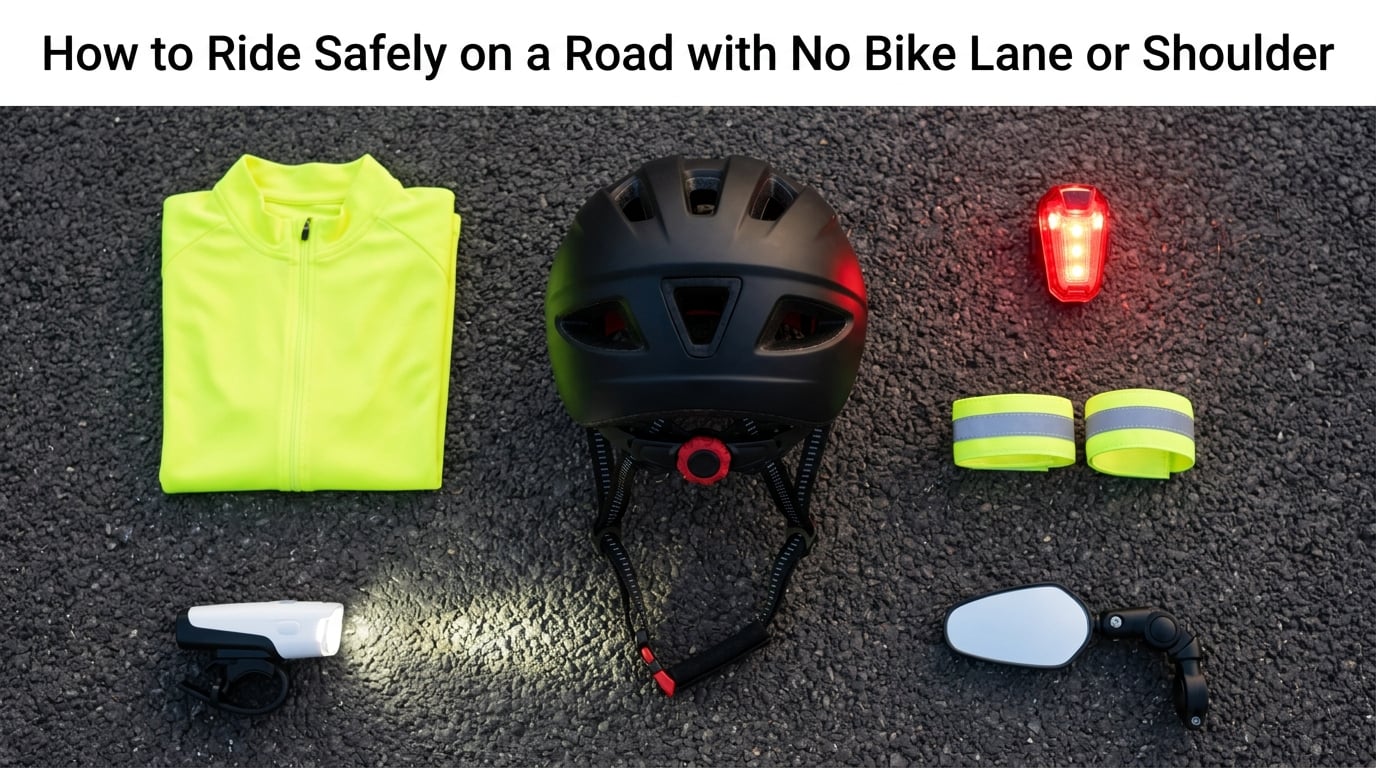
Use a bright, flashing red rear light mounted on your seat post, backpack, or helmet. Use a white front light, ideally in a flashing or pulse mode during the day and a steady beam at night. Position lights where they are not blocked by your body or gear. A light hidden behind a jacket or saddlebag does nothing.
Clothing and Reflective Gear
Bright, contrasting clothing makes a measurable difference in how early drivers detect you. Neon yellow, bright orange, and lime green are the most effective colors because they stand out against every common background, whether that is gray asphalt, green trees, or blue sky.
Reflective gear adds another layer after dark. Reflective ankle bands move as you pedal, which creates motion that catches a driver’s eye. A reflective vest over your regular riding clothes is an easy, inexpensive upgrade that dramatically increases your visibility at night.
Daytime Running Lights
The concept of daytime running lights comes from the motorcycle and automotive world, where studies showed that always-on lights reduced multi-vehicle crashes. The same principle applies to cyclists. A flashing light during the day breaks the visual monotony of the road and draws a driver’s attention.
If you ride on shoulder-less roads regularly, invest in lights with a dedicated daylight flash mode. These modes are designed to be visible from a greater distance in bright conditions, and they are worth every penny for the extra reaction time they buy you.
Intersections: Approach, Position, and Turns
Intersections are where the majority of car-bicycle collisions happen. On roads with no bike lane, you are navigating intersections as a full vehicle, and your positioning and communication determine whether drivers understand what you are about to do.
Approaching Intersections Safely
As you approach any intersection, scan for cars that might turn across your path. Check your mirror, look over your shoulder, and watch the cars in the oncoming lane for anyone signaling a left turn. Slow slightly so you have more reaction time, and position yourself based on what you plan to do next.
If you are going straight, hold your position in the right third of the through lane. Do not drift right into the space where a right-turning car might squeeze past you. If you are turning left, begin your merge into the left lane or left turn lane well before the intersection.
Left Turns From the Lane
Left turns on a road with no shoulder require merging into the left lane or the center turn lane. Start the process early, at least 100 feet before the intersection. Check behind you, signal left, make eye contact with the driver behind you if possible, and merge one lane at a time.
Once you are in the left turn lane or the left side of the travel lane, wait for oncoming traffic to clear. Signal again, make your turn, and land in the right third of the new road. If traffic is heavy and merging feels unsafe, you can use the pedestrian option: cross to the far corner as a pedestrian would, using crosswalks, then start riding in the new direction.
Right Turns and Right-Hook Avoidance
The right hook is one of the most common intersection crashes. It happens when a car passes you on the left and then immediately turns right across your path. On roads with no bike lane, your best defense is lane position. If you are approaching a right turn and a car is next to you or behind you, take the center of the lane so the car cannot pass and then cut you off.
Never pass stopped cars on the right at an intersection. A car that appears to be going straight may turn right into you. If there is a line of stopped cars, take the lane and wait in line like any other vehicle. It feels slower, but it is dramatically safer.
Dealing With High-Speed and Aggressive Drivers
Not every driver will treat you with patience. On roads with no bike lane or shoulder, you will eventually encounter drivers who speed, pass too closely, honk, or yell. How you handle these moments is a critical part of riding safely.
Staying Calm Under Pressure
Your first job is to stay calm. A close pass or a honk triggers a fight-or-flight response that can make you swerve, brake suddenly, or make a poor decision. Train yourself to hold your line, keep both hands on the bars, and breathe. Reacting emotionally on a bike in traffic is how accidents happen.
If a driver passes too closely, do not chase them, do not gesture, and do not try to catch up at the next light. Let it go. Your goal is to get home safely, not to win an argument with a stranger who does not understand cycling laws.
What to Do When Passed Too Closely
If you are consistently getting close passes on a particular stretch, check your lane position. Riders who hug the edge tend to get the closest passes because drivers think they can squeeze by. Moving further into the lane, even just one or two feet, often makes drivers give you more room because they have to commit to a full lane change.
A rearview mirror, whether handlebar-mounted, helmet-mounted, or eyeglass-mounted, helps you see approaching cars without turning your head. This lets you hold a steady line while monitoring what is behind you. Many experienced commuters consider a mirror essential on high-speed roads.
Handling Honking and Verbal Aggression
If a driver honks at you for being in the lane, hold your position and do not panic. A honk does not mean you are doing something wrong. It often means the driver is frustrated, but frustration does not change your legal right to the lane. Wave politely, keep riding, and move right only when it is genuinely safe to do so.
If a driver yells or escalates, do not engage. Keep riding, note the license plate if you can, and report dangerous behavior to local police if warranted. Most encounters end as quickly as they begin, and the best response is to be the calm, predictable road user in the situation.
Route Planning: Avoiding the Worst Roads
The safest way to handle a dangerous road is to not ride on it at all. Smart route planning is one of the most underappreciated safety skills, and modern tools make it easier than ever to find quiet, comfortable alternatives to high-speed shoulder-less roads.
Using Strava Heatmaps and Komoot
Strava’s heatmap shows where cyclists actually ride, and it is one of the most powerful route-planning tools available. Roads with heavy cyclist traffic tend to be safer, more comfortable, and better connected to other cycling routes. If a road does not appear on the heatmap, it probably means cyclists avoid it for a reason.
Komoot and Ride with GPS are excellent for building routes that prioritize bike-friendly roads. Both platforms let you filter by surface type, road type, and elevation. You can often find a parallel route that adds only a few minutes to your ride but eliminates miles of stressful high-speed road.
Identifying Quieter Alternatives
When evaluating alternative routes, look for residential streets that parallel major arterials, roads with lower speed limits, roads with fewer lanes, and roads that connect to parks or greenways. A route that uses a bike path for even a mile can break up a stressful ride into manageable segments.
Spend a weekend exploring your area on a bike with no agenda. You will discover roads, paths, and connectors that do not show up on any mapping app. Local knowledge is gold, and the riders who know the back routes are the ones who enjoy their commutes the most.
Time-of-Day Strategy
When you ride matters almost as much as where you ride. A 45 mph road that is empty at 6 AM can be a nightmare at 5 PM. If you have flexibility, shift your ride times to avoid rush hours. Early morning and mid-morning rides typically have lighter traffic and calmer drivers.
Daylight also matters. Riding at dawn or dusk, when the sun is low and glare blinds drivers, is far more dangerous than riding at noon. If you must ride at those times, double down on lights and reflective gear.
Emergency Maneuvers Every Cyclist Should Know
Even with perfect positioning and visibility, things go wrong on the road. A car cuts you off, a pothole appears, a dog runs out. Knowing how to react in an emergency is the difference between a close call and a crash.
The Quick Stop
The quick stop is the most important emergency braking technique. When you need to stop as fast as possible, shift your weight back behind the saddle, drop your heels, and apply both brakes firmly with the front brake doing about 70 percent of the work. The front brake is your most powerful stopping tool, but you must get your weight back to prevent going over the bars.
Practice this in a parking lot before you need it on the road. Start at low speed and gradually increase. The goal is to build muscle memory so that when a car pulls out in front of you, your body automatically shifts back and brakes hard without thinking. Our guide on braking without flipping over the bars goes deeper on this critical skill.
Dodge and Recovery
Sometimes you cannot stop in time and need to swerve around an obstacle. The dodge is a quick, controlled steering input to one side and then back. The key is to keep your upper body loose and let the bike lean under you. Do not yank the bars, and do not lock your arms.
Practice dodging around a water bottle in a parking lot. Approach at riding speed, swerve left around the bottle, then swerve right back to your original line. The motion should be smooth and quick, not jerky. A well-executed dodge takes less than a second and keeps you upright.
Shoulder Bail: Last Resort Only
If a car is coming straight at you with no time to stop or swerve within your lane, your last resort is to bail off the road entirely. Aim for grass, dirt, or gravel, not a ditch or guardrail. Get your weight back, brake hard, and try to control your deceleration as you leave the pavement.
This is a survival move, not a technique you practice regularly. The goal is simply to get off the road and away from the threat. If you end up on the ground, you are still better off than being hit at speed.
Night Riding on Roads Without Shoulders
Riding at night on a road with no bike lane or shoulder raises the stakes significantly. Visibility drops, driver attention drops, and the margin for error shrinks. If you ride at night on these roads, you need to treat visibility as a life-safety system, not an afterthought.
Light Setup for Unlit Roads
On an unlit rural or suburban road, your front light needs to do double duty. It needs to make you visible to drivers, and it needs to illuminate the road ahead so you can see potholes, debris, and edge lines. Look for a light with at least 800 lumens, preferably more, with a steady beam that has both a wide flood for peripheral visibility and a focused spot for distance.
Your rear light should be bright, red, and visible from at least a half mile. Many night riders run two rear lights, one on the bike and one on the helmet or backpack, for redundancy. If one fails or is blocked, the other keeps you visible.
Reflective Strategy
Lights fail, batteries die, and mounts break. Reflective gear is your backup system. Reflective ankle bands, a reflective vest, and reflective tape on your bike and helmet ensure that even if your lights go out, you are still visible to headlights. Reflective material works by bouncing light directly back toward its source, which means it is most effective for drivers approaching from behind with their headlights on.
Position reflective items on moving parts of your body whenever possible. Ankle bands that move as you pedal are more noticeable than static reflective patches because the motion draws the eye.
When to Avoid Riding Entirely
Some conditions are simply too dangerous for riding on shoulder-less roads. Heavy rain reduces visibility and traction. Fog makes lights less effective. Ice eliminates your ability to brake or turn. If conditions are bad, take a different route, delay your ride, or find another way home.
There is no shame in being conservative. The cyclist who lives to ride tomorrow is the one who makes smart decisions about when not to ride today. For more on the bigger picture of cycling safety advocacy, our piece on street safety advocacy explores how infrastructure and education work together to make roads safer for everyone.
FAQ’s
Where do you ride a bike if there is no bike lane?
If there is no bike lane, ride in the right third of the travel lane, approximately three to four feet from the edge of the pavement. If the lane is too narrow for a car to safely pass you within it, take the center of the lane so drivers must make a full lane change to pass. Never ride on the sidewalk against the flow of traffic, and avoid hugging the edge, which encourages dangerous close passes.
What is the 75% rule in cycling?
The 75% rule in training refers to keeping 75% of your riding below a certain heart rate threshold to build aerobic base fitness. In the context of road safety, some cycling educators reference a similar concept for lane positioning, suggesting you ride in the portion of the lane that gives you at least 75% of the safety benefits, which usually means controlling the lane on narrow roads rather than hugging the edge.
Is it legal to ride on the shoulder of a road?
Laws vary by state, but in most U.S. states, cyclists may use the shoulder when it is safe and passable. However, the shoulder is often full of debris, gravel, rumble strips, and storm drains that make it unsafe. Experienced cyclists generally recommend riding in the travel lane rather than on the shoulder because shoulders are not maintained to the same standard as the road surface and can create conflicts at intersections and driveways.
Should I ride on the shoulder or take the lane?
Take the lane when the road is narrow, traffic is fast, the shoulder has debris or rumble strips, or you are approaching an intersection. Use the shoulder only when it is wide, clean, smooth, and free of right-turn conflicts. When in doubt, control the lane, as it makes you more visible and forces drivers to make safe passing decisions.
How do I deal with cars passing too closely on narrow roads?
If cars are passing too closely, move further into the lane rather than closer to the edge. Riders who hug the edge get the closest passes because drivers think they can squeeze by. Moving to the center of the lane forces drivers to make a full lane change, which results in wider passing distances. Use a flashing rear light, wear bright clothing, and consider a rearview mirror to monitor approaching traffic.
What gear do I need for riding on roads without shoulders?
Essential gear includes a bright front light, a flashing rear light, a properly fitted helmet, bright or reflective clothing, and a rearview mirror. Optional but recommended items include reflective ankle bands, a bell or horn for audible signaling, and puncture-resistant tires since debris often accumulates at the road edge. Lights should be used during the day as well as at night for maximum visibility.
Conclusion: Ride Predictable, Ride Visible, Ride Confident
Learning how to ride safely on a road with no bike lane or shoulder comes down to three core principles. Position yourself where drivers can see you and cannot pass unsafely. Communicate your intentions with signals, eye contact, and lights. Stay calm and predictable, even when drivers are not.
The instinct to hug the edge and get out of the way is strong, but it is wrong. Taking the lane on narrow roads is not just your legal right, it is your safest option. It makes you visible, it prevents close passes, and it tells drivers exactly what to expect. Every experienced cyclist who rides shoulder-less roads regularly has learned this lesson through practice.
Start small. Practice lane positioning on a quiet road with light traffic. Practice your quick stops and emergency maneuvers in a parking lot. Plan routes that build your confidence gradually. The more you ride in traffic with the right techniques, the more natural it becomes. You will go from gripping the bars in fear to riding with the calm confidence of someone who knows exactly what they are doing.
Every ride makes you a better, safer cyclist. Get out there, be visible, hold your line, and enjoy the road.