
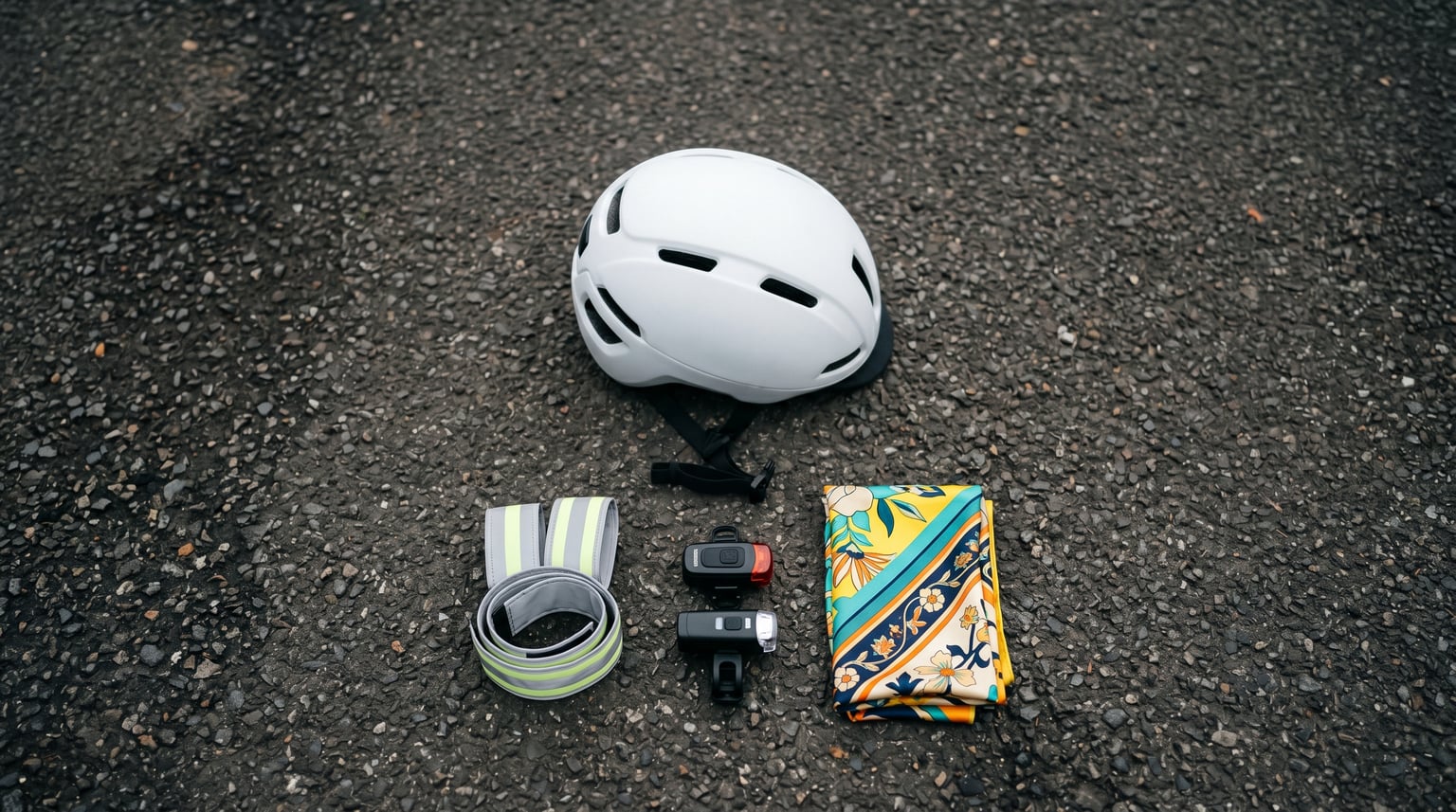
Most cyclists and motorcycle riders have heard the same advice: wear bright neon yellow from head to toe. But plenty of riders ask how to make yourself more visible without looking like a traffic cone, and the good news is that head-to-toe high-vis is not the only option that works. By combining strategic reflective placement, bright accents, quality lights, and an understanding of how drivers actually notice movement, you can stay safe and still look like yourself.
This guide breaks down the science of visibility, the accessories that blend into everyday clothes, and the specific tactics our team has tested over years of urban commuting. We also cover visibility safety tips for bikepacking that apply to everyday rides too.
Table of Contents
Why Drivers Miss Cyclists (and What Actually Works)
Drivers who collide with cyclists often say they never saw them. This is not always a lie. The human eye is wired to notice movement and contrast, not static blocks of color. That is why a cyclist in a bright yellow jacket standing still at an intersection can still blend into a busy visual background.
The concept that explains this is called conspicuity, which is simply the ability to be noticed. High conspicuity does not require fluorescent clothing. It requires contrast against your surroundings, motion cues, and the right placement of reflective or illuminated elements.
The Biomotion Advantage
Researchers have found that drivers recognize another human faster when they see moving joints. This is called biomotion. When your ankles, knees, and wrists move, drivers subconsciously identify you as a person rather than a road sign or mailbox.
This is why reflective ankle bands outperform static reflective vests in many visibility studies. The movement of your pedaling legs creates a flashing pattern that the brain processes as human motion. You do not need to be fully reflective to get this benefit. Just a small reflective point on each ankle does the heavy lifting.
One Reddit commuter we tracked put it well: drivers seem to notice the moving reflective bits more than the static bright fabric. This matches what visibility researchers have reported for years.
How to Make Yourself More Visible Without Looking Like a Traffic Cone
Here is the core strategy. You will combine four elements: strategic reflective points, a single bright accent, front and rear lights, and smart lane positioning. None of these require dressing in head-to-toe neon.
1. Place Reflective Material on Moving Parts
Put reflective bands on your ankles and wrists. Add reflective tape to your pedals, shoes, or the lower legs of your pants. The movement of these points creates the biomotion effect described above, which is more effective than a static reflective vest.
You can find thin reflective ankle bands that wrap flat against your leg and disappear under normal pants. Some are barely wider than a watch strap. When a car’s headlights hit them at night, they light up like a beacon, but during the day nobody notices them.
2. Use One Bright Accent, Not a Full Suit
A single bright element draws attention without taking over your whole look. The most effective spot for this accent is your helmet, because it sits at the highest point of your body and moves with your head. A white, yellow, or orange helmet stands out against asphalt, sky, and buildings.
Other good accent options include a bright bag, a colored scarf, or bright shoes. The point is contrast. Pick one element that pops against the road environment and let the rest of your outfit stay neutral.
3. Run Front and Rear Lights, Even During the Day
Daytime running lights are not just for cars. Studies and real-world commuter reports show that a flashing rear light during daylight hours significantly increases the distance at which drivers notice you. A solid front light pointed slightly toward oncoming traffic does the same from the front.
You do not need the most expensive light on the market. Even a basic LED light with a flashing mode improves your conspicuity. The key is using it consistently, not just at night.
4. Position Yourself Where Drivers Look
Lane positioning is a visibility tool that costs nothing. Drivers scan specific areas of the road, particularly the center of their travel lane and the edges near intersections. Riding too close to the curb can actually hide you behind parked cars and debris.
Take the lane when approaching intersections or when the lane is too narrow to share safely. Move slightly within your lane as you approach driveways or side streets. This lateral movement creates the motion cue drivers need to register your presence. Our team covers more of these cycling safety techniques in a separate guide.
5. Build Contrast Into Your Outfit
If you wear dark clothes, add a contrasting layer. A dark jacket with a light backpack creates a two-tone profile that breaks up your silhouette. Contrasting colors help drivers distinguish you from the road surface, especially at dusk when everything starts to look gray.
The contrast does not need to be fluorescent. White against black, tan against navy, or a light gray helmet against a dark coat all work. The goal is to avoid being a single dark mass that disappears into the background.
6. Use Movement to Your Advantage
Forum riders consistently report that small unpredictable movements, like a slight weave or a hand signal, get more attention than static high-vis gear. This aligns with the biomotion principle. When you signal a turn with your arm, you create lateral movement that drivers notice.
Even an upright riding posture helps. Riders on upright bikes are spotted sooner than riders hunched over drop bars, because the upright silhouette reads more clearly as a person.
Daytime vs Nighttime Visibility Strategies
Visibility needs shift depending on time of day and weather. Here is how to adjust your approach.
Daytime Riding
During the day, contrast matters more than reflectivity because headlights are not illuminating your gear. A bright helmet, a flashing rear light, and contrasting layers are your best tools. Many riders skip lights during the day, but a flashing tail light in daylight is one of the highest-impact visibility upgrades you can make.
Night Riding
At night, reflective material becomes your strongest asset. Headlights from cars will bounce off reflective surfaces and send light straight back to the driver. Focus reflective placement on your ankles, pedals, helmet, and bag. Combine this with a strong front light and a steady or flashing rear light.
Avoid relying solely on bright fabric at night. Fluorescent colors need ultraviolet light to glow, and streetlights do not produce enough of it. Reflective material, by contrast, works directly with car headlights.
Fog and Low-Visibility Conditions
Fog is one of the toughest environments for visibility. Use a front light on a steady setting so oncoming traffic sees a consistent glow rather than a flashing dot that fog scatters. Add reflective bands on your arms and legs, since fog diffuses light from all angles. Slow down and take the lane so you are not surprised by obstacles hidden in the mist.
For riders who also tackle off-road conditions, our guide on mountain bike safety skills includes tips that transfer to low-visibility road riding.
Visibility Accessories That Work With Street Clothes
You do not need to buy a full cycling wardrobe. These accessories attach to or sit alongside your normal clothes and disappear when you arrive at your destination.
Reflective Ankle and Wrist Bands
These are the single best visibility investment for street-clothes riders. They wrap around your ankles or wrists, stay flat, and cost very little. The biomotion effect from pedaling makes them extremely effective at night. Slip them off and pocket them when you arrive.
Reflective Tape
Adhesive reflective tape can go on your helmet, bike frame, fenders, panniers, or even the back of a jacket you already own. Choose silver or white tape for maximum reflectivity. A few strips on the back of a messenger bag turn any bag into a safety accessory after dark.
Clip-On Lights
Small clip-on LED lights attach to your bag, jacket hem, or helmet strap. A red clip light on your back and a white one on your chest or bag front add redundancy to your main lights. They weigh almost nothing and cost less than a coffee.
Bright Helmet or Helmet Cover
If you do not want a bright helmet permanently, a removable bright helmet cover does the job. White, yellow, or orange covers pop against urban backgrounds and fold into a jersey pocket when you arrive.
Common Visibility Mistakes to Avoid
Even experienced riders make these errors. Here are the ones our team sees most often.
Wearing dark clothes with a single rear light and nothing else. One light from one angle is easy to miss. Add reflective points and a front light so drivers approaching from any direction can spot you.
Trusting high-vis alone. Some cyclists argue that high-vis creates a false sense of security. Fluorescent fabric helps during the day but does little at night without headlights hitting it. Treat high-vis as one tool, not a complete solution.
Static gear with no motion cues. A reflective vest that does not move is less effective than a small reflective band on a moving ankle. If you only buy one reflective item, make it something that moves with your body.
Hiding in the gutter. Riding tight against the curb puts you behind parked cars, road signs, and debris. Drivers pulling out of side streets will not see you until it is too late.
FAQ’s
How do I increase my visibility on a bike?
Use a combination of reflective ankle bands, a flashing rear light during day and night, a bright helmet or accent piece, and smart lane positioning. Place reflective material on moving body parts for maximum effect.
How can I improve my visibility in fog?
Run a steady front light rather than a flashing one, since fog scatters flashing light. Add reflective bands on your arms and legs, slow down, and take the lane so you have more space to react to hidden obstacles.
How can you improve your visibility to other traffic?
Position yourself where drivers naturally scan, use front and rear lights, wear at least one contrasting or bright accent, add reflective material to moving parts, and use hand signals to create lateral motion that catches driver attention.
How to be more visible on a motorcycle?
Wear a bright or white helmet, use daytime running lights, flash your brake light before stopping, add reflective tape to your bike and gear, and avoid lingering in driver blind spots. Move slightly within your lane near intersections to create motion cues.
Conclusion
You do not need to dress head-to-toe in neon to stay safe on the road. The most effective approach to how to make yourself more visible without looking like a traffic cone combines reflective material on moving parts, a single bright accent like a helmet, front and rear lights used consistently, and lane positioning that puts you where drivers actually look. Start with ankle bands and a flashing tail light, then build from there. You will look like yourself and still get home safe.