
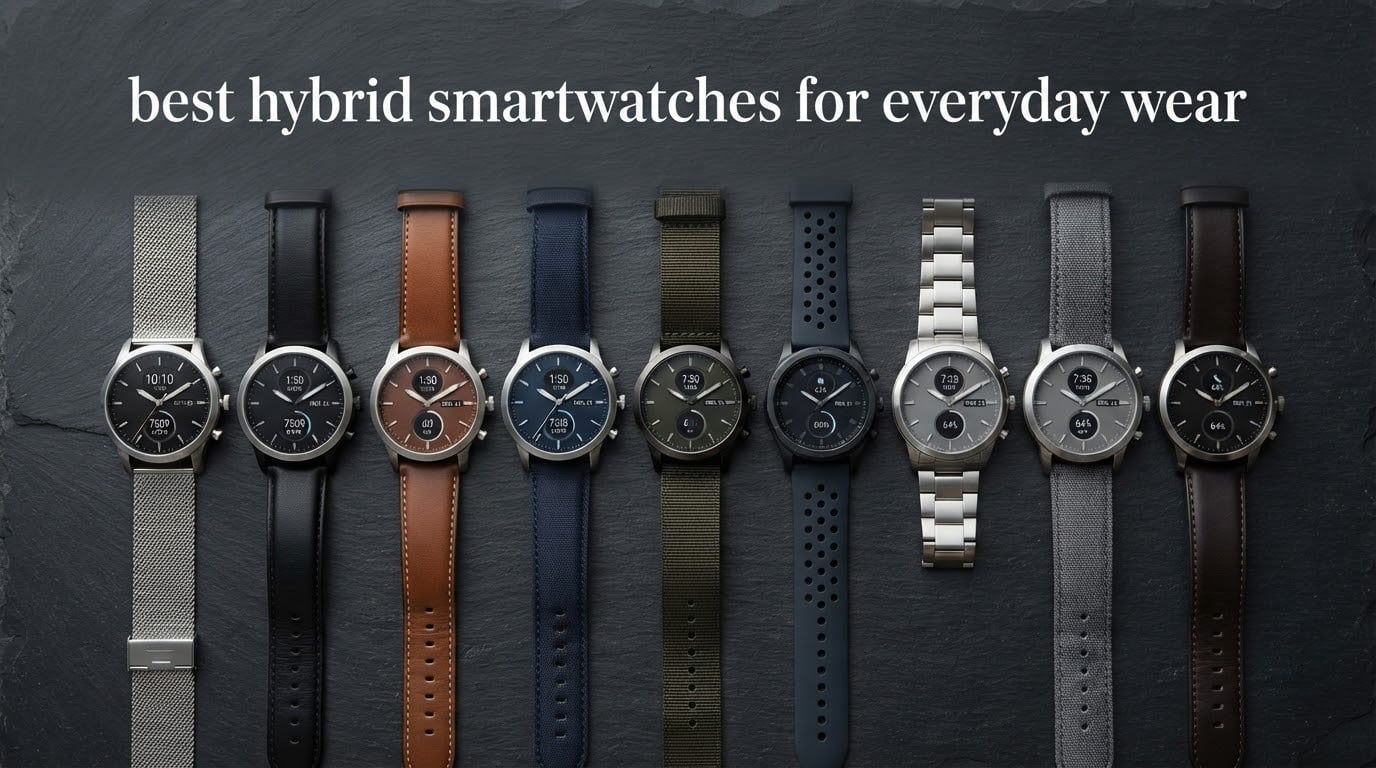
A hybrid smartwatch is a normal-looking analog watch with a hidden smart layer: Bluetooth time sync, step counting, heart rate, sleep tracking and vibration alerts for calls and texts. No screen, no glowing rectangle, and a battery measured in weeks or months instead of hours. That makes it the answer for anyone who wants the data without the screen time, or who simply refuses to charge a watch every night.
We assembled this roundup around one question: which hybrid smartwatches survive an actual working week. We looked at battery claims against real use, sensor stacks, water ratings, case sizing, strap materials and the quality of the companion app, because on a watch with no screen the app is the whole experience. Every pick below is a watch you can wear to a meeting and to the trail without changing anything.
One honest note before we start. The hybrid category has thinned out. Fossil stopped making smartwatches, and Skagen, Kronaby, Movado and Frederique Constant hybrids have all been discontinued. What is left is a smaller, more deliberate group: three Withings models, four Casio and G-Shock connected watches, one Garmin and one Citizen. That is why this list is nine deep instead of twelve, and why each pick gets more scrutiny than a longer list would allow.
Table of Contents
Top 3 Picks: Best Hybrid Smartwatches for Everyday Wear (October 2026)


If you want one watch that covers steps, training and phone syncing without ever visiting a charger, the Casio Move GBA800UC is the pick. Owners rate it 4.5 across 483 reviews, and the build shrugs off a real working week plus a workout without complaint.
When health data is the reason you are here, the Withings ScanWatch 2 is the one. It is the most reviewed watch in this guide at 702 reviews, and it is the only pick here with a medical-grade ECG and atrial fibrillation detection sitting inside a dress-watch case.
For pure toughness, the Casio G-Steel GBM2100 carries the highest rating in this roundup at 4.6. The metal-clad case, Tough Solar charging and 200 metre rating make it the least fussy daily driver on the list.
Every Pick at a Glance: Type, Battery, Water Rating and Sensors
| Product | Specifications | Action |
|---|---|---|
| Casio Move GBA800UC |
|
Check Latest Price |
| Withings ScanWatch 2 |
|
Check Latest Price |
| Casio G-Steel GBM2100 |
|
Check Latest Price |
 Casio GAB2100-1A Casio GAB2100-1A |
|
Check Latest Price |
 Withings ScanWatch Light Withings ScanWatch Light |
|
Check Latest Price |
 Withings ScanWatch Nova Withings ScanWatch Nova |
|
Check Latest Price |
 Garmin Instinct Crossover Garmin Instinct Crossover |
|
Check Latest Price |
 Citizen CZ Smart PQ2 Citizen CZ Smart PQ2 |
|
Check Latest Price |
 Casio GM-B2100 Full Metal Casio GM-B2100 Full Metal |
|
Check Latest Price |
Two taxonomy notes before the reviews, because the word hybrid gets stretched a lot in this category. A true no-screen hybrid has physical hands and no display at all, and only the Withings watches qualify. The Casio, Garmin and Citizen models keep a small digital screen for data and notifications. Both are hybrids; they just give you different amounts of information on the wrist.
1. Casio Move GBA800UC: The Connected Fitness Watch With Real Training Tools
Casio G-Shock Move GBA800UC-5A | Analog-Digital Sports Watch | Bluetooth® Smartphone Link | Step Counter | 200M Water Resistant | Shock Resistant
Analog-digital display
Bluetooth time and date sync
200 m water resistance
Step log and calorie tracking
Pros
- Real training tools including a 20-set multi-timer and 200-lap stopwatch memory
- Step and calorie logging through a 3-axis accelerometer
- Shock-resistant G-Shock build rated to 200 metres
- Lightweight and comfortable for all-day wear
- Double LED backlight for night reading
Cons
- Phone link covers time sync alarms and settings only
- no message notifications
- No heart rate sensor and no built-in GPS
- Fitness data is step and calorie based rather than physiological
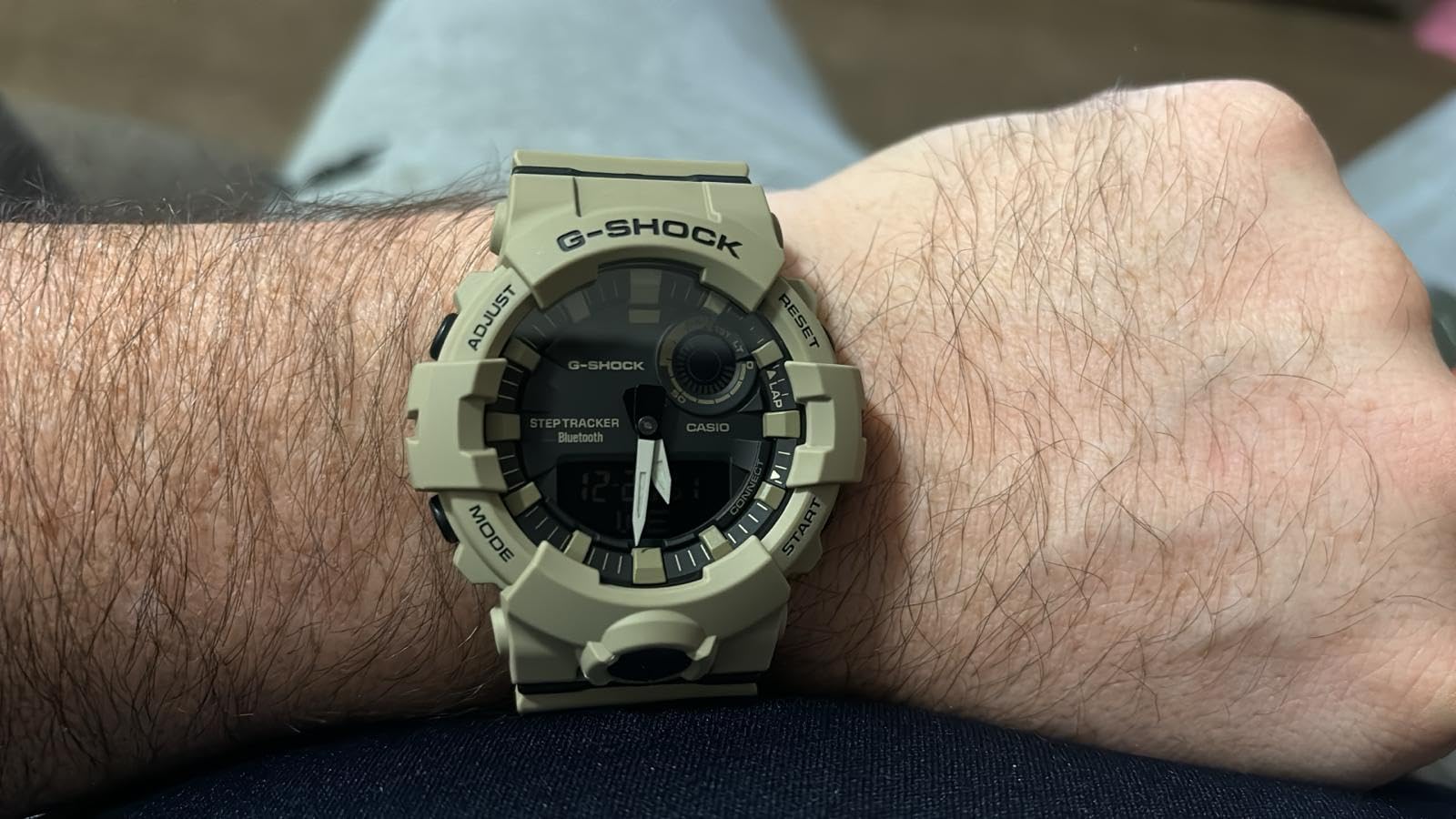
The GBA800UC is the watch I keep reaching for when the question is what survives a real week. It syncs time and date over Bluetooth, logs steps and calories through a three-axis accelerometer, and carries five exercise intensity levels with progress indicators. The multi-timer holds up to 20 sets and the stopwatch keeps 200 laps with target time alarms.
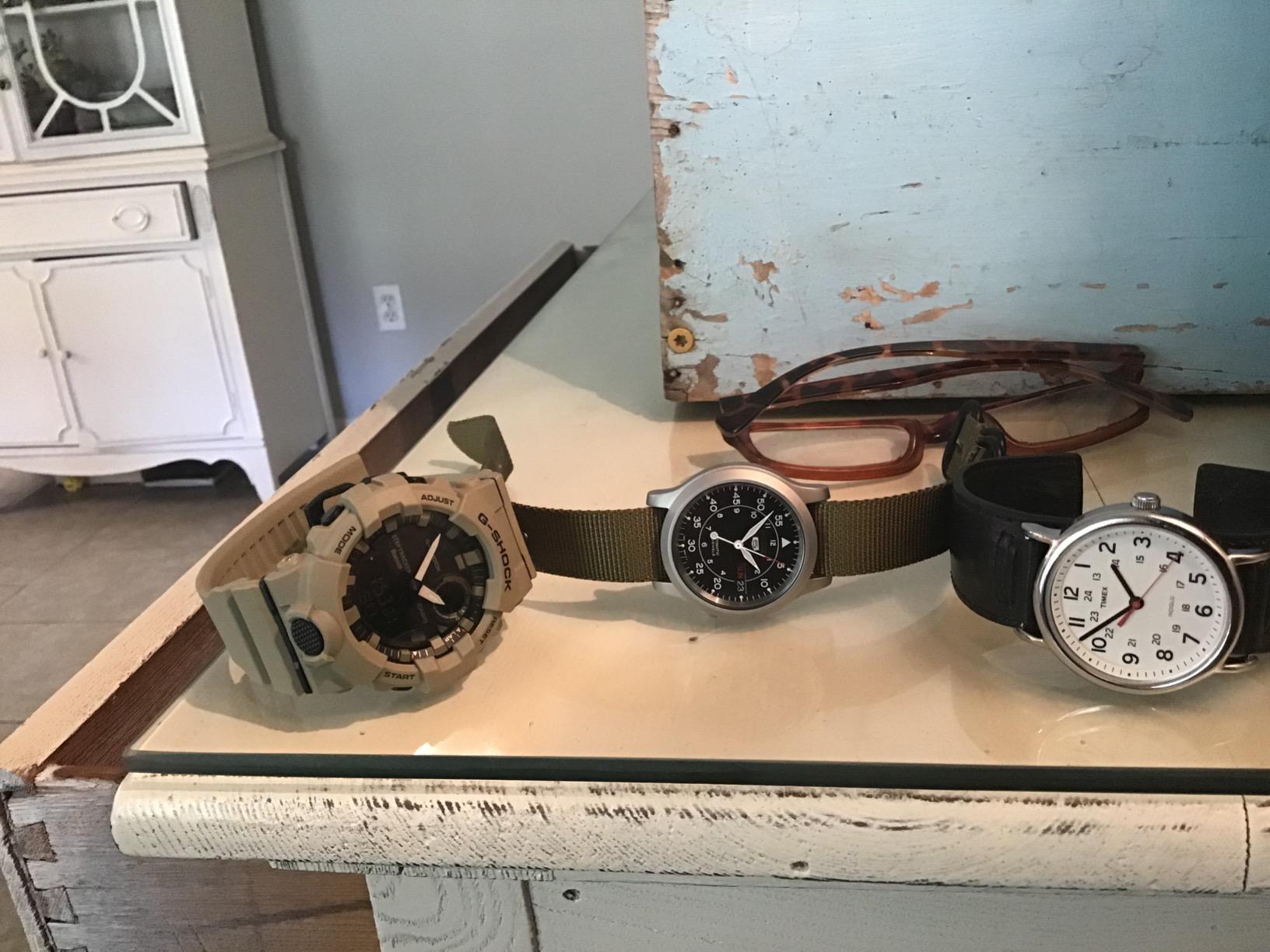
For everyday wear that means it does not feel like a fitness gadget. It looks like a square-cased Casio, it is light enough to forget, and the shock-resistant construction handles a bike rack, a gym bag and a sink without anxiety. Owners report two years of accurate, scratch-free performance, which is a longer track record than most smartwatches in this guide can offer.
The catch is that the smart layer is narrow by design. The Bluetooth link handles time adjustment, alarms and settings. It does not mirror calls or texts, and there is no heart rate sensor or GPS anywhere in the package. You get an activity tracker and a serious interval timer rather than a notification device.
Reviewers describe the app as unremarkable and the sync as dependable. What they do not question is the training hardware, and several owners use it for swim intervals and cycling sessions because the 200 metre rating is real rather than decorative.
Who the Casio Move suits
Pick this if your everyday wear includes a manual job, a bike commute or a gym membership, and you want interval tools and a step log without charging anything. It is also the easiest hybrid to wear in an office that frowns on gadgets. If your commuting kit is still undecided, our picks for the [8 Best Fitness Hybrid Bikes](https://betterbike.org/best-fitness-hybrid-bikes/) pair well with a watch that logs the ride without a screen.
Who the Casio Move does not suit
Skip it if you want to see who is texting you from your wrist. There is no notification layer at all, and anyone expecting heart rate or route tracking will find neither sensor present.
2. Withings ScanWatch 2: The Pick for Medical-Grade Heart Data
WITHINGS ScanWatch 2 – Women’s Men’s Health Smartwatch, ECG, SpO2, Temperature, Sleep Tracking, Respiratory Health, Waterproof, 30-Day Battery, 30-Day Battery, Android & iOS
Stainless steel case with sapphire glass
Medical-grade ECG with AFib detection
Up to 35-day battery
Sleep staging breathing and VO2 max
Pros
- Only watch here with a 30-second medical-grade ECG and AFib detection
- 35-day battery between charges
- Deeper analytics than any other hybrid with sleep staging and VO2 max
- HSA and FSA eligible so doctor visits can count toward a deductible
- Scrolling subdial notifications genuinely reduce phone checks
Cons
- Domed crystal catches glare from most angles
- Polished dark hour markers have no paint contrast for readability
- GPS comes from your phone rather than the watch
- Withings Plus gates some analytics behind a subscription
- 38mm version reads small on larger wrists
The ScanWatch 2 is the reason this category still matters. It carries a 30-second medical-grade ECG with atrial fibrillation detection, continuous heart rate with high and low alerts, and sleep stages, breathing metrics and more than 40 sport profiles with VO2 max and heart rate zones. Battery life runs up to 35 days on a two-hour charge.
Design-wise it is the most convincing dress watch here. Stainless steel case, sapphire glass, a physical crown and a pusher instead of a touchscreen. It reads as a traditional Swiss-looking watch in a meeting, which is the entire point of the format.
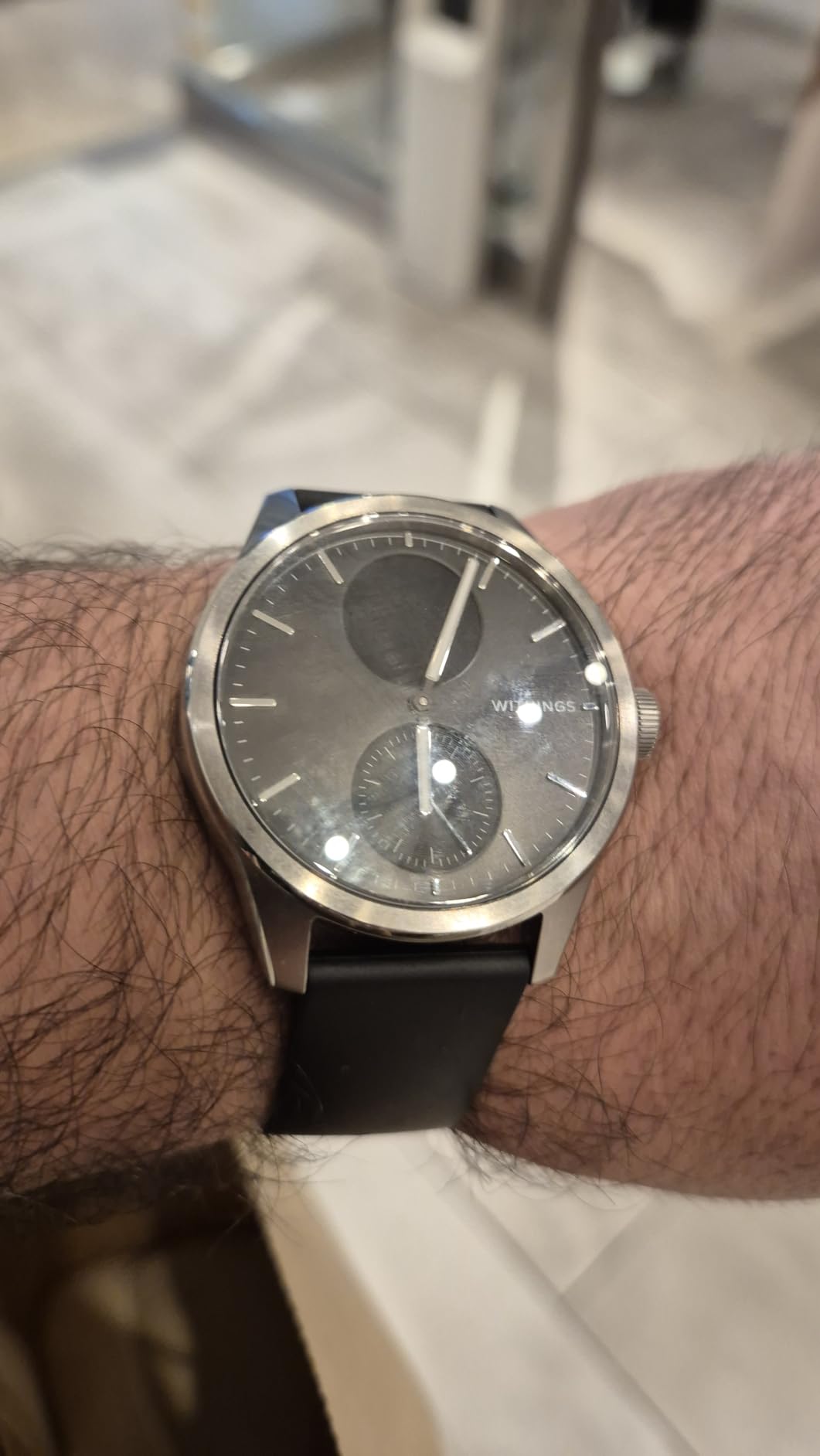
The honest drawback owners mention most is the domed crystal. It catches glare from most angles, and reviewers call it the biggest design flaw in an otherwise well-executed watch. The polished dark hour markers add a second legibility problem with no paint contrast underneath.
Other complaints are softer: location comes from your phone since there is no built-in GPS, some of the deeper analytics sit behind Withings Plus, and the 38mm option feels undersized next to the 42mm. All three are trade-offs rather than failures.
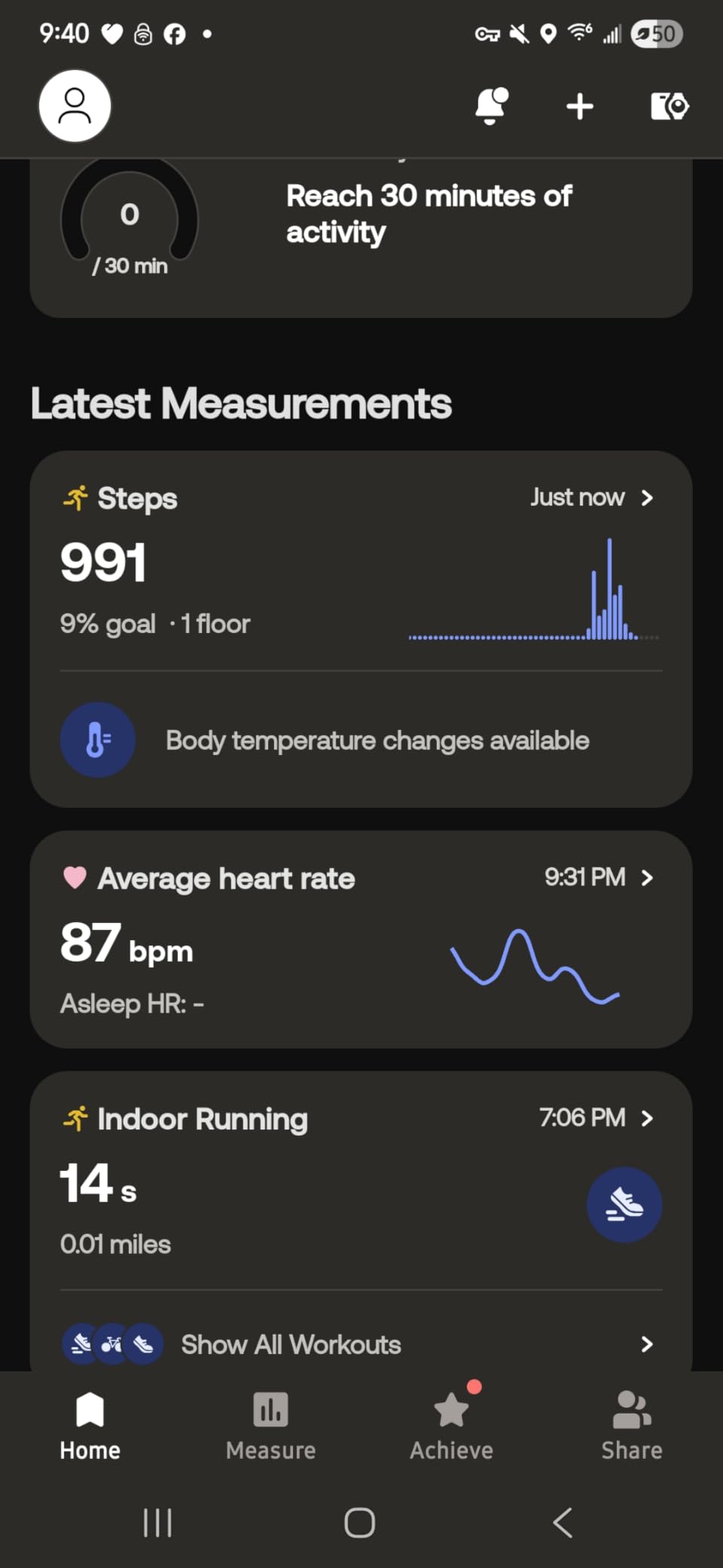
What the ScanWatch 2 does better than the rest
The health stack is unmatched in this list. ECG, blood oxygen, body temperature, sleep staging and VO2 max in a case that looks like a dress watch is a combination nothing else here offers.
Where it frustrates owners
The crystal glare is the first thing people mention, and the app lag after a phone change is the second. If you are sensitive to reflections or you work under bright office lighting, test it in that room before committing.
3. Casio G-Steel GBM2100A-1A2: The Metal-Clad G-Shock Daily Driver
G-Shock Casio G-Steel Solar Connected Blue Dial Black Resin Strap Watch – GBM2100A-1A2
Metal-clad resin case with octagonal bezel
Tough Solar charging
20 bar water resistance
Bluetooth smartphone link with auto time sync
Pros
- Highest rating in this roundup at 4.6 across 230 owners
- Metal-clad finish reads dressier than a typical bulky G-Shock
- Solar charging removes the battery replacement routine
- Bio-based resin band handles wrist swelling well
- Blue metallic vapour deposition dial looks refined
Cons
- 45mm case with 48mm lug-to-lug runs large on smaller wrists
- Glare on the dial affects legibility at some angles
- Solar and Bluetooth layers are basic next to health-tracking hybrids
- Resin band will not suit a steel bracelet preference
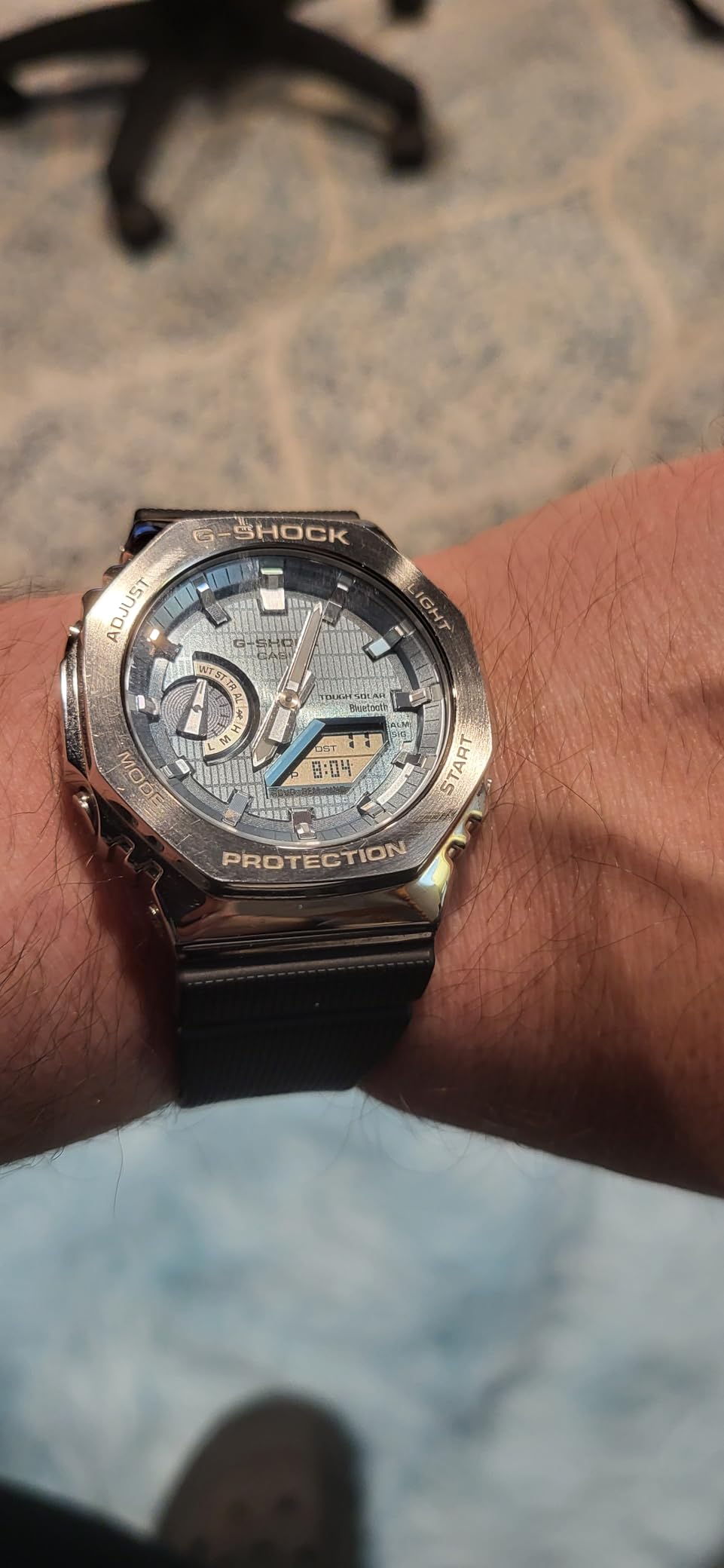
The GBM2100A-1A2 solves a specific problem: you want G-Shock durability without the toy-like bulk. The octagonal bezel is metal-clad resin, the band is bio-based resin that handles wrist swelling through the day, and the blue metallic vapour deposition dial looks far more considered than the usual G-Shock grey.
Tough Solar handles the power side and Bluetooth Smartphone Link handles time sync, with a phone finder function as a bonus. Holding the connect button re-syncs instantly, which owners travelling across time zones rate highly. At roughly five ounces it disappears on the wrist.
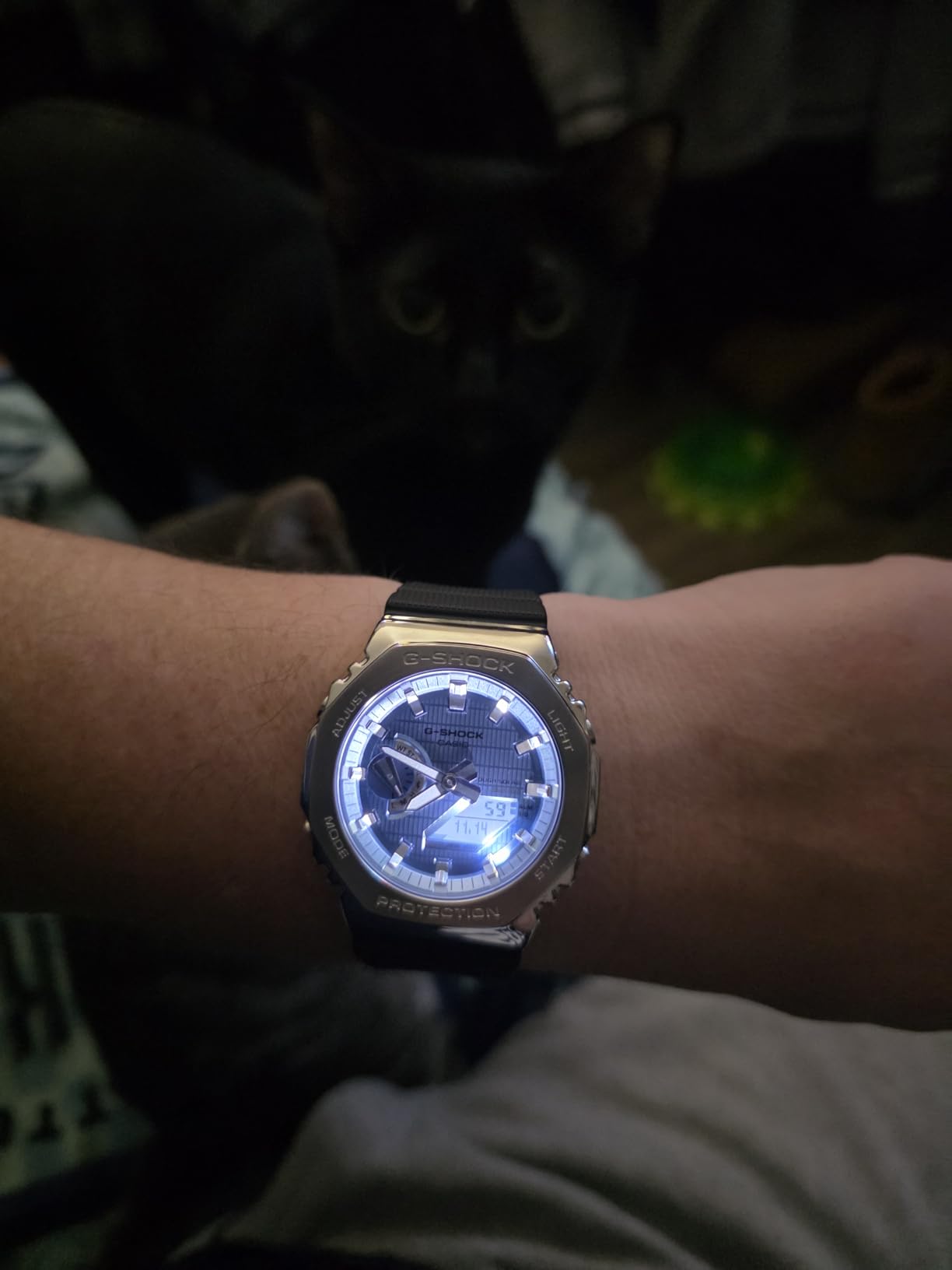
Be clear about what this is not. There is no heart rate sensor, no SpO2 and no notification mirroring. The smart layer here means accurate time, phone finding and nothing more. Many owners describe it as the watch that finally made them stop thinking about watches at all.
The size is the real constraint. A 45mm case with 48mm lug-to-lug is large, and reviewers with smaller wrists call it out directly. Dial glare shows up at certain angles, and the resin band is not going to satisfy anyone who wants brushed steel.
Why this one earns its spot
It is the most rugged pick, the best rated at 4.6, and the only watch here you can genuinely forget about. Commuting, fieldwork, the gym and a Saturday on the bike all use the same watch.
What you give up choosing it
Health data and message alerts. Also, if your wrist measures under about seven inches, try it on first, because 48mm lug-to-lug overhangs noticeably on smaller frames.
4. Casio GAB2100-1A: The Retro Casioak With the Readable Display
G-Shock Casio Analog-Digital Tough Solar Connected Black Watch | GAB2100-1A
48.5mm resin case with mineral crystal
Tough Solar charging
Bluetooth time and date sync
200 metre water resistance
Pros
- Casioak styling sharp enough for the office and rugged enough for daily use
- Very light and comfortable for long wear
- Positive LCD is far more readable than negative-display variants
- Reported timekeeping accuracy of about half a second over two weeks
- Carbon fibre reinforced interior case
Cons
- Casio Watches app is clunky and drains phone battery
- Auto-sync timing is unpredictable for frequent travellers
- Digital sub-window overlaps the hands at certain times of day
- Small date window and dim hand illumination after sitting overnight
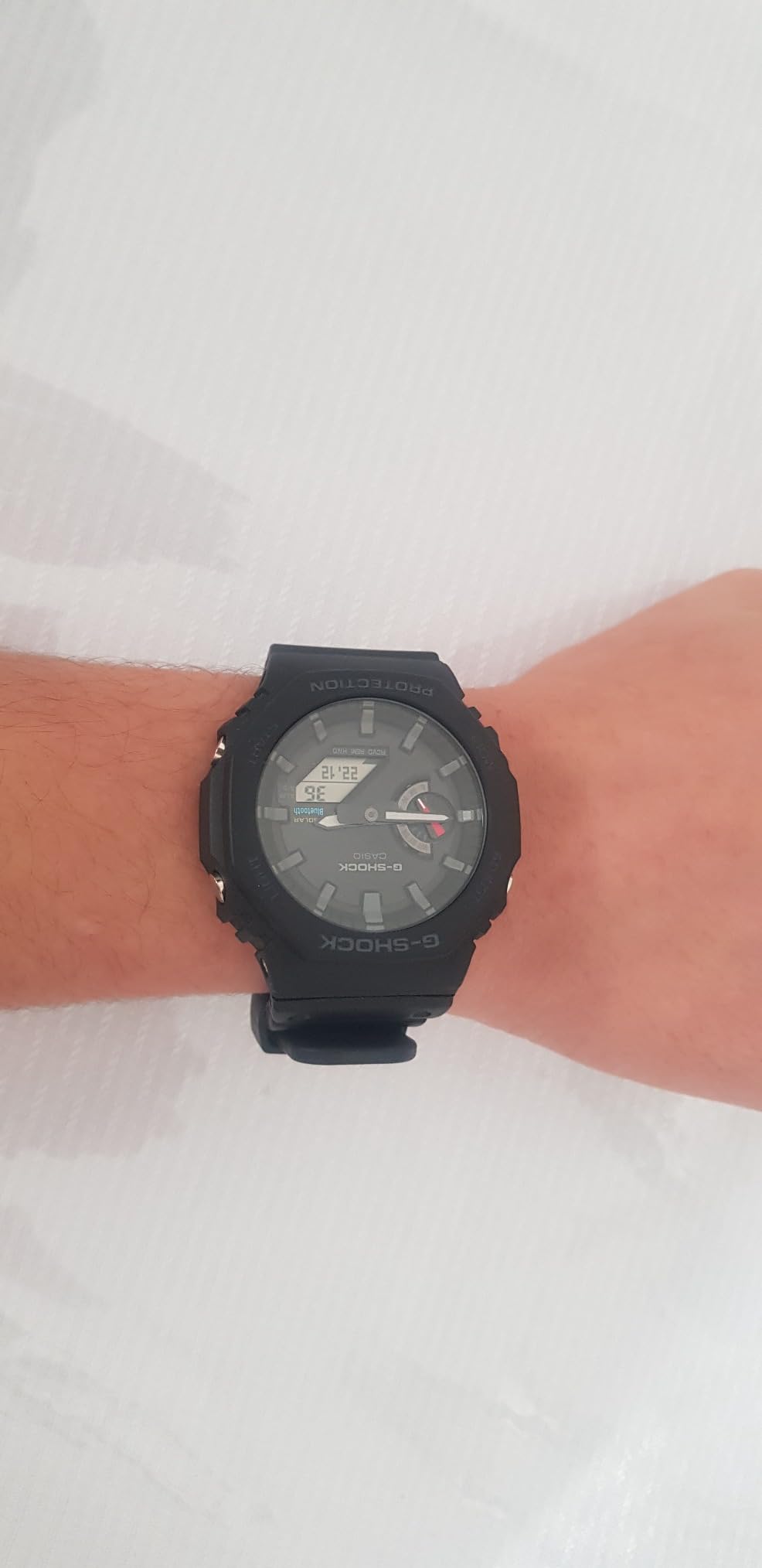
The GA-2100 line is the design that turned G-Shock into something you can wear with a shirt, and the GAB2100-1A keeps that silhouette while adding Tough Solar and Bluetooth Smartphone Link through the Casio Watches app. It is the watch most owners in this guide describe as the one they stop thinking about.
One specific detail matters more than the spec sheet suggests. This is the positive LCD variant, and owners are explicit that the negative-display versions are close to unreadable in daylight. At 48.5mm it is the largest case in the roundup, and the mineral crystal takes scratches eventually rather than never.
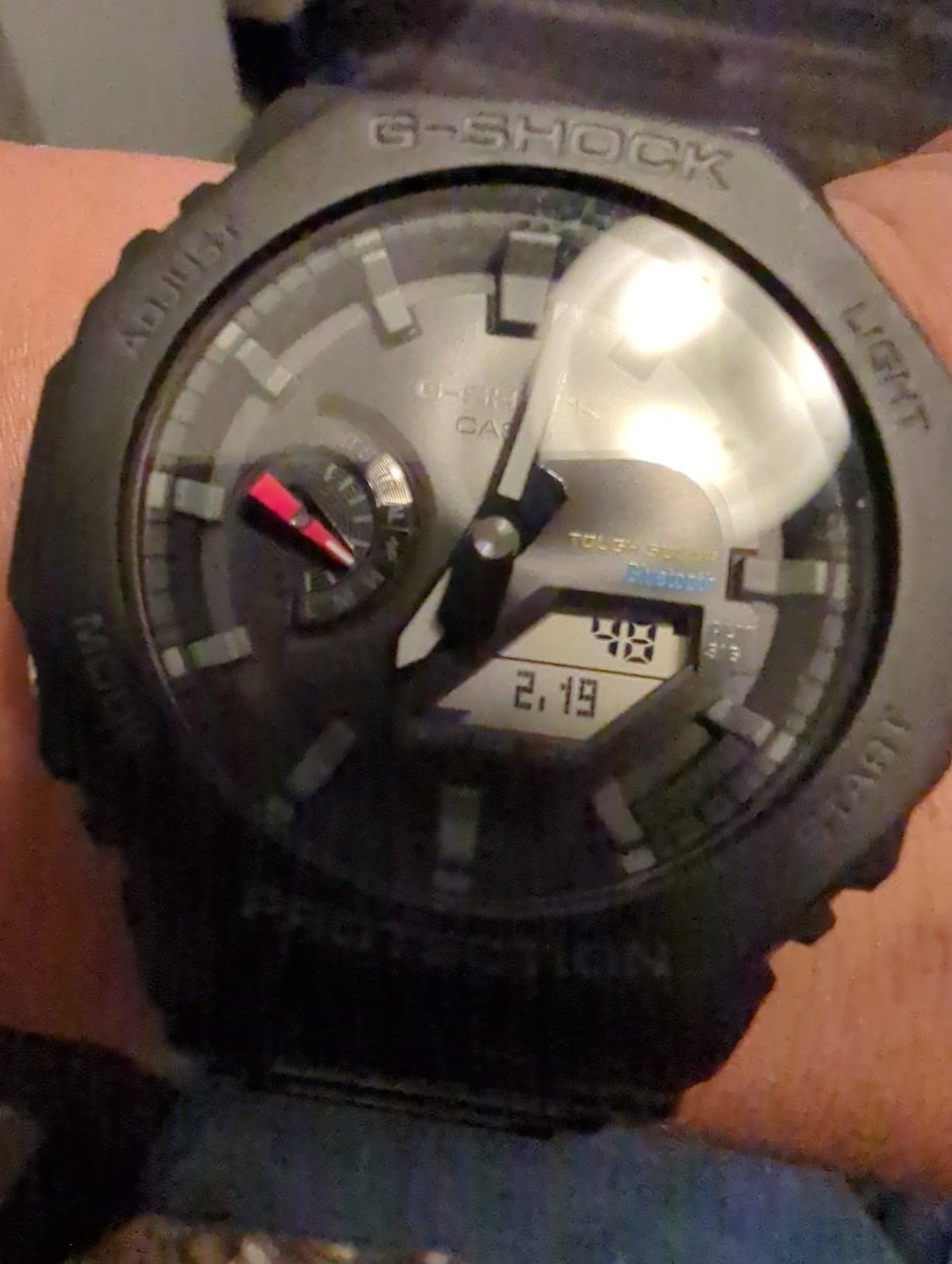
The software is where this watch loses points. The Casio Watches app is criticised as clunky and as a heavy phone battery drain. Auto-sync timing is unpredictable for frequent travellers, and the phone finder only works after a same-day sync, which limits its usefulness.
Two smaller annoyances: the digital sub-window overlaps the hands at some times of day, and the hand illumination dims after the watch has sat overnight. Neither is serious, both are annoying in week one and invisible by week two.
Best reasons to buy it
Two years of owners report accurate, scratch-free performance with no charging routine. If you want one watch that works everywhere and never asks anything of you, this is the shortest path there.
Reasons to look elsewhere
If you read your phone from your wrist, there are no message alerts here. And if a 48.5mm case already sounds large, the smaller GBM2100 metal-clad model gives you a tighter footprint with the same connected feature set.
5. Withings ScanWatch Light: The Cheapest Way Into a True No-Screen Hybrid
Withings ScanWatch Light – Hybrid Smartwatch, 24/7 Heart Monitoring, Activity Tracking, Cycle Tracking, Sleep Monitoring, Connected GPS, 30-Day Battery Life, Android & Apple Compatible, HSA/FSA
37mm stainless steel case with flat crystal
24/7 heart rate and sleep duration tracking
Connected GPS via smartphone
Multi-week battery with fluoroelastomer band
Pros
- Flat crystal is far more readable than the domed crystals on earlier Withings hybrids
- Classic analog styling that works casual or formal
- Multi-week battery supports overnight health tracking
- Scrolling notifications on the upper subdial
- Fluoroelastomer band included for easy summer wear
Cons
- No ECG function unlike the higher-tier Withings watches
- Several advanced health insights sit behind Withings Plus
- 37mm case can read dainty on larger wrists
- Step counts can run low compared with other devices
- Workouts must be started on the watch rather than in the app
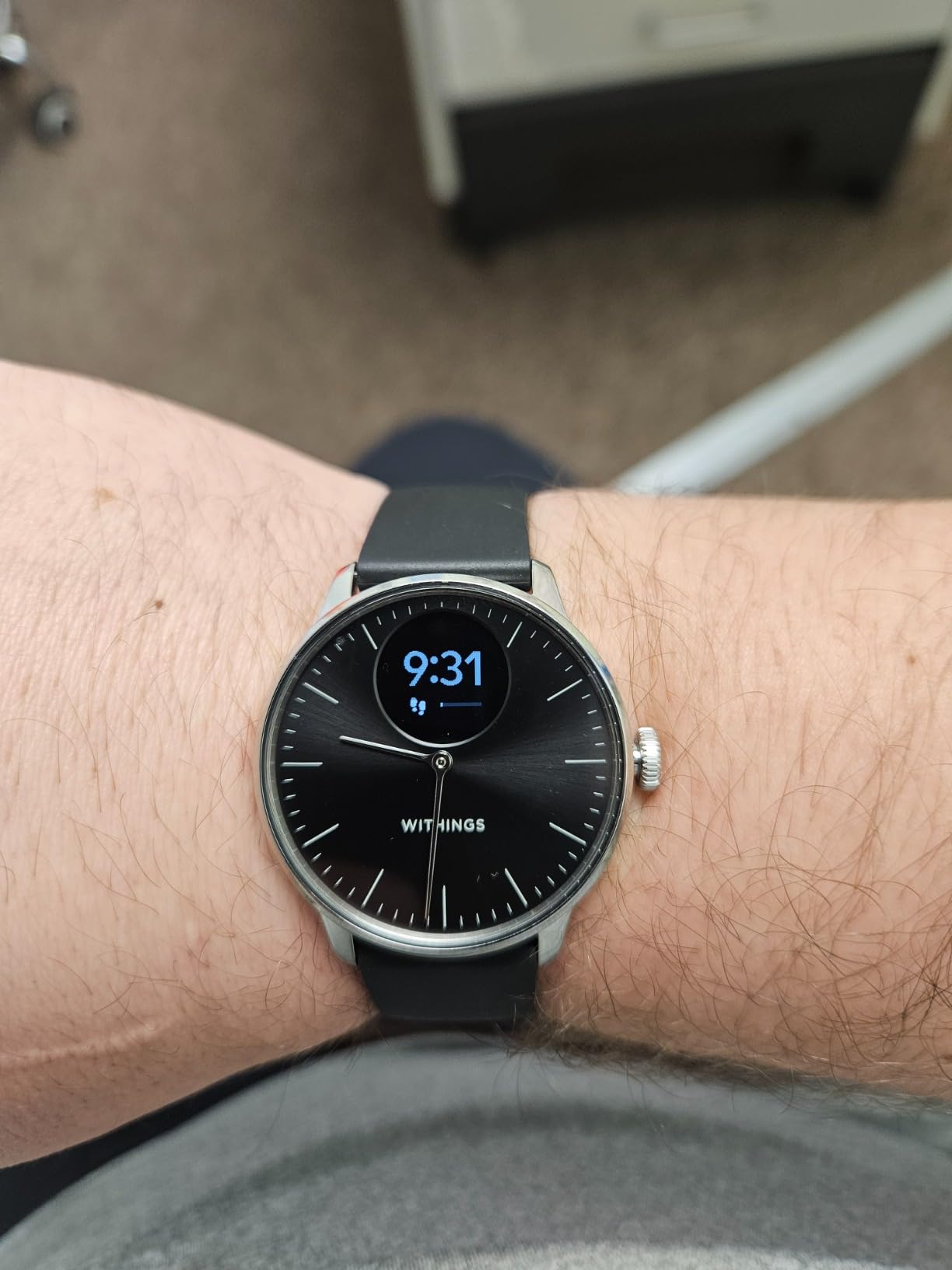
The ScanWatch Light is the entry point to a genuine no-screen hybrid. Physical hands, a discreet upper subdial, and no display anywhere on the watch. It measures 24/7 heart rate and sleep duration, tracks a 0.63 inch display through the app, and runs on connected GPS from your phone.
The flat crystal is the headline improvement over previous Withings hybrids. Owners single it out as the reason the dial is finally readable at an angle, and the physical crown and pusher give tactile interaction rather than touchscreen taps. The fluoroelastomer band is a nice touch for anyone who finds leather heat unbearable.
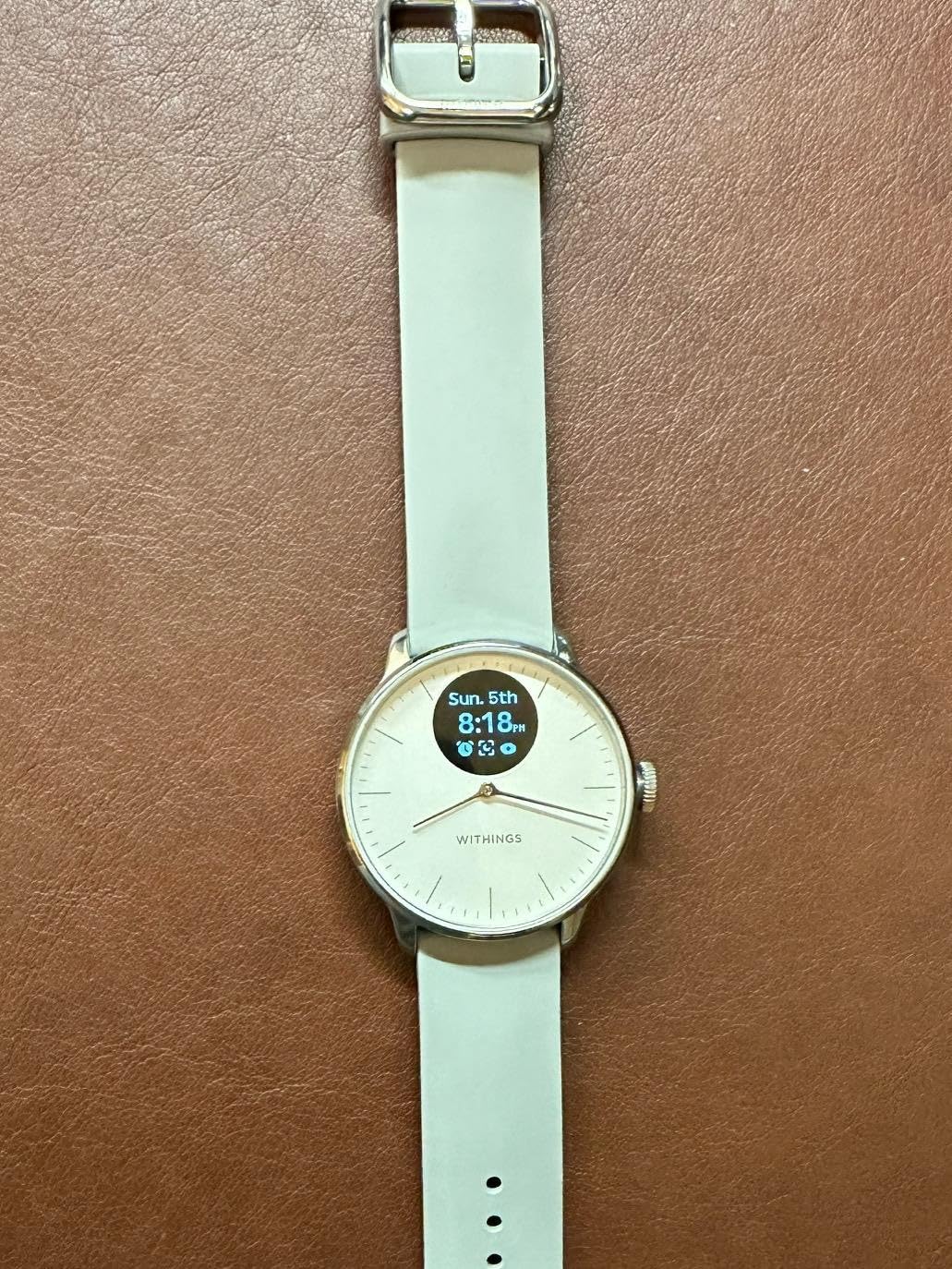
It is also the lowest-rated Withings here at 3.8 across 546 reviews, and the reasons are consistent. There is no ECG on this model. Several advanced health insights sit behind the Withings Plus subscription. And the 37mm case reads dainty on larger wrists.
On data quality, some reviewers report step counts running below other devices because of a different counting algorithm. Workout launching from the phone app does not work well, so workouts have to be preselected on the watch. Intermittent notification delivery is the other recurring complaint.
Where the Light wins
Readability. The flat crystal fixes the single most common complaint about older Withings hybrids, and the scrolling subdial notifications let you leave the phone in your pocket. Water resistance is IPX4, which covers sweat and rain.
Where you should spend more
If ECG matters to you, step up to the ScanWatch 2. If you are on a larger wrist, the Nova is the better shape. The Light makes most sense as the entry point when you want the look and the battery first, not the medical hardware.
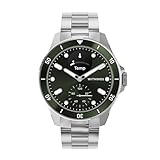
6. Withings ScanWatch Nova: The Widest Sensor Stack in the Category
WITHINGS Scanwatch Nova – Heart Health Hybrid Smart Watch for Men & Women – SPO2, Temperature Monitoring, Sleep, Respiratory Health, Cycle Monitoring, 30-Day Battery Life, Apple iOS/Android
Analog dive-style case with rotating bezel
ECG, SpO2 and skin temperature
30-day battery with USB-C dock
IP68 water resistance to 10 metres
Pros
- Flat sapphire crystal resists glare far better than domed crystals
- Strongest sensor stack available on a hybrid
- Chunky luminous hands stay readable in low light
- Some buyers report metrics comparing favourably with an Apple Watch
- Thirty-day battery with a USB-C docking station included
Cons
- Companion app described as limited and buggy against the hardware quality
- Alarms can only be set through a clunky in-app time wheel
- Battery is not user-replaceable
- Optical heart rate can read low during workouts for some users
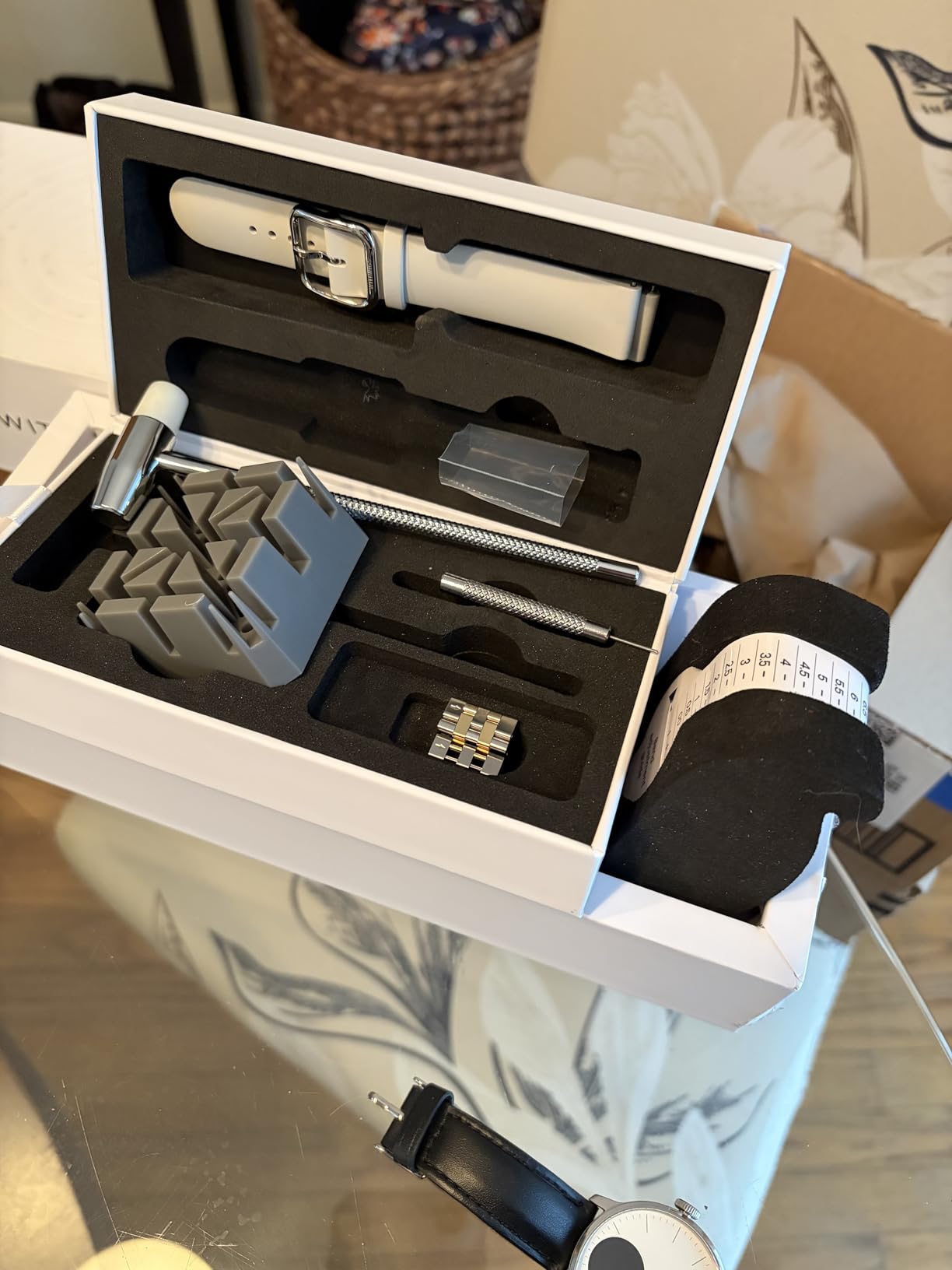
- supplied bracelet sizing suits small wrists and needs tools and added links to fit most men
The Nova is the most watch-like hybrid here. It has a rotating bezel, a dive-style dial and chunky luminous hands, and it measures ECG, blood oxygen, skin temperature and overnight heart rate variability. Sleep Quality Score covers light sleep, deep sleep, duration, disturbances and regularity, with menstrual cycle phase and symptom logging alongside.
Forty recognised activities come with heart rate zones, a VO2 max Fitness Level and connected GPS. Battery life is 30 days from a two-hour charge, and the IP68 rating is the strongest water figure in this roundup at 10 metres. Several buyers report health metrics that compare favourably with an Apple Watch.
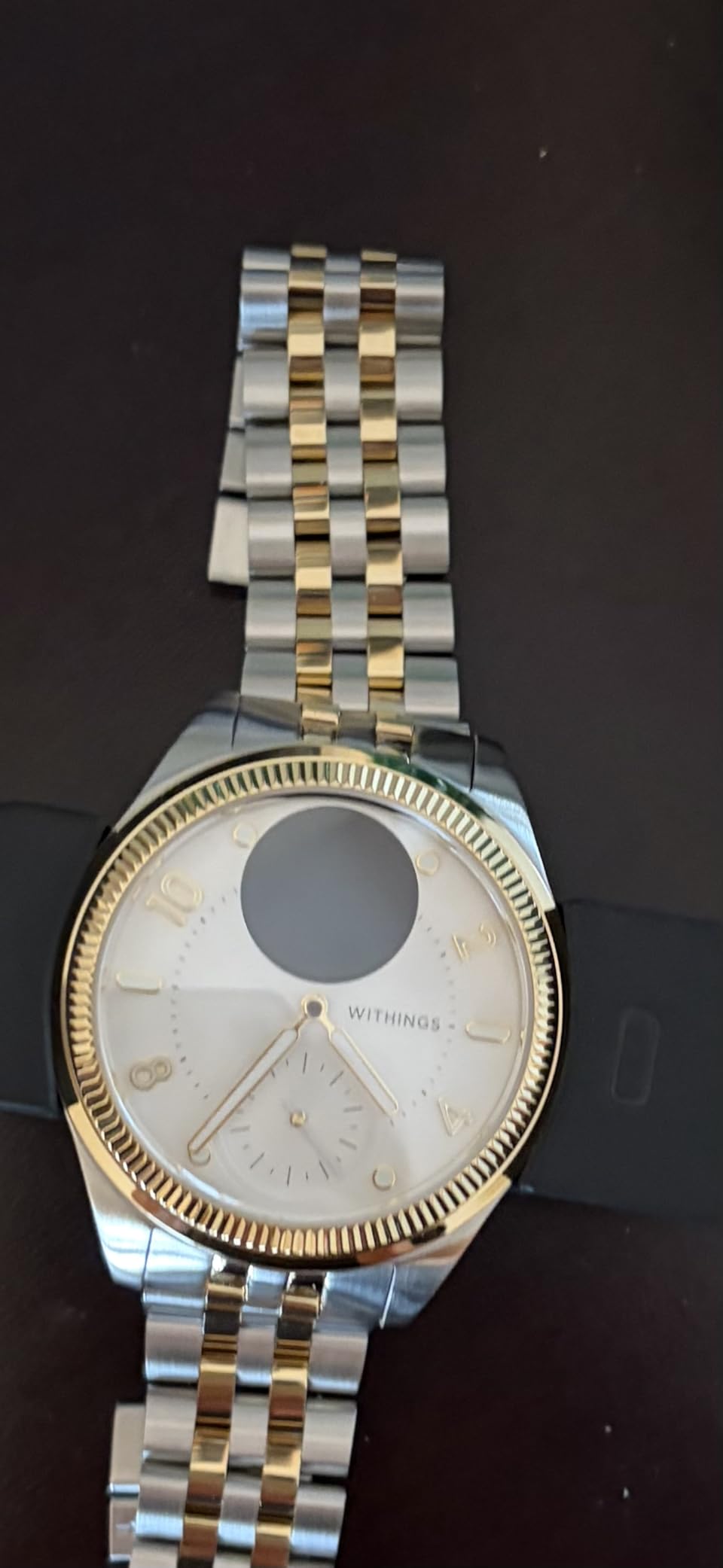
Hardware ahead of software is the recurring theme. The companion app is described as limited and buggy compared with the watch itself, and alarms cannot be set on the watch at all. You set them through a clunky in-app time wheel, which is exactly the friction a screenless design should avoid.
There are three more practical issues. The battery is not user-replaceable, which owners associate with a disposable feel. The optical heart rate sensor can read noticeably low during workouts for some users. And the stock bracelet sizing suits small wrists, needing tools and added links for most men.
Best reasons to choose it
If sleep and stress data are your priority, nothing else in this guide measures this much. Temperature and SpO2 tracking plus a full sleep score in a dive-style case is a genuinely different use case from a step log.
Reasons to pass
The app is the weak link, and this watch needs the app more than most. If you dislike fiddling with software, or you are on a wrist that needs bracelet links added, the ScanWatch 2 is the calmer choice.
7. Garmin Instinct Crossover: The Pick When You Need Real GPS
Garmin Instinct® Crossover, Hybrid Smartwatch, 45mm, Black
45mm resin case with silicone band
MIL-STD-810 rugged construction
10 ATM water resistance
Built-in GPS with GLONASS and Galileo
Pros
- Only watch in this guide with real built-in GPS that works without a phone
- Garmin Pay contactless payment where supported
- Up to 28 days in smartwatch mode and 71 days in battery saver
- Owners report it holding up after a full year of daily wear
- Swapping to a leather strap makes it pass as a plain dress watch
Cons
- Menu navigation is complicated compared with touchscreen rivals
- Sleep stage and REM detection reported as poor
- Small screen text is difficult for older eyes
- No touchscreen means many Connect IQ apps and data fields are unavailable
- Activity tracking can stop runs prematurely
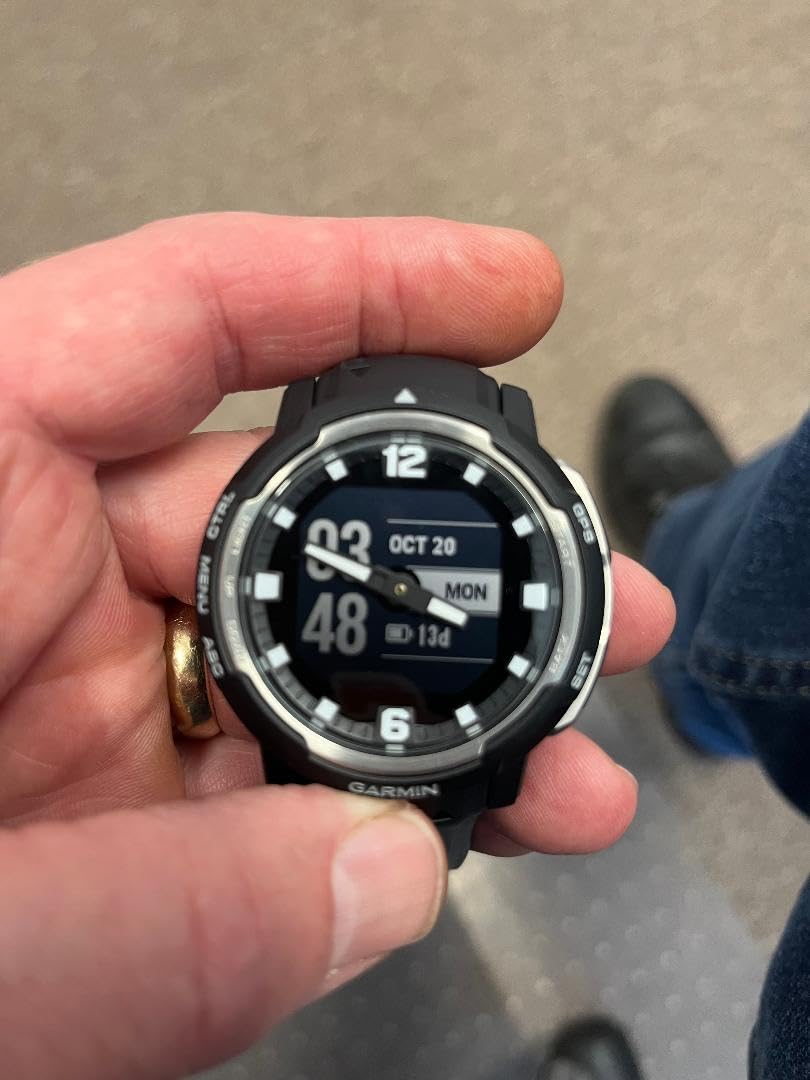
The Instinct Crossover solves the thing most dress-style hybrids cannot. It has built-in GPS with GLONASS and Galileo support, plus ABC sensors, so it tracks a route without your phone in your pocket. Garmin Pay works where supported. That is a real fitness watch with analog styling, not a notification accessory.
Construction is MIL-STD-810 rated for thermal and shock resistance with a 10 ATM water rating at 100 metres. Owners report it holding up after a full year of daily wear, and several describe swapping to a leather strap so it reads as a plain dress watch in the office.
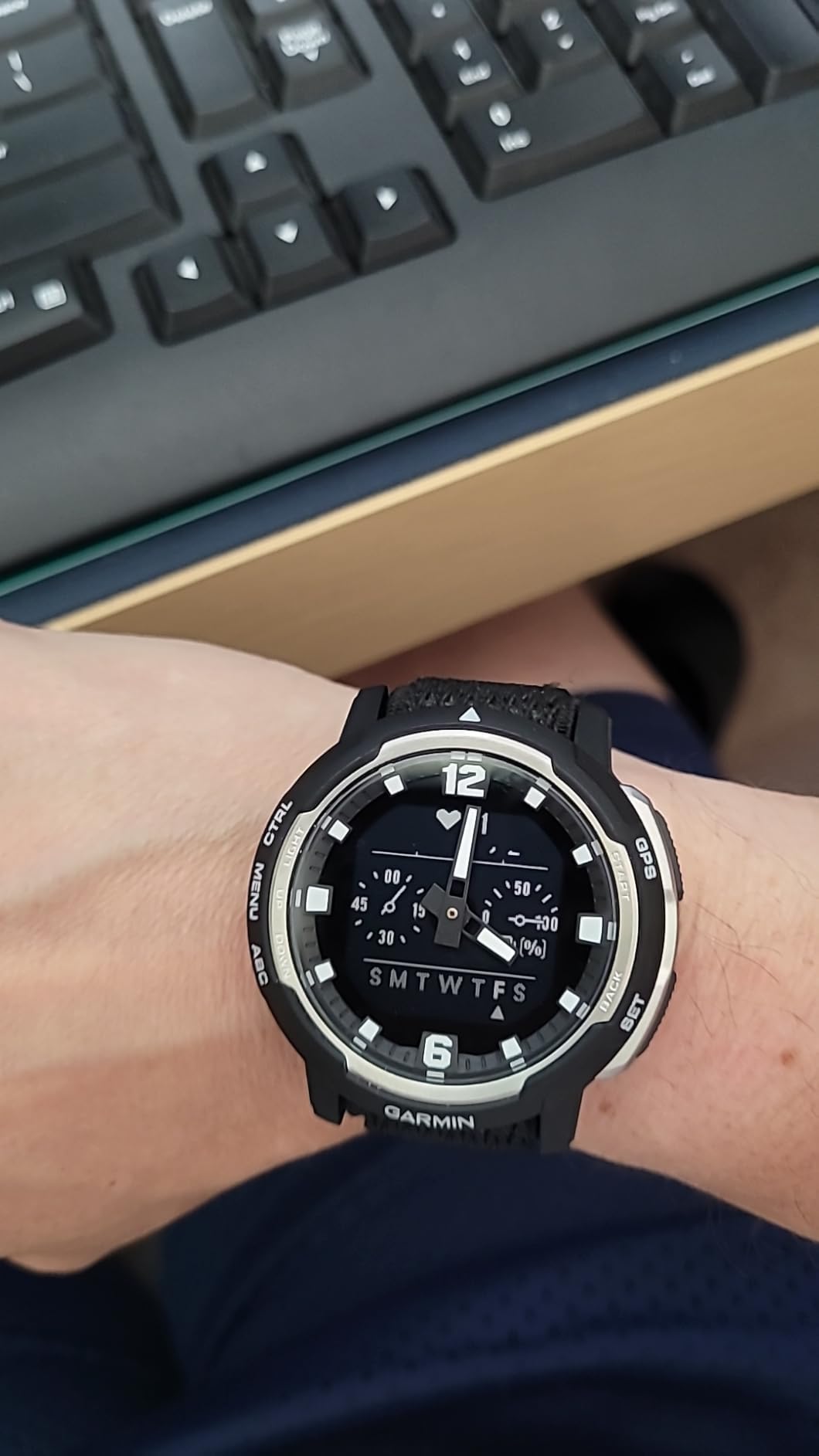
There is a real cost to that ruggedness. There is no touchscreen, so menu navigation is button-driven and described as complicated against touchscreen rivals. Many Connect IQ apps and data fields are unavailable despite the marketing, and one reviewer calls the product description misleading on that point.
Data quality is the other concern. Sleep stage and REM detection is reported as poor, the 1.27 inch mono-lume screen is small for older eyes, and activity tracking can end runs prematurely or read slow weight movements as new repetitions.
Best reasons to buy it
Outdoor days, trail runs and travel where the phone battery is the weak link. It is the only pick here with standalone GPS, contactless payment and a battery measured in weeks under normal use.
Reasons to look elsewhere
If sleep quality is what you are chasing, this is the wrong Garmin for you. If you are over 50 and want readable numbers at a glance, the small mono-lume screen will frustrate you.
8. Citizen CZ Smart PQ2: The Best Dress Watch Here, With the Weakest Rating
Citizen CZ Smart PQ2 Hybrid Smartwatch with YouQ Wellness app Featuring IBM Watson® AI and NASA Research, Black and White Customizable Display, Bluetooth, HR, Activity Tracker, 18-Day Battery Life
Stainless steel case with 26mm silicone band
Analog hands with an inner digital display
18-day battery with about 50 minutes to 80 percent
IPX7 water resistance to 30 metres
Pros
- Classic Citizen styling without the bulky look of screen-first smartwatches
- Battery beyond 15 days per charge in real use
- Simple app interface covering the core fitness features
- Double-tap backlight is genuinely useful
- Amazon Alexa built in with a microphone
Cons
- Software and firmware reliability is the dominant complaint
- 23 percent of reviews are one or two stars and multiple units stopped charging within a year
- SpO2 readings reported 2 to 4 percent low and heart rate far off on a treadmill
- Only splash resistant to 30 metres and no GPS
- Requires reconnecting and recalibrating after a day away from the phone
On looks alone, the CZ Smart PQ2 is the most traditional watch in this guide. Stainless steel case, silicone band at 26mm, analog hands over an inner digital display, and a design that would pass in a boardroom without a second look. It is also the only watch here with Amazon Alexa built in.
The wellness layer runs through the YouQ app, built on NASA Ames research and IBM Watson models. It does chronotype detection and a 24-hour alertness forecast from heart rate, SpO2, activity and sleep data, plus a gamified alertness monitor. Battery life is 18 days, hitting roughly 80 percent in about 50 minutes.
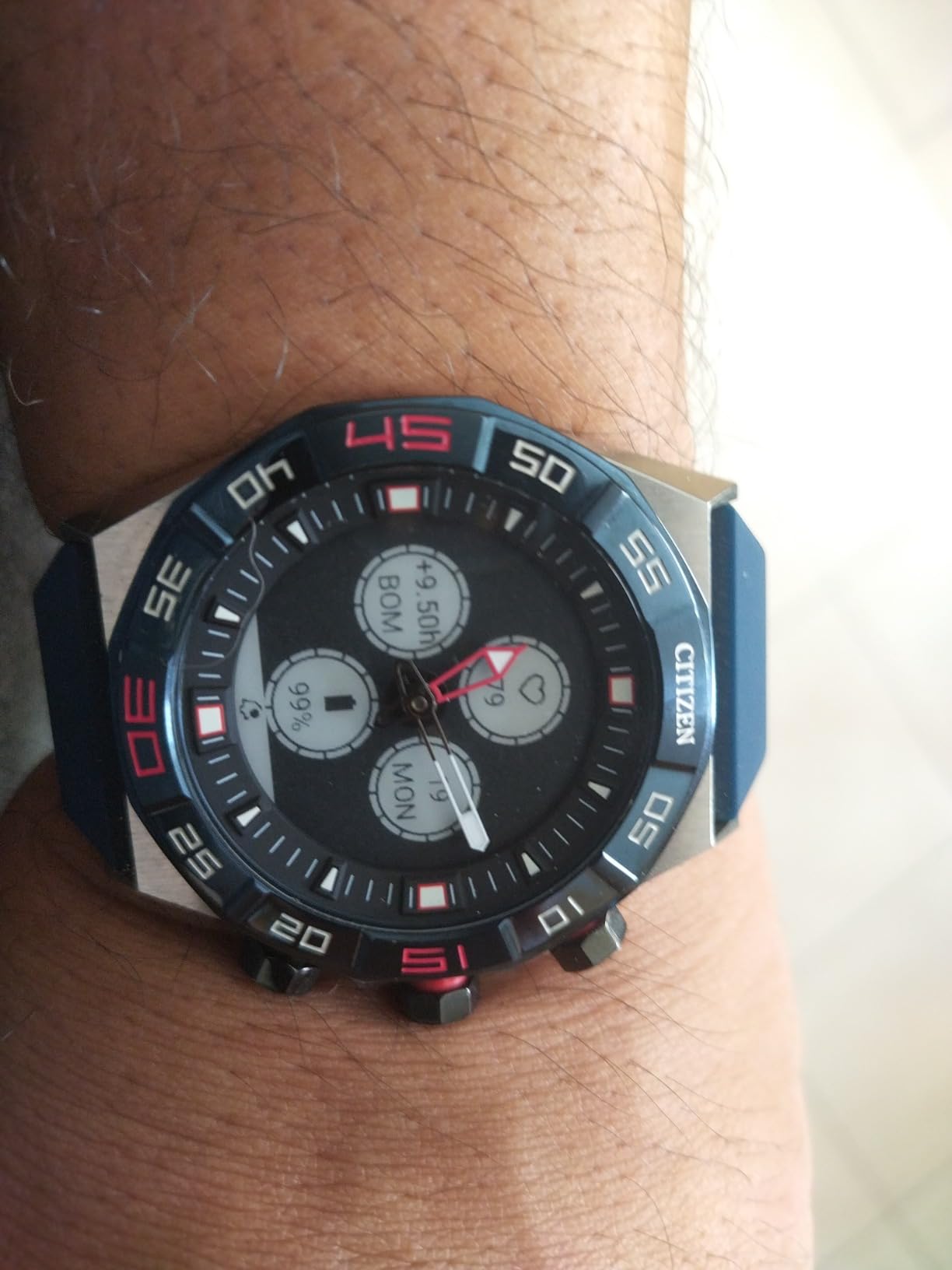
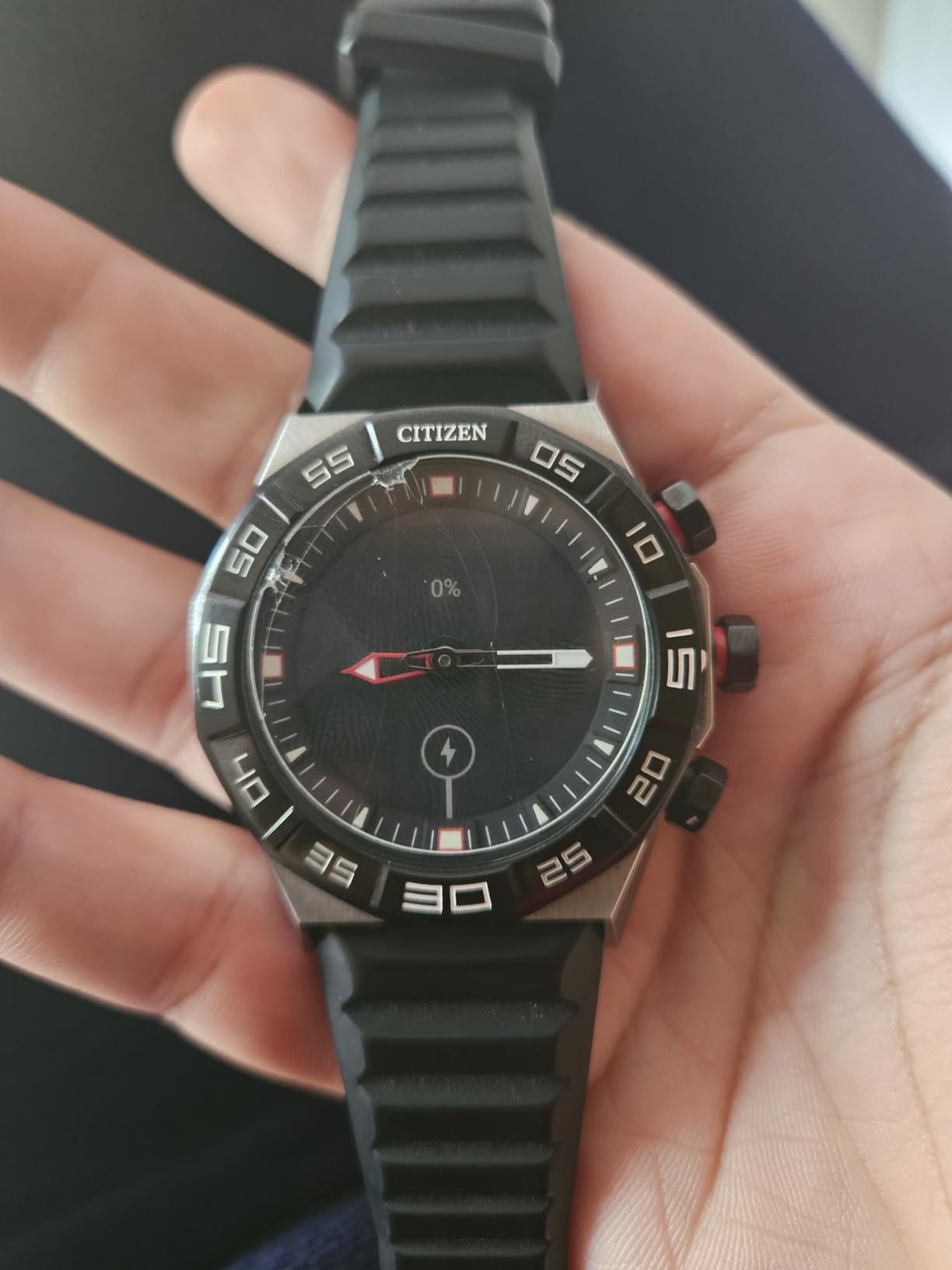
Then the software problems start. This is the lowest-rated watch in the roundup at 3.4 across 432 reviews, and 23 percent of those reviews are one or two stars. Syncing failures and lost history are the dominant complaint, and multiple owners report units that stopped charging within a year.
Sensor accuracy is the second issue, with SpO2 reported 2 to 4 percent low and heart rate well off compared with other watches on a treadmill. There is no GPS, water resistance is only 30 metres, and the watch needs reconnecting and recalibrating after a day away from the phone. The Citizen Connected app is also US-centric.
Reasons it is still worth a look
The styling is unmatched, the battery is genuinely long, and the app avoids the feature bloat that makes people quit smartwatches. If Alexa and a dress-watch silhouette matter more than sensor accuracy, it delivers.
Reasons to skip it
Reliability is the issue, and warranty handling compounds it. Buying a health watch that loses its history and stops charging is a bad trade, which is why this one sits near the bottom of our order despite the good looks.
9. Casio GM-B2100 Full Metal: A Connected Analog Watch With No Smart Layer
Casio GM-B2100BD-1AJF [G-Shock GA-2100 Series Full Metal Model with Smartphone Link] Men’s Watch Shipped from Japan Aug 2022 Model
Full metal GA-2100 case and band
Smartphone Link connectivity
Rechargeable lithium ion battery
Octagonal Casioak design
Pros
- Full metal construction gives the GA-2100 silhouette a premium jewellery-like finish
- Durable G-Shock build in a dress-appropriate case
- Smartphone Link keeps time and settings in sync
- Holds a 4.5 rating across 138 owners
Cons
- No fitness or health sensors at all
- Premium pricing buys metal finish rather than smart capability
- Heavier than resin G-Shock models
- Imported listings can route accessory and warranty support less directly
We include this one as a boundary marker. The GM-B2100 is a full metal G-Shock in the GA-2100 octagonal design language, with Smartphone Link connectivity and a rechargeable lithium ion battery. It looks like a piece of jewellery and syncs its time and settings to a phone.
That is the whole feature list. There is no heart rate sensor, no step tracking, no GPS and no notification layer. If you have decided that a plain quartz watch is what you actually wanted, this is the connected version of that decision, and it is the most premium-looking object on this list.
![Casio GM-B2100BD-1AJF [G-Shock GA-2100 Series Full Metal Model with Smartphone Link] Men's Watch Shipped from Japan Aug 2022 Model customer photo 1](https://betterbike.org/wp-content/uploads/2026/10/B0B78D7FJH_customer_1.jpg)
Owners are candid about the trade. The premium finish is the point, and the price premium buys metal rather than smart capability. The case and band are noticeably heavier than resin G-Shocks, which some like for the solid feel and others find tiring over a long day.
One practical caution: imported listings can route accessory and warranty support through a third party, so check the local warranty terms before buying outside your country.
![Casio GM-B2100BD-1AJF [G-Shock GA-2100 Series Full Metal Model with Smartphone Link] Men's Watch Shipped from Japan Aug 2022 Model customer photo 2](https://betterbike.org/wp-content/uploads/2026/10/B0B78D7FJH_customer_2.jpg)
Who this suits
Someone who wants a dress-appropriate G-Shock and genuinely does not want a fitness tracker. Pair it with a cheap fitness band if you want step and sleep data and keep the watch purely for time.
Who it does not suit
If you picked up this guide because you want heart rate or sleep tracking, this is the wrong watch. There are no sensors to activate and no app worth opening.
Hybrid Smartwatch vs Smartwatch vs Plain Quartz: What You Actually Give Up
This is the decision most guides get wrong, because they treat the hybrid as a compromise rather than a different tool. It is not a cheaper smartwatch. It is a watch with a small, specific job, and choosing it means choosing which features you are willing to lose.
Here is what you give up with a no-screen hybrid. No on-watch calls or a speaker. No contactless payment on most models, since NFC needs a secure element and a screen to confirm it. No turn-by-turn maps. No voice assistant on most of them. No third-party app ecosystem. And no real-time workout data, because there is nowhere to display it.
Here is what you get back. Battery life measured in weeks or months. A watch that passes every dress code. No screen to check at dinner. No glowing rectangle attracting conversations at the wrong moment. And a much better relationship with the small amount of data you do get, because you glance at an analog dial rather than a feed.
A plain quartz watch still wins if you do not want heart rate or step data at all. Forum discussion in r/Watches and r/smartwatch makes this point repeatedly: plenty of people decide the tracking was not worth the charging, the notifications or the anxiety, and go back to a watch that simply tells the time. If that is you, the Casio GA-2100 family in this guide is the sensible place to look.
Our own everyday-carry thinking applies here too. If you carry a multitool every day because the small tools get used, the same logic points to a durable, serviceable watch over a thin one. We wrote more on that in our guide to the [10 Best Multitools for Everyday Carry Ranked](https://betterbike.org/best-multitools-for-everyday-carry/), and the thinking transfers directly to watches.
Battery Life: The Hybrid’s Biggest Everyday Advantage
Battery is where hybrids win without qualification, and the numbers here are concrete rather than marketing. The Withings ScanWatch 2 runs up to 35 days between charges. The Nova manages 30 days. The Garmin Instinct Crossover claims up to 28 days in smartwatch mode, 71 days in battery saver and 25 hours in GPS mode. The Citizen CZ Smart PQ2 delivers an 18-day claim, with owners reporting beyond 15 days in practice.
The Casio models go a step further in a different direction. The GBM2100 and GAB2100 use Tough Solar, so there is no battery replacement routine and no charging cable in your bag. The GBA800UC is battery powered with Bluetooth time sync, and the GM-B2100 runs on a rechargeable lithium ion cell.
Compare that with a full smartwatch, which typically asks for a charge every day and sometimes twice a day if you use it for workouts. Forum users describe daily charging as the single biggest reason they downgraded from a screen-first watch. That frustration is precisely what created this category.
One practical note on the Withings models. Battery figures assume a mostly passive week. If you run connected GPS workouts daily with the screen active, expect the number to fall, and plan a charging cadence accordingly.
How to Choose the Best Hybrid Smartwatches for Everyday Wear
We ranked these picks on four things: whether the watch works without looking at it, whether it survives real wear, how honest the battery claim is, and how good the companion app is. Those four criteria decide almost everything in this category, because a screenless watch pushes all the real work into the app.
Decide whether you want a screenless watch or a small-screen one. The Withings models have no display at all. Notifications scroll on a subdial, and everything else lives in the app. The Casio, Garmin and Citizen models keep a small display for data and alerts. If you want to read messages at a glance, the small-screen group is the only realistic option.
Check the water rating against your actual week. A shower and a rainy commute need very little. A pool, a shower with hot tubs or open-water swimming needs far more. The G-Shock models carry 200 metre ratings, the Garmin is rated to 100 metres, the Citizen to 30 metres, and the Withings watches sit between IPX4 and IP68.
Assess the app, not the watch. On a hybrid, the app is where your history, trends and settings live. Withings is the strongest here and syncs cleanly with Apple Health. Garmin Connect is deep but busy. The Casio Watches app is the weakest, with owners reporting phone battery drain and unpredictable sync timing. The Citizen Connected app is basic and US-centric.
Confirm phone compatibility. Every watch here pairs with both iPhone and Android, so platform is not the filter it once was. What does matter is notification support. The Casio GBA800UC and the GM-B2100 handle time and settings sync only, with no message mirroring. The Withings, Garmin and Citizen watches do mirror alerts.
Think about the brand staying in business. This is unglamorous and it matters. Fossil has exited the smartwatch market, and Skagen, Kronaby, Movado and Frederique Constant hybrids are all discontinued. Buying from a brand with a watch business is safer than buying from a brand with a gadget business, and it is one reason the Casio models rank so highly here.
Before you commit, verify three things in the listing. The case diameter against your wrist, the water rating against your real exposure, and whether the smart features listed match the ones you will actually use. Everything else is preference.
Sizing, Straps and Case Materials for Small Wrists
Sizing is the most common regret in this category, and it splits people cleanly. The Withings ScanWatch 2 comes in 38mm and 42mm, and owners on r/withings describe the 42mm as feeling noticeably more premium. The ScanWatch Light is 37mm and reads dainty on larger wrists.
The Casio models run large. The GAB2100 is 48.5mm across, the GBM2100 is 45mm with a 48mm lug-to-lug, and the Garmin Instinct Crossover is 45mm with a 22mm band. Those figures are real, and they matter more than the product photography suggests.
A rough rule helps. If your wrist measures under about six and a half inches, anything above 42mm will overhang and will not stay comfortably under a shirt cuff. Above 48mm and you are choosing the watch rather than the watch choosing you.
Strap material is the second decision. The Withings ScanWatch Light and Nova include fluoroelastomer and rubber straps, which handle sweat and heat better than leather. The Casio G-Shock bands are bio-based resin and are nearly indestructible. The ScanWatch 2 ships with silicone, and its bracelet option needs tools and added links for most wrists.
On materials, sapphire crystal appears on the ScanWatch 2 and the Nova and resists scratches far better than mineral crystal. The Casio models use mineral or resin, which will show marks eventually. Stainless steel cases throughout the Withings and Citizen watches take a polish that hides scuffs well.
Why More People Are Going Back to Analog-Style Watches
The shift is real and it has a few clear causes. The first is notification fatigue. Forum users describe muting every alert, then admitting they might as well wear a mechanical watch because the notifications were never the point.
The second is charging anxiety. Daily charging turns a watch into a device with a maintenance schedule, and people tire of it faster than they tire of any other smartwatch complaint.
The third is context. A glowing screen at a dinner table or a client meeting is socially expensive, and an analog dial removes the problem entirely. That is the core reason hybrids exist, and no firmware update to a screen-first watch will fix it.
The fourth is data anxiety. Chasing sleep scores and readiness numbers can make a normal day feel like a failing report. A hybrid keeps the metrics you would actually use and hides the rest.
The most sensible setup we see is a two-watch rotation. A hybrid handles weekdays, dress codes and travel, and a full smartwatch covers weekends, workouts and maps. If one watch has to do both jobs, you are better served by a screen-first model anyway.
For anyone who wants one dependable tool rather than a rotation, our guide to [10 Best Multitools for Everyday Carry Ranked](https://betterbike.org/best-multitools-for-everyday-carry/) makes the same argument from a different angle.
Frequently Asked Questions
What is a hybrid smartwatch?
A hybrid smartwatch is a traditional analog watch with physical hour and minute hands plus a hidden smart layer: Bluetooth time sync, step counting, heart rate and sleep tracking, and vibration alerts when your phone gets a message. It has no full screen, so the dial is the display, and it usually runs for weeks or months instead of needing a daily charge.
What is a hybrid smartwatch that looks like a regular watch?
The Withings ScanWatch 2 and ScanWatch Nova are the closest to a regular watch, using analog hands with a discreet subdial and no visible display. The Casio GAB2100 and GM-B2100 also read as ordinary watches because their digital windows are small and monochrome. All four sync to a phone and track activity without looking like a gadget.
Which hybrid smartwatch is the best?
For most people the Withings ScanWatch 2 is the best hybrid smartwatch, with a medical-grade ECG, sleep staging and up to 35 days of battery in a dress-watch case. If you want maximum durability instead, the Casio G-Steel GBM2100 carries the highest rating in our roundup with a metal-clad case and solar power.
How long does a hybrid smartwatch battery last?
Most hybrids here run between 15 and 35 days per charge. The Withings ScanWatch 2 claims up to 35 days, the Nova 30 days, the Garmin Instinct Crossover up to 28 days in smartwatch mode, and the Citizen CZ Smart PQ2 about 18 days. The Tough Solar Casio models need no charging routine at all.
Why are people ditching smart watches?
The most common reasons are notification fatigue, daily charging, screen distraction and social pressure at work or dinner. Forum users describe muting every alert and then deciding a plain analog watch suits them better. Hybrids exist because they solve those four problems while keeping the tracking people actually use.
Can a hybrid smartwatch make phone calls or take payments?
Rarely. A screenless hybrid cannot confirm a payment without a display, so only the Garmin Instinct Crossover offers contactless payment through Garmin Pay. No watch in this roundup makes calls from the wrist. If you need calls, wallet payments or maps, buy a full screen-first smartwatch instead.
Do hybrid smartwatches work with both iPhone and Android?
All nine watches in this roundup pair with both iOS and Android. What differs is notification support rather than compatibility. The Casio Move and GM-B2100 sync time and settings only, while the Withings, Garmin and Citizen watches mirror calls, texts, email and calendar alerts to the wrist.
Is a hybrid smartwatch worth it versus a plain quartz watch?
It depends entirely on whether you want heart rate, sleep and step data. If you do not, a quartz watch is cheaper, lasts years and needs no app. If you do want those numbers but refuse to wear a glowing screen, a hybrid is the only option that gives you both, and the battery advantage is measured in weeks.
The Verdict: Which Hybrid to Buy First
Buy the Casio Move GBA800UC if you want one watch for the whole week and nothing more from your wrist. Buy the Withings ScanWatch 2 if heart health is the reason you are considering a wearable at all, and you want dress-watch styling with it. Those two cover almost everyone.
Move up to the Casio G-Steel GBM2100 for toughness, the Garmin Instinct Crossover for standalone GPS, or the ScanWatch Nova for the deepest sleep and stress data. Our picks for the best hybrid smartwatches for everyday wear in 2026 come down to one rule: choose the watch that measures the things you care about and nothing you do not.
Whatever you pick, check the case diameter against your wrist first. It is the one mistake buyers regret.