
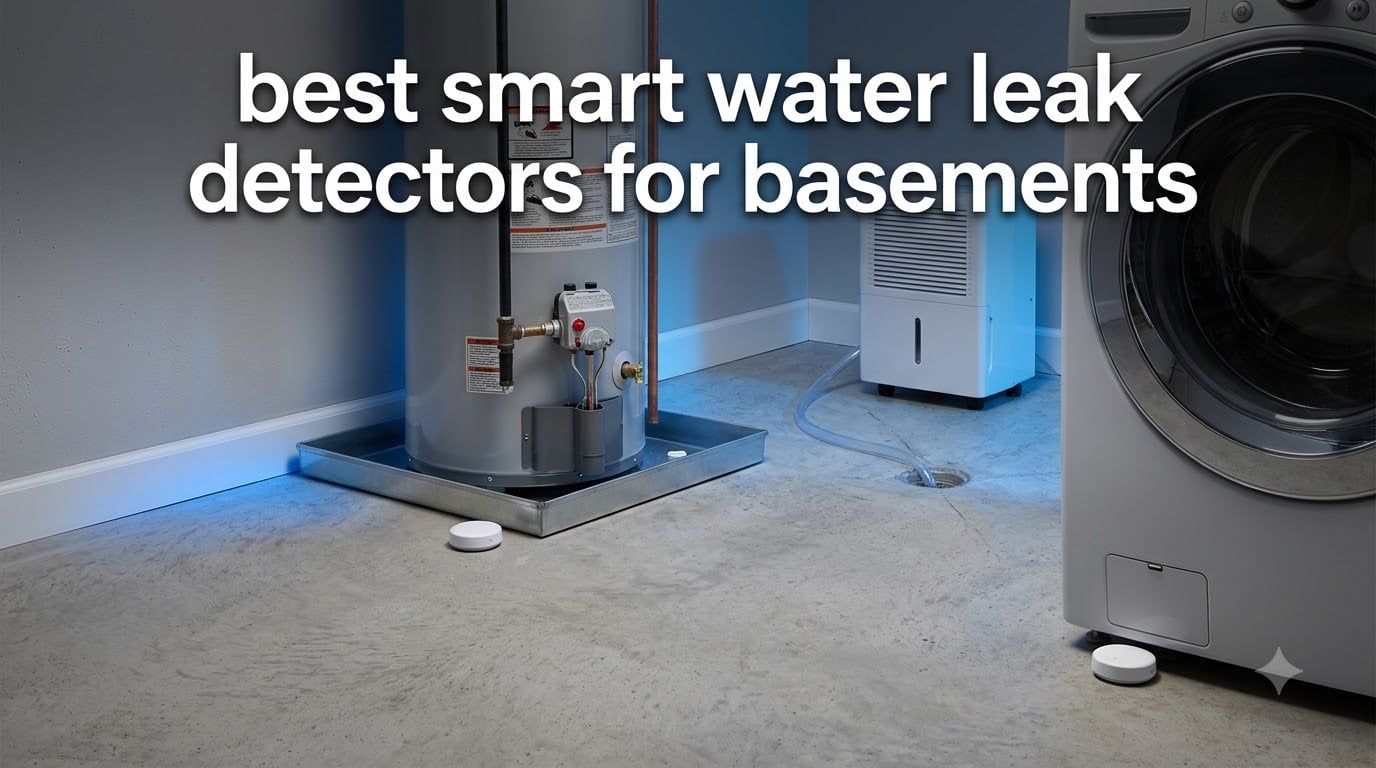
A smart water leak detector is a small battery-powered sensor that uses conductive probes to spot pooling water or falling drips, then sounds a local alarm and pushes an alert to your phone. For basements, our top three picks are the YoLink starter kit for long-range LoRa reach, the X-Sense SWS54 for the loudest dual alarms, and the GoveeLife four-pack for covering multiple basement zones from one gateway.
Basements are the worst room in the house for water damage because the water almost never becomes visible until it is expensive. A burst supply line behind a finished wall, a water heater tank slowly weeping into its pan, a sump pump that quit at 2am in a storm, a washing machine supply hose that let go while you were away for a week. Each of those starts as a puddle smaller than a dinner plate and ends as soaked insulation, warped baseboards and mould that keeps growing long after the water is gone.
That is why the best smart water leak detectors for basements are built around reach and silence rather than alarm volume. A sensor that only works inside Wi-Fi range is useless in the one room where the signal is weakest, and a sensor that screams at 105dB every time a dehumidifier drains is one you will learn to ignore.
We compared ten detectors that span the whole range of approaches: LoRa kits that punch through concrete and soil, hub-free Wi-Fi pucks, Zigbee sensors for HomeKit and SmartThings homes, and plain local sirens for occupied basements. We also worked through the placement problem, because on a sloped slab a sensor is only as good as the spot where water actually reaches its probes.
Before we get into the picks, one related basement upgrade worth mentioning: if your real problem is humidity rather than a burst pipe, our basement dehumidifier picks cut a lot of the condensation that trips cheaper sensors. Most of the false alarms we read about come from exactly that source.
Table of Contents
Top 3 Picks: Best Smart Water Leak Detectors for Basements (October 2026)

YoLink Water Leak Starter Kit
- LoRa range to 1320 ft
- 4 silent sensors plus hub
- 5-year AAA battery life
- Control-D2D works during outages

X-Sense SWS54 Kit
- Dual 120 dB alarms
- 1804 ft open-area range
- Detects pooling at 0.4 mm
- Base runs through power cuts

GoveeLife Water Leak Detector 2
- 1968 ft LoRa reach
- Four sensors plus gateway
- SMS app and email alerts
- IP66 housing
The YoLink kit wins on range and scale. The X-Sense kit wins when you need to actually hear the alarm from another floor. The GoveeLife pack wins when the goal is simply covering four or more basement zones without running cables or adding a second hub.
All 10 Detectors at a Glance
| Product | Specifications | Action |
|---|---|---|
| YoLink Water Leak Starter Kit |
|
Check Latest Price |
 Aqara Water Leak Sensor 3 Pack Aqara Water Leak Sensor 3 Pack |
|
Check Latest Price |
| X-Sense Wi-Fi Water Leak Detector Kit SWS54 |
|
Check Latest Price |
 METAK Water Leak Detector Alarm METAK Water Leak Detector Alarm |
|
Check Latest Price |
| GoveeLife Water Leak Detector 2 4 Pack |
|
Check Latest Price |
 SwitchBot WiFi Water Sensor SwitchBot WiFi Water Sensor |
|
Check Latest Price |
 Winees WiFi Water Leak Detector 3 Pack Winees WiFi Water Leak Detector 3 Pack |
|
Check Latest Price |
 Kidde WiFi Water Leak and Freeze Alarm Kidde WiFi Water Leak and Freeze Alarm |
|
Check Latest Price |
 Tapo Smart Water Leak Detector T300 Tapo Smart Water Leak Detector T300 |
|
Check Latest Price |
 Aeotec SmartThings Water Leak Sensor Aeotec SmartThings Water Leak Sensor |
|
Check Latest Price |
How We Evaluated Basement Leak Detectors
We scored every detector on the same six things: wireless reach from a basement floor, how the sensor behaves on concrete and sloped slabs, whether the alerts reach a phone when nobody is home, how long the batteries actually last in a cold damp room, and what the total cost looks like once you add any hub or gateway that is not in the box.
To be straight about what this is: we are not a lab. The ratings, review counts and specifications below come from the manufacturers’ listings and from thousands of written buyer reports, and we have not measured decibels with a sound meter or flooded a mock basement. Where a number matters to your decision, we give the manufacturer figure and say so. Where buyers repeatedly report the opposite of the spec sheet, we flag that too.
We paid close attention to the four failure modes that show up again and again in owner reports: sensors that sit too high to catch a spreading puddle, sensors that lose their gateway connection after a power cut, batteries that die quietly without warning, and alerts that stop when the internet drops.
1. YoLink Water Leak Starter Kit, Best Long-Range Coverage for Basements and Sheds
YoLink Water Leak Sensor 1 Kit: 4-Pack + Hub
LoRa to 1320 ft
Silent sensors
2 AAA, 5 years
Hub included
Pros
- Reaches basements
- sheds and outbuildings where Wi-Fi fails
- App email and SMS alerts with location-based sensor names
- Control-D2D still triggers sirens or valves when the internet is down
- Two AAA cells per sensor rated at 5 years
- One hub covers 300+ YoLink devices
Cons
- Leak Sensor 1 units are silent so audible alerts need a SpeakerHub or siren
- Probe sensors miss moisture soaked into porous surfaces
Four sensors, a hub and a 1320 ft LoRa link in one box. That range is why this kit keeps surfacing in basement threads, and users on r/homeautomation specifically credit LoRa systems for the parts of a property that sit outside normal Wi-Fi coverage.
Each Leak Sensor 1 pairs with the hub over LoRa and can be named for its location, so the alert says water heater pan rather than device three. You get push, email and SMS. For a basement you are away from, having SMS in the mix is the difference between a puddle and a flooded room.
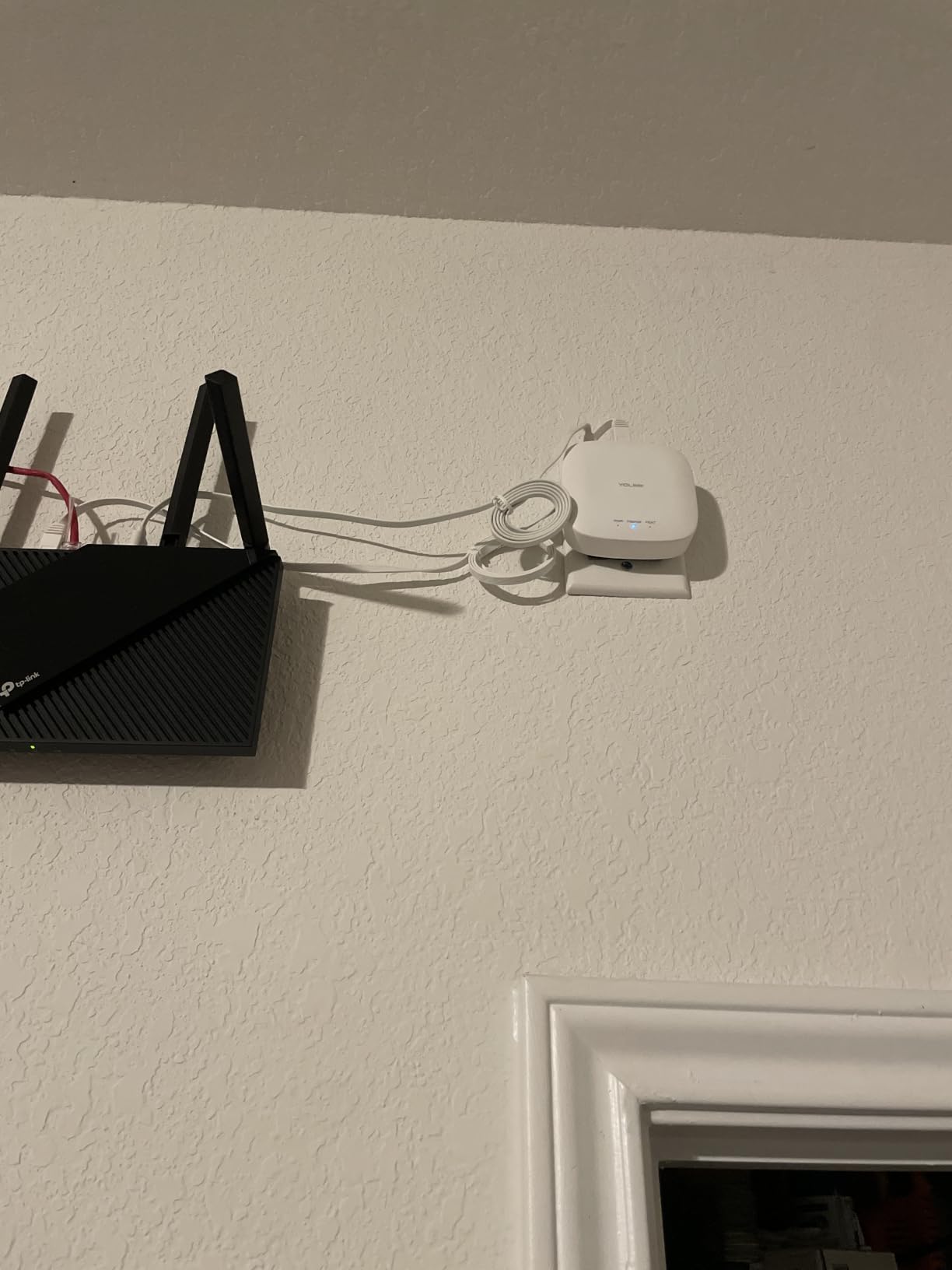
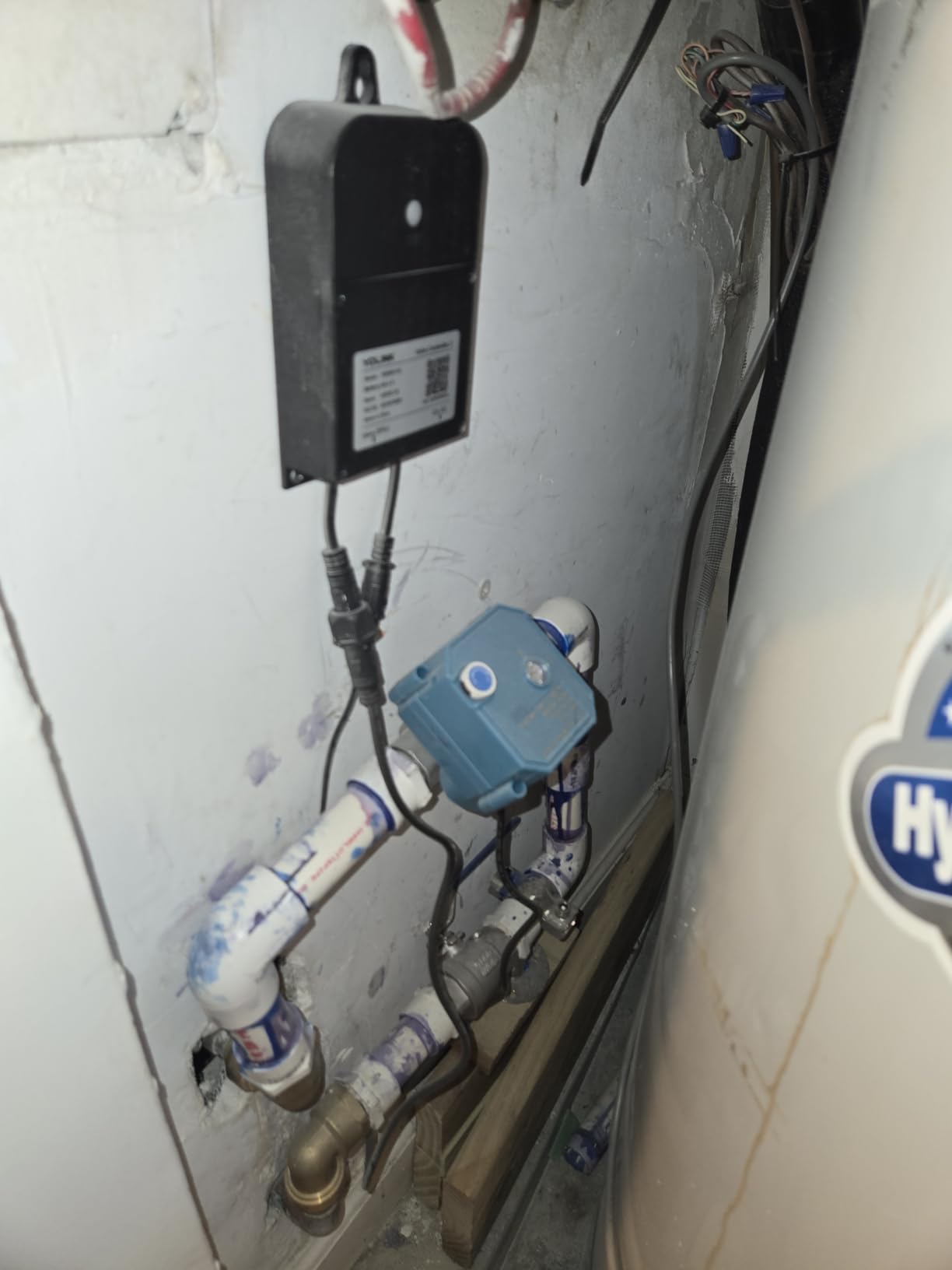
Two details are unusual at this level. Control-D2D lets a sensor trigger a local YoLink siren or shutoff valve even when your internet is down, which matters because basement internet often fails during the storm that flooded the sump. And the hub scales past 300 devices, so you can extend to a rental unit or a garage later.
The trade-off is silence. These units have no siren, so audible alerts need a SpeakerHub or a YoLink siren as a second purchase. That is the right call for a finished basement you live in and the wrong call for a storage room where an alarm would reach nobody.
When the silent design is the right call
Choose this kit when your basement is unoccupied most of the day, has plumbing spread across a large footprint, or needs monitoring while you travel. Phone and email alerts do the work, and no one upstairs is startled at 3am by a noise they cannot trace.
LoRa also avoids depending on your phone network, which helps where cellular reception in the basement is poor.
Where the limitations bite
The probe design only senses standing water touching the metal pins, so a leak wicking into concrete or cardboard leaves the sensor quiet. The sensors are named by location too, so set names carefully at install time rather than renaming pucks on an uneven floor later.
2. Aqara Water Leak Sensor 3 Pack, Best for Apple Home and Very Shallow Leaks
Aqara Water Leak Sensor 3 Pack, Zigbee Water Leak Detector for Alarm System
Zigbee to Aqara hub
Detects 0.5 mm
IP67 housing
55 dB hub alarm
Pros
- Probes trigger at water levels as shallow as 0.5 mm
- Compact wireless body needs no wiring or screws
- Works with Apple HomeKit
- Google Home
- Alexa and IFTTT
- IP67 housing with rust-proof coating suits damp basements
Cons
- Aqara hub sold separately adds to the cost
- Must sit within about 10 meters of the hub
- Hub alarm output is a modest 55 dB
This is the pick if your home runs on HomeKit and you care about catching the first millimetre of water rather than the first puddle. The probes are extremely sensitive, which is what you want around a water heater pan where the first sign of trouble is a film of water.
It is also the smallest option here at just under two inches square and 0.59 inch thick, so it tucks behind a water heater, beside a sump pump or under a washing machine without lifting anything. The sealed IP67 housing with a rust-resistant coating suits a space that sits at high humidity.
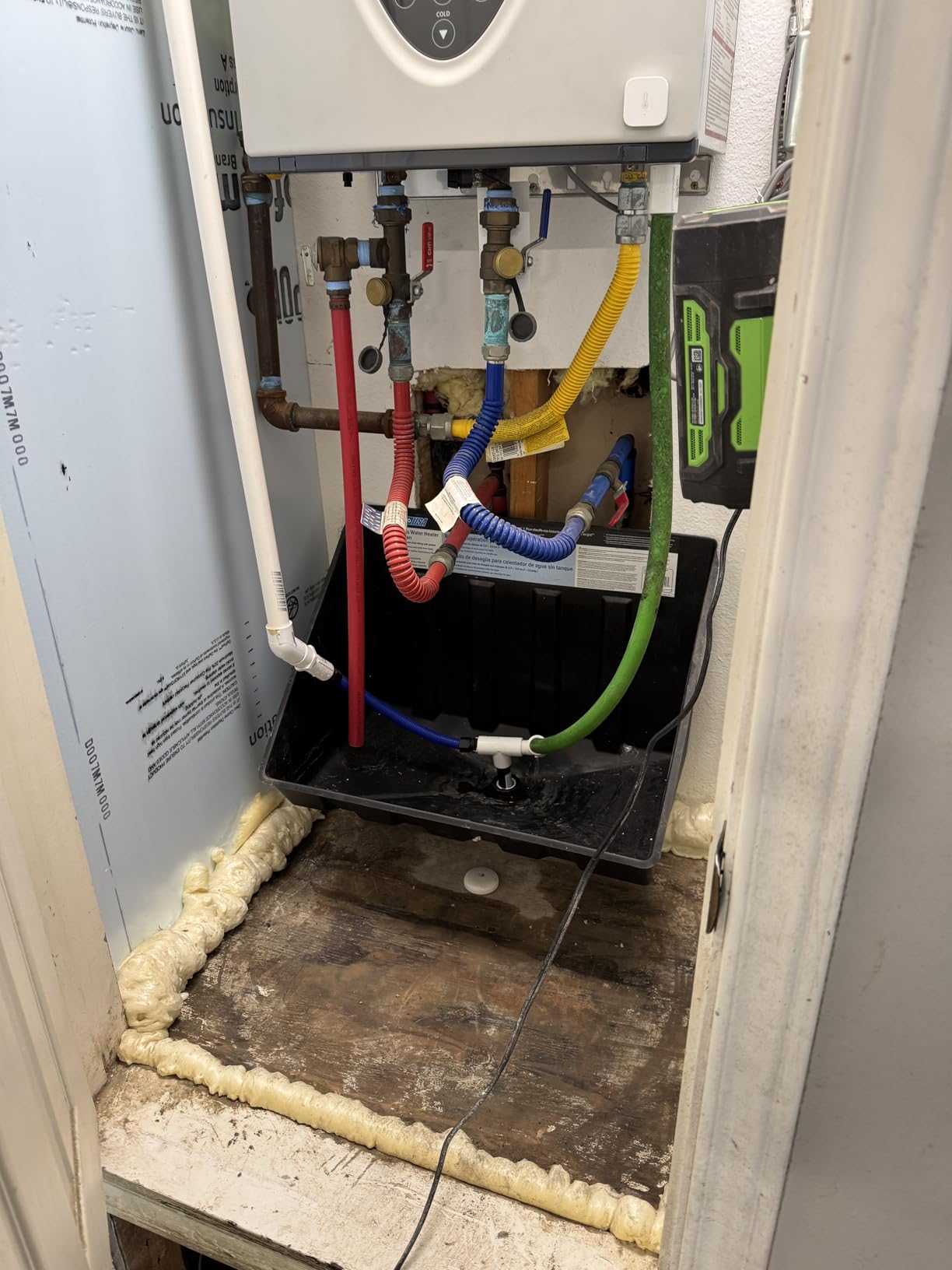
Pair it with an Aqara hub and it becomes an ordinary HomeKit, Google Home or Alexa sensor, so leak events join your normal automations. The catch is that the hub is not in the pack, and the sensor must sit within about 10 meters of it for a steady Zigbee connection. With a poured wall between the sensor and a hub on the floor above, that limit decides the outcome.
Buyers also note the alert is a 55 dB tone from the hub, closer to a refrigerator hum than an alarm. You will not hear it from two floors up. This is a phone-alert sensor first and a siren second.
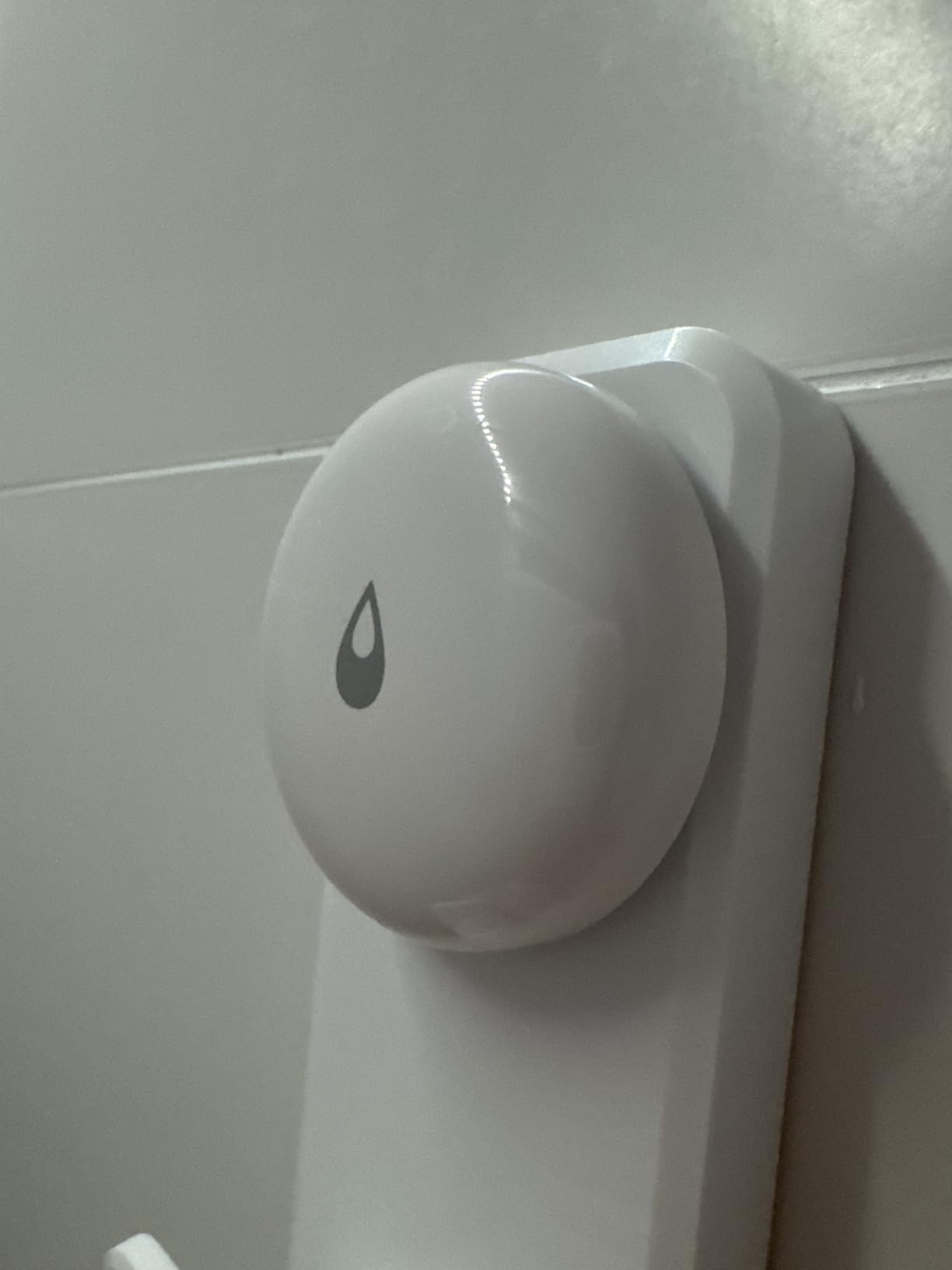
Why 0.5 mm sensitivity matters downstairs
A shallow-reading probe catches the film of water that forms under a water heater tank or a weeping supply joint long before it becomes visible. On an uneven slab that film spreads wider than it is deep, so sensitivity is doing the work flat placement cannot.
What to check before buying
Measure the distance from your intended sensor spots to wherever the hub would live. If it can sit in the basement near the utility area, the 10 meter limit stops mattering. If the hub has to live upstairs, pick a kit with longer reach.
Also factor in the separately sold hub when comparing options, and note that third-party Zigbee USB dongles are not officially supported, which rules this out for a dedicated Home Assistant or Hubitat build.
3. X-Sense Wi-Fi Water Leak Detector Kit SWS54, Best for Hearing the Alarm From Another Floor
X-Sense Wi-Fi Water Leak Detector Kit, 120 dB, 3 Sensors + Base, SWS54
Dual 120 dB alarms
1804 ft range
0.4 mm pooling
IP66 housing
Pros
- Sensors and base station both sound at 120 dB
- Very long 1804 ft open-area range
- Six probes catch drips from above and pooling from below
- Base station keeps sounding during a power outage
- App sharing for up to 12 users
Cons
- Audio alarm cannot be fully disabled in the app
- 2.4 GHz Wi-Fi only so 5 GHz networks need a separate SSID
- Changing batteries in awkward high spots takes effort
Three sensors and a base station, both sounding at 120 dB. That volume is the highest on this list, and it is the reason to pick this kit when the people who need to hear a leak are not in the basement.
Buyers describe real saves with this kit: a sump pump that failed, a window well that filled during heavy rain, a laundry overflow noticed before the drywall was ruined. The 1804 ft open-area range leaves room to put the base on an upper floor and the sensors spread across a large basement.
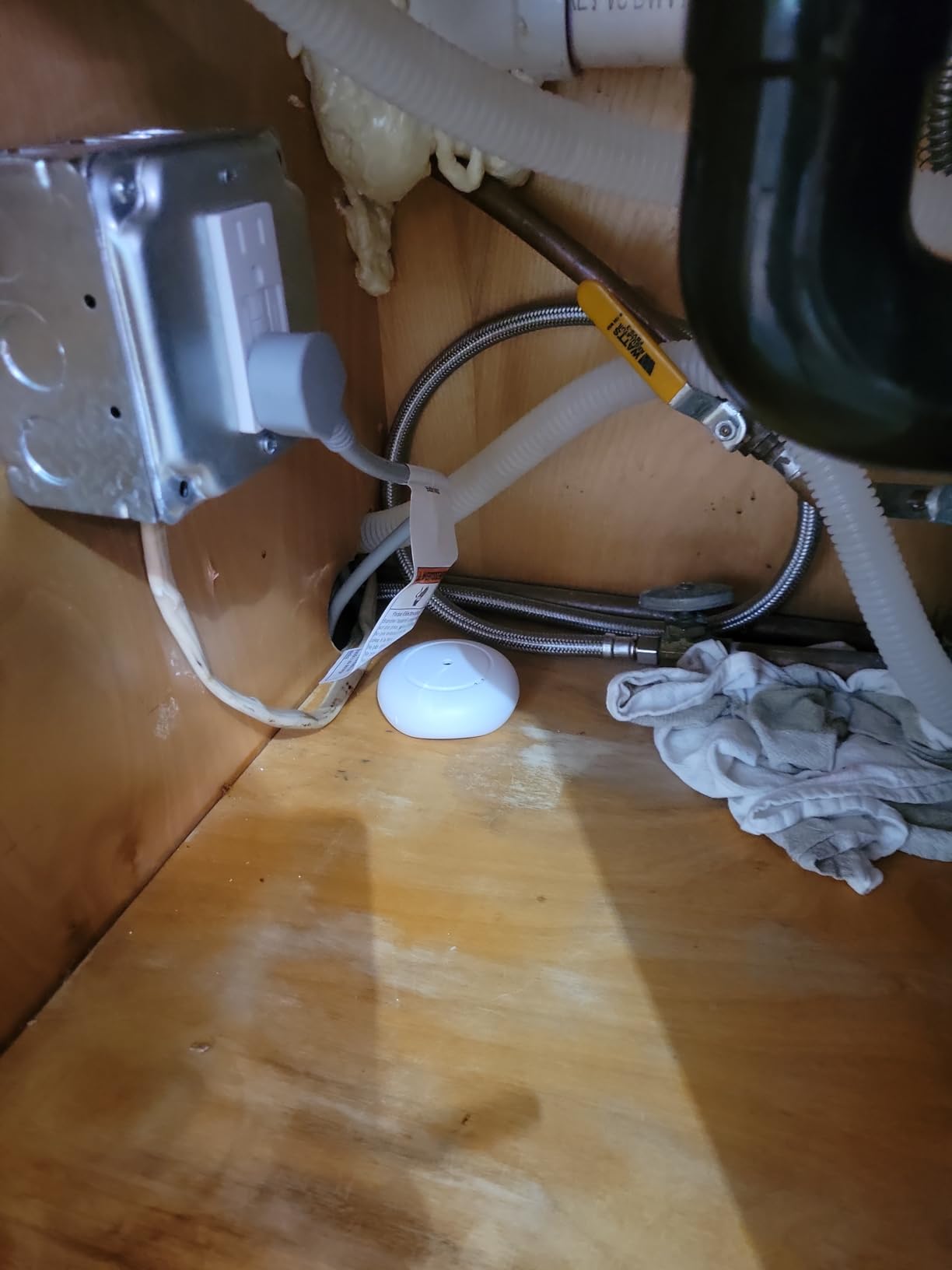
Detection is thorough. Two upper probes look for drips falling from above and the lower probes register pooling as shallow as 0.4 mm, so it handles a slow ceiling drip and a sudden floor flood. The base station keeps alarming during a power cut, which matters where a flooded electrical panel is a real possibility.
Two honest complaints recur. You cannot fully mute the audio in the app; you can drop the volume and change the voice, but some owners have had to unplug the speaker. And setup is 2.4 GHz only, so a 5 GHz network needs a separate name.
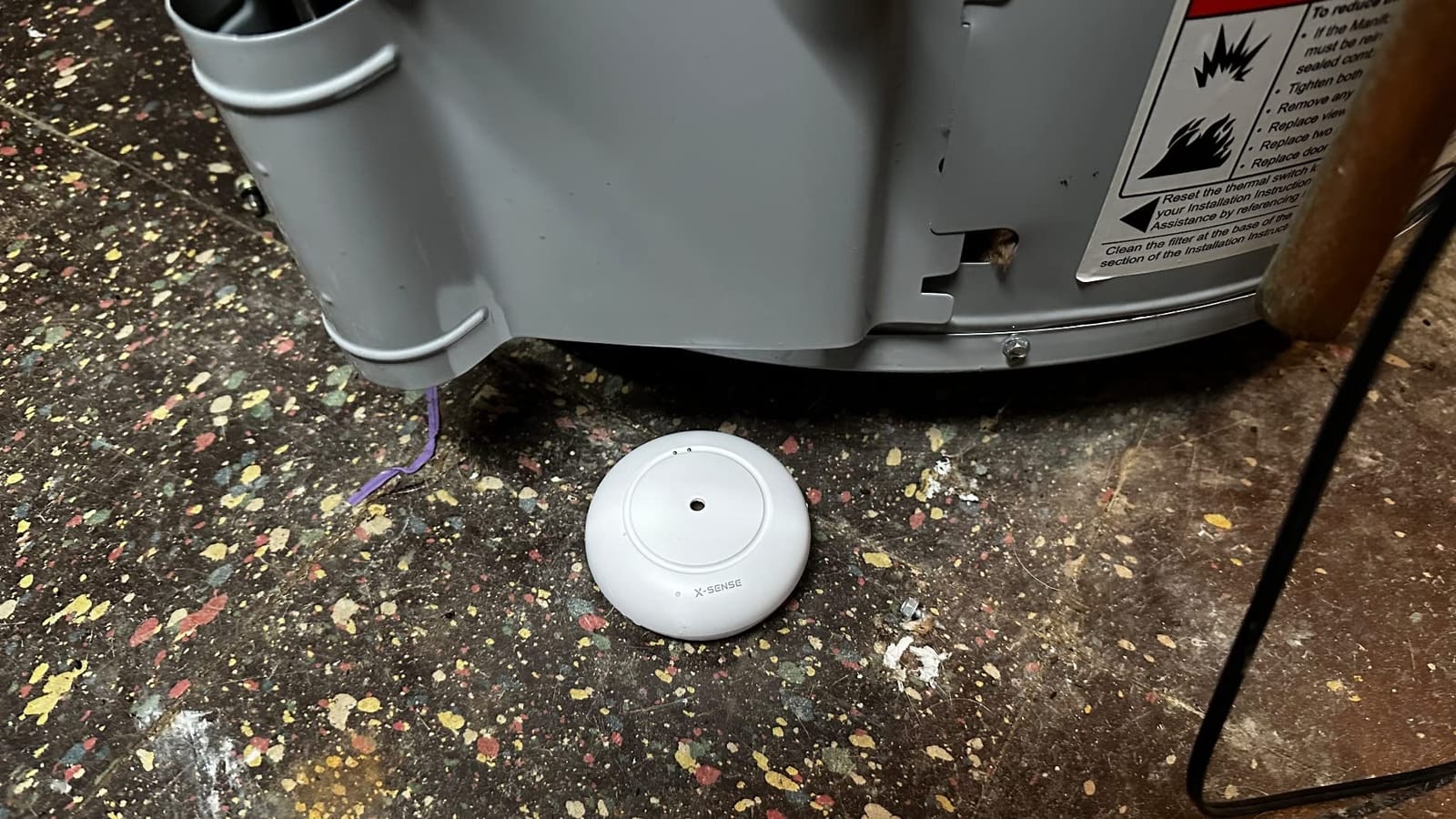
Alarm loudness versus a live-in basement
At 120 dB the base station and any triggered sensor are loud enough to wake a sleeping household. That is right for a storage basement and wrong for a bedroom suite or finished rec room, where one false alarm from a dehumidifier line is enough to make you unplug the base.
Pair this kit with placement discipline. Keep sensors off the floor where a dehumidifier drain hose runs, and never directly under a condensate drip line.
Where the range figure needs context
The 1804 ft number is open-air distance, and a poured concrete basement cuts it substantially. Even so, the sensors talk to the base station rather than your router, so the practical limit is the distance to wherever you put the base.
Each sensor takes three AAA cells, so keep spare batteries on hand before placing them in low-clearance corners.
4. METAK Water Leak Detector Alarm, Best Budget Local Siren for a Single Spot
METAK Water Leak Detector Alarm: WiFi Water Flooding Monitor Smart App Sink Overflow Monitoring Adjustable Wet Moisture Alert Pipe Leakage Drip Detection Warning for Home Basement Floor
100 dB siren
6 probes
IP66 shell
2-year battery
Pros
- Triggers on very small amounts of water
- 100 dB alarm carries several rooms
- IP66 shell for high-humidity basements
- Low-battery beep and flashing red light
- Mute button once you find the source
Cons
- Multiple reviews report no Wi-Fi or app connectivity despite the listing wording
- Single sensor per pack so a basement needs several
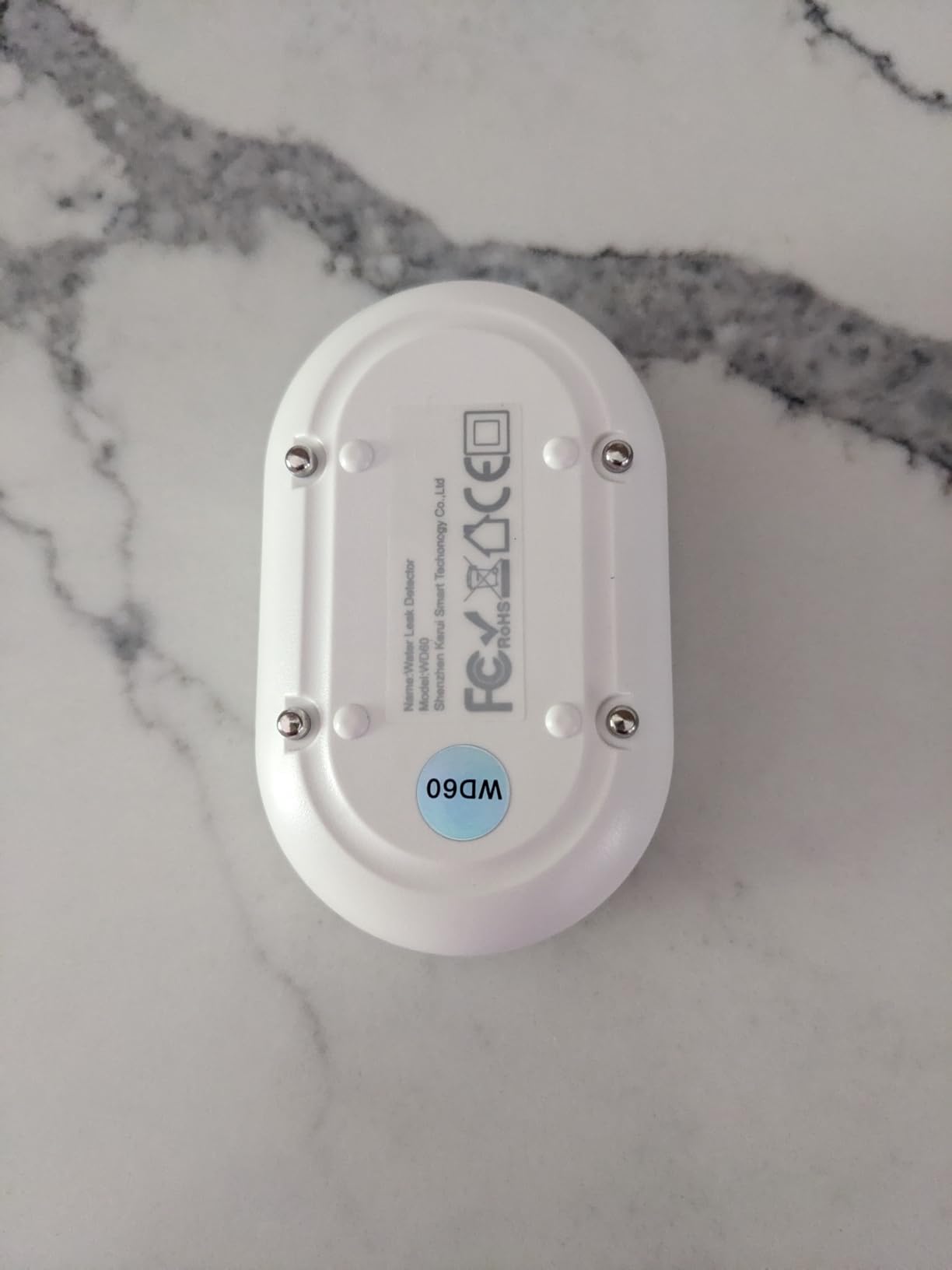
A 100 dB siren with six probes and nothing else. Four rear probes look for pooling and two front probes catch a drip, which makes it a good watchman for a single high-risk spot such as directly under a water heater or beside a sump pump.
Owners report it reacting to remarkably small amounts of water, including condensation and a damp paper towel. The IP66 shell and two-year battery fit an unheated space with no fuss, and the mute button lets you silence it once you have found the problem.
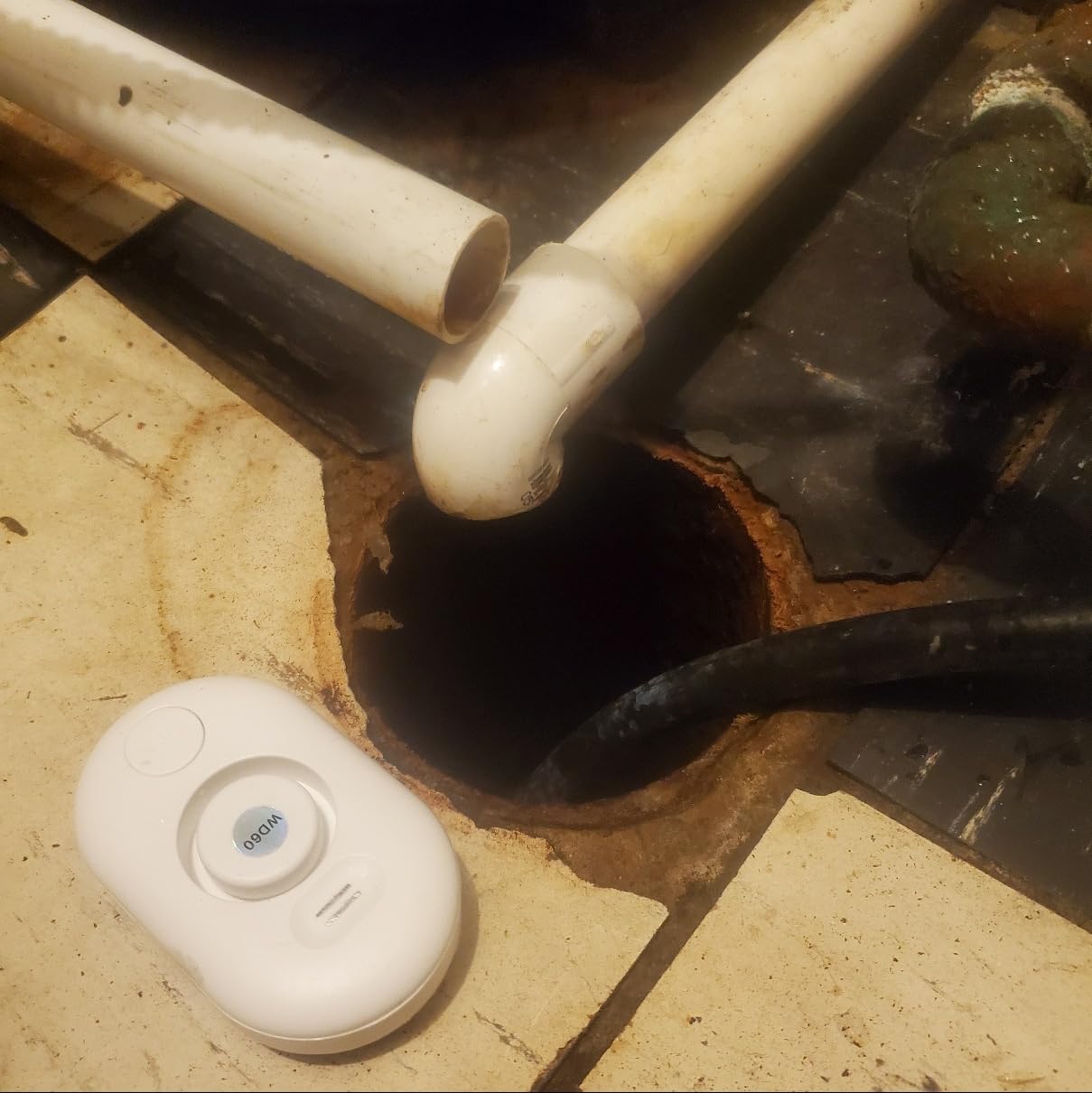
Here is what you need to know before buying. Despite the listing mentioning an app, multiple reviews describe this as a standalone local siren with no Wi-Fi or app connection. If that is the unit you receive, it only helps if someone stands near enough to hear it.
That is a category difference rather than a flaw. A local siren is valid for the basement you walk through twice a day and poor for a basement you monitor from another city.
The case for a local-only alarm
No hub, no app, no account and no cloud to lose. There is nothing to re-pair after a router reset and nothing to stop reporting when a vendor changes an API. In a space you pass through regularly, a loud local siren is a reasonable layer.
It also works as a backup inside a larger system, sitting under a water heater while your phone sensors handle remote alerts.
When to spend a little more instead
If nobody is home during the day, or your basement is in a different building from where you sleep, a siren nobody hears is the same as no alarm. Put your money into a hub-free Wi-Fi sensor or a LoRa kit with phone alerts instead.
Budget for several of these, since each pack holds a single detector and a basement has more than one place water can appear.
5. GoveeLife Smart Water Leak Detector 2 4 Pack, Best Value for Covering Multiple Basement Zones
GoveeLife Smart Water Leak Detector 2 with 1968ft Ultra-Long Range, 4 Pack
LoRa to 1968 ft
4 sensors plus gateway
IP66 housing
5-year battery
Pros
- Longest claimed range in this roundup at 1968 ft
- Three alert types: SMS
- app push and email
- Two top and four bottom probes per sensor
- One gateway supports up to 100 sensors
- Over five years of battery life per sensor
Cons
- Plug-in gateway can block the second socket on a duplex outlet
- Phone alarm tones are short and do not latch
- Manual does not line up well with the app
Four sensors and a gateway reaching a claimed 1968 ft over LoRa. Forum buyers point to Govee sensors as a cost-effective way to cover many basement zones at once, and this four-pack is that idea with the sensors included.
Alerts come by SMS, app push and email together, the widest net here. Owners describe catching a washing machine hose leak and an HVAC humidifier drip within seconds of the water arriving, and the gateway also accepts other Govee devices like a thermometer for a crawl space.
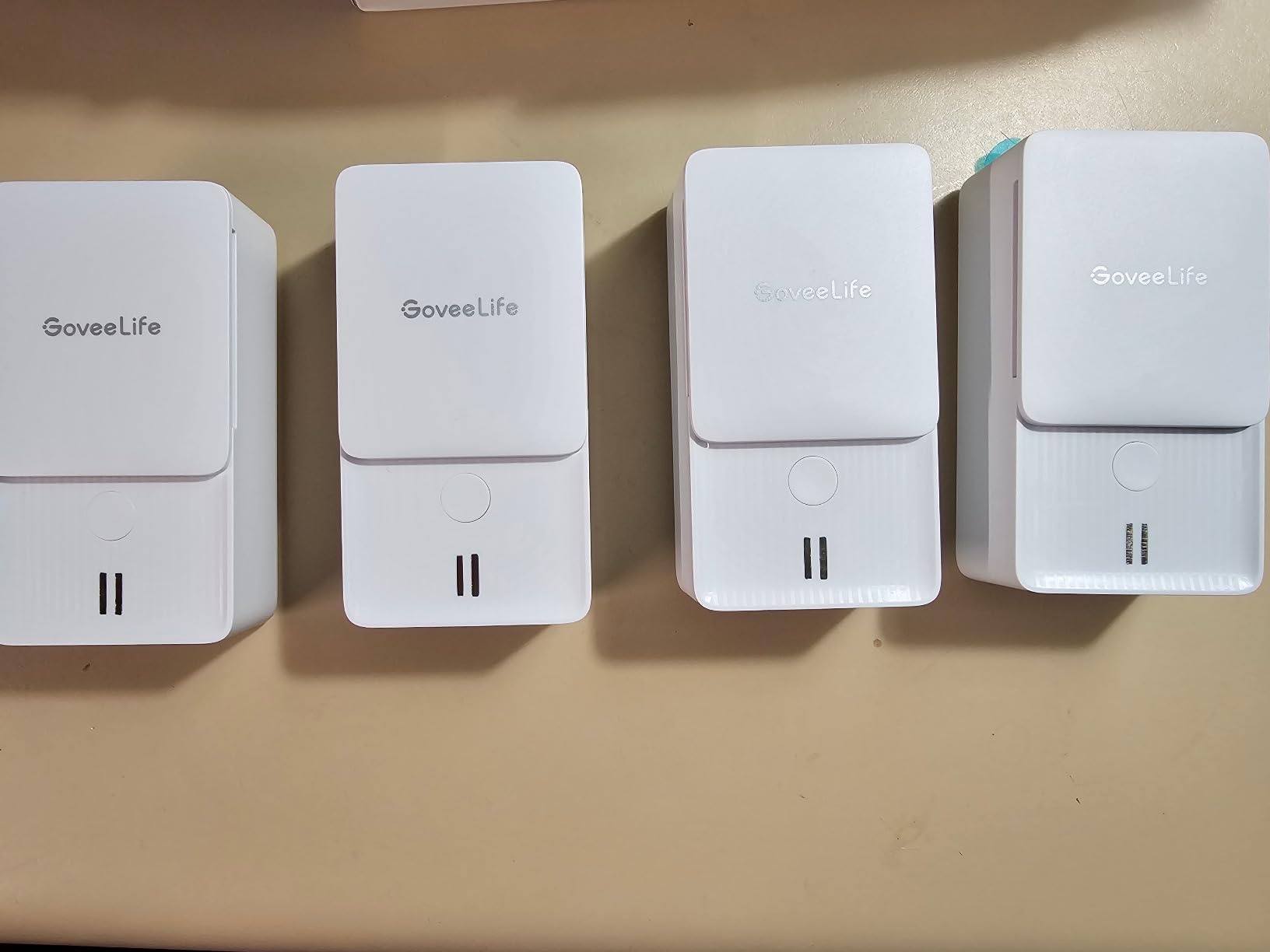
Each sensor carries two top and four bottom probes, so it handles a drip landing on the floor and a puddle spreading under an appliance, and the alarm reaches 100 dB. The gateway is the only part that touches your network, and it works on 2.4 GHz only.
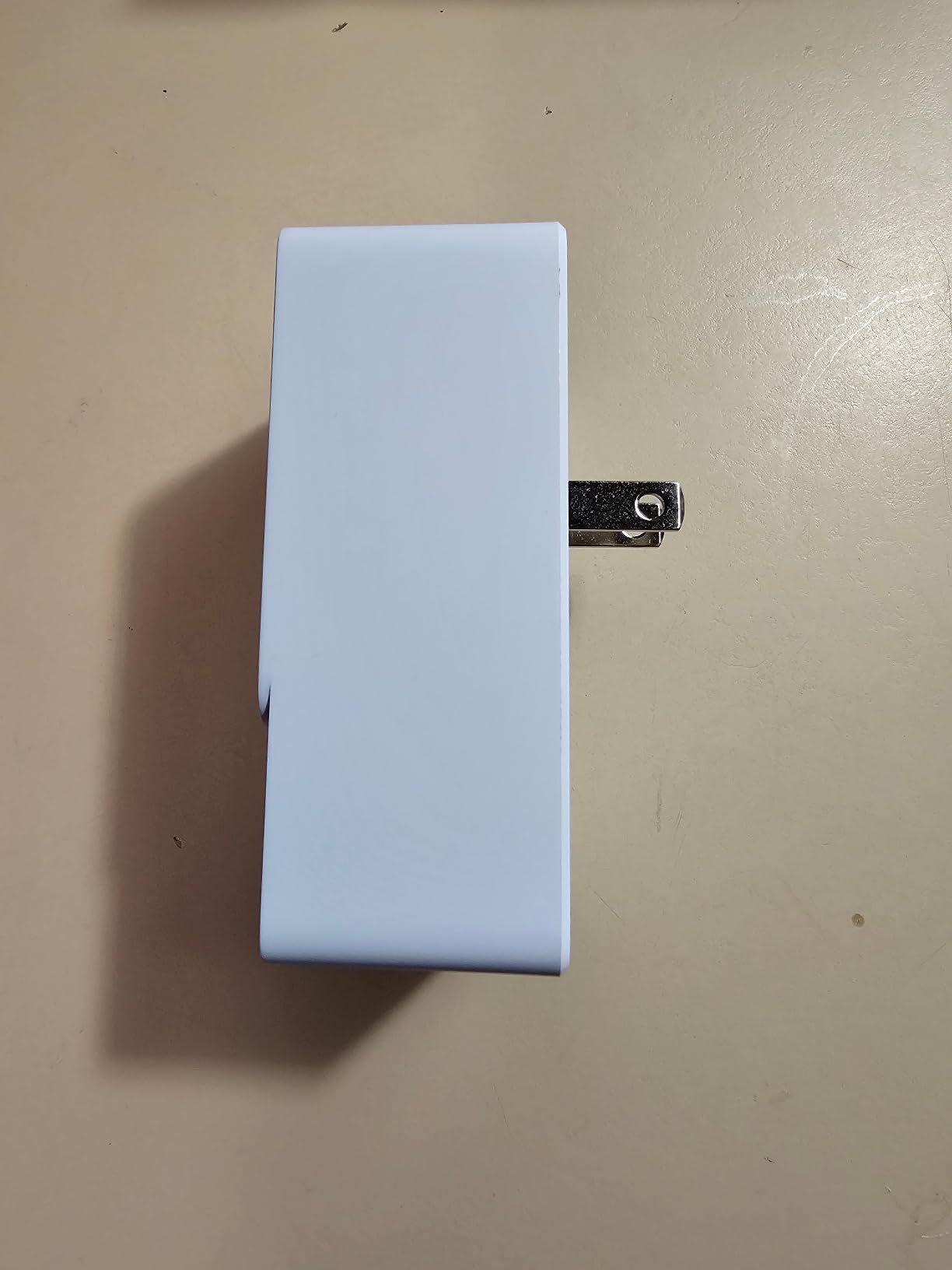
Watch the physical size. The plug-in gateway can partially cover the second socket on a duplex receptacle, which matters if your basement outlet already hosts a dehumidifier and a sump pump cord. The phone tone is also short and does not latch, so many route alerts through a voice assistant or a persistent ringtone.
Best use of a 100-sensor gateway
That 100-sensor ceiling makes this a strong pick for a larger property: a basement plus a garage plus a rental unit on one gateway. Users report nodes working around 75 ft from the bridge through a typical house, which covers outbuildings where Wi-Fi would not reach.
Setup friction to expect
The printed manual does not match the app well, particularly around enabling notifications, so expect a few minutes in the app before push alerts start arriving. Test that your first alert reaches your phone before you leave the house.
If your basement outlets are tight, an extender or a different gateway location solves the socket problem without unplugging anything else.
6. SwitchBot WiFi Water Sensor, Best for a Hub-Free Install
SwitchBot WiFi Water Sensor, Smart Water Leak Detector, 100dB Adjustable Alerts & App Alerts, IP67 Waterproof, Wireless Detector for Kitchen, Bathroom, Basement, No Hub Required (Support 2.4G)
No hub needed
0.5 mm probes
IP67 shell
100 dB alarm
Pros
- Connects straight to 2.4 GHz Wi-Fi with Bluetooth backup
- Cheapest way to cover several zones with separate sensors
- 100 dB alarm with adjustable volume and duration
- Works with Alexa
- Siri
- IFTTT and SmartThings
- Pairs with a SwitchBot Plug Mini to cut power
Cons
- Sensors must be re-paired after a Wi-Fi outage
- 2.4 GHz only and the 120 m range claim varies with building materials
- The pry tool for the sealed battery cover is stiff
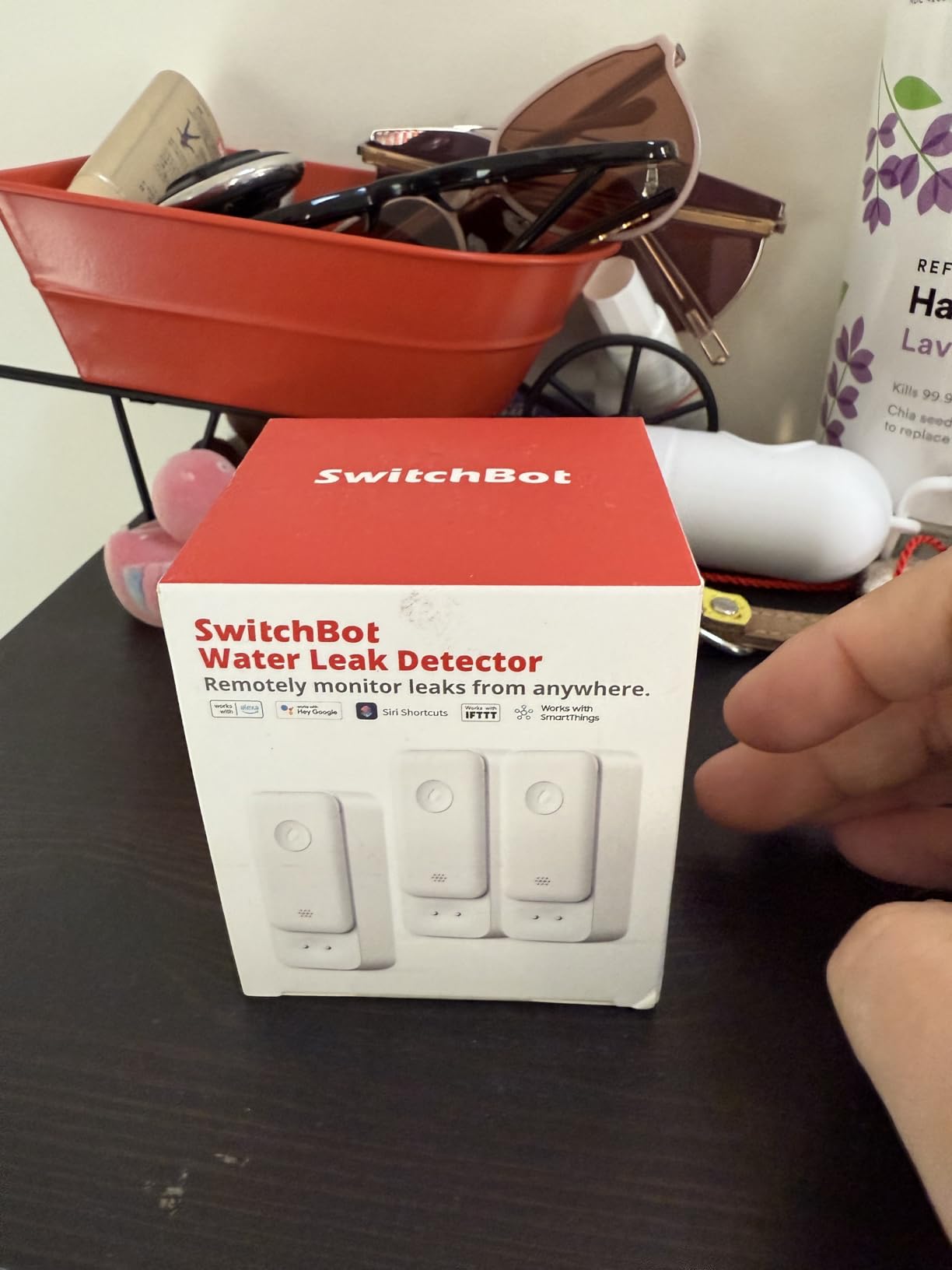
No hub, no gateway, no extra hardware. This sensor joins your 2.4 GHz network directly, with Bluetooth as a backup path. For a renter or anyone who does not want a hub downstairs, that is the whole appeal.
Four high-precision probes detect water at 0.5 mm, and the sealed IP67 shell handles damp conditions. The 100 dB alarm has adjustable loudness and duration plus an app mute, more control than most competitors offer.
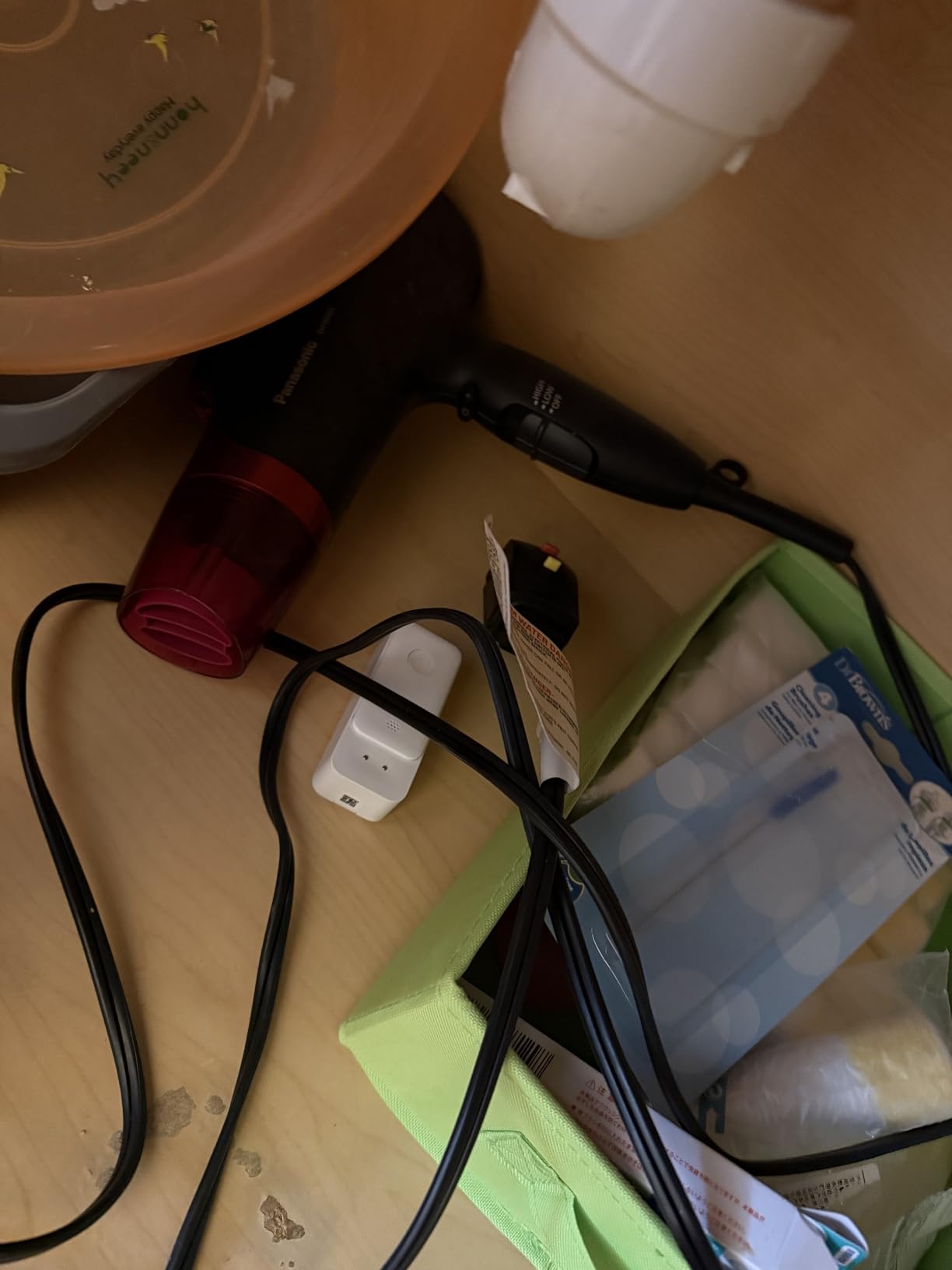
It pairs with Alexa, Google, Siri, IFTTT and SmartThings, and with a SwitchBot Plug Mini it can cut power to a leaking appliance rather than only raising an alarm. Reviewers describe catching a tankless water heater leak within minutes.
The real drawback, and a significant one, is that sensors generally need re-pairing after a Wi-Fi outage. Several owners treat that as routine maintenance. If your basement connection is unstable it becomes a hole in your coverage, which is another reason to sort the network out first.
Why single-sensor packs suit a basement
Basement coverage is a numbers game. You want a sensor at the water heater, one at the sump pump, one at the washing machine, one under the dehumidifier drain and one at a foundation wall corner. Single-sensor packs mean you buy exactly the number of locations you have, with no leftover hardware and no hub to place.
Plan around the re-pairing
Put a mesh node or dedicated access point in the basement before you install, and confirm the sensor holds a connection from the far corner. Owners who fixed their network first report far fewer connection complaints afterwards.
The 120 metre range is a best case that changes with construction. Poured walls and foil-backed insulation are the enemies, so test rather than assume.
7. Winees WiFi Water Leak Detector 3 Pack, Best for Sliding Under Appliances
Winees WiFi Water Leak Detector for Home, 3 Pack Water Sensors
1.8 mm thin sensors
200 m hub range
100 dB hub alarm
IP66 housing
Pros
- Sensors are 1.8 mm thick so they slide under appliances and into tight corners
- Pre-paired to the hub out of the box
- App
- SMS and email alerts name the exact sensor
- Hub alarm has three volume levels and four ring durations
- Reconnects on its own after a power outage
Cons
- Probes sit about 2 mm above the base so seeping and carpet soaks are missed
- Hub occasionally drops its Wi-Fi connection for a minute or two
- Sensors need a real puddle rather than light moisture to trigger
At 1.8 mm thick, these are the slimmest sensors here, and that number decides where you can put them. They slide under a washing machine, a utility sink or a wall base without lifting the appliance, which is exactly the placement that gets skipped in most basements.
Setup is the easiest here. The three sensors arrive pre-paired to the hub, so you plug in the hub, join Wi-Fi and name your sensors. Alerts arrive by app, SMS and email and identify which sensor triggered, and the hub siren has three volume levels plus durations from always-on down to 30 seconds.
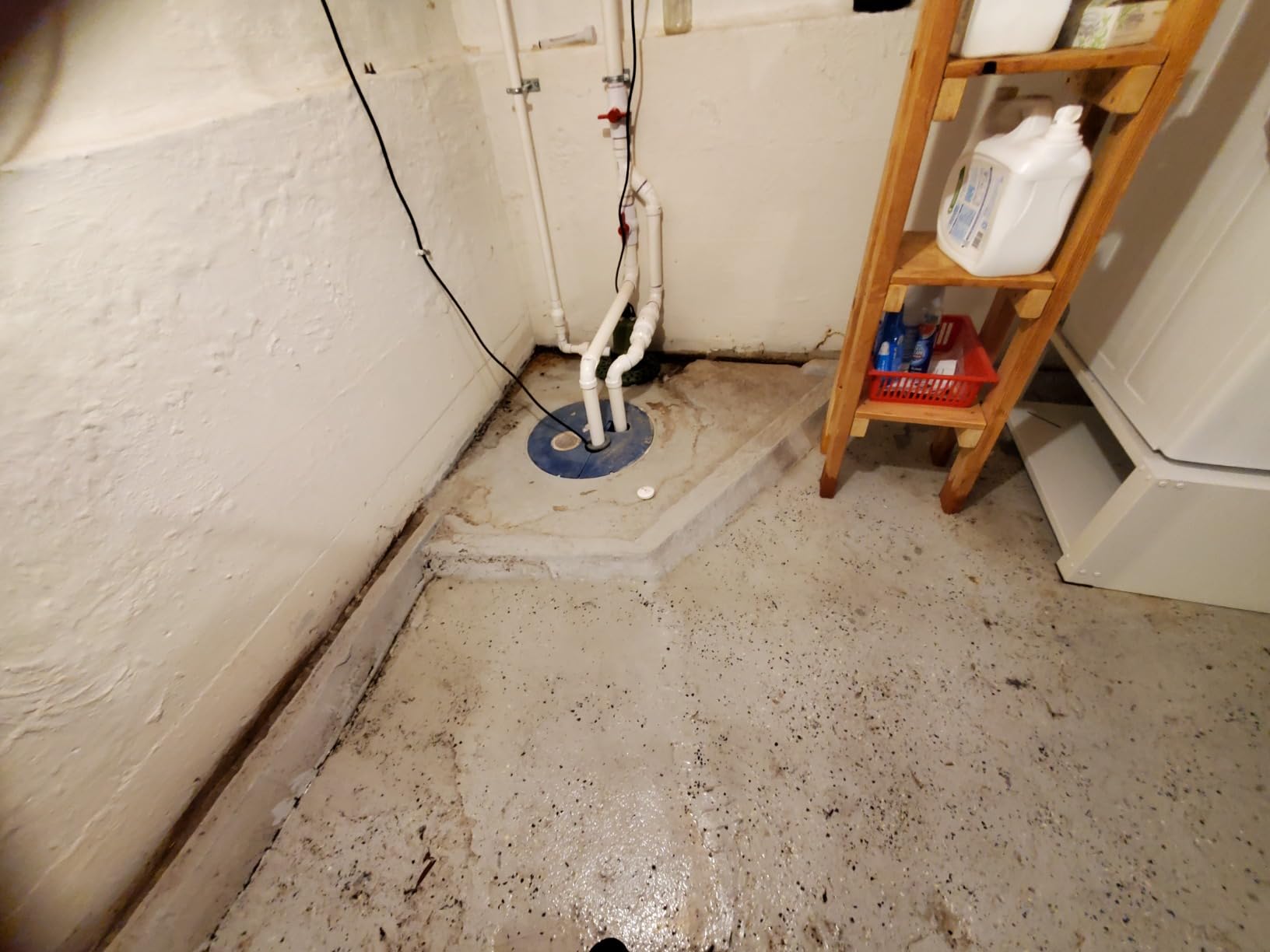
Basement owners especially like the loud hub alarm, since the hub can sit at the top of the stairs while the sensors stay at floor level. The 200 metre hub range covers a basement, a garage and a utility room, and the system reconnects on its own after a power cut.
There is a placement caveat in the reviews. The contact probes sit roughly 2 mm above the sensor base, so water soaking into carpet or seeping between floorboards may never reach them, and a light film is not enough to trigger. On bare concrete these perform well. On a finished floor, place them on the slab or in a low point.
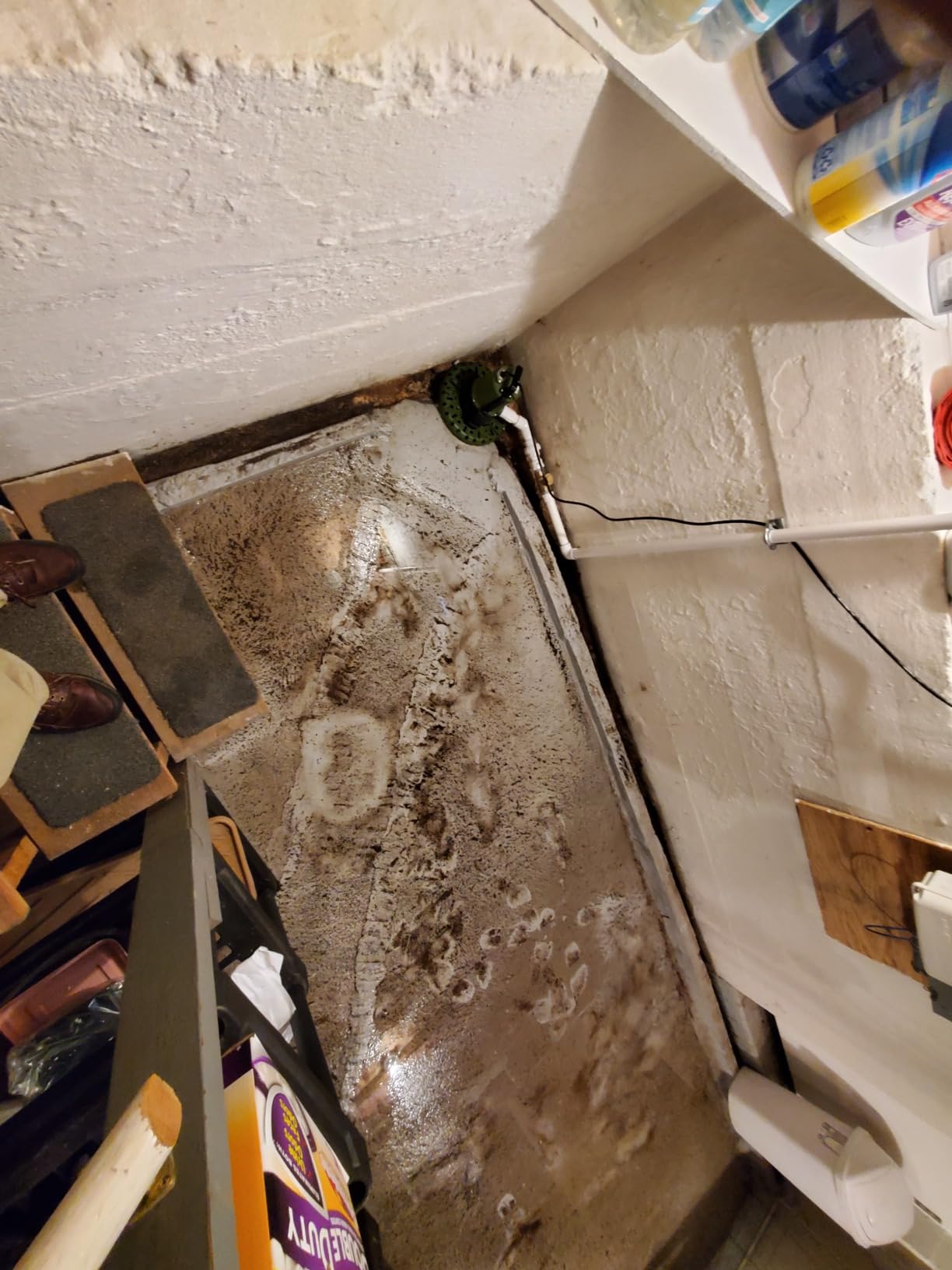
Where a 1.8 mm profile changes the plan
Most competing pucks are 0.6 to 1.2 inch tall, which means lifting the appliance or accepting a gap where water rarely travels. At 1.8 mm these disappear under a washer or a furnace, so you can protect the place where a slow hose leak actually starts. The IP66 sealed housing also holds up in sustained high humidity.
Where it falls short
The recessed probe height that makes it thin also makes it less sensitive to partial moisture. If your basement has a finished floor, add a second sensor with top-mounted drip probes higher up so you cover both slow soak and pooling.
Sensor naming follows the room you assign, so update the name if you later slide a puck. This pack also carries the largest share of one-star reviews here, mostly reliability complaints, so test every sensor with a damp cloth before you leave.
8. Kidde WiFi Water Leak and Freeze Alarm, Best for Unheated Basements
Kidde WiFi Water Leak Detector & Freeze Alarm, Alexa Device, Smart Leak Detector for Homes with App Alerts,White
Leak plus freeze at 37 F
2 AA batteries
Wi-Fi phone alerts
Alexa and Google
Pros
- Detects freezing at 37 F or a rapid temperature drop
- Compact housing fits beside a water heater or under a sink
- Notifications go to your phone and to friends and family
- Works with Alexa
- Google Home
- iPhone and Android
- Established home safety brand with a 1-year warranty
Cons
- Lowest rating in the roundup with 17 percent one-star reviews
- Single detector per pack so several are needed
- No siren volume is listed so delivery leans on the app
- Uses AA rather than AAA cells
If your basement is unheated, the freeze half of this device is the reason to buy it. It alerts at 37 degrees Fahrenheit or on a rapid temperature drop, the warning you want before a pipe in an exterior wall freezes and splits.
The body is compact at 3.5 inches square and 1.5 inch tall, so it fits beside a water heater or under a sink without dominating the space. Notifications go to your phone and can be shared with friends and family, and it works with Alexa, Google Home, iPhone and Android.
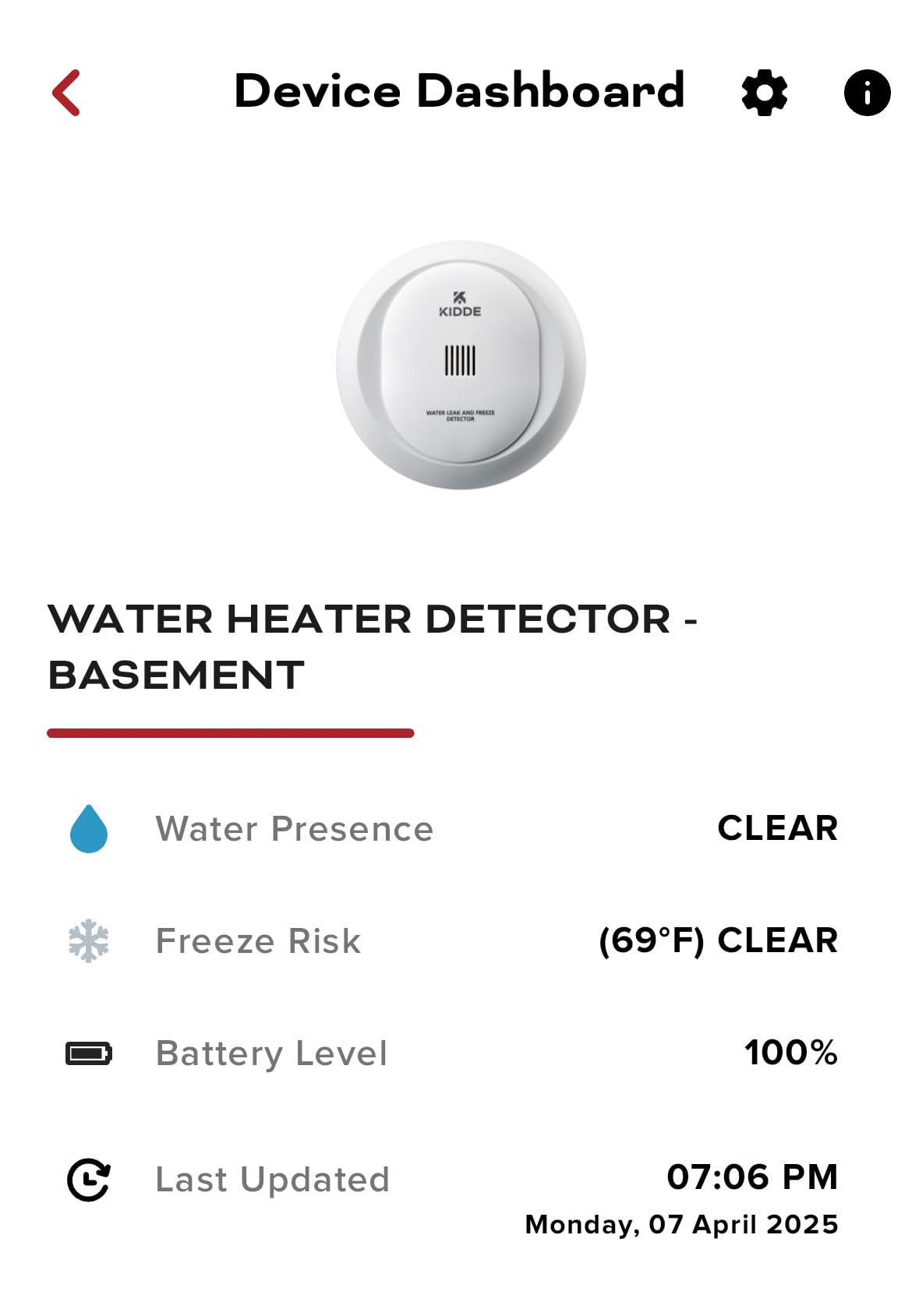
Being honest about the weak spots: this is the lowest-rated product here, with 17 percent of reviews at one star. The complaints cluster around missed alerts, dependence on the app, and single-sensor pack sizing. There is also no published siren volume, so do not expect a local alarm you can hear from another room.
It runs on two AA batteries, which typically means more frequent changes than the AAA cells used by most competitors. A low-battery prompt goes to the app, but a device you never open the app to check eventually goes quiet, so put replacement on your calendar.
Freeze alerts as an early warning system
A freeze alert gives you time to open a tap, let water run and call someone out before a split pipe turns into a flooded basement. For a garage or an unheated utility room that is worth more than a slightly louder siren.
Place it on the exterior wall nearest the unheated spaces rather than next to a heat source, since a sensor above a furnace will never see the cold.
Where it belongs in a system
Think of this as a specialist rather than a primary leak sensor. Pair it with a long-range kit on the main plumbing and let the Kidde unit handle cold spots and a garage you are not monitoring continuously.
Because delivery leans on the app, test the notification path after every router change. A smart leak detector that only notifies a phone is a phone-dependent device, not a siren, and it is worth knowing which one you own.
9. Tapo Smart Water Leak Detector T300, Best for the Fastest Trigger
Tapo Smart Water Leak Detector, Requires Tapo Hub, T300
Triggers in about 1 second
6 probes
IP67 housing
3-year battery
Pros
- Siren trips in about one second
- the fastest here
- Most consistent ratings in the roundup with 82 percent five-star
- Reviewers report stable connections and no dropouts
- Six probes sense drips from above and pooling from below
- Works with Alexa and Google Home announcements
Cons
- Requires a Tapo hub for Wi-Fi connectivity
- App can occasionally log you out and delay push alerts
- Taller profile does not fit under low-clearance appliances
- US units use different frequencies than hubs sold elsewhere
Response time is this sensor’s standout number. Six probes with top and bottom sensing can trip the siren in about one second, which is the difference between a soaked subfloor and a damp one.
The rating profile is the strongest here too, with 82 percent five-star reviews and only 4 percent one-star. Owners mention that it never disconnects, which matters more in a basement than any spec-sheet number, and several describe it saving a basement.
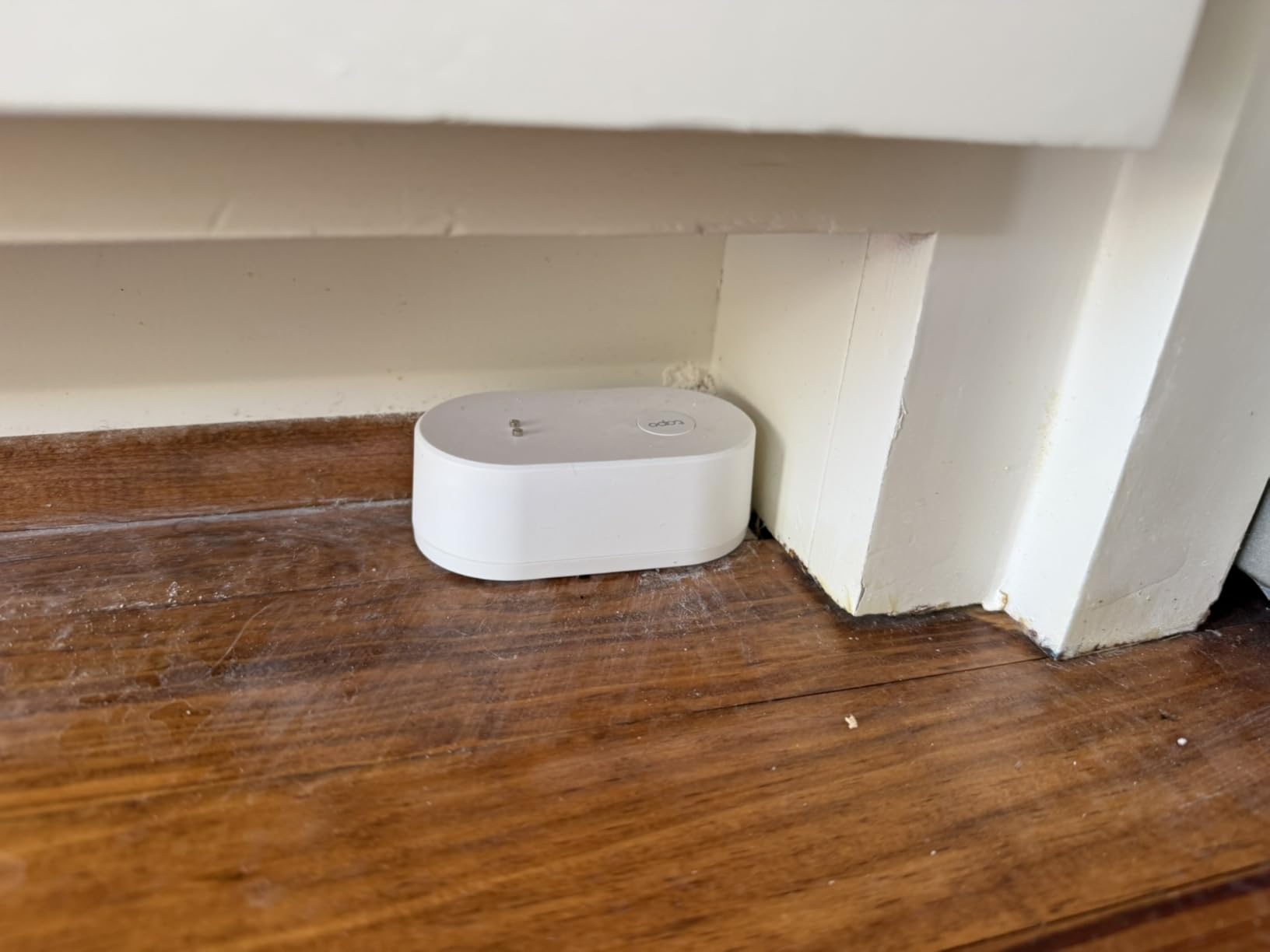
You will need a Tapo hub for Wi-Fi connectivity, so budget for that as a second purchase. Once connected it works with Alexa and Google Home, so every smart speaker can announce a leak, and the 90 dB alarm has adjustable volume with a one-press silence. The IP67 rating handles humid and dusty rooms, and two AAA cells are rated for up to three years.
The one complaint worth planning around is that the app can occasionally log you out, delaying push notifications. Routing alerts through a voice assistant sidesteps it. The body is also taller than the slimmer pucks here, so it will not slide under a low-clearance appliance, and US-market units use different radio frequencies than hubs sold in other regions.
When one second changes the outcome
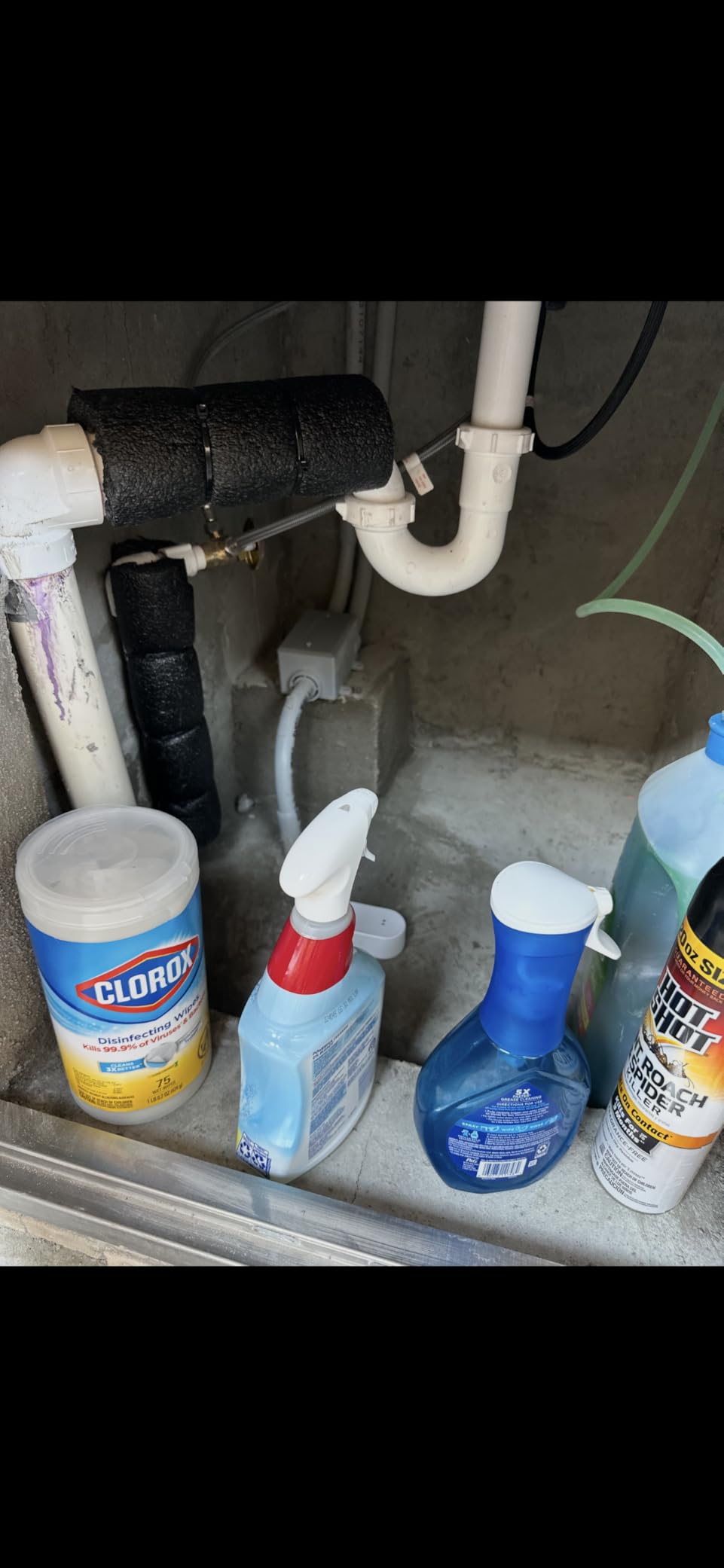
Fast triggering matters most in confined spaces, where there is little floor area before water reaches a wall, a stud or an outlet. A sensor that fires in a second gives you a chance to kill the supply valve, pull an appliance cord or move a stored box. Top-mounted drip probes can also catch the first drop rather than waiting for a puddle.
Hub dependency and how to live with it
The hub gives you reliable local behaviour: the sensor can trigger the hub alarm even if your phone is elsewhere, and the hub keeps the connection stable. Place it where you can hear it and where power is reliable.
Turn on voice assistant announcements so alerts do not depend solely on the phone app.
10. Aeotec SmartThings Water Leak Sensor, Best for an Existing SmartThings Setup
Aeotec SmartThings SmartThings Water Leak Sensor, ZigBee, Battery Powered, Smart Home Hub Compatible
Zigbee 50-130 ft
Moisture plus temperature
Hub required
0.91 inch body
Pros
- Tiny 0.91 by 0.65 by 0.79 inch body fits under sinks and behind washers
- Monitors moisture and temperature with light-up or siren alerts
- Programmable to shut off water flow or cut power to other devices
- Works with the SmartThings app and compatible Zigbee hubs
- 50-130 ft range suits a large basement
Cons
- Requires a separate SmartThings or Zigbee hub
- Zigbee range is shorter than LoRa kits and depends on construction
- Indoor use only
- Smallest review base in the roundup
If you already run SmartThings, this is the least disruptive option. It joins your existing Zigbee network through the SmartThings app and, unlike cloud-first sensors, keeps reporting to your own hub rather than depending on a vendor service staying online.
At 0.91 by 0.65 by 0.79 inches it is the smallest device here, so it goes under sinks and beside washing machines without moving anything. It senses moisture and temperature across a 32 to 104 degree operating range, with a light-up or siren alert.
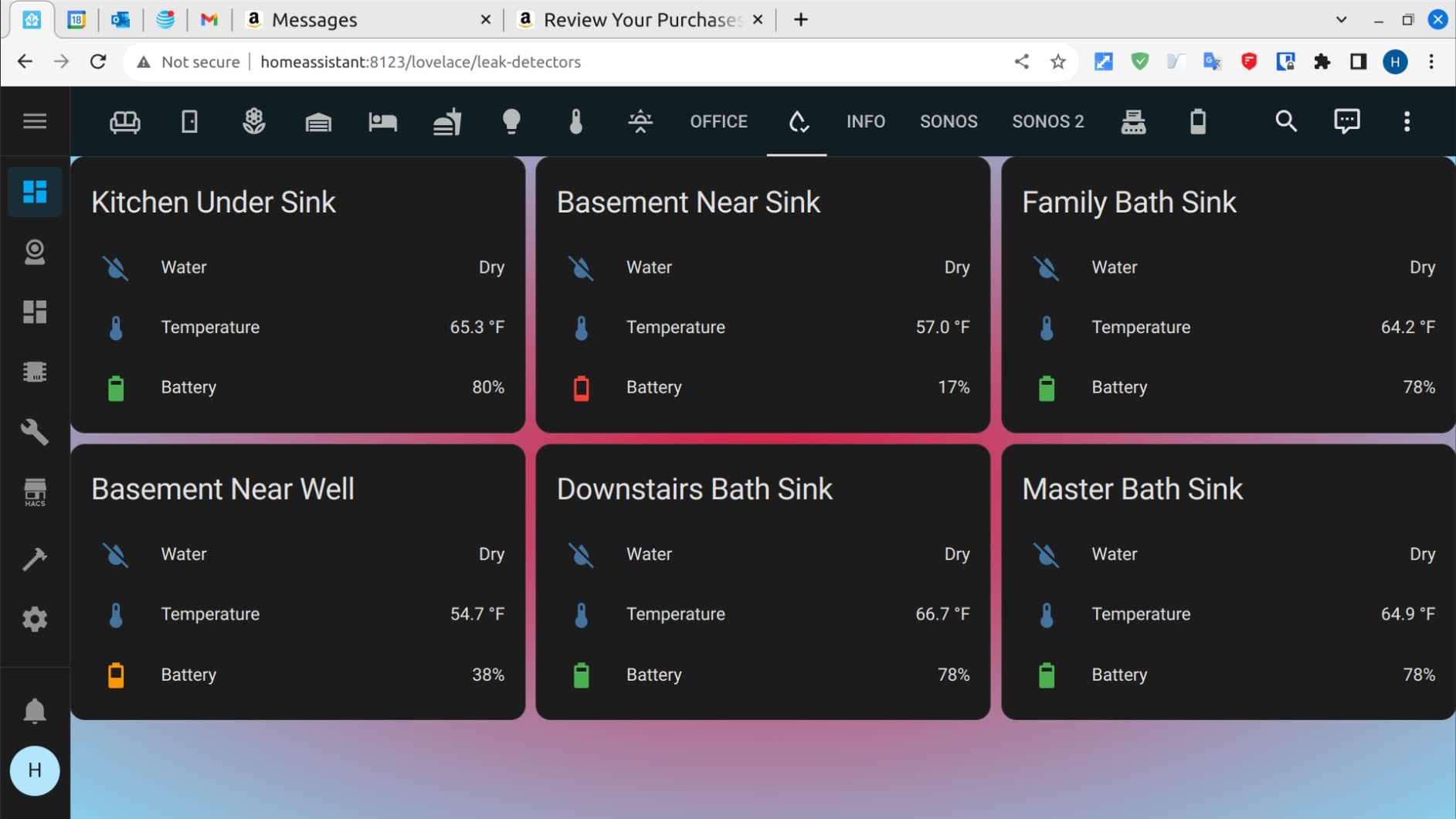
The automation capability is the real differentiator. It can be programmed to shut off water flow or cut power to connected devices on a leak, preventing both flood damage and electrocution risk from a wet outlet. Users running hubs specifically recommend this style to avoid app fragmentation, where you end up with five apps for five rooms.
The limits are clear. Zigbee range of 50 to 130 feet depends heavily on building materials, so a poured concrete wall between the sensor and your hub will cost you distance. It is indoor use only, and with the smallest review base here you have less long-term feedback to lean on.
Automation as the reason to choose Zigbee
Detectors that send a phone alert ask you to act. Sensors inside a hub ecosystem let you define what happens next: shut the main valve, cut power to a circuit, turn on a light so you can see the leak in the dark. That is a difference in outcome, not convenience.
It also means alerts keep working if your internet drops, as long as the hub has power.
Where the range limit bites
If your hub sits on the floor above and the basement has poured walls, put a repeater or a second hub node near the basement ceiling before placing sensors. Zigbee is low power by design, so mains-powered repeaters are the standard fix.
Because the review base is small, test each unit monthly with a damp cloth. A sensor that stopped reporting two years ago is the most common way people get a false sense of security.
How to Choose a Smart Water Leak Detector for a Basement
Start with reach, because it decides what you can use. Sensors that talk to a hub or gateway over Zigbee, LoRa or Sub-1G keep working at distances where a Wi-Fi sensor would have already given up. If your basement is below grade with poured walls, assume Wi-Fi is weak until you measure it.
Next, decide what the alert should be. A siren protects the people in the house, a phone alert protects the house when nobody is there, and a shutoff valve stops the water. Many basements need two of the three, because a phone alert at midnight tells you what you already suspected.
Low-battery behaviour deserves more attention than it gets. Look for a detector that reports low battery to the app rather than one that simply stops, and check whether it uses AA or AAA cells, since the smaller cells need replacing more often. A five-year claim assumes normal use in a temperate room, so expect less in a cold basement.
Think about false alarms before you install. Condensation on a concrete wall, a dehumidifier drain line, a sump pump discharge and a window well all produce water that is not a plumbing failure. Every sensor on this list can be silenced, and most of the frustration in owner reviews comes down to one placed in the wrong spot rather than a faulty device.
Finally, confirm the ecosystem. If you run Home Assistant or Hubitat, a Zigbee sensor on your own hub avoids adding another manufacturer’s app. If you use HomeKit, Google Home or Alexa, check the pairing path and whether a hub is included, because several options here need one bought separately.
Where to Place Leak Sensors in a Basement, Zone by Zone
Zone one is the water heater. Put a sensor in the pan or immediately beside the tank, not on the floor several feet away, because a failed tank often vents from the relief valve before it reaches the pan.
Zone two is the sump pit and its discharge line. Cover the pit lid area and the floor where the drain cover sits, and remember that a working sump pump can still discharge onto the slab and overwhelm it.
Zone three is the laundry and mechanical area. One sensor under the washing machine, one at the utility sink and one at the water softener or furnace condensate line covers most of what goes wrong in that corner.
Zone four is the perimeter. Place sensors at the base of foundation walls, around window wells and at any wall penetration where you have seen damp. On a slab that slopes, put the sensor in the low point, because that is where water travels.
Zone five is the dehumidifier and any drain hose. This is the main false alarm source, so offset the sensor a few inches from the drain path and keep it off the bare line itself.
Zone six is anything you would hate to lose, such as stored furniture, cardboard or a finished wall. Sensors do not detect rising damp in drywall, so use a separate humidity monitor for that. If mould and moisture are your main worry, the practical answer is pairing leak detection with proper dehumidification and airflow, and our basement setup guide covers the rest of what shares that space.
Fix Weak Basement Wi-Fi Before You Buy
Weak basement Wi-Fi is the most reported failure in leak detector forums, and no sensor fixes it. If a Wi-Fi model is going to work, give it a fair chance first by putting a mesh node or a wired access point near the basement ceiling, high enough that the signal reaches the slab rather than the router upstairs.
Split your network names so the sensor can join the 2.4 GHz band, since none of the Wi-Fi options on this list supports 5 GHz. Stand in the far corner of the basement with your phone and check the signal before ordering, and if the reading is poor, choose a Zigbee or LoRa kit that talks to a hub instead of your router.
Ask any seller how the sensor behaves during an outage, because the answers differ widely. Some keep reporting through a local hub, some need re-pairing afterwards, and some rely entirely on the cloud. That single question can decide the outcome for a finished basement. If the basement also doubles as a storage or hobby area, keeping track of what is down there matters as much as the plumbing; our beginner metal detector picks are a good example of the kind of gear that gets stacked in a dry corner next to a sump pump.
Frequently Asked Questions
What is the best water leak detector for a basement?
The best water leak detector for a basement is usually a kit that reaches beyond normal Wi-Fi range. Our top pick is the YoLink starter kit, whose LoRa link covers up to 1320 ft and still triggers local devices when the internet is down. For audible coverage, the X-Sense SWS54 sounds at 120 dB from both the sensors and the base station. GoveeLife’s four-pack covers the most zones from one gateway.
Are smart water detectors worth buying?
For most basements, yes, because the damage starts small and invisible. A sensor beside a water heater pan or a sump pump costs far less than replacing wet insulation, drywall and carpet after a slow leak you did not know about. The sensors worth buying alert you when you are away, which is exactly when basement leaks go from damp to destroyed.
What is the best water leak alarm for a basement with weak Wi-Fi?
Choose a sensor that talks to a hub rather than your router. Aqara and Aeotec use Zigbee with a 50 to 130 foot range, while YoLink and GoveeLife use LoRa and claim reach up to about 1320 ft and 1968 ft. Even better, fix the network first by adding a mesh node near the basement ceiling and splitting your 2.4 GHz and 5 GHz network names.
Do I need a hub for a smart water leak detector?
It depends on the model. SwitchBot connects directly to 2.4 GHz Wi-Fi with no hub, as does the Kidde Wi-Fi alarm. Aqara, Tapo, Aeotec and Winees all need a hub or gateway sold separately. YoLink and GoveeLife include one in the kit and use it as the long-range relay between your sensors and the internet, which is why they work so well below grade.
How many water leak sensors does a basement need?
Most basements need four to six. The usual set is one at the water heater, one at the sump pit and drain cover, one under the washing machine or utility sink, one at the lowest point of the foundation perimeter, and one away from the dehumidifier drain line. Add more if you store finished furniture downstairs or run a dehumidifier on a timer.
The Bottom Line
For most basements, the YoLink starter kit is the right starting point because range is the problem that basements create, and it handles that better than anything else here. Add the X-Sense SWS54 if you need the alarm heard from another floor, or the GoveeLife four-pack if you want the most zones covered from a single gateway.
Whichever you choose, test it with a damp cloth before you leave the house, name every sensor by its actual location, and put a mesh node in the basement before you blame the sensor. That is still our best advice for 2026: place it where the water will actually go.