
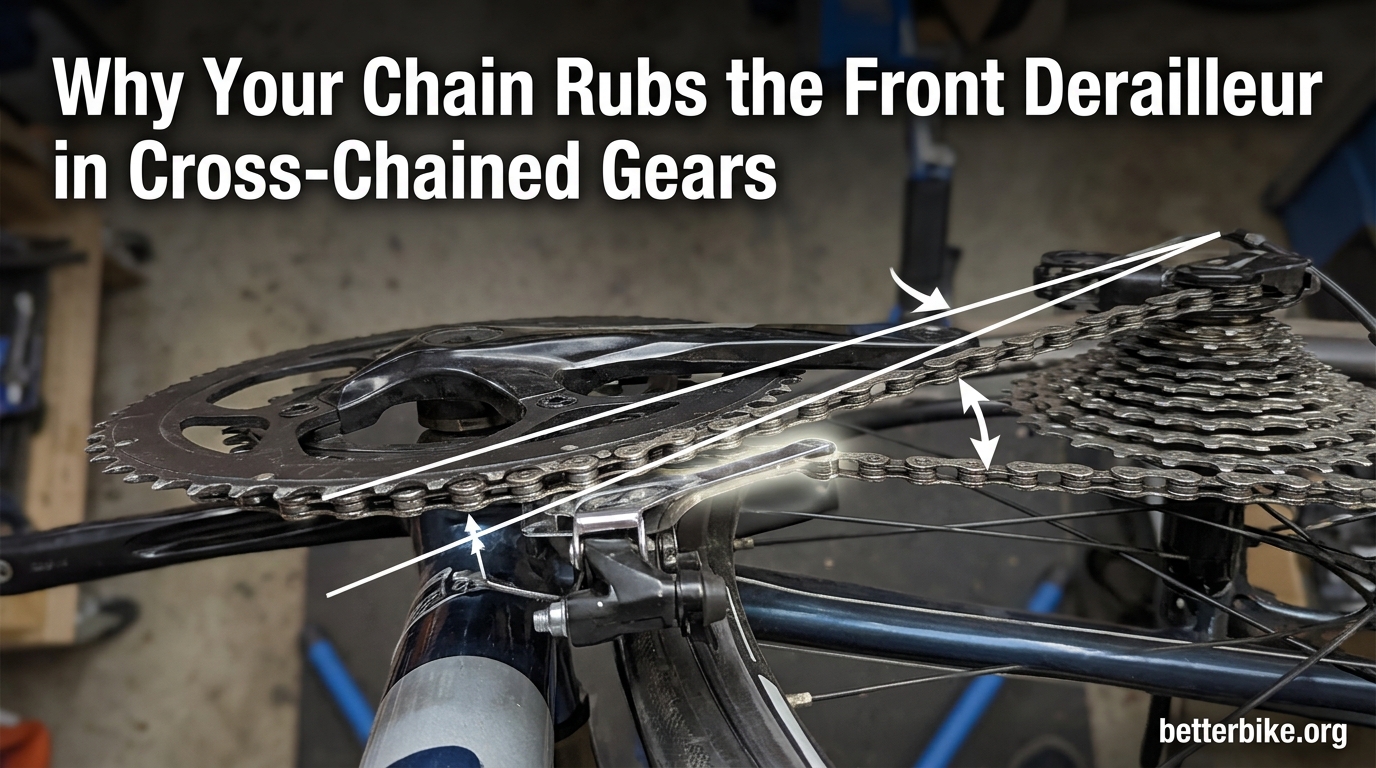
Your chain rubs the front derailleur in cross-chained gears because the chain runs at an extreme diagonal angle, which pulls it sideways into the derailleur cage. This happens in the big ring combined with the biggest cassette cog, or in the small ring combined with the smallest cog. The geometry of your drivetrain simply cannot keep the chain perfectly straight in those combinations, so a small amount of rub is mechanical reality, not a defect.
In the rest of this guide, I will walk you through exactly what cross-chaining is, why the chainline forces that rubbing sound, and when you should adjust your derailleur versus when you should just shift into a cleaner gear. We will also cover the trainer-specific case where cross-chaining is actually required, and the modern electronic shifting systems that handle this automatically.
Table of Contents
What Is Cross-Chaining on a Bike?
Cross-chaining means running your chain at the most extreme diagonal angle the cassette and chainrings allow. On a standard 2x or 3x drivetrain, there are two cross-chained positions to be aware of.
The first is the big-big combination: largest chainring up front paired with the largest cog on the cassette in back. The second is the small-small combination: smallest chainring up front with the smallest cog on the cassette. Both put the chain into a steep diagonal line that crosses the bike from corner to corner of the drivetrain.
Straight-chain positions, by contrast, pair the big ring with the smaller cogs in the middle of the cassette, and the small ring with the larger cogs. These give the chain a nearly straight line through the derailleur cage, which is exactly what the system was designed to do.
Manufacturers like Shimano and SRAM build the front derailleur cage to be wide enough to clear the chain in straight-line running. When you cross-chain, you pull that chain outside the design envelope, and contact becomes inevitable. If you are still building your shifting intuition, our guide on proper gear shifting technique covers the cleaner combinations to favor on climbs and descents.
Why Your Chain Rubs the Front Derailleur in Cross-Chained Gears
The chain rubs the front derailleur in cross-chained gears because the chainline angle pushes the chain outward into the cage plates. Here is the mechanical chain of events.
Your front derailleur sits above the chainrings with a cage that hugs the chain on both sides. The inner plate pushes the chain toward the bigger ring, the outer plate prevents the chain from falling off the smaller ring. The clearance between the chain and each plate is typically only 1 to 2 millimeters. That is plenty of room when the chain is running straight, but very little when the chain is pulled sideways.
In a big-big gear, the chain leaves the big ring and travels down to the largest cog. The cassette is wider than the chainring, so the chain angles sharply inward. The angled chainline drags the chain’s outer edge against the inner cage plate of the front derailleur. In a small-small gear, the chain angles the opposite way and contacts the outer cage plate.
Two mechanical realities drive this. First, the front derailleur is fixed in position above the chainrings and cannot move sideways to follow the chain. Second, the chain itself is rigid in the lateral direction. A chain under tension resists bending sideways, so it transmits the angled path directly into whatever surface is closest, which is the cage plate.
Test this on your own bike. Shift into the big ring, then shift one click at a time up the cassette toward the biggest cog. You will hear the rub start somewhere around the third or fourth largest cog and grow louder as you reach the biggest one. Now shift into the small ring and run down the cassette toward the smallest cog. The same thing happens in mirror image.
The Chainline Concept Explained
Chainline is the imaginary line that runs from the center of your chainrings to the center of your cassette sprockets. When the chain follows this line, it is straight and silent. When it deviates from the line, you get rub and accelerated wear.
Most road and gravel bikes aim for a chainline of around 43 to 45 millimeters, measured from the center of the seat tube or bottom bracket shell to the center of the chainring. The cassette sits roughly the same distance on the other side of the bike. The middle chainring (on a 3x) or the single chainring (on a 1x) is designed to be closest to this line.
The big ring sits further outboard from the frame centerline, and the small ring sits further inboard. The cassette, meanwhile, has its own range of positions across its width. When you combine a chainring far from center with a cassette cog far from center, the chainline angle steepens beyond what the derailleur was designed to accommodate.
Frame designers also matter here. Bikes with wider bottom bracket shells, such as fat-tire or mountain bikes, often have a longer chainstay offset, which can reduce cross-chain angles. Bikes with very short chainstays, common on modern road racing frames, sometimes have more pronounced cross-chaining because the cassette sits closer to the chainrings. Our article on bike gearing and drivetrain basics goes deeper on how frame geometry affects gear range.
Is Chain Rub Normal When Cross-Chaining?
Yes, some chain rub is normal and expected when cross-chaining. The drivetrain is not designed to run silently in those extreme combinations, and a properly tuned bike will still produce a light rubbing sound in the biggest and smallest cogs at the front extremes.
The rule of thumb our team uses is this. If the rub is faint, only appears in the single most extreme cog on each end of the cassette, and goes away the moment you shift one click back toward the middle, your bike is fine. If the rub is loud, appears across several cogs, or shows up in normal straight-line gears, you have a real adjustment problem.
Forum threads on r/cycling and r/bikewrench consistently confirm this. A 50×12 rub is most often a high limit screw or cable tension issue, not a cross-chaining inevitability. SRAM’s official position is that cross-chaining has no measurable effect on chain wear, though most mechanics still recommend avoiding it for efficiency reasons.
Front Derailleur Adjustment Basics
If your chain rub appears in normal gears, follow these steps to bring the front derailleur back into proper alignment. The whole process takes about 15 minutes with a 4mm and 5mm hex wrench plus a Phillips screwdriver.
Step 1: Set the Low Limit Screw
Shift into the smallest chainring and the smallest cassette cog. Look down at the front derailleur cage from above. The inner cage plate should sit 1 to 2 millimeters from the chain. Turn the L limit screw clockwise to move the cage inward toward the frame, counterclockwise to move it outward. Adjust until the gap is correct.
Step 2: Set the High Limit Screw
Shift into the biggest chainring and the smallest cassette cog (a straight-chain position, not the cross-chained big-big). Look down at the cage again. The outer cage plate should sit 1 to 2 millimeters from the chain. Turn the H limit screw to fine-tune the cage position.
Step 3: Adjust Cable Tension
Shift into the middle chainring or small chainring. Pedal and shift up to the big ring. If the shift is slow or hesitant, turn the barrel adjuster counterclockwise a quarter turn at a time until the shift becomes crisp. If the chain overshoots and tries to throw itself past the big ring, the limit screw is too loose, not the cable.
Step 4: Use the Trim Function
Most modern 2x and 3x shifters have a trim click. In the small ring, trim position 1 moves the cage slightly outward to clear the chain in the bigger cassette cogs. In the big ring, trim position 2 moves the cage slightly inward to clear the chain in the smaller cassette cogs. Using trim is the single most effective way to eliminate cross-chained rub without touching limit screws.
Step 5: Verify All Gears
Run through the entire gear range slowly, listening for rub. The cross-chained extremes may still whisper, but everything in the middle of the cassette in each chainring should be silent. If you still hear rub in non-cross-chained positions, repeat steps 1 through 3.
Electronic Groupsets and Auto-Trim Features
If you ride an electronic groupset like Shimano Di2, SRAM Red eTap AXS, or Campagnolo EPS, your front derailleur has motorized trim that activates automatically. The system detects cross-chaining based on the rear cassette position and micro-adjusts the front cage in real time.
Shimano’s Synchro Shift goes further, automatically shifting the front derailleur when the rear cassette reaches the extremes, so you never end up in big-big in the first place. SRAM’s AXS system uses automatic trim but leaves front shifts in the rider’s hands. Campagnolo’s EPS offers similar trim behavior to Shimano.
If you own one of these systems and still hear chain rub, the trim motor may need calibration. Most can be reset through the manufacturer’s app, such as Shimano E-Tube, SRAM AXS, or Campagnolo MyCampy. A full reset takes about 5 minutes and resolves most rub complaints on electronic bikes.
Trainer-Specific Cross-Chaining Notes
If you have a direct drive trainer like a Wahoo KICKR, Tacx Neo, or Saris H3, you have probably noticed that the manual tells you to shift into the biggest gear (big ring plus largest cassette cog) before mounting and dismounting the bike. This is intentional, and the chain rub you hear when getting on or off the trainer is normal.
The reason is mechanical. The largest gear combination reduces chain tension to its lowest point, which lets you slip the chain off the cassette for safe installation and removal of the bike. Trying to remove the bike in a harder gear risks the chain catching and damaging the cassette, the derailleur, or your trainer’s cassette body.
Once the bike is mounted and you have shifted into a normal gear for riding, the rub goes away. Treat the big-big mounting position as a brief, intentional cross-chain state, not a problem to solve.
Frequently Asked Questions
How do I stop my chain from rubbing the front derailleur?
Shift to a straighter chainline, use your shift lever’s trim function to nudge the front derailleur cage, and adjust the H and L limit screws so the cage sits 1 to 2 mm from the chain. If the rub only appears in the single most extreme cross-chained gear, that small amount of contact is normal.
How do I fix chain rubbing in general?
Check the limit screws on your front derailleur first, then adjust cable tension using the barrel adjuster. Make sure the derailleur cage is parallel to the chainrings and sits at the correct height above the largest chainring. Use trim clicks to fine-tune clearance in cross-chained gears.
How do I prevent cross-chaining on a bike?
Avoid pairing the big chainring with the largest cassette cogs, and avoid pairing the small chainring with the smallest cassette cogs. Run the big ring with the middle-to-smaller cogs, and the small ring with the middle-to-larger cogs for the most efficient, quiet pedaling.
What causes ghost shifting on a bike?
Ghost shifting happens when the chain jumps to a different gear without you touching the shifter. Common causes are a worn cassette, a stretched chain, a bent derailleur hanger, or insufficient cable tension. Cross-chaining accelerates these wear issues and can trigger ghost shifts under hard pedaling.
Final Thoughts on Chain Rub in Cross-Chained Gears
Your chain rubs the front derailleur in cross-chained gears because the diagonal chainline pulls the chain sideways into a cage that was designed for straight-chain running. A whisper of rub at the absolute extremes of the cassette is normal and acceptable. Loud rub, or rub in middle gears, means your limit screws, cable tension, or trim position need attention. Building up your essential bike maintenance knowledge will help you catch these adjustment issues early. Use the trim function on every ride, adjust the front derailleur twice a season, and remember that direct drive trainers intentionally require cross-chaining for safe bike removal.