
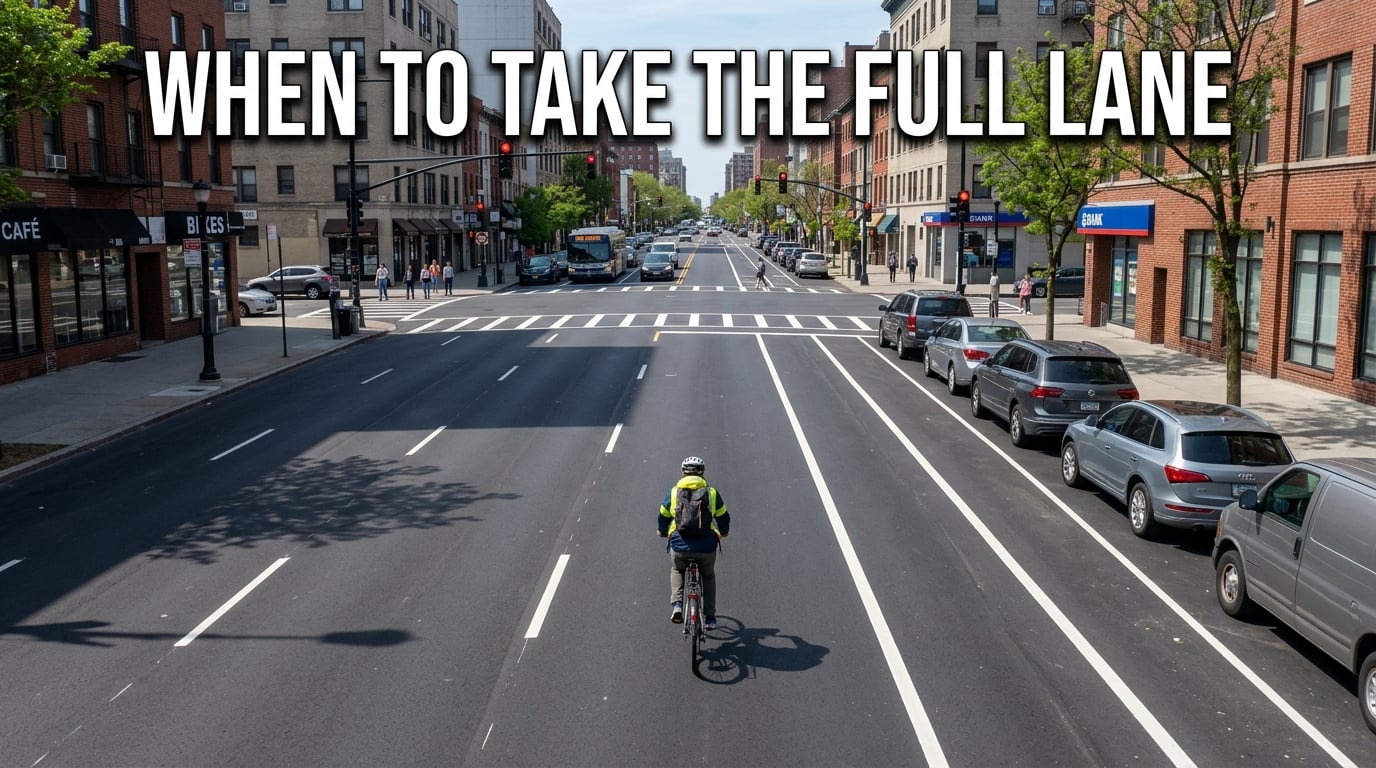
I learned about lane positioning the hard way. Three years ago I was commuting home on a 12-foot lane, hugging the curb like my dad taught me, when a delivery van buzzed me with maybe 18 inches to spare. The mirror clipped my handlebar and I went down. Nothing broken, but my whole understanding of “safe cycling” shifted that day.
If you have ever wondered when to take the full lane instead of hugging the curb, you are asking the right question. Most cyclists were taught to stay as far right as possible. That advice works on some roads. On others, it is exactly what gets you hurt. This guide breaks down the seven specific scenarios where you should claim the lane, the 14-foot rule that determines whether the lane is wide enough to share, and how to handle stoplights, intersections, night rides, and group rides without making drivers angry.
Table of Contents
What Taking the Lane Actually Means
Taking the lane means positioning your bicycle in the center or left portion of a traffic lane rather than riding along the curb edge. In vehicular cycling terms, you have two main choices. The right wheel position puts you about 4 to 5 feet off the curb, directly in the right tire track where cars drive. The left wheel position puts you near the center line, which is used when you want to discourage passing in the same lane entirely.
Both positions force drivers to treat you as a vehicle occupying a lane, not as an obstacle to squeeze past. According to CyclingSavvy and the League of American Bicyclists curriculum, this is the foundation of predictable riding. Drivers do not need to guess what you will do next when your position clearly tells them where you belong. Complete Streets policies that support cyclist lane positioning reinforce this approach at the infrastructure level, encouraging road designs that give bikes明确的行车道空间。
Hugging the curb feels safe because cars are farther away. In practice, it triggers the most common cyclist collisions. The 4 feet you save by moving right is exactly the 4 feet a distracted driver needs to misjudge your position and crowd you.
Here is what the curb actually offers you:
- Glass, nails, and debris that collects in the gutter where cars sweep it
- Door zone risk when parked cars line the street
- Reduced sightlines at driveways and side streets
- Squeeze passes when drivers try to overtake without changing lanes
- Right-hook danger at intersections where turning drivers never see you
Forum riders with 16-plus years of commuting experience will tell you the same thing. The far-right position makes you a target, not a protected rider.
7 Specific Scenarios When to Take the Full Lane
Here is the list most articles skip. These are the situations where claiming the lane is not optional.
- The lane is too narrow to share. If the lane is 14 feet or less, a car cannot safely pass you in the same lane. Ride in the center.
- You are approaching a right turn. Take the lane early to prevent drivers from turning right across your path.
- You are at a stoplight. Position yourself in front of cars in the right tire track, not beside them.
- There is debris, glass, or broken pavement in the gutter. Move left around hazards instead of dodging into traffic unpredictably.
- You are passing another cyclist. Use the lane briefly to overtake, just like a car would.
- You are preparing to turn left. Merge into the left lane in advance with clear hand signals.
- You see a parked car row, loading zone, or door zone ahead. Claim the lane before you reach it so drivers do not crowd you into opening doors.
The 14-Foot Substandard Road Rule
This is the number that determines almost every lane choice. A standard lane is about 12 feet wide. A bicycle takes up about 3 feet. That leaves only 4.5 feet per side for a passing car, which is not safe at any speed above 25 mph.
Florida bike law treats any travel lane of 14 feet or less as a substandard road. On these roads, cyclists are legally permitted to use the full lane. John Forester, who literally coined the term “vehicular cycling,” recommended the same threshold decades ago in Effective Cycling. If the lane is under 14 feet, take it.
Lane Positioning at Intersections and Stoplights
Intersections are where most cyclist fatalities happen. The biggest mistake is hugging the curb on the approach. Drivers turning right simply do not see cyclists who are tucked against the curb. They turn across your path and you have nowhere to go.
Our team recommends this stoplight routine:
- Approach the intersection in the right tire track, not the curb.
- Stop ahead of cars, in front of the white stop line, where drivers must look up to see you.
- If you are not turning right, position yourself in the center of the lane to prevent right hooks.
- Make eye contact with any driver to your right before proceeding.
This is the exact advice from the Traffic Skills 101 course taught by League of American Bicyclists certified instructors.
Night Riding and Group Riding Differences
Night riding shifts the calculus slightly. Drivers have reduced visibility, so a center-lane position combined with a bright rear light is even more important. Hugging the curb at night means drivers may not see you until they are already passing too close.
Group riding has the opposite instinct. New group riders want to single up and hug the right edge. That is wrong. In a pace line, the group should ride two abreast when possible and take the lane together. If you want to learn safe group riding techniques, lane control is where it starts.
Practical Tips for Riding Predictably
Taking the lane only works if drivers can predict your next move. Here is what our team does every ride.
Signal early and clearly. Use hand signals at least 50 feet before any turn or lane change. Hold the signal long enough for drivers to register it.
Maintain a straight line. Weaving inside the lane makes you look unstable and invites close passes. Pick your position and hold it.
Make eye contact. Especially at intersections. A driver who has looked at you will almost always yield.
Use a bright rear light even during the day. Florida bike advocates and BicycleSafe.com both emphasize this. A flashing light dramatically increases your recognition time.
Wear visible clothing. Neon yellow and orange show up in peripheral vision far better than black or dark blue.
Default position: right tire track. On roads with adequate lane width, ride in the right tire track, about 4 to 5 feet off the curb. This is visible, predictable, and discourages door zone risks.
FAQ’s
Is it safer to take the lane or hug the curb on a bicycle?
Taking the lane is safer in most situations where the lane is under 14 feet wide, at intersections, near parked cars, and in any spot where a driver might turn right across your path. Hugging the curb puts you in the door zone and the debris gutter, where most cyclist collisions actually happen.
Is it legal to take the full lane on a bicycle?
In most U.S. states, yes. Many states explicitly allow cyclists to use the full lane when the lane is too narrow to share, when preparing to turn, or when traveling at the normal speed of traffic. Florida, Nebraska, and Texas all have versions of this rule written into law.
What is the 14-foot rule in cycling?
The 14-foot rule states that any travel lane 14 feet wide or less is considered a substandard road. On these lanes, a car cannot safely pass a bicycle within the same lane, so cyclists are legally and practically justified in taking the full lane.
How do I avoid right hooks on a bike?
Take the lane before the intersection, position yourself in the center of the rightmost travel lane, and never pass on the right side of a car that is signaling or slowing to turn right. Make eye contact with the driver whenever possible.
Why do drivers get angry when cyclists take the lane?
Most driver frustration comes from misunderstanding. Many drivers believe cyclists are required to hug the curb at all times. In reality, taking the lane on narrow roads is both legal and safer, and it actually helps drivers by removing the need to guess whether they have room to pass.
Final Thoughts on When to Take the Full Lane Instead of Hugging the Curb
Knowing when to take the full lane instead of hugging the curb comes down to a handful of clear scenarios: narrow lanes under 14 feet, intersections, right turns, debris, parked cars, group rides, and left turn preparation. In each of these cases, claiming the lane is not aggression. It is the safest and most predictable thing you can do.
Start by defaulting to the right tire track on wide-open roads. Move into the center or left of the lane whenever the situation calls for it. Your visibility goes up, close passes drop sharply, and drivers actually thank you with their behavior, even if they never say it out loud.