
The seconds after a car hits your bike are disorienting, chaotic, and terrifying all at once. Your body is flooded with adrenaline, your mind is racing, and you may not even realize how hurt you are yet. Every cyclist I have talked to who went through a collision says the same thing: they wish they had known exactly what to do in those critical first minutes.
Knowing what to do in the first minutes after a bike crash with a car can protect your health, preserve evidence for an insurance claim, and prevent mistakes that are hard to undo later. The actions you take right after impact matter more than most riders realize. This guide walks you through every step, from the moment of collision through the days that follow, including scenarios most resources skip entirely.
Our team has pulled together advice from emergency responders, cycling advocacy organizations, bicycle attorneys, and real cyclists who have been through it. We also cover the topics competitors miss: hit-and-run situations, concussion and delayed symptom identification, and the emotional aftermath that can haunt you long after your scrapes heal. For more bike safety tips, our team has put together resources on staying visible and aware on the road.
Table of Contents
What to Do in the First Minutes After a Bike Crash with a Car
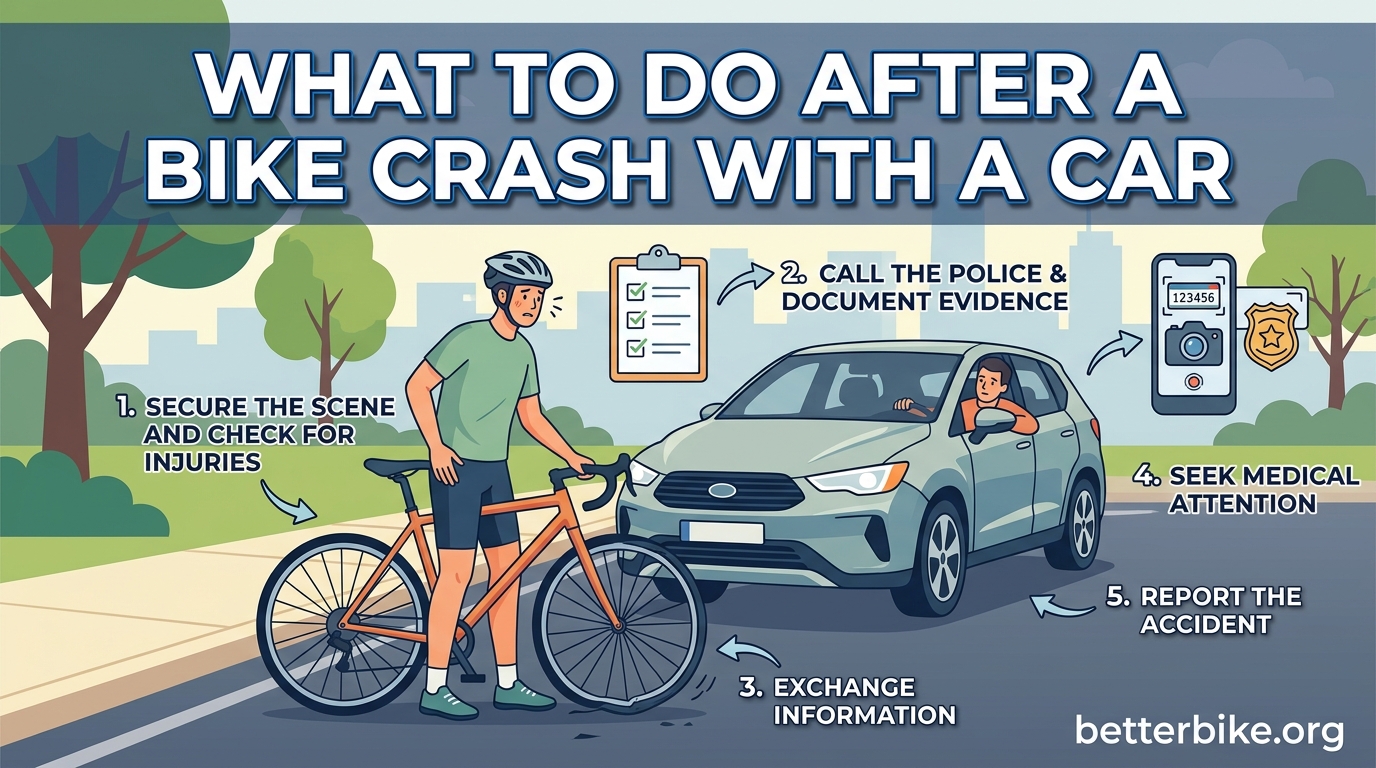
The first minutes after a collision are about three things: safety, health, and evidence. Follow these steps in order, and do not skip any of them even if you feel fine.
1. Stay still and breathe. Before you try to move, take a breath and mentally scan your body from head to toe. Do not jump up. The adrenaline surging through your system can mask fractures, organ damage, and spinal injuries for minutes or even hours. Moving too quickly can worsen injuries you cannot yet feel.
2. Assess yourself for injuries. Check your neck and back first. Try wiggling your fingers and toes. Look for blood, deformity, or numbness. If anything feels wrong with your spine, neck, or head, stay exactly where you are and wait for emergency responders.
3. Call 911. If you are able to reach your phone, dial 911 immediately. Request both police and medical response. Even if you think your injuries are minor, internal bleeding, concussions, and soft tissue damage often show zero symptoms in the first minutes. Having paramedics evaluate you at the scene creates a medical record that matters later.
4. Move to safety only if you are not injured. If you are certain your spine and limbs are intact, move yourself and your bike out of the traffic lane. If you have any doubt about spinal injury, stay put and let others redirect traffic around you.
5. Do not ride away. I cannot stress this enough. Countless cyclists in forum threads describe riding home after a crash, only to collapse miles later when adrenaline wears off. Even a low-speed collision can cause serious injuries that take hours to surface. Always get checked by a medical professional.
6. Keep your helmet. Do not throw away or alter your helmet after a crash, even if it looks fine. Hairline cracks and compression marks are critical evidence of impact force. Keep it exactly as it is until you have spoken with medical staff and, if applicable, an attorney.
7. Note the time and location. As soon as you are stable, note the exact time, street names, direction of travel for both you and the car, and any traffic controls like stop signs or signals. Your memory of these details will fade fast.
Gathering Information from the Driver
Once you are safe and emergency services are on the way, your next priority is collecting information from the driver. Do this before the driver has a chance to leave or change their story.
Here is exactly what you need from the driver:
- Full name and phone number
- Driver’s license number
- License plate number (write it down even if you also photograph it)
- Insurance company name and policy number
- Vehicle make, model, color, and year
- VIN (vehicle identification number, visible through the windshield on the dashboard)
- Home or work address
Photograph the driver’s license, insurance card, and license plate rather than just copying the information. Photos eliminate transcription errors and create a timestamped record.
Stay polite but firm when requesting this information. You are not accusing anyone of anything. You are simply following standard accident protocol.
What If the Driver Refuses to Give You Information?
If the driver will not share their details, do not escalate the situation. Write down or photograph the license plate immediately. Note the vehicle description, the driver’s physical appearance, and the direction they travel if they leave. Call 911 and report a driver refusing to exchange information after a collision. In most states, leaving the scene of an accident involving injury is a criminal offense.
Witnesses can be invaluable here. Ask anyone nearby if they caught the plate number or saw what happened. Get their names and phone numbers before they leave the scene.
Documenting the Scene: What Photos to Take
Photos are your strongest piece of evidence. Insurance companies and attorneys rely heavily on scene documentation to determine what happened and who was at fault. Take more photos than you think you need.
Use your phone to capture all of the following:
- Wide shots of the entire scene from multiple angles
- Close-ups of damage to your bike and to the vehicle
- Your helmet from all sides (even if it looks undamaged)
- Your clothing, especially tears, road rash, and blood
- Your visible injuries (bruises, scrapes, swelling)
- License plate of the vehicle
- Position of the vehicle and bike before anything is moved
- Road conditions: potholes, debris, construction, wet surfaces
- Traffic signs, signals, and road markings near the scene
- Any dash cams or GoPro cameras on vehicles or nearby buildings
If you had a bike-mounted camera or light, preserve the footage immediately. Do not overwrite or delete anything. Footage from the moments before and during impact can settle liability questions instantly.
Also photograph the surrounding area for reference points: storefronts, street signs, and intersections. These help establish the exact location when you file a police report or insurance claim.
Getting the Police Involved
Always call the police after a bike crash with a car, even if the collision seemed minor. A police report creates an official, independent record of what happened that carries far more weight than your word against the driver’s.
When officers arrive, describe what happened calmly and factually. Stick to what you observed directly. Do not speculate about what the driver was thinking or what might have happened. Use objective language: “I was traveling south in the bike lane when the vehicle turned right across my path.”
Ask the responding officer for three things: their name, their badge number, and the incident report number. Write all of this down. Ask how and when you can obtain a copy of the full report, since processing times vary by department.
What If Police Will Not Respond?
In some areas, police departments treat bike-car collisions as low priority, especially if no one is visibly bleeding. If dispatch says officers will not come to the scene, go to the nearest police station and file an incident report in person. Do this the same day if possible. Document the name of the person you spoke with at dispatch and the time of your call.
If there were witnesses, ask them to provide written statements. Witness accounts become even more important when there is no responding officer to observe the scene.
What NOT to Do at the Scene
The mistakes cyclists make in the first minutes after a crash can damage their health and their legal position. Here are the things you must avoid:
Do not admit fault. Even if you think you might have contributed to the crash, do not say so at the scene. You are in shock, your adrenaline is high, and you do not have a complete picture of what happened yet. Fault determination is complex and involves factors you may not be aware of.
Do not apologize. An apology can be interpreted as an admission of fault, even if you were just expressing concern. Stick to neutral language like “Are you okay?” and “Let me get your information.”
Do not refuse medical attention. Even if you feel fine, accept the paramedic evaluation when they arrive. Saying “I am not hurt” at the scene can be used against you later if symptoms develop. Let the professionals assess you.
Do not negotiate with the driver. Some drivers will offer cash on the spot to avoid going through insurance. Do not accept. What seems like a fair amount in the moment rarely covers medical bills, bike replacement, lost wages, and ongoing treatment.
Do not post on social media. Nothing about the crash should appear online until your claim is fully resolved. Insurance adjusters monitor social media, and an innocent photo of you smiling can be twisted to minimize your injuries.
Do not leave the scene prematurely. Stay until you have exchanged all information, spoken with police, and been evaluated by medical personnel. Leaving early means losing access to evidence and witnesses.
Delayed Symptoms and Concussion Signs to Watch For
This is the section I wish every cyclist read before their crash. Adrenaline is a powerful chemical. It can completely mask broken bones, torn ligaments, and even organ damage for hours after impact. By the time pain sets in, you may have already complicated your injuries by continuing to move normally.
Forum posts from real cyclists are full of stories like this: “I felt completely fine after the crash, rode home, and six hours later I could barely walk.” Or: “I did not realize I had a concussion until I could not remember my coworker’s name two days later.”
Concussion Symptoms to Watch For
Head impacts do not always cause unconsciousness. You can sustain a serious concussion without ever blacking out. Watch for these signs in the hours and days following your crash:
- Headache that worsens over time
- Nausea or vomiting
- Confusion, brain fog, or difficulty concentrating
- Sensitivity to light or noise
- Dizziness or balance problems
- Memory gaps about the crash or recent events
- Changes in sleep patterns (sleeping more or less than usual)
- Mood changes: irritability, sadness, or anxiety
- Slurred speech or difficulty finding words
If you experience any of these symptoms, go to an emergency room or urgent care immediately. A healthcare provider needs to evaluate you for traumatic brain injury. Concussions that go untreated can lead to long-term cognitive issues.
Other Delayed Injury Symptoms
Beyond concussions, watch for these delayed symptoms over the 72 hours following your crash:
- Swelling or bruising that appears hours later (soft tissue damage)
- Stiffness in neck, back, or shoulders that worsens over time (whiplash)
- Numbness or tingling in extremities (nerve compression)
- Abdominal pain or tenderness (possible internal bleeding)
- Difficulty breathing or chest pain (rib fractures or organ injury)
- Joint instability or clicking (ligament tears)
When in doubt, go to urgent care or the emergency room. It is always better to get checked and be told you are fine than to miss a serious injury.
Hit-and-Run: What to Do When the Driver Leaves
If the driver flees the scene, the first few minutes are critical. Your ability to identify the vehicle determines whether you can pursue a claim at all.
Call 911 immediately and report a hit-and-run. Give dispatch every detail you can remember: partial license plate, vehicle color, make and model, direction of travel, and any distinguishing features like bumper stickers or damage. Even a partial plate combined with a vehicle description can help police track down the driver.
Look around for witnesses immediately. People who saw the crash may walk away within minutes if no one asks them to stay. Get names and phone numbers from anyone who saw the incident or the fleeing vehicle.
Scan the area for cameras. Traffic cameras, business security systems, doorbell cameras, and dash cams on parked vehicles may have captured the crash or the fleeing driver. Note the locations of any cameras you spot and report them to police so they can request footage before it gets overwritten.
If the driver is never found, your own uninsured motorist coverage may apply. Many cyclists do not realize that their auto insurance or homeowner’s policy can cover hit-and-run injuries. Contact your insurance company to understand your coverage. A bicycle attorney can also help you explore options.
The Emotional Aftermath: Dealing with Trauma After a Crash
No competitor we reviewed discusses the psychological impact of being hit by a car while cycling. This is a significant gap, because the emotional aftermath can be just as debilitating as the physical injuries.
It is completely normal to feel anxious, angry, or fearful after a collision. Many cyclists experience symptoms of post-traumatic stress in the weeks and months following a crash: flashbacks to the moment of impact, panic attacks when riding near traffic, avoidance of the crash location, hypervigilance, sleep disturbances, and intrusive thoughts.
These responses are not a sign of weakness. Your brain and body went through a life-threatening event, and they need time to process it. Here is what can help:
- Talk about it. Share your experience with friends, family, or fellow cyclists who understand what you went through.
- Consider professional support. A therapist who specializes in trauma or PTSD can help you process the experience and develop coping strategies.
- Join a peer support group. Organizations like the Washington Area Bicyclist Association connect crash survivors with others who have been through similar experiences.
- Do not rush back to riding. Give yourself permission to heal emotionally as well as physically.
- Start small when you return. Practice on low-traffic paths before riding in busy streets again.
If anxiety about riding persists for more than a few weeks, or if you experience panic attacks, seek professional help. Untreated trauma does not just go away on its own.
Insurance Claims and Legal Next Steps
Once your immediate medical needs are addressed, the insurance and legal process begins. Taking the right steps early protects your ability to recover costs for medical bills, bike damage, and lost wages.
First, get a damage estimate for your bike from a reputable bike shop. Do not throw away any damaged gear. Your helmet, clothing, lights, and bike components are all evidence of impact force and damage scope. The bike shop can provide a written estimate for repair or replacement.
Keep every medical record, receipt, and bill related to the crash. This includes emergency room visits, urgent care, follow-up appointments, physical therapy, prescriptions, and mental health counseling. These documents form the basis of your claim.
Contact the driver’s insurance company to file a claim. Do not give a recorded statement without first consulting an attorney. Insurance adjusters are trained to minimize payouts, and anything you say can be used to reduce your settlement.
Consider consulting a bicycle accident attorney, especially if your injuries are significant. An attorney who understands cycling-specific issues can help you navigate liability disputes, deal with insurance tactics, and ensure you meet all filing deadlines. Most bicycle attorneys offer free initial consultations and work on contingency.
Be aware of the statute of limitations in your state. This is the legal deadline for filing a personal injury lawsuit, and it varies by jurisdiction. Missing this deadline means losing your right to pursue compensation entirely.
Be Prepared Before It Happens
No one expects to get hit by a car while riding. But knowing what to do in the first minutes after a bike crash with a car can make the difference between a manageable recovery and a drawn-out ordeal. The steps are simple: stay still, call 911, gather information, document everything, and get checked by a medical professional even if you feel fine.
Save this guide to your phone before you need it. Better yet, take a few minutes now to program emergency contacts into your phone and review your insurance coverage. Developing your cornering safety skills, practicing your cycling safety techniques, and understanding riding recovery tips can also help you avoid crashes in the first place and handle the unexpected when it happens.
The most important thing to remember is this: you are not alone. Thousands of cyclists go through this experience every year, and there are resources, advocates, and communities ready to support you through recovery. Ride safe, stay informed, and take care of yourself out there.
FAQ’s
What to do after getting hit by a car while biking?
Call 911 immediately for police and medical response. Stay still and assess your injuries before moving. Gather the driver’s name, license plate, insurance information, and contact details. Photograph the scene, vehicle damage, your bike, and your injuries. Get evaluated by medical professionals even if you feel fine, then file a police report and contact the driver’s insurance company.
What to do immediately after a collision?
In the first minutes after a collision, stay calm and check yourself for injuries starting with your neck and spine. Call 911 if anyone is hurt. Move to safety only if you are certain you have no spinal injuries. Exchange information with the other party, document the scene with photos, and do not admit fault or apologize.
What should you not say after a bike accident?
Do not admit fault, apologize, or say you are not hurt. Avoid speculating about what happened or making statements about the other driver’s intentions. Do not agree to settle on the spot for cash, and do not give recorded statements to insurance companies without consulting an attorney first.
What happens if a bike crashes into a car?
When a bike crashes into a car, the cyclist typically sustains the majority of injuries due to the difference in mass and protection. The driver is usually required to stop, exchange information, and remain at the scene. Police should be called to file an incident report. The cyclist may file a personal injury claim through the driver’s auto insurance to recover costs for medical bills, property damage, and lost wages.
How long after a bike crash can symptoms appear?
Delayed symptoms can appear anywhere from a few hours to 72 hours after a bike crash. Adrenaline masks pain and injury immediately after impact. Concussion symptoms, soft tissue damage, whiplash, and internal injuries may not become apparent until hours or days later. Seek medical attention if you experience headaches, dizziness, nausea, confusion, swelling, numbness, or abdominal pain in the days following a crash.
Should I call the police after a minor bike crash?
Yes, always call the police after any bike crash involving a vehicle, even a minor one. A police report creates an official record of the incident that is critical for insurance claims and any potential legal action. If police will not respond to the scene, go to the nearest station the same day and file an incident report in person.