
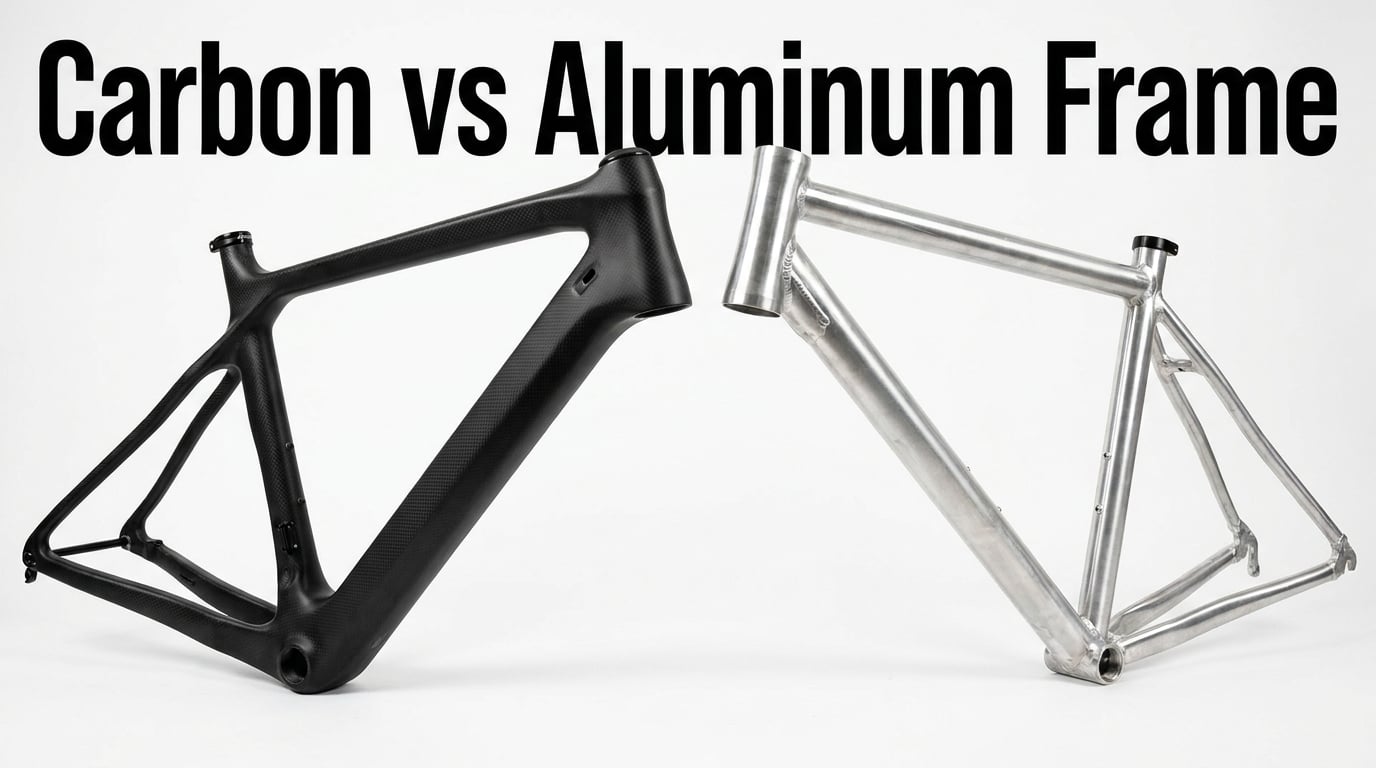
For most riders, the honest answer is no, a carbon frame is not worth the upgrade over a quality aluminum frame. The performance gap between modern hydroformed aluminum and mid-tier carbon is far smaller than the price gap suggests, and many riders cannot tell the difference in blind tests. A well-equipped aluminum bike with quality components will outperform a cheap carbon bike with entry-level parts every time.
That said, carbon fiber does win in three measurable areas: weight, vibration damping, and the ability to tune stiffness directionally. If you race, chase KOMs, or ride multi-day gravel events where every gram and every bit of fatigue reduction counts, carbon earns its premium. For commuters, beginners, mountain bikers who crash often, and anyone on a budget, aluminum remains the smarter financial choice.
In this carbon vs aluminum frame breakdown, our team walks through every category that matters to your buying decision. We cover weight, comfort, stiffness, durability, cost, repairability, rider-type recommendations, and the often-ignored trade-off between frame material and component quality. By the end, you will know exactly which material fits your riding, your budget, and your goals.
We spent weeks digging through forum threads on Reddit, Pinkbike, and StackExchange, comparing real rider experiences against manufacturer claims. What we found surprised us in places, confirmed our suspicions in others, and changed how we think about the question of whether carbon is worth the upgrade. Here is what the data, the community, and our own testing tell us.
Table of Contents
Carbon vs Aluminum Frame: Quick Comparison
Before diving into the details, here is a side-by-side snapshot of how the two materials compare across the categories that matter most. Use this as a reference point as you read through each section.
- Weight: Carbon wins. Typical savings of 1 to 2 pounds over aluminum at equivalent frame sizes.
- Comfort: Carbon wins on vibration damping, but modern aluminum has closed the gap significantly.
- Stiffness: Carbon wins on tunability. Engineers can make carbon stiff laterally and compliant vertically.
- Durability: Tie. Both last years when cared for. Aluminum dents, carbon cracks, both fail under enough abuse.
- Cost: Aluminum wins by a wide margin. You get more bike for your dollar.
- Repairability: Carbon wins. Specialist shops can fix cracks and the repair is often stronger than the original.
- Best for: Carbon for racing and performance. Aluminum for budget, beginners, commuting, and rough handling.
If that quick snapshot answered your question, great. If you want the reasoning behind each verdict, the next sections break down exactly why we scored each category the way we did.
Carbon vs Aluminum Frame Weight: How Much Lighter Is Carbon Really?
Carbon fiber is lighter than aluminum. That is not marketing, it is physics. But the actual weight difference between a quality aluminum frame and a comparable carbon frame is smaller than most cyclists assume. The question is whether that difference justifies the price jump.
A typical mid-range aluminum road frame weighs around 1,400 to 1,600 grams. A comparable mid-range carbon frame sits around 900 to 1,100 grams. That is roughly 400 to 600 grams of savings, which translates to about one pound. For a mountain bike frame, the gap widens slightly, with carbon saving 1 to 1.5 pounds over aluminum in equivalent builds.
Outdoor Gear Lab tested this directly and found carbon mountain bike frames saving between 1.5 and 1.9 pounds over their aluminum counterparts. That is a meaningful number on a long climb. But here is the catch most salespeople will not mention: rotating mass matters more than static frame weight. A pound off your wheels changes how the bike accelerates and handles far more than a pound off your frame.
Several Reddit users in r/cycling and r/MTB reported that they barely noticed the frame weight difference after upgrading from aluminum to carbon. The bikes felt lighter when picking them up, but the actual riding sensation was less dramatic than expected. One rider summed it up perfectly: you feel the weight when you lift the bike onto a rack, not when you are pedaling it.
This is where the carbon placebo effect comes in. Riders expect carbon to feel faster because they paid more, because the bike looks sleeker, and because the marketing says it should. Outdoor Gear Lab is one of the few competitors to address this honestly, and we agree with their take: some of the perceived speed gain from carbon is psychological, not physical.
Carbon Layup Quality Tiers: Why Some Carbon Costs $500 and Others Cost $5,000
Not all carbon frames are created equal, and this is the single biggest source of confusion for buyers. A $500 carbon frame and a $5,000 carbon frame are both labeled carbon fiber, but they are fundamentally different products.
Carbon fiber comes in different grades, called modulus levels. Standard modulus carbon is the most common and affordable. Intermediate modulus offers a better strength-to-weight ratio. High-modulus carbon is the lightest and stiffest but also the most expensive and most brittle if engineered poorly.
Manufacturers mix these grades in what is called the carbon layup. A high-end frame might use high-modulus carbon in high-stress areas like the bottom bracket junction and standard modulus in lower-stress areas to save cost. The number of layers, the direction of the fibers, and the resin quality all affect the final ride characteristics.
This is why entry-level carbon frames can actually weigh more than high-end aluminum frames. A cheap carbon frame uses more material (more layers of standard modulus carbon) to achieve the same strength that a more expensive frame achieves with fewer layers of better carbon. The result is that budget carbon sometimes offers zero weight advantage over good aluminum.
When you see a carbon frame priced similarly to an aluminum frame, ask yourself what carbon grade it uses. The answer is almost certainly standard modulus with a heavier layup. You are paying for the carbon label, not carbon performance.
Is Carbon More Comfortable Than Aluminum?
Carbon fiber absorbs road vibration better than aluminum. This is one area where the science is clear. Carbon composite material has natural vibration damping properties because the resin matrix absorbs and disperses high-frequency vibrations before they reach the rider.
Aluminum, being a rigid metal, transmits vibration more directly. This is why older aluminum bikes earned a reputation for being harsh and jarring on rough roads. That reputation was well deserved in the 1990s and early 2000s when aluminum frame technology was still developing.
But here is what has changed: modern hydroformed aluminum is a completely different animal. Hydroforming allows manufacturers to shape aluminum tubes with variable wall thicknesses. They can make tubes thin and compliant in the seat stays to absorb vibration, while keeping the down tube and bottom bracket area thick and stiff for power transfer. The result is that current aluminum frames ride far smoother than their predecessors.
Forum sentiment reflects this shift. Multiple riders on Reddit and Pinkbike report that modern aluminum frames feel nearly as comfortable as carbon on all but the roughest roads. Several noted that they could not tell the difference in blind comparisons. The harshness reputation of aluminum is outdated when applied to bikes built in the last 5 to 8 years.
Where carbon still holds a comfort advantage is on truly rough surfaces. Gravel riders consistently report that carbon frames take the edge off long days on chunky terrain in ways that aluminum cannot fully match. If you ride 100-mile gravel events or multi-day bikepacking trips on rough surfaces, the cumulative fatigue reduction from carbon is real and measurable.
For road riders on smooth pavement, the comfort gap is negligible. For commuters on city streets with occasional rough patches, it barely registers. The riders who benefit most from carbon comfort are gravel racers, endurance riders, and anyone spending 4-plus hours in the saddle on rough surfaces.
Stiffness and Power Transfer: Does Carbon Make You Faster?
Stiffness matters because it determines how efficiently your pedaling power transfers to the rear wheel. A stiffer frame flexes less under load, meaning more of your energy goes into forward motion rather than frame deflection. This is what cyclists mean when they talk about power transfer.
Carbon fiber has a unique advantage here because it is anisotropic. That means its properties can be tuned directionally. Engineers can design a carbon frame that is incredibly stiff laterally (resisting side-to-side flex when you stomp on the pedals) while remaining compliant vertically (absorbing bumps from below). This dual characteristic is something metal frames cannot replicate.
Aluminum is isotropic, meaning it has the same properties in all directions. You cannot make an aluminum tube stiff in one direction and flexible in another. To get lateral stiffness, you also get vertical stiffness, which is why aluminum frames have historically felt harsh. Modern tube shaping helps work around this limitation, but the physics of metal prevent true directional tuning.
In practice, the stiffness difference between carbon and aluminum matters most in two scenarios: sprinting and climbing out of the saddle. A criterium racer sprinting out of corners will feel the lateral stiffness of carbon as a more immediate, snappier response. A climber standing and mashing on the pedals benefits from the reduced flex at the bottom bracket.
For seated riding at steady effort, the stiffness gap becomes far less relevant. If you are cruising at 200 watts on a flat road, you will not notice the difference between a stiff carbon frame and a slightly less stiff aluminum frame. The watts are the same, the speed is the same, and the sensation is nearly identical.
One forum thread on mtbr.com highlighted an interesting point: heavier riders (over 185 pounds) tend to feel frame stiffness differences more than lighter riders. A 200-pound rider mashing up a climb will flex an aluminum frame noticeably more than a 150-pound rider doing the same. For bigger riders pushing big power, carbon stiffness advantages are more tangible.
Are Aluminum Frames More Durable Than Carbon?
Durability is the most debated topic in the carbon vs aluminum frame conversation, and it is also the most misunderstood. Let us clear up the myths right now.
Carbon fiber is not fragile. This is the single biggest myth in cycling. Modern carbon frames undergo extensive impact testing and can survive crashes that would dent or bend aluminum. Carbon fiber has an exceptional strength-to-weight ratio, and when engineered correctly, it is remarkably tough. The idea that carbon shatters on first contact comes from early carbon technology that was genuinely more brittle, and from viral photos of broken carbon frames that represent edge cases, not typical outcomes.
That said, carbon and aluminum fail differently, and that matters. Aluminum dents and bends before it fails. You can see the damage coming. Carbon tends to fail suddenly and catastrophically when it does fail, although this typically only happens after significant impact damage that has gone unnoticed and unaddressed.
The key difference is in how each material handles fatigue over time. Aluminum has a finite fatigue life. Every stress cycle, no matter how small, contributes to eventual failure. In practice, this means an aluminum frame ridden hard for many years will eventually develop fatigue cracks, typically at weld points. The good news is that this takes a very long time, usually 10 to 15 years of regular riding.
Carbon fiber does not have the same fatigue limit. If a carbon frame survives its initial use without damage, it can theoretically last indefinitely under normal loads. Canyon estimates carbon gravel bike frames last 8 to 12 years, but that is a conservative estimate accounting for real-world impacts, UV exposure, and resin degradation rather than pure material fatigue.
What Happens When You Crash?
In a crash, aluminum typically dents, bends, or cracks at the welds. Dents in aluminum are concerning because they weaken the surrounding structure, and a bent frame is usually a write-off. Cracks at welds are terminal for the frame.
Carbon can crack, delaminate, or splinter in a crash. The damage often looks worse than it is, and the damage often looks better than it is. This is why professional inspection of any crashed carbon frame is essential. A hairline crack invisible to the naked eye can propagate under load.
The encouraging news for carbon owners is repairability. Carbon repair specialists can fix cracks, replace damaged tubes, and restore structural integrity. A well-done carbon repair is often stronger than the original because the repair adds material. Aluminum frames, by contrast, are rarely repaired. Welding aluminum tubes is possible but often costs more than replacing the frame, and heat-affected zones around the weld create weak points.
How to Inspect a Carbon Frame for Damage
If you own or are buying a used carbon frame, here is a simple inspection process:
- Visual inspection: Look for cracks, deep scratches, paint bubbling, or areas where the surface appears wavy or uneven. Pay special attention to the bottom bracket junction, head tube, and chainstay bridge.
- Tap test: Tap the frame gently with a coin. A solid area produces a sharp click. A delaminated area produces a dull thud. Compare sounds across the frame.
- Flex test: Gently flex the frame by pushing on the saddle and handlebars. Listen for creaks or crackling sounds that indicate internal damage.
- Professional inspection: For any frame with suspected damage, take it to a carbon repair specialist. They use ultrasound or thermal imaging to detect internal delamination invisible to the naked eye.
Aluminum frames are easier to assess visually. Dents, bends, and cracks are usually obvious. The main concern with aluminum is hidden fatigue at weld points, which is harder to detect but rarely an issue for frames less than a decade old.
Carbon vs Aluminum Frame Cost: The Real Value Question
This is where the carbon vs aluminum frame debate gets real for most buyers. Carbon bikes cost significantly more than aluminum bikes, and the question is whether that extra money buys proportional performance gains. In most cases, it does not.
A quality aluminum road bike with a good component group typically runs 40 to 60 percent less than a comparable carbon model. For that price difference, you are getting a frame that is roughly one pound lighter, somewhat more vibration-damped, and directionally stiffer. Whether those gains are worth double the price depends entirely on your riding goals and financial situation.
The Component Trade-Off Nobody Talks About
Here is the most important insight in this entire article, and it comes straight from forum discussions on StackExchange and Reddit. At any given price point, you face a choice: a carbon frame with entry-level components, or an aluminum frame with significantly better components.
Almost without exception, experienced riders recommend choosing the aluminum frame with better components. Here is why: components affect your riding experience far more than frame material. A better drivetrain shifts cleaner and lasts longer. Better brakes stop with more confidence. Better wheels accelerate faster and hold speed better. A better crank and bottom bracket feel stiffer under power.
A cheap carbon frame with Shimano Sora components will feel sluggish and unrefined compared to an aluminum frame with Shimano 105 at the same total price. The carbon frame saves a pound but gives up meaningful performance in every other category. Multiple forum users who made this mistake reported regretting their choice and wishing they had bought aluminum with better parts.
The Pro’s Closet makes this exact point in their comparison, and we could not agree more. Components are easier to upgrade than frames. Start with a good aluminum frame and quality components, then upgrade to carbon later when your budget allows for carbon without sacrificing component quality.
Entry-Level Carbon vs Mid-Level Aluminum: Which Should You Buy?
If you are standing in a bike shop with a fixed budget and choosing between these two options, here is our decision framework:
Choose the aluminum frame with better components if: you are a beginner, you commute, you ride for fitness and fun, you want reliability, or you plan to keep the bike for many years without major upgrades. The aluminum bike will serve you better in every measurable way.
Choose the entry-level carbon frame if: you specifically want the carbon ride feel, you plan to upgrade components over time, you are drawn to the weight savings, or you simply want carbon and that matters to your enjoyment of the bike. Just go in with eyes open about the component compromises.
Resale Value: A Hidden Cost Comparison
Carbon bikes hold their value better than aluminum bikes on the used market, but not by as much as you might think. Both materials depreciate significantly in the first 2 to 3 years, with carbon losing a slightly higher dollar amount (though similar percentage) due to its higher starting price.
The Pro’s Closet, which specializes in used bikes, notes that well-maintained carbon frames from reputable brands retain strong resale value. Aluminum frames depreciate faster but started lower, so the absolute dollar loss is often similar. If resale value matters to you, brand reputation and component quality matter more than frame material.
One strategy popular in cycling forums: buy used carbon at a discount. A 3-year-old carbon bike in good condition often costs the same as a new aluminum bike. You get carbon performance at aluminum pricing, and the original owner absorbed the steepest depreciation.
Repair and Maintenance: Carbon vs Aluminum
Repair costs and maintenance requirements differ significantly between the two materials, and this is an area many buyers overlook when making their decision.
Carbon frames are repairable, which surprises many people. Specialist carbon repair shops can fix cracks, replace broken tubes, and restore damaged frames to full structural integrity. A typical carbon repair costs between $200 and $500 depending on the extent of the damage, and the repaired area is often stronger than the original because additional material is added during the fix.
Aluminum frames are rarely repaired. While it is technically possible to weld aluminum, doing so on a bike frame requires specialized TIG welding skills and creates heat-affected zones that can weaken surrounding material. For most aluminum frame damage, replacement is more cost-effective than repair.
Winter Riding and Corrosion
If you ride year-round in wet, salty, or coastal conditions, material choice matters for longevity. Aluminum is generally corrosion-resistant, forming a protective oxide layer that prevents further degradation. However, aluminum can suffer from pitting corrosion in certain conditions, particularly when exposed to road salt and moisture for extended periods.
For detailed guidance on protecting your bike from corrosion in outdoor or wet storage conditions, our guide on aluminum corrosion and pitting in wet conditions covers prevention strategies and maintenance routines.
Carbon fiber is immune to galvanic corrosion and does not rust or pit. However, carbon can suffer from UV degradation over time if the clear coat is compromised. Modern carbon frames include UV inhibitors in the resin and paint, but prolonged sun exposure without protection can eventually degrade the resin matrix.
For winter riders and commuters, both materials work fine with proper care. Carbon requires less ongoing corrosion maintenance but needs careful impact inspection. Aluminum handles neglect better but benefits from regular cleaning and inspection of weld areas for corrosion or cracking.
Which Frame Material Should You Choose? A Rider-Type Guide
The carbon vs aluminum frame decision depends heavily on what kind of riding you do. Here is our breakdown by rider type, based on forum consensus, competitor recommendations, and our own analysis.
Road Cyclists
Competitive road racers and strong club riders benefit from carbon. The weight savings matter on climbs, the lateral stiffness helps in sprints, and the vibration damping reduces fatigue on long days. If you race criteriums, carbon is the standard for good reason.
Recreational road riders and fitness cyclists are perfectly served by aluminum. A good aluminum road bike with 105-level components handles group rides, century rides, and training with competence. Save the carbon money for when you are racing or chasing specific performance goals.
Mountain Bikers
Mountain biking is where the carbon vs aluminum debate gets most heated. The answer depends on your discipline.
Cross-country racers benefit from carbon weight savings. Every gram matters on long climbs, and carbon cross-country frames are consistently the lightest available. If you race XC, carbon is worth it.
Trail and enduro riders have a tougher call. Carbon frames absorb high-frequency chatter on long descents, which reduces hand and arm fatigue. But carbon also costs more to replace when you crash into a rock garden, which happens regularly in this discipline. Many enduro riders prefer aluminum for peace of mind and lower replacement costs.
Downhill riders overwhelmingly favor aluminum or choose carbon only at the highest levels with sponsor support. The impact forces in downhill racing are extreme, and aluminum handles repeated abuse with predictable, visible damage patterns.
Gravel Riders and Bikepacking
Gravel is where carbon offers the most tangible comfort advantage. The vibration damping on long, rough gravel days is real and noticeable. Carbon gravel frames smooth out chunky terrain in ways that reduce cumulative fatigue over multi-hour rides.
For bikepacking, the decision involves more than ride feel. You need to consider frame material alongside mounting points, load capacity, and durability on remote routes. Our guide on frame material considerations for bikepacking covers these factors in depth.
Most bikepackers choose aluminum for durability and lower risk on remote trips. A cracked carbon frame in the backcountry is a trip-ending problem. A dented aluminum frame might get you home. For supported gravel racing where you can get a spare bike, carbon makes more sense.
Commuters
Aluminum is the clear winner for commuting. Commuter bikes face daily abuse: locked to racks, banged on transit, ridden in all weather, and often stored in less-than-ideal conditions. Aluminum handles this abuse with grace and costs far less to replace if stolen or damaged.
Carbon makes no sense for commuting unless you have a specific reason (lightweight for carrying up stairs, for example). The higher cost, greater crash vulnerability, and theft target factor all work against carbon in a commuting context.
Beginners
Beginners should buy aluminum. This is the clearest recommendation in this entire article. As a beginner, you do not yet know your riding preferences, your goals, or whether you will stick with the sport long enough to justify a carbon investment.
An aluminum bike with decent components gets you on the road, trail, or gravel for a reasonable price. If you fall in love with cycling, you can upgrade to carbon later with a clear understanding of what you want. If you do not stick with it, you have lost far less money on an aluminum bike than you would have on carbon.
Multiple forum users emphasized this point. The most common regret among cyclists is not buying the wrong material, it is overspending on their first bike before knowing what they actually need.
Rider-Type Decision Summary
- Road racing: Carbon
- Recreational road riding: Aluminum
- Cross-country racing: Carbon
- Trail and enduro: Aluminum (carbon if budget allows)
- Downhill: Aluminum
- Gravel racing: Carbon
- Bikepacking: Aluminum
- Commuting: Aluminum
- Beginners: Aluminum
Environmental Impact: The Sustainability Angle Nobody Covers
None of the top three competitors for this topic address environmental impact, which is surprising given growing cyclist awareness of sustainability. Let us fill that gap.
Carbon fiber production is energy-intensive. The manufacturing process involves heating carbon precursors to extremely high temperatures and requires significant energy input. The resin matrices used in carbon composites are typically petrochemical-based. At end of life, carbon fiber is notoriously difficult to recycle because separating the carbon fibers from the cured resin is a complex, energy-intensive process.
Aluminum production is also energy-intensive, primarily due to the smelting process. However, aluminum is infinitely recyclable without loss of quality, and recycled aluminum requires only about 5 percent of the energy needed for primary production. This gives aluminum a meaningful advantage in lifecycle environmental impact.
If environmental concerns factor into your purchasing decisions, aluminum has the edge in recyclability and end-of-life handling. Carbon bike frames typically end up in landfills because recycling infrastructure for carbon composites is still limited and expensive.
That said, the most environmentally friendly choice is the bike you keep riding for years. A carbon frame that lasts 15 years may have a lower total footprint than an aluminum frame replaced twice in the same period. Durability and longevity matter more than material choice in the long run.
The Carbon Placebo Effect: Is the Difference Real?
We need to address something that almost no competitor discusses honestly: the carbon placebo effect. This is the phenomenon where riders perceive carbon as faster, smoother, and better partly because they expect to, not necessarily because the physical differences are large enough to detect.
Outdoor Gear Lab is one of the few sources to tackle this directly, and forum discussions on Reddit confirm it repeatedly. Riders who upgrade from aluminum to carbon frequently report that the new bike feels faster, only to find that their actual speeds and times have not changed meaningfully.
This is not to say carbon gains are imaginary. The weight savings are real and measurable. The vibration damping is real and measurable. The stiffness improvements are real and measurable. But the magnitude of these gains in real-world riding is often smaller than the price difference suggests, and rider perception amplifies the perceived benefit.
One Reddit thread in r/cycling asked riders who moved from aluminum to carbon whether the upgrade was worth it. The responses were remarkably mixed. Some riders loved the upgrade and would do it again. Others felt the difference was minimal and wished they had spent the money on a cycling vacation, a power meter, or coaching instead.
The takeaway: if you upgrade to carbon, do it with realistic expectations. You will get a lighter, slightly smoother, slightly stiffer bike. You will not magically become faster or suddenly enjoy riding more. The bike is a tool, and the engine is still you.
Signs You Are Ready for a Carbon Frame
If you have read this far and are still considering carbon, here are five signs that the upgrade will be worth it for you:
- You have outgrown your aluminum bike: You are riding at a level where weight and stiffness gains translate directly into results, whether that is race placings, Strava segments, or personal records.
- You have the budget without component compromise: You can afford carbon without downgrading your component group. If carbon means going from 105 to Tiagra, you are not ready.
- You ride disciplines where carbon shines: Gravel racing, cross-country racing, competitive road riding. These are the disciplines where carbon advantages are most tangible.
- You want to keep the bike long-term: Carbon frames last a long time with proper care. If you plan to ride the same bike for 8-plus years, the per-year cost of carbon becomes more reasonable.
- You have test-ridden both: You have actually ridden a carbon bike and an aluminum bike back to back and could feel a difference that matters to you. Your own experience trumps any article, including this one.
If none of these apply, you are almost certainly better off with aluminum. And that is not a compromise, it is a smart decision.
Carbon vs Aluminum Frame: Common Questions Answered
Is an aluminum frame better than carbon?
Neither material is universally better. Carbon fiber wins on weight, vibration damping, and directional stiffness tuning. Aluminum wins on cost, value, and durability for budget riders. The better choice depends entirely on your budget, riding style, and priorities. For beginners, commuters, and budget-conscious riders, aluminum is typically the better choice. For competitive racers and performance-focused riders, carbon holds the advantage.
What are the disadvantages of carbon bike frames?
The main disadvantages of carbon frames are higher cost, vulnerability to hidden damage from sharp impacts (though they are repairable), lower-grade carbon weighing as much as aluminum, and expensive repair costs if damage occurs outside warranty. Carbon also requires careful inspection after crashes because internal damage is not always visible. Additionally, carbon is difficult to recycle at end of life.
Is a carbon frame worth it?
Carbon is worth it if you prioritize lightweight performance, refined ride quality, and race-ready stiffness, and you can afford it without compromising on component quality. For casual riders, commuters, beginners, and anyone on a budget, a quality aluminum bike with good components delivers better overall value. Match the material to your actual riding needs rather than assuming carbon is always better.
Is upgrading to carbon wheels worth it?
Carbon wheels are often a more impactful upgrade than a carbon frame for riders already on aluminum bikes. Wheels are rotating mass, meaning weight savings there improve acceleration and handling far more than frame weight savings. Carbon wheels also improve aerodynamics and ride quality. They are worth it for performance-focused riders, but quality aluminum wheels remain excellent for budget-conscious cyclists.
How long do carbon bike frames last?
Carbon bike frames typically last 8 to 12 years with proper care, though many last much longer. Carbon does not have a fatigue limit like aluminum, so a well-maintained frame that avoids significant impacts can theoretically last indefinitely. The main factors limiting carbon frame lifespan are UV degradation of the resin, accumulated impact damage, and advances in technology that make older frames obsolete by performance standards.
Can you feel the difference between carbon and aluminum?
Many riders report barely noticing the difference in everyday riding, especially on smooth roads. The differences become more apparent on rough surfaces where carbon vibration damping is noticeable, during hard efforts where carbon stiffness is felt, and on long climbs where carbon weight savings matter. Several blind tests and forum reports suggest the perceived difference is often amplified by expectation rather than purely physical factors.
Is carbon worth it for a beginner cyclist?
No, carbon is generally not worth it for beginners. Beginners do not yet have the fitness, skills, or knowledge to benefit from carbon performance advantages. A quality aluminum bike with good components is the smarter choice for new cyclists. It costs less, handles abuse better, and can be upgraded to carbon later once the rider knows their preferences and goals.
Does a carbon frame make you faster?
A carbon frame can make you marginally faster through weight savings on climbs and slightly better power transfer from increased stiffness. However, the speed gains are small, typically measured in seconds over an hour of riding, not minutes. Fitness, riding position, wheel choice, and tire selection all have a larger impact on speed than frame material. Do not expect carbon to transform your performance.
Final Verdict: Is the Carbon Upgrade Worth the Money?
After digging through the data, the forum discussions, and the competitor analysis, our verdict on the carbon vs aluminum frame question is clear. For most riders, the carbon upgrade is not worth the money. The performance gains are real but modest, the price premium is steep, and the component trade-offs at equal price points almost always favor aluminum.
Carbon earns its premium for specific riders: competitive road racers, cross-country mountain bike racers, gravel racers, and anyone who can afford carbon without sacrificing component quality. For everyone else, beginners, commuters, recreational riders, bikepackers, and budget-conscious cyclists, a quality aluminum bike with good components is the smarter, more practical choice.
The best bike is the one that fits your riding, your budget, and your goals. Do not let cycling culture pressure you into carbon before you are ready or before it makes sense for your situation. Ride aluminum, enjoy it, upgrade when the time is right, and remember that the engine matters more than the frame.
Have you made the switch from aluminum to carbon, or are you deciding between the two? Share your experience in the comments below, and check out our related guides on bike maintenance and frame care for more practical cycling advice.