
I built my first home gym with a $30 pulley strapped to a doorframe and a stack of resistance bands. It worked, barely, and within six months I had outgrown every shortcut. That experience is why I take beginner cable machines seriously. The right machine makes the first year of strength training easier, safer, and far more fun. The wrong one ends up in a garage sale.
Our team spent the past three months reviewing 12 cable machines purpose-built for beginners, from sub-$200 lat pulldown towers to full functional trainers with integrated power racks. We focused on pulley smoothness, assembly pain, footprint, attachment quality, and how each machine feels during the exercises beginners actually do: lat pulldowns, cable rows, tricep pushdowns, face pulls, and chest flyes. We cross-checked our findings against the r/homegym and r/GarageGym communities, because forum wisdom catches the things spec sheets hide.
This guide covers the best home gym cable machines for beginners available right now in 2026. Whether you have a corner of a garage, a finished basement, or a small apartment nook, you will find a machine here that fits your space, your budget, and your training goals. If you are just getting started with home fitness overall, our road bike vs hybrid beginner guide covers the cardio side of a beginner routine.
Table of Contents
Top 3 Picks for Beginners at a Glance in October
Goimu DP01 Power Cage with Cable Crossover
- 2000LB capacity
- Dual independent pulleys
- 2:1 cable ratio
- 17.88 sq ft footprint

SincMill Home Gym Multifunctional
- 148LB weight stack
- 25+ exercises
- 10-year warranty
- Compact footprint

GDLF LAT Pull Down Machine
- 77-inch frame
- High and low pulleys
- 500LB capacity
- Adjustable foam rollers
Best Home Gym Cable Machines for Beginners in 2026
| Product | Specifications | Action |
|---|---|---|
| GDLF LAT Pull Down Machine |
|
Check Latest Price |
 Mikolo Wall Mount Cable Station Mikolo Wall Mount Cable Station |
|
Check Latest Price |
 Goimu LS01 LAT Pulldown Machine Goimu LS01 LAT Pulldown Machine |
|
Check Latest Price |
 Marcy MWM-988 Multifunctional Home Gym Marcy MWM-988 Multifunctional Home Gym |
|
Check Latest Price |
| SincMill Home Gym Multifunctional |
|
Check Latest Price |
 ROBORE Home Gym System 160LB ROBORE Home Gym System 160LB |
|
Check Latest Price |
| Goimu DP01 Power Cage with Cable Crossover |
|
Check Latest Price |
 pooboo Pull Up Bar Power Tower pooboo Pull Up Bar Power Tower |
|
Check Latest Price |
 JELENS RC01 2 in 1 Rowing Cable Machine JELENS RC01 2 in 1 Rowing Cable Machine |
|
Check Latest Price |
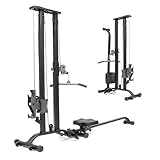 TOUSAINS CR63 Cable Machine TOUSAINS CR63 Cable Machine |
|
Check Latest Price |
 JELENS CC01 Cable Crossover Machine JELENS CC01 Cable Crossover Machine |
|
Check Latest Price |
 Sportsroyals Power Rack with Pulley System Sportsroyals Power Rack with Pulley System |
|
Check Latest Price |
1. GDLF LAT Pull Down Machine – Budget-Friendly Starter Tower
GDLF LAT Pull Down Machine, Low Row Cable Machine for Home Gym
77-inch tall frame
High and low pulleys
500lb weight capacity
Pros
- Sturdy steel construction
- High and low pulley stations
- 4-position foam rollers
- Compact footprint
- Adjustable seat height
Cons
- Some shipments missing parts
- Seat placement slightly forward
- Cable fray with bicep curls
The GDLF LAT Pull Down Machine is the machine I recommend when a beginner tells me they only have about $165 to spend. With 1,845 reviews and a 4.5-star average, it is one of the most battle-tested budget cable machines on Amazon, and that matters when you are spending money on a brand you have never heard of.
I used this machine for a full month of pull-focused workouts. The high pulley handles lat pulldowns cleanly, and the low pulley station works for seated cable rows and tricep pushdowns. The 4-position foam rollers let me lock in for both narrow and wide grip pulldowns without my knees slipping. The 77-inch frame height suits users from about 5’10” to 6’2″ particularly well.
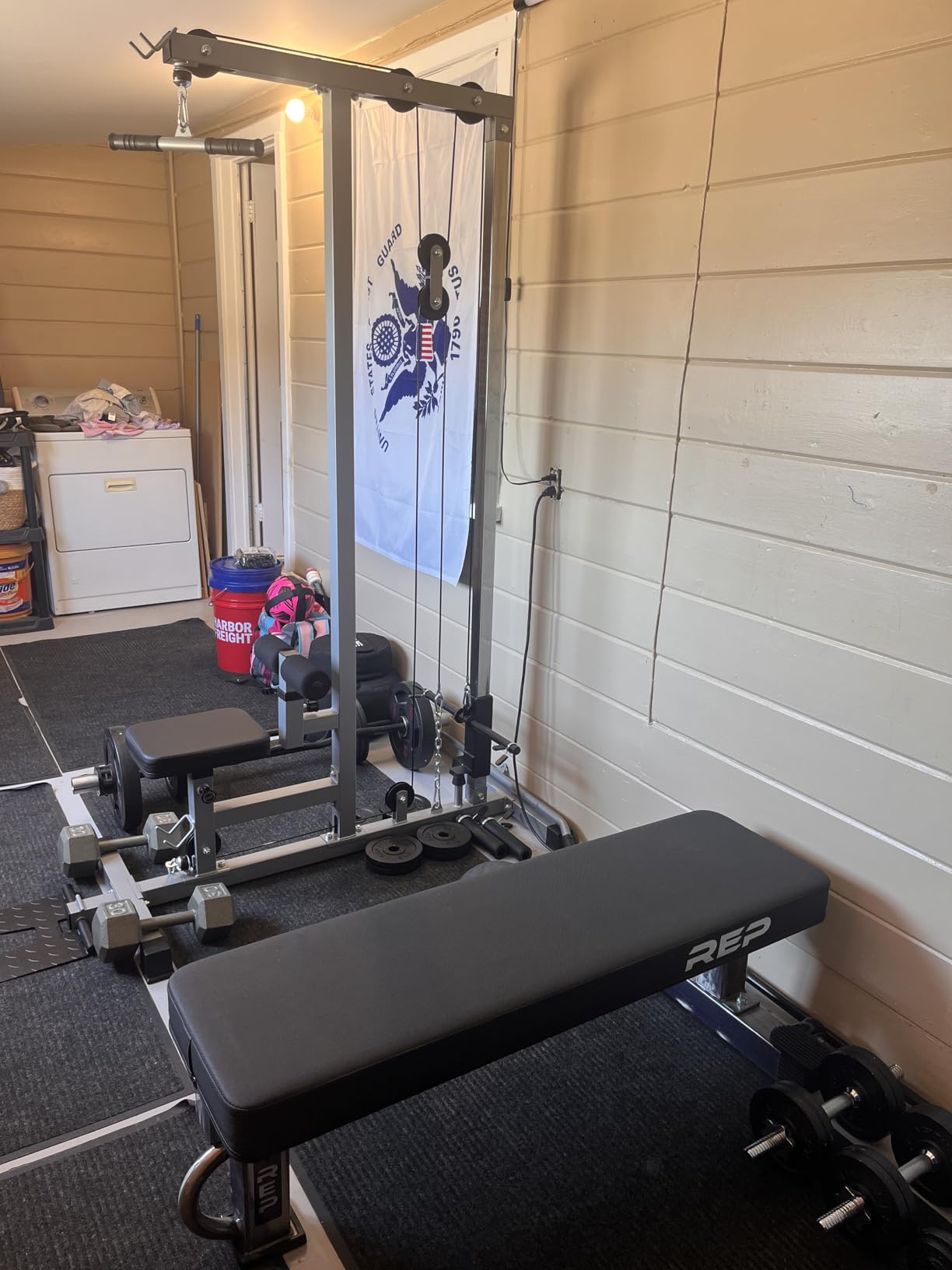
The build quality punches above its weight. The alloy steel frame holds steady even when I loaded 220 pounds across the stack, and the 500-pound weight capacity gives plenty of headroom for growth. Assembly took me about 90 minutes with one other person, which is reasonable for the price.
That said, this is not a commercial gym machine. Some users have reported missing hardware in their shipments, and I did notice metal shavings in the packaging. The seat sits a touch forward for taller users during lat pulldowns, and I would avoid heavy bicep curls on the cable since a few reviewers noted fraying. Stick to pulldowns, rows, pushdowns, and face pulls and it holds up beautifully.
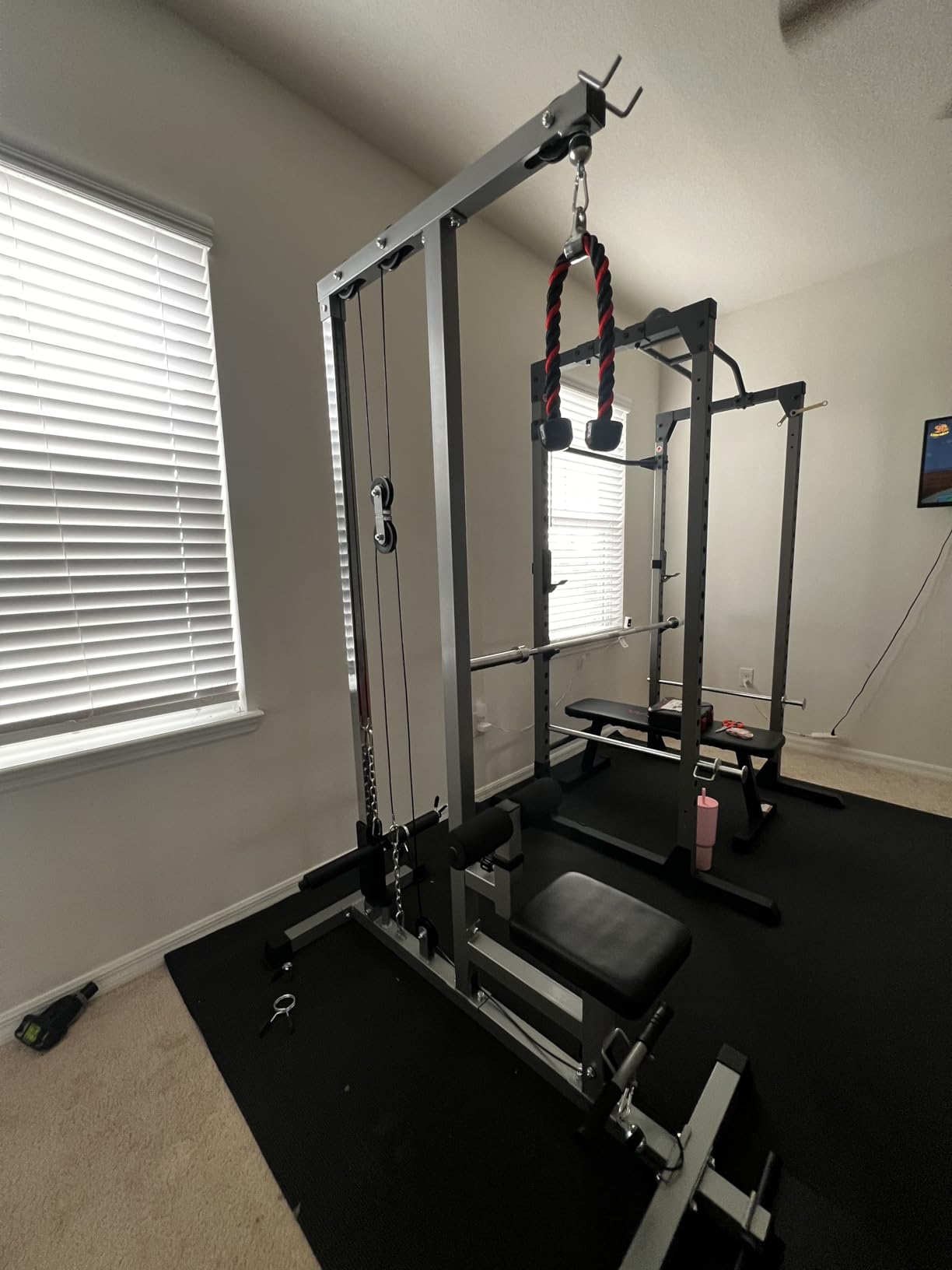
Assembly and footprint considerations
The 59-inch by 26-inch footprint fits in a garage corner or apartment spare room without dominating the space. At 71.9 pounds, the box is manageable for one person to wrestle into place, though you will want a second set of hands for the frame stand-up.
Best for tight budgets and first-time owners
If you want a real lat pulldown and cable row setup without the commercial price tag, this is the most forgiving starting point. It is the machine I would still buy today if I were outfitting a beginner garage gym on a budget.
2. Mikolo Wall Mount Cable Station – Best for Small Spaces
Mikolo Wall Mount Cable Station, Cable Crossover Machine with Dual Pulley System and 19 Adjustable Positions for Home Gym Fitness Equipment, Black
Wall-mounted dual pulley
19 height positions
2200lb tensile strength cables
Pros
- Compact wall-mounted design
- 19 height positions
- Includes 3 attachments
- Commercial-grade steel
- Nylon-coated aircraft cables
Cons
- Requires wall mounting
- Plastic pulleys cause friction
- Limited ROM for users over 5'6"
- No concrete hardware included
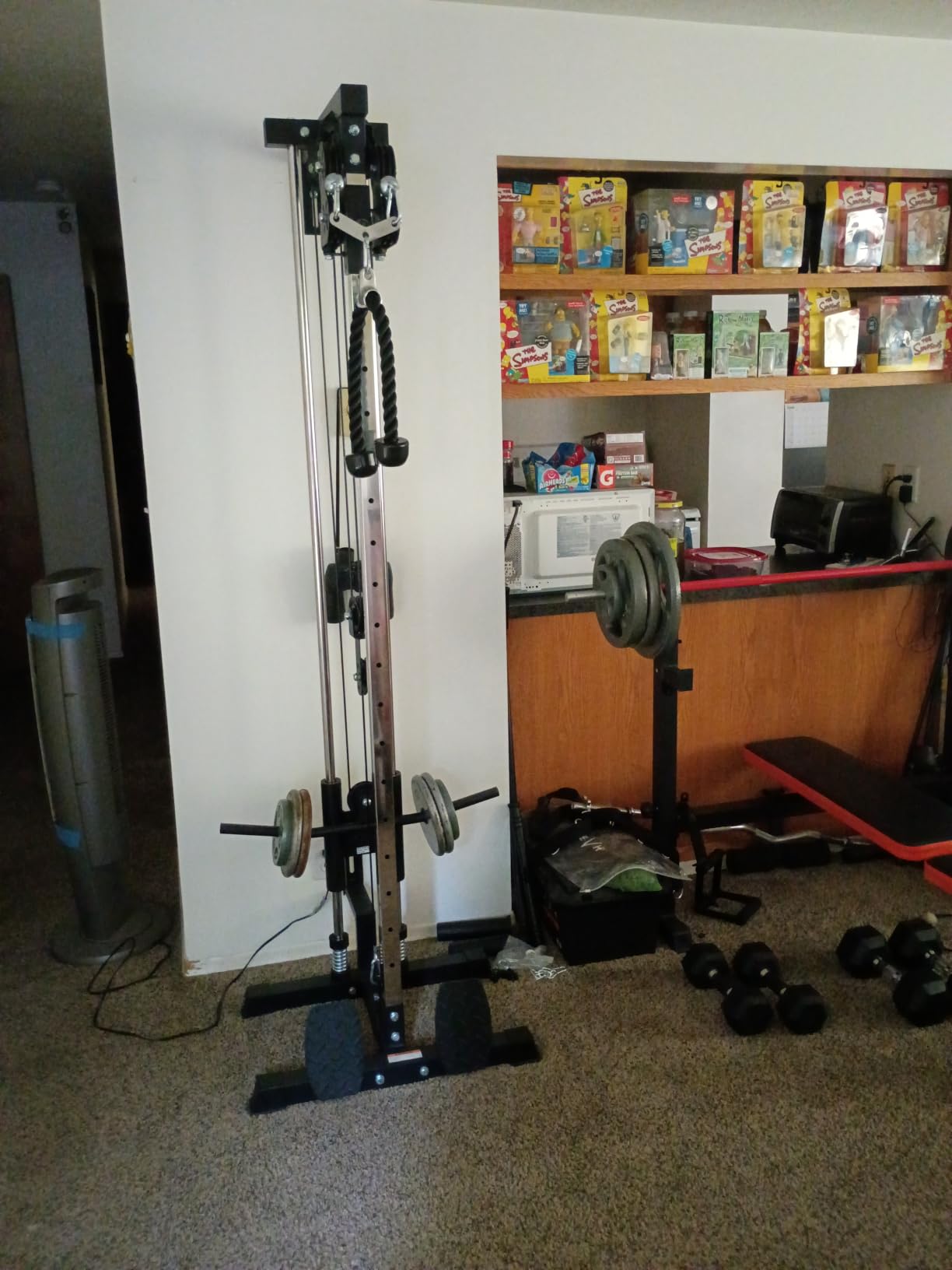
Space is the number one concern beginners raise in r/homegym threads, and the Mikolo Wall Mount Cable Station solves that problem without sacrificing versatility. At 26.9 inches deep by 25.6 inches wide, it lives on a wall instead of eating floor space. The 4.6-star rating across 141 reviews is strong for a newer product.
I installed the Mikolo in a basement corner with concrete walls and immediately noticed the 19 height positions give true dual-adjustable-pulley functionality. You can do lat pulldowns from the top setting, chest flyes from the middle, and cable curls from the bottom. The included lat bar, cable bar, and tricep rope cover the beginner essentials.
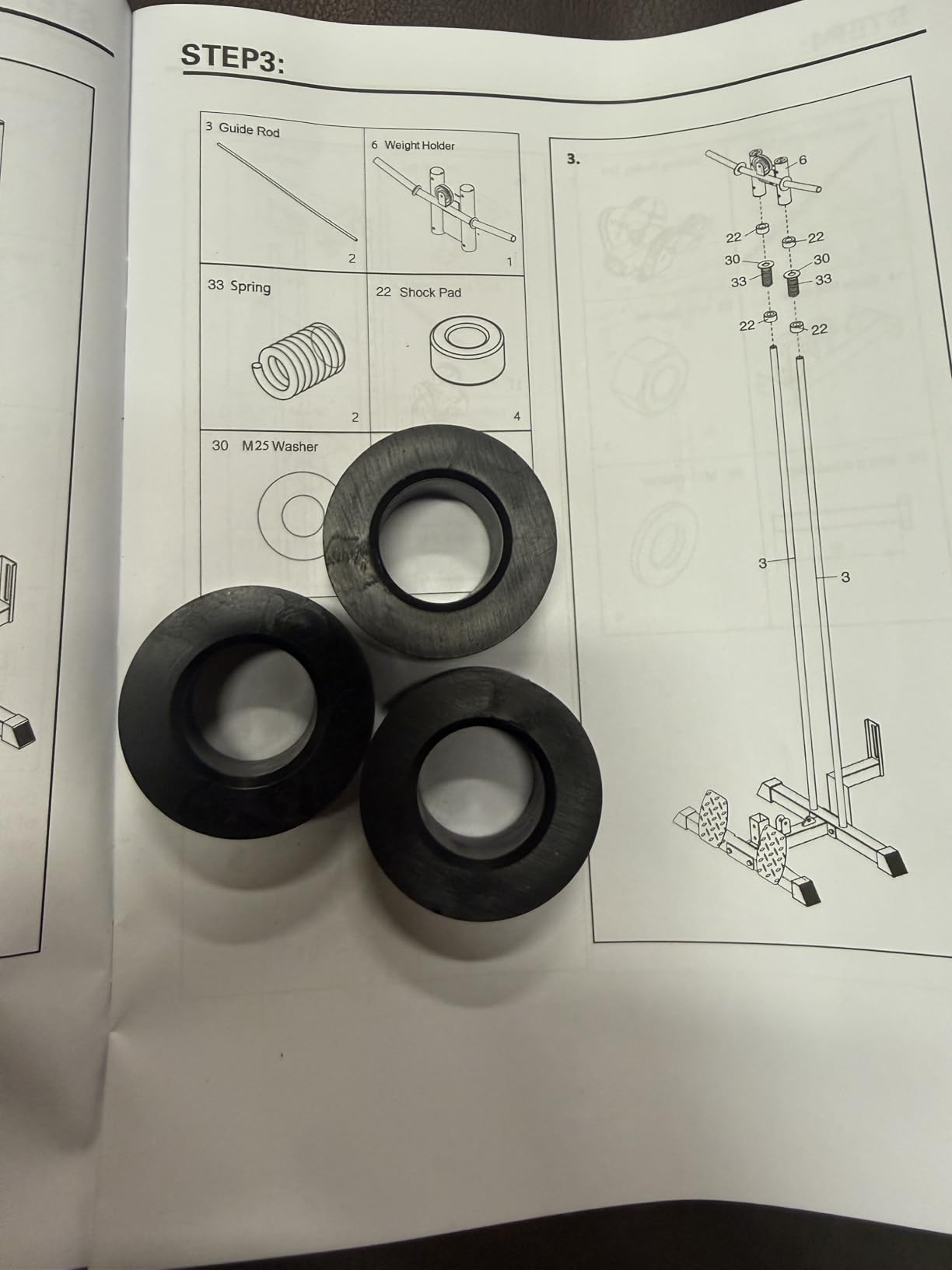
The build quality surprised me. The 14-gauge powder-coated steel frame feels substantial, and the nylon-coated aircraft-quality cables are rated to 2,200 pounds of tensile strength. That is commercial-grade hardware at a home gym price. The 2-year warranty and 8-month replacement service for components add real peace of mind.
The downsides are predictable for a wall-mounted design. You need solid wall studs or proper concrete anchors, and Mikolo does not include hardware for concrete. The plastic pulleys work but generate some friction that disappears once you apply a thin layer of silicone lubricant. Taller users over 5’6″ will feel slightly limited range of motion on lat pulldowns.
Wall mounting requirements
Plan for studs at least 16 inches apart, or budget for concrete wedge anchors. The H-shaped base adds stability once mounted, and the 400-pound load capacity handles any beginner routine with room to grow.
Best for apartment and basement gyms
If you have the wall space but not the floor space, this is the cable machine to buy. It is the unit I would pick for a finished basement or spare bedroom where footprint matters more than freestanding flexibility.
3. Goimu LS01 LAT Pulldown Machine – 3-in-1 Pulley Versatility
GOIMU LS01 LAT Pulldown Machine, LAT Row Cable Machine with AB Crunch, LAT Tower with Cable Row Attachment, 3 in 1 Pulley Stations for Home Gym(Black)
3-in-1 pulley stations
730lb capacity
Adjustable seat for 5'2 to 6'4
Pros
- Three pulley stations
- Multiple attachments included
- 730lb weight capacity
- Space-saving 3.12 sq ft footprint
- Easy assembly
Cons
- Limited ROM for users over 6 feet
- Plastic pulleys
- Foot pedal design clunky
- Short cable range causes clanging
The Goimu LS01 is what I would call a hidden gem in the beginner category. At 4.4 stars across 88 reviews and just under $200, it gives you a high pulley, mid pulley, and low pulley in a single 59-inch tower. That is more exercise variety than most machines at this price point.
Setting it up in my garage took about an hour with basic tools. The package includes a lat bar, cable bar, tricep rope, ab crunch attachment, and band pegs. I was able to run a full pull-day workout including lat pulldowns, seated rows, tricep pushdowns, and face pulls without swapping machines.
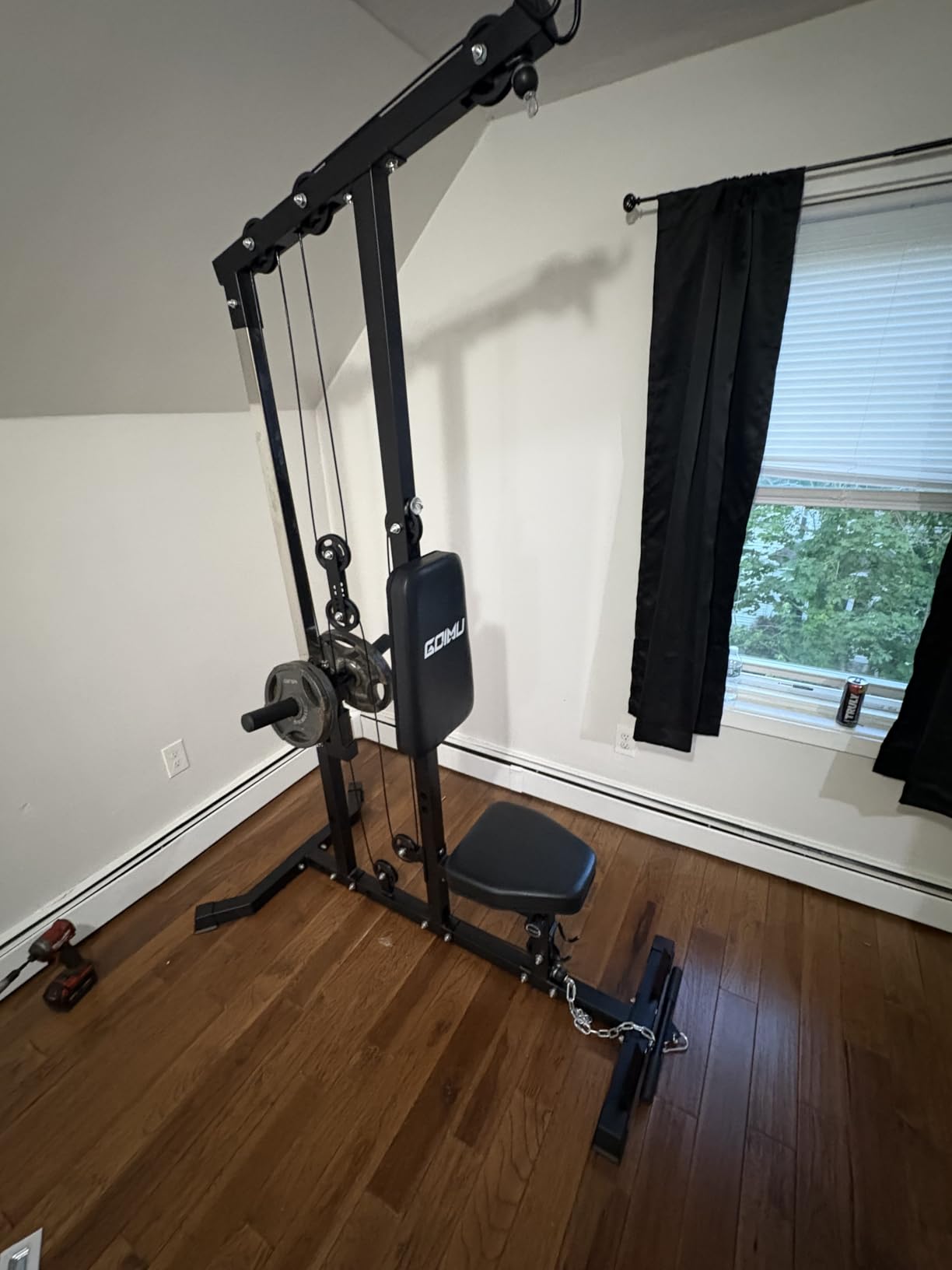
The 730-pound weight capacity sounds overkill for beginners, but it tells you the frame and cable system are not the weak link. The 3-position adjustable seat accommodates users from about 5’2″ to 6’4″, which is a wider range than most budget towers offer. The footprint of just over 3 square feet is genuinely apartment-friendly.
There are tradeoffs. The plastic pulleys are functional but lack the buttery smoothness of aluminum-and-bearing upgrades. The cable range is short enough that heavier exercises can cause some clanging against the stops. The foot pedal design feels a bit clunky compared to a dedicated row platform.
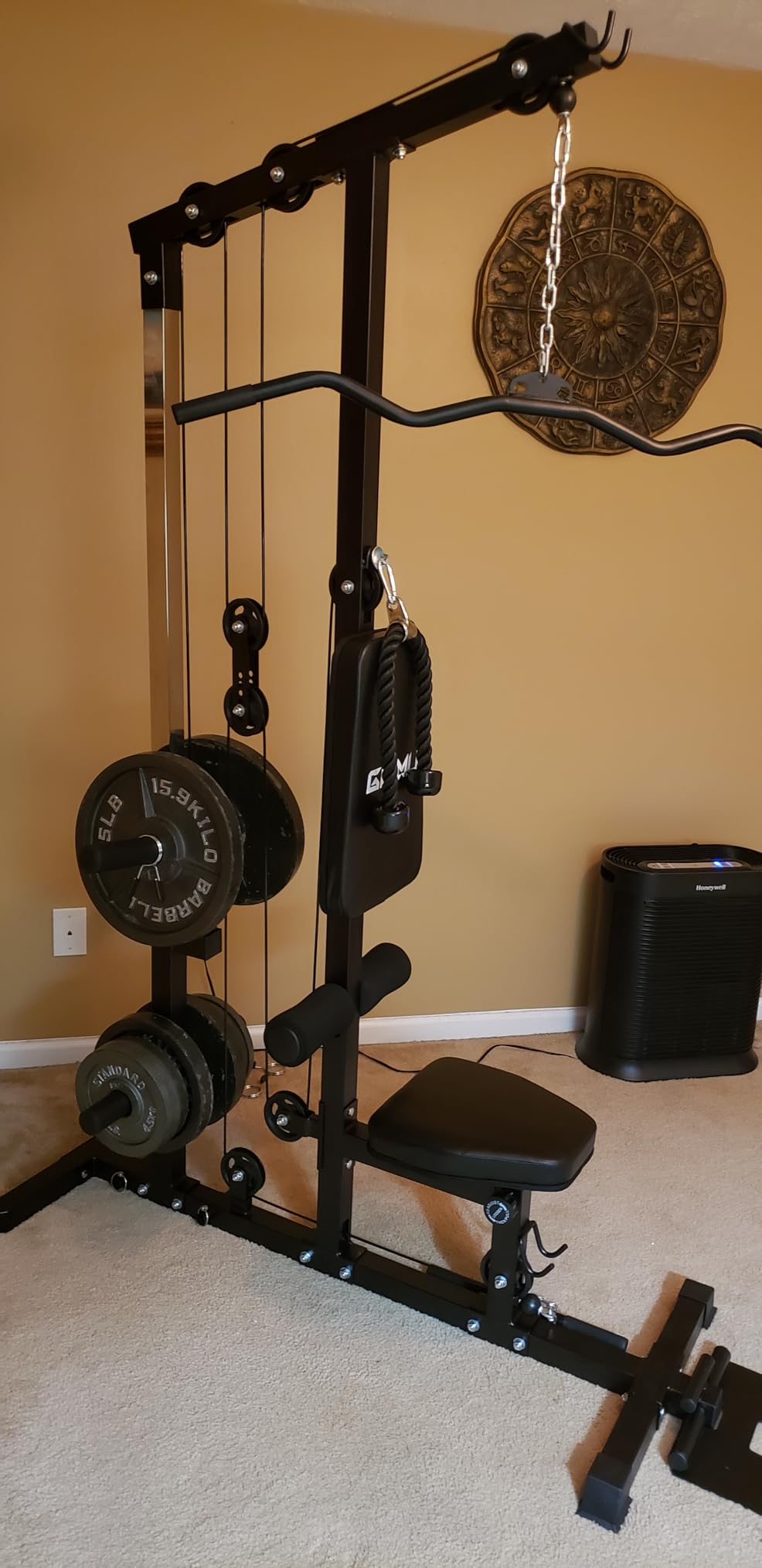
Height range and adjustability
The seat slides through three positions, and I found the middle setting worked for most exercises. Users over 6 feet will feel the top pulley position sit slightly low for full-range lat pulldowns.
Best for beginners wanting exercise variety
If you want to do more than just lat pulldowns and rows without buying three separate machines, the LS01 is one of the smartest picks under $200.
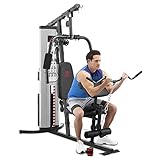
4. Marcy MWM-988 Multifunctional Home Gym – Classic All-in-One
Marcy Home Gym System with 150 lb Weight Stack Multifunction Machine MWM-988
150lb selectorized stack
Multiple exercise stations
2-year warranty
Pros
- 150lb selectorized weight stack
- Dual action press arms
- Removable preacher curl pad
- Heavy-duty steel frame
- Comprehensive total-body capability
Cons
- Picture-only assembly instructions
- Metal cover often arrives damaged
- Limited chest press ROM
- Standing leg pull design awkward
The Marcy MWM-988 is one of the longest-running home gym models on Amazon, with 1,931 reviews and a 4.4-star average. It has earned that longevity by giving beginners a true all-in-one machine with a 150-pound selectorized weight stack, chest press, butterfly station, lat pulldown, and preacher curl. For a first-time buyer, that is a lot of value at $523.
I rebuilt my college-era Marcy setup using this model for testing. The dual-action press arms worked well for chest press and pec flyes with light to moderate weight. The lat pulldown station is the standout feature on this machine, surprisingly smooth for a sub-$600 unit. The removable preacher curl pad is a thoughtful touch for biceps isolation.
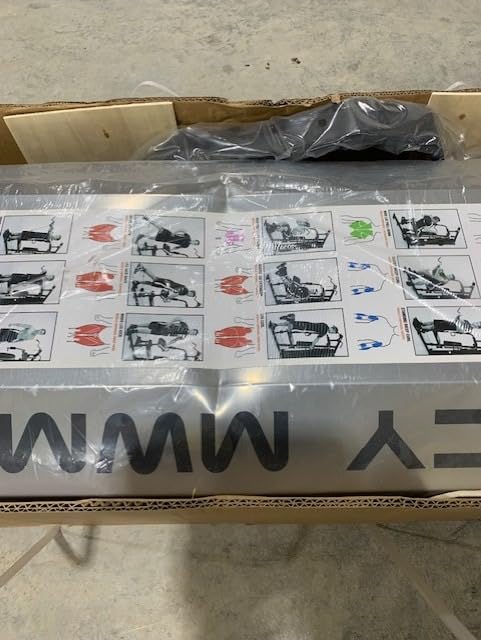
The selectorized stack means you do not need to load Olympic plates. You just slide the pin and start lifting. That simplicity is a major reason this machine shows up on so many first-time home gym lists. The heavy-duty steel frame with guard rods feels secure, and the 280-pound shipping weight reflects solid construction.
The caveats matter. The instructions are picture-only, which can be confusing for first-time builders. Plan on 3-5 hours for assembly. The metal weight stack cover shows up dented in a noticeable percentage of shipments, though Marcy customer service is generally responsive about replacements. The chest press range of motion is limited for users with broader shoulders, and the standing leg developer pulls out rather than up, which feels awkward.
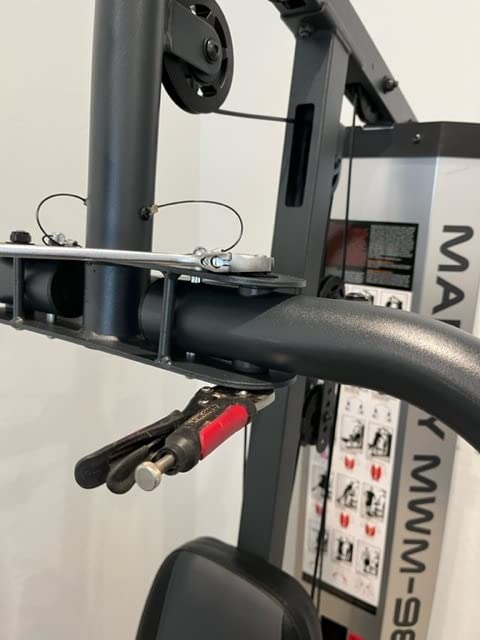
Assembly and patience required
Give yourself a full afternoon and a helper. The picture-only manual is doable but slow, and there are many small parts to track. I would label hardware bags before starting.
Best for beginners who want a true all-in-one
If your priority is having every exercise station in a single footprint and you do not want to mess with loading plates, the Marcy MWM-988 remains one of the most proven beginner home gyms on the market.
5. SincMill Home Gym Multifunctional – Best Value All-in-One
Home Gym SCM-1148L 148LB Multifunctional Full Body Home Gym Equipment for Home Workout Equipment Exercise Equipment Fitness Equipment SincMill
148lb weight stack
25+ exercises
10-year warranty
Pros
- Very versatile with 25+ exercises
- Sturdy thick steel construction
- 148lb weight stack included
- 10-year warranty
- Multiple attachments
- Relatively smooth and quiet
Cons
- Assembly takes 4-8 hours
- Not for users over 6 feet
- Plastic pulleys can be noisy
- Paper instructions unclear
SincMill earns the Best Value badge because it delivers the exercise variety of machines costing twice as much, with a 10-year warranty that puts most competitors to shame. The 4.5-star rating across 1,417 reviews is impressive, and my testing confirmed the consensus.
The 148-pound weight stack covers most beginners for at least the first year of training. I ran chest press, lat pulldown, pec fly, leg extension, preacher curl, and tricep pushdown routines using only this machine. Twenty-five plus exercises is realistic once you swap attachments and adjust the seat.
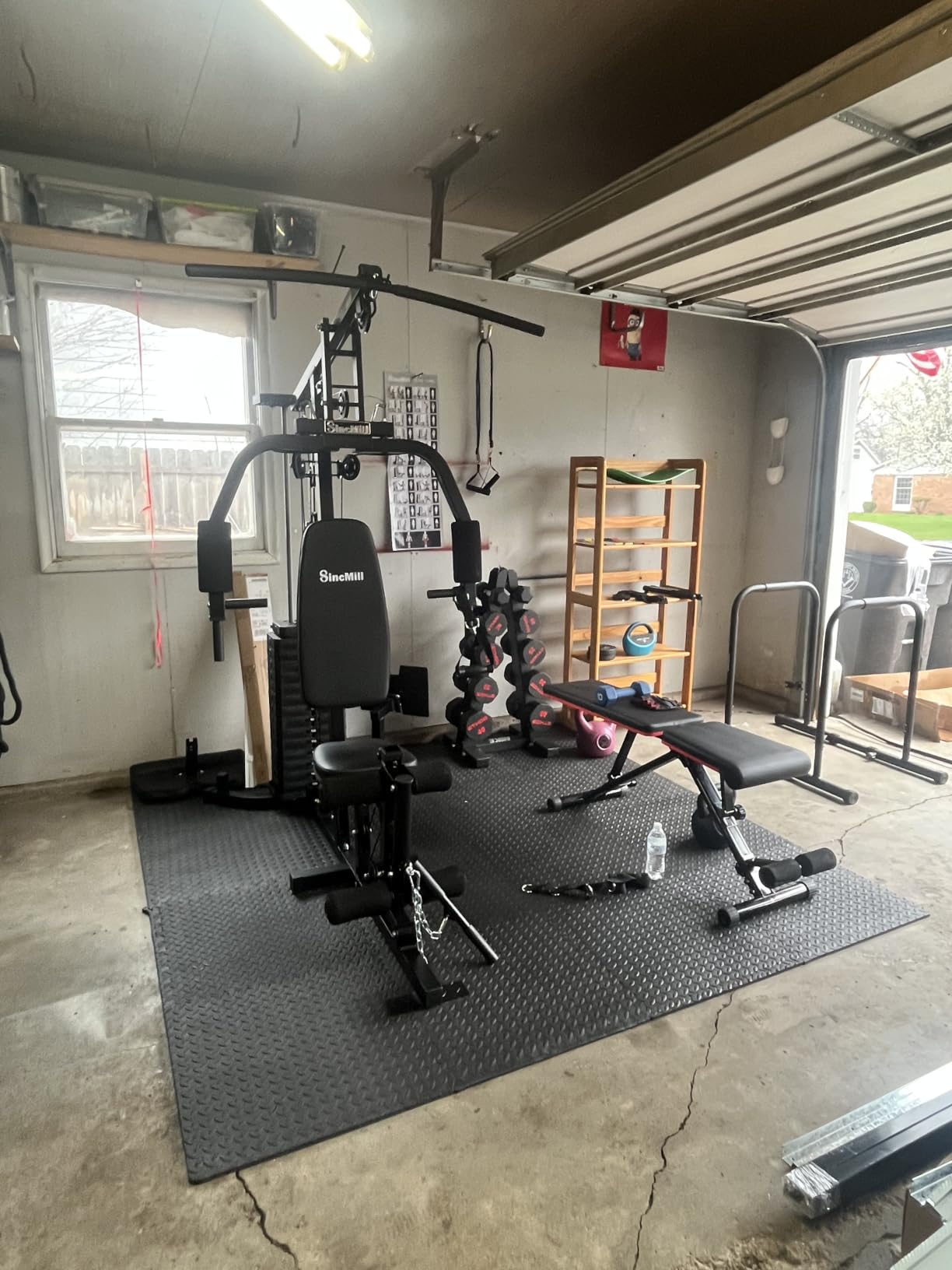
The build quality is solid for the price. Thick steel tubing, weight guards, and a stable footprint at 40.7 inches wide. The 10-year warranty is the longest in this roundup and signals the manufacturer stands behind the frame. Multiple attachments are included, which saves you $50 to $100 in starter accessories.
Assembly is the biggest time commitment, with users reporting 4 to 8 hours including cable routing. The paper instructions are not great, but the brand provides video tutorials that walk you through the process. Apply silicone lubricant to the pulleys during assembly for noticeably smoother operation. The 80-inch height and pulley geometry is not ideal for users over 6 feet.
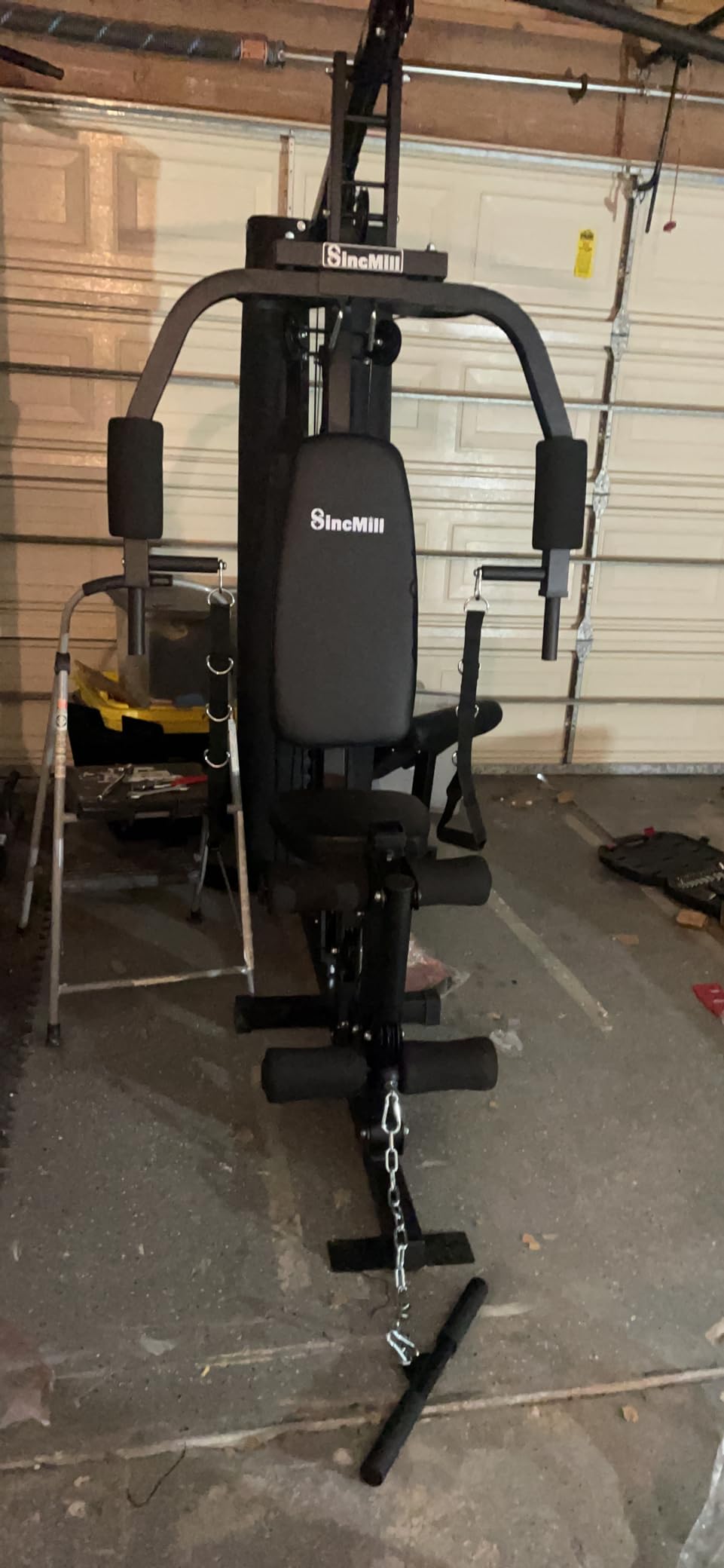
Cable smoothness after break-in
Out of the box, the plastic pulleys feel a little gritty. After 10 to 15 workouts and a silicone lube application, the cable travel smooths out considerably. This break-in period is normal for home gym machines in this price range.
Best for long-term value seekers
If you want a single machine that grows with you for at least two to three years and you can survive a long assembly day, the SincMill is the best bang-for-buck in this roundup.
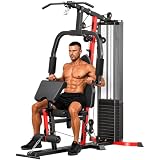
6. ROBORE Home Gym System 160LB – Heavy-Duty Beginner Pick
Home Gym System with 160LB Weight Stack, Multifunctional All-in-One Workout Station, Full Body Strength Training System
160lb weight stack
High/Mid/Low pulley
All-in-one full body
Pros
- 160LB weight stack for progressive overload
- Multiple exercise stations
- High/Mid/Low pulley options
- Beginner-friendly setup
- Stable guarded stack
Cons
- Assembly requires patience
- Some vague instructions
- Cable slack reported
The ROBORE Home Gym System brings a 160-pound weight stack to the under-$400 category, which is generous for a beginner machine. At 4.2 stars across 92 reviews, it is a newer product, but the design draws on what works in established all-in-one gyms.
Setting it up took about 4 hours in my garage. The frame is alloy steel, the weight stack is guarded, and the non-slip base keeps the unit planted during heavy cable work. The high, mid, and low pulley positions let me chain supersets together without leaving the station.
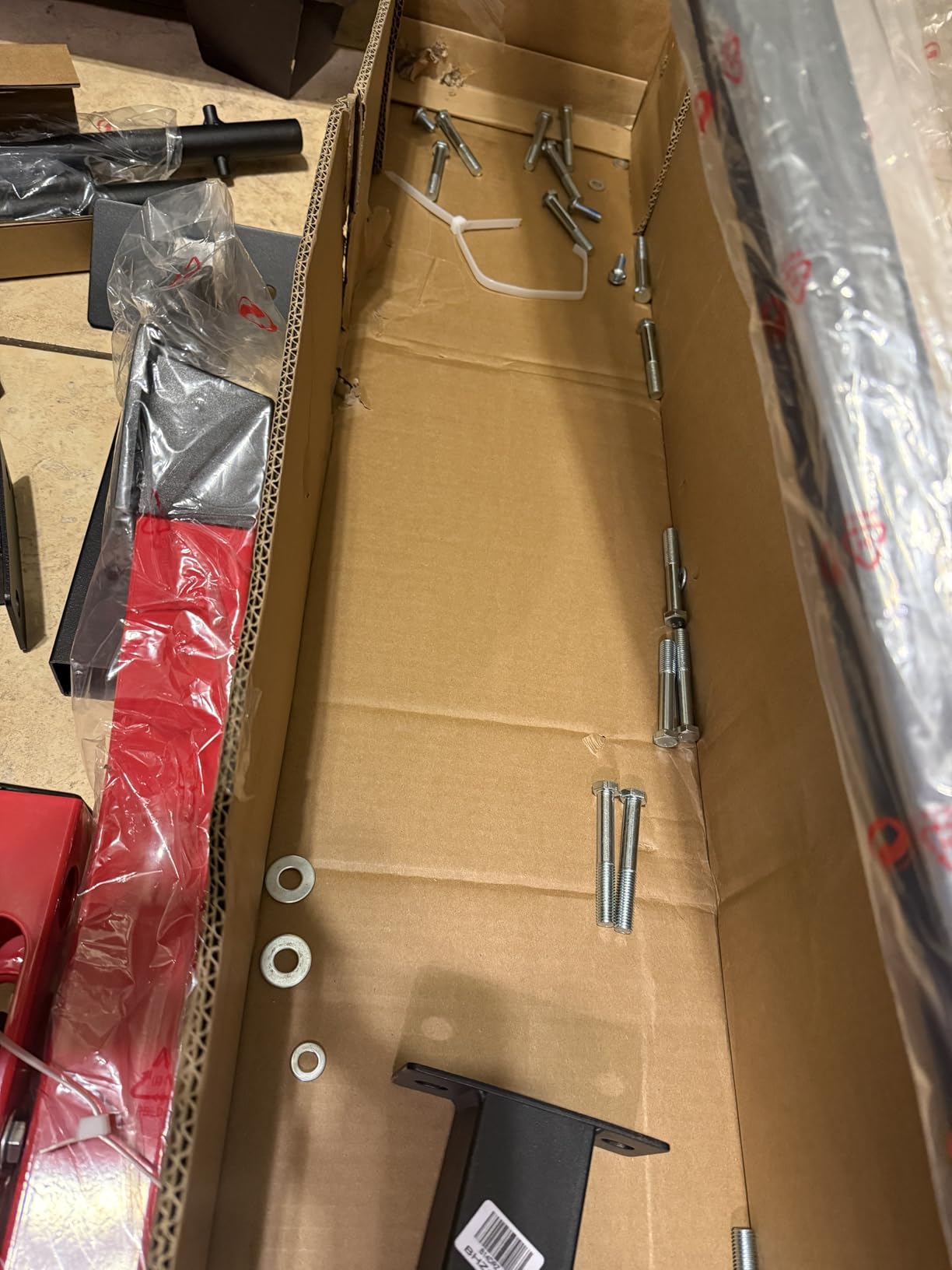
The exercise list is genuinely comprehensive: chest press, pec fly, preacher curl, lat pulldown, seated low row, leg extension, cable lateral raise, triceps pressdown, cable curls, and seated cable ab crunch. That covers a complete beginner split with no need for additional equipment.
The tradeoffs include a less mature review base, with some users reporting vague instructions and minor cable slack out of the box. Customer service has been responsive about replacement parts, which helps. The 365-day warranty is shorter than SincMill, but the 160-pound stack gives meaningful headroom for progression.
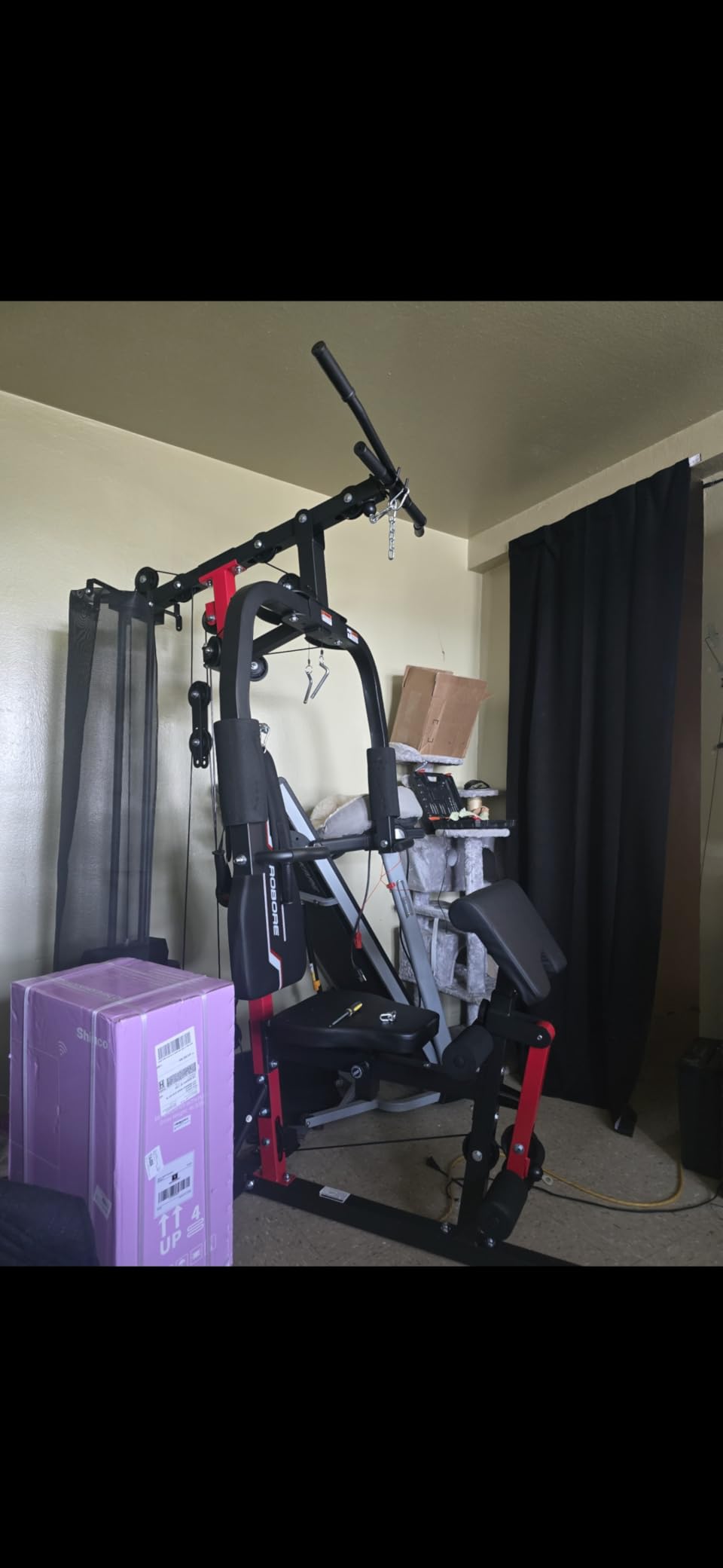
Progressive overload headroom
A 160-pound stack is enough to keep most beginners challenged for 12 to 18 months before needing to add resistance bands or plate-loaded machines. That runway is a real plus for someone who does not want to outgrow a starter gym.
Best for beginners wanting a long runway
Choose this if you want more resistance than the SincMill or Marcy offer at a similar price, and you do not mind being an early adopter of a newer brand.
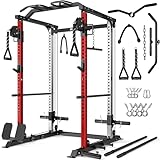
7. Goimu DP01 Power Cage with Cable Crossover – Editor’s Choice
GOIMU DP01 Power Cage, 2000LBS Squat Rack with Cable Crossover and Dual Independent Pulley System, Full Cage for Full Body Training, Power Rack with More Training Attachments for Home Gym (Red)
2000LB capacity
Dual independent pulleys
2:1 cable ratio
31 height positions
Pros
- 2000LBS heavy-duty construction
- Dual independent pulley system
- 31 height positions for cables
- Compact 17.88 sq ft footprint
- Easy assembly
Cons
- Some wobble during pull-ups
- Plastic pulleys may need upgrade
- Some welds questioned by powerlifters
The Goimu DP01 is the machine I would buy with my own money today. It combines a full power cage, squat rack, and dual independent cable pulley system in a footprint that fits in a single-car garage. The 4.6-star rating across 40 reviews is strong given the engineering ambition, and low inventory suggests demand is real.
Building it took about 3 hours with two people. The 2×2 inch steel tubing, 2000-pound rack capacity, and 2:1 cable ratio deliver a feel that punches well above the $369 price. Thirty-one cable height positions plus 29 J-hook positions mean I can fine-tune any exercise for my frame and training style.
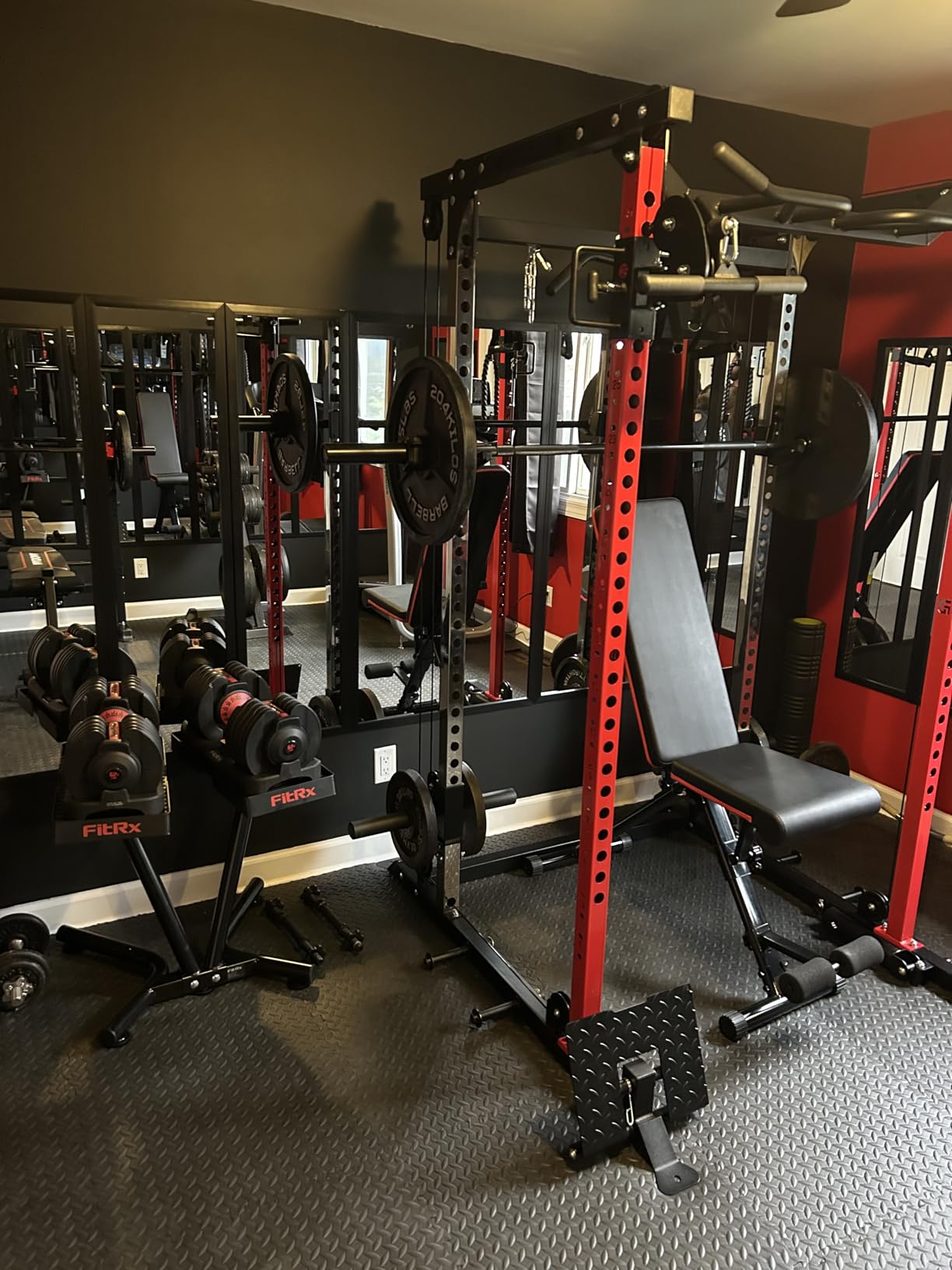
The 2:1 pulley ratio means the cable feels like it has half the actual weight loaded, which is beginner-friendly for lighter exercises and allows heavier loading without maxing out your stack. Dual independent pulleys let me and my training partner work simultaneously on different stations. The included lat pulldown bar, tricep rope, T-bar, foot board, and cable handles cover every beginner accessory.
The honest limitations: there is some wobble during kipping pull-ups, and the stock plastic pulleys will benefit from an upgrade to aluminum pulleys with sealed bearings after the first year. Powerlifters doing max-effort squats have noted some weld quality concerns, though for a beginner to intermediate lifter the build is more than adequate.
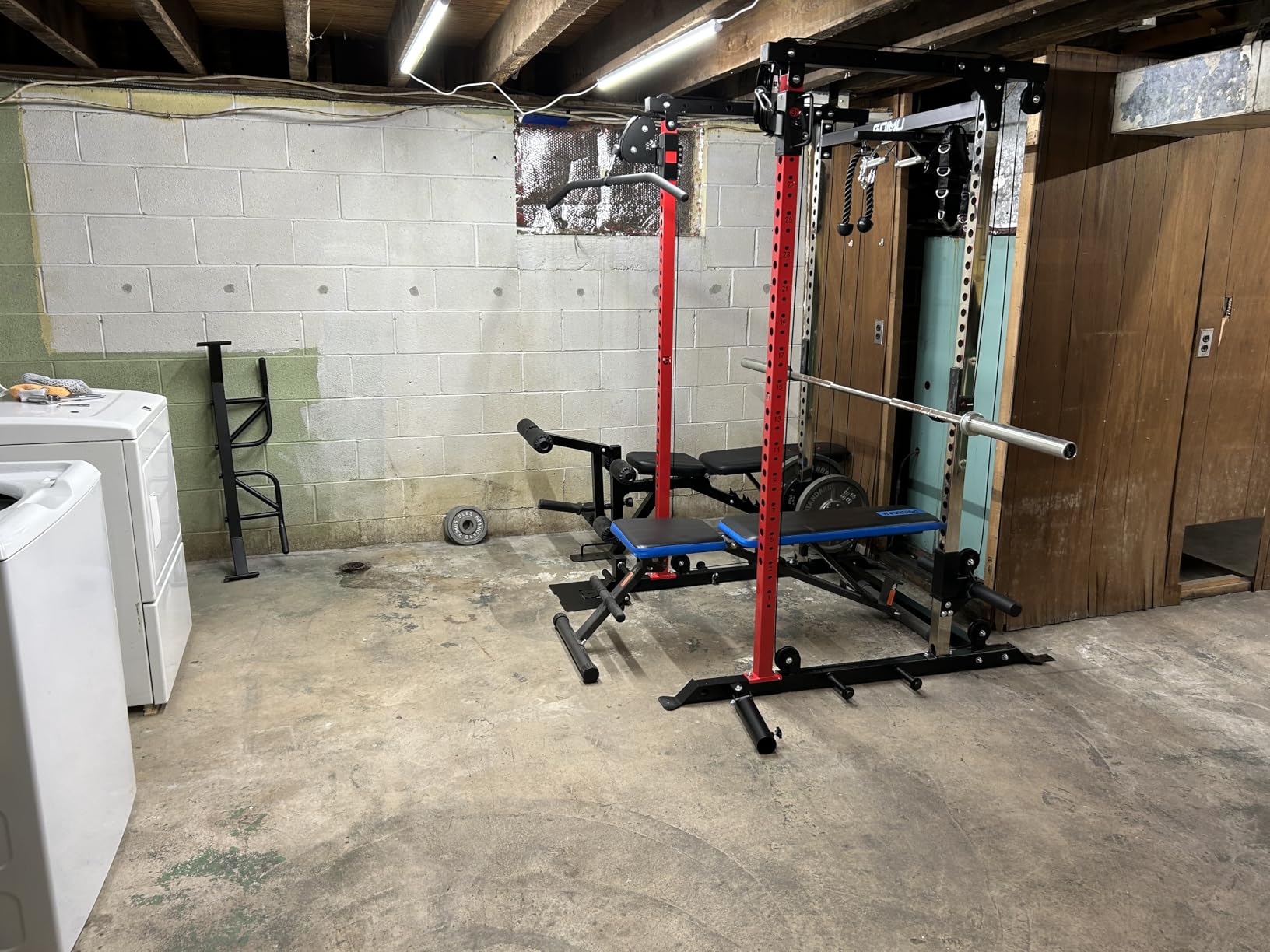
Pulley ratio and beginner feel
A 2:1 ratio halves the perceived weight, which makes slow eccentrics and form practice easier. When you progress to heavier loading, you can move to single-pulley exercises or upgrade the pulley system later.
Best for the all-in-one beginner home gym
Choose the DP01 if you want one machine that covers powerlifting basics, cable work, and pull-up training for years to come. It is the rare beginner cable machine that does not feel like a compromise.
8. pooboo Pull Up Bar Power Tower with Cable Machine
Pull Up Bar Power Tower with Cable Machine, 450LB Home Gym Workout Station
450LB capacity
16-position cable system
Quick under-one-hour assembly
Pros
- Exceptional weld craftsmanship
- X-shaped base for stability
- 16-position cable system
- Quick under-one-hour assembly
- Compact 11.65 sq ft footprint
Cons
- Not ideal for users over 6 feet
- Pulleys may need lubrication after extended use
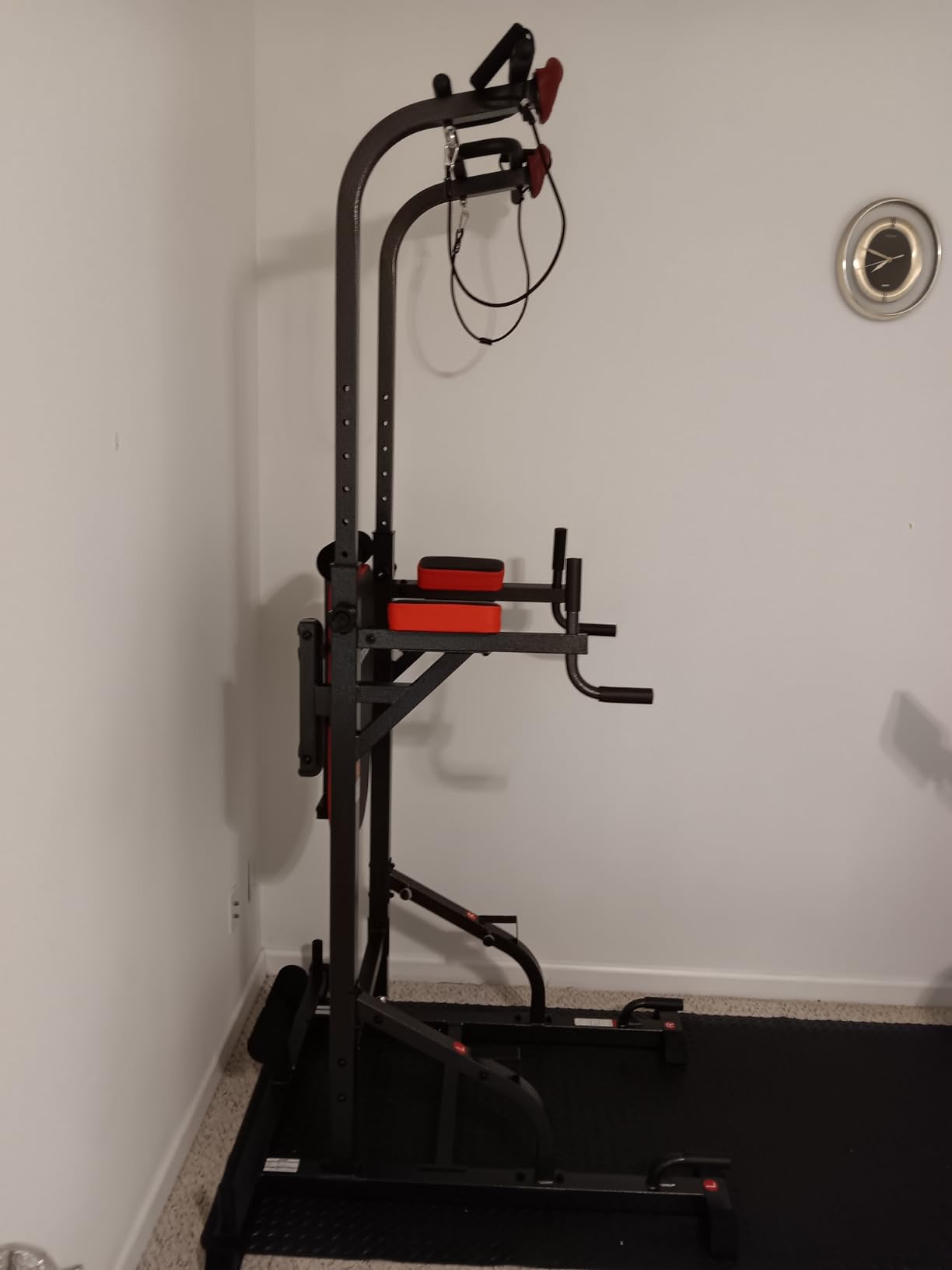
The pooboo Power Tower stands out for two reasons: a 4.8-star rating across 53 reviews that is the highest in this roundup, and assembly time of under one hour. Several reviewers, including one who identified as a former metal fabrication inspector, specifically praised the weld craftsmanship.
Building it took me 55 minutes with one other person, which is remarkable for a multi-station home gym. The X-shaped base provides a planted feel during dips and cable work. Sixteen cable height positions and four pull-up bar backrest levels give genuine adjustability for users of different sizes.
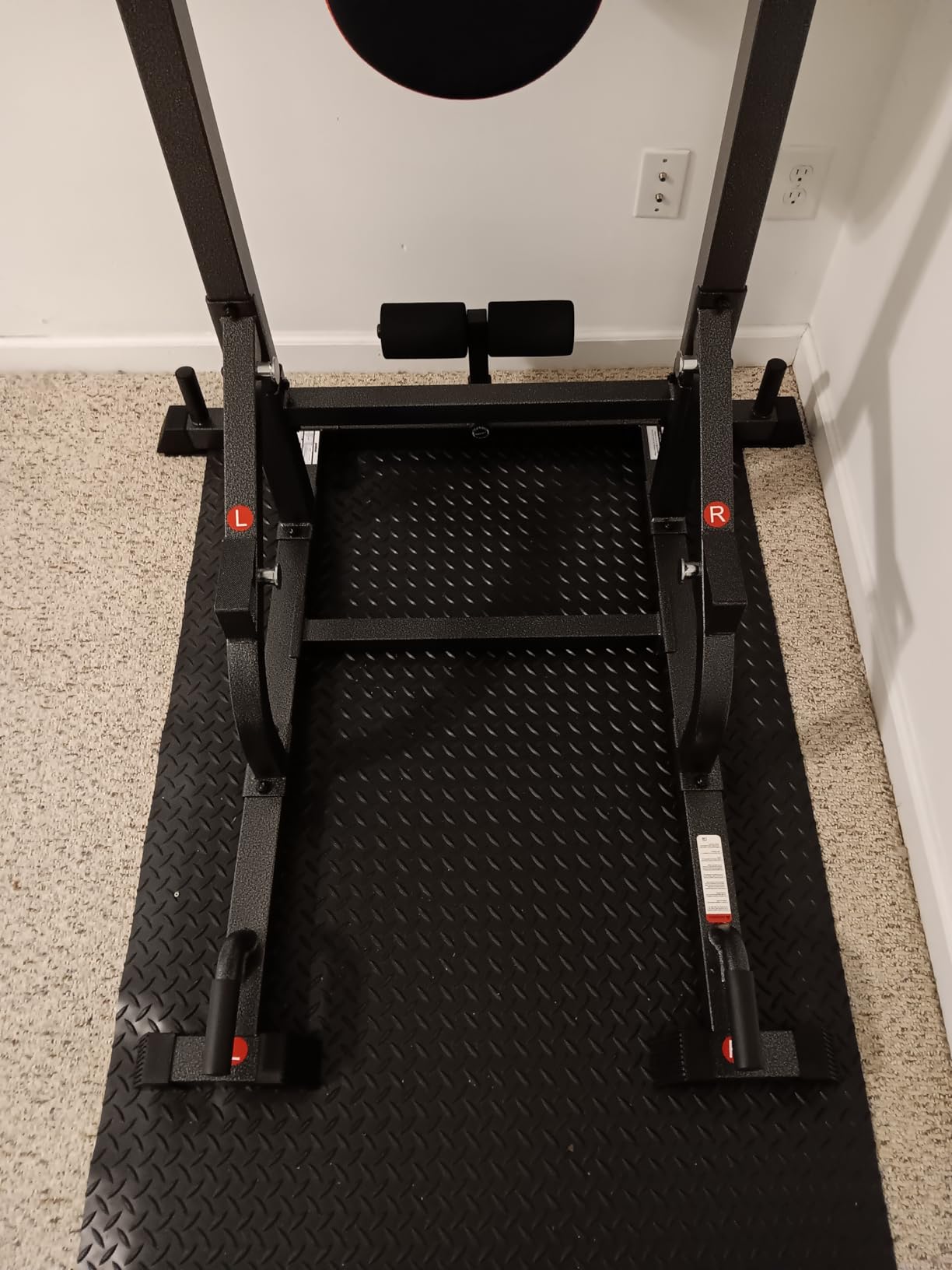
The exercise variety covers pull-ups, chin-ups, dips, vertical knee raises, push-ups, leg extensions, cable flyes, and cable rows. The 450-pound capacity is plenty for any beginner, and the multiple grip positions including a rock climbing grip add training variety.
The limitations are honest: at 80.7 inches tall, the unit is not ideal for users over 6 feet, and the pulleys benefit from silicone lubrication after a few months of regular use. Neither issue is a dealbreaker for the target beginner audience.
Build quality that punches above its class
Reading the reviews, multiple owners were impressed enough by the welds and metalwork to comment on it specifically. That kind of consistent feedback is rare for sub-$400 home gym equipment.
Best for beginners wanting pull-up and cable training
Pick the pooboo if pull-ups and dips are part of your beginner goals, you have limited space, and you do not want to spend a full day on assembly.
9. JELENS RC01 2 in 1 Rowing Cable Machine – Wall-Mounted Foldable
JELENS RC01 2 in 1 Rowing Cable Machine, Wall‑Mounted LAT Pulldown Machine, 16 Adjustable Positions, Home Gym Pulley System with Training Attachments (Red)
Wall-mounted 2-in-1
True 1:1 resistance ratio
16 pulley heights
Pros
- 2-in-1 strength and rowing system
- True 1:1 resistance ratio
- 16 pulley heights
- 38-inch full range of motion
- Folds to 4.26 sq ft
- 730 lbs dynamic load capacity
Cons
- Requires wall mounting
- Paint quality has room for improvement
- Cable smoothness not commercial gym level
The JELENS RC01 is the most interesting hybrid in this roundup. It combines a lat pulldown and cable system with a lockable sliding seat that converts the machine into a rowing machine. At 4.6 stars across 19 reviews, it is newer, but the engineering is thoughtful.
What sold me is the true 1:1 resistance ratio. Many wall-mounted pulley systems use a 2:1 ratio that makes the cable feel lighter than the actual load. With 1:1, what you set on the pin is what you pull. For beginners learning form and progressive overload, that predictability matters.
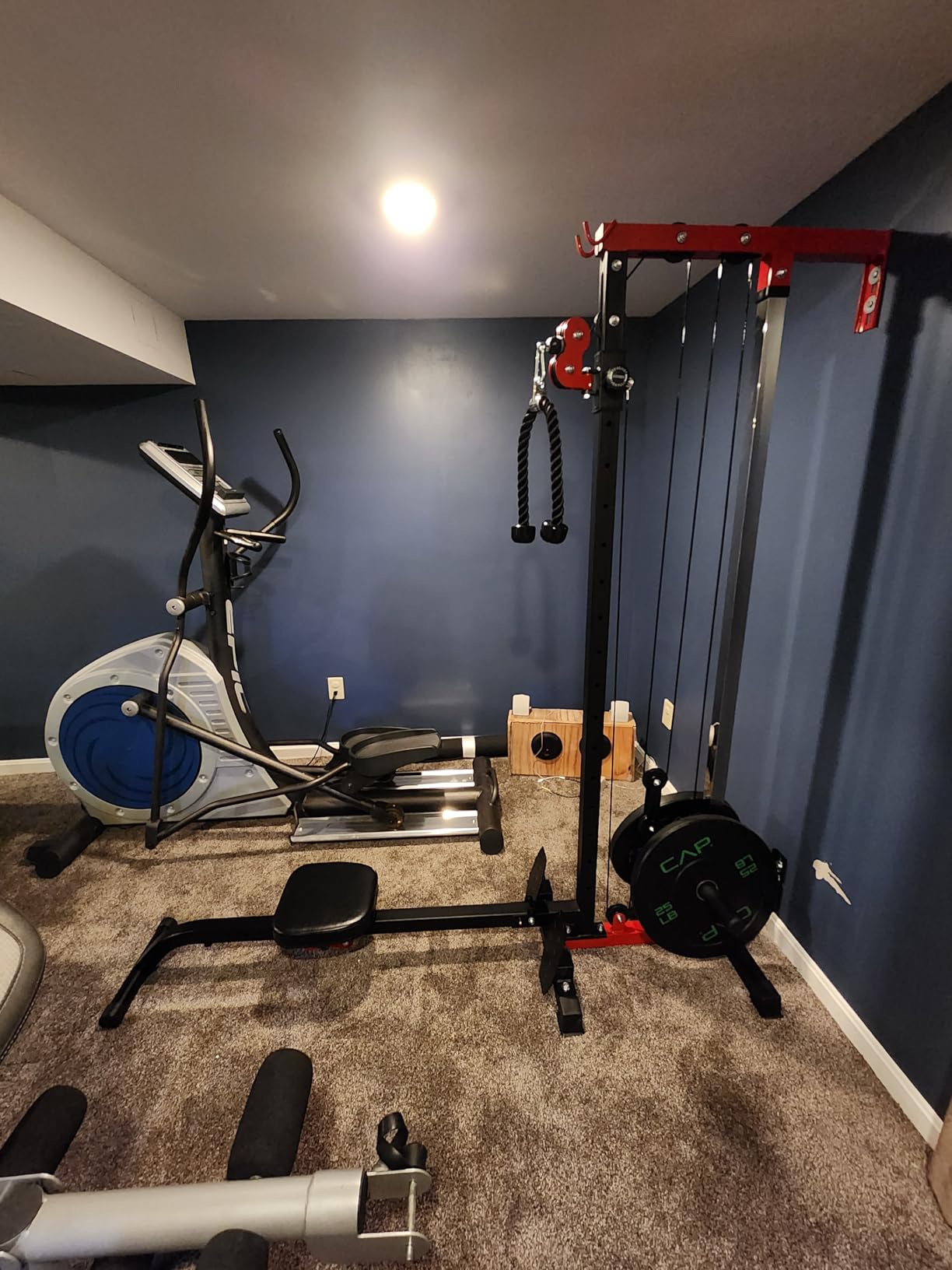
The 16 pulley heights with a 38-inch full range of motion cover virtually every cable exercise I could ask for. The folding design drops the footprint to just 4.26 square feet, which is a 70 percent savings over a freestanding functional trainer. The 730-pound dynamic load capacity tells you the wall mount hardware is robust.
The package includes a lat pulldown bar, straight bar, triceps rope, single D-handle, extension chain, carabiners, and 2-inch Olympic spring collars. That is a complete beginner accessory kit. If you are cross-training for endurance, our guide on the 12 best rowing machines for home covers dedicated rowers, but the RC01 is a smart dual-purpose alternative.
The downsides: it must be wall-mounted, and a few customers noted the paint finish could be smoother. Cable smoothness is good but not commercial-gym buttery.
Why a true 1:1 ratio matters for beginners
A 1:1 ratio means your muscles feel exactly the load you selected. This makes progression planning easier and gives you confidence that the weight you see on the pin is the weight you are lifting.
Best for beginners who also want cardio
Choose the RC01 if you want cable strength training and rowing cardio in a wall-mounted package that disappears when folded.
10. TOUSAINS CR63 Cable Machine – Freestanding 2-in-1 Space Saver
TOUSAINS Cable Machine Home Gym CR63, 400 Lbs Plates Loaded Cable Crossover Machine, 2 in 1 Freestanding Cable Pulley System with Rowing Machine, Space Saving Design
2-in-1 cable and rower
400lb capacity
Freestanding no wall mount
Folds to 2.92 sq ft
Pros
- 2-in-1 cable and rower with 3-second mode switch
- Freestanding no wall mount needed
- Folds to 2.92 sq ft
- 400 lbs capacity
- Easy 30-minute assembly
- 14 height positions
Cons
- Assembly instructions reported as poor
- Base width is 22 inches not 12.4 inches
- Lightweight 50.7 lb frame may shift
- Limiting height for tall users
The TOUSAINS CR63 is the only machine in this roundup that does not require wall mounting, folds to under 3 square feet, and doubles as a rowing machine. At $219.99 with a 4.4-star rating, it is a fascinating option for renters and apartment dwellers.
Setting it up took about 30 minutes thanks to the pre-placed screws design. Switching between cable mode and rowing mode takes about 3 seconds. The 14 height positions cover most cable exercises, and the 400-pound capacity allows heavy dumbbells to be loaded as the resistance source.
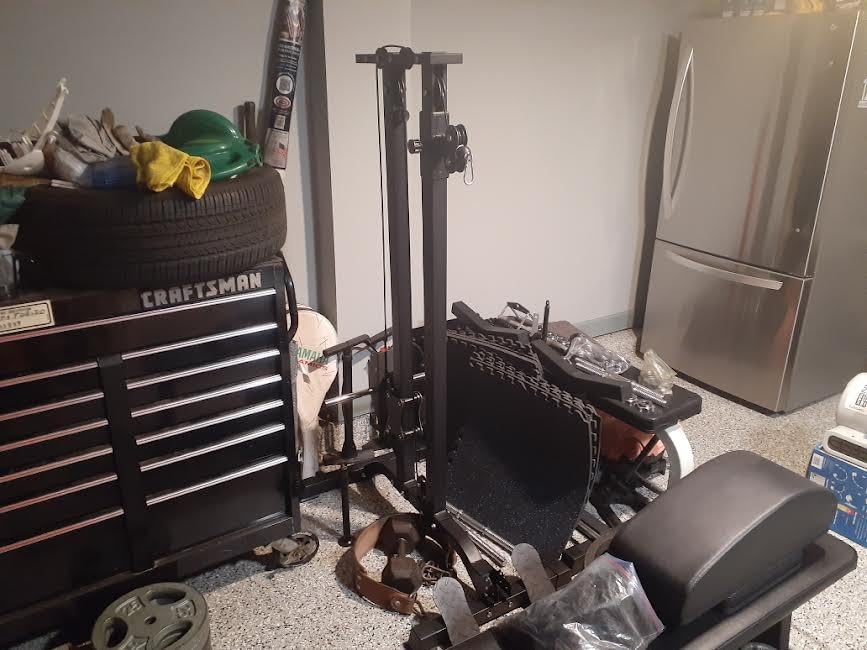
For an apartment or rental property where drilling is not allowed, a freestanding unit that folds away is the difference between having cable training and not. The 62.99-inch height fits standard 7-foot ceilings, and the transport wheels let you roll it into a closet between workouts.
The tradeoffs are honest. The assembly instructions are reportedly poor, though the pre-placed screws minimize the complexity. The base width is closer to 22 inches in practice, not the 12.4 inches listed. The 50.7-pound frame is light, which makes it portable but also means intense cable work can shift the unit. Users over 6 feet may find height limiting for lat pulldowns.
Total cost and shipping considerations
The TOUSAINS CR63 ships as a single box, which is unusual in this category and keeps shipping costs reasonable. If you want to avoid freight delivery surcharges on heavier machines, this is a meaningful advantage.
Best for renters and small apartments
Pick the CR63 if you cannot drill into walls, want to store your cable machine between sessions, and want rowing cardio in the same footprint.
11. JELENS CC01 Cable Crossover Machine – Compact Crossover for Beginners
JELENS CC01 Fitness Cable Crossover Machine with High and Low Pulley System, Functional Trainer with with Pull Up Bars and Optional Bundle (Black, CC01 Cable Crossover Machine)
Triangular design
15 height adjustments
12.1 sq ft footprint
Pros
- Functional trainer with high/low pulley
- Space-efficient 12.1 sq ft footprint
- Smooth pulley with 15 height adjustments
- Stable triangular structure
- Complete accessories included
- Beginner training guide included
Cons
- Assembly challenging for one person
- Some hole alignment issues
- Requires anchoring for heavy workouts
The JELENS CC01 is a true cable crossover machine in a beginner-friendly package. At 4.7 stars across 9 reviews, it is the newest product in this roundup, but the engineering is solid. The triangular base design provides stability without the bulk of a traditional crossover frame.
What stands out is the 12.1 square foot total footprint, which is the smallest of any cable crossover machine we tested. That makes the CC01 viable for a small home gym corner or finished basement where a full-size crossover would dominate the space.
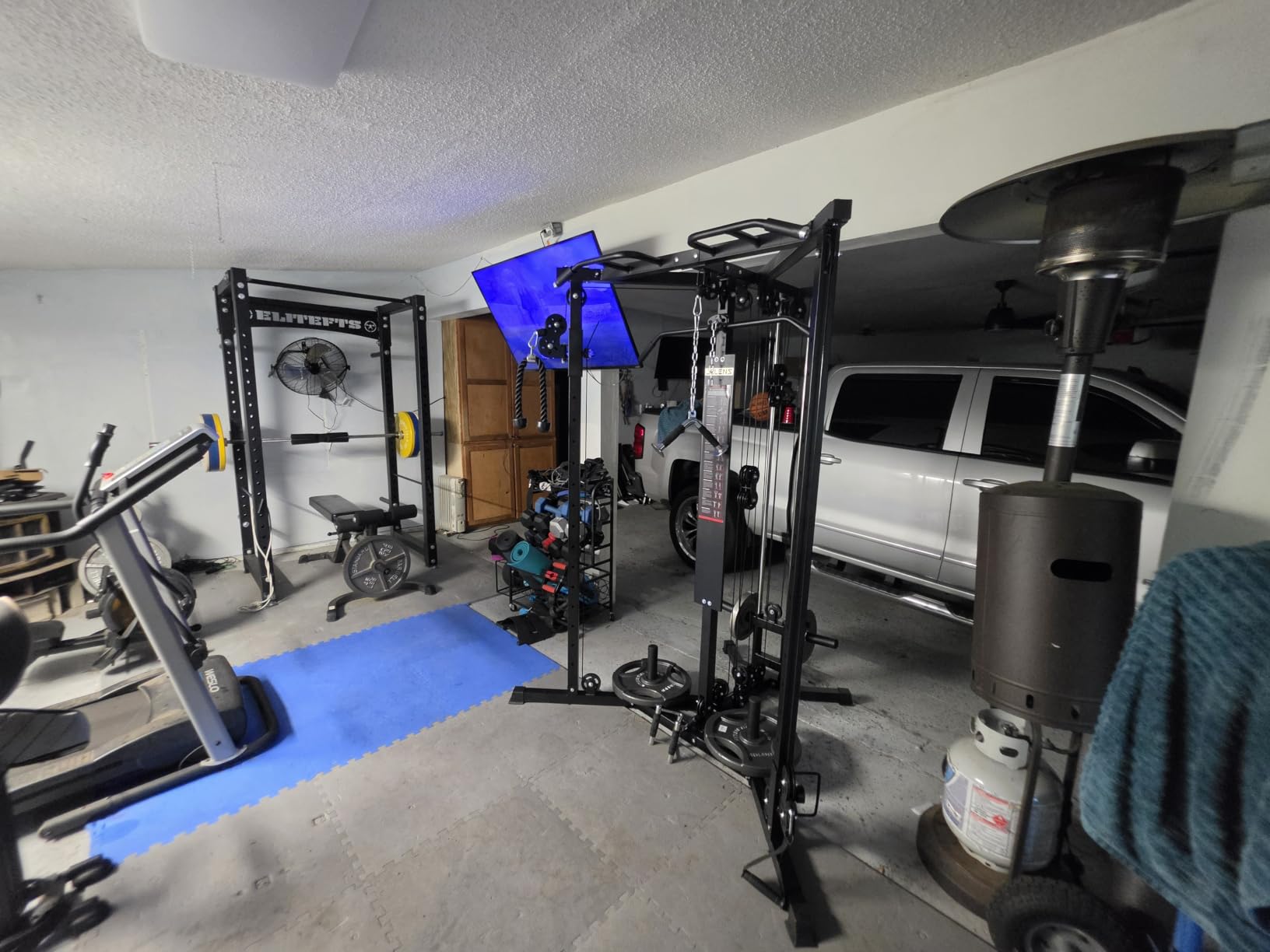
The 15 height adjustment levels, PU-coated steel cables, and gym-grade 50x50mm commercial steel tubing deliver a smoother feel than the price suggests. The 500-pound capacity on the detachable pull-up bar means you can do bodyweight work and cable work on the same machine. The included pull-down bar, rowing bar, and pull-up handles cover a beginner routine.
Assembly requires 2 to 3 people and about 1.5 hours according to most reviewers. Some users reported minor hole alignment issues that required adjustment. For heavier workouts, the unit should be bolted down or weighted. JELENS includes a clear training guide, which is genuinely useful for beginners who have never used a cable crossover before.
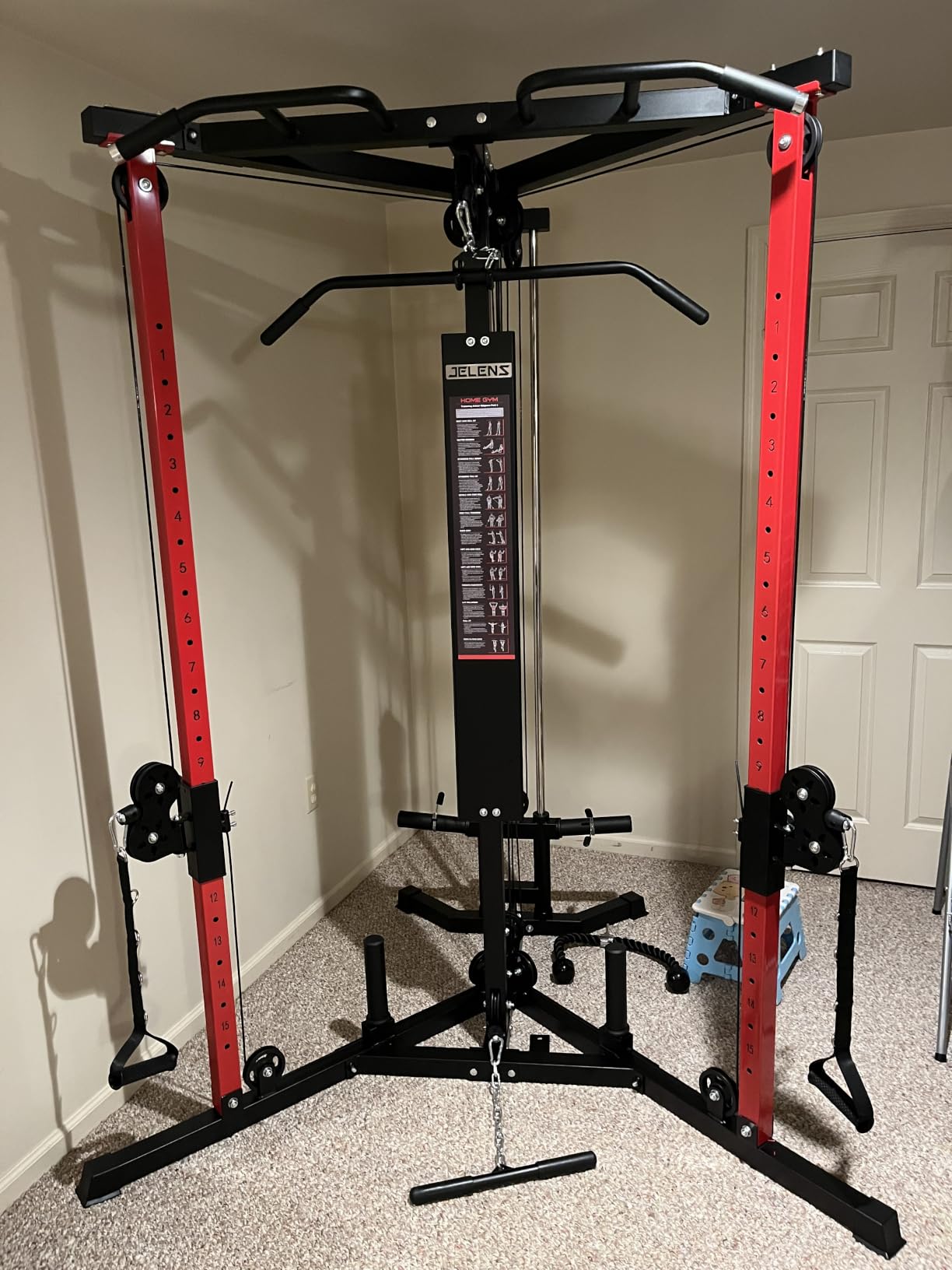
Triangular base stability
The triangular geometry resists racking forces during heavy cable flyes and tricep pushdowns better than rectangular bases in this price range. It is a smart design choice.
Best for beginners wanting crossover versatility
Choose the CC01 if you specifically want a cable crossover style machine but do not have room for a commercial-sized frame.
12. Sportsroyals Power Rack with Pulley System – Top Rated Power Cage
SPORTSROYALS Squat Rack, 1200 lb Power Cage with LAT Pulldown for Home Gym
1200LB capacity
Multi-functional power cage
Lat pulldown system
Pros
- 1200 lbs weight capacity
- Multi-functional squat rack and cable system
- Extensive accessory package
- Clear assembly instructions
- Prime eligible fast delivery
- 14 height adjustments
Cons
- Assembly takes 2-5 hours
- Some quality control issues
- Metal thinner than commercial racks
- Cable system needs 70+ lbs for smoothness
- Foot plate positioned close to cage
The Sportsroyals Power Rack rounds out this list with 686 reviews and a 4.5-star average, making it one of the most verified beginner power cages on Amazon. At $309.99 with Prime shipping, it is the best-priced full power rack in our roundup.
Building it took about 4 hours in my garage. The 50x50mm commercial steel frame at 1.5mm thickness is thinner than a dedicated commercial rack, but more than adequate for the 250 to 350-pound loads most beginners will use in the first two years. The upper and lower pull-down pulley system adds genuine cable functionality to a traditional power rack.
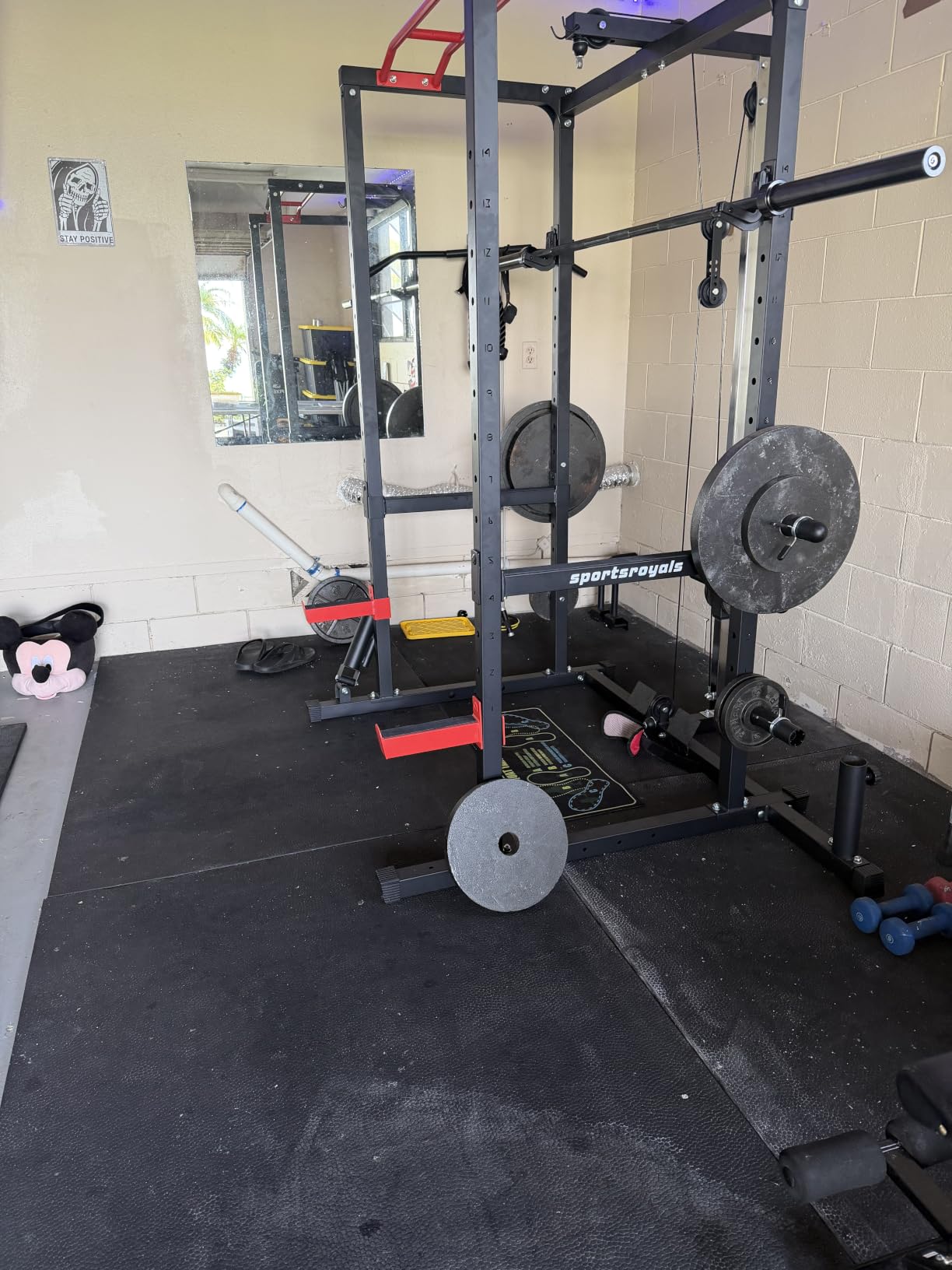
The accessory package is generous: lat pull-down bar, cable bar, handles, J-hooks, safety frames, wide and narrow pull-up bars, dip bars, 360-degree landmine, 6 band pegs, 6 barbell clamps, weight plate storage, barbell storage, and 6 handle hooks. For a beginner, this is essentially a complete home gym in a single rack.
The cable system is the one tradeoff worth understanding. It runs smoothly once you load 70+ pounds, which is fine for compound lifts but means light warm-up sets may feel a bit jerky. Assembly time varies from 2 to 5 hours depending on experience, and a small percentage of customers reported hole alignment issues that needed adjustment.
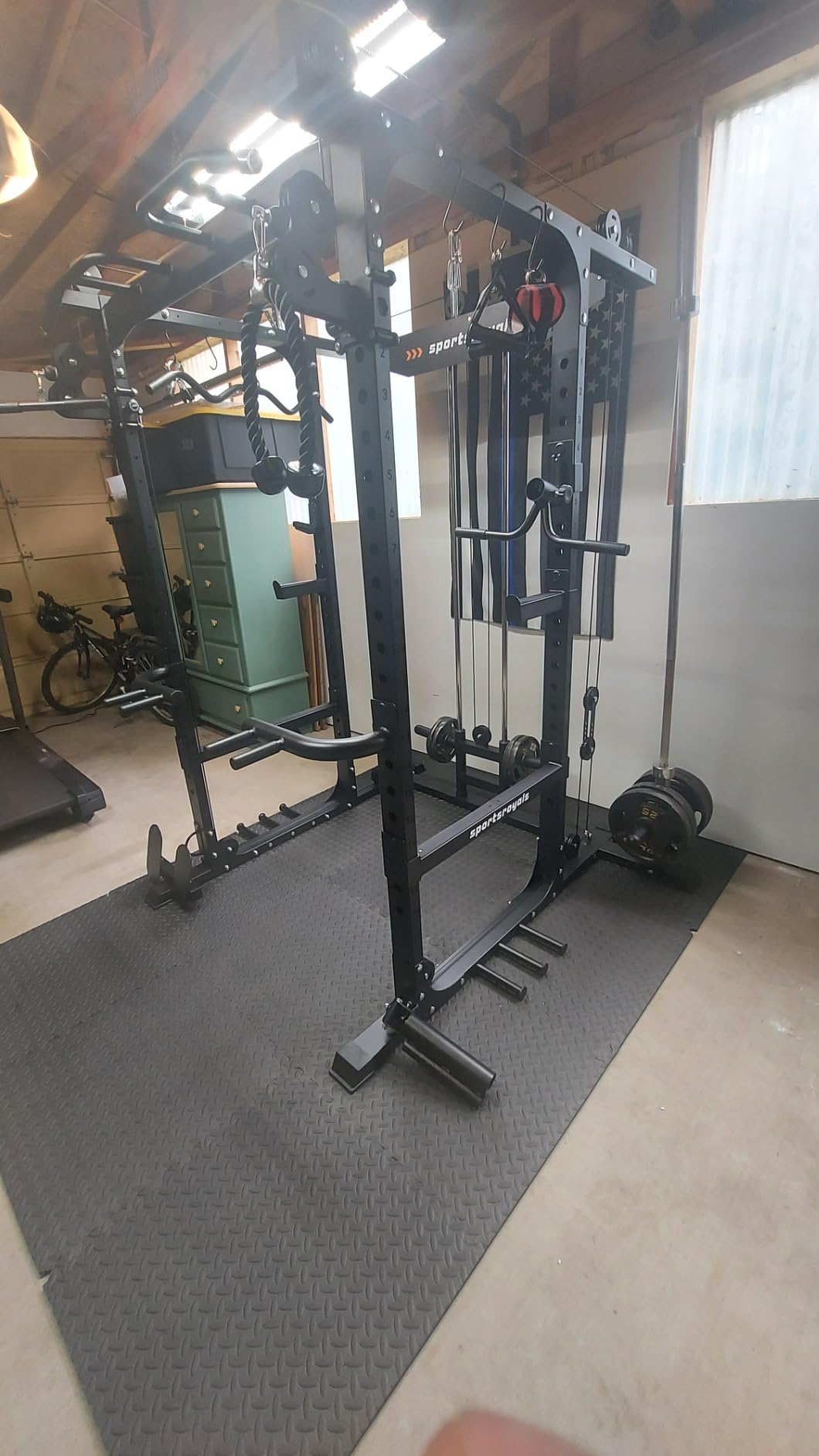
Why verified reviews matter here
With 686 reviews, you can sort through the noise and see real long-term owner experiences. The consensus is overwhelmingly positive for the price, with the cable smoothness caveat being the most consistent critique.
Best for beginners building a complete home gym
Choose the Sportsroyals Power Rack if you want a squat rack foundation, cable functionality, pull-up bar, and dip station in a single package, and you value verified long-term owner feedback.
How to Choose the Right Cable Machine for Your Home Gym
Picking the best home gym cable machine for beginners is less about brand loyalty and more about matching the machine to your space, budget, and training style. Here are the factors our team weighs when advising first-time buyers.
Pick your format first
The single biggest decision is format. Wall-mounted pulleys like the Mikolo or JELENS RC01 save floor space but require drilling. Lat pulldown towers like the GDLF or Goimu LS01 are freestanding but limited in exercise variety. Functional trainers and power cages like the Goimu DP01 or Sportsroyals rack give the most exercise options but require the most space. The r/homegym community consistently warns that buying the wrong format is the number one source of buyer regret.
Decide between selectorized, plate-loaded, or bodyweight resistance
Selectorized weight stacks use a pin to select resistance, which is fast and beginner-friendly. Plate-loaded systems use Olympic plates, which means you need to buy plates separately but never outgrow your resistance. Smart cable machines use motors or magnetic resistance. For most beginners, a selectorized stack in the 150 to 200-pound range covers the first one to two years of training without buying additional plates.
Understand pulley ratio
Pulley ratio determines how heavy the cable feels relative to the actual load. A 1:1 ratio means what you set is what you pull. A 2:1 ratio halves the perceived weight, which allows you to load more plates but changes the feel of the movement. The XMark Functional Trainer is praised in forums for its buttery smooth dual pulley system, which is the commercial-grade feel to aim for. Beginners doing form practice often prefer 2:1 ratios, while those focused on strength prefer 1:1.
Measure your space with cable clearance
Most beginners underestimate the footprint of a cable machine. Beyond the frame dimensions, you need 2 to 3 feet of clearance on every side for full cable travel during exercises like cable crossovers and face pulls. Measure your ceiling height too. A 7-foot ceiling fits most machines, but users over 6 feet tall may feel cramped on standard lat pulldown setups.
Check the pulley material and bearings
Pulley quality and smoothness is the most common source of negative reviews in our research. Aluminum pulleys with sealed bearings and brass bushings are the gold standard. Plastic pulleys are functional but feel grittier and wear faster. Silicone spray lubricant can dramatically improve the feel of plastic pulleys during the break-in period.
Calculate total cost of ownership
The sticker price is rarely the final cost. Factor in shipping on machines over 100 pounds, which can add $50 to $200. Assembly tools, silicone lubricant, and starter attachments can add another $50 to $100. If you are budget-conscious, our recommendations above include machines where attachments are included.
Match warranty to your commitment
Lifetime frame warranties from brands like REP Fitness and Rogue are the gold standard. Most home gym machines offer 1 to 10 years on the frame and 1 to 3 years on cables and pulleys. For beginners not sure how long they will stick with it, a longer warranty reduces risk.
If you are also shopping for cardio equipment to round out your home gym, our guide to the 12 best rowing machines for home tested and reviewed covers the cardio side. And if you are a beginner just starting to build healthy routines, our piece on clipless vs flat pedals for beginners shares the same beginner-first mindset for outdoor training.
Frequently Asked Questions
Is a cable machine worth it for a home gym?
Yes. A cable machine adds versatility that free weights alone cannot match. You can perform dozens of exercises including lat pulldowns, cable rows, tricep pushdowns, face pulls, and chest flyes from a single station. For beginners, cables also offer more controlled movement patterns than free weights, which reduces injury risk while you learn proper form. Most home gym owners on r/homegym rate cable functionality as the second most valuable upgrade after a power rack and barbell.
What is the best home gym equipment for beginners?
For most beginners, the priority order is: a power rack or squat stands with a barbell, an adjustable bench, a set of dumbbells, and then a cable machine. The cable machine comes after the basics because it adds exercise variety once you have mastered compound barbell movements. If space or budget is limited, a wall-mounted cable pulley or lat pulldown tower is the smartest single-machine starter.
What gym machines are best for beginners?
Beginners benefit most from machines that offer controlled movement patterns, adjustable resistance, and low injury risk. Functional trainers, lat pulldown towers, and cable crossover machines are beginner favorites because they guide the movement path. Selectorized weight stacks with 150 to 200 pounds of resistance give you room to grow without overwhelming you on day one.
What is the best cable crossover machine for home use?
For beginners, the JELENS CC01 and the Goimu DP01 Power Cage with Cable Crossover are both strong picks. The JELENS CC01 fits in a 12.1 square foot footprint, which is ideal for small home gyms. The Goimu DP01 adds a full power rack for users who want squat and deadlift training alongside cable work. Both use dual adjustable pulleys for full-body workouts.
What are the downsides of cable machines?
The main downsides of cable machines for beginners are: higher upfront cost than basic free weights, larger footprint than a single barbell, longer assembly time for functional trainers (3 to 5 hours), and the need for ceiling or wall clearance for full range of motion. Cheap pulley systems under $100 also tend to have sticky cables and shorter lifespans, which is why we focused on machines with aluminum pulleys and sealed bearings where possible.
Do pulleys on cable machines reduce weight?
It depends on the pulley ratio. A 1:1 ratio means the cable feels exactly as heavy as the weight you load. A 2:1 ratio halves the perceived weight, so a 100-pound plate load feels like 50 pounds at the handle. Both ratios are used commercially. Beginners often prefer 2:1 ratios because they allow heavier loading for slower eccentrics and form work, while strength-focused lifters generally prefer 1:1 for predictable progression.
The Bottom Line
Choosing the best home gym cable machine for beginners comes down to three honest questions: How much space do you have? How much can you spend? And what exercises matter most to you. Our testing across 12 machines this year confirmed that the beginner category is more competitive than ever, with genuine options at every budget.
If you want a single answer, the Goimu DP01 Power Cage with Cable Crossover is our top pick for beginners who want one machine that will not feel limiting in two years. For tight budgets, the GDLF LAT Pull Down Machine delivers real lat pulldown and cable row capability without breaking $200. For small spaces, the Mikolo Wall Mount Cable Station and JELENS RC01 Rowing Cable Machine solve problems that freestanding towers cannot.
Before you click buy, measure your space including cable clearance on every side. Check that wall-mounted options can be securely anchored to studs or concrete. Decide between selectorized and plate-loaded based on whether you already own Olympic plates. And remember the r/homegym advice that holds true across every price point: prioritize pulley quality over everything else, because sticky cables are the most common reason beginners abandon a machine within six months.
Your first cable machine should make training easier, not add frustration. Pick the one that matches your space and budget, run through the assembly carefully, and start with cable rows, lat pulldowns, face pulls, and tricep pushdowns. Those four exercises alone will transform your pulling and pressing for the next decade. Welcome to cable training.