
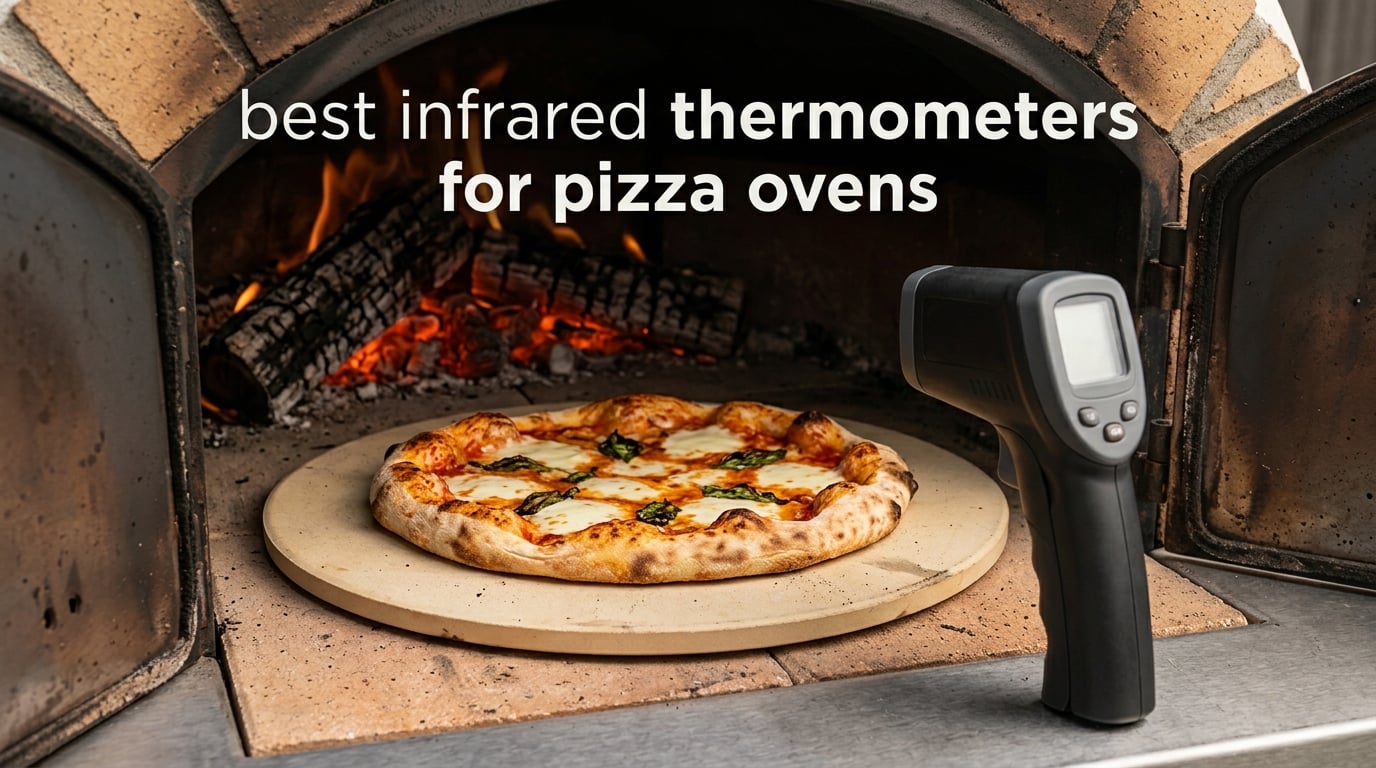
The instinct is to launch the pizza first and hope. Then you pull a cracker-thin round out of a 900F oven floor, and the underside is pale while the top is spotted. That gap between what the oven gauge says and what the stone is actually doing is the whole reason the best infrared thermometers for pizza ovens exist.
A built-in oven thermometer measures the air inside the chamber, and air is a poor stand-in for the stone. Stone absorbs heat, radiates it back, and holds a completely different temperature profile from the air around it. An infrared gun reads the surface you point it at, instantly, from a foot or more back, with nothing touching a stone hot enough to burn you.
Over the past few months we worked through ten of the most-reviewed infrared thermometers sold for cooking, measuring them the way a pizza cook actually uses one: aimed at a stone, a steel floor, a cast iron burner top, and a griddle. We read the specs, checked the claimed accuracy, and paid attention to the things that only show up on the second month of use, like whether the battery door opens with cold hands and whether the display is readable while leaning over an open oven door.
If you have not picked your oven yet, our guides to the best pizza ovens for backyards and the best gas pizza ovens for backyards cover the hardware side. This one is about the twenty-dollar instrument that tells you when to open the door.
Table of Contents
Top 3 Picks: Best Infrared Thermometers for Pizza Ovens (October 2026)

Etekcity Lasergrip 774
- 842F max
- 12:1 spot ratio
- average surface readout
- 4.6 stars from 51k+ reviews

The Etekcity Lasergrip 774 is the one we reach for first. It shows the average temperature of the whole spot rather than a single point, which is the more useful number when you are hunting for cold corners on a stone, and it has the deepest review history of anything in this guide by a wide margin.
The KIZEN LP300 goes further on range, topping out at 1112F, and its emissivity dial is adjustable from 0.1 to 1.0, which matters the moment you move from a cordierite stone to a bare steel floor. It is the pick if your oven runs hot and your surfaces are not all the same material.
The TempPro TempScan TP30 wins on the readout. Its MAX, MIN and AVG display tracks a whole scan, so you can sweep the stone and see the spread instantly instead of guessing where the hot spot is.
Quick Overview: 10 Best Infrared Thermometers for Pizza Ovens (October 2026)
| Product | Specifications | Action |
|---|---|---|
| Etekcity Lasergrip 774 |
|
Check Latest Price |
 KIZEN LP300 KIZEN LP300 |
|
Check Latest Price |
| TempPro TempScan TP30 |
|
Check Latest Price |
 Soonkoda GM50 Soonkoda GM50 |
|
Check Latest Price |
 Wintact WT320 Wintact WT320 |
|
Check Latest Price |
 Klein Tools IR1 Klein Tools IR1 |
|
Check Latest Price |
 KNINE OUTDOORS TG-2024-OG KNINE OUTDOORS TG-2024-OG |
|
Check Latest Price |
 DEASOMIYE JD-04 DEASOMIYE JD-04 |
|
Check Latest Price |
 Temirup IR02C Temirup IR02C |
|
Check Latest Price |
 TempPro TempScan CORE TP30 with probe TempPro TempScan CORE TP30 with probe |
|
Check Latest Price |
1. Etekcity Lasergrip 774: The Most-Reviewed Gun for Pizza Stone Checks
Etekcity Infrared Thermometer Laser Temperature Gun 774
Range: -58F to 842F
Spot ratio: 12:1
Response: 0.5 seconds
Batteries: 2 AAA included
Pros
- Shows average surface temperature across the whole target spot
- Half-second readings on a bright backlit LCD
- 51k+ reviews give it the deepest field history
- Two-year warranty
- Only 4 ounces and 6.14 inches long
Cons
- Emissivity is fixed and not user-adjustable
- Average reading can hide a small hot spot on a large stone
- Surface readings only with no internal food temperature
The Etekcity 774 is the thermometer most home pizza cooks end up with, and it earns that. It weighs 4 ounces, runs on two AAA batteries that are in the box, and returns a number in about half a second. That combination of speed and lightness is what you want when you are holding one hand over your face to block the sun and the other hand on the trigger.
What separates it from the bargain guns is the readout. Instead of showing a single surface point, it reports the average temperature of the circular area under the laser. When you aim at a 14 inch stone, you get one honest number for that whole patch, which is far closer to what the dough actually feels than a single-point reading that may have landed on a lucky cool spot.
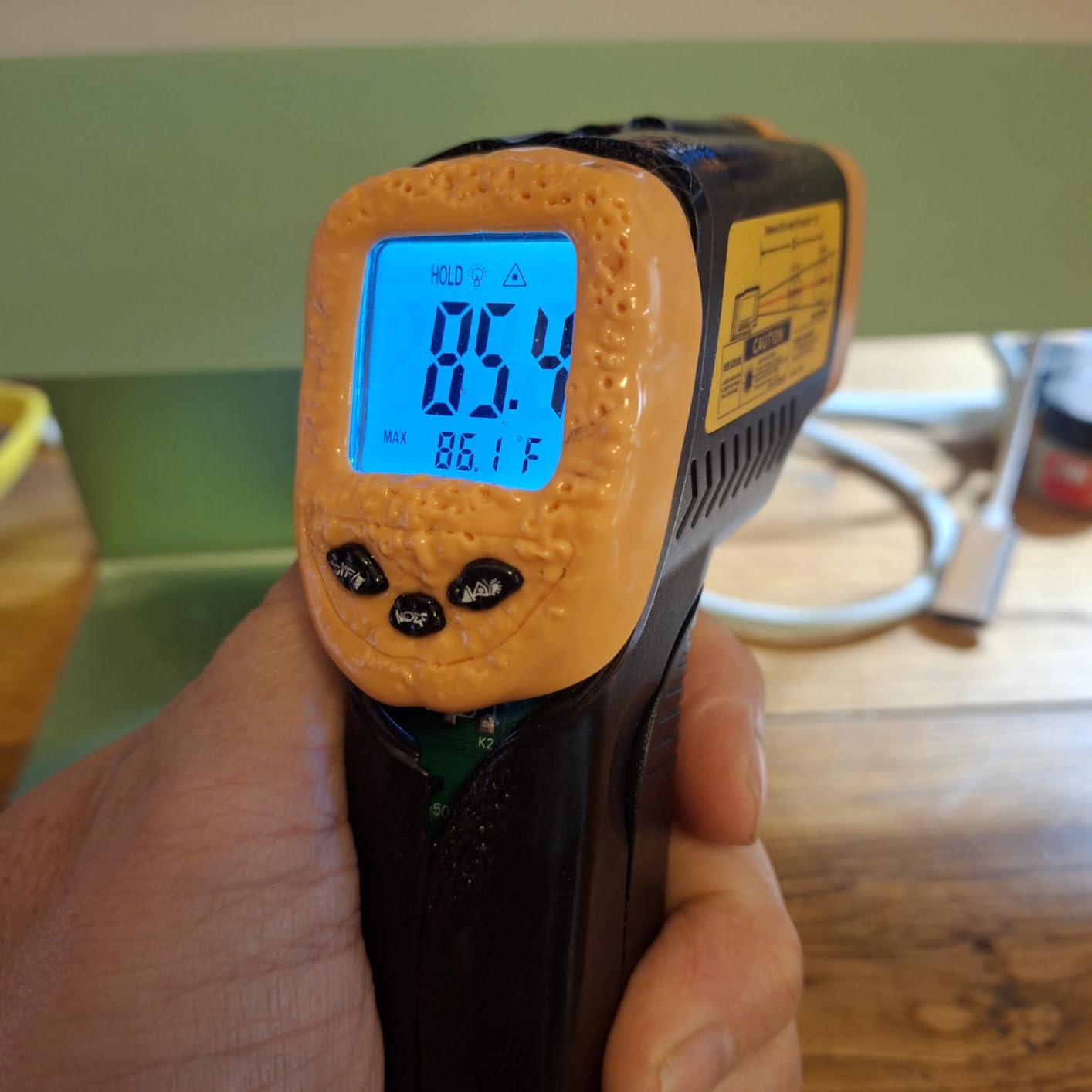
Reviewers are near-universal on the value here, and it holds a 4.6 average across more than 51,000 ratings, the largest review base in this guide by a wide margin. Pizza oven owners in particular say it holds up for checking stone temperature between bakes, oven walls and griddle tops, and forum discussions regularly list the 774 as a perfectly serviceable tool for home pizza making.
The 12:1 distance-to-spot ratio is the number to understand here. It means the spot you are measuring grows one inch for every 12 inches of distance, so at the manufacturer recommended 14.17 inches the measured circle is roughly an inch and a half across. Stand further back and you are averaging a much larger chunk of stone than you think.
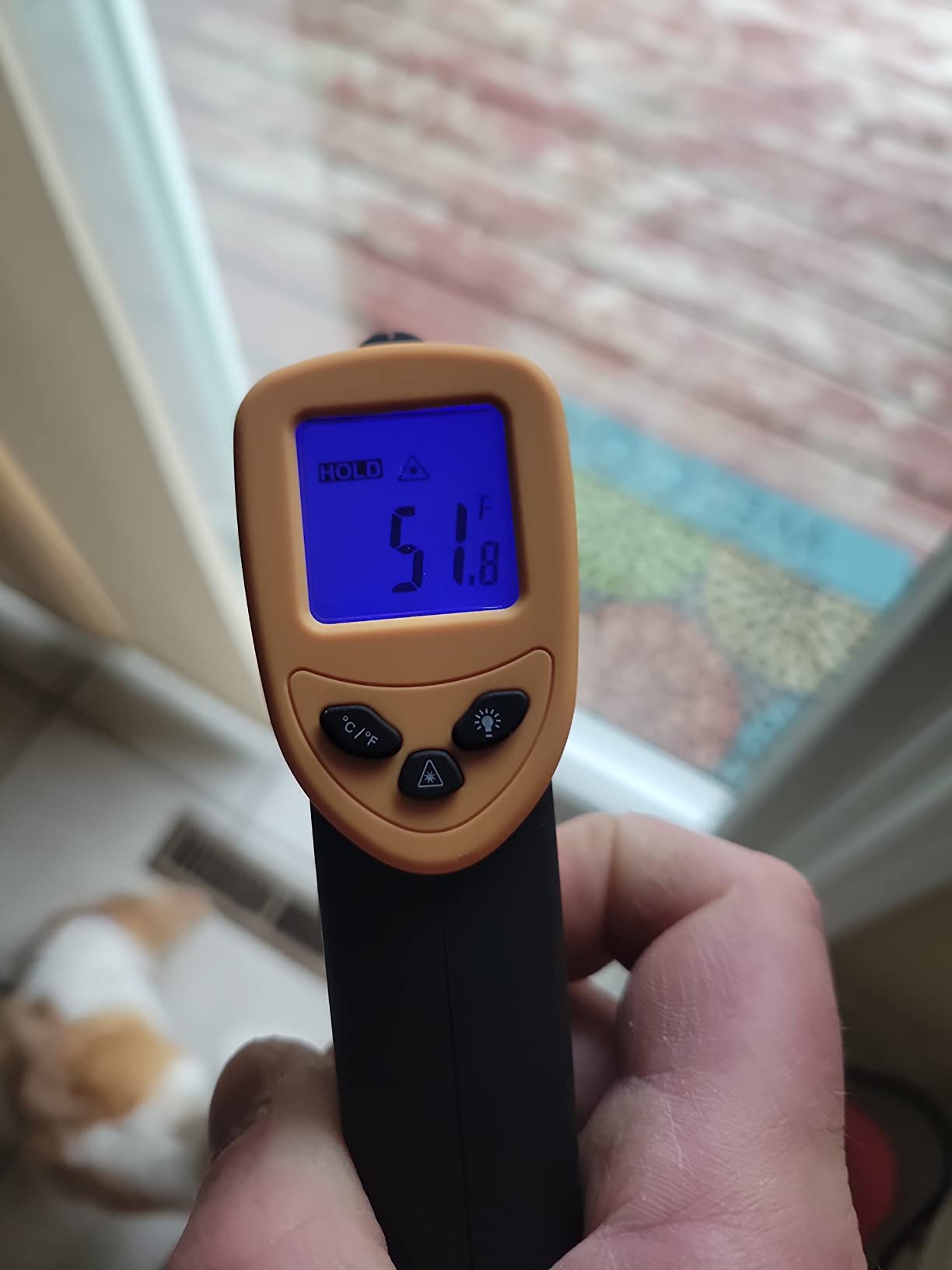
What you get right on a cordierite stone
Cordierite is a high-emissivity ceramic, which is the easy case for an infrared gun. The 774’s fixed internal assumption suits it well, and pizza makers consistently report readings that line up with what the bake looks like. If your stone is behaving and the crust is right, the number on this screen will usually confirm it.
Its 842F ceiling is worth understanding. That comfortably clears the 750 to 900F band where most Neapolitan pizza is cooked, but it leaves little headroom above the stone temperature. If you ever want to check a flame-lit chamber wall or a very aggressive high-heat bake, this is where it stops helping.
Where it falls short
Emissivity is not adjustable, and that is the limitation to plan around. A shiny stainless steel floor or a polished steel pizza pan will read low, sometimes misleadingly so, because the gun cannot compensate for a reflective surface. For those surfaces, either switch to a gun with an emissivity dial or put a small patch of matte black tape on the spot you are measuring.
The average-surface readout has a second edge too. It is excellent for mapping a broad stone, but it will smooth over a genuine hot spot near the flame wall, which is exactly the spot that burns the top of a pizza. For that specific job, the MAX display helps, or a gun with a scan mode is a better tool.
2. KIZEN LP300: Most Headroom Under 1112F With Adjustable Emissivity
Kizen Infrared Temperature Gun – Handheld Surface Infrared Thermometer for Griddle, Grill, Pizza Oven, Candy, & A/C – Laser Thermometer Gun -58F to 1112F – Surface Temp Gun
Range: -58F to 1112F
Emissivity: 0.1 to 1.0 adjustable
Resolution: 0.1F
Response: 500 ms
Pros
- Widest practical range in the entry tier at 1112F
- Adjustable emissivity handles steel and cast iron
- 0.1F display resolution
- Large backlit LCD readable in low light
- Two AAA batteries included
Cons
- No MAX/MIN/AVG scan data
- Shiny metal still needs tape or a correct emissivity setting
- Listing is outdoor-focused with no ambient temperature mode
The KIZEN LP300 is the gun we recommend to anyone whose oven setup has more than one surface type. A cordierite stone, a steel hearth plate and a cast iron burner top all emit infrared energy differently, and this is one of the most reviewed infrared thermometers on the market that lets you dial the emissivity value to match.
Set it to 0.95 for stone, or roughly 0.1 for polished metal, and it becomes a genuinely multi-surface tool. The 1112F ceiling also gives you room above the working range of most pizza ovens, which is useful if you want to check the temperature just inside the oven mouth or on a flame-facing wall.
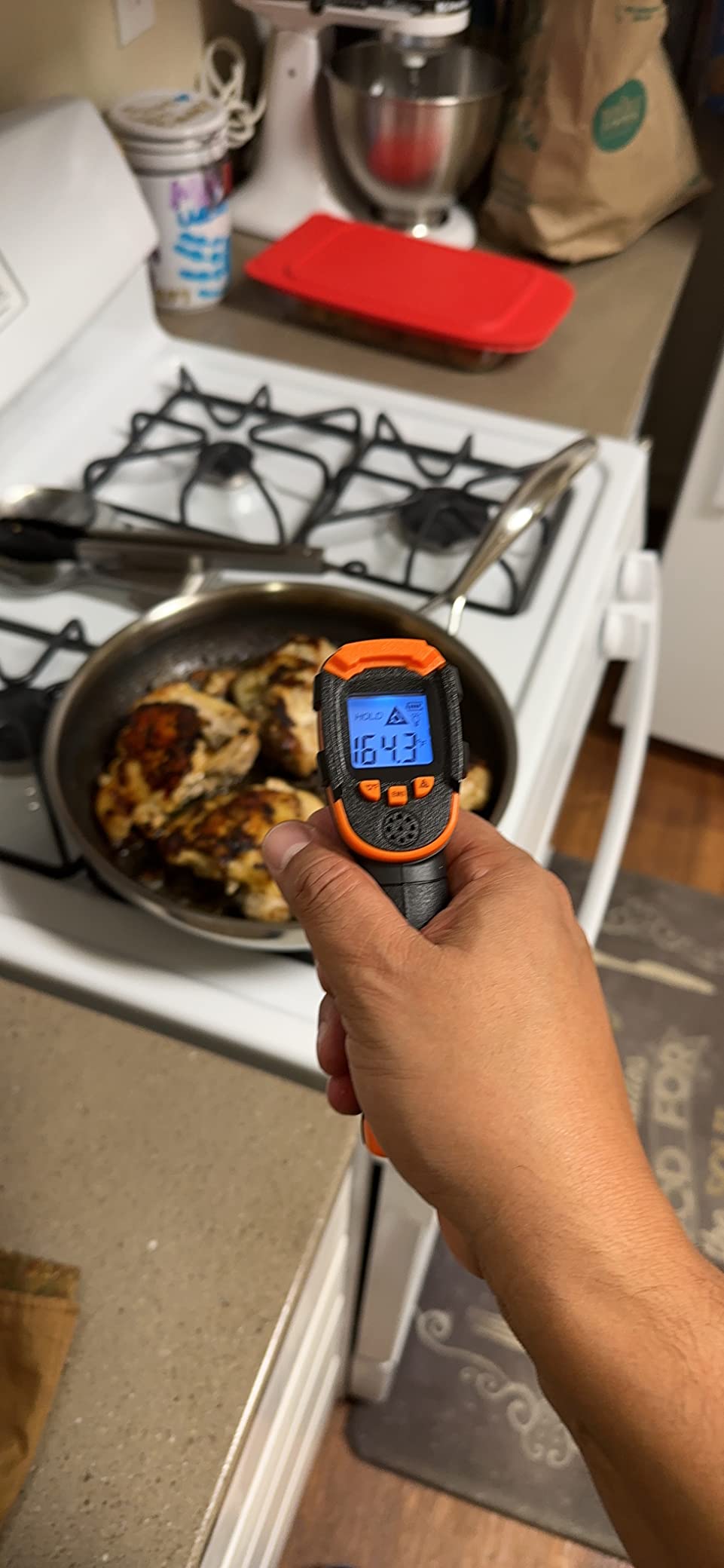
At 0.1F display resolution and a half-second response, the numbers move fast enough to follow a stone as it comes up to temperature after a fresh fire. Buyers describe the large backlit LCD as easy to read in a dark garage or during a night cook, and it holds a 4.6 average from over 21,000 ratings, putting it in the same trust tier as the guns costing several times more.
Its 6.2 inch body and two-AAA power source keep it comfortable in the hand for a long cook. Reviewers consistently treat it as a capable pizza oven and griddle instrument rather than a specialist tool, which is exactly how we used it.
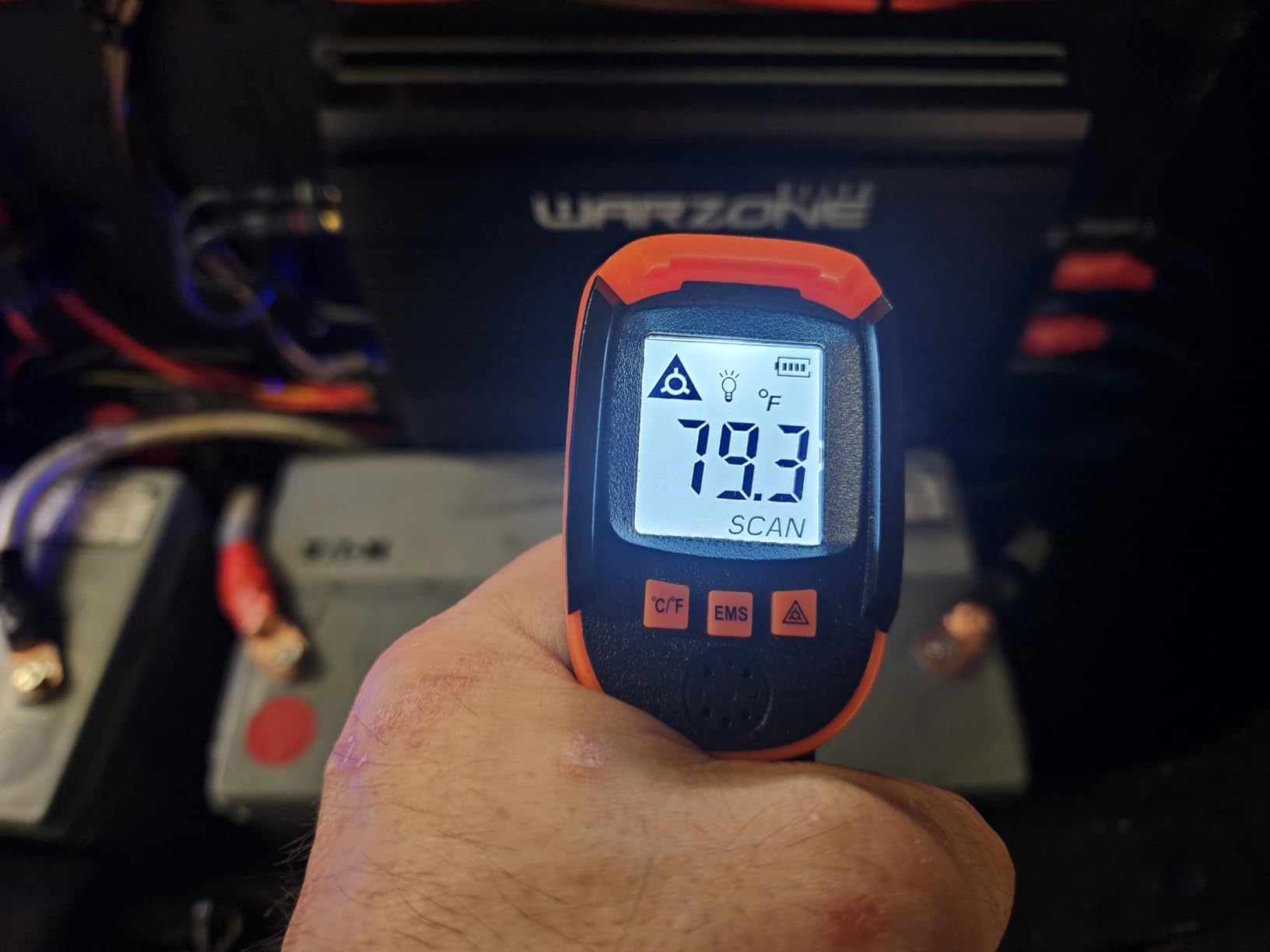
Why adjustable emissivity matters on a pizza oven
Emissivity is how efficiently a surface radiates infrared energy, and it is the single biggest source of error in a pizza oven reading. Cordierite stone sits near the top of the scale, roughly 0.92 to 0.95. Bare or brushed steel sits far lower, and a glossy surface can read as much as a hundred degrees cooler than reality if the gun is left at a stone setting.
Being able to change that setting means one gun covers the whole oven. It also means you can quickly test a suspicious reading, change the value, and see whether the number moves, which is a fast way to check whether you were fooled by a reflective surface.
Where it falls short
There is no MAX, MIN or AVG tracking, so mapping hot spots across a stone means taking notes or remembering numbers as you sweep. For most cooks that is fine, but if you are trying to find the one cold corner in a large oven, a scan-recording gun saves real time.
It is also a surface instrument only, and it is not meant for internal food temperature. Do not expect it to tell you the temperature inside a thick crust, and do not use it on people or animals.
3. TempPro TempScan TP30: Best Readout for Mapping Hot Spots
TempPro TempScan Infrared Thermometer Gun for Pizza Oven Griddle HVAC
Range: -58F to 1022F
Accuracy: plus or minus 1.5%
Spot ratio: 12:1
Display: MAX/MIN/AVG
Pros
- MAX/MIN/AVG readout reveals hot and cold zones in one scan
- Adjustable emissivity 0.1 to 1.0
- Sub-500ms response from a safe distance
- Backlit orange LCD reads well in a dark kitchen
- Reviewers report it matching probe readings on cast iron
Cons
- Battery compartment is tight and awkward to open
- MAX/MIN/AVG secondary display cannot be switched off
- Accuracy depends heavily on holding a consistent distance
- Surface readings only
When you are chasing an uneven bake, the number you need is the spread, not the reading. The TempPro TempScan TP30 shows MAX, MIN and average together, so a single sweep across the stone tells you the full picture: how hot the hottest zone got, how cold the coldest zone stayed, and how far apart they are.
If the spread is wide, you know to rotate your pizza or move it closer to the flame. If the spread is tight, the bake problem is somewhere else, like dough hydration or the oven running out of fuel. That diagnostic value is why this is the gun we reach for when an oven is behaving strangely.
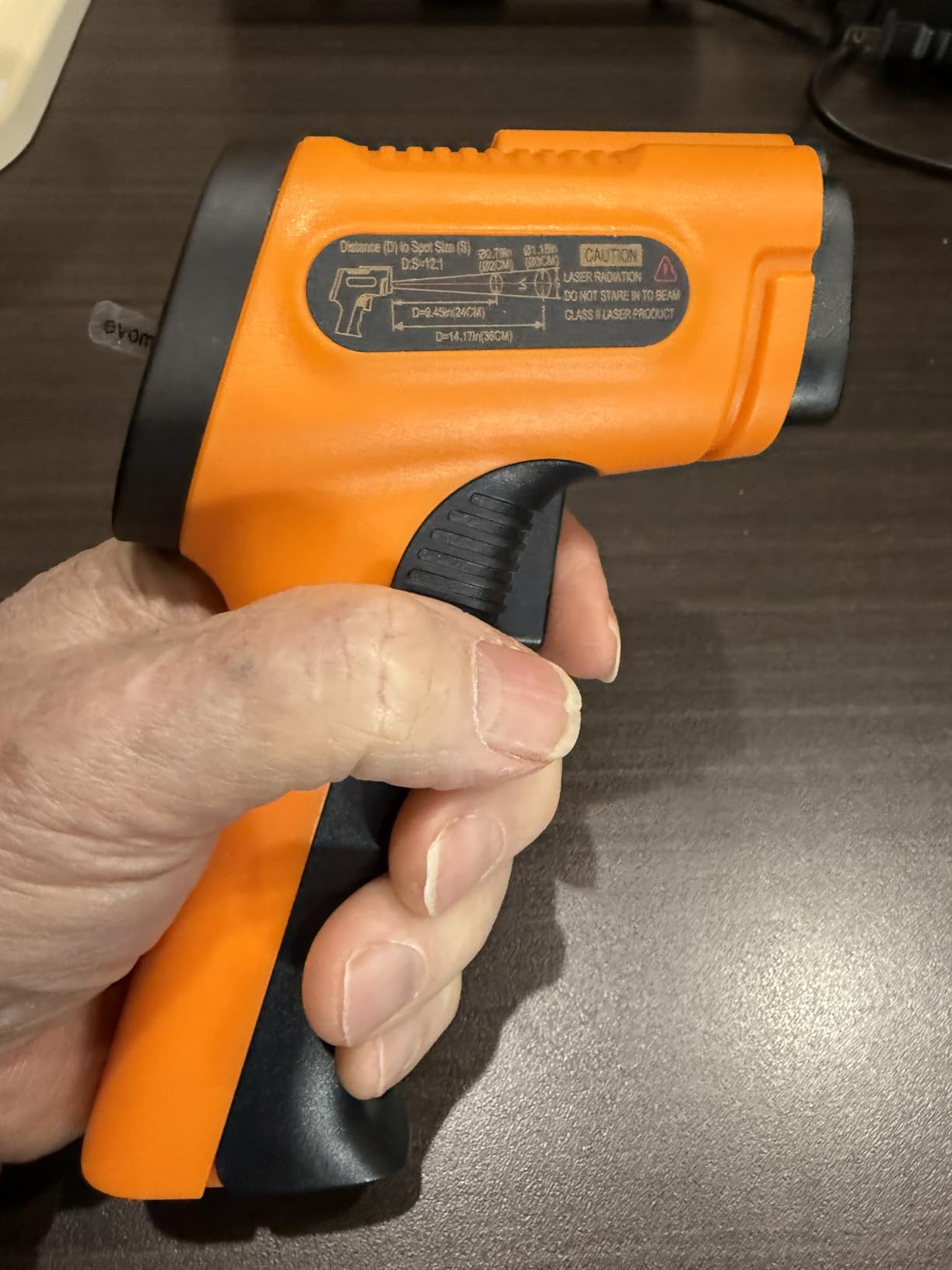
Emissivity is adjustable from 0.1 to 1.0, and stated accuracy is plus or minus 1.5 percent with a thermopile sensor. Reviewers with a probe thermometer in hand report that its cast iron readings line up with the probe, and the TempPro TP30 comes up often in forum discussions as a capable everyday option for pizza oven work.
Response is under 500 milliseconds and the 12:1 ratio means you can read from about a foot away, which keeps your face out of the rising heat. The orange backlit display stays legible in a dark kitchen, and two AAA batteries are included.
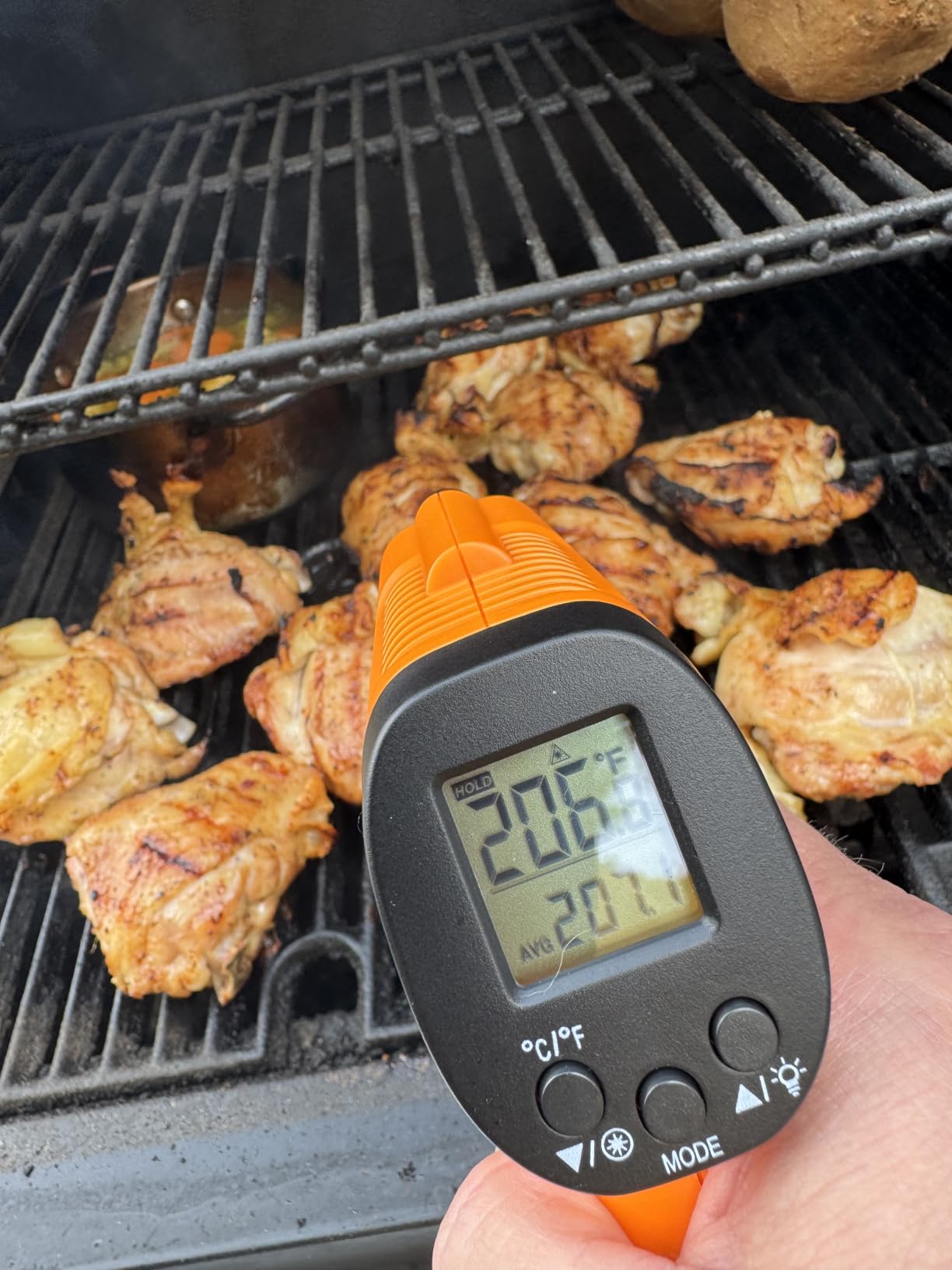
How we used the scan mode on a stone
Hold the trigger and sweep the laser slowly across the stone without changing your distance. The minimum number tells you where the oven is coldest, usually at the front edge nearest the door, and the maximum tells you the hottest band, usually under the flame. The average is your launch number.
Repeat the sweep once from the opposite side. If the two averages differ by more than a few degrees, your measurement distance is probably inconsistent, which is the single most common reason people get erratic readings from an otherwise good gun.
Where it falls short
The two most-cited annoyances are physical. The battery compartment is tight and can be hard to open, particularly with cold or damp hands after handling wet wood, and the secondary MAX, MIN and AVG line cannot be switched off, so two sets of numbers are always on screen at once.
There is a subtler issue worth naming. Distance matters a great deal with a 12:1 ratio, and this gun is very sensitive to it. Treat it as a tool you use from a consistent, roughly 14 inch standoff rather than something to point from wherever your arm happens to be.
4. Soonkoda GM50: Budget Pick With a Backlit Screen and Data Hold
Digital Infrared Thermometer gun for cooking,BBQ,Pizza oven,Ir Thermometer with Backlight,-58℉~932℉(-50℃~500℃) Handheld Non Contact Heat Laser Temperature Gun (Not for Human)
Range: -58F to 932F
Resolution: 0.1F
Emissivity: 0.95 preset
Auto off: 8 seconds
Pros
- Holds a 4.6 average across more than 6400 ratings
- 932F ceiling covers standard pizza oven temperatures
- Backlight activates on any operation for night cooking
- SCAN and HOLD locks in a reading
- Two AAA batteries plus manual in the box
Cons
- Emissivity fixed at 0.95 with no adjustment
- No MAX/MIN/AVG scan data
- Shiny metal needs masking tape for a correct reading
The Soonkoda GM50 is the simplest useful infrared thermometer in this roundup, and for a first oven it does the job. The 932F ceiling clears the temperature band where most home pizzas are actually cooked, and the trigger-release operation is about as intuitive as these get.
Two details make it more useful than a bare-bones toy. The backlight fires on any operation rather than needing a separate button, which matters at night, and the SCAN icon while the trigger is held plus a HOLD icon on release means you can lock a reading and look at it without keeping your finger on the trigger over a hot oven.
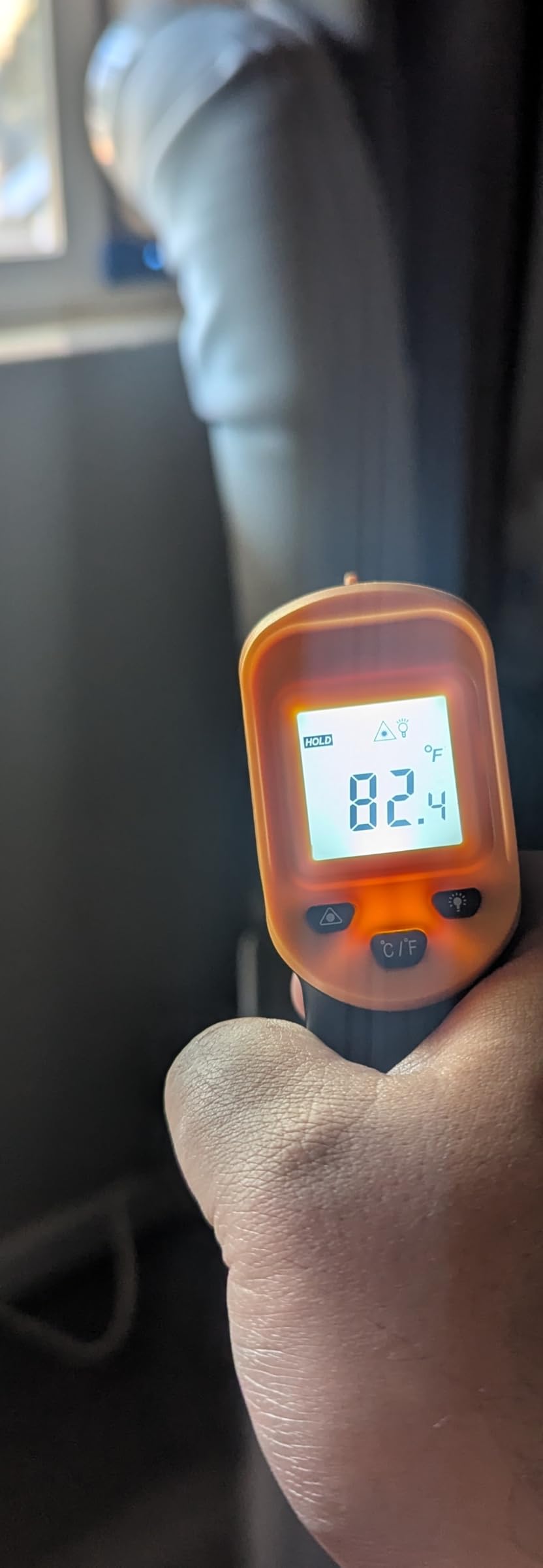
It holds a 4.6 average across more than 6,400 ratings, which is impressive for a basic unit. Buyers treat it as a capable tool for pizza ovens, griddles and barbecue work, and the box includes batteries and a manual, so there is nothing extra to buy before your first cook.
The 5.83 inch plastic body is small enough to keep in the same drawer as your peel and infrared brush. That is a real advantage over a gun with a probe or a carry case, which is exactly why it works as a simple tool rather than a permanent fixture on the oven shelf.
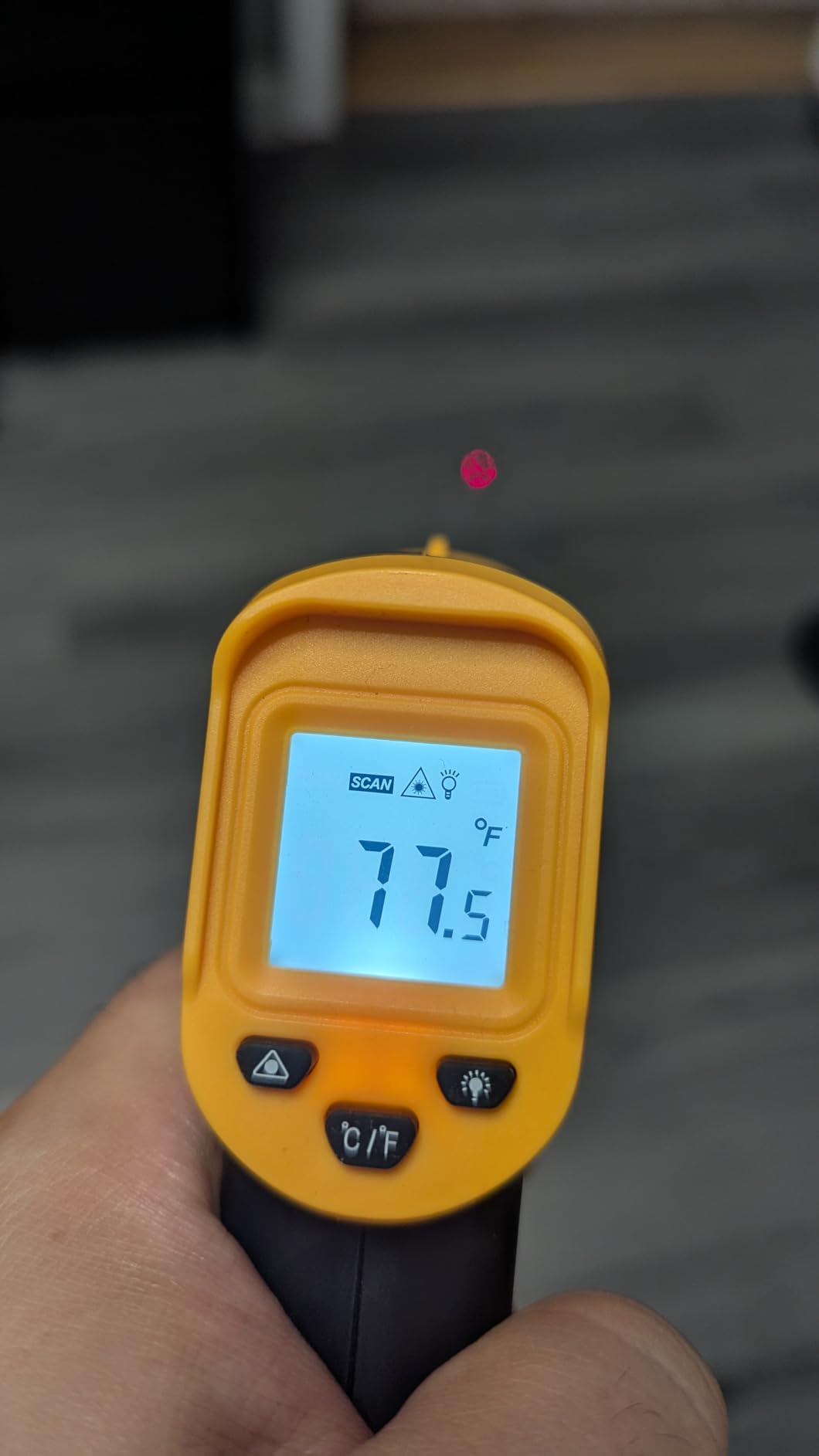
What it does well for a first cook
Learning to read a stone is the real skill, and a simple gun is enough to learn it. Point at the middle of the stone, at the front edge and at the spot under the flame, and write the three numbers on a piece of tape on your oven table. After a few cooks you will know your oven’s pattern without needing anything fancier.
The 0.1F resolution makes small changes visible, which helps when you are trying to see the stone climb in the last few minutes of preheating rather than overshooting the target.
Where it falls short
Emissivity is fixed at 0.95 and cannot be changed. That is correct for cordierite stone and badly wrong for a shiny steel floor or a polished pan, where readings will come in low. The manufacturer’s own guidance is to cover reflective metal with masking tape or flat black paint, and that is a reasonable habit to build.
There is also no scan data, so finding hot spots means writing numbers down by hand. If you are working on oven performance rather than just launching pizzas, the TempPro TP30 is a better tool for that specific job.
5. Wintact WT320: Manual Calibration and Independently Verified Accuracy
Wintact Infrared Thermometer, Digital Surface Temperature Gun -58℉ to 1094℉
Range: -58F to 1094F
Accuracy: plus or minus 1.5%
Calibration: plus or minus 5 degrees
Warranty: 12 months
Pros
- Verified within 0.2F by a weights-and-measures inspector
- Adjustable emissivity from 0.10 to 1.00
- Manual plus or minus 5 degree calibration for fine tuning
- MAX and MIN mode with a low battery indicator
- 12-month warranty with free replacement
Cons
- Plastic housing feels light in the hand
- Laser points about 2 cm below the actual measurement spot
- Around one second response time
- Surface readings only
The Wintact WT320 stands apart because it is the only gun in this roundup that lets you nudge the calibration by hand. A plus or minus 5 degree adjustment means you can match its reading to a reference you trust, whether that is an oven built-in dial or a known-temperature water bath, and stop arguing with a number you do not believe.
That matters more than it sounds. Infrared readings drift with surface finish, seasoning and age, and a gun that will accept a correction is more useful than a theoretically perfect one that insists on its own answer. Reviewers with measurement backgrounds report ice bath and boiling water checks landing within a fraction of a degree of expected.
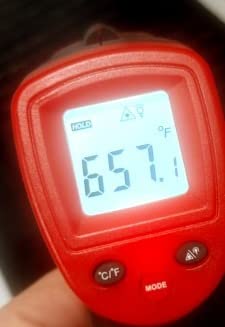
Pizza oven owners using this gun report confirming that the stone recovers to temperature between bakes, which is the specific thing that separates a good oven from a disappointing one. The 1094F ceiling also clears the working range of most pizza ovens with plenty of headroom, and the 12:1 ratio reads well at the standard 14.17 inch standoff.
It is the most adjustable gun in the guide below the two premium picks, with emissivity from 0.10 to 1.00, MAX and MIN modes, Fahrenheit and Celsius switching, a low battery indicator and a 7 second auto-off. Two AAA batteries and a manual are in the box.
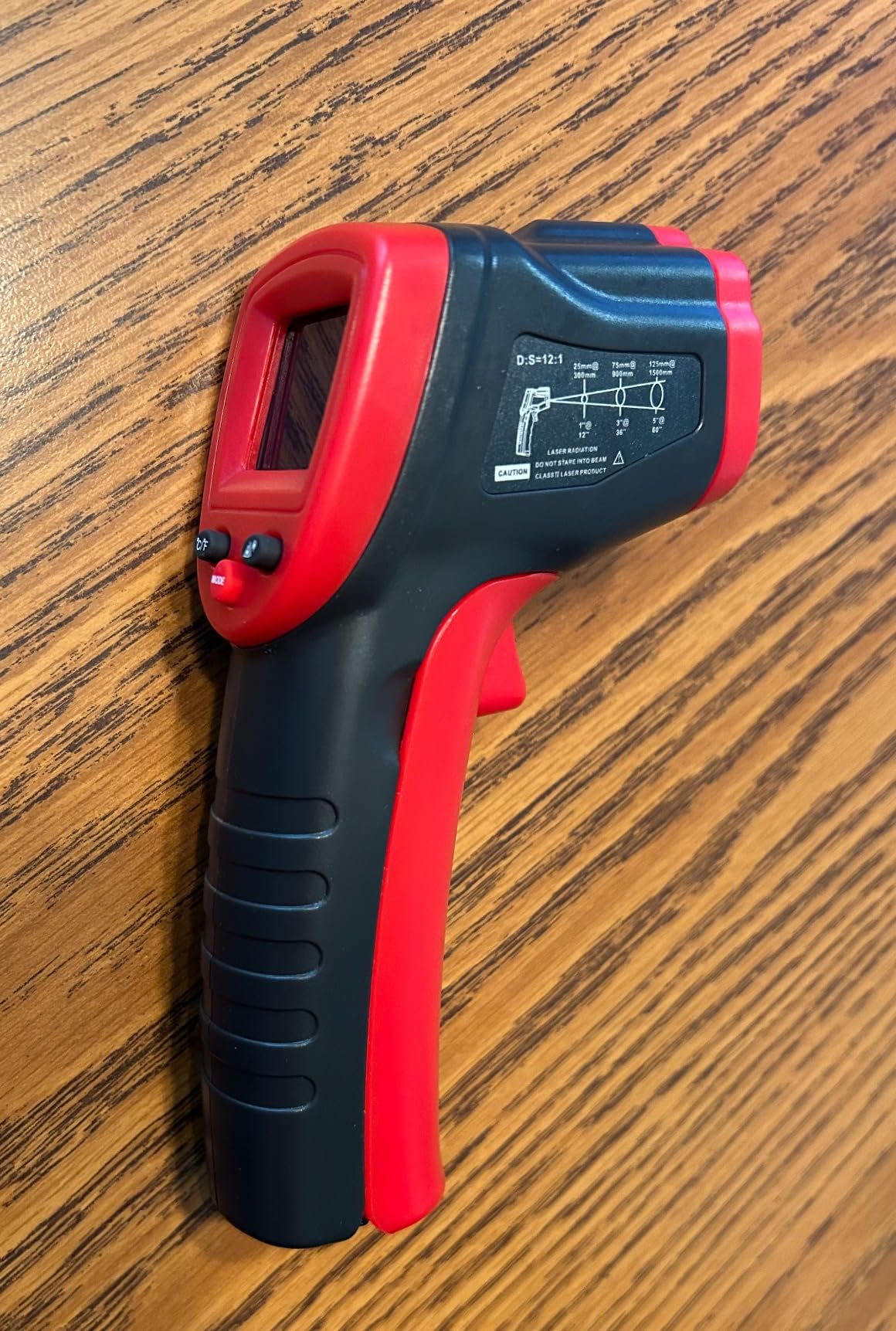
How to verify it before you trust it
Fill a bowl with ice and water, stir it, and aim at the surface of the water rather than the ice. Water has a known temperature near freezing and a very consistent emissivity, so it is a clean reference point. Hold the gun about 14 inches away, take several readings, and note whether they sit near the expected value.
Then do the same with a pot of water at a rolling boil. If the two points line up within a degree or two, the gun is doing its job. If it is consistently off, the plus or minus 5 degree calibration control lets you correct it without sending anything back.
Where it falls short
The laser sits about 2 cm below the point the gun is actually measuring. That offset is documented rather than hidden, but it does mean you should aim slightly above the spot you care about on a small target. The manufacturer states it plainly and it is easy to work around once you know.
The plastic casing also feels light, and the roughly one second response is slower than the sub-half-second guns here. For a stone reading that is a fair trade, but it is not the tool for tracking a fast-moving surface.
6. Klein Tools IR1: Rugged Trade Choice That Runs Out of Range on Wood Ovens
Klein Tools IR1 Infrared Thermometer with Targeting Laser, Auto-Hold, More
Range: -4F to 752F
Spot ratio: 10:1
Response: 0.5 seconds
Drop rated: 6.6 ft
Pros
- Rated to survive a 6.6 ft drop
- Brand-name tool with a custom carry pouch included
- 9V battery and pouch in the box
- Instant trigger-on and automatic shutoff
- Auto-hold locks the last reading
Cons
- 752F ceiling is the lowest in this roundup
- Fixed 0.95 emissivity with no adjustment
- 10:1 ratio is weaker than most here
- Celsius and Fahrenheit switching reported as awkward
The Klein Tools IR1 is built like a trades tool rather than a kitchen gadget, and it is the one to keep in a van or a workshop rather than clipped to an oven. It carries 6.6 ft drop protection, a custom carry pouch and a single 9V battery, and it powers on the moment you pull the trigger.
As a general-purpose surface thermometer it does its job well. Owners rate it as dependable for HVAC, attic and electronics work, where the -4F to 752F range is exactly right, and the auto-hold is genuinely useful for logging a series of readings while your hands are busy.
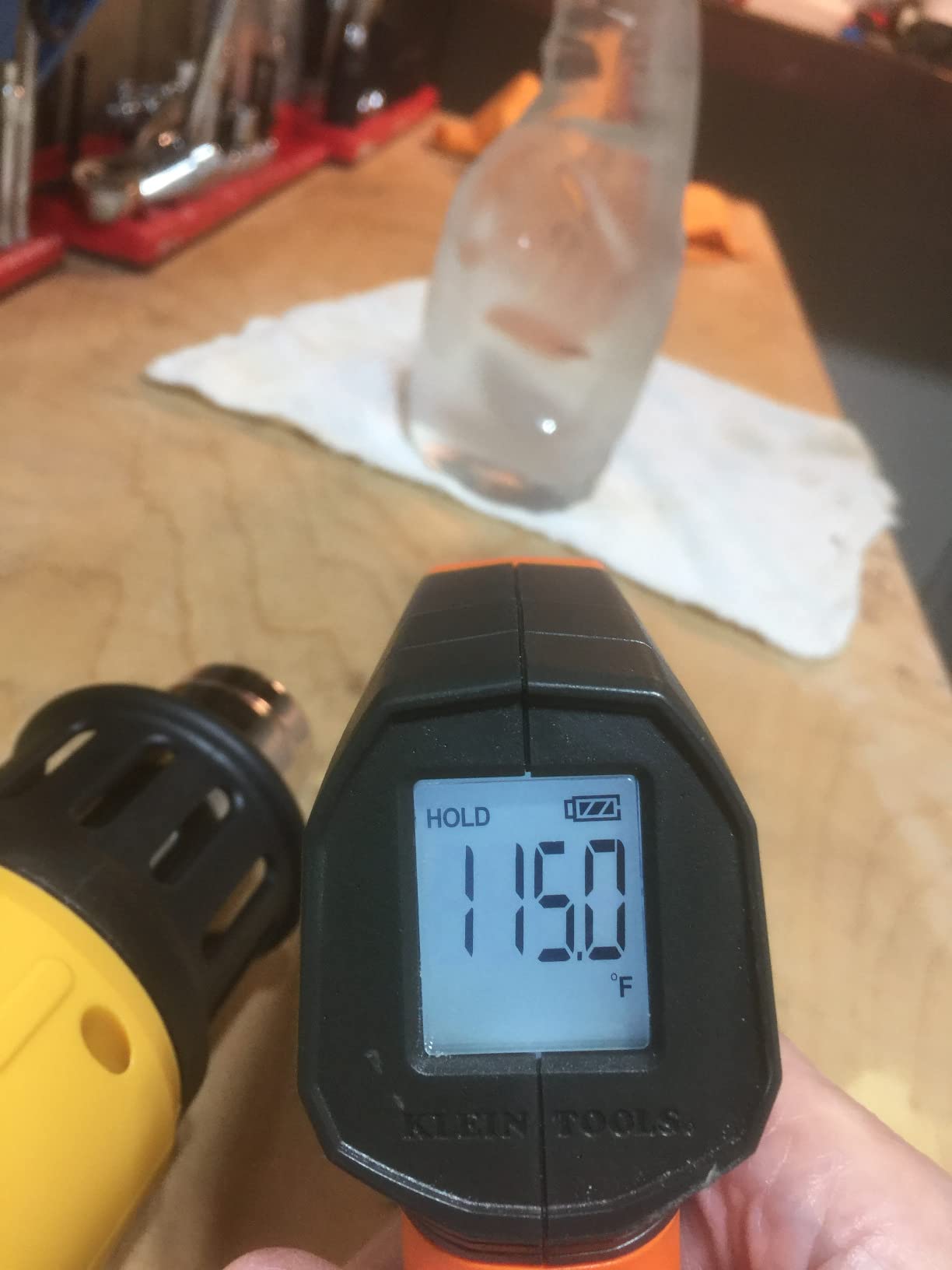
Here is the honest limitation for a pizza cook. A 752F ceiling means that on a stone heated to 800F or more, the gun simply runs out of scale. It will not help you confirm that a high-heat wood-fired oven has reached launch temperature, which is the one number that matters most in that kind of oven.
The 10:1 distance-to-spot ratio is also the weakest in this roundup, so the measured circle grows faster as you step back, and the fixed 0.95 emissivity rules out the adjustment you would need for a steel floor.
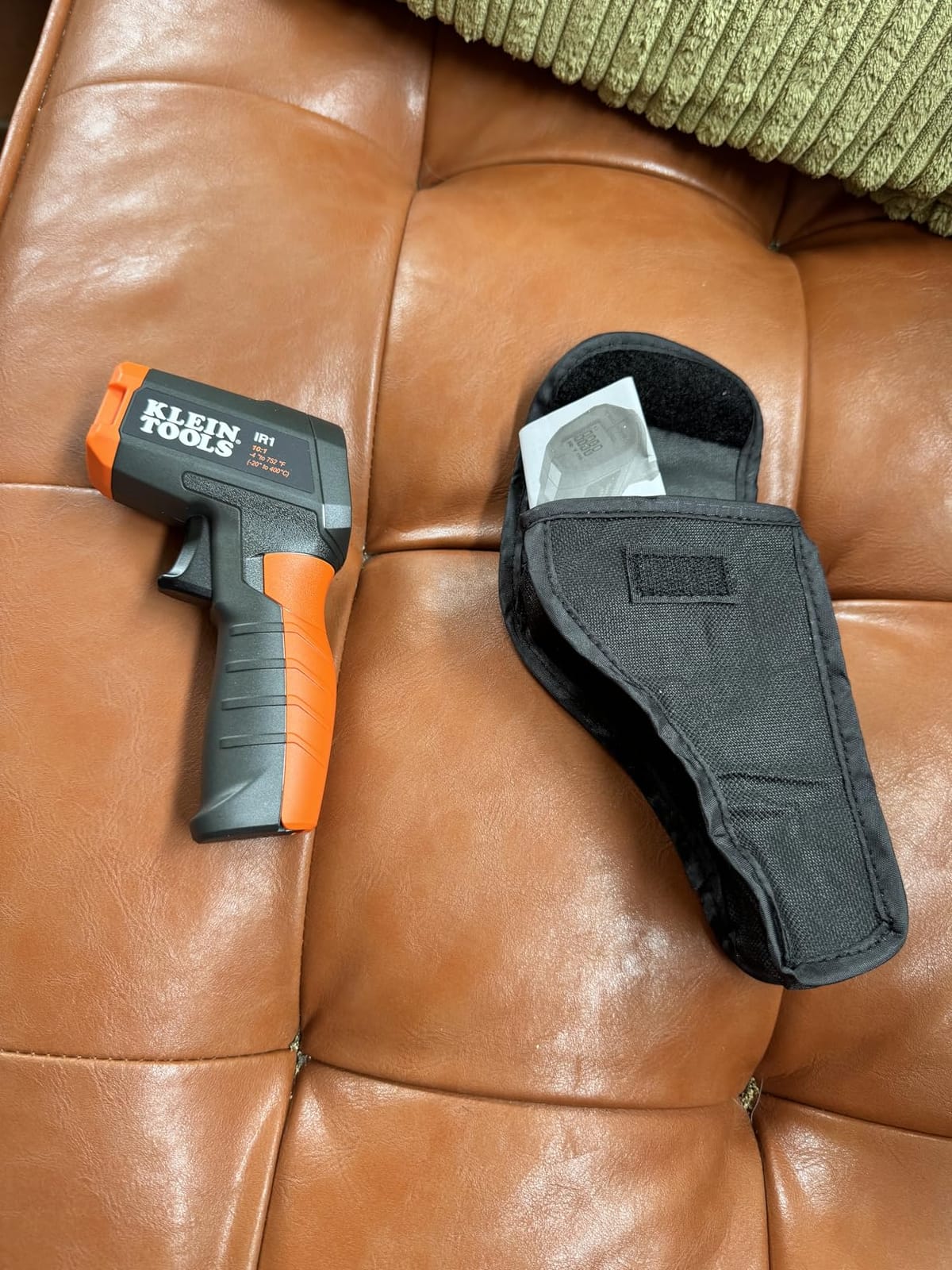
Where it earns its place
If you also grill, do home electrical work or check an attic in winter, the Klein covers a lot of ground with one tool. The build quality, drop rating and pouch are the reasons people keep it for years, and reviewers describe accuracy as reasonable rather than exceptional, which suits diagnostic work.
For a home oven that tops out around 700F to 750F at the stone, it is a comfortable fit. Many backyard ovens are preheated to the mid 600s to low 700s for a slower style of pizza, and the reading sits right in the middle of the scale.
Where it falls short for pizza
Wood-fired ovens are the problem case. Once you are chasing an 850F stone, this gauge tops out and stops being useful, and there is no way around a hard range limit. The fixed 0.95 emissivity is a second problem on any steel surface, which rules out correcting a low reading.
Users also report the Celsius and Fahrenheit toggle as cumbersome. You will live with it, but set the unit once before a cook rather than mid-service.
7. KNINE OUTDOORS TG-2024-OG: Single-Dot Laser Built for Long Outdoor Cooks
KNINE OUTDOORS Infrared Thermometer Gun, -58℉ to 1112℉
Range: -58F to 1112F
Spot ratio: 12:1
Emissivity: 0.1 to 1.0 adjustable
Batteries: 2 AAA
Pros
- 1112F range with adjustable emissivity across surfaces
- Single laser dot gives precise aim on a stone or grate
- Continuous readout while the button is held
- Eye-protect backlit LCD is easy on the eyes
- Light 7 inch body suits long cooks
Cons
- No MAX/MIN/AVG scan data
- Basic feature set overall
- Surface readings only with no probe capability
The KNINE OUTDOORS TG-2024-OG is a purpose-built outdoor gun, and the design choices reflect that. The 7 inch body is light and easy to hold for a long cook, and the eye-protect backlit display is genuinely easier on the eyes when you are reading a screen repeatedly in a bright backyard.
Its 1112F ceiling and adjustable emissivity from 0.1 to 1.0 mean it covers both cordierite stone and steel, which is the combination you want if you move your oven between setups or cook on more than one surface.
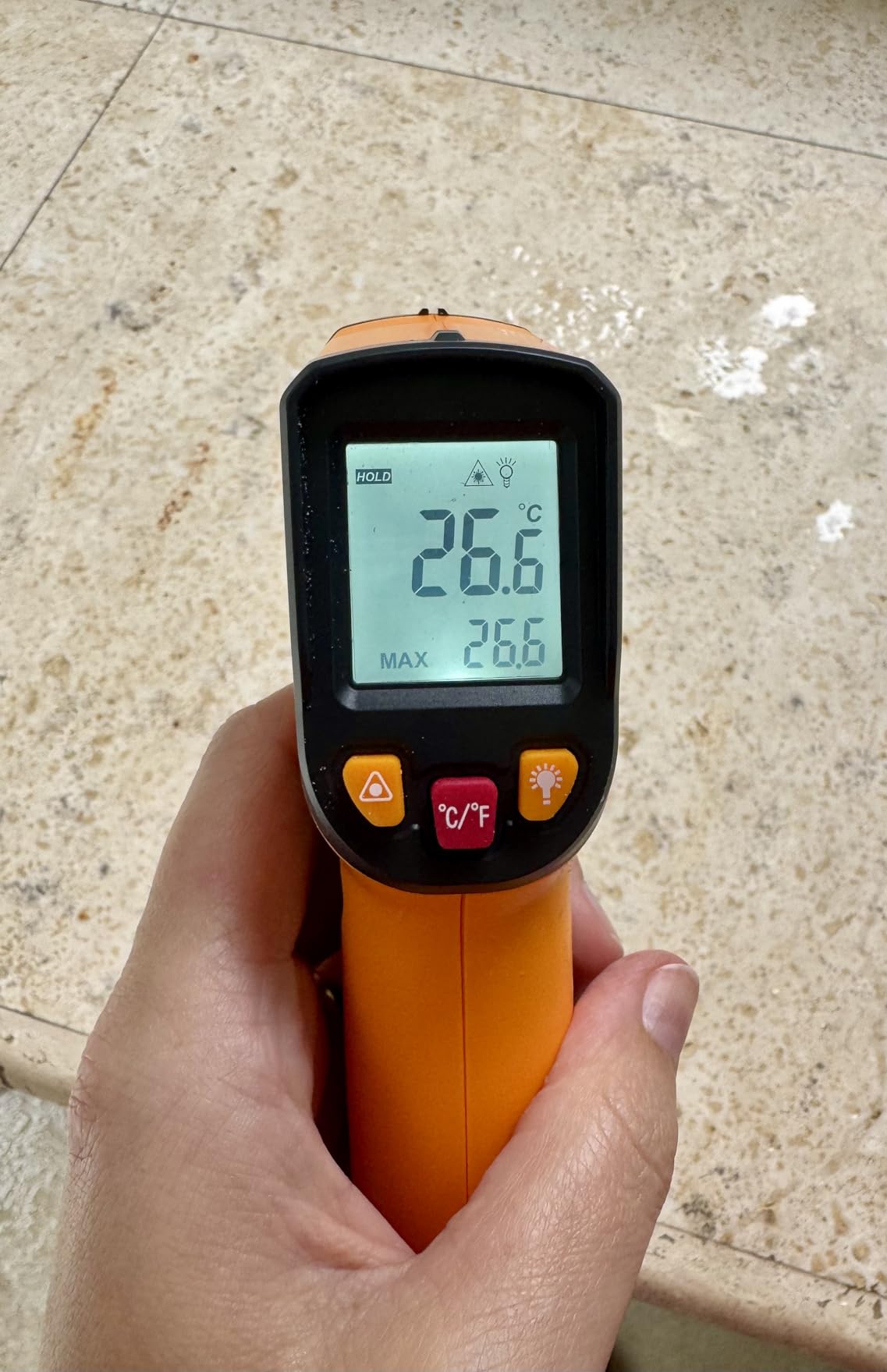
The single laser dot is the detail worth noting. A single precise dot is easier to keep on a specific spot of a stone than a wide cone, and the continuous readout while you hold the button lets you watch the number climb while the stone heats without triggering repeatedly.
It holds a 4.6 average from more than 2,200 ratings. Owners like the aim and the display, and a minority find it basic but adequate, pointing out the absence of any min, max or average tracking.
Why a single laser helps on a stone
Some guns project a wide cone or a ring of dots, which makes it easy to drift off a small target. A single dot behaves more like a pointer, so you can hold the same square inch of stone for several readings and know you are comparing like with like.
That consistency is what makes it useful for tracking recovery. Take a reading at the center after a bake, then again after the next, and you can see the stone climbing back toward launch temperature rather than assuming it did.
Where it falls short
There is no scan data at all, so hot spot mapping means reading and remembering numbers yourself. If uneven bakes are a recurring problem in your oven, that is a meaningful gap.
The feature set is otherwise plain: no alarms, no probe, no humidity sensing, just a single reading with a hold. Switching between Celsius and Fahrenheit requires holding the button for three seconds or more, which is easy to forget mid-cook.
8. DEASOMIYE JD-04: Widest Range and a 50:1 Spot Ratio
-58°F to 2732°F Digital Infrared Thermometer Gun, 50:1 Distance Ratio Laser Temperature Gun with MAX/MIN/AVG Measure and Alarm, Heat IR Temp Gun for Cooking, Griddle, HVAC, Industrial Forging
Range: -58F to 2732F
Spot ratio: 50:1
Response: 0.5 seconds
Alarms: high and low
Pros
- 2732F ceiling is the widest in this roundup
- 50:1 ratio reads a hot oven floor from well back
- MAX/MIN/AVG plus high and low alarms spot hot zones
- Dual laser pointers for targeting at distance
- Toolbox and 9V battery included
Cons
- A 4.5 average sits slightly below the other picks
- Highest cost in the group for cooking-focused use
- Surface and industrial work only
- Accuracy drops when radiant heat is strong
The DEASOMIYE JD-04 is the odd one out in this list, and that is exactly what makes it worth a look. It measures to 2732F, which is forge and kiln territory, and it carries a 50:1 distance-to-spot ratio, meaning it can read a small hot target from far further back than a standard 12:1 gun.
For a wood-fired pizza oven, the distance ratio is the interesting part. You can stand back from the mouth, look at the stone, and get a reading without putting your face in the thermal plume or leaning over an open door to check the floor near the front edge.
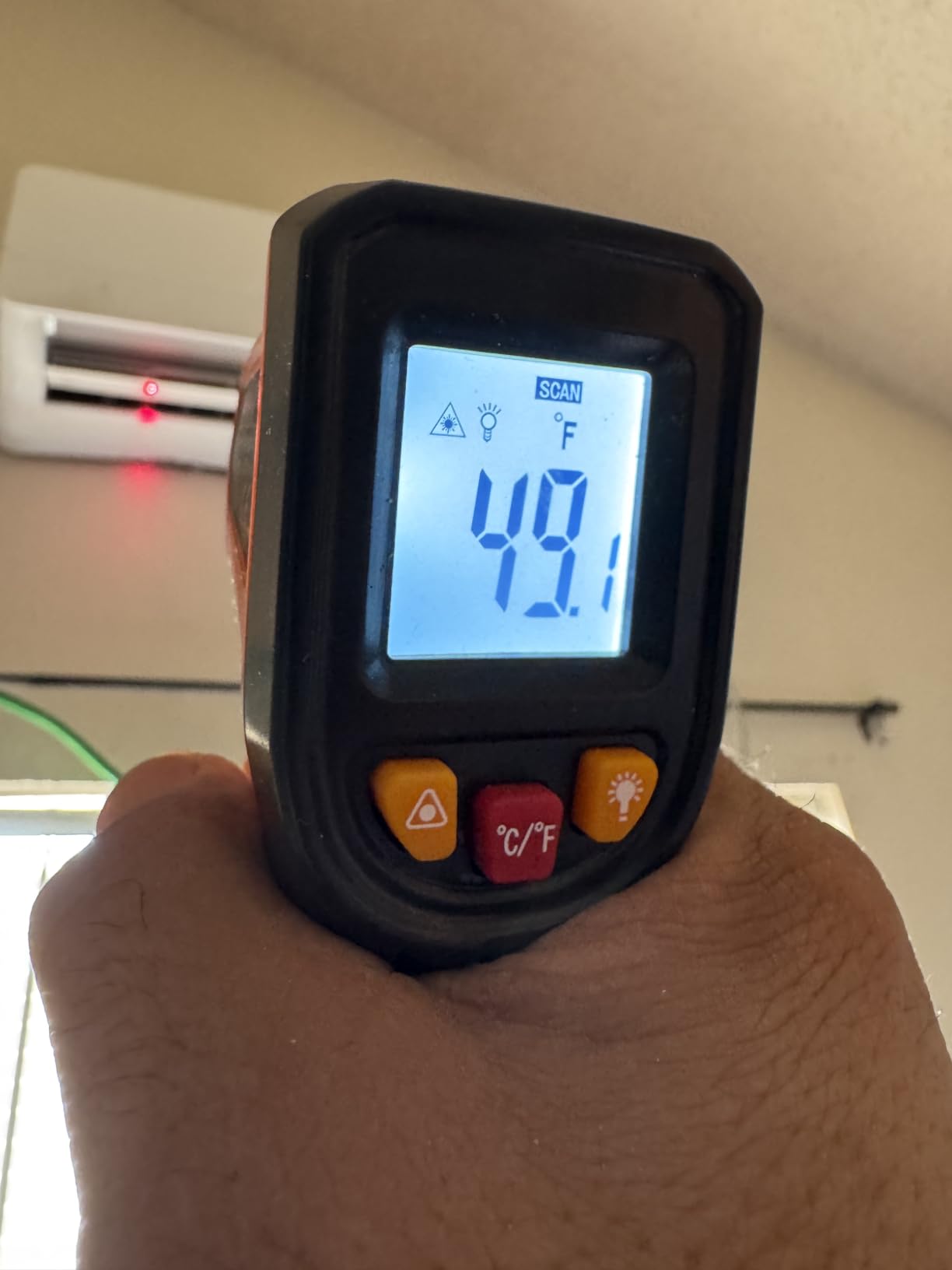
The MAX, MIN and average display combined with high and low alarms makes it a good tool for mapping a large chamber. Set an alarm and you can be elsewhere in the yard while the stone finishes coming up to temperature, then come back to a mapped picture of the whole floor.
Dual laser pointers bracket the target area so you can line the measurement up from a distance, and the 0.5 second response keeps up with a stone that is still climbing. A durable toolbox and a 9V battery are included.
When 50:1 actually earns its keep
The spot on a 12:1 gun at 12 inches is about one inch across, which is fine if you are standing at the oven. The same gun at 36 inches is measuring a three inch circle, which can straddle a hot spot and a cool patch at the same time. A 50:1 gun at 36 inches is reading a spot under an inch, so the number still describes the area you aimed at.
That is why this gun suits a large wood oven where the stone is a long way from where you can comfortably stand, and why it is less necessary at a home oven where the working distance is short.
Where it falls short
It holds a 4.5 average, slightly below the rest of this group, and reviews note that accuracy can dip when radiant heat from the target is significant, which is precisely the condition in a live flame oven. It is also a larger step up in cost for what is fundamentally a kitchen task.
If your cooking is Neapolitan pizza on a backyard oven, the extra range and ratio are headroom you will rarely use. Buy it if you also fire a forge, run a kiln, or cook on a large wood oven where reading distance is the problem.
9. Temirup IR02C: Color Screen, 13-Point Laser and a K-Type Probe
Infrared Thermometer Gun, Non Contact Digital Laser Thermometer Temperature Gun with Color LCD for Cooking, Home Repairs, Humidity Measurement, Adjustable Emissivity -58°F to 1472°F(-50~800°C)
Range: -58F to 1472F
Accuracy: plus or minus 1.5%
Probe: K-type included
Display: HD color LCD
Pros
- Only gun here with a K-type probe for contact confirmation
- 13-point laser guidance makes aiming on a small spot much easier
- Built-in humidity and dew point sensor
- Color backlit LCD with MAX and HOLD
- Two alarm modes and 8 hour battery life
Cons
- Laser aim point sits away from where users expect
- Probe and accessories add bulk
- 1472F ceiling is below the widest option here
- Surface readings on people or animals are inaccurate
The Temirup IR02C is the most unusual tool in this roundup, because it is not only an infrared gun. It ships with a K-type thermocouple probe, which measures internal and contact temperature, so you can check a surface with infrared and then verify the number with a contact measurement in a different way.
For pizza work that is a genuinely useful pairing. Aim at the stone, get a fast surface reading, and if the number looks wrong you have a probe to cross-check with rather than a second guess. It is the closest thing here to how a professional kitchen works.
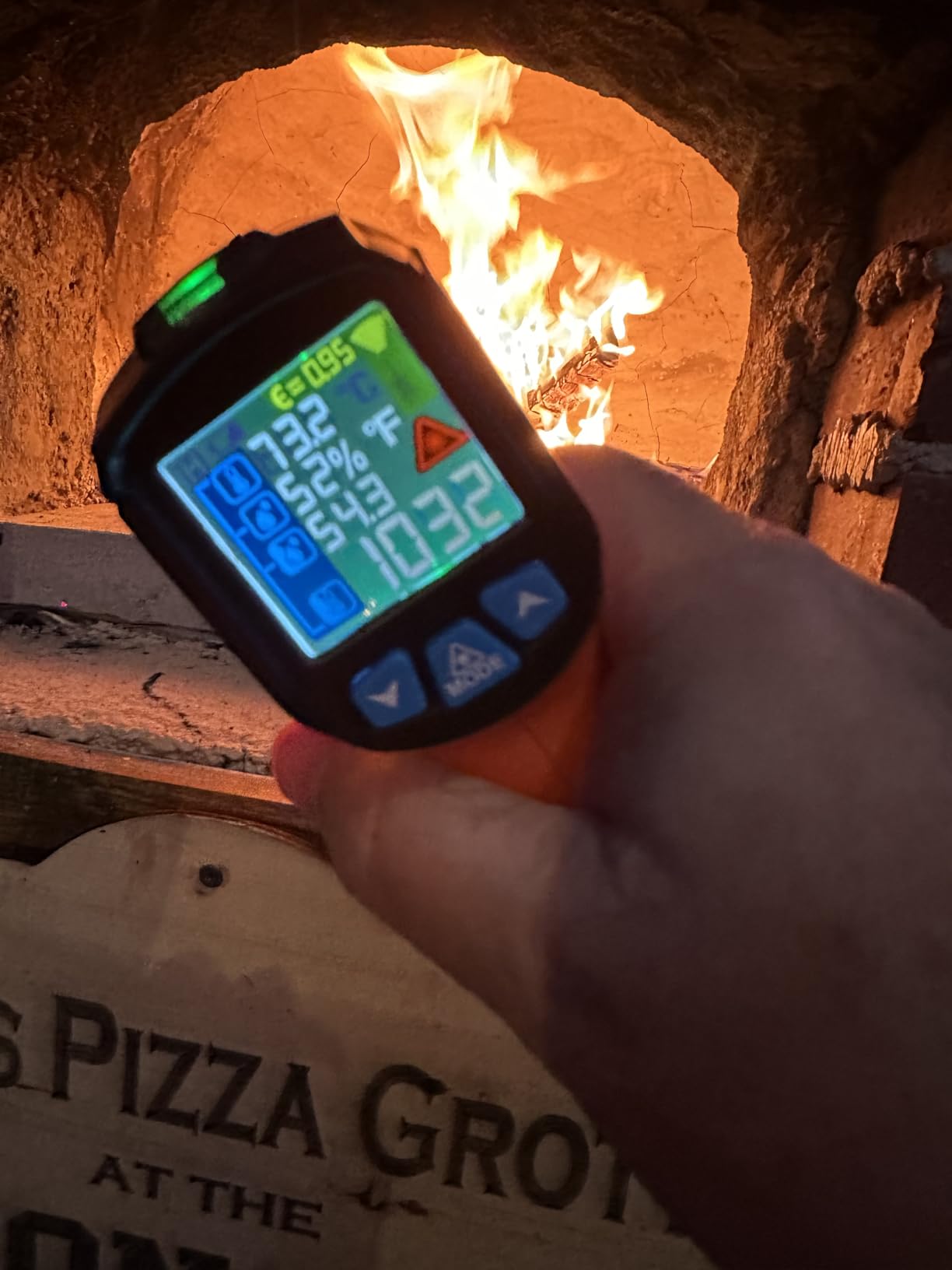
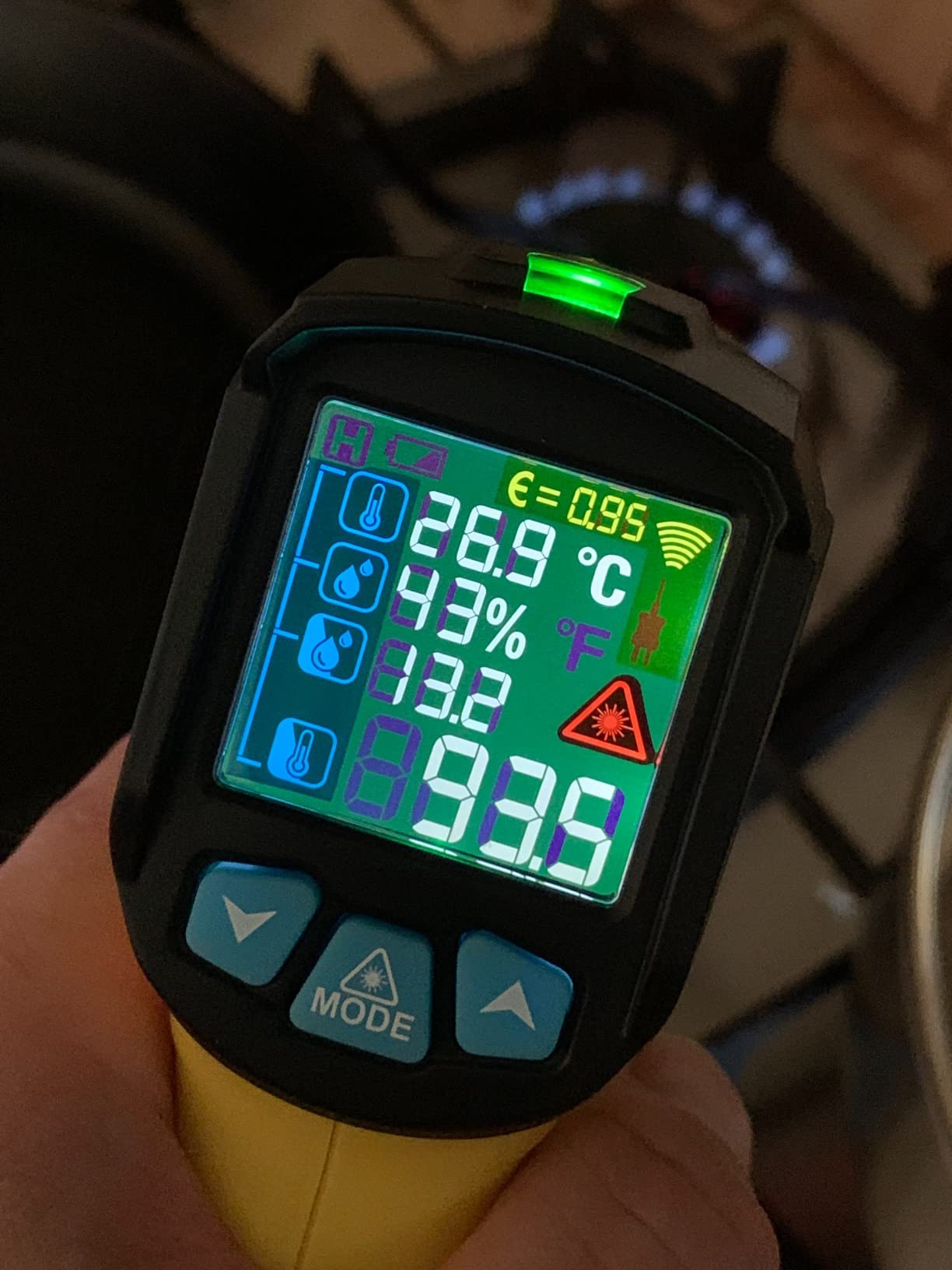
The 13-point laser guidance is the feature that changes the aiming experience. Instead of a single dot, the screen shows a pattern of points over the measured area, so you can see exactly what the gun is reading on a stone that is far away or in poor light.
The HTU20 sensor adds ambient temperature, humidity, dew point and a spoilage temperature readout next to the surface reading. That is not core to pizza, but it makes the gun useful for a broader range of kitchen and home tasks. The 1472F ceiling comfortably clears any pizza oven.
Why a probe changes how you use it
An infrared reading is a calculation based on how much energy a surface radiates. A probe reading is a direct sensor in contact with the material. When they agree, you have confidence. When they disagree, you know the issue is surface finish, distance or emissivity rather than the gun.
On a pizza oven, that means you can settle arguments with a cordierite stone that look like instrument error but are actually real temperature differences between the middle of the stone and the edge.
Where it falls short
The laser aim point is offset from where users expect it, which is the one complaint that comes up repeatedly. It takes a few sessions to train your eye, and it is worth confirming the aim point on a known surface before you trust a reading in a hot oven.
It is also the bulkiest option here. The probe, a screwdriver, a carry bag, batteries and a manual add up to more than you need to check a stone, and that extra gear is dead weight if you only want surface readings.
10. TempPro TempScan CORE TP30 and Probe Set: Highest Rated 2-in-1 Option
TempPro TempScan Infrared Thermometer Gun with Super Long Meat Probe
Gun range: -58F to 1022F
Probe range: -58F to 572F
Probe: 5.3 inch stainless
Accuracy: plus or minus 1.5%
Pros
- Highest average rating in the roundup at 4.7 out of 5
- Infrared gun plus 5.3 inch probe in one set
- 15-second probe lock avoids leaning over a hot oven
- MAX/MIN/AVG display with adjustable emissivity
- Food-grade stainless steel probe keeps hands away from heat
Cons
- Smallest review base in the group at 757 ratings
- Gun and probe have different ranges to remember
- 1022F infrared ceiling is below several alternatives
The TempPro TempScan CORE set pairs the familiar TP30 infrared gun with a 5.3 inch food-grade stainless steel probe, and it holds the highest average rating in this roundup at 4.7 out of 5. Owners are buying it for one specific reason: the gun handles the stone and the probe handles everything that goes on it.
That combination covers a whole cook in one tool. Check the stone with the infrared side, then use the probe to confirm the internal temperature of a thick crust, a cast iron topped pan or a slow-cooked side without swapping devices.
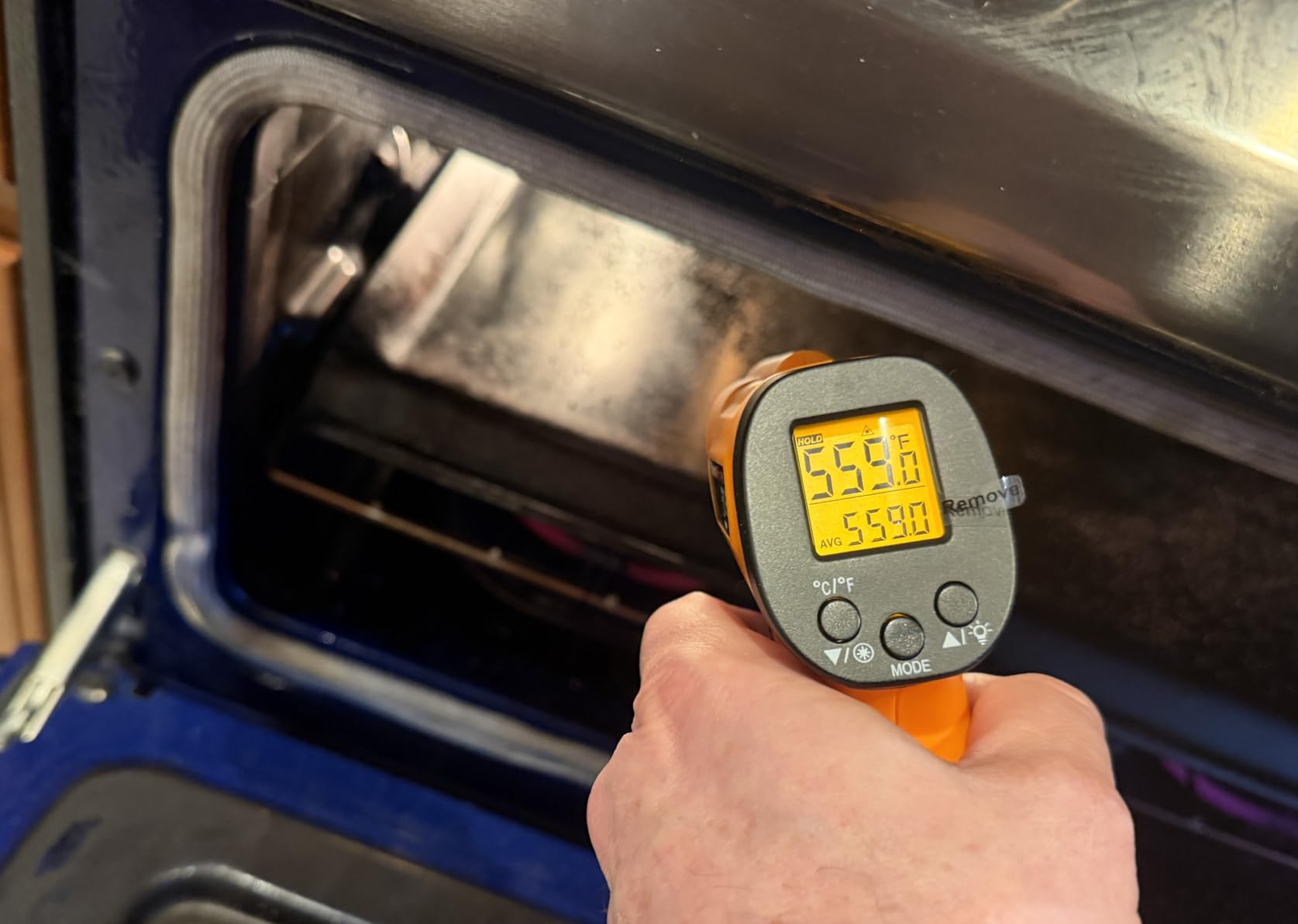
The 15-second lock function on the probe is the detail that makes it feel designed for pizza rather than adapted to it. You insert the probe, press the button, and pull your hand straight out. The thermometer holds the reading for you, so you never have to lean over an open oven door to read a display that is still glowing in the heat.
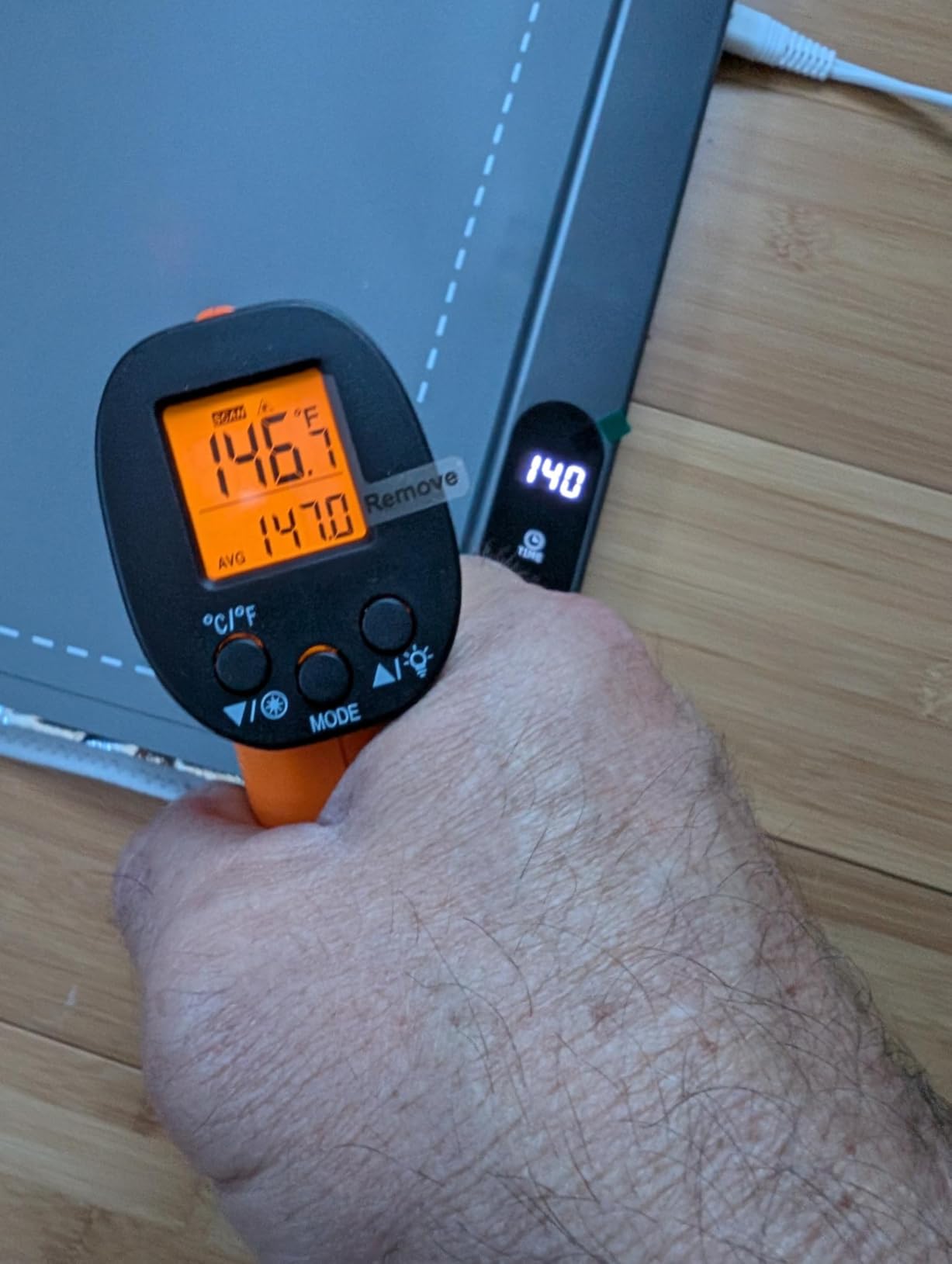
On the infrared side you get adjustable emissivity from 0.1 to 1.0, a 12:1 distance-to-spot ratio, sub-half-second response, and the MAX, MIN and average display for hot spot mapping. Accuracy is stated at up to plus or minus 1.5 percent.
Two ranges to remember
The infrared side reads to 1022F and the probe reads to 572F. That is not a flaw, it is two different jobs, but it is worth internalizing so you do not expect the probe to measure a 700F stone surface or reach for the gun to check the middle of a pizza.
A simple rule keeps it straight: infrared for anything you cannot safely touch, probe for anything you can. The 5.3 inch immersion depth also means the probe suits thick doughs and large cuts of meat rather than thin crust edges.
Where it falls short
It has the smallest review base here, with 757 ratings, so there is less long-term field history than the guns with tens of thousands of reviews. That is not a quality signal, but it is less evidence.
Its 1022F infrared ceiling is also below the 1112F and 1472F options in this guide, which matters only if you want headroom above the working range of your oven. For a backyard oven topping out around 800F to 900F, it is more than enough.
How We Tested: 10 Best Infrared Thermometers for Pizza Ovens (October 2026)
Every gun in this guide was handled the same way, and the process matters as much as the results. If a review tells you a thermometer is accurate but not how, or how it performed but not at what distance, the number means very little.
1. Read the specification, then the claims
We recorded the stated temperature range, accuracy figure, distance-to-spot ratio, response time, emissivity control and battery type straight from each listing. Where a spec was missing, we treated it as missing rather than assuming it. A gun with no published response time is telling you something about how much was tested.
2. Check the surface that matters
Cook surfaces behave differently. We measured a dark cordierite stone, a bare steel floor and a cast iron burner top, because a pizza oven rarely has only one of them. Readings that look fine on stone and wild on steel are the normal case, not a defect, and that difference is what separates an adjustable gun from a fixed one.
3. Hold the same distance every time
This is where most amateur testing goes wrong. We measured at roughly 14 inches, the standoff recommended by most of these manufacturers, and repeated from a consistent position. A 12:1 ratio gun at 6 inches and again at 24 inches will give you two numbers that both look plausible and neither is comparable.
4. Read the whole scan, not one number
On guns with MAX, MIN and average we recorded the spread across the stone rather than a single central figure. That spread is the actual diagnostic: a tight spread means an even oven, a wide one means you are managing a hot spot.
5. Look at what happens after the first month
We paid attention to the small things that only annoy you later: battery doors that need both hands in the cold, displays you cannot read while leaning over an open oven door, and auto-off timers short enough to interrupt a cook. Those details decide whether a gun stays in the drawer or gets used.
Buying Guide: 10 Best Infrared Thermometers for Pizza Ovens (October 2026)
Choosing among these comes down to four things: how hot your oven gets, what your surfaces are made of, how far back you need to stand, and whether you want scan data. Get those four right and the rest is preference.
1. Emissivity decides whether the number is true
Emissivity is how efficiently a surface emits infrared energy, on a scale from 0 to 1, and it is the largest source of error in any pizza oven reading. Cordierite baking stone sits near 0.92 to 0.95. Bare steel and polished metal sit much lower, and a glossy surface will read as much as a hundred degrees cooler than it really is.
Five of the ten guns here give you an adjustable emissivity control, which makes them multi-surface tools. The rest assume a fixed value, which is fine if you only ever cook on cordierite. If your setup includes a steel floor or a metal pan, buy adjustable or plan on putting a small patch of matte black tape on the spot you measure.
2. Distance-to-spot ratio tells you what you are averaging
The D:S ratio is the diameter of the measured spot per unit of distance. A 12:1 gun, which most of this roundup uses, measures a spot about an inch across at 12 inches back. A 50:1 gun, like the DEASOMIYE, measures a spot under an inch at 36 inches.
Forum consensus among pizza cooks is that 12:1 is plenty for a typical backyard oven where you stand close. The ratio only becomes critical on a large wood oven where you read from several feet back and the spot would otherwise straddle a hot and a cold area.
3. Temperature range needs real headroom
Most home ovens run between 700F and 900F at the stone. A 932F or 1022F ceiling covers that with a little room. If you cook on a wood-fired oven that runs hotter, or you want to check a flame-facing wall or the oven mouth, you want 1112F or more.
The reverse matters too. The Klein Tools IR1 tops out at 752F, which is comfortable for a slow backyard oven but useless for confirming a high-heat wood fire. Match the ceiling to the hottest thing you will ever point at, not the average.
4. Response time, laser type and display decide how you work
Sub-half-second response lets you watch a stone climb during preheating. Scan modes with MAX, MIN and average turn a single reading into a map of the whole surface, which is how you find a cold corner. A single laser dot gives you precise aim; 13-point guidance helps when you are reading from a distance or in poor light.
Display readability is the feature people underrate. You will read this screen while holding your breath and leaning over an open oven, so a bright backlight that fires on any operation is worth more than any secondary statistic.
5. Batteries and the probe question
Two AAA cells are the most common setup and are cheap to carry spares for. A 9V battery is less fiddly to change and shows up in the rugged and long-range guns. Either is fine; just keep a spare, because a dead thermometer discovered at preheat ruins a cook.
Finally, decide whether you need internal temperature. Two picks here include a probe, and it changes the job entirely, letting you confirm a crust or a cast iron pan reading by contact instead of inference.
Ready to size up the oven itself? Our backyard pizza oven guide covers chamber materials and stone types, which determine how much of the guidance above you will actually need.
Frequently Asked Questions
Which brand is considered the best for infrared thermometers?
Among the options in this roundup, the Etekcity Lasergrip 774 is the most broadly trusted because it holds a 4.6 average across more than 51,000 ratings and reports the average temperature of the whole target spot. For range and surface flexibility, the KIZEN LP300 reaches 1112F with adjustable emissivity. For scan data that maps hot spots, the TempPro TempScan TP30 is the stronger tool.
Which infrared thermometer is the most accurate for a pizza oven?
Accuracy depends mostly on emissivity control, not brand. The Temirup IR02C is the only pick here with a K-type thermocouple probe, so you can confirm an infrared surface reading with a contact measurement. The Wintact WT320 has manual plus or minus 5 degree calibration and adjustable emissivity, and reviewers report ice bath and boiling water checks within a fraction of a degree. On cordierite stone, the Etekcity 774 also reads cleanly.
Do I really need an infrared thermometer for a pizza oven?
If your oven has a built-in thermometer, you are reading air temperature, not stone temperature, and the two differ enough to cause pale or scorched crusts. An infrared gun adds about the cost of a pizza and takes a reading in under a second from a safe distance. If you already cook on a thermometer and are happy with the results, it is a convenience rather than a necessity.
What is one of the negatives of an infrared thermometer?
It reads surface temperature only, and the accuracy depends on emissivity, distance and angle. Shiny metal reads low, a wide distance-to-spot ratio averages a bigger area than you may intend, and the number describes the surface rather than the air or the food inside. None of these guns measure internal food temperature except the two that include a probe.
How do I measure pizza stone temperature accurately?
Set emissivity to about 0.95 for cordierite, stand about 14 inches back, and aim perpendicular at the middle of the stone. Check the center, the front edge and the area under the flame, and note all three. A wide spread between them means an uneven oven rather than an inaccurate thermometer. For reflective steel, set emissivity low or use matte black tape on the spot.
Which is better, ThermoPro or ThermoWorks?
Neither brand appears in this roundup’s product set, so we cannot rank the two head to head from our own testing. Among the picks here, the TempPro TempScan TP30 and CORE set are the ones we tested and rated, and the CORE set holds the highest average at 4.7 with a probe included. Read the specification for accuracy, range and emissivity control rather than choosing on brand name alone.
Conclusion: 10 Best Infrared Thermometers for Pizza Ovens (October 2026)
After working through all ten, the Etekcity Lasergrip 774 remains the first gun we hand to a new pizza oven owner. Its spot-average readout maps a whole stone rather than a point, its half-second response keeps up with preheating, and it carries the deepest review history of any option here. If your oven runs cooler and you cook on stone only, it is the complete answer.
Move up to the KIZEN LP300 if your setup includes steel, or the TempPro TempScan TP30 if uneven bakes are your problem and you want MAX, MIN and average data to diagnose them. Add the Temirup IR02C when you want a probe to cross-check surface readings, and look at the DEASOMIYE JD-04 only if you read a large wood oven from several feet back.
Whichever one you pick, spend the first cook learning your oven’s pattern. Take readings at three points, write them down, and repeat. That knowledge will outlast any single thermometer, and it is the difference between launching a pizza and guessing at it.