
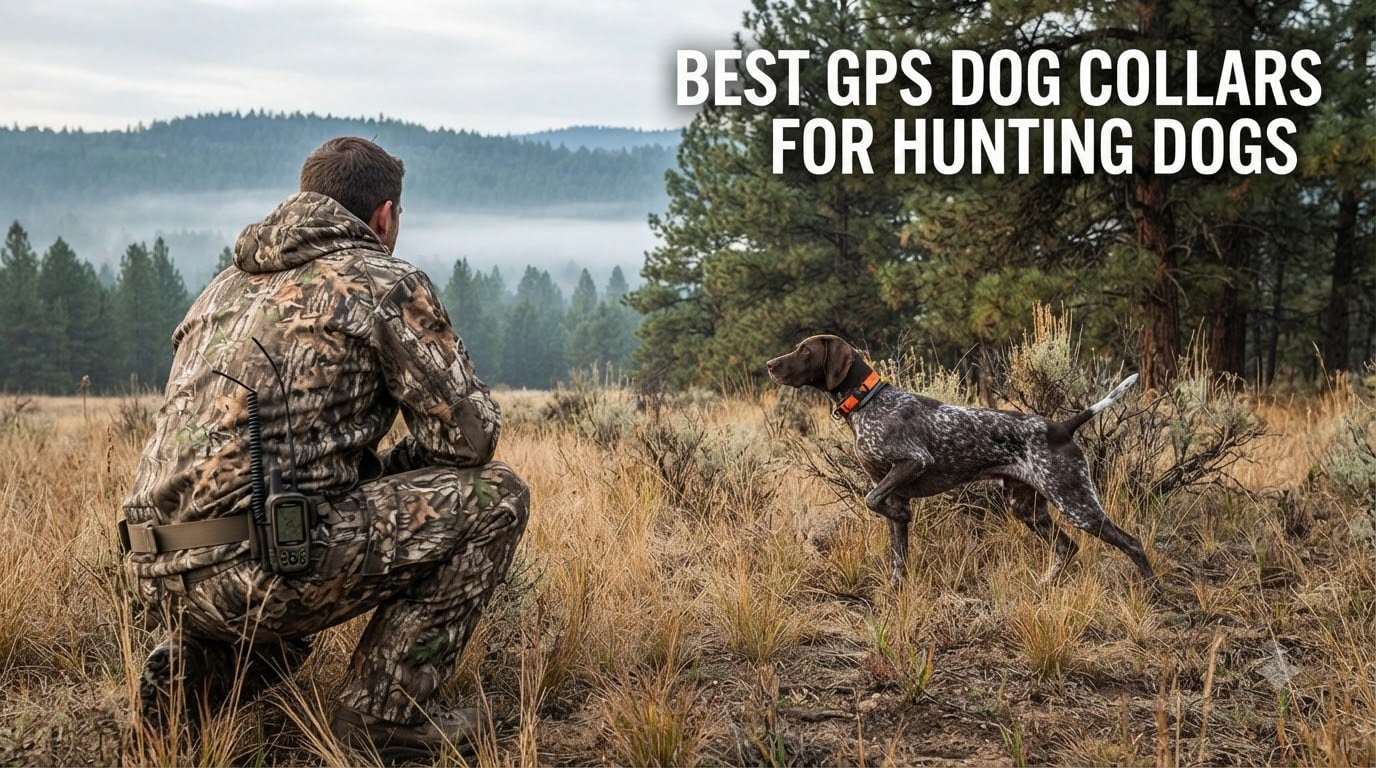
The biggest risk on a hunt is not the weather. It is the ten minutes after your pointing dog goes on point in heavy timber and you cannot see her, and you still do not know whether she is holding a bird or three hundred yards off your left shoulder running deer tracks. One handler put it better than any manufacturer does: the value of these systems is that he can finally know what the dog is doing when it is out of his sight, and it makes training for some things much easier.
That is what these systems do. A GPS dog collar for a hunting dog gets a satellite position fix, then sends those coordinates straight to a handheld receiver or your phone by radio, refreshing every two to five seconds. Because the link does not run through a cell tower, it keeps working in national forest, on BLM land and in steep drainages where cellular trackers go silent. If you are researching the best gps dog collars for hunting dogs this season, that single distinction decides most of your shortlist.
Our verdict up front: the Dogtra PATHFINDER2 Compass is the best overall hunting dog GPS collar, because it delivers a 9-mile radio range, two-second location updates, full e-collar training and no subscription fee without needing cell service. Everything else in this roundup is either a step up in satellite safety, a step up in multi-day collar battery, or a step down in features for a specific job.
We spent six weeks comparing seven dedicated hunting-grade systems across three architecture families: standalone radio, cellular backhaul, and Bluetooth proximity. We looked at rated range against real terrain, update rates, battery under a full day of use, multi-dog capacity, collar weight and fit, and how much setup each one asks of you before the first hunt. Specs come from the manufacturers; the failure-mode notes come from hunting forum threads, because that is where the useful warnings live.
Table of Contents
Our Top 3: Best GPS Dog Collar Picks in 2026

Dogtra PATHFINDER2 Compass
- 9-mile radio range
- 2-second updates
- built-in compass handheld
- no subscription
- expands to 21 dogs

Garmin Alpha 300i with TT25
- 20 dogs at 9 miles
- 2.5-second updates
- inReach satellite SOS
- three-day collar battery
- treed and on-point alerts

Garmin Alpha TT 25 Collar
- 68-hour battery per pack
- 136 hours with expanded pack
- 1.3 oz slim fit
- multicolor LED
- 18 stimulation levels
One caveat worth stating before the individual reviews: the Editor’s Choice went to the Dogtra on the strength of its evidence base rather than its star average. It carries 330 reviews, more than five times the volume of any other system here, and 4.2 with a 7% one-star share is a rating that has already absorbed a lot of use. The Alpha 300i scores higher on satisfaction at 4.7, but on 65 reviews we treat that number with more caution.
Best GPS Dog Collars for Hunting Dogs at a Glance
| Product | Specifications | Action |
|---|---|---|
| Dogtra PATHFINDER2 Compass |
|
Check Latest Price |
| Garmin Alpha TT 25 Collar |
|
Check Latest Price |
 Garmin Alpha 200i with TT 15 Garmin Alpha 200i with TT 15 |
|
Check Latest Price |
| Garmin Alpha 300i with TT25 |
|
Check Latest Price |
 SportDOG TEK 2.0 Add A Dog Collar SportDOG TEK 2.0 Add A Dog Collar |
|
Check Latest Price |
 eMACROS Dog GPS Tracker eMACROS Dog GPS Tracker |
|
Check Latest Price |
 Aorkuler Outdoor GPS Tracker 2 Aorkuler Outdoor GPS Tracker 2 |
|
Check Latest Price |
Two things stand out immediately. Every product in this table is a standalone radio system that ignores cell coverage entirely, and every one of them carries no recurring subscription charge for tracking. That is not a coincidence of this roundup. It is the defining feature of the category.
For a broader look at tracking hardware, including the cellular and consumer options we deliberately left out, see our guide to the best GPS trackers for dogs tested and compared.
1. Dogtra PATHFINDER2 Compass Review – Best All-Round Hunting GPS Collar System
Dogtra PATHFINDER2 Compass Live GPS Dog Tracking & Training System – 9-Mile Range E-Collar Handheld with No Subscription, Offline Maps, GPS Fence, Expandable up to 21 Dogs, for Dogs 35+ lbs
9-mile radio range
2-second updates
21-dog capacity
IPX9K waterproof
Suits dogs 35 lbs and up
Pros
- 9-mile radio range with no subscription or cellular signal needed
- 2-second updates with a compass on the handheld
- expands to 21 dogs with 4 shown at once
- IPX9K waterproofing for rain and river crossings
- silent vibration mode keeps the dog quiet
Cons
- Only suits dogs 35 lbs and up
- 2-inch touchscreen is fiddly with gloves or rain
- full mapping features need the free app set up first
This is the system we ended up recommending to more people than any other. The Pathfinder2 Compass is a two-piece kit: a collar with a GPS receiver and radio transmitter, plus a handheld with its own screen. Nothing routes through a cloud service, nothing routes through a cell tower, and there is no monthly fee attached to the tracking function.
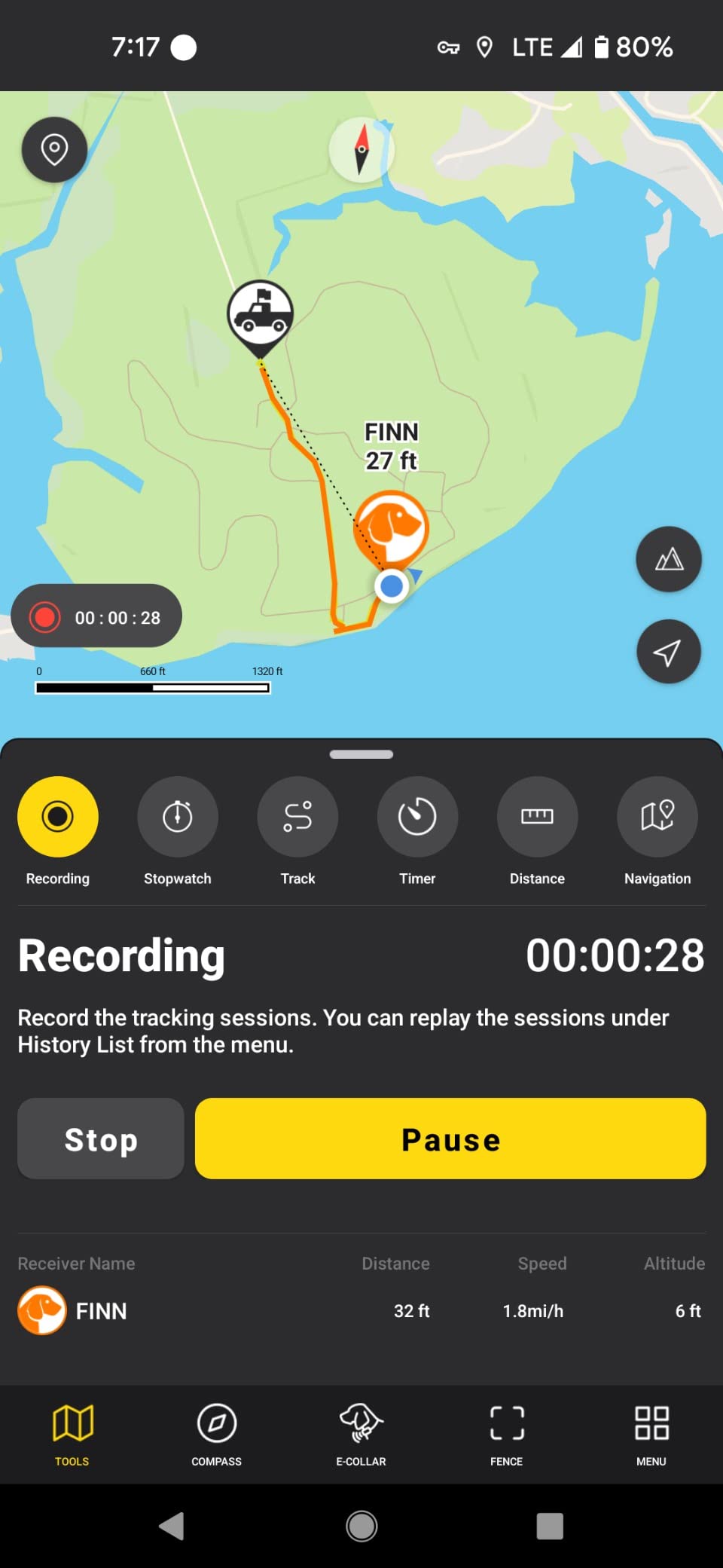
The handheld runs completely on its own. That sounds obvious until you have used a phone-based tracker with a flat battery in the cold, because the phone is the single point of failure in that architecture. The PATHFINDER2 handheld charges over USB-C, carries a two-inch sunlight-readable LCD, and puts a live compass, distance, speed and motion state on one screen.
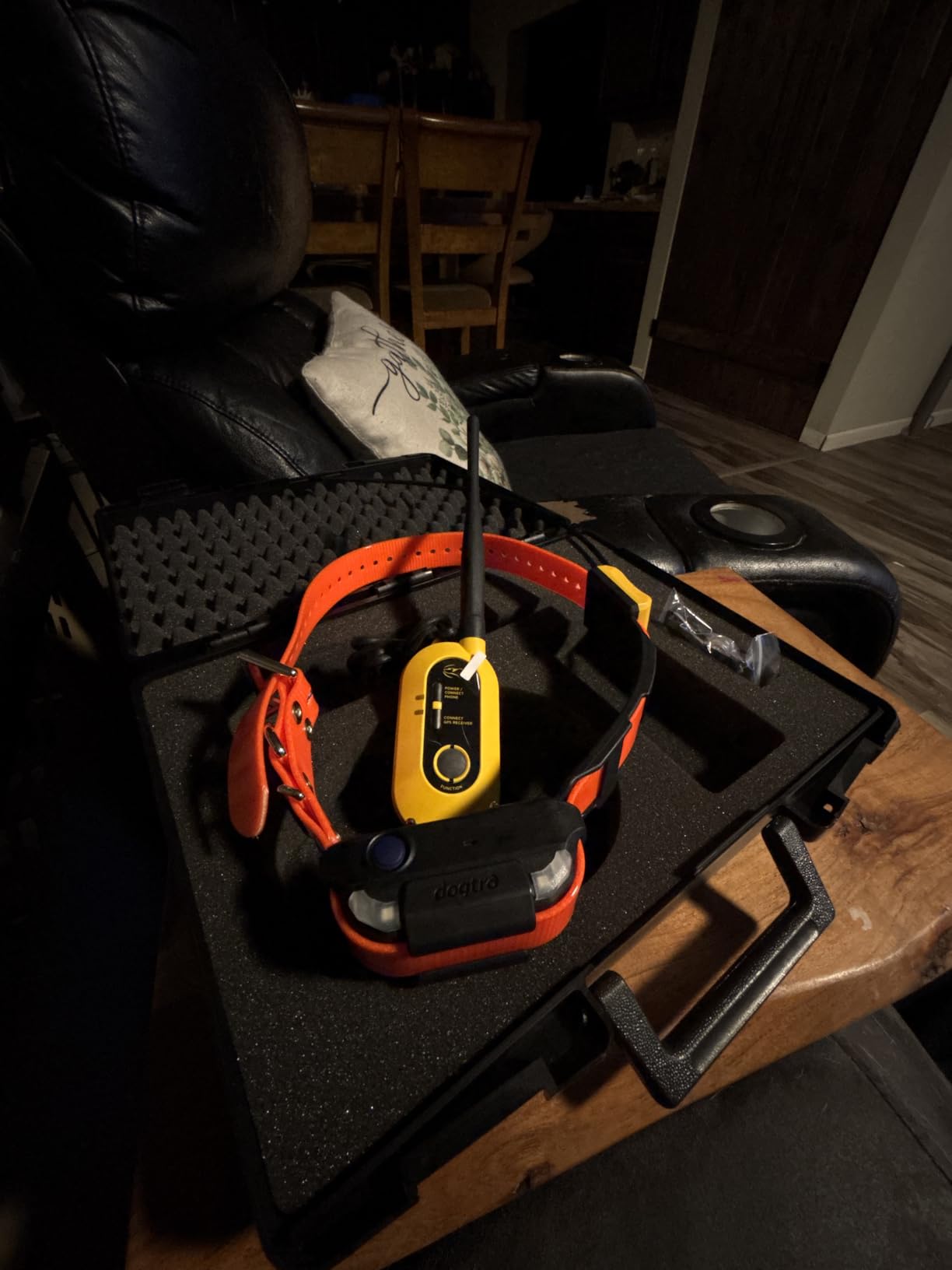
Two-second updates are the standout spec here. Garmin’s current hunting collars refresh at 2.5 seconds, so the difference is marginal on paper, but a running hound covers ground quickly and the extra half-second matters more in practice than the number suggests. For a pointer locked on point and not moving, neither difference is visible at all.
Training is built in rather than bolted on. You get Nick, Constant, Tone, Pager and an LED locate mode, which is a wider set than most e-collars in this price band. The silent vibration mode is the one we like for grouse and woodcock water, where any noise puts birds down.
The app adds offline maps, public land boundaries and a customizable GPS fence, and it is free. Those features are optional rather than required: if you never pair the handheld with the app, tracking still works. We think of that as the correct priority for hunting hardware.
What you give up compared with the Garmin bundles
The screen is two inches. That is plenty for one dog or two, and genuinely cramped once you are cycling through four at once in a full pack. Gloves and rain make it worse, which is a real consideration for a November hunt in a wet state.
It also fits dogs 35 pounds and up. If your string is mostly setters or brittanys under that weight, this collar is not for you, and you should look at the Garmin TT 25 section instead. This is the single most common reason handlers end up buying a second system.
Who should buy it and who should skip it
Buy this one if you run two to four dogs, hunt in thick cover or rough terrain, and want one box that covers tracking, training and paper maps without a subscription. The evidence base is the deepest of any system here, and the receiver is the easiest of the seven to learn.
Skip it if you need satellite SOS for backcountry emergencies, if you run a pack deeper than four dogs and want every position visible at once, or if your dogs are small. For deep timber and swamp, the Alpha 300i is the stronger tool, and the difference is not marginal.
2. Garmin Alpha TT 25 Review – Best Collar for Multi-Day Hunts and Small Dogs
Garmin Alpha® TT 25, GPS Dog Tracking & Training Collar
1.3 oz collar
68-hour battery per pack
9-mile range at 2.5-second updates
18 stimulation levels
Multicolor LED
Pros
- Slim 1.3 oz collar fits large and small breeds
- up to 68 hours per battery pack and 136 with the expanded pack
- 18 stimulation levels plus tone and vibration
- multicolor LED locate light for dusk recovery
- user-replaceable batteries and flex band
Cons
- Handheld is sold separately
- all mapping happens on the handheld
- stimulation contacts bother some sensitive dogs
The TT 25 is the best dog tracker collar for hunting if your priority is the collar itself rather than the receiver. At 1.3 ounces it is light enough for a female pointer or a small setter, and the battery figure is the one that changes how you plan a trip: up to 68 hours per standard pack with dynamic tracking, or up to 136 hours with the expanded pack.
That is a genuine multi-day capability. Most handlers charge collars overnight out of habit; with this one you can leave a kennel string running for a long weekend hunt without turning the tracking system into a nightly charging chore.
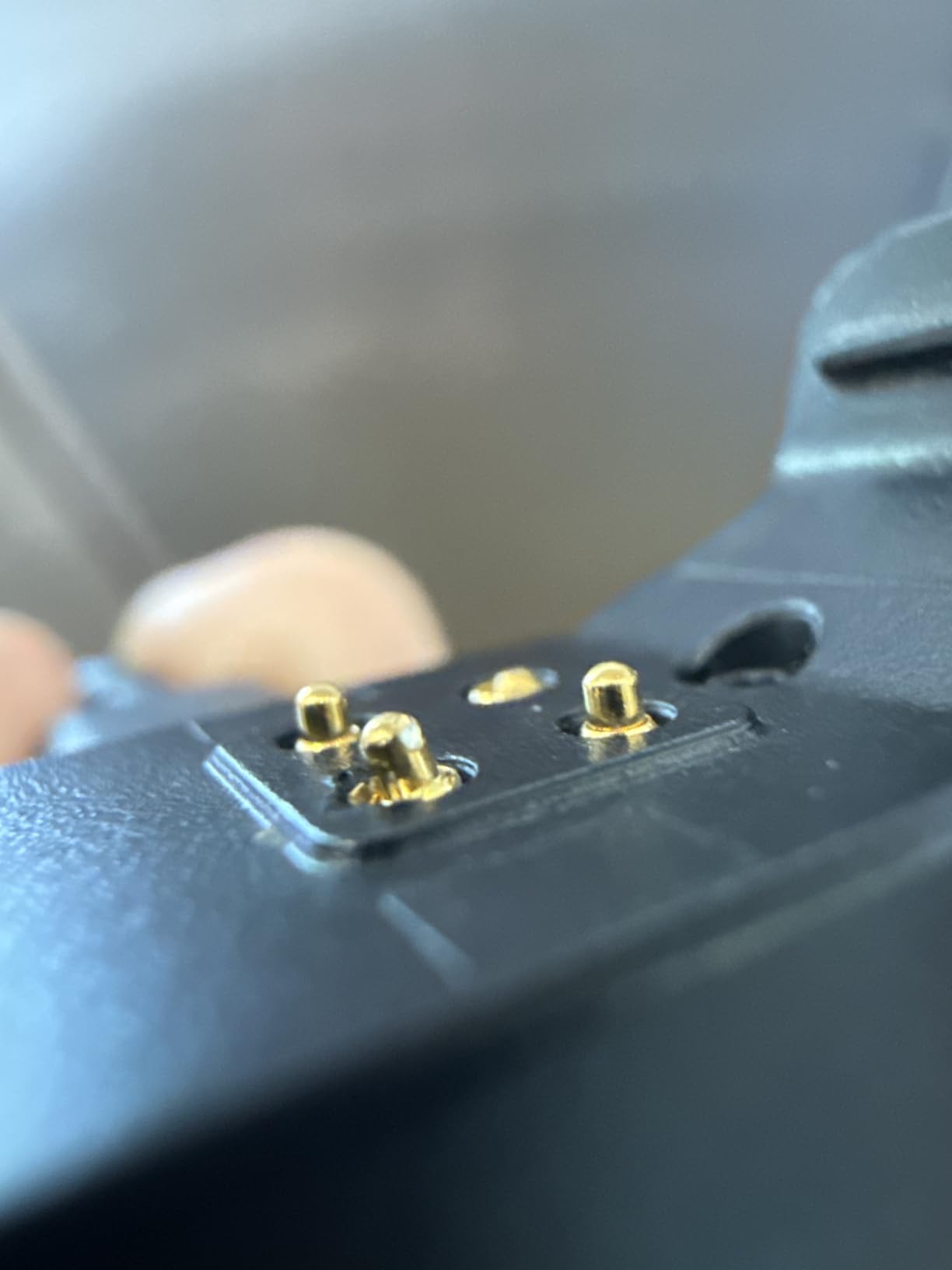
Eighteen levels of continuous or momentary stimulation, plus tone and vibration, cover nearly every training style we ran into. Vibration is the underrated mode here, because it is the only recall channel that works for a deaf or partially deaf dog, and it does not disturb a bird the way a tone can.
The multicolor LED is more than a gimmick. Dogs that go on point at dusk and drift into a weed edge are hard to find with a headlamp alone, and owners consistently single out the LED as the difference between recovering a bird and losing the dog.
User-replaceable batteries and a user-replaceable flex band extend the service life of the collar considerably, which matters for a tool you plan to keep for seasons. It also takes automatic Wi-Fi updates while charging, so firmware maintenance happens in the kennel rather than in the field.
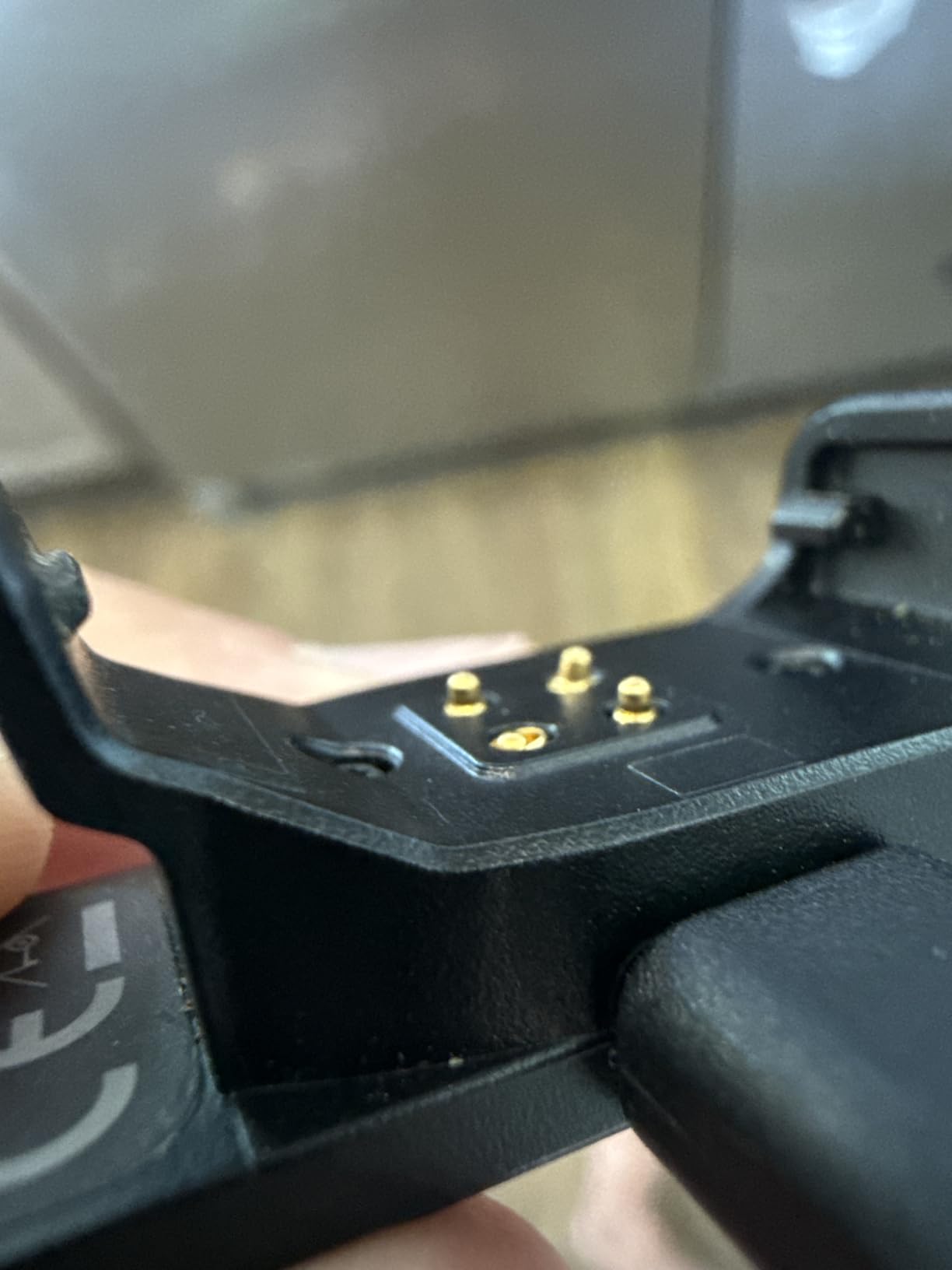
The buy-it-separately problem, and why it matters here
The TT 25 is a collar only. To see a map you need a Garmin Alpha or Pro 550 Plus handheld, and that is the complaint buyers raise most often. Read the listing carefully and budget for the receiver, because the surprise second purchase is the most common regret we heard about.
There is also no map on the collar. Every mapping function happens on the handheld, which sounds like a limitation until you consider that a 1.3 oz collar with a screen would be a worse collar for the dog.
Where the TT 25 fits best
Choose this collar if you run smaller dogs, if you hunt multiple days from a camp, or if you already own a compatible Garmin handheld and want a second or third dog added to the system. In that last case it is straightforwardly the cheapest path to expanding an existing kennel setup.
Do not choose it for satellite emergency messaging. The TT 25 is a tracker and a trainer; the SOS capability lives in the handheld, and only on the inReach models.
3. Garmin Alpha 200i with TT 15 Review – Most Compact with Satellite Safety
Garmin Alpha 200i/TT 15 Dog Tracking and Training Bundle, Handheld and Collar, Utilizes inReach Technology, Sunlight-readable 3.6″ Touchscreen (010-02230-00), Black
Handheld plus TT 15 collar
3.5-inch touchscreen
Tracks 20 dogs at 9 miles
inReach interactive SOS
20-hour battery
Pros
- Complete handheld and collar bundle ready to hunt
- tracks up to 20 dogs from 9 miles at 2.5-second updates
- interactive SOS and two-way satellite messaging
- preloaded TopoActive maps with BirdsEye imagery
- 18 stimulation levels plus tone and vibration
Cons
- inReach needs an active paid satellite subscription
- battery drops to about 15 hours with inReach switched on
- runs Android and can feel dated
This bundle is the cleanest way to get satellite emergency capability without buying a separate communicator. The Alpha 200i handheld pairs with the TT 15 collar and runs interactive SOS plus two-way messaging over the Iridium satellite network, which works where there is no cell reception and no view of a sky horizon is required beyond open air.
The 3.5-inch capacitive touchscreen is sunlight-readable and stays legible in open country, and it comes preloaded with TopoActive maps plus downloadable BirdsEye satellite imagery. A built-in three-axis compass and barometric altimeter handle navigation when you are walking a ridge line rather than following a dog across a field.
Tracking is 20 dogs from up to 9 miles at a 2.5-second update rate, with multi-GNSS support across GPS and Galileo. The TT 15 collar carries a top-mounted high-sensitivity GPS/GLONASS receiver, which is the placement that tends to hold a fix better on a running dog than a collar-wrapped antenna.
Hunt Metrics is a nice quiet extra: it records each dog’s daily distance, patterns and behaviour, which is useful if you are trying to work out which dog is ranging too wide before the hunt starts.
What the subscription actually changes
The inReach functions are not included free. You need an active satellite subscription to send SOS and messages, and this is the single most repeated complaint in the reviews. The sat comms themselves are a paid service no matter which brand you buy.
Battery is the other trade. The handheld is rated around 20 hours normally, dropping to about 15 with inReach enabled. That still covers a full hunting day with margin, and you can top it up between days, but it is not a spec you can ignore.
Who this bundle fits
It suits handlers who hunt alone in remote country where a medical evacuation is a real possibility, and who want tracking and training in one box. Backward compatibility with older Alpha collars also makes it a reasonable way to build onto a system you already partially own.
It is a weaker choice if you want the newest handheld, since the Alpha 200i runs Android and can feel dated next to current devices, or if you need the full multi-dog view with four positions on screen at once.
4. Garmin Alpha 300i with TT 25 Review – Best Pick for Backcountry Hunts
Garmin Alpha 300i Dog Tracking System with Alpha TT25 Dog Collar Bundle
Tracks 20 dogs at 9 miles
2.5-second updates
inReach SOS and satellite text
55-hour handheld battery
Treed and on-point alerts
Pros
- Works in deep woods and swamp with no cell service nearby
- collar battery runs close to three days on a single charge
- inReach interactive SOS and satellite text messaging
- real-time treed and on-point dog alerts
- channel congestion monitoring reduces interference
Cons
- Highest price point in this roundup
- satellite features need an active paid subscription
- touchscreen takes some getting used to in the field
This is the system to buy when the hunt happens somewhere with no bars, no road and no quick way back. Bird dog hunters using this setup describe it as reliable in deep timber and swamp, which are the two environments where cheaper radio systems tend to lose the dog on you.
Real-time treed and on-point dog alerts are the feature that changes how a hunt actually runs. Rather than circling the airspace hoping to pick up a signal, the handheld tells you the dog is on point or up a tree, and you can walk to the bird instead of searching for the dog.
The TT25 collar in this bundle uses a top-mounted GPS and Galileo receiver and adds multicolor LED beacon lights for low-light tracking. Hunt Metrics logs distance, speed and time on dog, which gives you a record of how hard each dog worked across a season rather than just an impression.
VHF transmission on unique channels with congestion monitoring is a small detail that pays off in public land. When several handlers are working the same BLM block, the system reduces interference rather than showing you a dog that is really three hunters away.
The handheld runs up to 55 hours per charge and the bundle includes a power bank and a field travel bag. The bag matters more than it sounds: a three-and-a-half pound unit plus spare collars plus a charger is a kennel-management problem, not a shopping problem.
The honest trade-offs
This is the most expensive item in the roundup, and satellite features still require a paid subscription. If you hunt on public land near a road and never go more than an hour from the truck, that money buys you very little.
The 65-review base is also the second thinnest here. A 4.7 rating on 65 reviews is excellent, but we weight review volume heavily for a tool you will depend on in cover. The bundle also carries third-party extras that make the package bulkier than the bare system.
When it is worth paying for
Buy this one for multi-day wilderness trips, solo backcountry hunting, and any pack you expect to run out of sight in heavy cover. The combination of on-point alerts, three-day collar battery and satellite SOS is the most complete safety package in this list.
For fair-weather close-working dogs on familiar public land, the PATHFINDER2 Compass does the same core job for a good deal less. That is a reasonable trade, and plenty of handlers make it.
5. SportDOG TEK 2.0 Add A Dog Collar Review – Best for Large Packs
SportDOG TEK Series 2.0 Add A Dog GPS Collar, 16 KM Range, 21 Dog Tracking, Waterproof, Dogs Necks 10.75, 23 Inches
16 km range on TEK 2.0 handheld
21-dog tracking
DryTek waterproof to 7.6 meters
Neck range 10.75 to 23 inches
3-year warranty
Pros
- Long 16 km rated range on the TEK 2.0 handheld
- tracks up to 21 dogs on one handheld
- waterproof to 7.6 meters of submersion
- backward compatible with TEK 1.5 handhelds
- three-year manufacturer warranty
Cons
- Requires a TEK handheld which is not included
- handheld map quality is basic next to newer systems
- only works inside the SportDOG TEK ecosystem
SportDOG occupies a different corner of this market, and for one job it is genuinely the best tool: packs. A TEK 2.0 handheld tracks up to 21 dogs, which is the highest documented capacity we found in this roundup, and HopTek technology raises the transmitting output to back it up.
DryTek waterproofing is rated for submersion up to 7.6 meters, so the collar handles river work and duck season without the anxiety that a wet morning creates with lesser collars. The adjustable neck range covers 10.75 to 23 inches, a wider span than most of the collars here.
Backward compatibility with TEK 1.5 handhelds is the reason many owners bought this particular collar. If you already run TEK gear, a new dog joins your existing system rather than starting a second ecosystem. That is a real and underrated advantage.
The three-year manufacturer warranty is the longest in this group, and it matters for a collar that lives in mud, water and brush for a decade.
The add-a-dog reality
Be clear about what you are buying. This is a single add-a-dog collar, and it needs a TEK handheld to be of any use. Owners who already have one describe pairing as immediate; owners without one describe buying the collar as a mistake of timing.
Handheld map quality is also the weakest point. SportDOG gives you direction, distance and status, and the maps are basic compared with the Garmin touchscreen experience. For a handler running eight hounds who mainly needs to know which way the pack went, that is an acceptable trade. For someone who wants to navigate by topo, it is not.
Who this fits
Choose TEK if you run a genuine pack, if your dogs already work in water, or if you want the longest warranty in the category. The 16 km rated range on the TEK 2.0 handheld is the highest figure listed by any product here.
Pass if you want training stimulation built into the same collar, or if you need satellite messaging. TEK does tracking; it does not do training or SOS.
6. eMACROS Dog GPS Tracker Review – Best No-Subscription Backup Tracker
eMACROS Dog GPS Tracker No Subscription, Off-Grid, Up to 3 Mile Long Range
Up to 3-mile open range
5-day tracker battery
3-level virtual fence
IP67 waterproof
Arrow and distance display
Pros
- No subscription
- app or cellular signal required
- up to 5 days of tracker battery life
- arrow and distance guidance is easy to learn
- three-level virtual fence at 200
- 500 and 1000 ft
- night-find light and sound with reflective collar
Cons
- Only 12 reviews in the data we reviewed
- range drops to about 0.5 mile in forest
- no map display at all
- suits dogs 35 lbs and up
This is the cheapest way to add a second layer of safety to a kennel, and it does one thing with no strings attached: radio tracking with no subscription, no app, no phone and no cellular signal. The handheld controller runs about two days per charge while the tracker itself runs up to five days.
The interface is an arrow plus a distance number. No map, no compass rose, no training functions. For someone who has never used a GPS dog collar, that simplicity is a genuine advantage, and it is the opposite of the Garmin learning curve.
A three-level virtual fence at 200, 500 and 1000 feet adds a boundary alert, and there is a night-find light and sound plus a reflective collar for dusk recovery. IP67 waterproofing handles rain and mud without special handling.
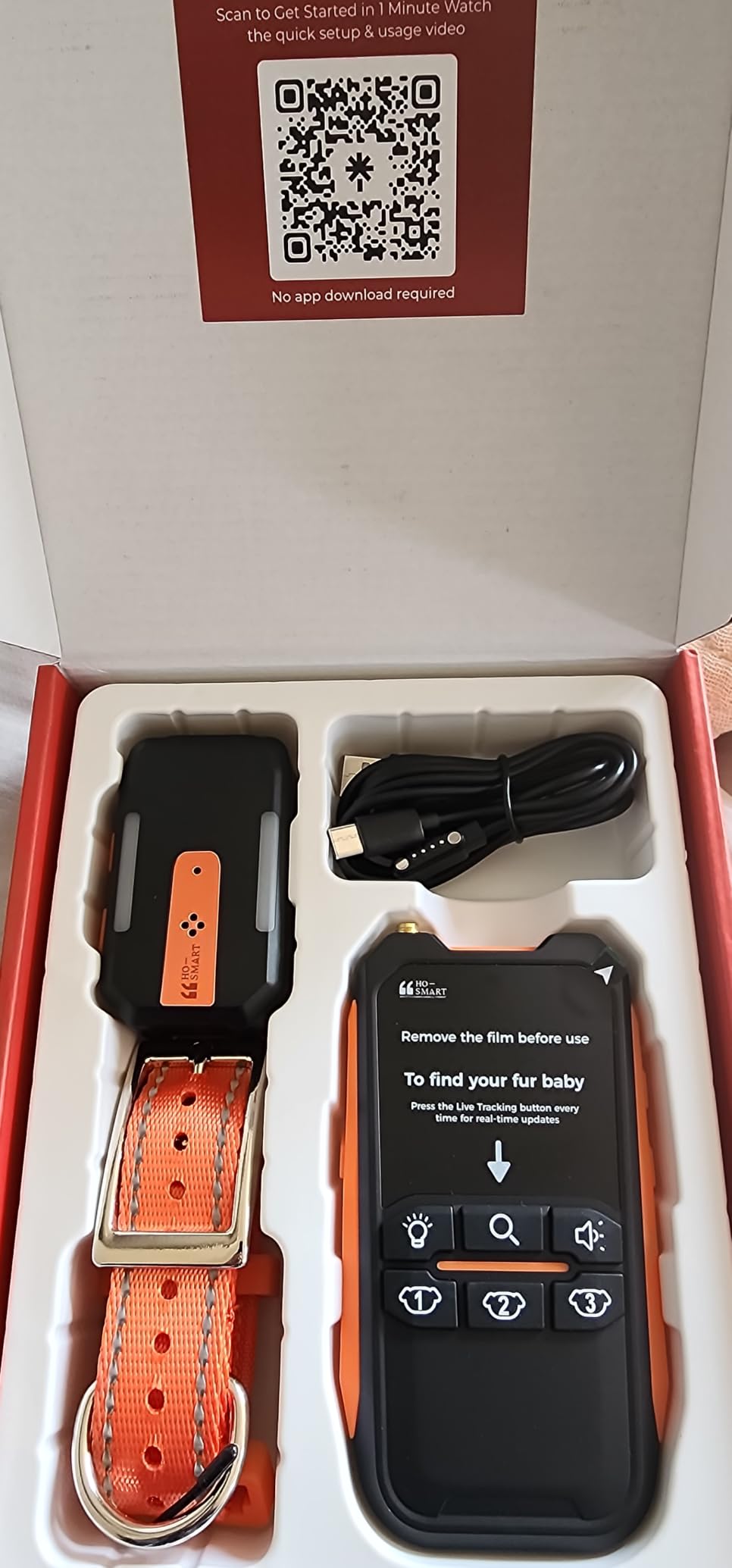
Range is where honesty matters most with this one. Up to 3 miles in open seaside conditions, up to 2 miles in rural areas, and up to 0.5 miles in forested areas. That last number is not a typo, and it is why this belongs in the backup seat rather than the primary seat for anyone hunting timber.
It fits dogs 35 pounds and up, matching the Dogtra’s floor, so neither of the two lightweight options covers a small setter.
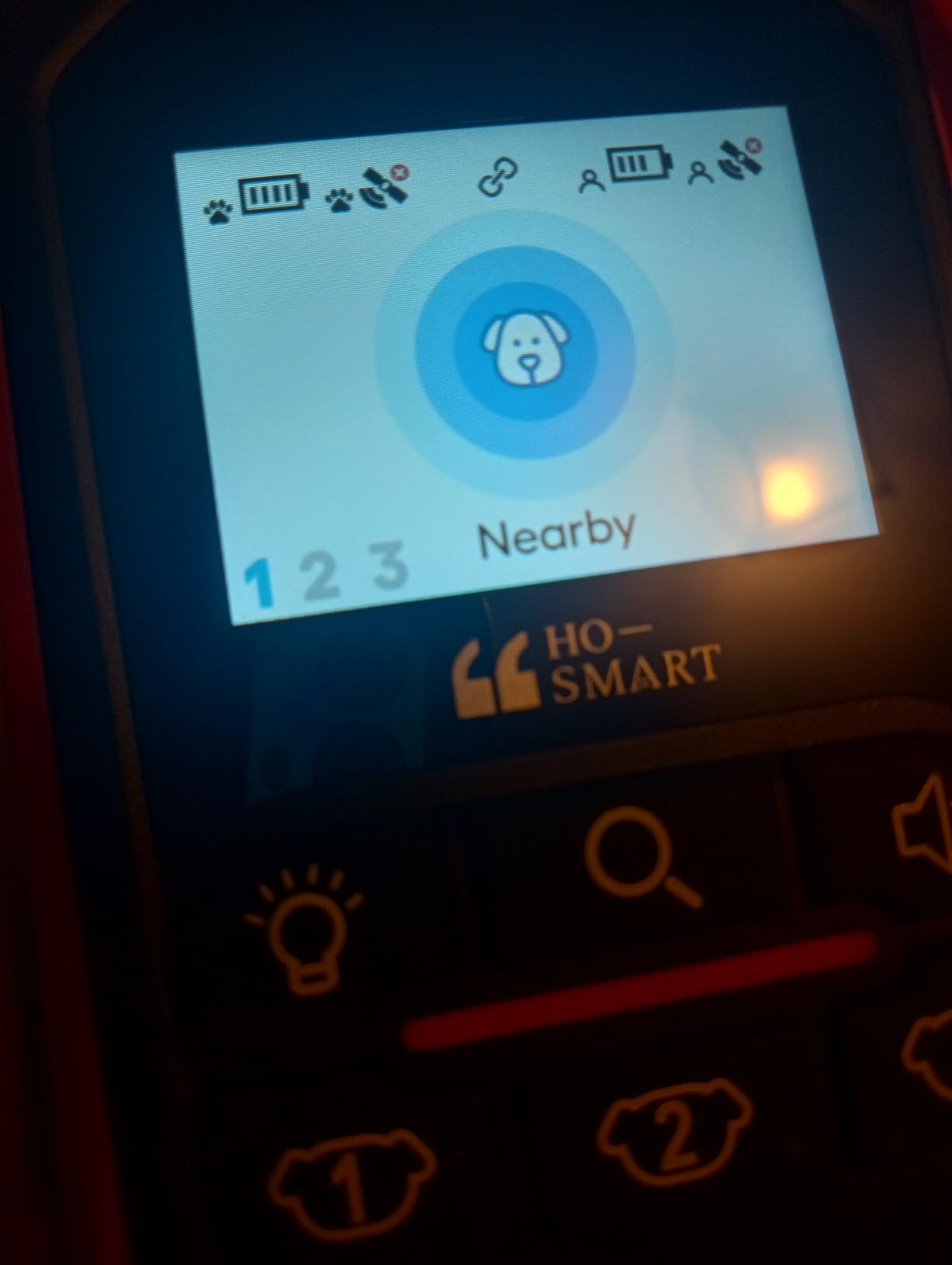
How to read the 4.8 rating
The raw average is the highest in this roundup at 4.8 with zero one- or two-star reviews. That figure rests on 12 reviews, which is the smallest base of any product here, and a 4.8 built on 12 responses tells you very little about a third winter of service.
Treat it as encouraging rather than proven. The reviewers who did respond describe a simple, effective, zero-cost device that does exactly one thing, and nothing in the data contradicts them.
Where it makes sense
Buy it as a backup collar for a second dog, as a system for a handler who hunts open country and hates subscriptions, or as a training aid for a young dog working in a field. The fence levels and the night-find mode are both genuinely useful for young dogs.
Do not rely on it alone in heavy timber, and do not expect map detail, training functions or a pack larger than a couple of dogs. For any of those jobs, spend more on a system with a real handheld.
7. Aorkuler Outdoor GPS Tracker 2 Review – Most Versatile for Short Trips
Outdoor GPS Dog Tracker – No Monthly Fees, No Phone or Cellular Signal Needed, Real-Time Tracking for Remote & Rural Areas, Hiking, Camping, Farms & Large Open Spaces(Tracker 2)
3-second updates
3.5-mile range
1.08 oz tracker
No app or monthly fees
Up to 24 hours continuous tracking
Pros
- No monthly fees and no dependence on cell or Wi-Fi coverage
- tracker weighs just 1.08 oz
- green direction arrow proves reliable for locating a dog
- 2-3 hour full recharge
- support is repeatedly praised as responsive
Cons
- GPS lock-on can take many minutes
- distance readings are less accurate than the direction arrow
- needs recalibrating after each shutdown
The Aorkuler is the lightest unit in this roundup at 1.08 ounces, which matters more than it sounds for a dog working hard in brush. It runs on a handheld controller with no app, no network and no monthly fees, and it fits most collars rather than requiring a dedicated system.
GPS updates every three seconds with up to 3.5 miles of range, and the green direction arrow on the handheld is described by owners as dependable for locating a dog off leash. You get a two to three hour full recharge and up to 24 hours of continuous tracking.
Battery figures depend heavily on how you use it. Owners report up to 10 or more days at one to two hours of daily use, which is realistic for someone checking on a farm dog twice a day and completely wrong for an all-day hunt.
The warranty is one year, extended to three with registration, which is a better arrangement than most products here manage.
Why the rating sits where it does
This is the lowest-rated item in the group at 4.0, with a 12% one-star share, and the complaints are consistent rather than random. GPS acquisition is slow, often taking many minutes to lock on, and the unit needs recalibrating after each shutdown.
Distance readings are noticeably inaccurate while direction is more trustworthy. That combination is workable if you know it going in: circle on the arrow until the number settles, rather than trusting the yardage. Accuracy also suffers in heavy tree cover and around buildings.
The honest use case
This is a short-trip tracker. For a farm, a large property, a hunt where the dog stays within sightline of open ground, or a backup device in a kennel bag, it does the job at a modest outlay with no recurring cost.
It is not an all-day hunting solution. A slow satellite lock at dawn, when you want a position before you unload, is the wrong failure mode for a pointing dog. If your hunt depends on knowing where a dog is within seconds of it going out of sight, look at the Pathfinder2 or the Garmin bundles instead.
How to Choose a GPS Dog Collar for Hunting Dogs
Every decision below matters, but only two of them are genuinely hard. The first is range, because rated line-of-sight miles are the number manufacturers most reliably oversell. The second is architecture, because a cellular tracker in a national forest is a very expensive paperweight.
Line-of-sight range versus real terrain
Line-of-sight range means the distance the radio signal travels with nothing in the way. Ridges, dense timber, standing water and rolling hills all cut that number hard, and the loss compounds. In hilly or heavily timbered country, a fair expectation is roughly 50 to 70 percent of the rated figure. A 9-mile system in open CRP ground is a 9-mile system. The same system in second-growth timber across a ravine might give you 5 or 6 useful miles and some genuinely frustrating gaps.
Match the range to the country, not to the spec sheet. Most upland bird hunting happens within two or three miles of the handler, and every system here covers that comfortably. Range only becomes the deciding factor when dogs are running big and country is rough.
Standalone radio, cellular, or Bluetooth
Standalone radio systems send the collar position straight to a handheld by radio frequency. They need no phone, no tower and no subscription, and they are what all seven products in this roundup use. Cellular systems send the position through a cell tower to a cloud service and an app, which makes them convenient for house pets and useless where you are actually hunting. Bluetooth proximity finders like an AirTag rely on phones nearby reporting their own location, and there are no phones in the backcountry.
If someone tells you a consumer tracker works for hunting, they are describing a hunt that happens next to a road.
Update rate and battery life are the same decision
A two-second update rate looks better than a five-second one and costs battery to deliver. One handler described a Garmin Astro that ran out of power quickly with the refresh rate turned up to five seconds, which is the opposite of what the setting is supposed to do. Faster refresh means the radio transmits more often, and the radio is what drains the pack.
For most hunting, 2.5 to 3 seconds is the sweet spot. Anything faster buys you very little on a dog that has stopped. If your dogs range hard and stay running, use the slower setting and add a second battery rather than chasing refresh speed.
Also plan for cold. Battery capacity drops in winter conditions, and the rated hours assume comfortable temperatures. For a late-season deer or waterfowl trip, treat the rated figure as a ceiling and charge between days.
Multi-dog capacity and the real cost per dog
Capacity is a headline spec, but the number that matters is your actual kennel size and the incremental cost per receiver collar. A system rated for 20 dogs is only useful if you can afford 20 collars, and each extra receiver collar is a separate purchase.
Our advice is to buy the handheld once and add collars over two or three seasons rather than trying to outfit a full string on day one. The SportDOG TEK 2.0 rated 21 dogs on one handheld is the highest capacity here, and the Dogtra Pathfinder2 expands to 21 dogs showing four at a time, but neither makes a 20-dog kennel cheap.
Budget for the kennel itself as well as the electronics. If your dogs spend their off-season nights in a run, our picks for the best dog crates for large dogs cover the housing side of that setup.
Training integration and collar fit
For hunting dogs specifically, a collar that both tracks and trains saves you from carrying two devices. Look for momentary and continuous stimulation levels, tone and vibration, and put vibration first for a deaf dog, since it is the only recall channel that reaches them.
Fit matters more than most buyers expect. Weight thresholds matter: the Dogtra Pathfinder2 and the eMACROS both specify dogs 35 pounds and up, while the Garmin TT 25 at 1.3 ounces is slim enough for small dogs and large ones alike. A collar that is too heavy sits low on the neck and rubs under the jaw all day. Check the neck circumference range and fit it snug enough that it cannot catch on brush, then walk the dog before you rely on it.
If you are still weighing a collar versus a plain training collar, our guide to hunting dog training collars covers the non-GPS side properly.
One practical habit worth adopting: write down the radio frequency of your collar when you set it up. Hunters with full-function trackers can tune into that frequency and help with a search. It costs you thirty seconds and it is the kind of detail that only matters on the worst day of the season.
Why AirTag, Fi and Tractive Collars Fail in the Backcountry
These products are excellent at what they are built for, and they are built for a different job. The failure is not a bad satellite fix. The GPS chip in a phone-grade tracker is generally accurate. The failure is the link back to you.
A cellular tracker needs a cell tower between the dog and you. Public land is exactly where towers are not. Hunters report collars going dead once the dog runs beyond coverage, and one documented test in a remote national forest with a single bar of service failed to lock onto the dog at all. Some cellular collars also run on a single carrier, so coverage depends on whose towers you happen to be near rather than on the nearest tower.
An AirTag is worse, because it is not a tracker at all. It is a Bluetooth beacon that piggybacks on other people’s phones reporting their own location. That network is dense in a city and empty in a drainage in Wyoming. There is also no live position, only a last-reported proximity.
None of that matters if your hunt happens at a state park within signal range. All of it matters if you are two hours from the truck. The dedicated hunting systems in this roundup exist because the radio link was designed for open country rather than adapting a house-pet architecture to a treeline.
What Actually Fails in the Field
The spec sheets describe a system on a good day. Hunting forum threads describe the other kind of day, and these are the failures we would want you to know about before the season starts.
Battery drain follows your update rate, not your battery size. Fast refresh settings cost you hours, and the fix is the slower rate rather than a bigger pack. Plan charging around the hunt, not around the specification.
Satellite re-acquisition is slow after a power cycle. A handler reported that after powering off, it can take several minutes to acquire satellites and the signal. Never plan to switch a collar off and back on at the truck and expect an instant fix.
A stale last-known-position readout confuses people more than any other issue. When the signal drops, the screen still shows how far the dog was when the unit last had a signal, which might have been yesterday at a location far from where you are standing. Treat any position you did not see update as unconfirmed.
Firmware updates cause real friction. Handlers report updating their GPS collars and still having problems afterward, and compatibility between generations of collars and handhelds is not always seamless. Check that a new collar is supported by your existing handheld before you buy it as an add-on.
E-collar rules are regional, and this is worth checking before you spend. One hunter reported that in their area all the Alpha units, other Astro units and the 550 Plus were restricted and the GPS function shuts off where stimulation is not permitted. Verify the rules where you hunt, and if stimulation is restricted, confirm with the manufacturer what the GPS-only behaviour is before relying on it.
Ecosystem lock-in is the quiet cost nobody budgets for. Extra receiver collars run 200 to 300 each depending on brand, so a 10 to 20 dog string is a major capital purchase spread over years. Decide the ecosystem first, then plan the collar count.
Frequently Asked Questions
Do GPS hunting collars require monthly fees?
No. Every dedicated hunting-grade system in this roundup tracks with no recurring charge. Satellite SOS and two-way messaging, available on the Garmin Alpha 200i and Alpha 300i, do require a separate subscription, but the tracking and training functions never do. Consumer cellular trackers like Fi and Tractive do charge monthly, which is one of several reasons we left them out.
Can I use a Tractive or Fi collar for hunting?
Only if you hunt within cell coverage, which for most upland and backcountry hunting means no. Those collars send your dog’s position through a cell tower to an app, so once the dog ranges beyond tower coverage the collar goes dark in exactly the terrain where you need it most. Some also depend on a single carrier, so performance varies with whose towers are nearby.
How far can a hunting GPS collar track?
Rated figures in this roundup run from 3 miles to 10 miles, and rated range means clear line of sight. In hilly or heavily timbered country a fair expectation is roughly 50 to 70 percent of the rated number. Most upland bird hunting happens within two or three miles of the handler, which every system here covers comfortably.
How long does a hunting GPS collar battery last?
It depends on update rate more than anything else. The Garmin Alpha TT 25 is rated up to 68 hours per battery pack and up to 136 with the expanded pack, while the Alpha 300i collar runs close to three days. Handheld batteries are shorter, around 20 to 55 hours depending on the model, and satellite messaging shortens that further. Cold weather cuts all of these figures.
How many dogs can one GPS collar system track?
Up to 21 on the systems we tested here. The SportDOG TEK 2.0 handheld and the Dogtra Pathfinder2 both handle 21 dogs, and the Garmin Alpha 200i and Alpha 300i track up to 20 with data storage for 250 dogs for in-field switching. Each extra receiver collar is a separate purchase, so build a pack over a few seasons rather than all at once.
Final Verdict
If you run two to four dogs in typical upland country and want one box that tracks, trains and never sends you to a subscription page, the Dogtra PATHFINDER2 Compass is our pick for the best gps dog collars for hunting dogs this year. Its 9-mile radio range, two-second updates and 330-review track record make it the safest default choice, and its small screen and 35-pound weight floor are the two limits worth checking against your dogs.
Hunt alone in country with no road behind you and add satellite messaging, and the Alpha 300i with TT 25 is the better tool. Run a genuine pack and want the longest range and warranty, and the SportDOG TEK 2.0 ecosystem does more dogs on one receiver than anything else we tested. Hunt multi-day camps with smaller dogs, and the Garmin Alpha TT 25 collar is hard to argue with on battery life and weight.
Whichever one you choose, fit it properly, write down the collar frequency, keep a plain backup collar with ID in the kennel, and check your region’s e-collar rules before the first hunt.