
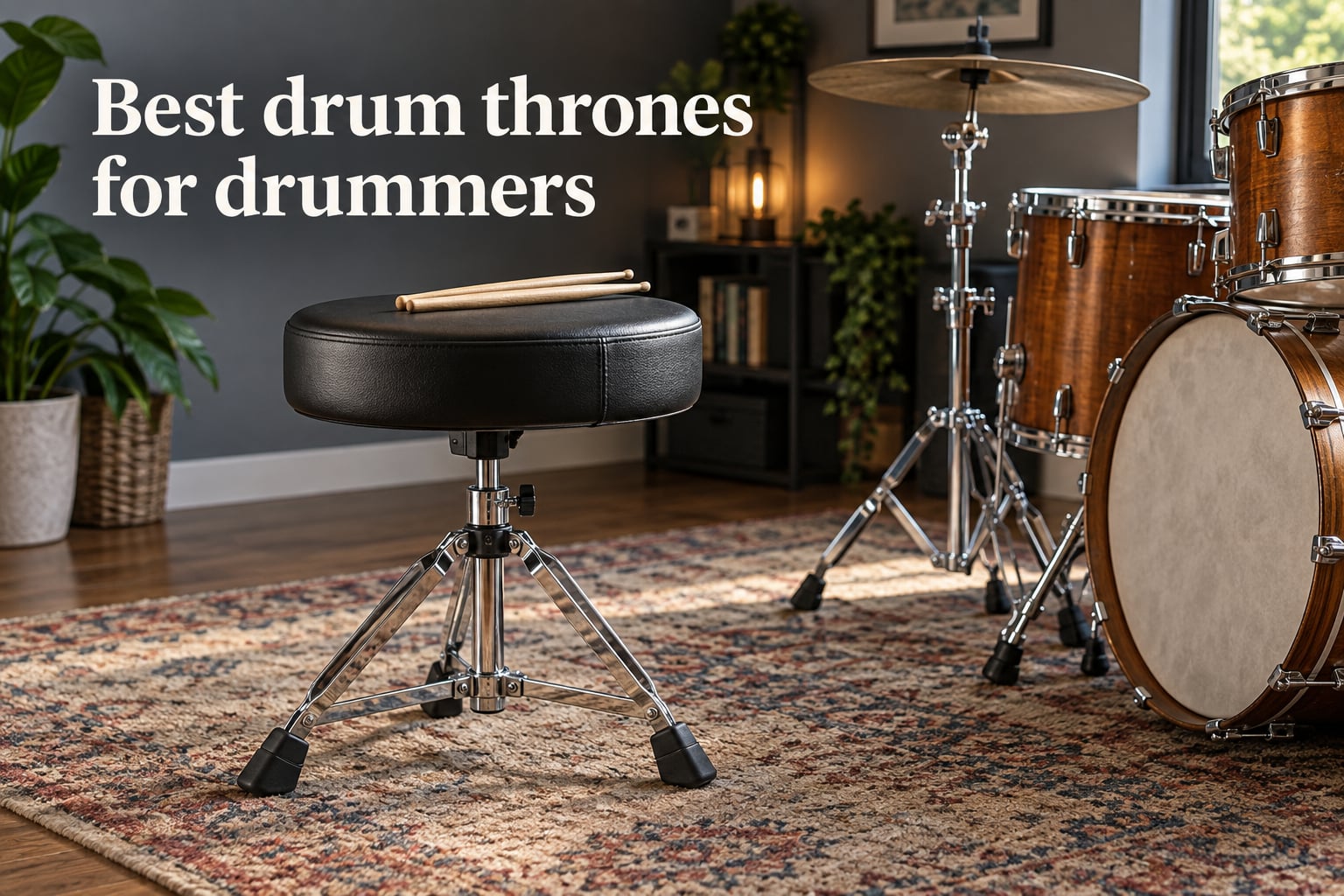
Most drummers buy a throne the way they buy a snare cable: pick one, drag it into the corner, and deal with it for a decade. That is a shame, because the seat is where you spend every minute of practice, every rehearsal, and every show. Sit badly for two hours and your lower back knows about it the next morning. Sit well and the same two hours feels almost ordinary.
That is the whole reason we put the best drum thrones for drummers head to head. A drum throne is not a kitchen stool with a taller post. It is a purpose-built piece of hardware with a wide splayed base, a threaded or pneumatic height mechanism, a locking collar so the seat does not creep while you play, and a seat shape chosen to spread pressure across your sit bones instead of your tailbone. The difference shows up in hour three, not hour one.
We compared twelve thrones across seat type, height range, bracing, weight capacity and cushioning, and we read what owners report after months rather than days of use. We also looked at what drummers ask about most on r/drums and the wider drum forums: round versus saddle, spindle versus gas lift, backrests that push you forward, and which budget throne will not wobble. If you are still choosing practice surfaces, our guide to the best practice pads pairs well with a throne that will not slide around on the carpet.
Here is the short version before we get into the details. The Donner throne is the one we would put in front of most people because it carries the largest review base in this group and a double-braced base that stays planted. If you want a seat you can set once and forget, the Gibraltar 6608 has a memory lock and a wide 18 to 24 inch range. And if you are chasing the best-built saddle on the market and you do not mind carrying it, the Roc-N-Soc Nitro is hard to argue with.
Table of Contents
Top 3 Picks for the Best Drum Thrones in 2026
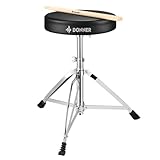
Donner Drum Throne with 5A Drumsticks
- Double-braced base
- 4-position height lock
- 250 lb capacity
- 5A sticks included

Gibraltar 6608 Motorcycle-Style Throne
- Memory lock
- 18-24 inch range
- 330 lb capacity
- 5 year warranty

ROC-N-SOC Nitro Gas Lift Saddle Throne
- Gas lift height adjustment
- Free-spinning saddle
- 330 lb capacity
Best Drum Thrones at a Glance in 2026
| Product | Specifications | Action |
|---|---|---|
| Donner Drum Throne with 5A Drumsticks |
|
Check Latest Price |
| Gibraltar 6608 Motorcycle-Style Throne |
|
Check Latest Price |
 EASTROCK Leather Drum Throne EASTROCK Leather Drum Throne |
|
Check Latest Price |
 Gibraltar 9608MB Throne with Backrest Gibraltar 9608MB Throne with Backrest |
|
Check Latest Price |
 Gibraltar 4608 Round Throne Gibraltar 4608 Round Throne |
|
Check Latest Price |
| ROC-N-SOC Nitro Gas Lift Saddle Throne |
|
Check Latest Price |
 DW 3000 Series DWCP3100 Throne DW 3000 Series DWCP3100 Throne |
|
Check Latest Price |
 GrowDaily Drum Throne with 5A Drumsticks GrowDaily Drum Throne with 5A Drumsticks |
|
Check Latest Price |
 AODSK Double-Braced Drum Throne AODSK Double-Braced Drum Throne |
|
Check Latest Price |
 AKLOT Hydraulic Saddle Drum Throne AKLOT Hydraulic Saddle Drum Throne |
|
Check Latest Price |
 5 CORE DS 01 BLK Drum Throne 5 CORE DS 01 BLK Drum Throne |
|
Check Latest Price |
 DW 5000 Series DWCP5100 Round Top Throne DW 5000 Series DWCP5100 Round Top Throne |
|
Check Latest Price |
1. Donner Drum Throne: The All-Rounder With the Biggest Following
Donner Drum Throne Set, Padded Seat Height Adjustable Drum Stool for Adults, 5A Drumsticks Included, Multiple Iterations, Drummer Gifts for Men Him Teens
High-density sponge seat
4-position bolt lock height
Double-braced base
250 lb capacity
Pros
- Largest review base in the group
- Double-braced base resists wobble
- High-density sponge holds its shape
- Folds flat for transport
- Includes a pair of 5A sticks
Cons
- Basic round pad rather than a contoured saddle
- 250 lb limit is modest for heavier players
- Four discrete height positions instead of continuous adjustment
I set this throne up in under five minutes and started using it as my default seat on an acoustic kit. The cushion is a 14 inch round pad in faux leather over high-density sponge, and after months of daily practice it still springs back rather than dished in the middle. That is the single most important thing on this list, because a throne that flattens stops supporting you.
Stability is where it earns the top spot. The base is double-braced, and the three rubber non-skid sleeves sit on a triangular aluminium bracket, which means the stool stays planted even when I lean into a fill. Owners on the forums repeatedly call double bracing the baseline for serious playing, and this one has it at a price that undercuts almost every established brand.
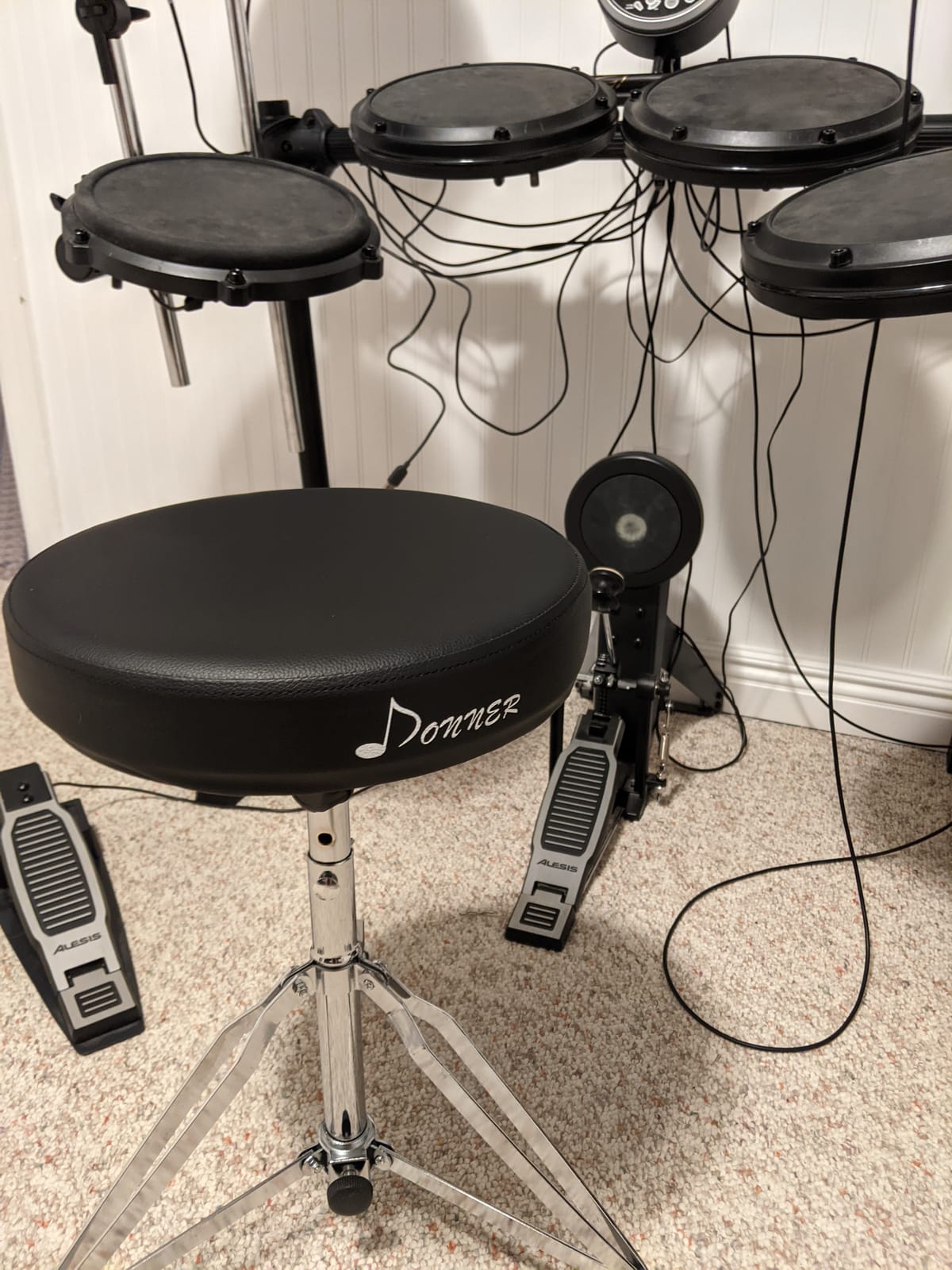
Height adjustment uses a four-position bolt lock plus a bottom knob, and the listed seat height is 22.8 inches. In practice that means you choose a position rather than dialling one in continuously, which is a trade-off some drummers like because the setting cannot drift. If your kit setup changes height often, that rigidity can feel limiting.
The throne folds for transport, and the package even includes a pair of 5A drumsticks, which is a small touch that matters most for a first kit. The listed weight is 2.9 kg, so it is not something you will dread carrying to a rehearsal space.
What you notice in the first month
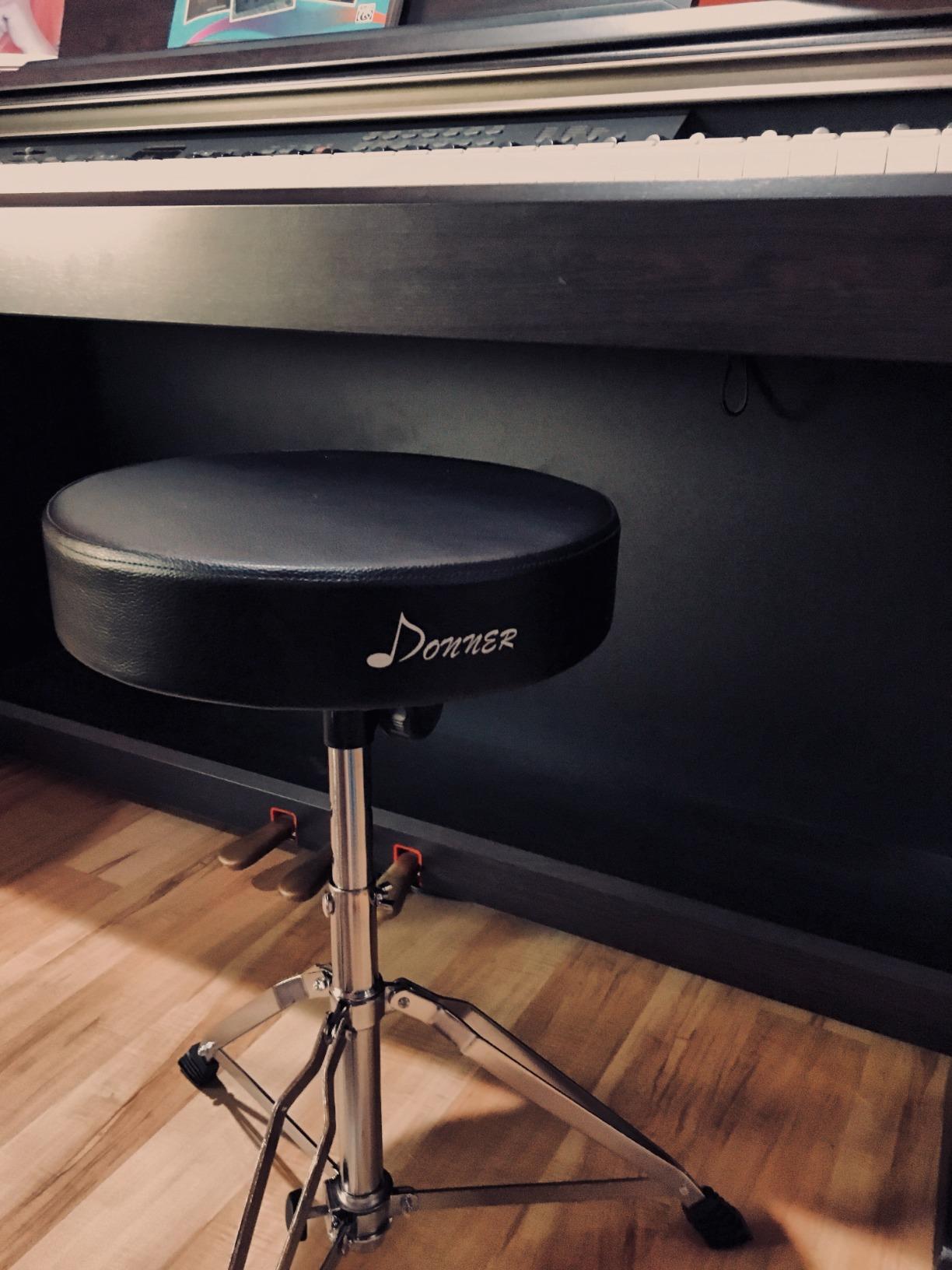
The thing that stands out immediately is how quiet and planted it feels. There is no swivel to catch your legs and no creak when you reposition, so you can sit down, adjust once, and stop thinking about the throne entirely. Owners also point out the anti-slip sleeves, which matter more than they sound like on a carpeted rehearsal room floor.
It doubles as a general instrument seat too, so a lot of buyers end up using it for guitar or keyboard practice. Just note that it is sold as a drum throne and performs best at the heights a kit needs rather than at every height a music stool should cover.
Who should skip it
Drummers above 250 lb will hit the ceiling on the stated capacity quickly, and the round pad is less forgiving over a five-hour session than a saddle or memory foam top. If long sessions and heavy playing are your normal week, spend up and go to a saddle design with more padding and a higher rating.
It is also the throne to skip if you need continuous height changes on the fly. The four-position lock is stable but coarse, so players who constantly move between a low floor tom position and a high kit position will find it slower than a gas lift.
2. Gibraltar 6608: Best Value Motorcycle-Style Throne
Gibraltar Drum Throne with Adjustable Height Motorcycle-Style Seat, Double-Braced Legs, Sturdy Drum Stool for Drummers, Comfortable Cushion for Practice or Performance (6608)
Motorcycle-style vinyl saddle
Top-grade foam
Cast collar with memory lock
330 lb capacity
Pros
- Memory lock holds your height setting
- 18-24 inch range suits most body sizes
- Collapsible double-braced base
- 5 year limited warranty
Cons
- Vinyl gets hot during long warm-room sessions
- No back support
- 10 pounds is heavier than basic stools
The Gibraltar 6608 is the throne I recommend to drummers moving up from a cheap stool. The seat is a contoured motorcycle-style pad in vinyl with thigh cutouts, roughly 15.5 inches wide, and the thigh cutouts are not styling. They give your legs somewhere to go when you sit back, which is what stops the numbness that saddle seats are blamed for.
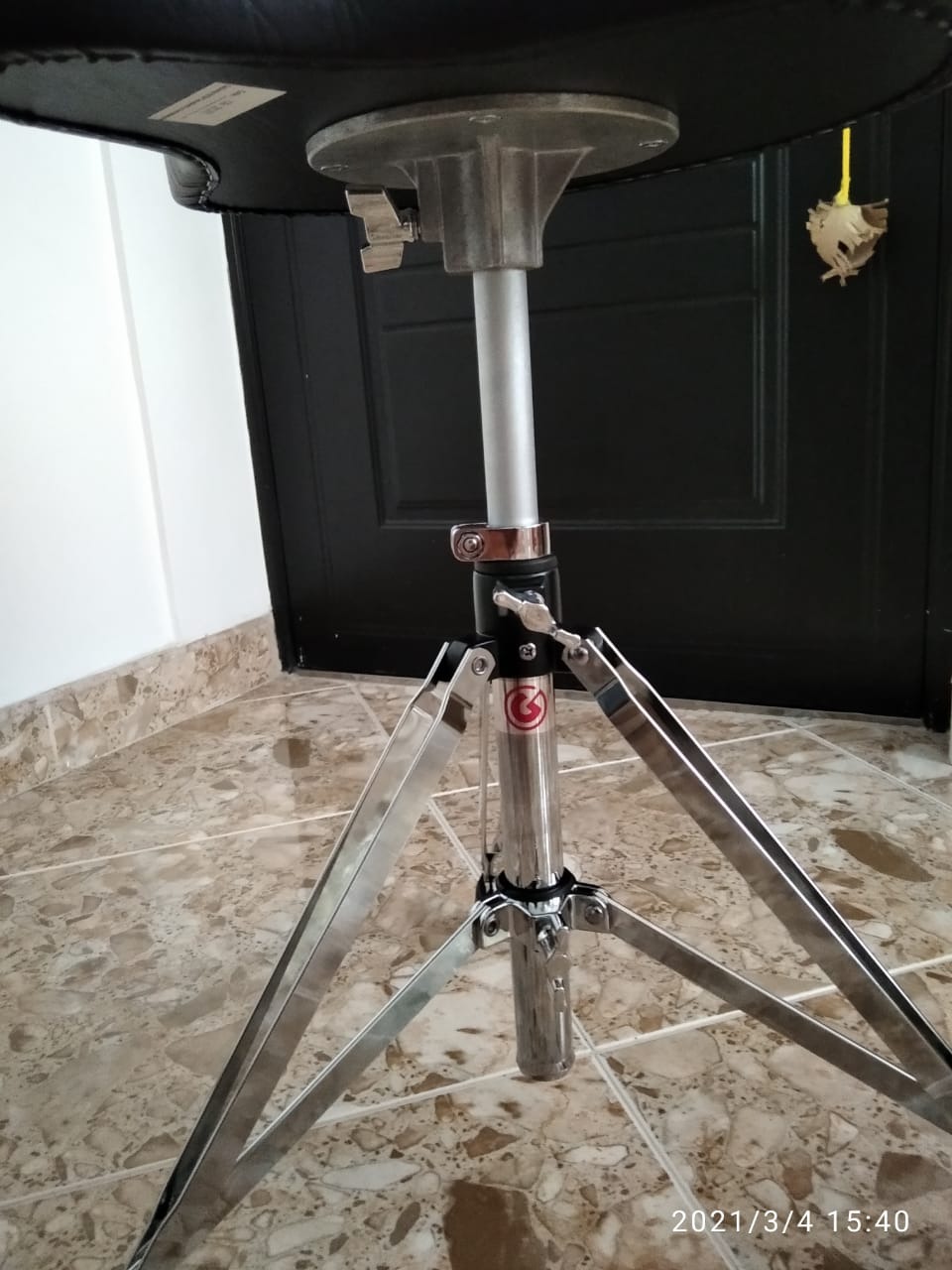
Height adjustment is where this model separates itself from the budget tier. It uses a cast height-adjust collar with a nylon bushing, a knurled stem and a memory lock, so you set the height once and it stays there. With a 4.5 rating across nearly 2,900 reviews, the memory lock is the feature owners mention most often when they explain why they stopped shopping.
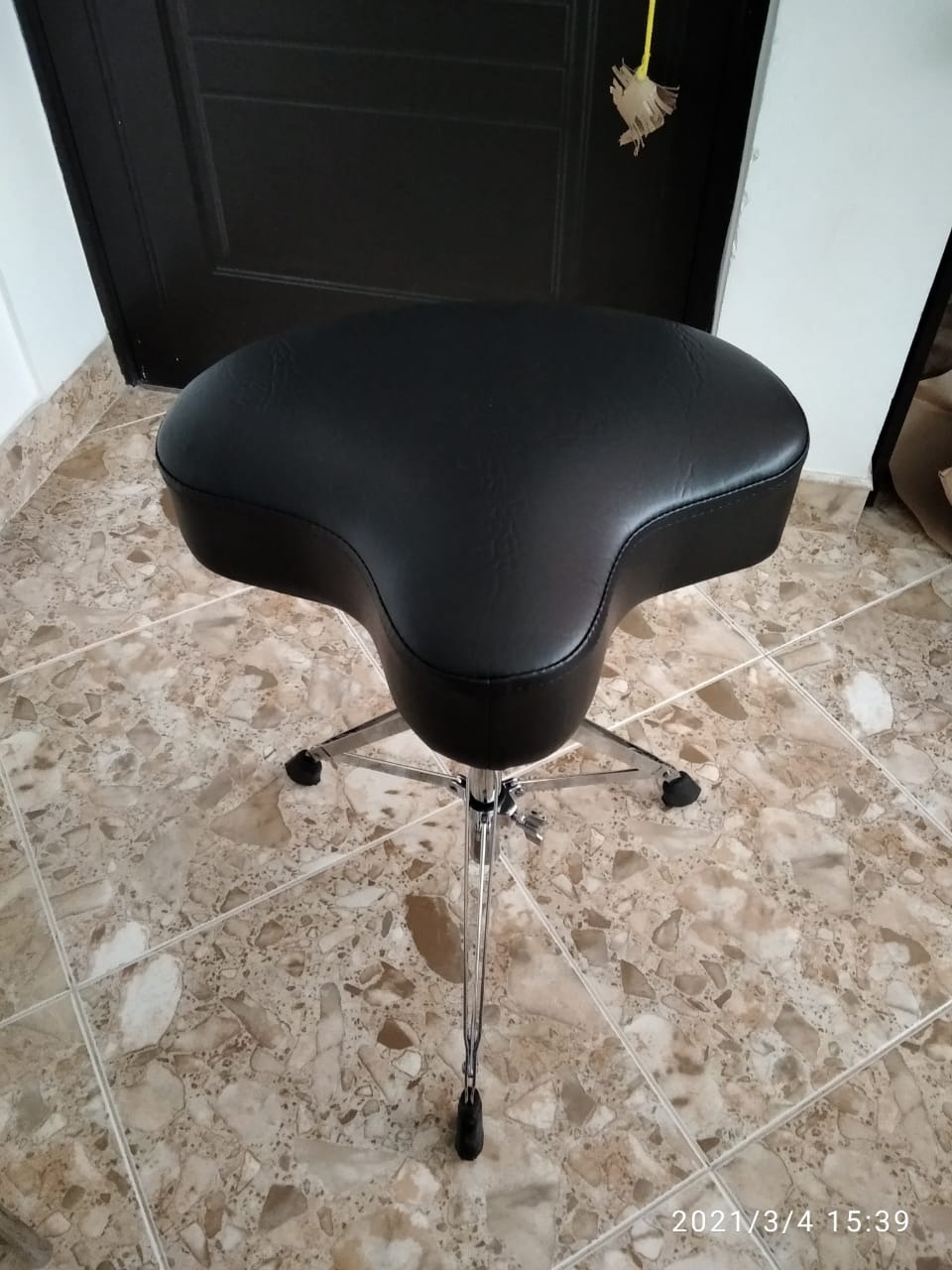
The base is a double-braced tripod that collapses for carrying, and the whole thing weighs 10 pounds. That is heavier than a student stool but very reasonable for something that never flexes when you hit hard. Gibraltar also backs it with a 5 year limited warranty, which is longer than anything else in this group.
The listed height range is 18 to 24 inches, which covers most drummers comfortably. Taller players sitting at a high floor-tom position may want to check their final height against their kit before committing, and the product listing gives you the full range to measure against.
What you notice in the first month
You notice the seat shape within a few minutes. The front cutout means you can sit slightly forward and slightly back without the edge of the pad digging in, which is the difference between comfortable and numb on a long set. The foam underneath is genuinely good rather than thin filler, and it survives a summer of rehearsals.
Adjusting the memory lock is the other early win. You loosen the collar, set the height, tighten it, and it is done. Gigging drummers who move between kits say this consistency is worth more than any cushion upgrade.
Who should skip it
Two profiles should pass. First, players with lower-back fatigue who need lumbar support, because there is no backrest on this model at all. Second, anyone who sweats heavily in a warm room, since vinyl is the least breathable covering on the market and can feel sticky after a couple of hours.
At 10 pounds it is also a compromise for players who carry their throne between venues constantly. It folds, but it is not a lightweight touring throne. If transport weight is the deciding factor, the Gibraltar 4608 further down this list is built for it.
3. EASTROCK Leather Drum Throne: Best for Kids and First Kits
EASTROCK Drum Throne,Padded Drum Seat Drumming Stools with Anti-Slip Feet for Adults and Kids Drummers (Dark Black)
7 cm sponge on 30 cm seat
Five height positions,16.5-21.3 inch range
180 lb capacity
Folding legs
Pros
- Thick high-density sponge resists deforming
- Five leg holes give a useful height range
- Three large anti-slip feet
- Legs fold for easy storage
- Doubles as a keyboard or guitar seat
Cons
- 180 lb capacity is the lowest here
- Plain round seat with no back support
- Discrete height positions only
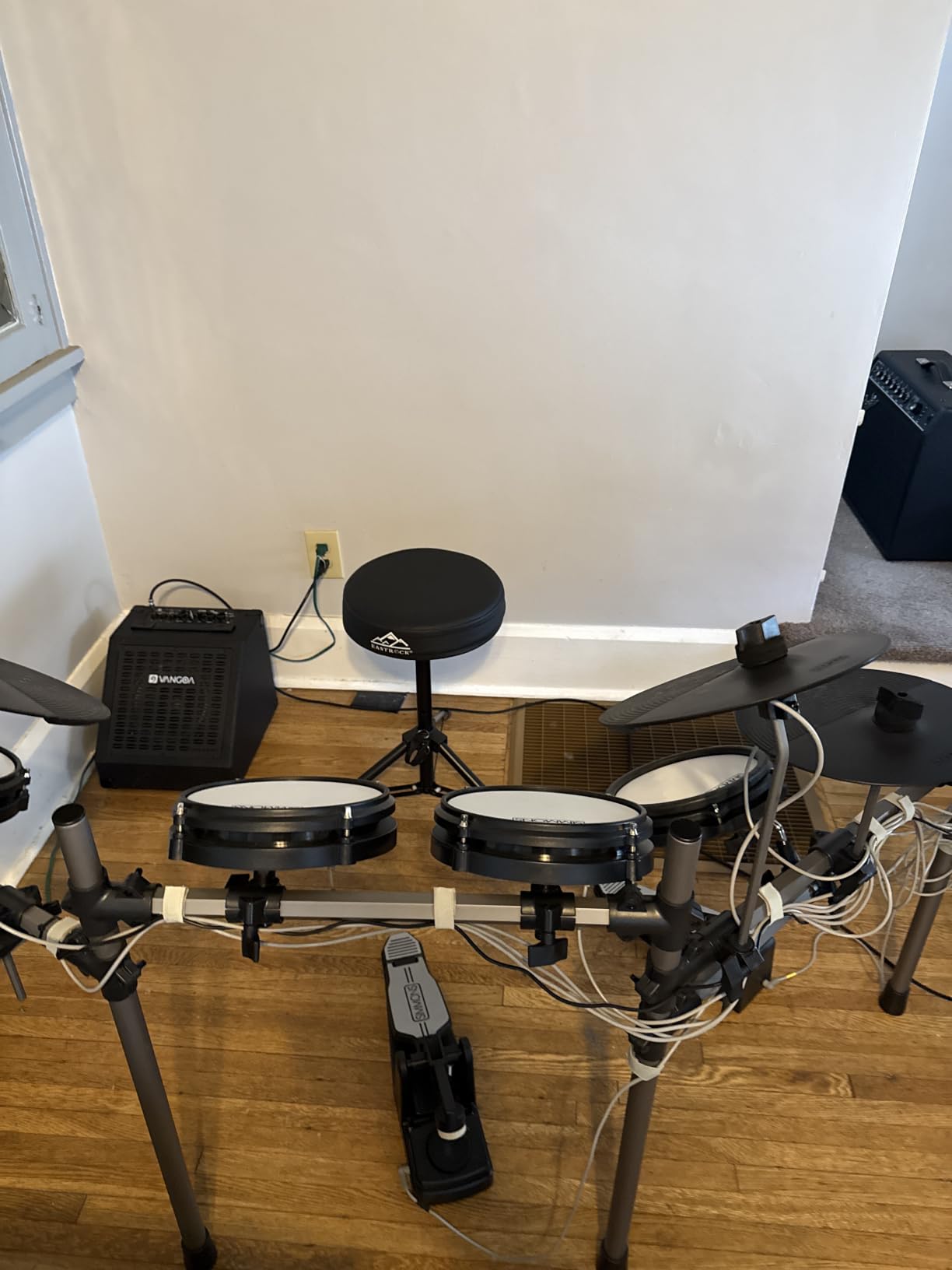
I put this throne on an electronic kit for a younger player in my circle, and it did the job without any drama. The seat is 30 cm across with 7 cm of high-density sponge, which is a genuinely thick pad, and after weeks of practice sessions it still holds its shape. The leather finish wipes clean, which matters in a shared household.
Height adjustment runs through five leg holes, giving a 16.5 to 21.3 inch range. That is a real span rather than a token adjustment, and it means one throne can follow a player from a 10-year-old to an adult. The three large rubber feet plus double-supported legs kept it steady the whole time.
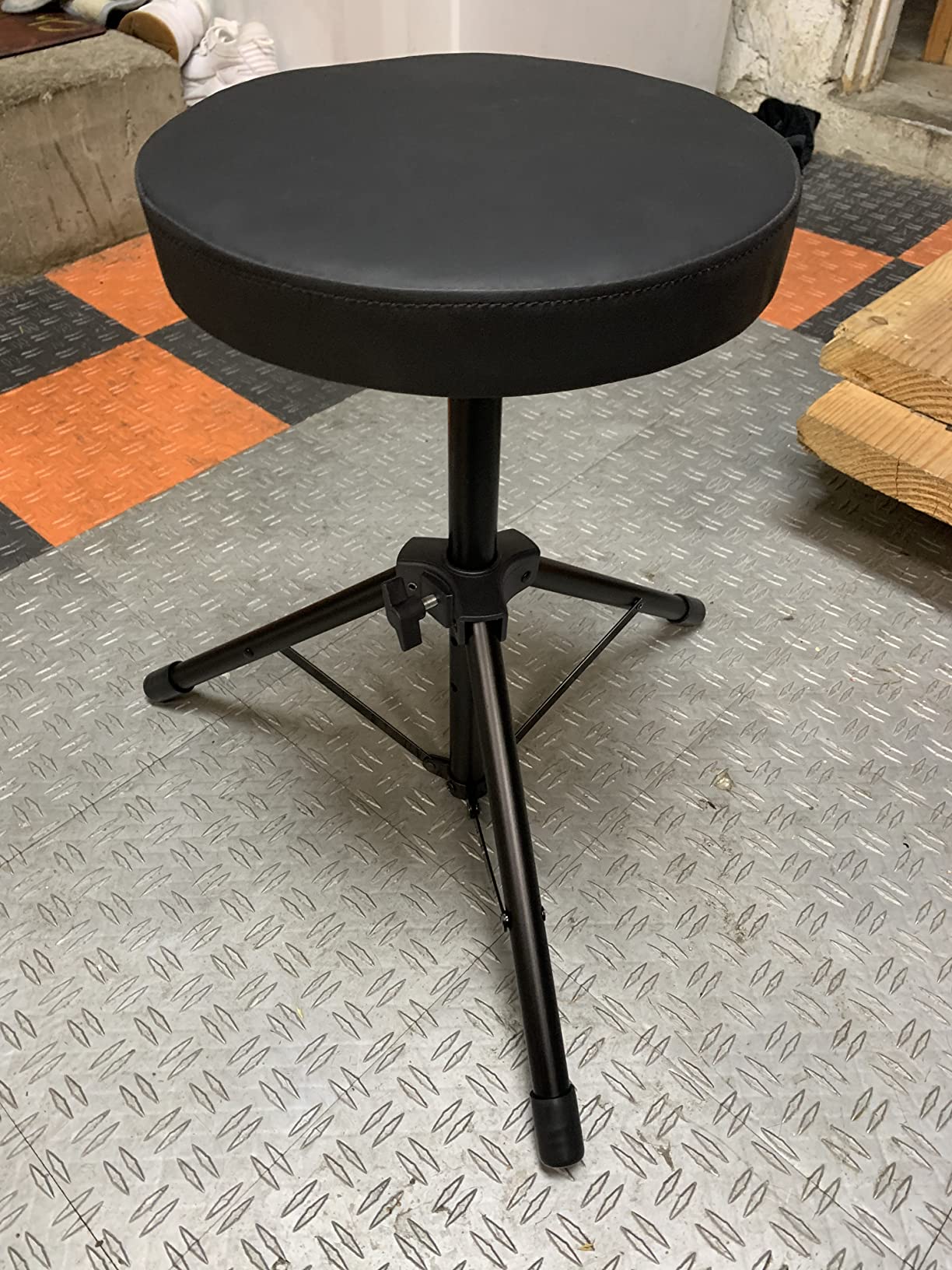
Weighing 6.5 pounds with folding legs, this is the easiest throne here to move between a bedroom, a rehearsal space and a lesson. Nobody thinks about weight until they are carrying a throne up three flights of stairs, and this one simply does not register as heavy.
It also ranks near the top of the Drum Stools category with more than 2,100 reviews, and owners consistently describe the value as the main event. For a first kit, a practice throne or a shared family seat, the maths works out well.
What you notice in the first month
The sponge depth is the first surprise. At 7 cm the pad is closer to a practice throne cushion than a budget stool pad, and that thickness does most of the comfort work. The fold-flat legs mean it can live under a bed or in a corner instead of becoming permanent furniture.
Reviewers also point out that it works just as well for keyboard, guitar and other seated instruments, so a household that plays more than one thing gets more out of it.
Who should skip it
Adult drummers above 180 lb should look elsewhere. That is the lowest capacity in this roundup, and it is the single most important number to check before buying any throne.
It is also not built for long marathon sessions on a hard kit. The plain round seat has no contoured shape and no back support, so it is a fine two-hour practice seat rather than an all-day throne. Players chasing saddle comfort need to look at the Gibraltar 6608 or the AKLOT further down.
4. Gibraltar 9608MB: Best Drum Throne With a Backrest
Gibraltar Drum Throne with Adjustable Height Motorcycle Seat & Backrest, Double-Braced Drum Stool, Comfortable Supportive Cushion for Drummers, Studio or Stage Use (9608MB)
Oversized motorcycle saddle
Adjustable backrest
19-27 inch memory lock range
285 lb capacity
Pros
- Backrest gives real lumbar support
- Oversized memory foam saddle with thigh cutouts
- Memory lock holds height
- Double-braced base does not shift
- Cordura top wipes clean
Cons
- Backrest sits close to the seat for some bodies
- Bracket can loosen and need re-tightening
- 18 pounds is heavy to carry
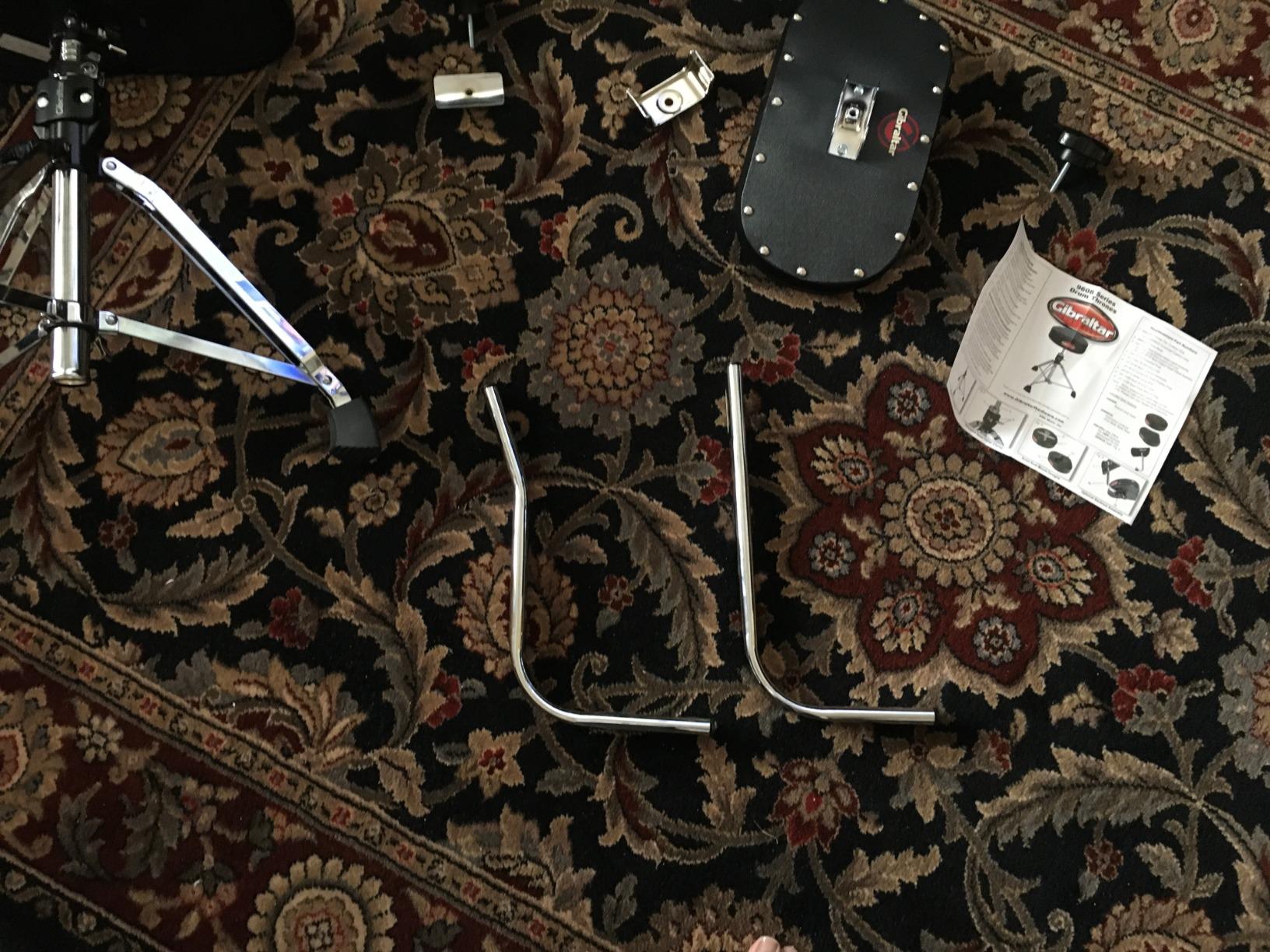
This is the model I would point a drummer with a bad back toward. The seat is an oversized motorcycle-style saddle with top-grade memory foam and thigh cutouts, and behind it sits an adjustable backrest on a bracket. The combination is the only one in this roundup that supports the lumbar region, and for long practice sessions that is worth a great deal.
Height adjustment runs from 19 to 27 inches with a memory lock, so the range is wide enough for both very tall and very short drummers. The base is a heavy duty double-braced tripod that stays put once assembled, and the Cordura top with wrapped vinyl edges shrugs off sweat and wipes down after a show.
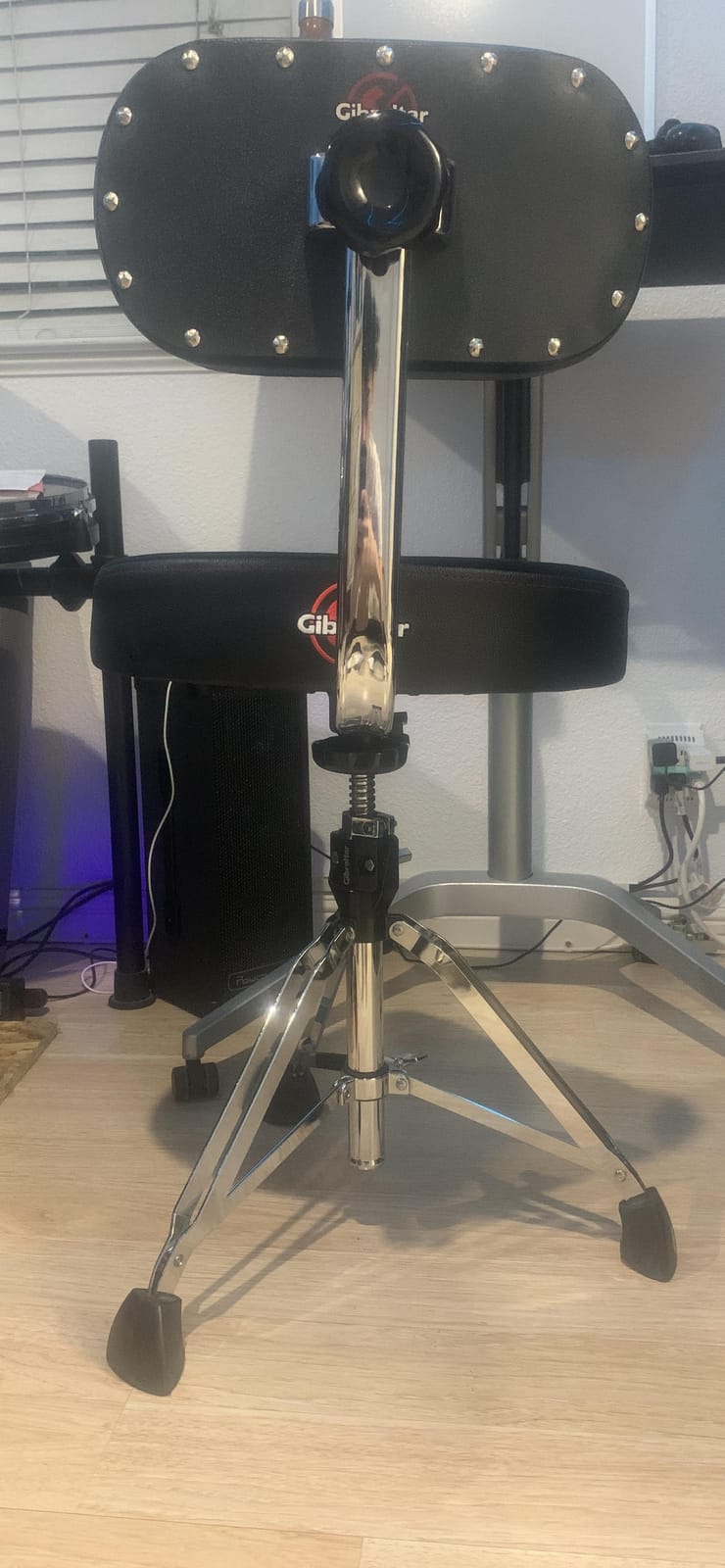
Owners also report using it as a keyboard or guitar practice chair, which is not surprising for something this stable. Multiple reviewers mention that it is one of the most comfortable thrones they have owned, and lumbar support is the reason given nearly every time.
The weight is the tradeoff. At 18 pounds this is the heaviest throne in the roundup, and if you are moving it to every gig you will feel that immediately. The warranty is also a 1 year limited warranty, which is the shortest listed here.
What you notice in the first month
The backrest is the whole story, and the adjustment is what separates this from a fixed lumbar support. You can set the height and the angle, and for drummers who slump or lean forward over a kit it genuinely changes how the throne feels at hour three rather than hour one.
Second, the foam. Owners doing marathon sessions single out the memory foam saddle as noticeably more forgiving than the flat round tops on cheaper thrones, and the thigh cutouts keep leg movement free when you rotate around the kit.
Who should skip it
The backrest is not automatically good. A recurring review note is that it can sit too close to the seat for some body types and feel as though it pushes you forward, which is the wrong advice for a drummer trying to fix their posture. Forum discussion about thrones with backrests also warns that they can encourage slouching if the seat is too far back.
It is also too heavy for touring players and slightly overbuilt for someone who just wants a firm seat for an hour of practice. If you have no back issues, the added weight buys you little.
5. Gibraltar 4608: Best Lightweight Throne for Travel
Gibraltar Drum Throne with Adjustable Height, Round Seat, Single-Braced Drum Stool, Lightweight Portable Design, Comfortable Cushion, Ideal for Practice, Travel, or Gigs, 4000 Series (4608)
12 inch round foam seat
Knurled height stem
Single-braced tripod
5 year warranty
Pros
- Light and compact enough to carry to gigs
- 12 inch foam seat handles practice sessions
- Knurled stem sets position precisely
- No assembly required
- 5 year limited warranty
Cons
- Single-braced base is less rigid under hard playing
- Flat round seat with no thigh cutouts
- Listed item weight understates the real heft
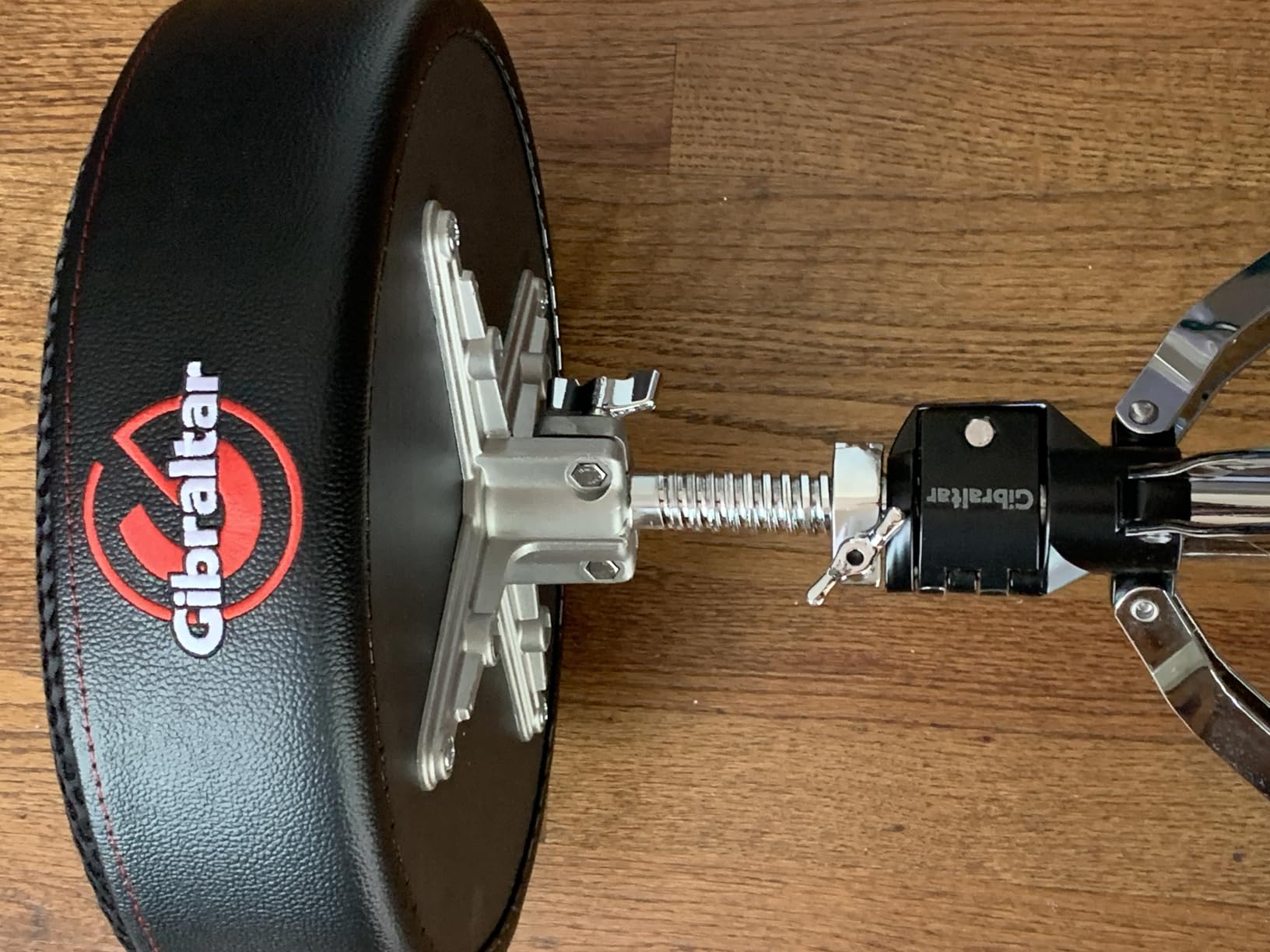
This is the throne I take when the priority is getting it out of the car and set up fast. The seat is a 12 inch round pad in vinyl over top-grade foam, and the whole unit is built to be light rather than heavy. No assembly is required, so you can go from case to playing position in under a minute.
Height adjustment uses a knurled stem, which makes it easy to set a repeatable position because the knurling gives your fingers something to grip. At 4.5 stars from 575 reviews with a notably high share of five-star ratings, owners treat it as a portable mid-tier Gibraltar rather than a cheap substitute.
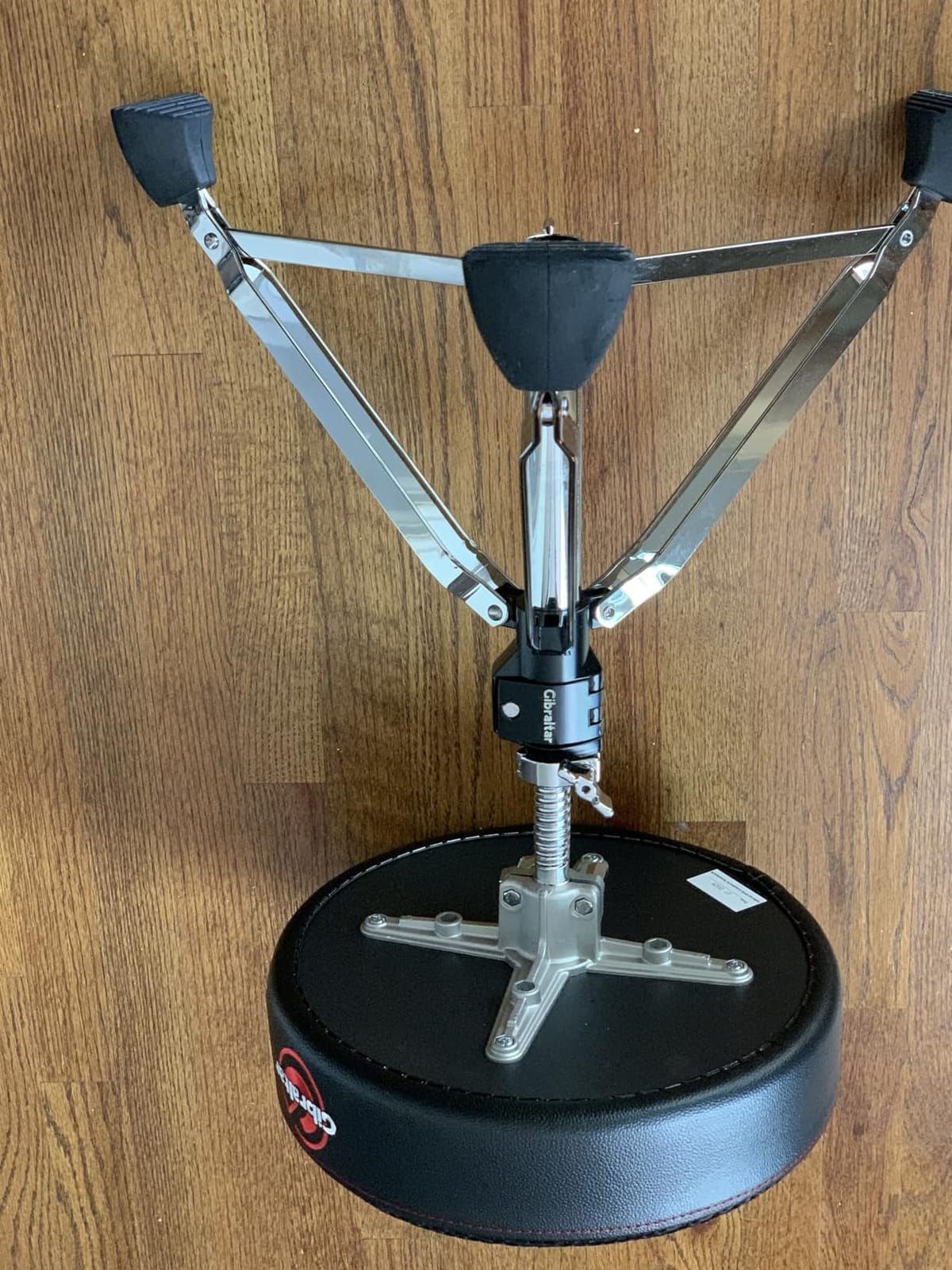
It is the throne to consider if you play electronic kits in different rooms, teach, or move between a rehearsal space and a stage. The 12 inch footprint is compact and the base folds down, so it fits into a car boot next to a snare and cymbals without a dedicated case.
One practical note: the listed item weight of 1 kg understates the real-world heft, so do not plan on packing it into a gig bag with your sticks. Plan on carrying it in one hand alongside a snare.
What you notice in the first month
Setup speed. There is nothing to assemble and the legs unfold in one motion, which means moving between two rooms mid-session is realistic rather than aspirational. For an electronic kit owner who changes rooms constantly, that is the feature that matters.
The second thing is that the foam holds up well for practice-length sessions. It is not plush, but reviewers describe it as comfortable enough for practice and travel, and the vinyl wipes clean after sweaty hands.
Who should skip it
Single bracing is the limiting factor. It keeps the weight down, but under hard playing the base does not have the rigidity of a double-braced tripod, and reviewers who moved up from a double-braced throne notice the difference. If you play loud with a big kit, stability is worth more than portability.
It is also a flat round seat with no thigh cutouts, so long sessions on it are less comfortable than the Gibraltar 6608. Treat this as the transportable option, not the comfort option.
6. ROC-N-SOC Nitro: The Best Built Saddle in the Roundup
ROC-N-SOC Nitro Drum Throne with Original Saddle – Black
Gas lift height adjustment
Free-spinning saddle seat
Stainless steel frame
330 lb capacity
Pros
- Smoothest gas lift adjustment here
- Free-spinning seat saves twisting to reach the kit
- 4.8 rating with 92 percent five-star
- Stainless steel and 330 lb capacity
- Available in three colours
Cons
- Tied for the most expensive model here
- 15.7 pounds is heavy to carry between shows
- Free-spinning seat has no tilt adjustment
The Roc-N-Soc Nitro is the throne I would buy for myself. Height adjustment is a gas lift rather than a threaded spindle, so you raise and lower it with a smooth lever motion instead of twisting, and the setting stays exactly where you put it. Once you have used one, screw collars feel like a downgrade.
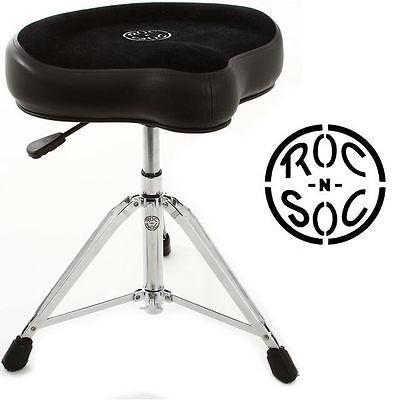
The second feature that changes playing is the free-spinning saddle. You can rotate to reach a tom or a cymbal without shifting the base or lifting your weight, which takes a lot of unnecessary motion out of a busy fill. The saddle itself is the original Roc-N-Soc shape, the one most drummers describe as the most comfortable seat they have sat on.
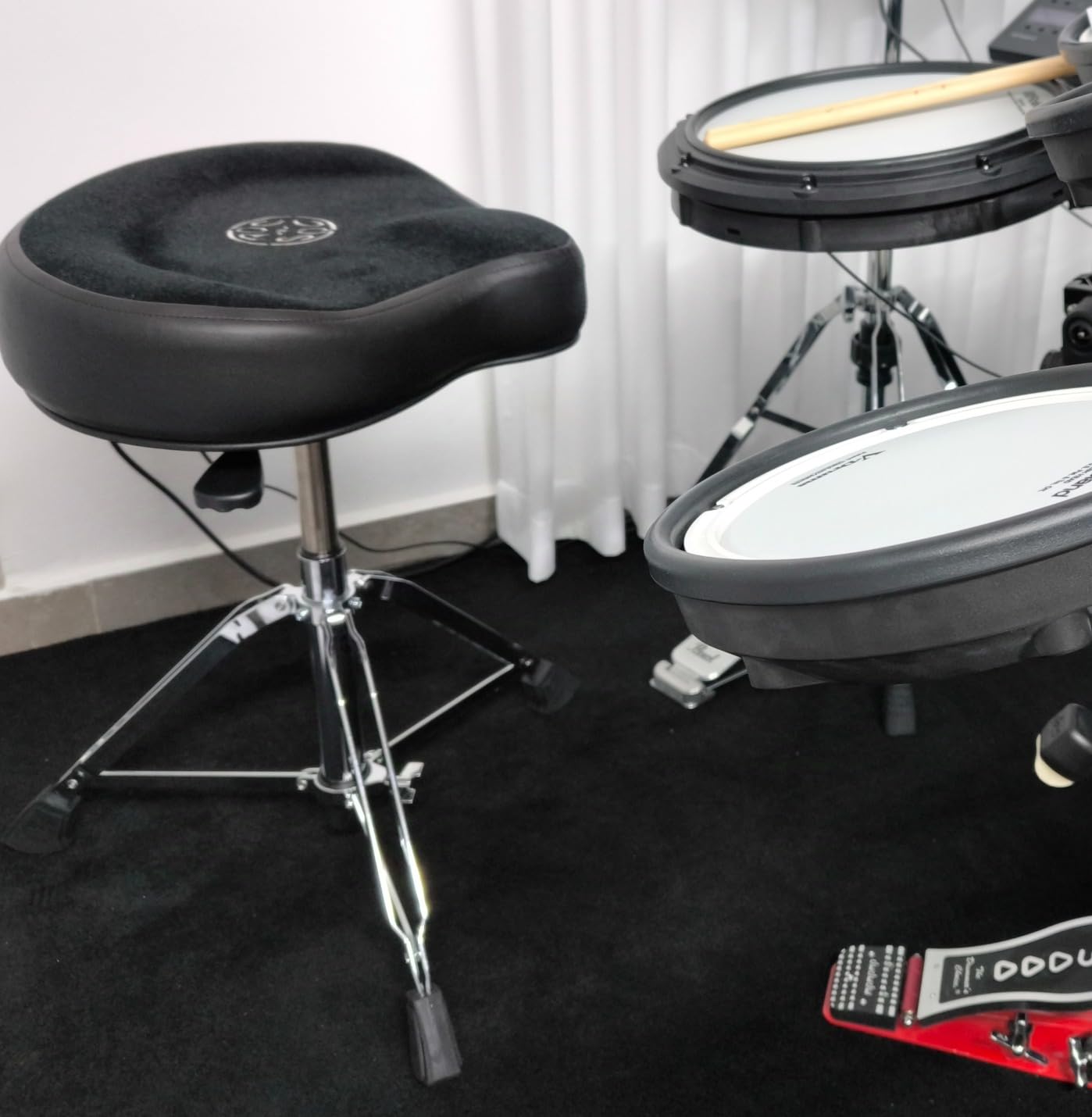
It holds a 4.8 rating from 513 reviews with 92 percent of ratings at five stars and no one-star ratings at all, which makes it the highest-rated product in this group. Construction is stainless steel with a 330 lb capacity, and it comes in black, red and blue.
Build quality is the through-line in owner feedback, and forum drummers consistently treat Roc-N-Soc as the benchmark other thrones are measured against. That reputation is why the brand shows up again and again in throne threads.
What you notice in the first month
The gas lift is the first difference you feel. Moving the seat up an inch takes a nudge rather than thirty seconds of spinning, and because the mechanism holds position, your throne height becomes a fixed part of your setup instead of something you re-check every session.
The spinning saddle takes a few days to get used to, and then it becomes invisible. Owners who moved from a plain fixed-seat throne report the biggest surprise is how much less their torso twists during fast passages around the kit.
Who should skip it
Two groups. Players who carry their throne to every gig, because 15.7 pounds without a case is a lot to lift between shows. And players who want a saddle that tilts to match their sitting posture, because the free-spinning seat gives you rotation without any contour adjustment.
It is also the premium-priced option in this group, so if you are building a first kit on a fixed budget the money goes further somewhere else. Nothing about it is bad, but the build quality is what you are paying for.
7. DW 3000 Series DWCP3100: Sturdy Build With a Vise Memory Lock
DW Drum Workshop 3000 SERIES DWCP3100 THRONE W/ VISE MEMORY
Vise memory lock height
Tripod base with ear casting
Vinyl over foam seat
330 lb capacity
Pros
- Heavy duty construction stays planted
- Memory lock holds its setting
- Vinyl seat wipes clean
- DW builds hardware for kit use
- No assembly required
Cons
- Round 13 inch seat is less comfy over long sessions
- No back support
- Costs more than generic budget hardware
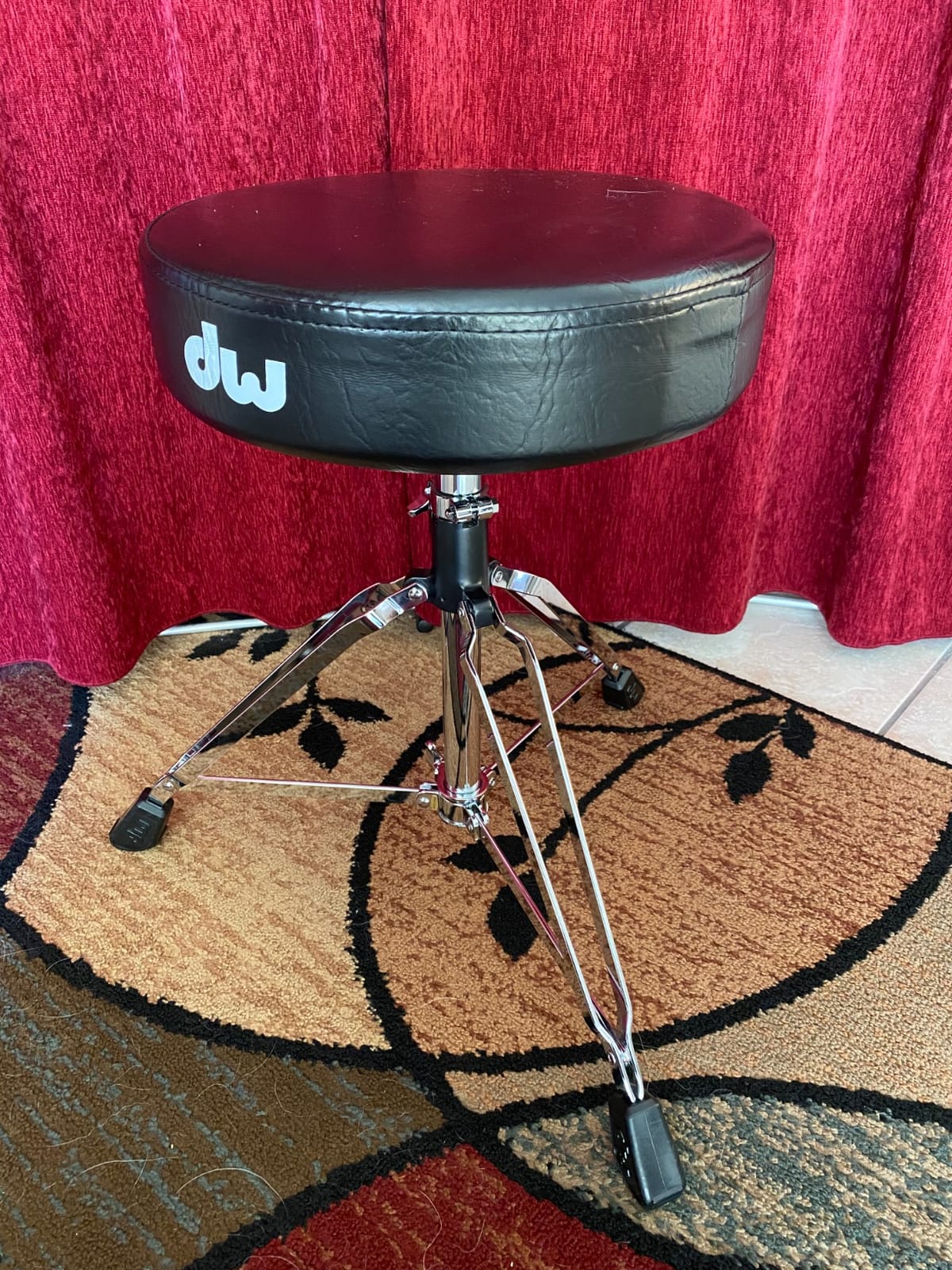
DW builds hardware for drums, and this throne shows it. The base is a sturdy tripod with a solid ear casting, which is the kind of detail that decides whether a stool flexes when you lean into a groove. Owners describe it as planted, and at 4.7 stars across 438 reviews the feedback is unusually consistent.
Height adjustment uses a vise-style memory lock rather than a plain collar, so it grips the post firmly and does not creep over weeks of use. The 13 inch vinyl-covered foam seat is 13 inches wide and easy to wipe down, and the listed capacity is 330 lb.
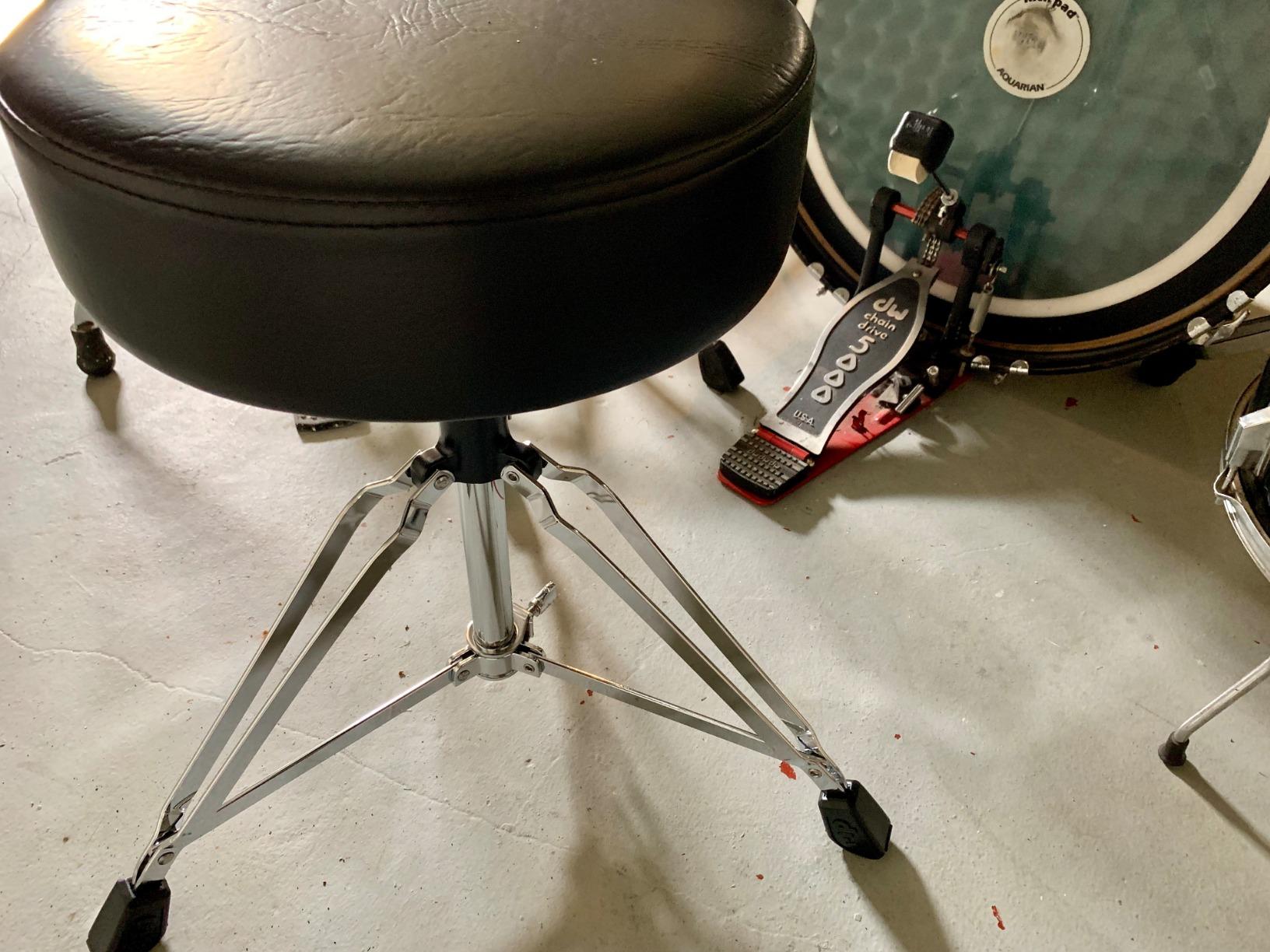
No assembly is required, which matters more than it sounds for anyone building a kit in a small space. The whole design is deliberately simple: one adjustment point, one seat, one base, nothing to loosen and nothing to break.
DW is an established drum maker, so the hardware is purpose-built around how a kit is used rather than adapted from furniture. That shows up in the castings and the joint hardware.
What you notice in the first month
The vise memory lock. It takes a little more effort to set than a thumb collar, and in exchange the height does not change between Tuesday and Saturday. Gigging drummers who value a repeatable setup rate that above cushioning.
Second, the seat is easy to clean and does not cling to sweat the way some fabric coverings do. For someone who plays two or three nights a week, a wipe-down is the whole maintenance routine.
Who should skip it
If your sessions run past two hours, the flat 13 inch vinyl round top is a step below a memory foam or saddle seat. Comfort is the one place this throne does not lead, and the gap shows up in marathon practice and long rehearsal days.
There is no back support either, so players managing lower-back issues should look at a lumbar-supported model instead. And if you are buying purely on price, the same basic hardware exists for less in generic thrones.
8. GrowDaily Drum Throne: Best Spare or Second Throne
GrowDaily Drum Throne Seat,Adjustable Stool Drum Universal Thick Padded Drum Throne Drummer Stool with 2Pacs 5A Drumsticks
Faux leather over thick sponge
16.93-23.62 inch range
Folding double-braced legs
272 lb capacity
Pros
- Thick sponge resists deforming
- Useful 16.93-23.62 inch height range
- Folds flat for transport
- Aluminium bracket keeps it steady
- Includes two pairs of 5A sticks
Cons
- Around a 12 inch seat is small for adults
- Some owners report rocking at the seat post
- Locking collar can drift out of adjustment
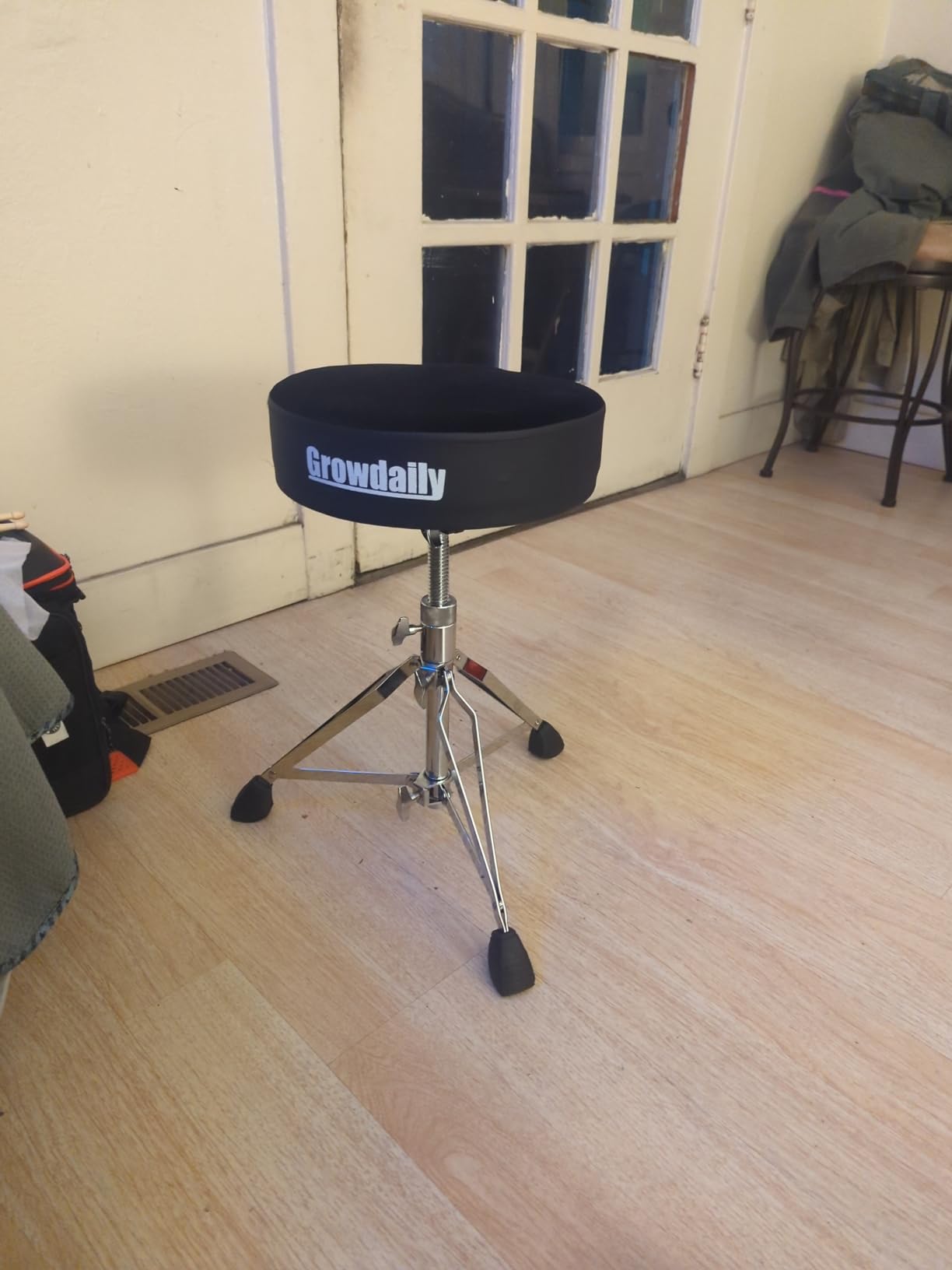
This is the throne I keep as a second seat, and it is a sensible reason to own one. The cushion is thick high-density sponge wrapped in breathable faux leather, and the height range of 16.93 to 23.62 inches is wide enough to cover a practice kit, a teaching kit and most stage risers.
The base is a double-braced aluminium tripod with three non-slip sleeves, and the legs fold for transport. That combination of bracing and folding is unusual at this level and is what keeps it stable while still being packable.
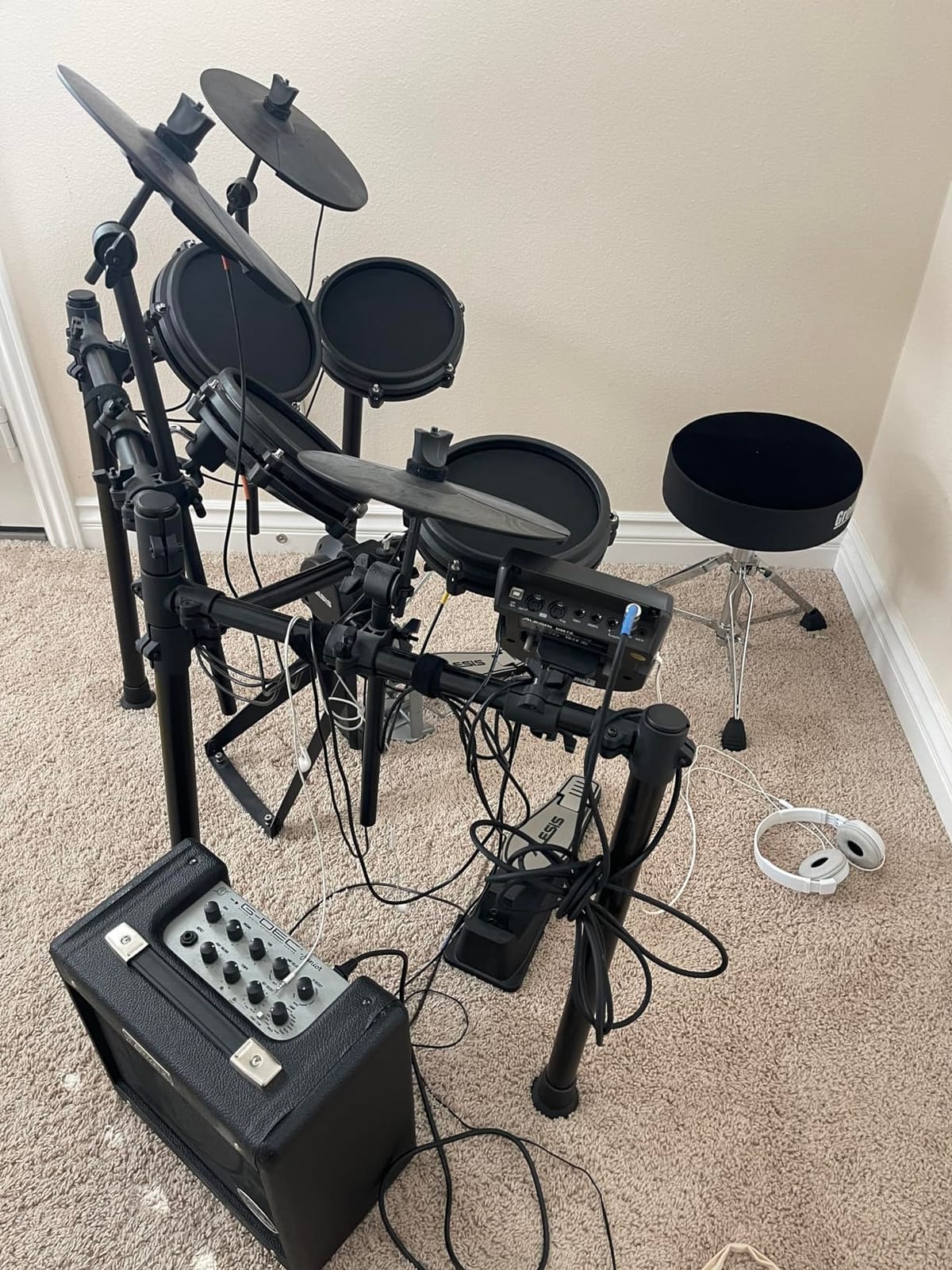
Two pairs of 5A sticks are included, which makes it a natural gift for a new drummer. The faux leather finish is described by some owners as velour-like, so if you sweat heavily you may prefer a vinyl or Cordura top.
At 430 reviews and 4.4 stars, buyers mostly treat it as a solid budget throne for two-hour practice sessions, and several use it as a dedicated practice or spare seat so their main throne never leaves the stage.
What you notice in the first month
The height range is what you notice, not the seat. Coming from a throne with three or four positions, having a continuous-looking span from just under 17 to almost 24 inches makes it easy to match a kit without crouching.
Assembly is quick, the padding holds its loft, and the folding legs mean it lives in a bag rather than against a wall. Owners frequently describe it as the throne they are not precious about, which is exactly what a second throne should be.
Who should skip it
Adults with a bigger frame should note the roughly 12 inch seat diameter. It is closer to a kid throne than to an adult saddle, and larger players describe it as small after longer sessions. Check that against the DW 5000 or the Gibraltar 4608 if you want a wider top.
There are also reports of the seat rocking at the post and of the locking collar drifting out of adjustment, both of which call for an occasional bolt check. Fine for a practice seat, less ideal as your only throne on a touring rig.
9. AODSK Double-Braced Throne: The Most Versatile for Young Players
AODSK Drum Throne, 16.3-20.7″ Height, Thick Padded Seat, Double-Braced
16.14-20.47 inch range
250 lb capacity
Thick sponge cushion
Synthetic leather top
Pros
- A low-cost entry point in the roundup
- Adequate for a first kit or a child
- Reinforced alloy steel legs
- Wipe-clean synthetic leather
- Low profile suits smaller players
Cons
- Seat hardware loosens during play and needs retightening
- Weak welds and thin tubing
- Small seat is child oriented
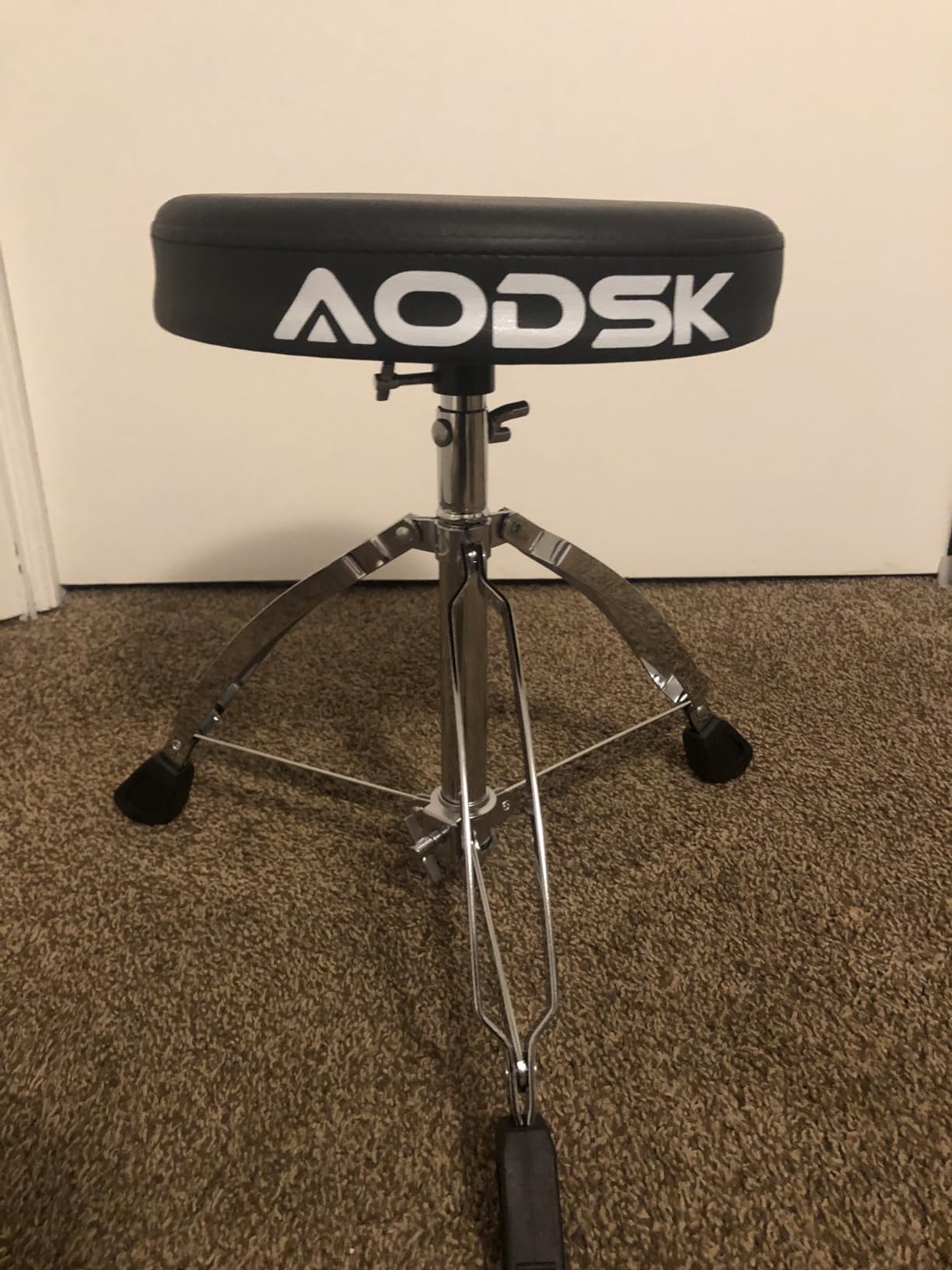
I want to be straightforward about this one: it is among the lowest-cost thrones here and the lowest rated at 4.0 stars from 326 reviews, and those two facts are related. For a child’s first kit or a light-use practice seat it is perfectly serviceable, with a 250 lb stated capacity on reinforced alloy steel legs and a thick sponge pad that stays comfortable for an hour or more.
Low profile sizing is its other argument. The 16.14 to 20.47 inch range is the shortest here, which suits smaller players and shorter setups. The synthetic leather surface is waterproof and wipes clean, which matters in a kid’s bedroom with a carpet.
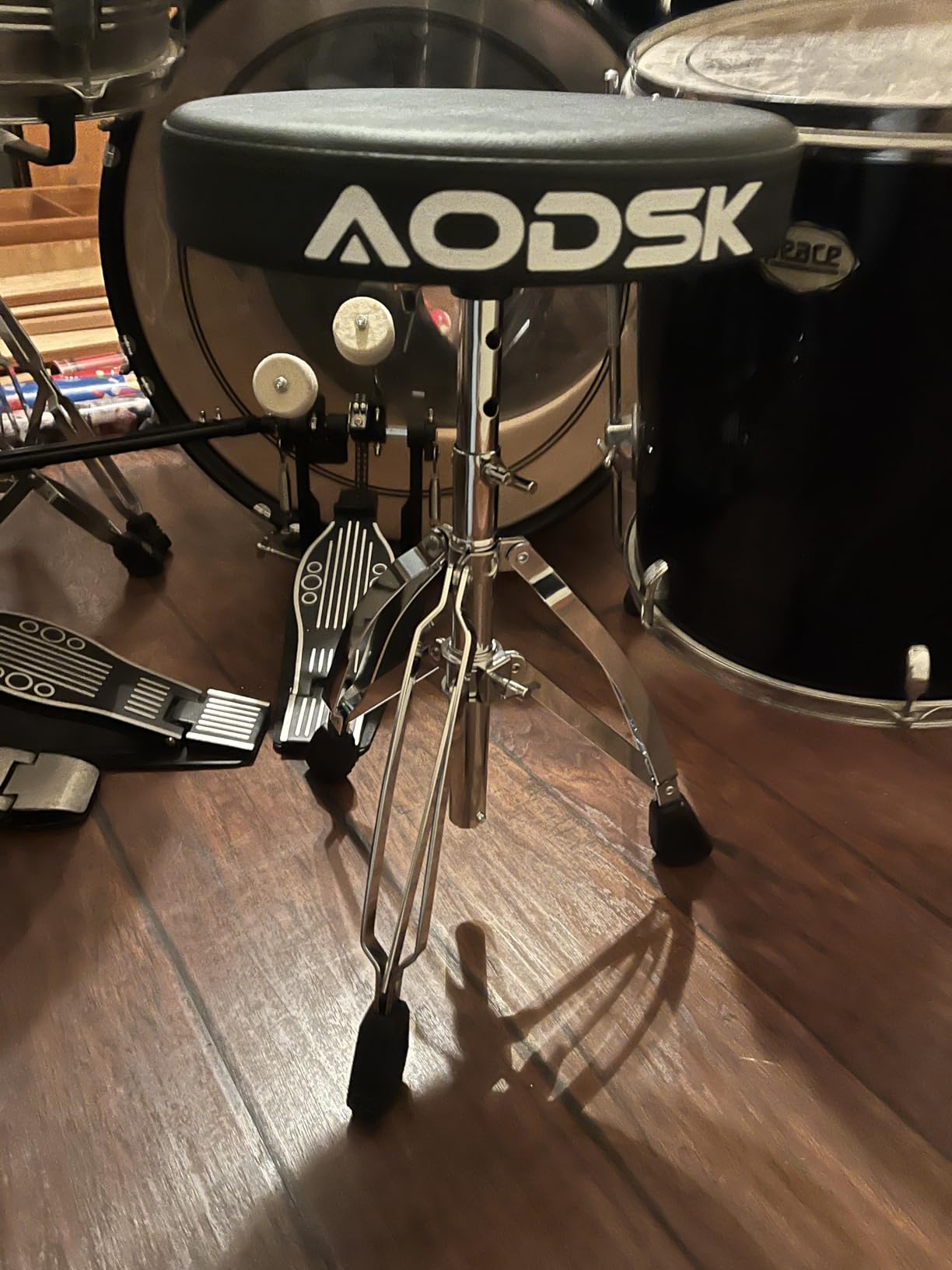
That said, the reviews split sharply by user type. Parents buying a first throne for a child rate it as an inexpensive and functional stool. Adult drummers describe bending tubing, a weld that gives way at the post-to-seat joint, and a base wobble that tightening cannot fully remove.
There is also a recurring note about a chemical smell straight out of the box that takes days to dissipate, which is a real consideration in a bedroom or small practice room.
What you notice in the first month
If you are setting it up for a young drummer, the first month is mostly uneventful. It holds height, the pad is comfortable, and nobody is playing hard enough to shake the base apart. Simple and functional is the correct standard for a first throne.
The wide soft cushion and the short, stable stance also mean it is easy for a small player to get on and off independently, which is a real practical advantage in a teaching environment.
Who should skip it
Anyone playing hard on an adult kit should skip it. The hardware loosens during play and needs constant retightening, the tubing is thin, and reviewers report the seat bending away from the base. That is a durability pattern, not a bad day.
It is also the wrong choice for heavy drummers at 250 lb capacity with construction that does not back that figure up, and for anyone with an existing back issue, since a plain round pad gives no support. If you are buying for a child, spend a little more for the GrowDaily or the EASTROCK and you will get double bracing and a wider seat.
10. AKLOT Hydraulic Saddle: Best for Comfort With a Lever Lift
AKLOT Saddle Drum Throne, Hydraulic Druming Throne, Heavy Duty Seat, Height Adjustable Plush Chair, Motorcycle Style Drum Stool for Adults Drummers Grey
Hydraulic gas lever,17-24 inch range
9.5 cm foam saddle
Double rod steel tripod,440 lb capacity
Pros
- Saddle shape cuts fatigue on long sessions
- Suede and PU covering is more breathable than vinyl
- One-handed hydraulic lever holds its height
- Double rod steel tripod with 440 lb rating
- Backrest version available
Cons
- Some units arrive with a faulty hydraulic cylinder
- Some do not reach the advertised maximum height
- Rubber feet can carry a strong odour
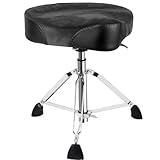
The AKLOT is the throne I recommend to drummers who already own something decent and want a comfort upgrade rather than a durability upgrade. The saddle is 43.5 cm wide and 39 cm long with 9.5 cm of high-density foam, and the shape spreads your weight across the sit bones instead of the tailbone.
Height adjustment is a hydraulic gas lever covering 17 to 24 inches, and it is genuinely one-handed. Owners coming from Mapex and Roc-N-Soc saddles describe the comfort difference as substantial, and the base is a double rod steel tripod with a claimed 440 lb bearing capacity and treaded rubber sleeves for grip.
The covering is plush suede with PU leather rather than all-vinyl, and that matters more than it sounds for players who sweat during a long set. The breathability of the top is a real difference after a two-hour show. An adjustable backrest option with three mounting holes is also available in some versions.
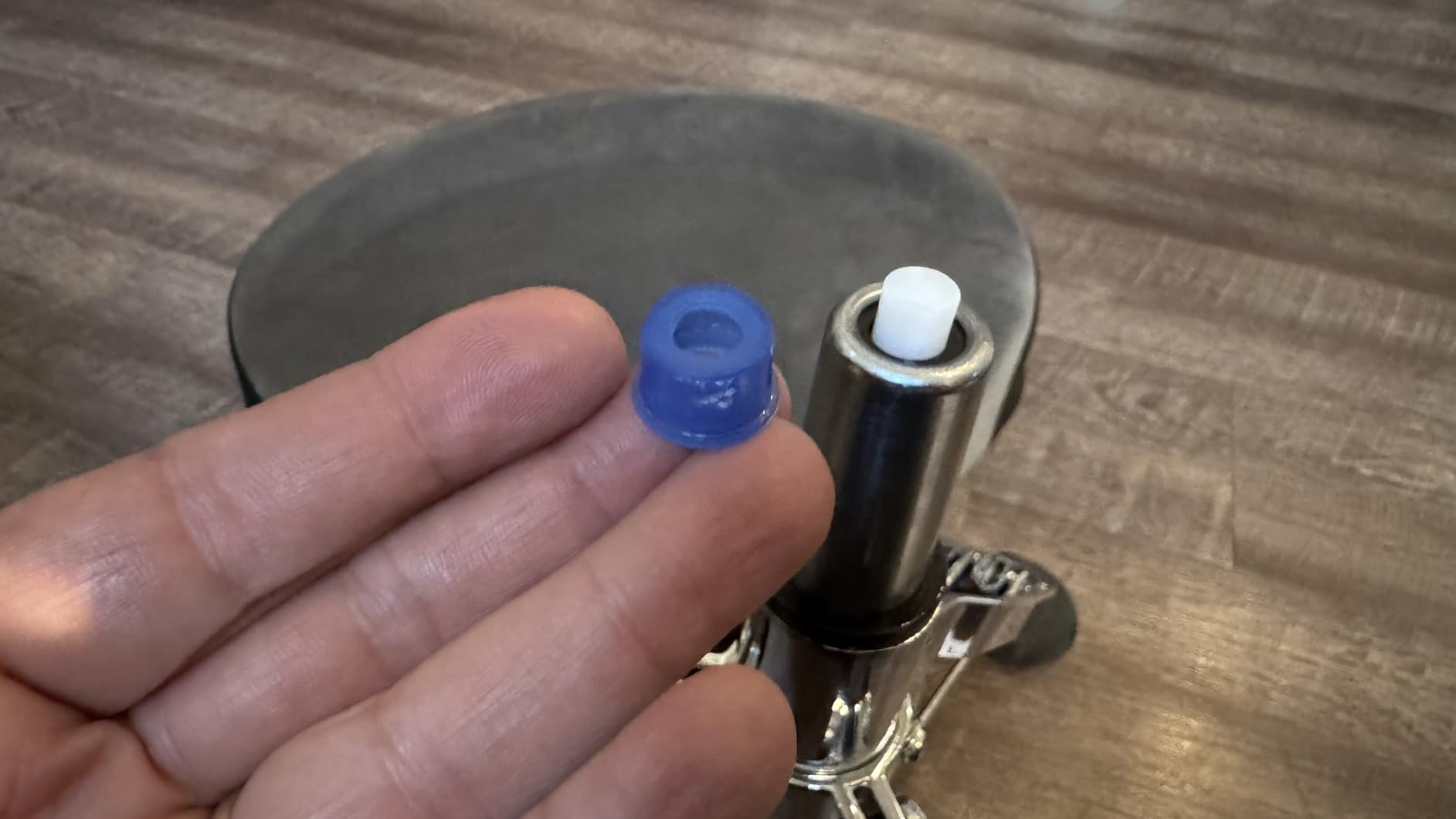
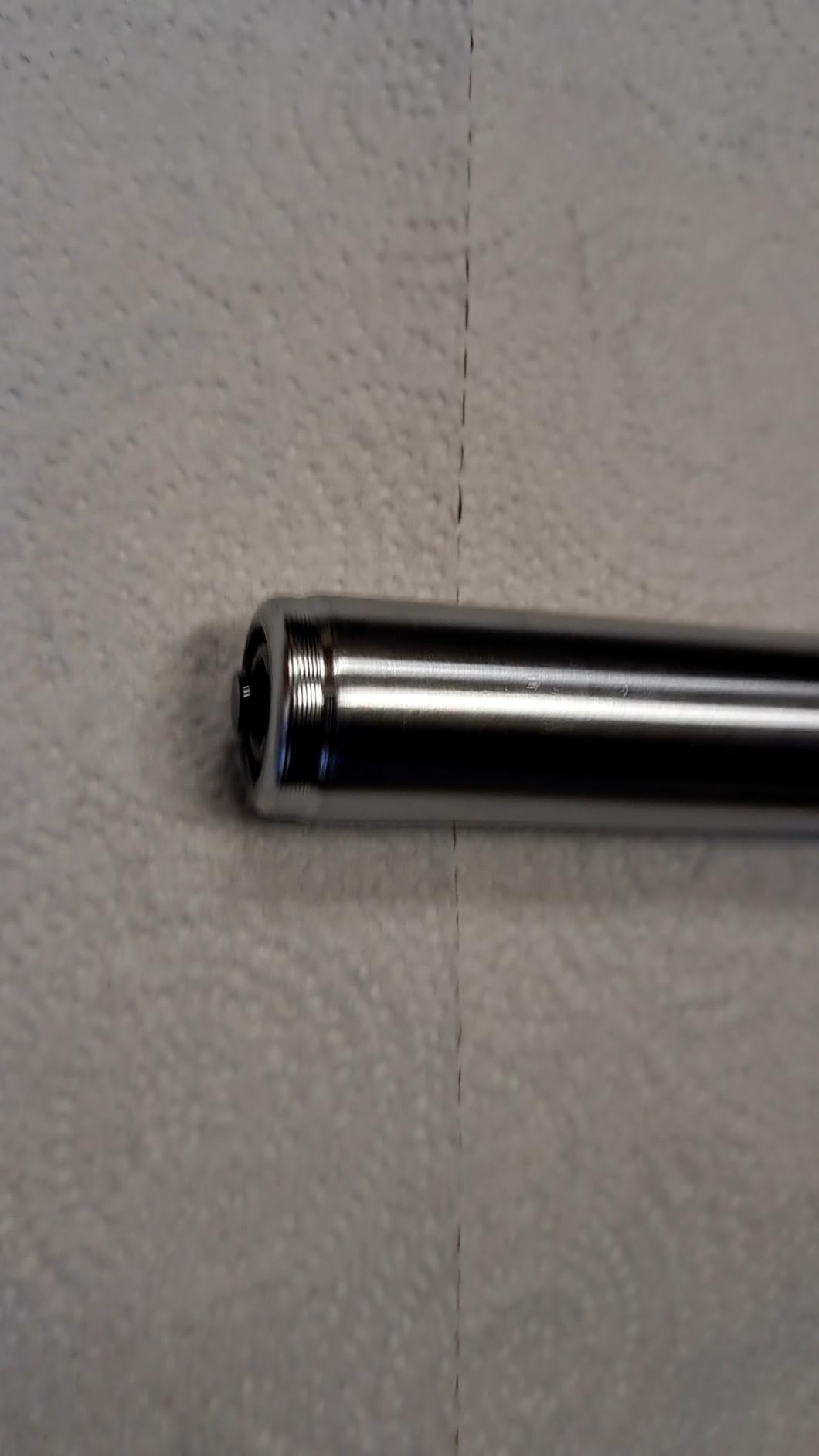
Quality control is the caveat. At 318 reviews and 4.5 stars, the recurring complaints are faulty hydraulic cylinders, a broken plastic piece on the adjustment lever, and a few units that do not reach the advertised maximum height. Owner reports say customer service has in some cases replaced faulty units at no charge.
What you notice in the first month
Comfort is the immediate thing. A 9.5 cm foam saddle with a contoured shape is a different experience from a flat round pad, and you notice it within the first session, especially if your previous throne was a basic stool. Sitting angles also feel more natural because the saddle lets you set your legs rather than the other way round.
The lever is the second thing. One-handed adjustment between songs or between rooms takes seconds, and the setting holds once you let go of the lever.
Who should skip it
Buyers who need guaranteed consistency should skip it. Hydraulics need a quality cylinder, and there are enough reports of failed cylinders and broken lever plastics to warrant checking your unit as soon as it arrives rather than when it fails mid-show.
Also consider the 12 pound listed weight if you are moving between venues, and be aware that the strong rubber foot odour reported by some owners can linger in a car or small room for a period. If the saddle shape is not what you want, a motorcycle-style seat such as the Gibraltar 6608 is a safer bet.
11. 5 CORE DS 01 BLK: The Thick-Cushion Budget Throne
5 CORE Drum Throne Thick 3″ Padded Drum Seat Height Adjustable Drumming Stools with Anti-Slip Feet Drummers Chair for Practice and Performance Black – DS 01 BLK
3 inch padding on 12 inch seat
20.5-22 inch adjustment
Anti-slip feet
Iron frame,310 lb
Pros
- Unusually thick 3 inch padding for the price
- Iron frame with reinforced joints
- Anti-slip feet reduce wobble
- Quick unfolding tripod legs
- Doubles as a music stool
Cons
- Narrow 20.5-22 inch height range
- Flat round top gives less support
- Iron frame is heavy at 9.5 pounds
The 5 CORE throne exists for one reason: cushion depth. At 3 inches of padding on a 12 inch leather top, it is thicker than most seats in this roundup including several that cost far more, and at 4.2 stars from 174 reviews the feedback is that the padding is the reason people keep it.
The frame is an iron alloy with reinforced joints and a listed capacity of 310 lb, and the anti-slip rubber feet do more for wobble than their price suggests. The tripod legs unfold quickly and the seat installs fast with the included hardware.
What you notice in the first month
You notice the softness immediately, and it stays noticeable. Nothing else here matches 3 inches of padding at this level, and for a drummer who plays seated for hours without caring much about seat shape, that is the whole decision.
It also works as a guitar or general music stool, which broadens its usefulness in a practice room where one seat does several jobs.
Who should skip it
Anyone outside the 20.5 to 22 inch window should pass. That is the tightest height range in the roundup, and it excludes very tall and very short drummers outright, which is a genuine problem for adults rather than a minor inconvenience.
The flat round top also gives less support than a saddle or contoured seat over long sessions, and the iron frame at 9.5 pounds is heavy for a throne in this category. Good cushioning cannot compensate for a height range that does not fit you.
12. DW 5000 Series DWCP5100: Best Heavy-Duty Round Top from DW
DW 5000 Series Round Top Throne (DWCP5100)
13 inch dual-foam round top
Heavy duty locking base
Glossy painted black metal
Pros
- Dual foam set top is well padded for a round throne
- Heavy duty locking base stays put
- 4.7 rating with 84 percent five-star
- Compact 13 inch top suits smaller players
- No assembly required
Cons
- Listed 30 lb maximum weight figure is erroneous
- Round foam top is less comfy than a saddle seat
- 13.9 pounds is heavy
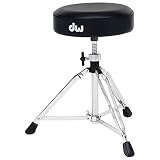
The DW 5000 Series is the sturdier sibling of the DW 3000 throne, and it is the pick here for anyone who wants a round seat that simply does not move. Construction is heavy duty with a locking tripod base, finished in glossy painted or powder-coated black metal, and it needs no assembly.
The 13 inch round top uses a dual foam set, which is unusually well padded for a round seat at this level. It holds a 4.7 rating from 152 reviews with 84 percent of ratings at five stars and only 2 percent at one star, the second strongest rating distribution in the group.
What you notice in the first month
Stability above all else. This throne is described by owners as build-first, and the locking base keeps a consistent setup that does not need re-checking between sets. If you play hard and your previous stool wandered, that difference is immediate.
The 13 inch top is compact, which suits players who prefer a smaller seat footprint and better access around the kit. Foam comfort is better than a basic round pad even though it is not in saddle territory.
Who should skip it
Long-session comfort seekers should look past it. A round foam top, however well padded, does not match a saddle or memory foam seat across a full afternoon, and there is no back support for anyone managing lower-back fatigue.
At 13.9 pounds it is also among the heavier thrones here, which matters for touring players. One caution on the specifications: the listed maximum weight recommendation of 30 lb is clearly an erroneous listing figure rather than a real capacity, and it should be disregarded in favour of the build quality and owner feedback.
How to Choose the Right Drum Throne in 2026
Start with your height and your body weight, because those two numbers eliminate half the options before comfort enters the picture. A throne that cannot reach the height you need for your kit will not be rescued by a better seat, and a throne rated below your weight will not survive hard playing. Every model in this roundup publishes a capacity figure, and forum drummers consistently say those published numbers deserve more weight than marketing claims of heavy duty construction.
Second, decide how much you are moving. A drummer who plays one kit in one room and a drummer who carries a throne to every rehearsal are buying different products, and the throne that suits the first will frustrate the second. Portability is not a feature you can add later, which is why two of the picks above exist mainly for it.
Round, saddle or split seat: pick your shape
Round seats are the most common and the most compact. They work well for kit layouts where you need to get your knees in close, and they are usually the lightest and least expensive option. Their weakness is pressure concentration, because a flat round pad pushes your weight onto a smaller area than a contoured seat does.
Saddle seats spread pressure across the sit bones and often include thigh cutouts that free up leg movement. They suit long sessions, larger drummers and anyone who plays a lot of quiet playing where you are seated rather than moving. Split seat designs take this further by removing the centre section entirely so there is no tailbone contact at all, which is why they show up in every conversation about thrones for sciatica or back pain.
The practical answer from drummers on the forums is that saddle shapes feel different after the first ten minutes and better after the first hour, so if you are undecided, borrow a saddle throne before you commit. Round-to-saddle is the upgrade most people make and rarely regret, while the reverse is harder to justify.
Spindle, gas lift or hydraulic: how height adjustment matters
A threaded spindle is the traditional mechanism: you twist the seat to raise or lower it, then tighten a collar. It is simple, cheap and durable, but it is slow, and the collar needs checking periodically. A gas lift replaces the thread with a lever and a pneumatic cylinder, which makes adjustment one-handed and fast, at the cost of a component that can lose pressure over years.
A memory lock is the feature that sits on top of either mechanism. It is a cam, wing nut or vise that grips the post and holds your chosen height so it cannot creep. Gigging drummers prioritise it above everything else, because a throne that changes height between songs changes your leg angle and therefore your timing and your tone.
Hydraulic levers sit between the two, offering a smooth one-handed lift that holds its setting. They feel excellent but depend on cylinder quality, and it is worth checking your unit on arrival rather than discovering a problem mid-gig.
Bracing and weight capacity: the numbers that decide stability
Double bracing means a second, thinner brace runs between each pair of legs. It adds weight and rigidity, and it is the reason heavy-duty thrones feel planted under a hard stroke. Single bracing keeps the weight down for portability and is a reasonable trade for electronic kits and practice thrones, but reviewers consistently report less rigidity when playing hard.
Capacity figures in this roundup run from 180 lb on the EASTROCK to 440 lb on the AKLOT’s claimed bearing rating, with most established-brand thrones sitting around 250 to 330 lb. Match your own weight plus a margin rather than picking the highest number you can find, because a throne that is over capacity is a liability on a hard playing style.
Cushion depth, covers and backrests
Cushion depth matters more than any other comfort spec for a round seat. The thrones here range from 3 inch padding on the 5 CORE up to 7 cm of sponge on the EASTROCK, and thicker foam also resists flattening, which is the failure mode that ruins cheap thrones after a year. A good test is whether the pad still springs back after you sit down, not how soft it feels in the shop.
Covering material is the second decision. Vinyl is durable and wipes clean but gets hot and sticky during long sessions in warm rooms. Faux leather is similar with a softer feel. Suede or cloth blends are noticeably more breathable, which matters if you sweat heavily during shows. Cordura over foam is the hardest-wearing combination and is what you want on a throne that gets moved constantly.
Backrests are the most over-sold feature on the market. They genuinely help players with lower-back fatigue, and only the Gibraltar 9608MB in this roundup has an adjustable one. But a poorly positioned backrest pushes you forward and encourages slouching, which is the opposite of what you bought it for. Check the height and angle adjustment before you commit, and treat a fixed backrest as decoration rather than support.
Electronic kits, kids and multi-throne setups
Electronic kit owners have different needs from acoustic drummers. Trigger pads sit at lower heights than acoustic toms, the frames are less stable than a wooden kit, and the throne often has to double as a general music seat. That points toward a lighter, single-braced or folding throne with a low minimum height, and it points away from 15 pound professional thrones. Rubber feet matter more too, since mesh heads and rubber pads are unforgiving when a stool slides.
For younger players, weight capacity and minimum height are the filters, and those two numbers are where the 5 CORE and the AODSK fall short for adults but work for children. A 250 lb capacity with a double-braced base is a sensible ceiling to aim for if the same throne will follow a player from lessons to a first band.
Finally, many drummers own more than one throne, and that is not extravagance. A dedicated practice throne that never leaves the room, a portable throne for gigs, and a comfortable saddle or backrest throne for long studio sessions is a common and sensible setup. Build the main throne first, then add a transportable second one for the days you are moving.
Frequently Asked Questions
Which drum throne is the best overall?
The Donner drum throne is the best all-round choice in this roundup, with the largest review base of any model here and a double-braced base that stays planted during hard playing. The Gibraltar 6608 is the better pick if you want a memory lock and a contoured motorcycle-style saddle, while the ROC-N-SOC Nitro is the highest rated for players who want a gas lift and a free-spinning seat.
Which type of drum throne is better, round or saddle?
Saddle thrones are more comfortable over long sessions because they spread pressure across the sit bones and usually include thigh cutouts that free up leg movement. Round thrones are more compact, lighter and better for tight kit layouts where you need your knees in close. Most drummers find the saddle shape feels different for the first ten minutes and better after the first hour.
What is the best drum throne on a tight budget?
The Donner drum throne and the AODSK double-braced throne are the lowest-cost options here, and both include a double-braced base. The Donner carries a 250 lb capacity and far more owner feedback, so it is the safer budget buy for an adult. The AODSK makes more sense for a child’s first throne or a light-use practice seat.
Can a regular stool work as a drum throne?
A standard bar stool can work for short practice sessions, but it is usually too narrow, too high and not adjustable enough to match your kit. Drummers who use a general stool end up with a seat that pushes their weight onto the tailbone and a base that slides or creeps. If you already own a stool, a dedicated throne is one of the cheapest upgrades you can make to your playing comfort.
How do I fix a wobbly drum throne?
Start by tightening every bolt where the seat meets the post, then work outward to the leg braces and feet, and check that all three legs are making firm contact with the floor. If a thread is stripped or the wobble is at the base rather than the seat, tighten in small increments and confirm the leg sleeves are seated fully. Check the throne periodically, because play vibration loosens joints over time and a five minute check prevents a bent frame.
The Best Drum Thrones in 2026: Final Verdict
After working through twelve thrones, the best drum thrones for drummers still come down to three clear winners. The Donner takes the top spot for anyone who wants proven stability and the widest evidence base at the lowest risk. The Gibraltar 6608 is the value pick for drummers who want a contoured saddle and a memory lock without stepping up to professional pricing. And the ROC-N-SOC Nitro is the build-quality answer, with the highest rating in the group and the smoothest height adjustment we tested.
After that, match the throne to the problem rather than the brand. Back pain points to the Gibraltar 9608MB. Carrying gear to every show points to the Gibraltar 4608. Heavy playing points to anything double-braced with a 300 lb or higher capacity. Whatever you choose, set the height once with the memory lock, check the bolts every few months, and give the cushion a squeeze before it flattens on you.
Once you have the throne dialled in, it is worth pairing it with a solid surface. Our guide to the best practice pads covers the setups that keep a throne stable and a practice room quiet.