
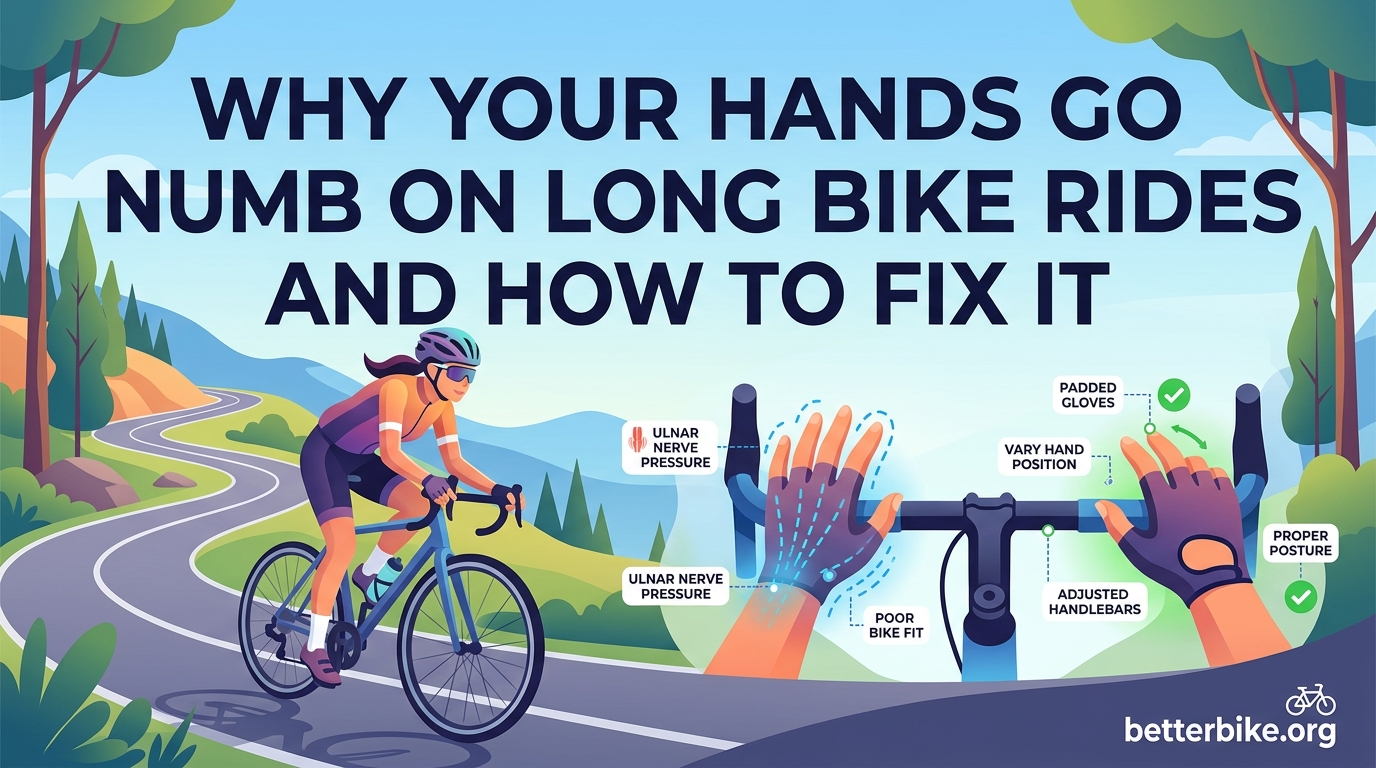
Your hands go numb on long bike rides because sustained pressure compresses the nerves running through your wrists and palms, blocking signals between your fingers and brain. The fix almost always comes down to redistributing that pressure through saddle position, handlebar reach, wrist posture, and core strength, not gloves or padding alone.
If you have ever felt that pins-and-needles sensation creep into your fingers 15 miles into a ride, you are far from alone. Over on the cycling subreddits, hand numbness after 8 to 20 miles is one of the most complained-about issues year after year. It affects road cyclists, mountain bikers, gravel riders, and weekend warriors alike.
The good news is that the vast majority of cases are fixable without expensive medical intervention. Most riders can trace their numb hands back to a handful of bike fit issues and body mechanics that respond well to targeted adjustments.
In this guide, I will walk you through exactly why your hands go numb on long bike rides, how to diagnose which nerve is causing the problem based on which fingers tingle, and an 8-step fix sequence you can work through in the right order. I will also cover the hidden causes most cycling articles skip entirely, like thoracic outlet syndrome and tight pecs, plus what to do mid-ride when the numbness hits.
Table of Contents
Why Your Hands Go Numb on Long Bike Rides: The Science
The medical term for that tingling, numb sensation is paresthesia. It happens when a nerve gets compressed or squeezed between a hard surface (like your handlebars) and a bone in your hand or wrist. The compression blocks the electrochemical signals that normally travel along the nerve, and your brain interprets the blocked signal as numbness or tingling.
Three main nerves run through your hand, and each one follows a different path from your neck down through your shoulder, arm, and wrist. Any of them can get pinched at multiple points along that journey.
The ulnar nerve runs down the inner side of your arm and controls your pinky and ring finger. The median nerve runs through the center of your wrist in the carpal tunnel and feeds your thumb, index, and middle fingers. The radial nerve travels along the back of your forearm and provides sensation to the back of your hand.
When you ride a bike, you are essentially resting a large portion of your body weight on your palms for extended periods. On a properly fitted bike, your weight should be distributed roughly 30 percent through your hands and 70 percent through your saddle. When that ratio shifts, even by a small amount, the extra weight on your palms compresses these nerves.
Here is where it gets interesting. The problem is rarely the handlebars themselves. The handlebars are just the last point of contact. The real culprit is usually upstream, in your saddle position, your reach, or your core strength. Fixing the handlebars with thicker tape or gel pads without addressing the root cause is like taking painkillers for a toothache without seeing the dentist.
One rider on the r/bikefit subreddit put it perfectly: “I spent months buying different gloves and bar tape before someone told me to level my saddle. Two-minute fix, problem gone.”
Which Fingers Are Going Numb? A Diagnostic Guide
Before you change anything on your bike, figure out which nerve is being compressed. The fastest way to do that is to pay attention to which fingers go numb. This single piece of information narrows down the problem dramatically and tells you where to look for the fix.
Pinky and Ring Finger Numb: Ulnar Nerve (Cyclist’s Palsy)
If your pinky and ring finger go numb, you are compressing your ulnar nerve. This is the most common type of hand numbness in cycling, and it has its own name: cyclist’s palsy, also called handlebar palsy.
The ulnar nerve enters your hand through Guyon’s canal, a narrow passage on the pinky-finger side of your wrist, right next to the pisiform bone. When you rest the heel of your hand on the handlebars for long periods, you compress this nerve right at that canal. The pressure is often worse when your wrist is cocked backward in extension.
Cyclist’s palsy is almost always a pressure and position problem. The fixes involve redistributing weight off the heel of your hand, correcting wrist angle, and making sure your saddle is not pitching you forward onto your palms.
Thumb, Index, or Middle Finger Numb: Median Nerve (Carpal Tunnel Connection)
If your thumb, index finger, or middle finger goes numb, your median nerve is being compressed. This is the same nerve involved in carpal tunnel syndrome, which office workers know well from typing all day.
The median nerve passes through the carpal tunnel in the center of your wrist. On a bike, it gets compressed when your wrist is bent into excessive flexion, meaning the palm is curled too far downward toward the forearm. This can happen if your hoods are tilted too far down or if you are gripping the bars in a way that bends your wrist.
Median nerve compression is less common than ulnar nerve compression in cycling, but it does happen, particularly with riders who have pre-existing carpal tunnel tendencies from desk work.
Whole-Hand Numbness: Circulation or Thoracic Outlet
If your entire hand goes numb, both sides including all fingers, the problem may not be at your wrist at all. Whole-hand numbness often indicates compression higher up in the nerve pathway, at the neck or in the thoracic outlet, or it can be a circulation issue where blood flow to the hand is restricted.
True whole-hand numbness warrants a closer look at your neck position on the bike and potentially a conversation with a physical therapist or doctor. It can be a sign of thoracic outlet syndrome, which I will cover in detail in the next section.
One-Sided Numbness: What It Means When Only One Hand Goes Numb
If only your left or right hand goes numb, pay close attention. One-sided numbness is a question that comes up constantly on cycling forums, and most articles gloss over it.
One-sided numbness usually means there is an asymmetry somewhere in your setup or your body. Your saddle might be slightly crooked or twisted. Your reach might be uneven because of a stem that is slightly off-center. You might have a leg-length discrepancy that causes you to shift your weight to one side unconsciously.
It can also be a body-side issue. If you have tighter pecs or a stiffer thoracic spine on one side, that asymmetry travels all the way down to how you grip the bars. One rider on r/cycling discovered their left-hand numbness disappeared after treating a tight left shoulder they had been ignoring for months.
If one hand consistently goes numb and the other does not, a professional bike fit is the fastest way to identify the asymmetry. Trying to self-diagnose one-sided numbness through trial and error can take months.
The Hidden Causes Most Cyclists Never Check
Most cycling articles stop at saddle position and wrist angle. Those are important, but they are not the whole story. Three hidden causes account for a large share of stubborn hand numbness cases that do not respond to standard bike fit adjustments.
Neck Position and Cervical Spine
Your nerves start in your cervical spine, the seven vertebrae in your neck. When you ride in an aggressive position with your head tilted up to see the road, you are extending your cervical spine. This extension narrows the intervertebral foramina, the small openings where nerves exit the spinal column.
If those openings narrow enough, they can pinch the nerve roots that eventually branch into your arm and hand. The result is numbness that feels exactly like a hand or wrist problem, but the actual compression site is in your neck.
This is why raising your handlebars sometimes fixes hand numbness even though the handlebars are nowhere near your neck. A higher front end means less cervical extension, which means less pinching at the nerve roots.
Signs that your neck might be the problem: numbness that does not change when you shift hand positions, numbness accompanied by neck stiffness or upper-back tension, or numbness that lingers after you get off the bike.
Thoracic Outlet Syndrome and Tight Pecs
After the nerves leave your neck, they pass through a narrow space called the thoracic outlet, located between your collarbone and your first rib. If the muscles in this area, particularly the pectoralis minor, become tight, they can compress the nerve bundle as it passes through.
This is thoracic outlet syndrome, and it is almost entirely absent from mainstream cycling content. Only one major competitor article covers it, despite the fact that cycling posture, hunched forward with shoulders rolled in, is a textbook setup for tight pecs and thoracic outlet compression.
The cycling position naturally shortens your pec muscles over time. If you ride a lot and never stretch your chest, your pec minor gradually tightens and pulls down on the nerve pathway. Many cyclists who cannot figure out why their hands still go numb after a perfect bike fit are dealing with this exact issue.
The fix involves stretching your pecs regularly, strengthening your mid-back and shoulder blade stabilizers, and being mindful of your upper-body posture on the bike. A simple doorway stretch, holding your forearm against a doorframe with your arm at 90 degrees and gently turning away, can make a noticeable difference over a few weeks.
Core Strength: The Overlooked Foundation
Here is the truth that the gear-first articles will not tell you: a strong core is the single best defense against hand numbness.
Your core muscles are what hold your upper body in a position that does not dump weight onto your hands. When your core is fatigued or weak, you collapse forward onto the handlebars, and your palms take the load. No amount of bar tape or gel padding can compensate for a core that is not doing its job.
One experienced rider on r/cycling summarized it bluntly: “Fix your core and your hands stop hurting. That is the secret nobody wants to hear because it requires actual work.”
You do not need to do crunches. Planks, dead bugs, bird dogs, and anti-rotation exercises like the Pallof press build the type of core endurance that supports you on long rides. Even two or three short sessions per week can transform how much weight rides on your hands.
If you have tried every bike fit adjustment and your hands still go numb after 20 miles, your core is the next place to look. It is also the cheapest fix available, requiring zero equipment purchases.
How to Fix Hand Numbness in the Right Order
The order matters here. Many riders jump straight to buying new gloves or bar tape, then wonder why nothing changed. Work through these steps from the top. Fix the upstream causes before you touch the handlebars.
Step 1: Check Your Saddle Tilt
Your saddle tilt is the number-one cause of hand numbness, and it is the easiest fix. If your saddle nose tilts down even slightly, gravity slides you forward on every pedal stroke. Your hands then have to catch your body weight to keep you from sliding off the front of the bike.
Check your saddle with a spirit level. The saddle should be perfectly level, or at most tilted down by one or two degrees. Anything more than that and you are fighting gravity with your hands for the entire ride.
A simple test: sit on your bike in riding position, take your hands off the bars while holding the position, and see if you slide forward. If you do, your saddle tilt is too nose-down.
Step 2: Adjust Saddle Fore-Aft Position
Where your saddle sits front-to-back on the rails determines how much weight lands on your hands. A saddle that is too far forward puts your center of gravity over the bars instead of over the bottom bracket.
Try sliding your saddle back 5 to 10 millimeters on the rails. This small shift moves your weight rearward, loading your sit bones more and your palms less. It also often improves your pedaling efficiency by giving you more leverage.
Be aware that moving the saddle back effectively increases your reach to the bars. If you move the saddle back, you may need to counter with a shorter stem to keep your reach comfortable.
Step 3: Evaluate Handlebar Reach and Stem Length
If your reach to the handlebars is too long, you end up stretched out with most of your torso weight hanging from your arms. This is common on bikes that are slightly too large or on road bikes set up with long, aggressive stems.
A good check: when you are in the hoods, your torso should be at roughly a 45-degree angle to the ground, not stretched flat. Your elbows should have a slight bend, not be locked straight. If you are reaching so far that your elbows lock, you are carrying too much weight in your hands.
Shortening your stem by 10 to 20 millimeters is one of the most effective fixes for hand numbness. It is also a relatively cheap change compared to a full bike fit. If you go this route, consider a stem with a slight rise as well to bring the bars up and back.
Step 4: Set Your Hood Position
On drop bar bikes, the angle of your shift hoods matters more than most riders realize. If your hoods rotate too far downward, your wrists bend into extension, which compresses both the ulnar and median nerves.
The ideal hood position keeps your wrist in a neutral, straight line from your forearm to your hand. Look at your hands in the hoods from the side. If your wrist is sharply angled either up or down, rotate the hoods until your wrist is flat.
Most riders benefit from rotating their hoods slightly upward from where they initially set them. A neutral wrist line distributes pressure across more of your palm and reduces nerve compression dramatically.
Step 5: Fix Your Wrist Posture
Your wrist should sit at roughly 10 to 20 degrees of flexion when gripping the bars, not locked straight and not sharply bent. This slight angle keeps the carpal tunnel open and reduces compression on both major nerve pathways.
Pay attention to how you grip. Many cyclists unconsciously rest the heel of their hand on the bar, right over Guyon’s canal where the ulnar nerve passes. This is the classic cyclist’s palsy setup. Instead, distribute your grip more evenly across the meaty part of your palm, near the base of your thumb.
If you ride flat bars, consider ergonomic grips with a wing-shaped platform that supports the palm in a more natural position. These spread the pressure across a wider contact area, reducing peak pressure on any single nerve.
Step 6: Rotate Hand Positions Frequently
On a road bike, you have at least three positions: the hoods, the tops, and the drops. Use all of them. Changing positions every few miles shifts the pressure to different parts of your palm and gives compressed nerves a chance to recover.
On flat bar bikes, you have fewer options, which is why bar ends or alternative grips with multiple hand positions can help. Even small changes, like moving your hands an inch inward or outward on the grips, can relieve pressure.
The community consensus on this is unanimous. Every cycling forum thread about hand numbness includes multiple riders saying the same thing: change hand positions constantly. It is the simplest, free-est fix available.
Step 7: Build Core Strength
As I covered earlier, your core is what keeps weight off your hands. Start with three exercises done three times per week: a 60-second forearm plank, three sets of dead bugs (10 per side), and three sets of Pallof presses (10 per side).
Give it four to six weeks. Most riders who commit to a core routine report noticeable improvement in hand comfort on rides over 20 miles, even with no other changes to their bike setup.
This step is last in the sequence for a reason. It takes the longest to show results. But it is also the fix that produces the most durable, long-term improvement because it addresses the root cause rather than the symptom.
Step 8: Consider Bar Tape, Grips, and Gloves
Only after you have addressed saddle position, reach, hood angle, wrist posture, and core strength should you look at padding. Gloves and gel bar tape can provide marginal improvement, but they are the finishing touch, not the foundation.
If your bar tape is worn thin or rock-hard, replacing it is worth doing. Double-wrapping or using gel inserts under the tape can help for riders who have done everything else and still need a bit more cushioning.
One important note: thick padding can sometimes make things worse. If the padding is too soft, your hand sinks into it and the pressure distribution actually becomes more concentrated, not less. Firmer, even contact is better than squishy padding that compresses unevenly.
Quick Mid-Ride Fixes for Numb Hands
Sometimes you are 30 miles into a ride and the numbness hits. Here is what to do right now to get relief without stopping for a full bike adjustment.
Shake out your hands. Take one hand off the bar at a time and shake it vigorously for 10 to 15 seconds. This restores blood flow and gives the nerve a brief reprieve from compression.
Change positions immediately. If you have been in the hoods for 20 minutes, move to the tops or the drops. Shift your grip so pressure lands on a different part of your palm.
Sit back on your saddle. Slide your hips rearward on the saddle to shift weight from your hands to your sit bones. This is especially effective if you have gradually crept forward without noticing.
Relax your grip. Many cyclists develop a death grip on long rides without realizing it. Consciously loosen your fingers. You only need enough grip to control the bike, not squeeze the life out of it.
Stretch your neck and shoulders. Roll your shoulders back a few times and gently tilt your head side to side. This relieves tension in your cervical spine and thoracic outlet that may be contributing to the nerve compression.
Drop Bar vs Flat Bar: Different Bikes, Different Problems
The type of bars on your bike changes the numbness equation. Road bikes with drop bars offer more hand positions, which helps, but they also put you in a more aggressive, forward-weighted posture. The key on a road bike is making sure your hoods are angled correctly and your reach is not too long.
Flat bar bikes, including most mountain bikes and hybrids, give you fewer hand position options. This means pressure concentrates on the same part of your palm for the entire ride. Ergonomic grips with a wider platform are the single biggest improvement you can make on a flat bar bike.
Gravel bikes sit in between. The drop bars give you position variety, but the rougher terrain transmits more vibration through the bars into your hands. Thicker bar tape and gel inserts are more justified on gravel bikes because vibration dampening matters more on rough surfaces.
Regardless of bike type, the fundamental causes remain the same: saddle position, reach, wrist angle, and core strength. The bars are just where the pressure shows up.
Common Mistakes That Make Numbness Worse
Mistake 1: Buying gloves first. Gloves with gel padding feel like the obvious fix, but they mask the problem rather than solving it. If your saddle is tilted nose-down and dumping your weight forward, no glove will save you. Fix the bike first, add gloves last.
Mistake 2: Tilting the saddle nose down to relieve perineal pressure. Many riders tilt the saddle nose down to fix saddle soreness, but this directly causes hand numbness by sliding them forward onto their palms. Level the saddle and address saddle discomfort through saddle choice or height instead.
Mistake 3: Ignoring core strength. If you have been through three bike fits, tried every grip and glove, and your hands still hurt, your core is almost certainly the missing piece. No bike adjustment can compensate for a weak support structure.
Mistake 4: Death-gripping the bars. Tension in your hands usually comes from tension elsewhere. If your shoulders are hunched and your jaw is clenched, that tension travels down to your grip. Relax your upper body and your hands will follow.
Safety: Why Numb Hands Are More Than Just Annoying
Numb hands are not just a comfort issue. They are a genuine safety concern that most articles treat as an afterthought.
When your fingers are numb, your fine motor control degrades. You react more slowly when braking because you cannot feel the levers as precisely. Your shifting becomes less accurate. On technical descents, reduced hand sensitivity means slower, less confident steering inputs.
This is particularly dangerous on descents where braking precision and bar control matter most. Understanding proper weight distribution on the bike becomes critical when your hands are not giving you reliable feedback through the bars.
If your hands are numb before a descent, stop and shake them out. Do not push through numbness on technical terrain. The few minutes you lose stopping are nothing compared to what you lose in a crash caused by delayed braking.
When to See a Doctor vs When to See a Bike Fitter
Most hand numbness on the bike is a fit issue, not a medical condition. But some cases cross the line into territory where you need a professional evaluation.
See a bike fitter if: your hands go numb only on the bike and feel fine within minutes of stopping. This is almost always a positioning problem that a good fitter can resolve in a single session.
See a doctor if: numbness persists for hours or days after riding, you experience weakness in your grip or dropping objects, the numbness spreads beyond your hands into your arms, or you feel pain rather than just tingling. These can be signs of more serious nerve damage that needs medical attention.
Cyclist’s palsy, if left untreated, can take weeks to months to fully resolve. In mild cases where you catch it early and fix the bike fit, recovery typically takes a few days to two weeks. If you ignore it and keep riding through the numbness, recovery time extends significantly because the nerve has more time to become inflamed.
The rule of thumb: if changes to your bike fit and riding habits do not resolve the numbness within two to three weeks, schedule an appointment with a sports medicine doctor or physical therapist who understands cycling.
FAQ’s
How to fix numb hands fast?
Shake out your hands one at a time for 10-15 seconds, change your hand position on the bars, sit back on your saddle to shift weight to your sit bones, and consciously loosen your grip. These quick fixes provide temporary relief during a ride. For a permanent fix, check your saddle tilt (it should be level), evaluate your reach, and build core strength.
Why do my hands go numb when I’m riding my bike?
Your hands go numb because sustained pressure on the handlebars compresses the nerves in your wrist and palm. The ulnar nerve (pinky and ring finger) and median nerve (thumb, index, and middle finger) are the most commonly affected. The root cause is usually too much body weight on your hands due to saddle position, excessive reach, weak core strength, or poor wrist posture.
Will handlebar palsy go away?
Yes, handlebar palsy (cyclist’s palsy) typically goes away once you remove the pressure on the ulnar nerve. In mild cases caught early, recovery takes a few days to two weeks after fixing your bike fit and riding position. If you continue riding through the numbness, recovery can take weeks to months because the nerve becomes more inflamed. If numbness persists beyond a few weeks after making changes, see a doctor.
How do I stop numbness when cycling?
Work through fixes in this order: 1) Level your saddle so it is not nose-down. 2) Move the saddle back 5-10mm. 3) Shorten your stem if your reach is too long. 4) Angle your hoods so your wrist stays neutral. 5) Rotate hand positions every few miles. 6) Build core strength with planks and dead bugs. 7) Replace worn bar tape only after addressing the other factors.
When should I worry about numb hands?
See a doctor if numbness persists for hours or days after riding, if you experience grip weakness or start dropping objects, if numbness spreads into your arms, or if you feel sharp pain rather than tingling. These can indicate more serious nerve damage. Also seek medical attention if your whole hand goes numb (not just specific fingers), as this may indicate thoracic outlet syndrome or cervical spine issues.
Conclusion
Hand numbness on long bike rides is almost always fixable, but only if you address the root cause instead of slapping padding on the symptom. Start with your saddle tilt and fore-aft position, then work through reach, hood angle, wrist posture, hand position rotation, and core strength in that order.
The riders who solve this problem permanently are the ones who understand why their hands go numb on long bike rides and fix the pressure distribution, not the ones who buy the thickest gloves. Spend an afternoon working through the 8-step sequence above, commit to a basic core routine, and your hands will thank you on every ride over 20 miles.
And remember: numb hands are a safety issue, not just a comfort one. If your fingers tingle on a descent, stop and reset. Your braking precision and bike control depend on hands that can actually feel the bars.