
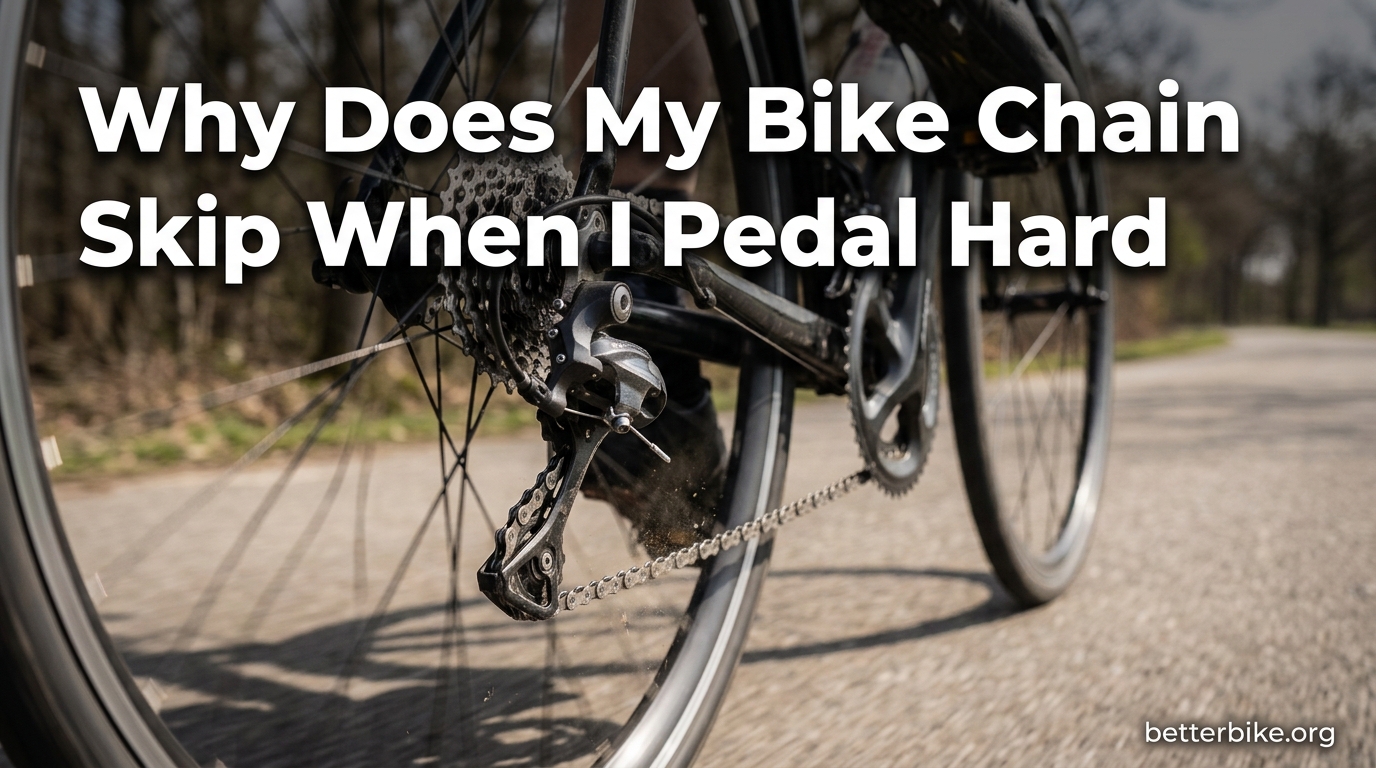
If your bike chain skips when you pedal hard, the drivetrain cannot hold the torque you are putting through it. On a normal pedal stroke the chain stays engaged with the cassette cogs, but under heavy load the chain rides up and over the teeth instead of seating between them. That is the popping, snapping, or screeching moment most riders describe.
I have owned a workshop for ten years and rebuilt hundreds of drivetrains. The good news is that bike chain skipping under load almost always comes from one of five causes, and most are cheap to fix at home. Below I walk through what causes the skip, how to confirm the culprit, and the exact steps to stop it for good.
Table of Contents
Why does my bike chain skip when I pedal hard?
A bike chain skips under hard pedaling because the chain and the gears it meshes with are no longer a perfect match. As parts wear, the chain stretches slightly, the cog teeth get hooked into a shark-fin shape, and the derailleur can drift out of alignment. When torque spikes during a climb, sprint, or stand-up pedal stroke, the chain jumps to the next tooth or skips over the cog entirely.
- Worn or stretched chain (most common cause)
- Worn cassette cogs or chainring teeth
- Stiff or damaged chain link
- Misadjusted derailleur or bent derailleur hanger
- Cross-chaining or shifting under heavy load
The rest of this guide covers each cause, the symptom that points to it, and the fix that actually works.
Cause #1: A worn or stretched chain
A bike chain does not get longer in the rubber-band sense. The inner pins and bushings wear down from pedaling force and grit, and the small gaps between rollers open up. Mechanics call this chain stretch, even though nothing is being pulled.
Once the chain lengthens past about 0.5 percent (a 12-speed chain wears out at 0.3 percent), the rollers no longer sit deep enough in the cog valleys. Under hard pedaling the chain climbs up the tooth and skips.
How to check
Use a chain wear indicator tool. Drop the prongs into the chain, and if the 0.5 percent side drops in flush, the chain is worn and needs replacement. If you do not have a tool, measure 12 full links from pin to pin. New 10-12 speed chains measure exactly 12 inches. Anything over 12 and 1/16 inches means the chain is stretched.
The fix
Install a new chain of the correct speed rating. If the cassette has been skipped with for thousands of miles, replace the cassette at the same time, otherwise the new chain will not seat properly on the worn teeth.
Cause #2: Worn cassette cogs or chainring teeth
Cassette cogs and chainrings wear in a tell-tale pattern called shark-tooth wear. The rear of each tooth, where the chain enters under load, gets hooked and curved instead of staying symmetric. When the chain lands on a worn tooth, the tooth acts like a ramp and the chain rolls over it.
Forum riders often report that a brand-new chain on an old cassette makes skipping worse, not better. The new chain is stiffer and the rollers are still sharp, so it cannot seat into the worn valleys of the old cassette. That mismatch is what causes the skip.
How to check
Look at the cogs from a side angle. Symmetrical, squared-off teeth are healthy. Curved, hooked, or pointed teeth are worn. Lift the chain off a cog and compare its profile to a new cog if you have one. The chainring wears the same way and is easiest to inspect on the largest ring.
The fix
Replace the cassette. Chainrings last much longer, but if the front rings are visibly hooked, swap them too. Budget chains and cassettes wear out faster than premium ones, so consider a higher-end replacement if you ride in wet or gritty conditions.
Cause #3: Stiff or damaged chain links
A single stiff link is enough to make a chain skip. The kink refuses to flex around the cassette cogs, so the chain jumps to release the tension. Stiff links usually come from a chain that was installed without proper lubrication, that has rusted, or that has taken a hard impact.
How to check
Slowly rotate the chain and watch each link pass through the derailleur pulleys. A good chain flexes smoothly. A stiff link hangs up, produces a click, or stops dead. You can usually identify the bad link by hand: hold the chain so the link hangs and try to flex it sideways. A working link moves freely. A stiff link resists.
The fix
Grip the stiff link on both sides and gently flex it laterally to free the plates. If that does not work, apply a drop of chain lube and work the link back and forth. If the link is bent, kinked, or rusted through, cut it out with a chain tool and install a master link.
Cause #4: Misadjusted derailleur or bent hanger
The rear derailleur is what aligns the chain with each cog. If the limit screws, B-tension screw, or cable tension are off, the chain sits slightly off-center on the cog. Under hard pedaling that misalignment becomes a skip.
A bent derailleur hanger is a common cause after a crash or even a tip-over in the garage. The hanger is the small aluminum piece that connects the derailleur to the frame, and a 1 mm bend is enough to throw off shifting on every gear.
How to check
Shift to the smallest cog and look from behind. The upper jockey wheel should sit directly under the smallest cog. If it points left or right, the hanger is bent. Shift through all gears and listen for a ticking or skipping noise that only happens in one gear, since that points to a limit screw or indexing issue.
The fix
For indexing problems, turn the barrel adjuster a quarter turn at a time while pedaling. Clockwise tightens cable tension and trims a slow-shifting upshift. Counter-clockwise loosens and fixes hesitant downshifts. For a bent hanger, use a derailleur alignment tool or take it to a shop. The hanger itself costs a few dollars and is worth replacing rather than bending back.
Cause #5: Improper shifting under load
Every cyclist has stomped on the pedals mid-shift and felt the chain jump. That is the derailleur trying to move the chain while torque is still applied. Modern drivetrains tolerate a little of this, but a hard pedal stroke during a shift forces the chain to skip rather than glide to the next cog.
Cross-chaining is the silent version of the same problem. Riding in the big chainring and the biggest cog, or the small chainring and the smallest cog, pulls the chain at a steep angle. That angle loads the side plates unevenly and can produce a skip under heavy torque. I see this on every long climb when a rider refuses to shift out of the big ring.
How to fix
Ease off the pedals for a half-rotation when shifting. Anticipate climbs and downshift before the gradient steepens so you are never mashing the big ring uphill. Stay away from the big-big and small-small gear combinations, and check out our guide to proper gear shifting technique for the full breakdown.
Quick diagnostic checklist
Use this table to match what you are feeling to the most likely cause before you start swapping parts.
| Symptom | Most likely cause | First check |
|---|---|---|
| Skip in every gear under load | Worn chain or cassette | Measure chain wear with a tool |
| Skip only in one or two gears | Derailleur indexing or bent hanger | Adjust barrel adjuster, inspect hanger |
| Skip happens when shifting under power | Rider error, cross-chain | Ease off pedals when shifting |
| Skip on a brand-new chain | Worn cassette cogs | Inspect cassette for shark-tooth wear |
| One link sticks during rotation | Stiff chain link | Flex the link by hand, lube if needed |
| Loud screeching with skip | Dry chain or grit buildup | Clean chain, re-lube, wipe excess |
| New bike, skip from day one | Factory cable stretch or hanger out of true | Take to shop for warranty tune-up |
How to measure chain wear at home
Measuring chain wear takes about a minute and is the single most useful check for preventing skip. Here is the process I use on every bike that comes into the shop.
- Shift the chain onto the largest cog to take tension off the derailleur.
- Pick a chain wear indicator tool that matches your drivetrain speed (10, 11, or 12 speed).
- Insert the hooked end into the chain so the tool drops into two rollers.
- Let the indicator fall straight down. If the 0.5 percent tip drops flush into the chain, the chain is worn out.
- For a 12-speed chain, replace at 0.3 percent. The tool will have a marked notch for this.
- If the tool stops on the chain, you are at 0.75 percent stretch and the cassette is almost certainly worn too.
Most home mechanics skip this step and end up buying the wrong part. A $15 chain wear indicator pays for itself the first time it tells you that the cassette is fine and the chain is the only thing to replace.
How to prevent chain skip
Skip is a wear problem, and wear is manageable. A short routine every few weeks is all it takes to keep the drivetrain quiet.
- Lube the chain every 100-150 miles, or after every wet ride. Wipe off the excess so grit does not stick to it.
- Replace the chain at 0.5 percent stretch (0.3 percent for 12-speed) to keep the cassette and chainrings happy.
- Clean the drivetrain with a rag and a degreaser every month if you ride in dust or mud.
- Avoid cross-chaining. Stay off the big-big and small-small combinations.
- Shift before the climb, not on it. Pedal lightly through every shift.
- Get a yearly tune-up to check hanger alignment, cable tension, and chainring wear.
For a complete walkthrough of cleaning the bike without damaging the bearings, see our bike maintenance guide.
FAQ’s
Why does my bike chain skip when I pedal hard?
A bike chain skips under hard pedaling because the chain and cassette are no longer a perfect mesh. Worn chain rollers, hooked cassette teeth, stiff links, or a misaligned derailleur all cause the chain to jump under heavy torque. Chain stretch is the most common cause, followed by worn cassette cogs.
How do I stop my bike chain from skipping?
Measure chain wear with a chain wear indicator tool first. If the chain is past 0.5 percent stretch, replace it and inspect the cassette for shark-tooth wear. Clean and lube the chain, flex any stiff links by hand, and re-index the rear derailleur using the barrel adjuster. Avoid pedaling hard during shifts and stay out of cross-chain gear combinations.
What causes a bike chain to skip under pressure?
The five most common causes are a worn or stretched chain, worn cassette cogs or chainring teeth, a stiff chain link, a misadjusted derailleur or bent hanger, and shifting under heavy load. High-torque moments like climbing, sprinting, and standing on the pedals expose the weakness, which is why the skip only shows up when you pedal hard.
Should I replace the chain or the cassette first?
Always start with the chain. Use a chain wear indicator to confirm the chain is past 0.5 percent stretch. If you install a new chain on a worn cassette, the skip often gets worse because the new chain cannot seat into hooked cog teeth. If the chain is only slightly worn but the cassette shows clear shark-tooth wear, replace both at the same time.
Can a new chain skip on an old cassette?
Yes, and it is a very common complaint. A new chain has stiff rollers and tight tolerances that do not match the worn valleys of an old cassette. The new chain rides up on the hooked teeth and skips under load. This is the reason mechanics recommend replacing the chain and cassette together once the cassette is visibly worn.
Is it safe to ride a bike with a skipping chain?
It is not safe for long. A skipping chain can throw you off balance mid-climb, snap under heavy load, or lock up the drivetrain in extreme cases. Limit riding to flat, low-torque routes until you have measured the chain and inspected the cassette, and avoid standing climbs or sprints that put maximum force through the drivetrain.
Final thoughts
A bike chain that skips when you pedal hard almost always comes down to a worn chain, a worn cassette, a stiff link, a bent derailleur hanger, or shifting under load. Start with a chain wear measurement, since that one tool tells you 80 percent of what you need to know. From there, replace the chain, inspect the cassette, lube the drivetrain, and re-index the derailleur. With those steps your chain should stop skipping and stay quiet for thousands of miles.