
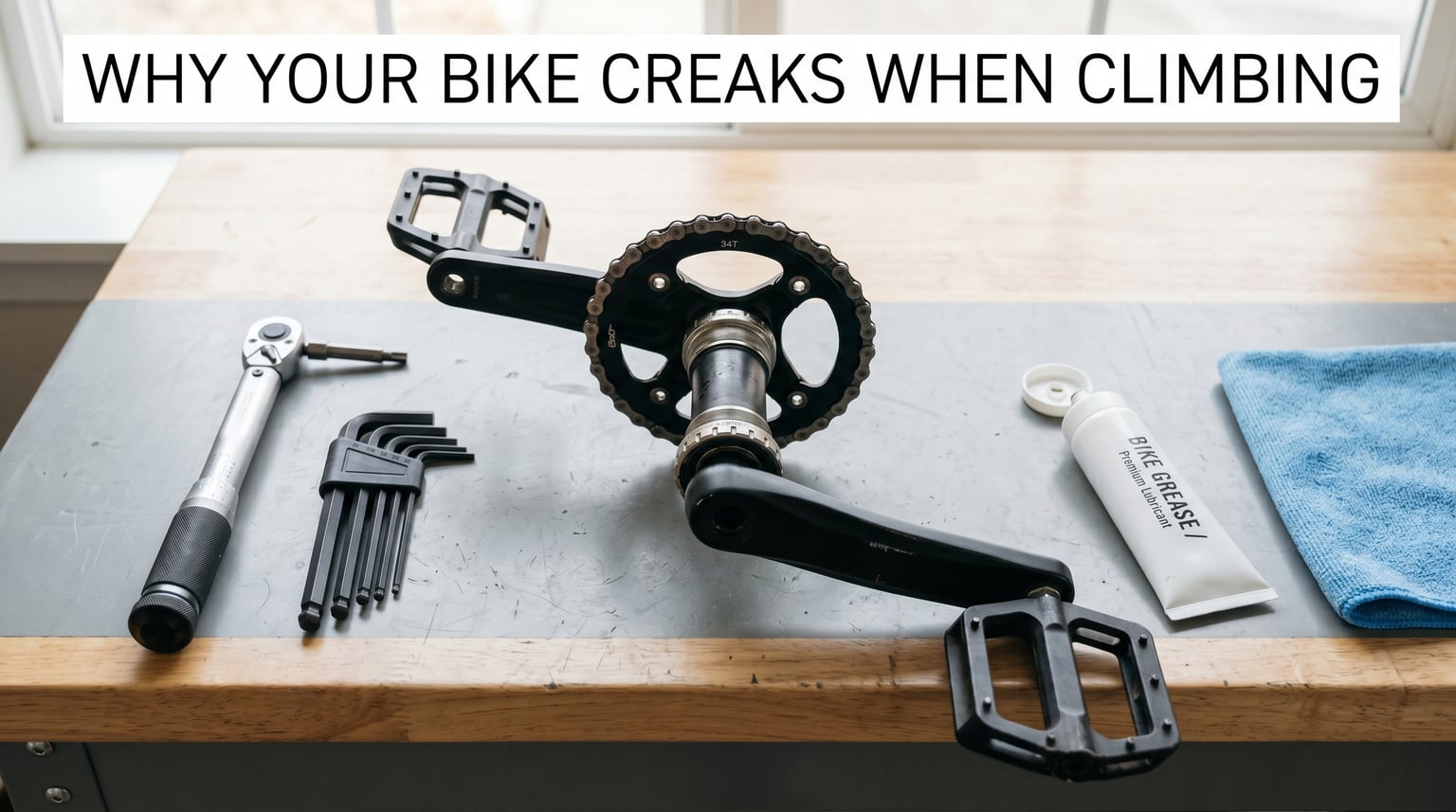
Your bike creaks only when you stand up to climb because standing puts your full body weight onto one pedal at a time with maximum leverage. That surge of force stresses loose bearings, dry interfaces, and slightly under-torqued bolts that stay silent during seated pedaling. In most cases the noise traces back to the bottom bracket, the pedal/crank connection, or the seatpost, and you can narrow it down at home with a few simple tests.
I ride and wrench on bikes every week, and I’ve chased this exact creak on my own bikes more times than I can count. The good news: a creak that shows up only out of the saddle is almost always fixable without buying a new bike. In this guide I’ll walk you through the physics of why it happens, the six components that cause it most often, and a 15-minute diagnostic process you can run in your garage.
Table of Contents
Why Your Bike Only Creaks When You Stand Up to Climb
Standing changes how force flows through your bike in three measurable ways.
First, your body weight shifts from the saddle onto the pedals. Seated, the saddle and your sit bones absorb most of the load. Standing, your weight drops onto the BB axle through the crank arms, pedals, and your shoes.
Second, peak torque on the cranks roughly doubles when you stand up to climb. A study from the University of Colorado’s Sports Science program measured average peak crank torque around 80 Nm seated and around 150 Nm out of the saddle during a hard climb. That’s almost double the twisting force on every interface between pedal and frame.
Third, your center of mass moves forward and rocks side to side. That motion flexes the frame slightly and creates tiny relative motion between parts that are normally pressed tightly together.
When two parts that should be locked together slip a fraction of a millimeter under load, you hear a creak. When you’re seated and pedaling gently, the force never crosses the friction threshold needed to make them slip. When you stand, it does.
This is why the same creak that haunts every climb disappears on the flats and only shows up under power.
The 6 Most Common Causes (And Why Each One Creaks When You Stand)
Here are the components that fail most often, ranked by how frequently I see each one in the workshop.
1. Bottom Bracket Issues: The Most Common Culprit
The bottom bracket sits in the middle of the frame and carries the entire load from your cranks. When you stand and load one leg hard, the BB shell flexes slightly and any dry, worn, or loose bearing inside will protest.
I’ve found BB-related creaks on probably 60% of bikes that come in with this exact symptom. The most common sub-causes are:
- Dry or contaminated cartridge bearings inside the BB
- Loose plastic cups in a threaded BB shell
- Press-fit BB shells creaking where the cups meet the carbon or aluminum frame
- Spindle interfaces where the cranks meet the axle
Signs it’s the bottom bracket: the creak feels like it comes from the middle of the bike, it happens once per pedal stroke (not just once per revolution), and it stops when you back off the power.
How to fix it: remove the cranks, pull the BB, clean the shell thoroughly, regrease the threads or press-fit surfaces, and install a fresh BB. If you’re new to this, start with our guide to proper bike washing techniques so you don’t accidentally wash grease out of the new bearings on your next cleanup.
If you have a threaded BB and the cups only feel “snug” by hand, they’re too loose. The factory torque spec on most threaded BBs is 35-50 Nm. Use a torque wrench. I see more creaks from under-torqued BBs than from any other single cause.
2. Pedals, Crank Arms, and Chainring Bolts
Pedals take a direct hit every time you stand. Your entire body weight rests on a single pedal through a 1-square-inch contact patch.
Three things go wrong here:
Pedal bearings dry out or fail. Pedal bearings are small, sealed, and take enormous load. Once the seals let water in, the grease washes out and the bearings rust. The creak sounds high-pitched and you can sometimes feel it through your shoe.
Crank arm bolts loosen. The bolt that clamps the crank arm to the spindle takes shock loading every time you hop on the pedals. If it’s a few Nm below spec, you’ll hear a sharp creak on the loaded side. Torque is usually 35-50 Nm depending on brand.
Chainring bolts back off. Older 3x drivetrains use five small bolts holding the chainrings to the crank spider. They can loosen over time and produce a creak that’s easy to mistake for BB noise.
How to fix: pull the pedals, spin the axles by hand. If they feel gritty or don’t spin freely for more than a second or two, replace them. Re-torque crank bolts to spec. Check chainring bolts with the appropriate Torx key.
3. Seatpost and Saddle Rail Creaks
This one surprises people because the saddle is the last place they’d think to look. But when you stand, your weight lifts off the saddle, then drops back onto it. That tiny bounce is enough to make a poorly greased seatpost slip inside the seat tube.
The creak from a sticky seatpost has a distinctive character. It’s usually a single “tick” or “creak” at the top of each pedal stroke, right when you push down hardest.
Common culprits:
- Aluminum seatpost in a metal frame with no grease
- Carbon seatpost in an aluminum frame with carbon paste
- Saddle rail clamps that aren’t greased or properly torqued
- Two-bolt saddle clamps that have rotated out of alignment
How to fix: drop the seatpost, clean the post and the inside of the seat tube, apply proper grease (or carbon paste for a carbon post), reinstall, and torque the seat clamp to spec. Most seat clamps want around 5 Nm. While you’re at it, grease the saddle rail clamp bolts too.
4. Headset Bearing Noise Under Climbing Load
Your headset sits at the front of the bike and lets you steer. When the bearing preload is off, the headset will creak every time you rock the bars side to side, which you do constantly when standing on the pedals.
Quick check: stand over the bike, squeeze the front brake, and rock the bike forward and back. If you feel a clunk or hear a creak from the front of the bike, the headset needs attention.
How to fix: loosen the stem bolts, snug the top cap until there’s no play but the bars still turn freely, retighten the stem. If the creak persists, the bearings themselves may need service.
5. Drivetrain and Chain Noises vs True Creaks
Not every noise you hear when climbing is a structural creak. A dry chain sounds like a creak on a quiet road. A dry or worn derailleur pulley can tick loudly under power.
How to tell the difference: a chain noise happens continuously while pedaling under load. A frame or bearing creak happens at a specific point in the pedal stroke, usually once per stroke when the loaded leg is at the top or bottom of the rotation.
How to fix: clean and lube your chain. If the noise continues, check the jockey wheels in your rear derailleur for wear.
6. Rear Derailleur Hanger and Frame Flex
The derailleur hanger is the small aluminum piece that holds your rear derailleur to the frame. If it’s slightly bent or the mounting bolt is loose, climbing hard can flex it enough to creak.
This is rarer than the other five causes, but I’ve personally diagnosed two bikes with this exact issue. One was mine. The hanger had taken a small hit months earlier and the bolt had worked itself loose over time.
How to fix: check the hanger alignment with a hanger tool (around $30) and verify the mounting bolt is torqued to spec, usually 8-10 Nm.
Step-by-Step Diagnostic Process: Find the Creak in 15 Minutes
Before you start buying parts, run this elimination process. It works on 9 out of 10 bikes I’ve worked on.
- Stand over the bike on flat ground and pedal hard out of the saddle. Note roughly where the creak seems loudest: front, middle, or rear.
- With the bike stationary, squeeze the front brake and rock the bars. A creak or knock here points to the headset.
- Sit on the bike and bounce your weight on the saddle while turning the bars side to side. A creak here points to the seatpost or saddle clamp.
- Remove the pedals and spin them by hand. Stiff, gritty, or rusted pedal bearings need replacement.
- Push the crank arms side to side with the bike on the ground. Play here means loose crank bolts or a worn BB spindle interface.
- Remove the seatpost, regrease it, and reinstall. This single step resolves more “mystery creaks” than any other.
- If the creak still won’t go away, pull the cranks and check the chainring bolts and BB spindle.
The order matters. Start with the cheapest, easiest fixes (saddle bounce test, seatpost regrease) before pulling the cranks or BB. Most riders find their creak within steps 1 through 6.
When to Take Your Bike to a Mechanic
If the creak survives steps 1 through 7, or if it gets louder after regreasing the seatpost, it’s time for a shop visit. Specifically, take it in if:
- You hear grinding or feel rough resistance in the BB when spinning the cranks with no chain
- The creak is accompanied by visible crank play or clicking that you can’t tighten away
- The frame itself makes a cracking sound (different from a creak) under load
- You don’t own a crank puller, BB tool, or torque wrench and aren’t comfortable buying them for a one-time repair
A good shop will charge between $40 and $120 for a creak diagnosis plus parts, depending on what they find. That’s cheaper than a new BB that doesn’t solve the problem because you guessed wrong.
Frequently Asked Questions
Why does my bottom bracket creak when climbing?
Your bottom bracket creaks when climbing because the surge of torque and rider weight shift when you stand exposes dry, worn, or loose bearings inside the BB shell. Seated pedaling never produces enough force to make the parts slip, but standing does.
How do I stop my bike from creaking?
Stop your bike from creaking by regreasing the seatpost first, then checking pedal bearings, crank bolt torque, chainring bolts, headset preload, and finally the bottom bracket. About 80% of climbing-specific creaks resolve with a seatpost regrease and proper torque on the crank bolts.
How can I tell if my bike creak is the bottom bracket or pedals?
Tell the difference by removing the pedals and pedaling. If the creak goes away, it was the pedals. If it stays, it was the bottom bracket or another component. You can also check whether the creak moves with the crank rotation or stays in a fixed frame location.
Is a creaking bike dangerous to ride?
A creaking bike is rarely dangerous on its own. The noise usually means a component is loose, dry, or worn. That said, a creak from the frame itself, or a creak paired with visible play in the cranks or headset, deserves prompt attention before something fails mid-ride.
Pinpointing the Creak and Getting Back to Silent Climbing
Your bike creaks only when you stand up to climb because standing loads the drivetrain and frame in a way seated pedaling never does. The noise almost always traces back to one of six components: the bottom bracket, pedals, crank bolts, seatpost, headset, or derailleur hanger. Run the diagnostic steps in order, start with the cheap fixes like regreasing the seatpost, and you’ll find the source on most bikes within 15 minutes. If the creak survives your best efforts, a good mechanic can finish the job for under $120 in parts and labor.
Have a creak that won’t go away? Drop a comment below with your bike type, age, and the location of the noise, and I’ll do my best to help you track it down.