
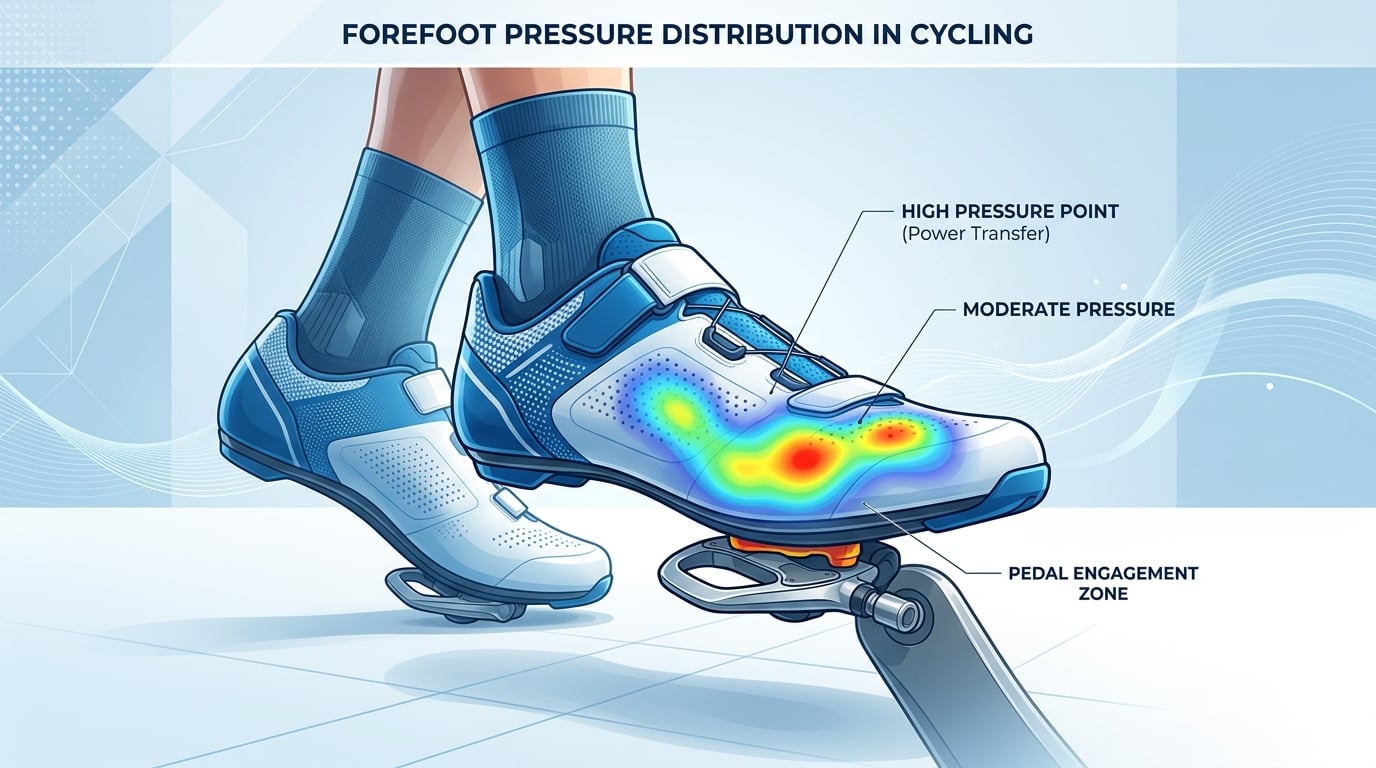
Your feet go numb or burn when cycling because of nerve compression in the foot, most often caused by shoes that are too tight, cleats positioned too far forward, or a saddle that shifts your weight onto the forefoot. When peripheral nerves like the sural nerve get squeezed between bone and shoe material, the electrochemical signals to your brain get disrupted. The result is that familiar tingling, pins-and-needles feeling that progresses into full numbness or a burning sensation cyclists call “hot foot.”
If you have ever felt your toes go dead halfway through a ride, you are not alone. Forum discussions on Reddit’s r/bikefit and r/cycling are filled with riders describing the exact same problem. Many have tried multiple shoes, several bike fits, and expensive insoles without full relief. The frustration is real, and the solutions are not always obvious.
Foot numbness matters more than most cyclists realize. It reduces your power transfer because you cannot feel the pedal beneath you. It compromises bike control when you need to react quickly. And if left unaddressed for months or years, persistent nerve compression can lead to longer-term foot neuropathy that lingers even off the bike.
In this guide, we will break down exactly why your feet go numb or burn when cycling, what each sensation tells you, and the specific changes you can make to your shoes, cleats, saddle, and insoles to fix it. We pulled insights from bike fitting experts, ergonomics specialists, and hundreds of forum posts from cyclists who have been through it.
Table of Contents
Why Your Feet Go Numb or Burn When Cycling: The Root Cause
At its core, foot numbness and burning while cycling is a nerve problem. Your feet are packed with peripheral nerves that carry sensory information from your skin, muscles, and joints back to your brain. The sural nerve runs along the outside of the foot and into the toes, while branches of the tibial nerve serve the sole and forefoot area.
When you pedal, your body weight plus the force of each pedal stroke concentrates pressure on a relatively small area, the ball of your foot. If your shoe is too narrow, your cleat is too far forward, or your insole lacks proper arch support, that pressure compresses the nerve canals running through the soft tissue of your forefoot.
Think of a nerve like a garden hose. Step on the hose and the water flow drops. Release the pressure and the flow returns. The same thing happens with compressed nerves. The tingling sensation you feel is the nerve starting to recover, much like when your foot falls asleep on the couch and you shake it awake.
Blood vessel restriction plays a secondary role. Tight shoes or excessive pressure can restrict blood flow to the toes, which amplifies the numbness and adds the burning sensation. Reduced circulation means less oxygen reaching the tissue, which your body interprets as heat or pain.
Numbness vs Burning: What Each Sensation Means
Not all foot discomfort on the bike is the same. Understanding the difference between numbness and burning helps you identify the root cause faster.
Numbness, that dead, disconnected feeling in your toes, is primarily nerve compression. The nerve signal is being blocked. This often points to shoe width issues, cleat position problems, or pressure on a specific nerve pathway. Numbness that comes on gradually after 30 to 50 minutes of riding is the classic pattern.
Burning, or “hot foot,” is different. That fiery sensation under the ball of your foot is usually linked to metatarsal pressure and inflammation. The heads of your metatarsal bones, the long bones behind your toes, are getting crushed against the pedal platform. When the tissue between those bones and the shoe sole gets inflamed, you feel heat.
Hot foot often shows up on long rides or high-intensity efforts where you are pushing bigger gears. It can also indicate that your shoe sole is too flexible, concentrating all your pedaling force on a tiny contact area rather than distributing it across the entire forefoot.
Some cyclists experience both sensations at once, numb toes combined with a burning ball of the foot. This typically means multiple issues are compounding. A narrow shoe causing nerve compression plus a soft sole causing metatarsal pressure, for example.
Shoe Fit: The Most Common Culprit
If we had to rank the causes of foot numbness in cycling, shoe fit would sit at the top. Cyclists spend hundreds on shoes based on stiffness ratings and brand reputation, then wear the wrong size or width for years without realizing it.
Here is the thing most people miss. Your feet swell during exercise. Blood flow increases, soft tissue expands, and your foot volume can grow by as much as a half size during a ride. A shoe that felt fine in the living room can become a vise on the bike after 45 minutes.
Shoe width is the biggest factor. Most cycling shoes are built on a standard last that is too narrow for many riders. If your foot spreads naturally wider than the shoe allows, the sides of the shoe compress the nerve canals running along the outside of your forefoot. That is exactly where the sural nerve and its branches sit.
Carbon soles can make this worse. A stiff carbon sole is great for power transfer because it does not flex under load. But that stiffness also means the shoe does not adapt to your foot shape at all. Every pressure point stays exactly where it is for the entire ride.
Overtightening is another common mistake. Cyclists crank down BOA dials or ratchet systems to get a secure fit, not realizing they are squeezing the forefoot. Many forum riders report that loosening the lower dial or strap over the ball of the foot made an immediate difference. Keep the shoe snug at the ankle and instep, but leave room across the forefoot.
Toe box shape matters too. A tapered toe box that narrows toward the front pushes the toes together and compresses the nerves between them. Look for shoes with a wider, more anatomical toe box that lets your toes splay naturally.
Cleat Position: Getting It Right
Cleat position is the second most common cause of cycling foot numbness, and it is also one of the easiest to fix. Where you place your cleat on the shoe determines exactly which part of your foot bears the pedaling load.
The fore-aft position is the adjustment that matters most for numbness. Most riders position the cleat so the pedal axle sits directly under the ball of the foot, the classic “metatarsal head” alignment. This puts maximum pressure right on the nerve-dense area of your forefoot.
Moving the cleat backward, closer to the heel, shifts the pedaling force behind the metatarsal heads. This reduces pressure on the nerves and blood vessels in the forefoot. Many cyclists who suffer from hot foot or numb toes find relief simply by sliding their cleats back 5 to 10 millimeters.
A word of caution from forum experience. One Reddit user reported that moving cleats all the way back eliminated their numbness but caused soft tissue pain elsewhere. The goal is finding the sweet spot, not going to extremes. Small adjustments of 2 to 3 millimeters at a time let you dial in the right position.
Lateral cleat adjustment also plays a role. The Q-factor, or the distance between your pedals, affects how your foot sits on the pedal. If your cleats are positioned too far inward, your foot hangs off the outside edge of the pedal, concentrating pressure on the outer nerves. Too far outward and the inner edge of your foot takes the load.
For riders whose feet naturally sit at an angle, known as a V-stance or duck-footed position, make sure your cleats accommodate your natural foot angle. Forcing your feet straight when they want to angle outward creates torsional pressure through the foot that can compress nerves over time.
If you use clipless pedals, check your float setting too. Cleats with zero float lock your foot into one position for the entire pedal stroke. This means the same nerves get compressed in the same way on every revolution. Cleats with a few degrees of float allow micro-movements that relieve sustained pressure.
Saddle Position and Its Effect on Your Feet
It might seem strange that your saddle affects your feet, but the connection is direct. Your saddle position determines how your body weight is distributed between the saddle, handlebars, and pedals. Shift that distribution and you change how much pressure lands on your feet.
Saddle height is the first variable. If your saddle is too high, you reach for the bottom of each pedal stroke. This shifts your weight forward and increases pressure on your hands and the front of your feet. Your toes grip the pedal to stabilize, which compresses the forefoot.
If your saddle is too low, your knees stay bent throughout the stroke. This reduces power and changes your pedaling dynamics, but it can also cause you to push harder through the downstroke, increasing forefoot loading.
Saddle setback, the fore-aft position of your saddle relative to the bottom bracket, also matters. A saddle pushed too far forward tips your weight onto the front of the bike. More weight on the handlebars means more weight on the pedals too, specifically on the forefoot as you push against it.
Saddle tilt is subtle but important. A nose-down tilt rotates your pelvis forward, shifting weight toward the handlebars and pedals. A level saddle or a very slight nose-down tilt (1 to 2 degrees) typically distributes weight most evenly across your sit bones, feet, and hands.
If you have addressed shoes and cleats but still experience numbness, saddle position is your next checkpoint. Even small adjustments of 3 to 5 millimeters in height or setback can change how your feet feel after an hour of riding.
Arch Support and Insoles: The Missing Piece
The stock insoles that come with cycling shoes are almost universally thin, flat, and useless. They provide no arch support, no metatarsal support, and no targeted pressure relief. For many cyclists, upgrading insoles is the single most effective change they can make.
Here is why arch support matters so much. When you pedal, your foot does not just sit there passively. The arch of your foot acts like a spring, absorbing and releasing force with each pedal stroke. If your arch collapses under load, the foot spreads wider, compressing nerves and blood vessels in the forefoot.
The transverse arch, which runs across the ball of the foot behind the metatarsal heads, is particularly important. When this arch sags, the metatarsal heads spread apart and press into the soft tissue below, pinching nerves in the process. This is the direct mechanical cause of hot foot for many riders.
A supportive insole does two things. It holds the longitudinal arch up so the foot does not collapse inward, and it provides a metatarsal button or pad that supports the transverse arch. This keeps the metatarsal heads from spreading and compressing the nerves between them.
Foot type matters here. High-arched feet, flat feet, and neutral feet all need different levels and shapes of support. One forum insight from a bike fitter noted that foot numbness is often about “a person’s flexibility and structure of the foot” rather than just shoe or cleat issues. Getting your foot type analyzed, either at a bike fit studio or with a simple wet foot test at home, helps you choose the right insole.
Be aware that even premium insoles do not work for everyone. One Reddit user reported that Specialized blue insoles did not fully resolve their numbness. If one insole does not work, it does not mean insoles are not the answer. It might mean you need a different arch height, a metatarsal pad in a different position, or a custom-molded option.
Blood Circulation and Foot Mechanics
Beyond the mechanical factors, your circulation and foot mechanics play a role in numbness that many guides overlook. Cycling is unique among sports because your feet stay in a fixed position on the pedals for extended periods. There is no natural movement to keep blood flowing and muscles engaged.
When you walk or run, your foot goes through a full range of motion with each step. The arch compresses and rebounds, the toes flex, the ankle moves. This pumping action keeps blood circulating through the foot. On a bike, none of that happens. Blood pools, pressure builds, and nerves get compressed in a static position.
Warming up before rides helps more than most people think. A proper warm-up dilates blood vessels and increases circulation to your extremities before you start pushing hard. Riders who jump straight into high-intensity efforts with cold feet often report numbness earlier in the ride.
Your overall flexibility affects foot numbness too. Tight calves, hamstrings, and hip flexors change your pedaling mechanics. Less flexible riders tend to ankling less, the natural up-and-down movement of the ankle during the pedal stroke, which means the foot stays rigid and pressure stays constant.
Foot type also influences how numbness develops. Riders with high arches tend to experience more burning and hot foot because pressure concentrates under a smaller contact area. Riders with flat feet tend toward more widespread numbness because the collapsed foot spreads pressure across the entire sole, compressing nerves throughout.
Left Foot vs Right Foot: Why Asymmetry Happens
One of the most common questions in cycling forums is why one foot goes numb more than the other. “Every ride about 45 to 50 minutes, my feet begin to go numb, left foot more than my right,” wrote one Reddit user. This asymmetry is surprisingly common and usually points to a specific issue.
The most common cause of one-sided numbness is a leg length difference. Even a small discrepancy of 3 to 5 millimeters between your legs changes how each foot interacts with the pedal. The shorter leg reaches more at the bottom of the stroke, increasing forefoot pressure on that side.
Pedal stroke asymmetry is another factor. Most cyclists favor one leg over the other without realizing it. If your left leg pushes harder or longer in the stroke, it accumulates more fatigue and pressure. This is why the dominant or stronger leg sometimes goes numb first.
Saddle position can create asymmetry too. If your saddle is slightly twisted or you sit slightly off-center, one foot bears more weight than the other. This is hard to detect on your own but a bike fitter can spot it quickly with video analysis.
Cleat position differences between left and right shoes are worth checking. Even if you think you set them identically, small differences in shoe construction or mounting can create slight variations. Measure the distance from the cleat to the back of each shoe to verify they match.
If you have persistent one-sided numbness that does not respond to these changes, consider seeing a bike fitter or sports physiotherapist. They can identify leg length differences, pedal stroke imbalances, or alignment issues that are invisible from the saddle.
10 Changes to Stop Your Feet Going Numb or Burning When Cycling
Now that we have covered the causes, here is a consolidated checklist of changes you can make. Work through these in order, starting with the easiest and most common fixes.
1. Loosen your shoes across the forefoot. Unfasten the lower BOA dial or strap by one or two clicks. Keep the shoe secure at the instep and ankle but give your forefoot room to breathe. This is the fastest fix and costs nothing.
2. Try thinner socks. Thick cycling socks eat up valuable space inside the shoe. A thin, moisture-wicking sock gives your foot more room and reduces compression. One Facebook user found this alone made a noticeable difference.
3. Move your cleats back 3 to 5 millimeters. Shift them toward the heel to move pressure off the metatarsal heads. Make small adjustments and test on a ride before going further. This single change resolves hot foot for many riders.
4. Upgrade your insoles. Replace the flat stock insoles with a cycling-specific pair that provides arch support and a metatarsal pad. Match the arch height to your foot type, low, medium, or high.
5. Check your saddle height. If your saddle is too high, your feet take on more load. Try dropping it 2 to 3 millimeters and see if your foot comfort improves on longer rides.
6. Level your saddle. A nose-down tilt of more than 2 degrees shifts weight forward. Use a level or phone app to check. A flat or barely nose-down position usually works best.
7. Warm up before hard efforts. Spend 10 to 15 minutes spinning at low intensity before pushing big gears. This dilates blood vessels and improves circulation to your feet before the real work begins.
8. Stand up and move your feet every 15 to 20 minutes. Coast for a few seconds, stand on the pedals, and wiggle your toes. This breaks up static pressure and restores blood flow. On indoor trainers where coasting is not possible, unclip one foot at a time and flex your ankle.
9. Consider wider shoes. If you have tried the above and still get numb, your shoes may simply be too narrow. Many brands now offer wide or extra-wide lasts. Getting professionally measured for width, not just length, can be eye-opening.
10. Get a professional bike fit. If numbness persists after trying everything, a bike fit is worth the investment. A fitter can check saddle position, cleat alignment, leg length differences, and foot mechanics all at once. Multiple forum users reported that a proper fit was what finally solved years of foot pain.
FAQ’s
How do I stop my feet from going numb when cycling?
To stop foot numbness when cycling, loosen your shoes across the forefoot, move your cleats 3 to 5mm toward the heel, upgrade to insoles with arch support and a metatarsal pad, and warm up for 10 to 15 minutes before hard efforts. Standing up every 15 to 20 minutes to restore blood flow also helps significantly.
Why do my feet burn while cycling?
Burning feet, or hot foot, is caused by metatarsal pressure and inflammation. The metatarsal heads behind your toes get compressed against the pedal, and the tissue between them becomes inflamed. Shoes that are too flexible, cleats too far forward, or a lack of transverse arch support are the usual triggers.
What causes numb toes while cycling?
Numb toes while cycling are caused by nerve compression in the forefoot. The sural nerve and its branches get squeezed between the metatarsal bones and tight shoe material. Common causes include shoes that are too narrow, cleats positioned too far forward, overtightened straps, and collapsed foot arches without insole support.
How to fix hot foot cycling?
Fix hot foot by moving cleats back 3 to 5mm to shift pressure behind the metatarsal heads, adding insoles with a metatarsal button to support the transverse arch, loosening the lower shoe strap, and wearing thinner socks. Stiffer-soled shoes also help by spreading pedaling force across a wider area.
Why does my left foot go numb more than my right when cycling?
One-sided foot numbness usually points to a leg length difference, pedal stroke asymmetry, or an off-center saddle position. Even a 3 to 5mm leg length difference changes forefoot pressure on the shorter side. A professional bike fit with video analysis can identify the exact cause.
Should I be worried if my toes stay numb days after cycling?
Numbness that lingers for days after cycling may indicate prolonged nerve compression or irritation. If it persists beyond a few days, consult a doctor or sports physiotherapist. Persistent numbness can be a sign of cycling-related foot neuropathy that may require targeted treatment beyond bike fit adjustments.
Final Thoughts on Cycling Foot Numbness
Foot numbness and burning are among the most common complaints in cycling, but they are also among the most fixable. Understanding that your feet go numb or burn when cycling because of nerve compression gives you a clear framework for troubleshooting. Start with the easy changes like loosening your shoes and moving cleats back. Work through the checklist systematically before investing in new equipment.
If you have tried everything in this guide and numbness persists, book a professional bike fit. A good fitter sees foot problems every day and can spot issues you cannot detect yourself, from subtle leg length differences to foot type mismatches with your current setup.
Do not ignore persistent numbness. What starts as a mild annoyance on long rides can become a chronic issue if the underlying nerve compression is never addressed. Your feet carry every watt of power you produce. Treat them right, and every ride gets more comfortable.