
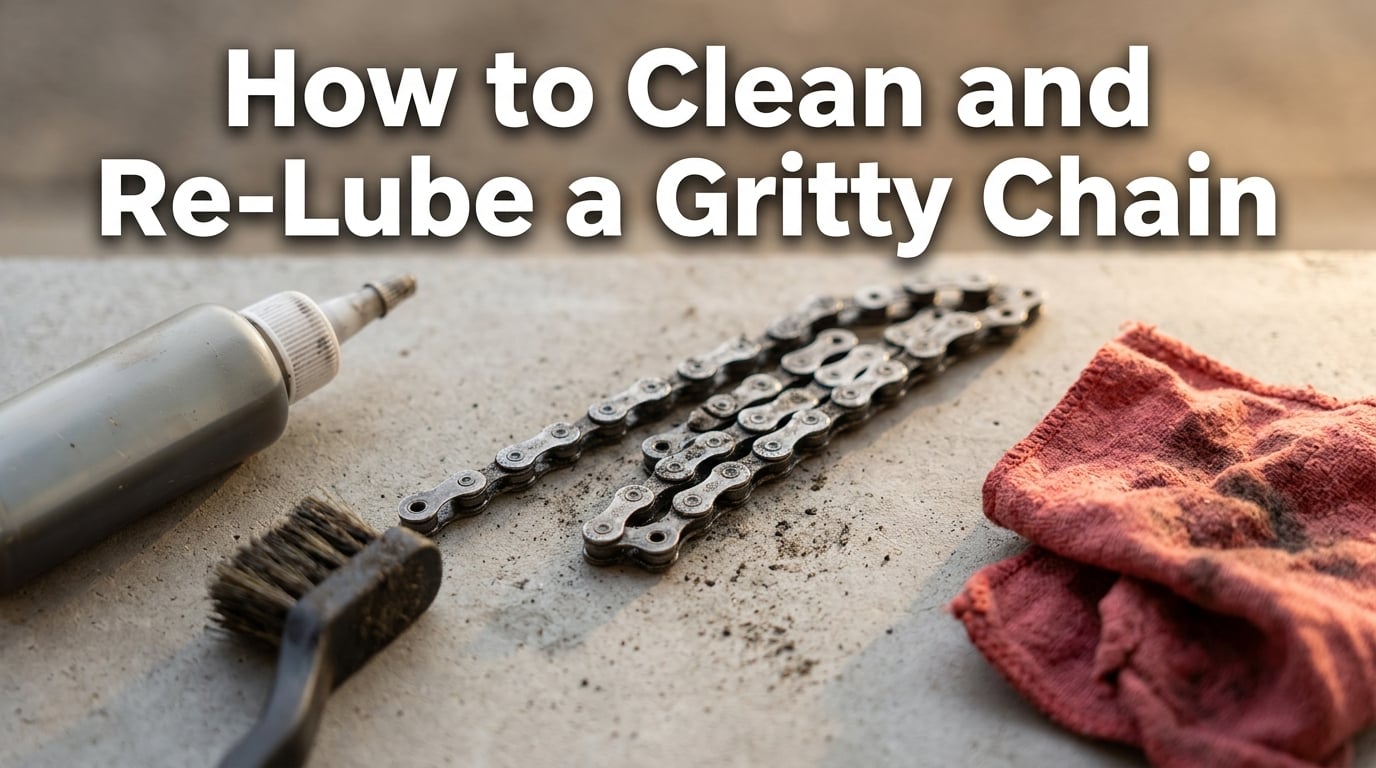
That crunching, sandy sound coming from your drivetrain is not normal, and it is not going to fix itself. If your chain has gotten gritty and loud, the fix is almost always the same: a proper degreasing, a full rinse, dry it completely, and then re-lube it the right way. I have walked dozens of riders through this exact process on our shop floor, and the result is the same every time: a quiet, smooth drivetrain that shifts better and lasts longer.
In this guide, I will show you how to clean and re-lube a chain that has gotten gritty and loud, exactly the way I do it on my own bikes. You will learn what causes the gritty feeling in the first place, which supplies you actually need (and which ones you can skip), and the step-by-step routine I use after every muddy ride. If you want to go beyond the chain and clean the rest of the bike, our guide on proper bike washing techniques that won’t damage your drivetrain pairs well with this one.
Table of Contents
Why Your Bike Chain Gets Gritty and Loud
A gritty chain is almost always a chain that has been lubed over the top of old, dirty lube. Every time fresh oil goes onto a dirty chain, it mixes with the existing grime and turns into a paste that sits between the rollers and pins. That paste is what you feel when the chain sounds like it is full of sand.
I learned this the hard way on my commuter bike. I would hit the chain with a quick lube every few weeks, never fully degrease it, and wonder why it kept getting louder. The grit was not coming from the road; it was coming from the chain’s own internal paste of old lube and dust.
What “gritty” actually means inside the chain
Your chain has hundreds of small moving parts: rollers, pins, bushings, and link plates. Lube is supposed to live in the tiny gaps between these parts. Once dirt gets mixed into that lube, those gaps stop moving freely, and you get friction, wear, and noise.
Why the noise shows up after you lube it
If your chain gets loud right after lubing, the chain was almost certainly not clean enough to begin with. Fresh lube is thinner than the grime underneath, and as it works its way into the chain, it loosens the old paste. That loosened paste is what you are hearing. The good news is that means the lube is doing its job; the bad news is you need to start over with a real cleaning.
What accelerates grime buildup
Wet weather, dusty trails, and indoor trainers all speed up grime. Riding in the rain washes the lube out and leaves a rust-friendly film. Dust sticks to fresh lube like a magnet. And indoor trainer rides, even though they look clean, sweat out lube faster than outdoor riding because there is no airflow to displace moisture.
Signs Your Chain Needs Cleaning and Re-Lubing
You do not need a calendar to tell you when your chain needs service. Your bike will tell you. I look for three things on every ride: how the chain sounds, how it looks, and how it shifts.
Audible signs
A clean, lubed chain is nearly silent under load. If you hear ticking, clicking, or a sandy crunch on every pedal stroke, that is a chain asking for help. Squeaks that change with cadence usually point to a dry link. A constant grinding sound usually means grime in the rollers.
Visual signs
Hold the chain up to a light and look at the rollers and link plates. A clean chain has a silvery or light golden color. A chain that is black, sticky, or gummy is overdue. If the lube on the chain looks like dark toothpaste, it is past time to clean it.
Performance signs
Slow or sloppy shifting under load is a classic sign. So is any hesitation when you stand up to sprint. If the chain feels “sticky” when you backpedal, the lube is doing more harm than good. If you ride a lot of long miles, having chain maintenance essentials for long rides packed in your kit is a smart move.
Tools and Supplies You’ll Need
You do not need a full shop to do this right. Here is what I keep in my cleaning kit, and what each item actually does.
- Bike-specific degreaser — Citrus or bio-based degreaser cuts old lube fast without harming rubber seals. Simple Green, Pedro’s, Finish Line, and Park Tool all make solid options.
- Chain scrubber tool — A small clamp-on device with brushes and a reservoir. Park Tool CM-5 and Pedro’s Chain Pig are the most common.
- Stiff-bristled brush — An old toothbrush works for tight spots. A larger brush handles the cassette and chainrings.
- Clean rags — At least three. One for degreasing, one for drying, one for the final lube wipe.
- Chain lube — Wet, dry, or wax-based. The right type depends on where you ride (more on that below).
- Work stand or hook — Anything that gets the rear wheel off the ground so you can spin the cranks freely.
- Gloves — Degreaser and old lube are not great for your skin.
A quick note: do not use WD-40 as your lube. I will explain why in the mistakes section, but it is worth flagging now because it is the most common product people reach for first.
How to Clean a Gritty Chain: Step-by-Step
This is the exact process I use. It takes me about 20 to 30 minutes from start to finish on a properly grimy chain, and less time when the chain is just lightly dirty.
Step 1: Prep the bike
Shift into the smallest cog on the back so the chain is on the straightest part of the cassette. Set the bike in a work stand or hang it from a hook so the rear wheel can spin freely. Put on your gloves. Lay a rag under the chain to catch drips.
Step 2: Quick wipe-down first
Before any degreaser touches the chain, take a clean rag and pinch the chain while backpedaling. This removes the top layer of surface grime and old lube. It also keeps the degreaser from getting overwhelmed on the first pass. I skip this step when I am in a hurry, and I always regret it.
Step 3: Apply degreaser
Spray or brush degreaser generously onto the chain, the cassette, the chainrings, and the jockey wheels. Let it sit for 2 to 3 minutes so it can break down the old lube. Do not let it dry on the bike; a dry degreaser film is harder to rinse off than a wet one.
Step 4: Scrub the chain
Clamp your chain scrubber tool onto the bottom run of the chain, fill it with degreaser, and slowly backpedal about 30 turns. If you do not have a scrubber tool, use a stiff brush and work the degreaser into the chain by hand, link by link. Pay extra attention to the rollers, not just the outside plates.
For the cassette and chainrings, use a brush to work the degreaser between the cogs. A rag twisted into a point works well in tight spots.
Step 5: Rinse and dry completely
Rinse the chain with clean water or, even better, wipe it down with a rag soaked in water. If you rinse with a hose, use low pressure and avoid spraying directly into bearings. A wet chain is fine for a moment, but you must dry it before lubing. I run a dry rag through the chain while backpedaling until the rag comes away clean.
Tip: If you want to verify the chain is “clean enough,” wipe it with a clean white rag. If the rag comes away gray or black, the chain is still dirty. Repeat the scrub. The chain is ready when the rag stays mostly clean.
How to Re-Lube Your Chain the Right Way
Once the chain is clean and dry, lubing takes about 5 minutes. The biggest mistake I see is people applying lube to the outside of the chain. Lube belongs on the inside, where the rollers meet the pins.
Step 1: Choose the right lube
Pick wet, dry, or wax-based lube based on the conditions you ride in. I will cover the differences in the next section. Whatever you choose, make sure it is labeled as a chain lube, not a general-purpose lubricant.
Step 2: Apply lube to the rollers
Hold the bottle over the chain and apply one small drop per roller as you slowly backpedal. Aim for the inside of the chain, where it meets the cassette, not the outside. One full pass around the chain is enough. More is not better here.
Step 3: Let it sit, then wipe excess
Let the lube soak in for 5 to 10 minutes. This is when the lube works its way into the pins and bushings. Then take a clean, dry rag and pinch the chain while backpedaling. The goal is to remove lube from the outside of the chain while leaving lube inside the rollers. If you skip this step, the outside lube will attract dirt within a few miles, and you will be back where you started.
Step 4: Test the chain
Spin the cranks and listen. The chain should be nearly silent. Shift through all the gears to make sure the lube did not gum anything up. Take a short test ride if you can; the chain should feel smooth and free, with no sticky patches.
Wet Lube vs Dry Lube vs Wax: Which One Fits Your Riding
Lube choice is the part most riders get wrong, and it matters more than people think. The right lube for a desert gravel rider is the wrong lube for a Pacific Northwest commuter. Here is how I think about it.
Wet lube
Wet lube is thick, sticky, and built to stay on the chain through rain and mud. It is the right choice if you ride in wet weather, commute year-round, or do any off-road riding. The downside is that wet lube attracts dust and grime, so it requires more frequent cleaning. If you use wet lube, plan to clean the chain about every 100 miles in dry conditions and after every wet ride.
Dry lube
Dry lube is thin, light, and almost wax-like. It is best for dry, dusty conditions: road riding in summer, gravel on dry days, and any climate where dust is the main enemy. Dry lube does not stand up to water, so it is a poor choice for wet climates. The upside is that it stays clean longer, so you can go 150 to 200 miles between cleanings.
Wax-based lube
Wax-based lubes, including hot wax dips, are the cleanest option. They are popular with racers and riders who obsess over watts. Wax does not attract dirt the way oil-based lubes do, and a properly waxed chain can run 200+ miles without needing attention. The downside is the application process: hot waxing requires melting paraffin wax and dipping the chain, which is more involved than drip-on lubes.
My default recommendation for most riders: dry lube in dry conditions, wet lube anywhere it rains more than once a week, and wax if you are willing to put in the prep work.
How Often Should You Clean and Re-Lube Your Chain
There is no single answer that fits every rider. I follow a loose cadence and adjust based on what I see and hear.
- Normal road riding, dry conditions: Wipe and re-lube every 150 to 200 miles. Full degrease every 400 to 500 miles.
- Wet or muddy riding: Lube after every wet ride, full clean every 100 to 150 miles.
- Mountain biking: Clean and lube after every muddy ride. For dry trail days, every 2 to 3 rides is fine.
- Indoor trainer: Every 2 to 4 weeks, even if the chain “looks” clean. Trainer sweat strips lube faster than most riders realize.
Common Mistakes That Make a Chain Gritty and Loud
I have made every mistake on this list at some point. Here is what to avoid, and why each one leads back to a gritty chain.
Lubing over a dirty chain
This is the number one cause of a gritty chain. Lube does not clean. It seals in whatever is already on the chain. If the chain looks black or feels sticky, lube will only make it worse. Always clean first.
Using WD-40 as a chain lubricant
WD-40 is a water displacement and a light solvent. It is great for cleaning a chain before you re-lube, but it is not a lubricant. Once it evaporates, you are left with no protection, and the chain will wear out faster. I have seen riders ruin chains in a few hundred miles by relying on WD-40 alone.
Over-applying lube
More lube does not mean more protection. Extra lube on the outside of the chain is a dirt magnet. Inside the rollers, you only need a small drop per link. If your chain is dripping lube when you finish, you used too much.
Skipping the wipe-down after lubing
After letting the lube soak in, you have to wipe the outside of the chain. The lube on the outside is wasted, and it will collect road grime on your very next ride. A clean wipe-down makes the lube job last twice as long.
Lubing a wet chain
Lube and water do not mix. Lube will not penetrate properly if the chain is wet, and it can trap moisture against the metal, which leads to rust. Always dry the chain fully before applying lube.
Troubleshooting: Chain Still Gritty or Noisy After Cleaning
Sometimes a chain stays noisy even after a full cleaning and lubing. When that happens, I check three things before assuming the chain itself is the problem.
Check for chain stretch
A chain stretches as it wears, and a stretched chain does not sit properly on the cassette and chainrings. Use a chain wear indicator tool. If the chain is past 0.5% stretch on a standard drivetrain or 0.75% on a 12-speed system, it is time to replace it. A stretched chain will accelerate wear on the cassette and chainrings, which is an expensive fix.
Inspect for tight links
A tight link is a single link that does not flex as freely as the rest. You can usually spot one by backpedaling slowly and watching for a stiff spot. To free a tight link, hold the chain on either side of the stiff link and gently flex it side to side. If that does not work, lightly backpedal against a bit of pedaling force; the click will usually pop the link free.
Look at the jockey wheels and cassette
Jockey wheels (the small pulleys in your rear derailleur) wear out and can develop rough surfaces. A rough jockey wheel will make a smooth chain sound gritty. Cassette cogs wear too, and worn cogs can cause noise even with a fresh chain. If your chain is new and still noisy, check the jockey wheels first; they are cheap and easy to replace.
Frequently Asked Questions
How do you fix a noisy bike chain?
The most common fix for a noisy chain is a full cleaning followed by fresh, properly applied lube. Clean the chain with degreaser, rinse, dry it completely, then apply one drop of chain lube per roller. Wipe off the excess lube from the outside of the chain after letting it sit for 5 to 10 minutes. If the chain is still noisy after that, check for a stretched chain, tight link, or worn jockey wheels.
Can you use WD-40 to lubricate a chain?
WD-40 is a water-displacing solvent, not a long-term chain lubricant. It can help clean a chain by dissolving old lube and grime, but once it evaporates, the chain has no real protection. Using WD-40 as a daily lube will cause faster chain wear, more noise, and rust in wet conditions. Use a dedicated bike chain lube instead.
Can I use vaseline to lube a bike chain?
Vaseline (petroleum jelly) is too thick for a bike chain. It will attract dirt, gum up quickly, and make shifting sluggish. It can also damage some rubber seals in suspension components if it migrates. Use a proper chain lube designed for bicycles; it is engineered to penetrate the rollers and stay there under load.
What is the best thing to clean a bike chain with?
A bike-specific degreaser is the best option for cleaning a chain. Citrus-based and bio-degreasers work well and are gentler on rubber and paint. For a homemade option, dish soap (like Dawn) mixed with warm water can handle light grime, but it will not cut heavy buildup the way a dedicated degreaser does. Avoid harsh solvents like paint thinner, which can damage chain coatings and seals.
Can I use Dawn dish soap to degrease a bike chain?
Yes, Dawn dish soap works for light to moderate grime. It is gentler than a dedicated degreaser and is safe for most chain finishes. For heavy, built-up grime, a bike-specific degreaser will work faster. Either way, rinse the chain with clean water afterward and dry it completely before applying lube.
How can I make my bike chain smooth again?
To make a bike chain smooth, follow these steps: 1) Degrease the chain with a bike-specific degreaser and a chain scrubber tool. 2) Rinse and dry the chain completely. 3) Apply one small drop of chain lube per roller on the inside of the chain while backpedaling. 4) Let the lube sit for 5 to 10 minutes. 5) Wipe off all excess lube from the outside of the chain. A properly cleaned and lubed chain should be nearly silent under load.
The Bottom Line
Knowing how to clean and re-lube a chain that has gotten gritty and loud is one of the highest-ROI skills a cyclist can learn. It costs about 30 minutes and a few dollars in supplies, and it gives you a quieter ride, sharper shifts, and a drivetrain that lasts thousands of miles longer.
Start by giving your chain a full degrease this weekend. Pick the lube that fits your local conditions, stick to the cadence that matches your riding, and your chain will not get gritty and loud on you again.