
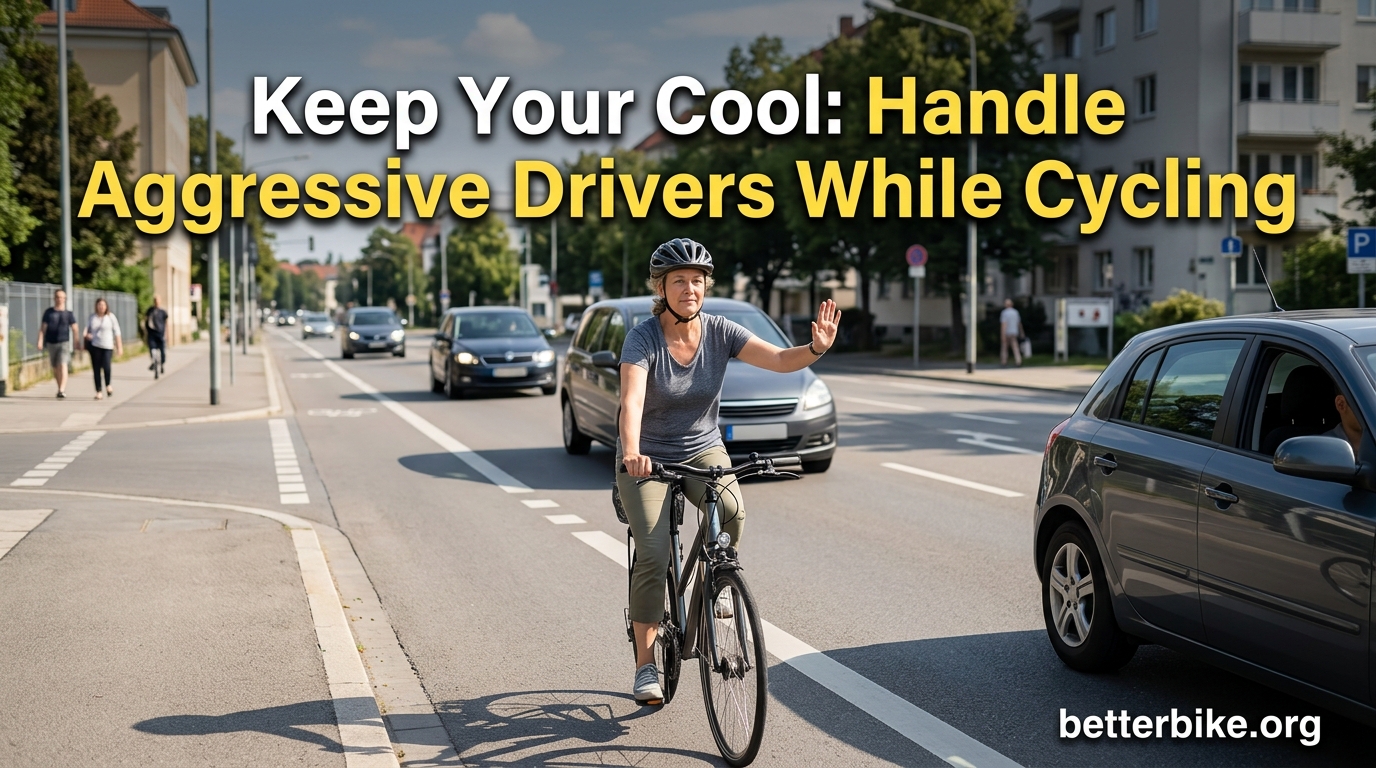
Every cyclist knows the feeling. You are riding lawfully in the road, and suddenly a driver screams at you, honks aggressively, or passes so close you can feel the side mirror brush your elbow. Your heart rate spikes. Adrenaline floods your system. The instinct to shout back or chase the car is almost overwhelming.
Learning how to keep your cool when a driver is aggressive toward cyclists is not just about manners. It is about survival. As cyclists, we have zero protection between our bodies and a two-ton vehicle. Responding with anger can escalate a tense moment into a dangerous confrontation in seconds.
In this guide, I will walk through practical, field-tested strategies for staying calm during driver confrontations. We will cover what to do in the moment, how to handle persistent harassers, what your legal rights are, and how to process the emotional aftermath so repeated incidents do not wear you down.
Table of Contents
Why Cyclists Face Driver Aggression
Driver aggression toward cyclists is not random. It stems from a mix of road psychology, territorial thinking, and genuine misunderstandings about traffic law. When you understand why drivers get angry, it becomes easier to stay detached instead of taking their behavior personally.
Many drivers see cyclists as obstacles slowing them down rather than legitimate road users with equal rights. Others feel a false sense of ownership over “their” lane and react with hostility when a bicycle occupies space they believe belongs to cars. Some simply do not know that cyclists have the legal right to take the full lane when conditions require it.
Common Types of Aggressive Behavior Cyclists Encounter
Aggressive driver behavior toward cyclists falls into several recognizable categories. Knowing them helps you assess severity quickly and respond appropriately:
- Buzzing or close passes: The driver deliberately passes within inches of your handlebars, sometimes at high speed. This is one of the most terrifying and dangerous forms of cyclist harassment.
- Horn harassment: The driver lays on the horn from behind or beside you, often to intimidate rather than warn. A sudden blast at close range can startle you into swerving.
- Verbal abuse: Shouting, cursing, or threats through an open window. Some drivers throw objects like drinks or trash.
- Rolling coal: The driver intentionally accelerates to produce a thick cloud of exhaust directly at the cyclist. This is a deliberate intimidation tactic.
- Brake checking: After passing, the driver cuts in front and slams the brakes, forcing you to take evasive action or stop suddenly.
- Following and stalking: The driver slows to match your speed, following you along your route. This is the most threatening behavior and may require police involvement.
Road Rage vs. Normal Driver Frustration
Not every honk is road rage. Normal driver frustration might involve a brief tap of the horn or a visible expression of annoyance through the windshield. The driver still maintains a safe distance and moves on quickly.
Road rage is different. It involves intentional, targeted aggression designed to intimidate or punish. A driver experiencing road rage may make multiple passes, shout continuously, or use their vehicle as a weapon. Recognizing this distinction helps you calibrate your response. Frustration usually fades on its own. Rage requires active de-escalation or disengagement on your part.
Why Cyclists Are Especially Vulnerable
Cyclists are what traffic safety experts call vulnerable road users. We have no steel frame, no airbags, and no crumple zone. A collision that would be a minor fender-bender between two cars can cause serious injury or death when one party is on a bicycle.
This physical vulnerability is compounded by a power imbalance. A driver can escalate and drive away. A cyclist cannot outrun a car, cannot match its weight, and has little protection if the situation turns physically violent. This is why de-escalation is not weakness. It is the smartest survival strategy available to us.
How to Keep Your Cool When a Driver Is Aggressive Toward Cyclists
The best response to an aggressive driver is to breathe deeply, avoid eye contact and gestures, create distance, and disengage as quickly as possible. If safe, note the license plate and report the incident later. Never retaliate.
That one-sentence answer captures the core approach. But execution matters. Here is a step-by-step breakdown of exactly what to do in the first seconds and minutes after a driver turns aggressive.
Step 1: Breathe Before You React
The moment aggression happens, your body enters fight-flight-freeze mode. Adrenaline floods your bloodstream. Your hands tighten on the bars. Your jaw clenches. This is a normal physiological response, but it is exactly the wrong state for making safety decisions.
Take one slow, deep breath before doing anything else. That single breath interrupts the adrenaline spiral and gives your prefrontal cortex a chance to stay online. It takes roughly four seconds, and it is the most important thing you can do.
Step 2: Do Not Make Eye Contact or Return Gestures
Eye contact is a dominance signal. In a confrontation with an already aggressive person, locking eyes can be read as a challenge. Looking away does not mean you are submitting. It means you are choosing not to engage.
The same goes for gestures of any kind. A wave that you think says “calm down” might be read as dismissive or mocking. A returned middle finger can turn a shouting match into a physical chase. Keep both hands on the bars and your eyes on the road ahead.
Step 3: Create Distance Immediately
Your priority is to put space between yourself and the aggressive driver. If the driver is behind you, move to the right and let them pass. If they are beside you, slow down or speed up to break proximity. If they have stopped ahead and are getting out of the car, do not stop. Ride around them and keep moving.
Consider turning onto a side street, bike path, or alley. A driver in a rage is unlikely to follow you into a space where their vehicle cannot go. Even a quick detour of one or two blocks is usually enough to end the encounter.
Step 4: Do Not Retaliate
This deserves its own emphasis because it is where most cyclists make their biggest mistake. Retaliation feels justified in the moment. The driver wronged you, and you want them to know it.
But retaliation backfires for several reasons. First, it escalates. An already angry driver may respond with their vehicle. Second, it shifts the narrative. If the incident is reported or filmed, the footage showing you shouting or kicking a car undermines your position. Third, you do not know who is in that vehicle or what they are capable of. In the United States, road rage incidents have escalated to shootings. No point is worth your life.
Step 5: Note Details for Reporting
If you can do so safely, memorize or mentally note the license plate number, vehicle make, model, color, and the direction of travel. Note the time and location. Do not reach for your phone while riding. Wait until you have stopped in a safe place to write anything down or file a report.
Techniques to Stay Calm in the Moment
Staying composed under aggression is a skill you can practice and improve. These techniques come from cyclists who have logged thousands of miles in heavy traffic, as well as de-escalation principles used by conflict resolution professionals.
Box Breathing on the Bike
Box breathing is a technique used by military personnel and first responders to manage adrenaline. Here is how it works on a bicycle:
- Inhale through your nose for a count of four.
- Hold your breath for a count of four.
- Exhale slowly through your mouth for a count of four.
- Hold empty for a count of four.
- Repeat three to five times.
The counting gives your mind a task to focus on instead of replaying the aggressive encounter. The controlled breathing lowers your heart rate and signals to your nervous system that the threat has passed. You can do this while riding at a steady pace.
The Counting Method
Some cyclists use a simpler variation: count slowly to five after the aggression occurs before allowing yourself to think about it at all. This tiny delay prevents the impulsive reaction that causes most escalations. By the time you reach five, your rational mind has re-engaged.
Mental Reframing Strategies
How you frame the incident internally shapes your emotional response. If you tell yourself “that driver tried to kill me,” your body stays in threat mode for hours. If you reframe it as “that driver made a dangerous mistake,” you can process it and move on.
Most aggressive drivers are not thinking about you as a person. They are reacting to their own bad day, their own frustration, or their own sense of entitlement on the road. Their behavior reflects their emotional state, not your worth as a cyclist or a human being.
One reframe that many experienced cyclists use: “I am not responsible for their reaction. I am only responsible for my response.” This mental boundary helps you let go of anger that would otherwise fester after the ride.
Physical Grounding on the Bike
When adrenaline hits, you tend to grip the handlebars too tightly, tense your shoulders, and hold your breath. This makes your riding worse at exactly the wrong moment. Tense riding is jerky riding, and jerky riding is dangerous riding.
Do a quick body scan: relax your shoulders, loosen your grip slightly, unlock your elbows, and soften your jaw. These physical adjustments feed back to your brain that the danger is manageable. Your riding stays smooth and predictable, which also makes you safer around other traffic.
Handling a Driver Who Won’t Back Off
Most aggressive encounters last seconds. The driver passes, yells, or honks, and then they are gone. But occasionally a driver will not let it go. They may slow to your speed, follow you through turns, or stop and get out of their vehicle. This is the scenario every cyclist fears most.
Here is what to do if a driver becomes persistent.
Call 911 Immediately
If a driver is following you, blocking your path, or has exited their vehicle, call 911. Do not wait to see if the situation resolves itself. Tell the dispatcher your exact location, the direction you are traveling, a description of the vehicle, and what the driver is doing.
Keep riding toward a public, well-lit area while you are on the phone. Gas stations, shopping centers, and police stations are all good destinations. Aggressive individuals are far less likely to continue their behavior in a public space with witnesses.
Find Safe Escape Routes
Cyclists have one major advantage in a pursuit scenario: we can go where cars cannot. Bike paths, pedestrian bridges, narrow alleyways, parks, and stairs are all escape routes a vehicle cannot follow. If you ride a regular route frequently, identify these escape options in advance so you do not have to think under pressure.
Ride through a red light if you must to escape a threatening driver. Getting to safety matters more than traffic compliance in a genuine emergency. If you are later questioned, the context of being threatened justifies the action.
Use Your Bike as a Barrier
If a driver confronts you on foot and you cannot ride away, keep your bicycle between yourself and them. This gives you a physical object to block with or push away if they lunge. It also keeps distance between you and the aggressor, which is your best protection.
If you carry a phone, keep it visible and clearly state that you are recording. Many aggressors back down immediately when they realize they are being filmed. You do not actually need to be recording for this to work, but having a phone visible changes the dynamic.
What to Say If You Must Communicate
Sometimes you cannot avoid speaking to the driver. They may block your path and demand a conversation. If you must respond, keep it brief, calm, and de-escalating. Effective phrases include:
- “I am just trying to get home safely, same as you.”
- “I do not want any trouble. Have a good day.”
- “I am calling the police.”
Do not argue about who was right. Do not explain traffic law. Do not apologize in a way that admits fault for something you did not do. Your goal is to end the interaction, not win a debate.
Documenting and Reporting Aggressive Drivers
Reporting aggressive drivers serves two purposes. It creates a record that can support legal action if needed, and it contributes to a pattern of documentation that can lead to consequences for repeat offenders. Many cyclists skip this step because it feels pointless, but consistent reporting does make a difference.
Bike Cameras and Dash Cams
A growing number of cyclists now ride with cameras, and for good reason. Video evidence is the single most powerful tool for holding aggressive drivers accountable. A front-facing camera on the handlebars captures the vehicle approaching and any close pass. A rear-facing camera on the seat post captures the license plate and the driver’s actions behind you.
If you ride regularly in traffic, consider investing in both. The footage can be submitted to police, shared with local cycling advocacy groups, or used in legal proceedings. Even without a formal complaint, the existence of footage discourages drivers from lying about what happened.
What Details to Capture
Whether you have a camera or not, capture as many details as possible immediately after the incident. Write them down or record a voice memo on your phone while they are fresh:
- License plate number and state
- Vehicle make, model, and color
- Time and exact location of the incident
- Description of the driver if visible
- What specifically the driver did
- Names and contact information for any witnesses
Filing a Police Report
Call the non-emergency police number for your area to file a report for non-violent incidents like close passes or verbal harassment. Call 911 for threats of violence, stalking, or physical assault.
Many police departments now offer online reporting forms for traffic incidents. These are often faster and less intimidating than a phone call. Provide your written account, any photos or video, and witness information. Request a report or case number so you can follow up.
Be aware that some officers may not take cyclist complaints seriously. Be polite but persistent. Reference specific traffic laws if you know them. If the first officer dismisses your report, ask to speak with a supervisor or file through a different channel.
Your Legal Rights as a Cyclist
Knowing your legal rights gives you confidence on the road and helps you make informed decisions about reporting and legal action. Laws vary by state and country, but several common protections apply widely.
Three-Foot Passing Laws
Most U.S. states have enacted some form of minimum passing distance law for vehicles overtaking cyclists. The most common standard is three feet, though some states require four feet or specify a “safe distance.” These laws give cyclists a legal basis for reporting close passes, and video evidence makes enforcement much more likely.
Check the specific law in your state. Knowing the exact statute number strengthens your police report and helps you respond confidently if questioned.
Bike Lane Protections
In many jurisdictions, vehicles are prohibited from driving or parking in designated bike lanes. Drivers who block bike lanes to pass traffic, make deliveries, or park force cyclists into dangerous merging situations. Report these violations to local traffic enforcement.
Harassment Laws That Apply to Cyclists
Some states have specific cyclist harassment laws that make it a criminal offense to intentionally threaten, intimidate, or throw objects at a cyclist. These laws carry penalties beyond standard traffic violations. Even in states without cyclist-specific statutes, general harassment and assault laws apply when a driver physically threatens or harms a cyclist.
If you experience threats of violence, stalking, or physical contact, you may have grounds for both criminal charges and a civil lawsuit. Consult with a bicycle injury attorney who understands cycling-specific cases.
Processing the Emotional Aftermath
What no competitor talks about enough is what happens after the ride. The adrenaline fades, but the anger, fear, and sense of violation can linger for days. Repeated exposure to aggressive drivers can lead to cycling anxiety, avoidance behavior, and even symptoms resembling post-traumatic stress.
Acknowledge what you feel. Being shaken after a close call or a confrontation is a normal human response, not weakness. Talk about the incident with other cyclists who understand the experience. Cycling communities, both local groups and online forums, provide validation and shared strategies that individual reflection cannot match.
If you find yourself increasingly anxious about riding, consider whether route changes might help. Lower-stress routes, bike paths separated from traffic, and riding at less congested times can reduce exposure without giving up cycling entirely. There is no shame in adjusting your approach to protect your mental health.
Over the long term, some cyclists find purpose in advocacy. Getting involved with local cycling organizations, attending city council meetings about bike infrastructure, and supporting legislation that protects vulnerable road users can transform anger and helplessness into constructive action. Channeling negative experiences into making roads safer for everyone is one of the most empowering things you can do.
FAQ’s
What is the 75 rule in cycling?
The 75 rule in cycling refers to a heart-rate training guideline stating that approximately 75% of your training time should be spent at or below 75% of your maximum heart rate. This builds a strong aerobic base without overtaxing your body. While it is primarily a fitness concept, maintaining a controlled heart rate also supports emotional regulation on the road, since riders with strong aerobic fitness recover from adrenaline spikes more quickly.
What are common causes of road rage between cyclists and drivers?
Common causes include perceived delay (drivers feeling cyclists slow them down), territorial attitudes about lane ownership, misunderstanding of cyclist legal rights, general stress transferred from other areas of life, and visibility conflicts where drivers fail to see cyclists until the last moment. Some aggression also stems from negative media portrayals of cyclists as rule-breakers, which creates a pre-existing bias that explodes in traffic encounters.
What is the best response to an aggressive driver?
The best response is to breathe deeply, avoid eye contact and any gestures, create physical distance by changing speed or route, and disengage as quickly as possible. Do not shout, gesture, or attempt to argue. If the driver persists or threatens you, call 911, ride toward a public area, and use your bike as a physical barrier if confronted on foot. Note the license plate and file a police report after you are safe.
What is cyclist syndrome?
Cyclist syndrome, more formally known as pudendal neuralgia, is a condition involving nerve pain in the pelvic region caused by prolonged pressure from bicycle saddles. While it is unrelated to aggressive driver encounters, chronic riding stress and tension from traffic confrontations can worsen physical discomfort. If you experience persistent numbness or pain in the saddle area, consult a medical professional and consider adjusting your bike fit or saddle choice.
Is it illegal to harass a cyclist?
Yes, in many jurisdictions it is illegal to harass a cyclist. Several U.S. states have passed specific cyclist harassment laws that make intentional intimidation, threats, or throwing objects at cyclists a criminal offense. Even in states without cyclist-specific statutes, general harassment, assault, and reckless driving laws apply. Buzzing a cyclist deliberately can be charged as reckless endangerment, and road rage incidents that escalate to physical threats can result in assault charges.
Conclusion
Every cyclist who rides in traffic will face driver aggression at some point. The question is not whether it will happen, but how you will respond when it does. Learning how to keep your cool when a driver is aggressive toward cyclists comes down to a few core principles: breathe before reacting, never retaliate, create distance, document when possible, and report consistently.
Your safety always comes first. No point about right-of-way is worth escalating a confrontation with someone protected by a two-ton vehicle. Ride predictably, know your legal rights, invest in a camera, and connect with your local cycling community for support and advocacy. The more of us who ride calmly and report consistently, the safer our roads become for everyone on two wheels.