
If your disc brakes rub only when you pedal but stay silent while coasting, the rotor is being pushed into the pads every time you apply power to the cranks. This load-dependent rub is one of the most common disc brake complaints we see on our shop floor, and it is almost always fixable without replacing parts.
Most riders first notice the noise during hard efforts or while climbing out of the saddle. The disc-brake rotors on modern road and mountain bikes sit within fractions of a millimeter of the pads, so even tiny deflections under pedaling force will create an audible scrape. We will walk you through exactly why this happens, how to tell which part of the bike is causing it, and the step-by-step fixes that actually work.
This guide covers disc brake maintenance tips for both hydraulic and mechanical systems, on a new bike or one you have ridden for years.
Table of Contents
Why Disc Brakes Rub Only When You Pedal (and Not When You Coast)
Disc brake rub during pedaling is caused by something moving the rotor toward one or both pads every time you push on the pedals. When you stop pedaling, the force disappears and the rub stops. Three mechanical issues cause this pattern more than any others.
1. Frame flex under load. When you stand and push hard, the rear triangle of your frame twists slightly, and the rear wheel shifts in the dropouts or thru-axle. On bikes with tight rotor-to-pad clearance (often under 0.5 mm per side), this tiny shift is enough for the rotor to kiss one pad. Carbon frames, small frames, and bikes with long chainstays flex the most.
2. Loose hub or wheel bearings. If the hub bearings have play, the rotor wobbles slightly as you apply power. The rub will sound rhythmic and may change with pedaling cadence. Coasting removes the lateral load, so the rotor recenters and the noise vanishes.
3. Caliper misalignment. A caliper that is centered on a workbench can shift slightly under real-world riding forces. The most common reason we see this is uneven thru-axle torque or a slightly loose caliper bolt. When the thru-axle is not torqued to spec, the entire hub and rotor can sit a hair off-center in the frame.
Less common causes include a slightly bent rotor, contaminated pads, a new pad break-in period, and weak frame alignment at the dropouts. We will cover how to tell these apart in the diagnosis section below.
Why It Happens on the Road but Not on a Stand
One of the most confusing parts of this problem is that the brakes can feel perfect on a repair stand and rub badly on the road. I have had customers swear the rotors were warped until I watched them sprint in the parking lot and heard the rub return.
The reason is simple: a bike on a stand has no rider, no drivetrain load, and no pedaling force. On the stand, the only thing holding the wheel in place is the axle clamp or thru-axle. The frame is unloaded, so it cannot flex, and the wheel cannot shift.
When you ride, three forces appear at once:
- Rider weight compresses the suspension and frame.
- Pedaling torque tries to twist the rear triangle sideways.
- Chain pull pulls the rear wheel forward in the dropouts.
All three of these can move the rotor relative to the pads by a fraction of a millimeter, which is exactly the clearance you have on most modern disc brakes. This is why the rub appears under load and disappears on the stand.
How to Diagnose the Exact Cause of Pedal-Only Brake Rub
Before grabbing any tools, spend two minutes identifying which of the three causes above applies to your bike. This step saves you from throwing parts at the problem.
Step 1: Listen to the Rub Pattern
Spin the wheel and listen. Does the rub happen at the same spot every rotation? That points to a bent rotor. Does it appear and disappear with each pedal stroke? That points to frame flex or loose bearings. Is the rub constant during pedaling but completely silent while freewheeling? That points to caliper misalignment under load.
Step 2: Check the Wheel for Play
With the bike on the ground, grab the front or rear wheel at the top and try to rock it side to side. If you feel a click or any movement, the hub bearings have play. Repeat with the wheel off the ground and the quick release or thru-axle loose. If the wheel moves but the bearings feel tight, your axle is the issue.
Step 3: Re-Torque the Thru-Axle
Most modern bikes use thru-axles tightened to a specific torque, usually between 5 and 15 Nm depending on the brand. If your axle is even slightly under-torqued, the hub can shift under pedaling force. Use a torque wrench every time you remove and reinstall the wheel.
Step 4: Inspect the Caliper Bolts
Grab the caliper body and try to wiggle it. It should be solid. A loose caliper bolt will let the entire caliper shift when you apply power to the pedals. This is one of the easiest fixes and is worth checking first.
Step 5: Look at the Rotor
Spin the wheel slowly and watch the rotor pass through the caliper gap. Look for a wobble. A bent rotor often shows up as a visible side-to-side movement. If the rotor looks straight but the pads look uneven, you may have uneven pad wear from a previous misalignment.
How to Fix Disc Brakes That Rub Only When You Pedal
Once you have identified the cause, the fix is usually straightforward. Here is the order I recommend trying, based on how often each one solves the problem.
Fix 1: Re-Torque the Thru-Axle or Quick Release
Remove the wheel, clean the dropouts or axle interface with a rag, and reinstall the wheel. If you have a thru-axle, torque it to the manufacturer spec with a torque wrench. If you have a quick release, close the lever firmly and check that the closed lever leaves a slight imprint in your palm – that is the right tightness.
This single fix solves about 40 percent of pedal-only rub cases in our experience.
Fix 2: Re-Center the Brake Caliper
- Loosen the two caliper mounting bolts just enough that the caliper can slide.
- Squeeze the brake lever firmly and hold it.
- While holding the lever, tighten the caliper bolts to spec.
- Release the lever and spin the wheel.
This recenters the caliper over the rotor using the pads themselves as a reference. For mechanical disc brakes, you may need to back off the pad adjustment screw first to make sure the pads are not pre-loaded against the rotor.
Fix 3: True a Bent Rotor
If the rub happens at the same spot every rotation, the rotor is bent. Mount the wheel in the frame and spin it slowly. Watch for the spot where the rotor comes closest to the pad. Use a rotor truing fork or a clean adjustable wrench to gently bend that spot back into alignment. Make small adjustments – 0.5 mm of bend correction at a time is plenty.
For rotors with more than a 1 mm wobble, replacement is usually faster and safer than truing.
Fix 4: Service or Replace Hub Bearings
If your hub has play, the fix depends on the bearing type. Cup-and-cone bearings can be adjusted by tightening the cone slightly until the play disappears. Sealed cartridge bearings usually need replacement if they have play. Take the wheel to a shop if you are not comfortable pressing bearings out and back in.
Fix 5: Address Frame Flex (For Performance Setups)
If your frame is unusually flexible or your brake clearance is very tight, consider going up one rotor size if your frame and fork allow it (for example, 140 mm to 160 mm). Larger rotors have more lateral stiffness and clear pad rub more easily. Some riders also add a chainstay protector or replace soft frame hardware to reduce frame movement.
Tools You Need for These Fixes
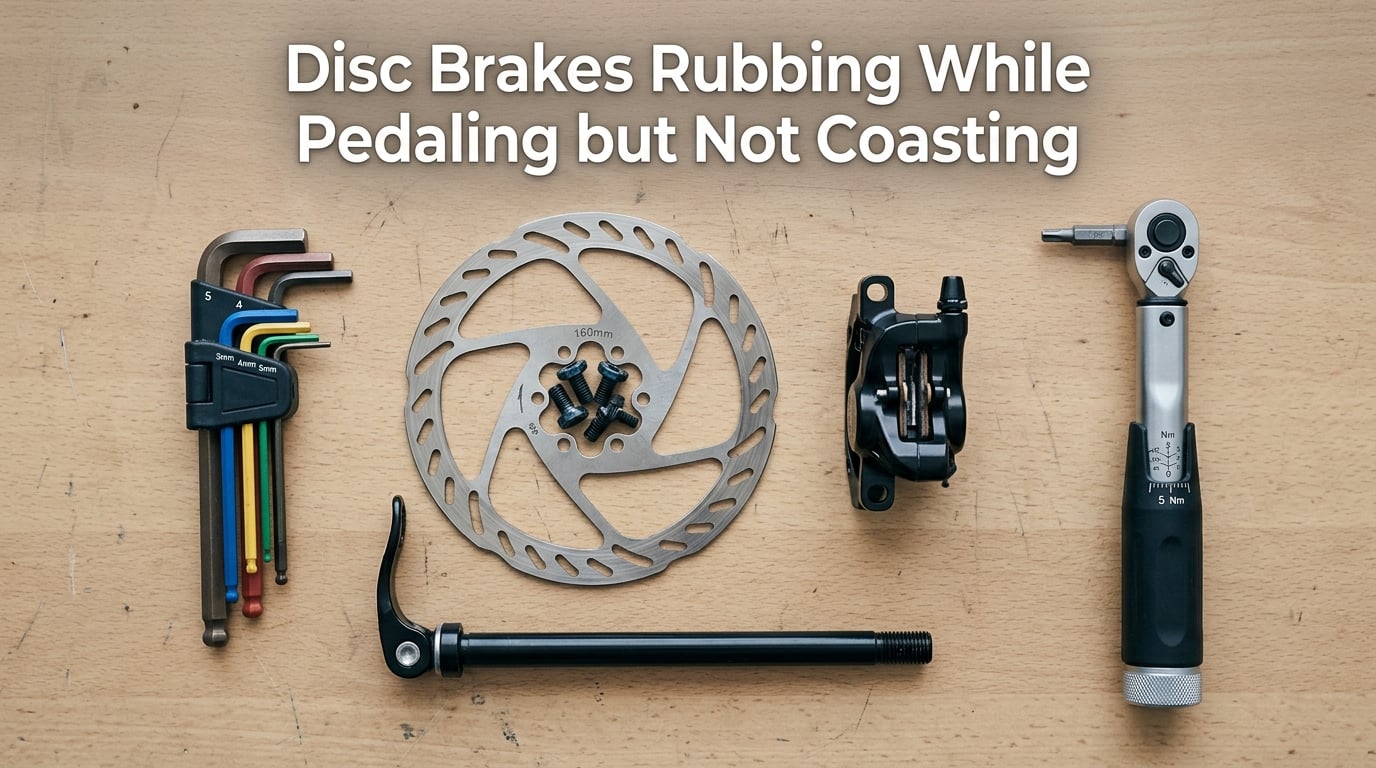
Most pedal-only rub cases can be resolved with a small set of tools. We recommend keeping these in your essential tools for brake adjustments kit.
- Torque wrench (with appropriate Nm range for your thru-axle and caliper bolts)
- 4 mm and 5 mm Allen keys
- Rotor truing fork (or a clean adjustable wrench)
- Isopropyl alcohol and a lint-free rag for cleaning rotors
- Pad spacer or clean business card for centering calipers
Hydraulic vs Mechanical Disc Brakes: Does It Matter?
Yes, slightly. Hydraulic systems self-adjust pad position as pads wear, which keeps the rotor centered automatically. Mechanical systems depend on a cable-actuated arm that can pull the caliper slightly off-center. If you have mechanical disc brakes and your rub only appears under load, pay extra attention to cable tension and the caliper arm return spring.
Hydraulic riders should still complete the caliper centering steps above, because piston position can shift if the lever was pumped without a rotor in place.
When to Seek Professional Help
Some symptoms mean it is time to visit a shop rather than continue at home. Stop and get help if you notice any of the following.
- The rotor has more than 1 mm of lateral wobble
- The pads are contaminated with oil, chain lube, or hydraulic fluid
- The hub bearings feel gritty when you spin the wheel
- The caliper mount on the frame or fork is loose or cracked
- The brake lever feels spongy after you finish the adjustments
These issues can compromise braking performance and rider safety. A certified mechanic will have the right tools to press bearings, bleed hydraulic lines, and confirm frame alignment.
FAQ
Why are my disc brakes rubbing?
Disc brakes rub because the rotor comes into contact with one or both pads. The most common causes are a caliper that is not centered over the rotor, a slightly bent rotor, loose hub bearings, or frame flex that only appears under pedaling force.
How to tell if a caliper is misaligned?
Spin the wheel and look down the seat tube or from behind the caliper. If the rotor passes closer to one pad than the other, the caliper is off-center. You can confirm by squeezing the brake lever – if the rub gets worse, the caliper is the issue.
What is the 30 30 30 rule for brakes?
The 30 30 30 rule refers to the bed-in process for new pads and rotors: 30 stops from 30 km/h with 30 seconds of cooling between stops. This heats the pad material and transfers a thin, even layer onto the rotor surface, which improves braking power and reduces noise.
How much disc brake rub is acceptable?
A small amount of rub that comes and goes with temperature, humidity, or wheel flex is normal and not a safety issue. Constant, loud rubbing that does not stop after centering the caliper and truing the rotor means something is wrong and should be fixed before riding.
How to adjust disc brakes on a bike so they don’t rub?
Loosen the caliper bolts, squeeze and hold the brake lever, retighten the bolts to spec, then spin the wheel to check. If rub remains, true the rotor with a truing fork. If rub still appears only when pedaling, check the thru-axle torque and hub bearings.
Final Thoughts
Disc brakes that rub only when you pedal but stay quiet during coasting come down to one simple truth: something is moving the rotor into the pads every time you apply power. In most cases the culprit is a thru-axle that needs re-torquing, a caliper that needs re-centering, or a frame that flexes more than the rotor clearance allows.
Start with the cheapest fix (re-torque the axle), work through the diagnosis in order, and do not ignore hub play if you find it. Once you have addressed the load-dependent rub, your brakes should stay silent on the road, on climbs, and on the stand.
If you found this guide helpful, the same principles apply to most disc brake maintenance tips we share for gravel and mixed-surface riding.