
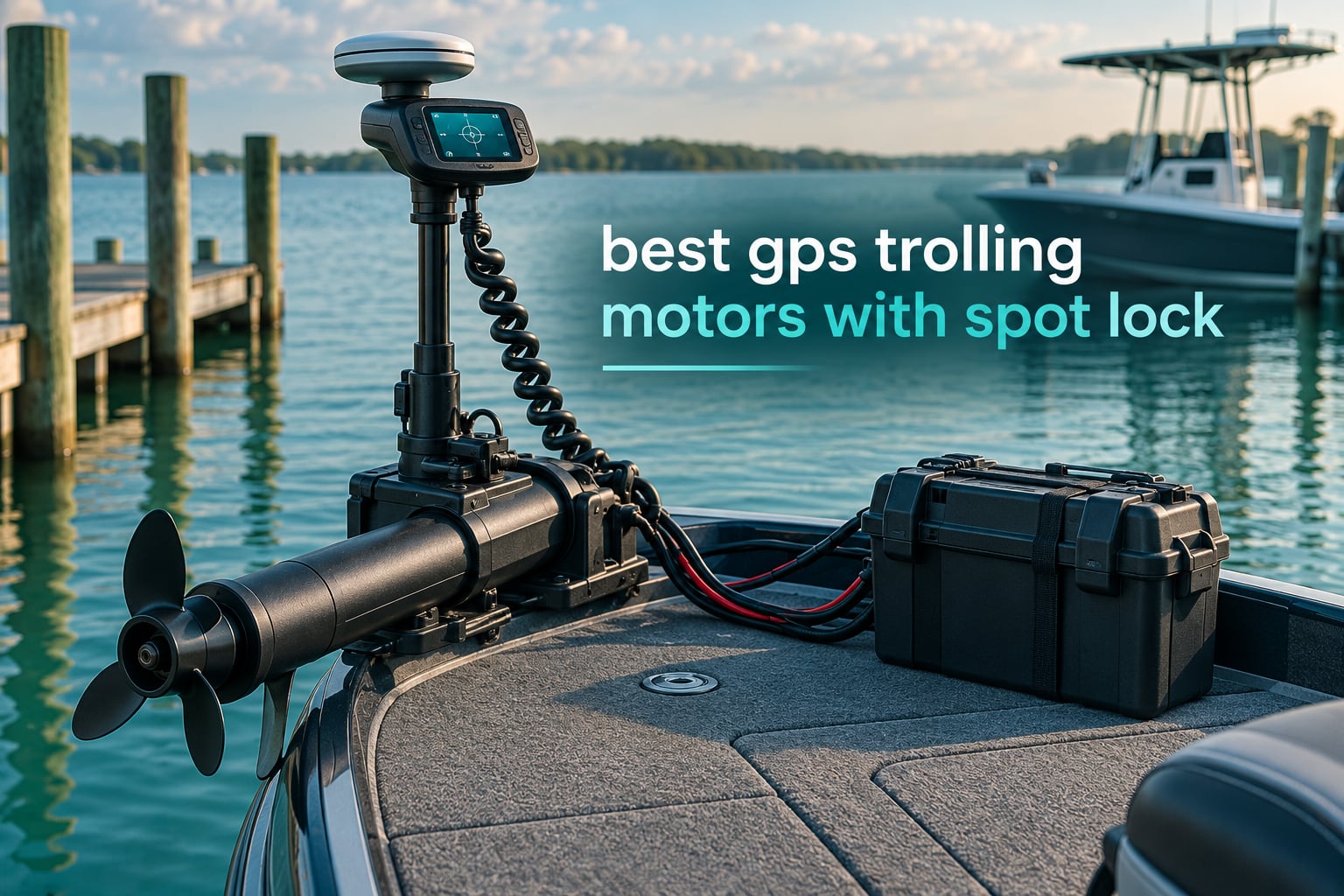
We spend a lot of time on this site talking about how to keep a bike still. The same question comes up on the water: how do you keep a boat exactly where you want it while you fish? That is the entire promise of a GPS trolling motor with Spot Lock, and picking the right one for your boat is harder than it looks because the feature is spread unevenly across the market.
Before we get into the picks, a quick disclosure. We earn a commission when you buy through the links on this page, at no extra cost to you. That does not change the order of the list, and it does not buy a better spot in the table.
This roundup covers the best GPS trolling motors with spot lock we could verify for 2026 across seven bow-mount models from Minn Kota, Garmin, Lowrance, Simrad and Haswing. We looked at thrust, voltage, shaft length, GPS hardware, owner review volume, the electronics each motor talks to, and the hardware that is not in the box. We did not fish a full season on every motor, and we say so plainly in each section where the evidence is thin rather than dressing up a spec sheet as a test result.
If your boat is small, start with our guide to trolling motors for small boats first, because most of the motors here are overkill for a 12-foot jon. And if your real question is whether a feature you already own can be upgraded later, the short answer in our buying guide is no, which surprises people.
Table of Contents
Top 3 GPS Trolling Motors With Spot Lock for October 2026

Minn Kota PowerDrive 55
- Spot-Lock with drift
- follow and dodge modes
- Deploy-Assist lever
- 12V 54 in shaft

Minn Kota Terrova 55
- Built-in Dual Spectrum CHIRP sonar
- Spot-Lock with Jog
- Corded foot pedal included

Minn Kota Riptide Terrova 80
- Marine corrosion protection
- Spot-Lock with Jog
- 24V 80 lb thrust
Those three are the safest buys in the category for most people, and the reasons differ. The PowerDrive has the deepest owner-review base of any motor here. The Terrova is the one to buy if you want sonar built into the shaft instead of a separate transducer. The Riptide Terrova is the saltwater option, and the only one rated for it in this group at a thrust level that will move a loaded skiff.
Quick Overview: Best Spot Lock Trolling Motors in October 2026
| Product | Specifications | Action |
|---|---|---|
| Minn Kota PowerDrive 55 |
|
Check Latest Price |
 Haswing Cayman GPS 55 Haswing Cayman GPS 55 |
|
Check Latest Price |
| Minn Kota Terrova 55 |
|
Check Latest Price |
| Minn Kota Riptide Terrova 80 |
|
Check Latest Price |
 Garmin Force 57 Garmin Force 57 |
|
Check Latest Price |
 Simrad RECON Saltwater 54 Simrad RECON Saltwater 54 |
|
Check Latest Price |
 Lowrance Ghost X 47 Lowrance Ghost X 47 |
|
Check Latest Price |
Every motor above is a bow mount, and that is not a coincidence. Spot Lock needs a heading sensor that knows which way the bow points, and the bow mount is where that hardware has room to live. Transom motors with GPS are increasingly common, but they anchor differently and they are not what most people mean when they search for a spot lock trolling motor.
1. Minn Kota PowerDrive 55 – Best Overall Spot Lock Trolling Motor
Minn Kota PowerDrive Bow-Mount Electric Trolling Motor with GPS – 55 Lb. Thrust, 54 In. Shaft, Freshwater
55 lb thrust
12V
54 in shaft
Freshwater bow mount
Pros
- Spot-Lock holds through wind and tide
- 142 owner reviews give the deepest evidence base
- Digital Maximizer stretches a single 12V battery
- Deploy-Assist lever for one-push deployment
Cons
- No foot pedal control on this model
- Some owners report intermittent GPS head failures
- Needs a 50A circuit breaker near the battery
The PowerDrive 55 is the motor I would put on a boat first, because it is the one where the owner evidence is deepest. At 142 ratings it carries a far larger review base than anything else in this roundup, and that matters for a feature like Spot Lock where the difference between a good GPS head and a bad one only shows up after a season of holding station in wind.
Owners describe the anchor behaviour in remarkably consistent terms: the boat stays put through wind and tide rather than creeping off the waypoint. The 55 lb of thrust on a 12V system is also the sweet spot for a mid-size aluminum boat, and the Deploy-Assist lever means you can get it in and out of the water without wrestling the head over the gunwale.
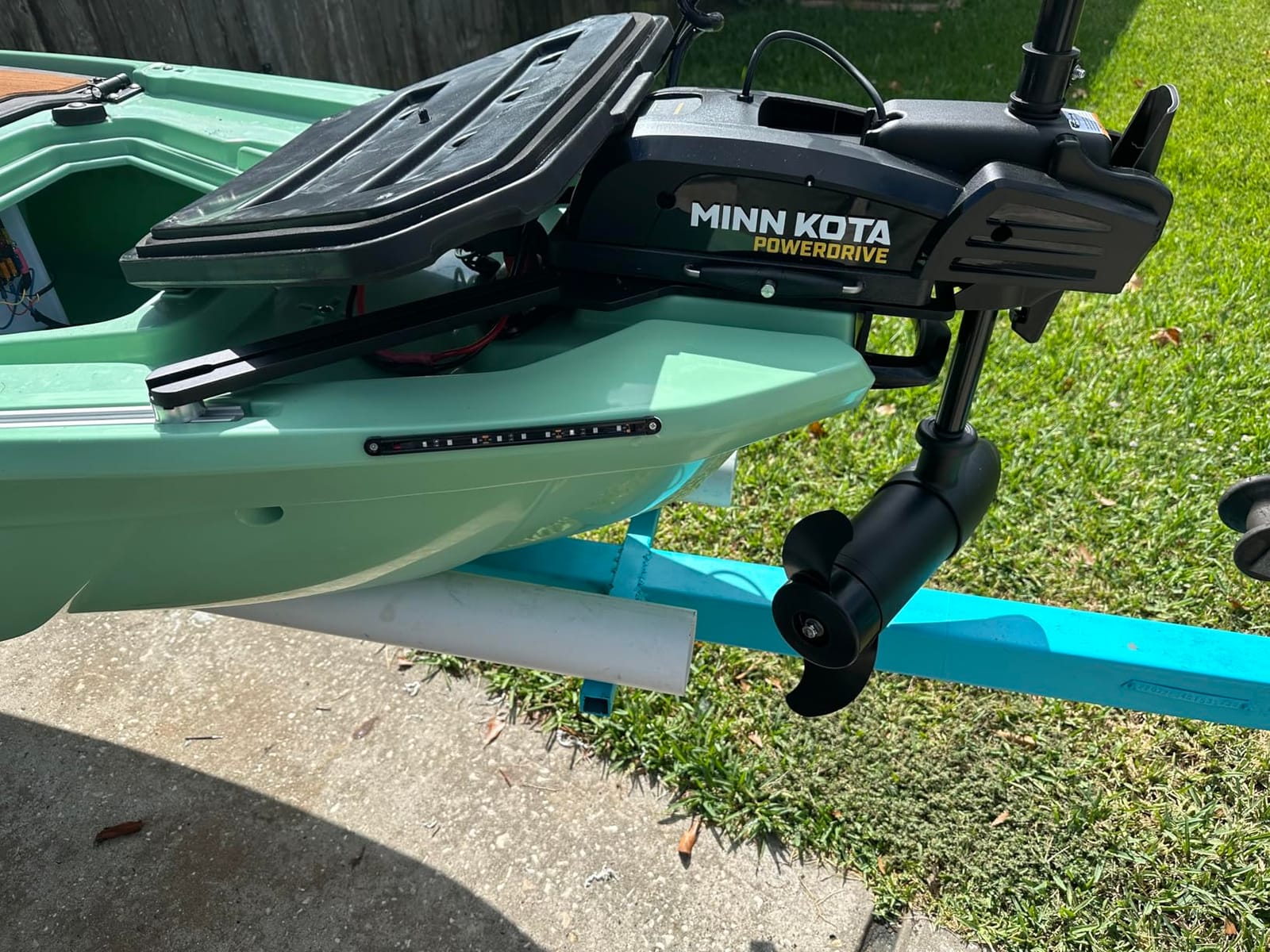
Battery behaviour is the other thing owners consistently highlight. Several report using roughly a quarter of a single 12V battery on a four to five hour trip at typical trolling speeds, which lines up with what Digital Maximizer is designed to do. That figure is what reviewers describe on their own boats, so treat it as a ballpark rather than a spec.
The honest weakness is the GPS head. A minority of owners report intermittent head failures that needed a replacement unit, and there is no foot pedal on this model, so control is handheld remote or tiller only. If you fish solo in a strong crosswind and want hands-free steering, that pedal gap matters more than the price difference between this and the Terrova.
What the 55 lb thrust number actually covers
Fifty-five pounds of thrust is a mid-range figure, and it suits boats in roughly the 16 to 20 foot range on one battery. It will move a heavier boat in calm water, but the honest test of a GPS anchor motor is not top speed, it is whether it has enough thrust left to correct position after a gust hits the beam.
The other thing worth checking is your bow height. Measure from the top of the bow deck to the waterline, then add 16 to 20 inches. On a boat with a tall deck that puts you in 54 inch territory, which is the shaft length this motor comes in.
Who should skip this motor
Skip it if you already run a Garmin or Lowrance display and want the motor on the same network. Minn Kota motors do not join a Garmin or Lowrance NMEA network for control, so you would be running two separate control systems on one boat.
Skip it if you fish saltwater. This is a freshwater build, and the shaft and lower unit are not coated for salt. The Riptide Terrova covers that use case, and it is the version to look at if your boat leaves the ramp.
2. Haswing Cayman GPS 55 – Stainless Shaft Bow Mount
PARKHO HASWING Boat Electric Trolling Motor – 12V 54″ 55lbs Cayman GPS Anchor Control Shaft Bow Mount Portable Fishing Boat Saltwater Freshwater with Wireless Remote Control
55 lb thrust
12V
54 in shaft
Stainless steel shaft
Pros
- Stainless steel shaft resists corrosion
- Quiet variable-speed running
- App and handheld remote give redundancy
- Automatic return if the boat drifts past 6 ft
Cons
- Only two owner reviews on this listing
- Warranty excludes saltwater corrosion damage
- Auto-return threshold of 6 ft is loose for tight structure
The Haswing Cayman GPS 55 is the interesting outsider in this group, and the reason is the shaft. Where most of the motors here use a composite shaft, this one is stainless steel, which is the material you want if you ever move the boat between freshwater and brackish water or deal with a shallow rocky launch.
The control approach is different too. You get a Helmsman companion app with a live map, saved spots and route recording on iOS and Android, plus a wireless handheld remote that works if your phone dies. Redundant control paths are genuinely useful when you are alone on a boat in fog.
Anchor Control locks the boat onto a marked position, and if it ends up more than six feet away the motor drives back to the spot on its own. That threshold is worth thinking about. Six feet is fine for covering a general area, but if you are working a specific brush pile edge, you would rather hold inside that.
Where the app approach earns its keep
Route recording and saved spots are the features owners would miss most going back to a tiller-and-remote setup. For a person fishing a set of waypoints repeatedly, being able to replay a route is closer to a trolling pattern than to a memory aid, and the variable speed control makes the difference between a smooth pass and a start-and-stop one.
There is also a safety buckle on the charging cable that acts as an emergency stop, which is the kind of detail that shows the design was thought about for smaller boats rather than lifted from a marine catalogue.
Who should skip this motor
Skip it if you want proven long-term reliability, because two reviews is not a reliability record. The listing is rated perfectly, but a perfect rating across two owners tells you almost nothing about what happens in year three, and this is exactly the motor category where the electronics decide how long the boat lasts.
Also read the warranty before you commit. The terms on this listing exclude corrosion damage from saltwater and exclude commercial or tournament use, so treat it as a freshwater motor even though the listing mentions salt water in its recommended uses. Kayak anglers who want a smaller package can look at our kayak trolling motor picks in the meantime.
3. Minn Kota Terrova 55 – Built-In CHIRP Sonar
Minn Kota Terrova Bow-Mount Electric Trolling Motor with GPS, Spot-Lock, Dual Spectrum CHIRP Sonar – 55 Lb. Thrust, 54 In. Shaft, Freshwater
55 lb thrust
12V
54 in shaft
CHIRP sonar in shaft
Pros
- Spot-Lock holds in wind
- current and whitecaps
- Built-in Dual Spectrum CHIRP sonar
- Jog shifts the locked point 5 ft
- Corded foot pedal included in the box
Cons
- Check third-party sonar compatibility before wiring
- Second battery
- box and breaker sold separately
- 63 lb motor is heavy to lift solo
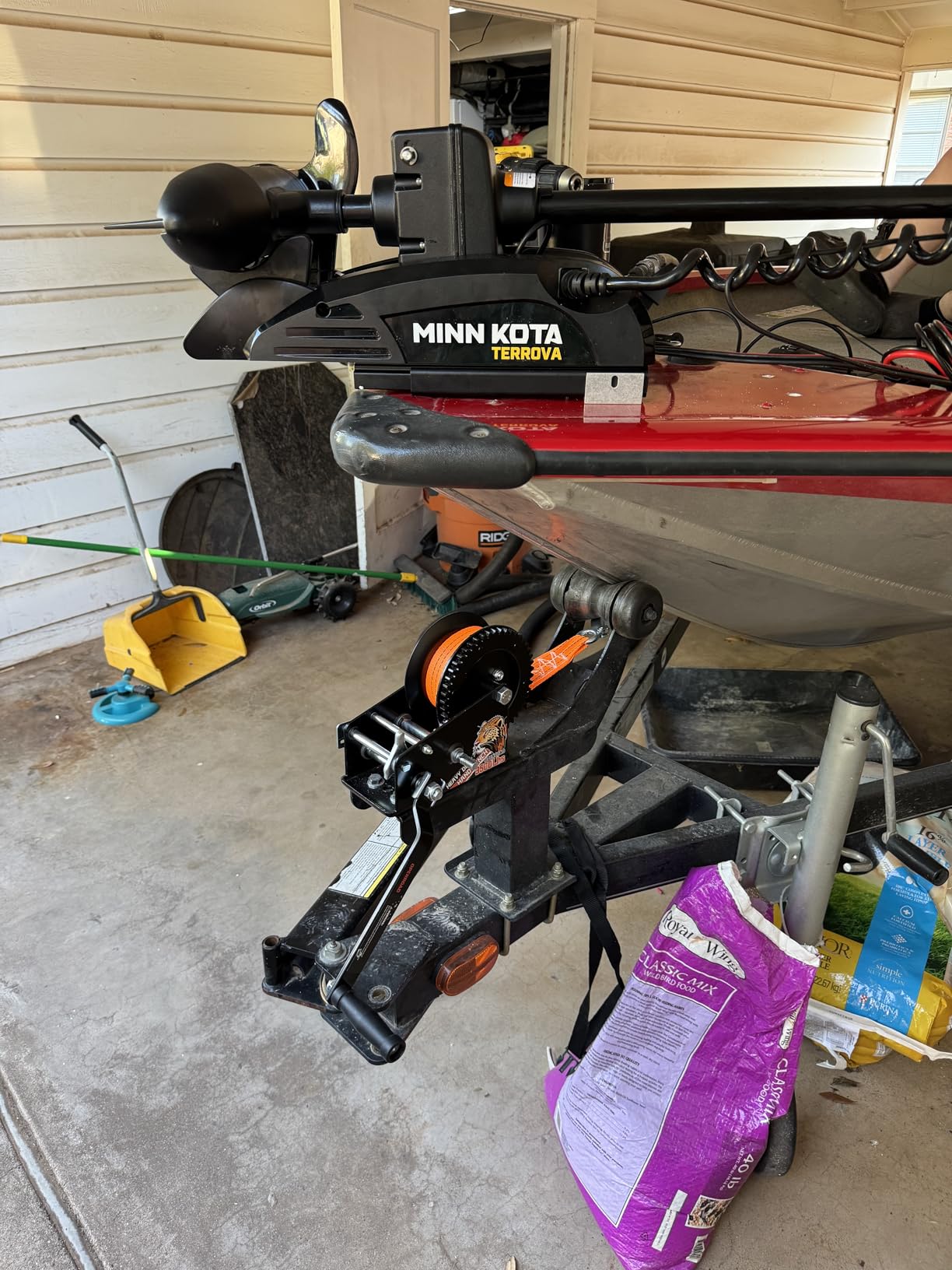
The Terrova 55 is the feature-complete freshwater package in this roundup, and the thing that separates it from the PowerDrive is the Dual Spectrum CHIRP transducer built into the shaft. Owners single out the sonar as noticeably clearer than what came on earlier trolling motors, with better bottom separation and crisper arches.
Everything else you would want is in the box: a wireless remote, a heading sensor, a lanyard, the MKP-32 prop, and a corded electric foot pedal with an 18 foot cable. That foot pedal has heel and toe dual steering plus dedicated Spot-Lock and AutoPilot buttons, which is the hands-free control the PowerDrive leaves out.
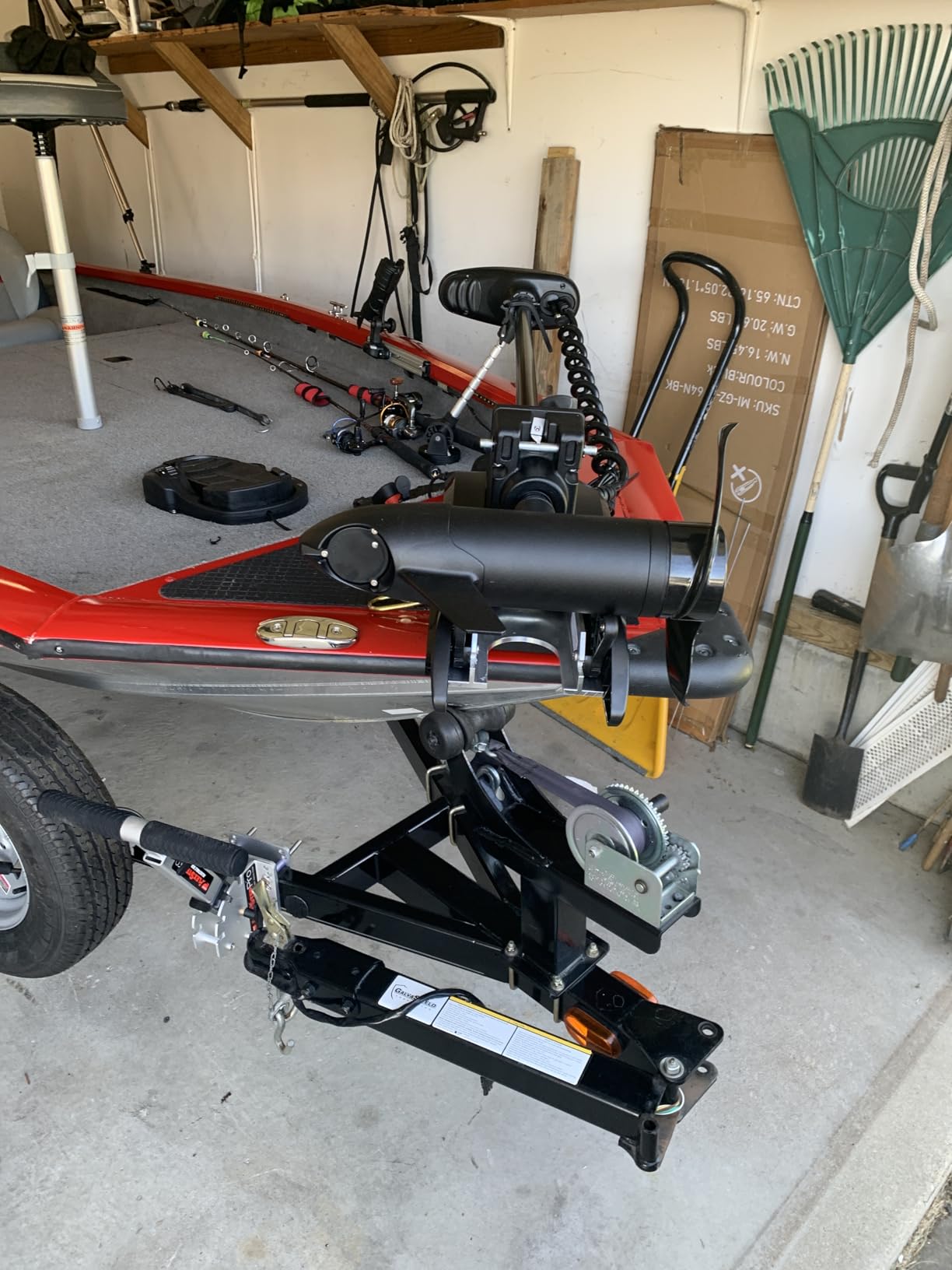
Spot-Lock on this motor comes with Jog, which moves the locked position five feet in any direction. On a brush pile or a ledge that is the feature that matters most, because you can walk the boat around the structure in five-foot steps instead of re-anchoring from scratch each time. Drift mode, follow mode and dodge mode are all present as well.
The Weedless Wedge 2 swept-back flared propeller is designed to move through vegetation without chopping it, and Digital Maximizer handles the power management. At 63 pounds the whole motor is a genuine lift, so plan the install with a second person or a lifting aid.
Why built-in sonar changes the install
A transducer in the shaft means the sonar data travels through the motor’s cable to your display, which means the wiring run is the install. The upside is one cable and no separate transducer to mount, and the downside is that you need to confirm your display is compatible before you cut anything, because not every third-party unit will pair with a shaft transducer.
Reviewers raise this compatibility check more than any other practical point on this motor. Verify the unit by serial number before installation rather than after, and remember that the battery, battery box and circuit breaker are all separate purchases. Our marine battery guide covers the bank sizing for a 12V setup like this one.
Who should skip this motor
Skip it if you already have a good sonar unit mounted and working. The built-in CHIRP is a strong reason to buy this motor instead of a bare anchor motor, but it is a poor reason to replace gear that already does the job well.
Skip it if you are chasing a saltwater application, and be realistic about weight if you are moving the motor between boats regularly. At 63 pounds plus a 54 inch shaft, this is a permanent installation rather than a portable one.
4. Minn Kota Riptide Terrova 80 – Saltwater Anchor Motor
Minn Kota Riptide Terrova Bow-Mount Electric Trolling Motor with GPS, Spot-Lock – 80 Lb. Thrust, 60 In. Shaft, Saltwater
80 lb thrust
24V
60 in shaft
Saltwater rated
Pros
- Marine-grade coated aluminum lower unit
- 80 lb thrust on a 24V bank
- One-touch fall-away deploy and stow lever
- LCD remote with programmable One-Boat Network buttons
- Good economy at low trolling speeds
Cons
- Requires a 24V battery bank to run
- One owner reported a drivetrain power failure
- 10 percent of reviews are 1-star
If your boat touches salt water, this is the only motor in the group built for it. The lower unit is grit-blasted and coated aluminum with a powder coat finish, and at 80 pounds of thrust on 24 volts it has the muscle to hold position on a Carolina Skiff class boat where current and wind are both working against you.
The anchor behaviour is what owners talk about most, and several describe it as a replacement for a fixed anchor rather than a supplement to one. One owner trolls all day at two knots on two 100Ah batteries, which is the efficiency figure that matters for anyone who spends a full day on the flats.
Deployment is a one-touch fall-away ramp lever, and the handheld remote has an LCD screen, a non-slip grip, and four programmable One-Boat Network buttons you can assign to whatever functions you use most. Spot-Lock with Jog, drift mode, follow mode and dodge mode are all included, so nothing about the control set is stripped back for the saltwater build.
What 24V changes about the rest of the boat
Running on 24V means a 24V battery bank rather than a single marine battery, and that is the single biggest reason people skip this motor. It is a larger electrical project, and the charger, breaker and cable sizes all change with it. Budget for the bank separately, because it is not in the box and it is often the more expensive half of the install.
The 60 inch shaft suits the taller bow decks typical of skiffs and bay boats. If your deck is low, the same motor is available in 54 inch shafts at 55 pounds of thrust, which is worth checking against your bow height before you commit to the 80.
Who should skip this motor
Skip it if your boat never leaves freshwater, because you would be paying for corrosion protection you will not use. The Terrova in the previous section is the right freshwater equivalent, and the difference in price between them is essentially the cost of the marine build.
One owner reported the propeller stopped turning and the unit went dead after several working outings, and about a tenth of the reviews here are 1-star, the highest negative share among the Minn Kota models in this roundup. One report is not a pattern, but it is worth registering your warranty and keeping your purchase documentation somewhere you will find it.
5. Garmin Force 57 – Wireless Pedal and Garmin Network
Garmin Force Trolling Motor 57″, 57in, 010-02025-00
24V or 36V
57 in shaft
Stainless steel bow mount
Pros
- Wireless foot pedal clears the front deck
- Gas-shock assisted deployment and stow
- Networks with Garmin sonar and LiveScope
- Stainless steel shaft and corrosion-resistant mount
Cons
- 109 lb weight means a two-person install
- One owner measured about 20 ft of drift
- Power cable length called too short
The Garmin Force is the right choice for one specific situation: you already run Garmin electronics. Integrated sonar and GPS anchoring over the Garmin network means the motor, your chartplotter and a forward-looking unit like LiveScope all live on the same system instead of running as separate boxes.
The wireless foot pedal is the feature Garmin pushes hardest, and it does exactly what it says: no cable across the deck, and the front of the boat stays clear for casting. The 57 inch stainless steel shaft deploys and stows on gas-shock assistance, which makes a 109 pound motor far more manageable than the weight suggests.
Support is the other thing reviewers mention without prompting. One owner had a defective shaft and a dead unit both replaced overnight at no cost, which is the kind of service experience that shapes how people talk about a brand in forums.
Where the Spot Lock accuracy story gets complicated
Here is the part that deserves attention before you buy. One Garmin Force owner reported roughly 20 feet of drift off a marked spot after repeated recalibration attempts. That is the single most serious negative report in this roundup, and while one owner is not a verdict on the platform, it is worth factoring in if precise anchor hold on a specific structure is the whole reason you want a GPS motor.
Against that, the motor shares the same GPS architecture and heading sensor approach as the rest of the modern category, so the more useful response is to test it on your own water before committing to a dock-side install. Clamping the motor to your boat first costs nothing and tells you more than any spec sheet.
Who should skip this motor
Skip it if your electronics are Humminbird, Lowrance or Simrad, because the ecosystem integration is the main argument for this motor and it disappears the moment you are on a different network. The same logic runs in reverse for the Simrad and Lowrance picks later in this list.
Skip it if you fish alone and like the idea of full hands-free helm control from a handheld device, since the pedal is wireless here but the motor is not steered from a joystick. Also plan the install around the 109 pound weight, and check the power cable length against your battery box position before you order.
6. Simrad RECON Saltwater 54 – Joystick Helm Control
Simrad RECON Saltwater 54” Trolling Motor with FreeSteer Joystick Remote, 000-16157-001
Saltwater rated
54, 60, 72 in shafts
Brushless motor
Pros
- FreeSteer joystick with color display
- Precision GPS anchoring rated at 3 ft
- Near-silent brushless motor
- Carbon fiber shaft with prop shaft anode
- Three shaft lengths available
Cons
- Only one owner review on this listing
- No published run time or battery figures
- Point-of-sale listing gives no endurance data
The Simrad RECON is the only motor in this roundup you steer with a joystick, and the FreeSteer remote with its color display and customizable buttons gives you full 360-degree helm control from anywhere on the boat. If you have ever fished a trolling motor with one hand on a tiller and a rod in the other, that is a meaningful change in how a day feels.
The anchoring spec is the strongest published number in the group at three feet of accuracy, and the drivetrain is a near-silent brushless motor on a carbon fiber shaft rated for harsh saltwater, with a prop shaft anode included. Shaft lengths run 54, 60 and 72 inches, which covers everything from a small skiff to a tall-deck offshore boat.
Simrad and Navico network integration means the motor can be controlled from a compatible display rather than only from the remote, and the box includes a Freesteer joystick, an N2K T-Joiner, a two-blade prop and the prop shaft anode.
What the single-review listing means for you
This listing carries one customer review, so owner-reported reliability data is effectively absent. Everything positive above comes from the published specifications, not from a body of owners telling us how it performed over a season, and we would rather say that plainly than dress up a spec sheet.
The practical approach is to treat the joystick and the three-foot anchoring claim as reasons to test it rather than reasons to buy it blind. Ask a Simrad dealer to demo the remote, and check that a Simrad display is part of your plan, because the network integration is where much of the value sits.
Who should skip this motor
Skip it if you are buying purely on owner feedback, because there is almost none, and skip it if you are on a tight budget for a freshwater boat, because this is a saltwater build and the 54 inch shaft is the smallest option.
Skip it if a handheld remote is enough for you. The joystick is a genuine advantage on a center console where you move around a lot, but on a jon boat it is hardware you will not use. At 65 pounds it is also lighter than the Garmin but heavier than the Minn Kota options, so plan the lift accordingly.
7. Lowrance Ghost X 47 – Sonar in the Box
Lowrance Ghost X Freshwater Trolling Motor 47-inch Shaft, Bow Mount, with Active Imaging Nosecone and Configurable Foot Pedal, 000-16475-001
Brushless
47 in shaft
Freshwater bow mount
Pros
- Active Imaging 3-in-1 nosecone included
- Silent brushless operation
- Configurable foot pedal with Power-Pole shortcut
- Anchor on a waypoint or any map point
- Lifetime shaft warranty
Cons
- Only two owner reviews on this listing
- 83.8 lb weight is a heavy lift
- 47 in shaft suits smaller boats
The Lowrance Ghost X pairs a brushless motor with a bundled Active Imaging 3-in-1 nosecone, which means you get CHIRP, SideScan and DownScan out of the box without buying a separate transducer. The brushless motor delivers 20 percent more thrust than the original Ghost and runs quietly enough to approach structure without spooking fish.
Anchor mode holds position on a waypoint, your current location, or any point you pick on a map, which is more flexible than marking only the spot you are standing on. The configurable foot pedal has a quick-access shortcut for a Power-Pole shallow-water anchor, a small touch that tells you the design team thought about anglers who run both.
An optional compact GPS remote with a cruise control button and an LED status ring is available separately. The box also carries a Compass-1, a mini 9-pin to 9-pin sonar adapter cable and an N2K T-Joiner for network connections.
How the bundled sonar compares
Compared with the Terrova, both approaches put sonar in the shaft, so the difference is what the transducer does rather than where it sits. The Active Imaging 3-in-1 package here covers CHIRP plus SideScan plus DownScan from one nosecone, which is the wider imaging set of the two.
The catch is shaft length. At 47 inches this is the shortest shaft in the roundup, which suits smaller boats with a low bow deck and limits you in choppy water where a longer shaft keeps the nosecone clear of the surface. The warranty is the strongest in the group as well, with a three-year motor warranty and a lifetime shaft warranty.
Who should skip this motor
Skip it if you want a large saltwater-capable boat covered, because this is a freshwater model on the shortest shaft here. For coastal water the Riptide Terrova or the Simrad RECON are the builds to compare.
Skip it if you are buying on owner reviews, because two reviews across the whole listing tells you very little. The pairing does work well for someone already inside the Lowrance and Simrad network, and one owner describes it as a clear upgrade on quietness, but this is a platform where the electronics reputation outruns the owner data.
How to Choose a Spot Lock Trolling Motor?
What Spot Lock actually does, and what it does not
Spot Lock is a GPS receiver and a heading sensor working together in the motor head. The GPS knows where the boat is, the heading sensor knows which way the bow points, and the control board fires small motor corrections to keep both fixed on the mark you set.
What it does not do is drift for you or hold a heading without a position. Cruise control on a non-GPS motor holds a speed and a straight line, which is a completely different feature. Several cheap motors advertise GPS and mean that you get speed control with a button, and that is why the naming in this category is worth reading carefully before you buy.
Jog is the companion feature and it matters more than most buyers expect. It shifts the locked position five feet in any direction, which turns a single anchor point into a short grid you can work across a brush pile or a ledge.
How much thrust you need for Spot Lock
The common starting rule is two pounds of thrust per one hundred pounds of loaded boat weight, and it is a decent floor rather than a target. For anchor work specifically, buy one tier above that number, because the thrust you spend holding position in wind is thrust you are not using to move.
A 16 foot jon boat loaded with two people and gear lands in the 2,000 to 2,500 pound range, which puts you at 55 pounds of thrust as a minimum and 70 to 80 as a more comfortable number if you fish in wind. The crappie and skip-and-shoot-dock anglers asking about this in forums generally end up wanting the longer shaft more than the extra thrust.
Voltage comes next, and it is a bigger commitment than most people expect. A 12V motor runs off one marine battery, a 24V motor needs a bank, and a 36V motor needs more of them. Every step up cuts current draw and extends runtime, but it also means a bigger electrical project.
For shaft length, measure the height of your bow deck at the mounting point to the waterline, then add 16 to 20 inches. A too-short shaft loses anchor accuracy in chop because the GPS head gets closer to the water, and a too-long shaft makes deployment awkward and adds weight forward.
Bow mount versus transom mount
Bow mounts win on Spot Lock for a mechanical reason. The heading sensor needs a stable reference and the motor head needs to be above the water, and the bow is the only place on most boats that gives you both comfortably.
Transom mounts are cheaper, lighter and easier to move between boats, which is why they make sense for small craft. Their GPS anchoring is improving, but if holding one exact spot is your goal, a bow mount is the honest answer.
Which electronics ecosystem you are buying into
This is the decision that forum threads keep coming back to, and it is more consequential than brand prestige. The motors here split cleanly: Minn Kota models pair naturally with Humminbird, the Garmin Force integrates with Garmin displays, the Simrad RECON integrates with Simrad and Navico, and the Lowrance Ghost X fits Lowrance and Simrad setups.
Buyers routinely worry about buying the wrong motor and being forced to change fish finders later. That worry is mostly unfounded, because the motor anchors and steers on its own system regardless of what display you run, but you do lose the convenience of controlling the motor from the screen and of shared sonar wiring.
The one real lock-in case is built-in sonar. If a third-party unit is not compatible with the shaft transducer, you have more invested in that brand’s network than you planned for. Verify compatibility before the install, not after.
Freshwater, saltwater, and the version you should buy
Salt-rated builds differ in the lower unit coating, the shaft material, the electronics sealing and the propeller, and the premium is real. The honest rule is simple: if your boat spends time in salt water, buy the saltwater version of the platform rather than a freshwater one and hope.
Within Minn Kota’s lineup that choice is between the Terrova and the Riptide Terrova, and within the broader category it is between the freshwater Lowrance Ghost X and the saltwater Simrad RECON. The Garmin Force listing describes itself for fresh water use, so a saltwater buyer should treat it cautiously.
One warning worth reading twice: the Haswing Cayman listing mentions salt water in its recommended uses while its warranty explicitly excludes corrosion damage from salt. That contradiction is exactly the kind of detail that only shows up in the fine print.
Auto stow and deploy, and why it is not automatic here
Only the Ulterra genuinely deploys and stows by itself, and it is not in this roundup because it was not among the models we could verify as a complete unit. Everyone else here deploys with a lever, a gas shock or a foot pedal, which for most anglers is not a problem at all.
What auto deploy would buy you is hands-free stowage in shallow water when you are alone, and it costs weight and adds moving parts. That is a real tradeoff, and a manual Deploy-Assist lever on a lighter motor is a reasonable substitute for a lot of anglers.
Batteries, wiring and what the motor does not include
No motor in this roundup comes with a battery, and most do not come with a battery box or a circuit breaker either. A single 12V setup needs one deep-cycle marine battery, a proper box with ventilation, and a breaker near the battery, which is why reviewers on the PowerDrive specifically mention needing a 50A breaker on an aluminum boat.
AGM and lithium both work, and lithium gives you noticeably more usable capacity for the same physical size, at a higher upfront cost. Our battery guide for trolling motors covers the sizing math for 12V and 24V banks.
For a 24V motor like the Riptide Terrova, the bank is the expensive part of the project. Add the charger, the cable gauge, the breaker and the install labour to the motor and you will find that the electrical side can rival the motor itself, which is the cost creep that is almost never mentioned in roundups like this one.
Known failure modes nobody puts in the marketing
GPS head failures on a minority of PowerDrive units, requiring a replacement head.
Auto deploy mechanisms and their extra moving parts, on any platform that offers them.
Remote latching and foot pedal cord trip hazards, reported across brands rather than specific to one.
GPS confusion in open water with no fixed reference, raised repeatedly by owners in forums.
Anchor hold degradation in heavy crosswind, which is a thrust and calibration problem more than a GPS one.
Warranty service voided by buying through an unauthorized seller, which is a purchasing problem, not a product one.
The last item is worth dwelling on. Registering the motor promptly and buying through a channel that will honour the manufacturer warranty is worth more to most owners than a small difference between two models.
Can you add Spot Lock to an existing trolling motor?
No, and this is the question we get asked most often after the buying guide. Spot Lock is not an add-on module. The GPS receiver lives in the motor head, the heading sensor is a separate included component, and the control board has to know about both.
There is no retrofit path that gives a plain motor the feature later. If you want Spot Lock, you are buying a motor that shipped with it, which is the clearest argument for spending up front rather than buying a cheap motor now and replacing it later.
What the motor actually costs once it is installed
Budget the motor, then budget again for the bank, the charger, the breaker, the cable, the mount hardware if it is not included, and the install labour. On a 12V setup the electrical side is often smaller than the motor. On a 24V setup it is frequently the larger half, and that is the number that surprises people at the dock.
We would also factor in a service kit and a spare prop, because trolling motors live or die by their prop and shaft hardware, and those are cheap items to have on hand before you need them on a Saturday morning.
Frequently Asked Questions
Which spot lock trolling motor is the most reliable?
Among the motors we reviewed, the Minn Kota PowerDrive 55 has the deepest owner evidence at 142 ratings, and owners consistently report holding position through wind and tide. Reliability data on the newer platforms is thin: the Simrad RECON and Lowrance Ghost X listings have one and two reviews respectively, so owner history cannot speak to them yet. Look at the share of 1-star reviews alongside the average, not the average alone.
What trolling motor has auto deploy and spot lock?
The Minn Kota Ulterra is the well-known model that deploys and stows fully on its own while carrying Spot Lock, but it was not among the units we could verify as a complete listing for this roundup. Everything here deploys manually through a lever, a gas shock or a foot pedal. If true auto stow matters to you, contact a Minn Kota dealer directly rather than buying one of these on the assumption it self-deploys.
Are Garmin or Minn Kota trolling motors better?
Neither is better in the abstract, because they anchor through the same basic method. Choose Minn Kota if you run Humminbird or want the deepest owner history, and choose Garmin if you run Garmin displays and want the motor, chartplotter and LiveScope on one network. The real difference is ecosystem fit, not anchor quality. Owners in fishing forums routinely rate several brands as good when the electronics already match.
Can you add spot lock to an existing trolling motor?
No. The GPS receiver is built into the motor head, the heading sensor is a separate included component, and the control board has to be built to read both. There is no retrofit module that turns a standard motor into a Spot Lock motor. If holding one exact position matters to you, the motor has to ship with the feature, so plan for that in the original purchase.
How much thrust do I need for spot lock?
Start with two pounds of thrust per one hundred pounds of loaded boat weight, then buy one tier higher, because wind and current will eat into whatever thrust you have. A 16 foot jon boat loaded with two anglers lands near 2,000 to 2,500 pounds, which makes 55 pounds of thrust a floor and 70 to 80 a more comfortable figure. Shaft length matters as much as thrust in chop.
Is spot lock worth the money?
It is worth it if you fish structure and hold a position for a living, especially alone or in wind, because it turns a drifting boat into a fixed station you can fish hands-free. It is not worth a premium if you troll straight for a few hours, since cruise control does that job. The honest test is whether you have ever fought to keep a boat still over a spot you wanted.
Final Verdict: Which Spot Lock Trolling Motor Should You Buy?
For most anglers on a mid-size freshwater boat, the Minn Kota PowerDrive 55 is where we would start. It has the deepest owner record in this group, the anchor behaviour owners describe is consistent, and it keeps the electrical project to a single battery. Add the Terrova 55 if you want built-in CHIRP sonar and a foot pedal in the box, and step up to the Riptide Terrova 80 if the boat ever sees salt water.
The rest of the list is an ecosystem decision more than a performance one. Garmin for Garmin displays, Simrad for joystick helm control on a center console, Lowrance if you want imaging sonar bundled in. And if you are still weighing a smaller craft, our small boat motor guide will save you buying more boat than you need.