
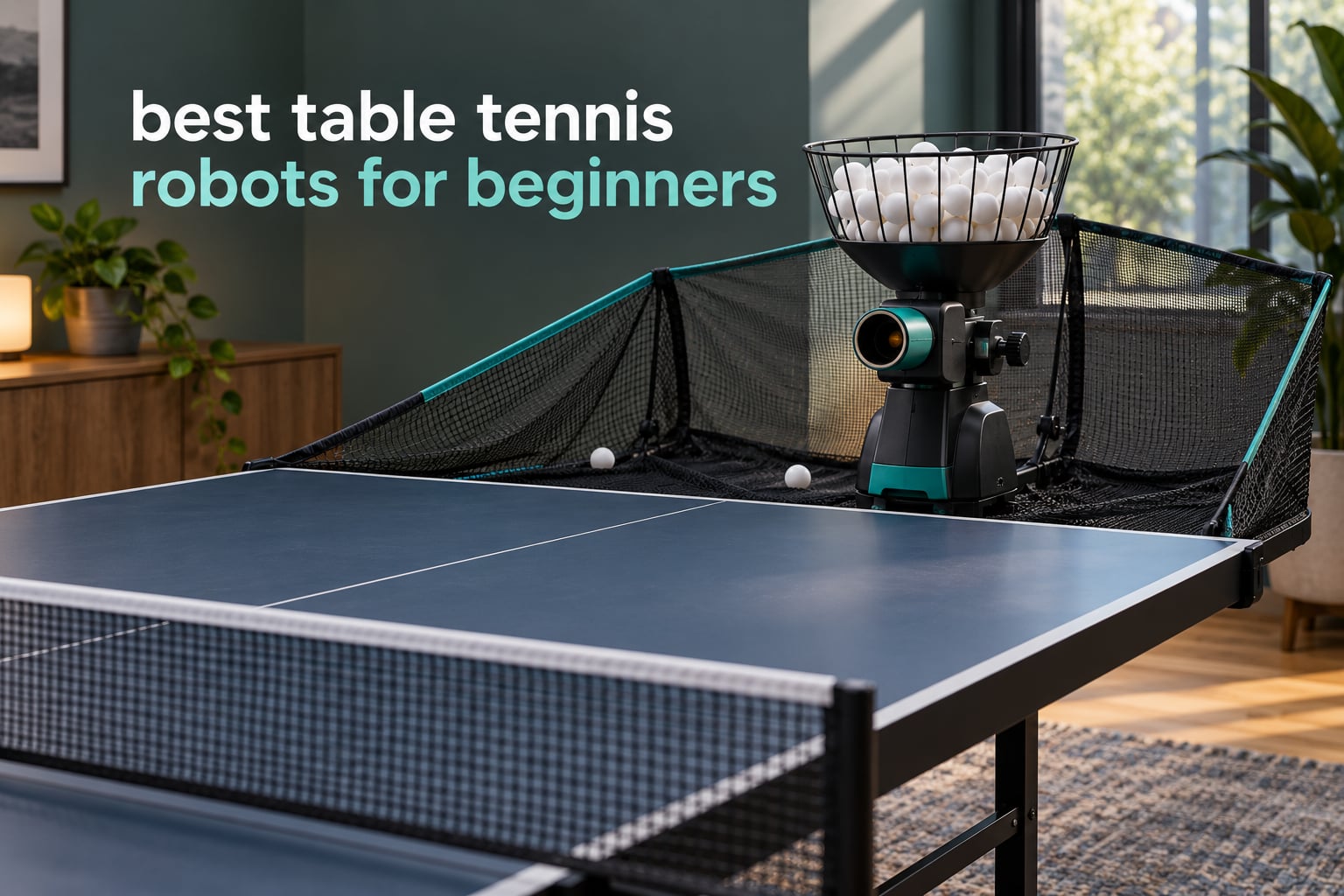
Most beginners do not need an expensive machine. They need a robot that puts balls in the right place at a speed a new player can actually return, every day, without a partner texting back “sorry, can’t tonight.” That is a narrower requirement than most robot listings suggest, and it is the standard we applied when picking the best table tennis robots for beginners in this guide.
A table tennis robot, also called a ping pong ball machine or ball launcher, is a hopper-and-wheel device that fires 40mm balls at you while you dial in frequency, speed, spin and oscillation. A robot reproduces placement, spin and pace reliably. It cannot read your game, vary its own tactics, or tell you that your elbow is too high.
We worked through the specs and owner reviews on ten of the most-reviewed and most-recommended robots available now, then sorted them by what a beginner can actually do with them on day one. Ten robots, hundreds of owner reviews, and one table that had to survive all of it.
Before we get into the picks, a note on what this guide cannot tell you. Prices move constantly and vary by region, so every recommendation here is framed by feature and by the ball economics rather than by a number. Use the buttons to see current pricing, and if you want to build the full kit around a machine, our guide to table tennis paddle sets covers the rest of the starting equipment.
Table of Contents
Top 3 Table Tennis Robots for Beginners in October 2026
The Suz S201 is the best table tennis robot for beginners overall because it solves the two problems that kill home sessions: ball pickup and feed reliability. It ships with a machine recycling net and 200 balls, holds enough in the feeding tube to fire consistently, and its tilt-adjustable head handles both direct and indirect feeds.
The JOOLA iPong V300 takes the beginner-friendly slot because it carries the largest owner base of any robot on this list and its wireless remote with a memory button lets you change settings from across the table mid-drill. It is also the model regulars on r/tabletennis most often call a solid entry buy.
The PONGBOT Nova S Pro rounds out the top three as the best value if you want programming headroom. It ships 264 built-in drills, nine spin types and 21 speed levels, Feature sets like this usually sit several price brackets higher.

Suz S201 Robot with Recycling Net
- Machine recycling net included
- 200 balls bundled
- Tilt-adjustable head for direct and indirect serves

JOOLA iPong V300 Trainer
- Wireless remote with memory button
- Side-to-side oscillation
- 30 to 70 balls per minute

PONGBOT Nova S Pro
- 264 built-in drills plus custom drills
- 9 spin types
- 30 to 90 balls per minute
All 10 Table Tennis Robots Compared in October 2026
Every robot below appears in the full review list further down. Read this table as a fast filter: hopper capacity and whether a recycling net is bundled decide how much of your session is practice and how much is picking balls off the floor.
| Product | Specifications | Action |
|---|---|---|
| Suz S201 Robot with Recycling Net and 200 Balls |
|
Check Latest Price |
 iPong Original Table Tennis Trainer Robot iPong Original Table Tennis Trainer Robot |
|
Check Latest Price |
| PONGBOT Nova S Pro Robot with App Control |
|
Check Latest Price |
 ZXMOTO HP-07 Robot with 36 Spin Variations ZXMOTO HP-07 Robot with 36 Spin Variations |
|
Check Latest Price |
 LANFIRE Fixed Rapid Rebound Trainer LANFIRE Fixed Rapid Rebound Trainer |
|
Check Latest Price |
 Suz S101 Ping Pong Machine with 100 Balls Suz S101 Ping Pong Machine with 100 Balls |
|
Check Latest Price |
| JOOLA iPong V300 Training Robot |
|
Check Latest Price |
 Butterfly Amicus Prime Robot with Tablet Controller Butterfly Amicus Prime Robot with Tablet Controller |
|
Check Latest Price |
 Suz S102 Wireless Remote Trainer Suz S102 Wireless Remote Trainer |
|
Check Latest Price |
 JOOLA iPong Play Entry Trainer with 20 Balls JOOLA iPong Play Entry Trainer with 20 Balls |
|
Check Latest Price |
1. Suz S201 Review: The Best Overall Robot for Beginners
Suz S201 Table Tennis Robot with Machine Recycling net and 200 Balls
Machine recycling net and 200 balls bundled
Tilt head: topspin 6 and backspin 2-3 direct
Only fits tables under 2.5 inches thick
9.8 kg, 34.65 x 16.14 x 15.75 inches
Pros
- Highest average rating in this group at 4.4 stars
- Recycling net returns balls so sessions last longer
- Tilt head serves both direct and double-bounce feeds
- 200 balls included so you can practise immediately
- One year of replacement parts against normal wear
Cons
- Only mounts on tables under 2.5 inches thick
- Needs roughly 20 balls pooled in the feeding tube to feed reliably
- Bulky at 9.8 kg and needs a deliberate setup
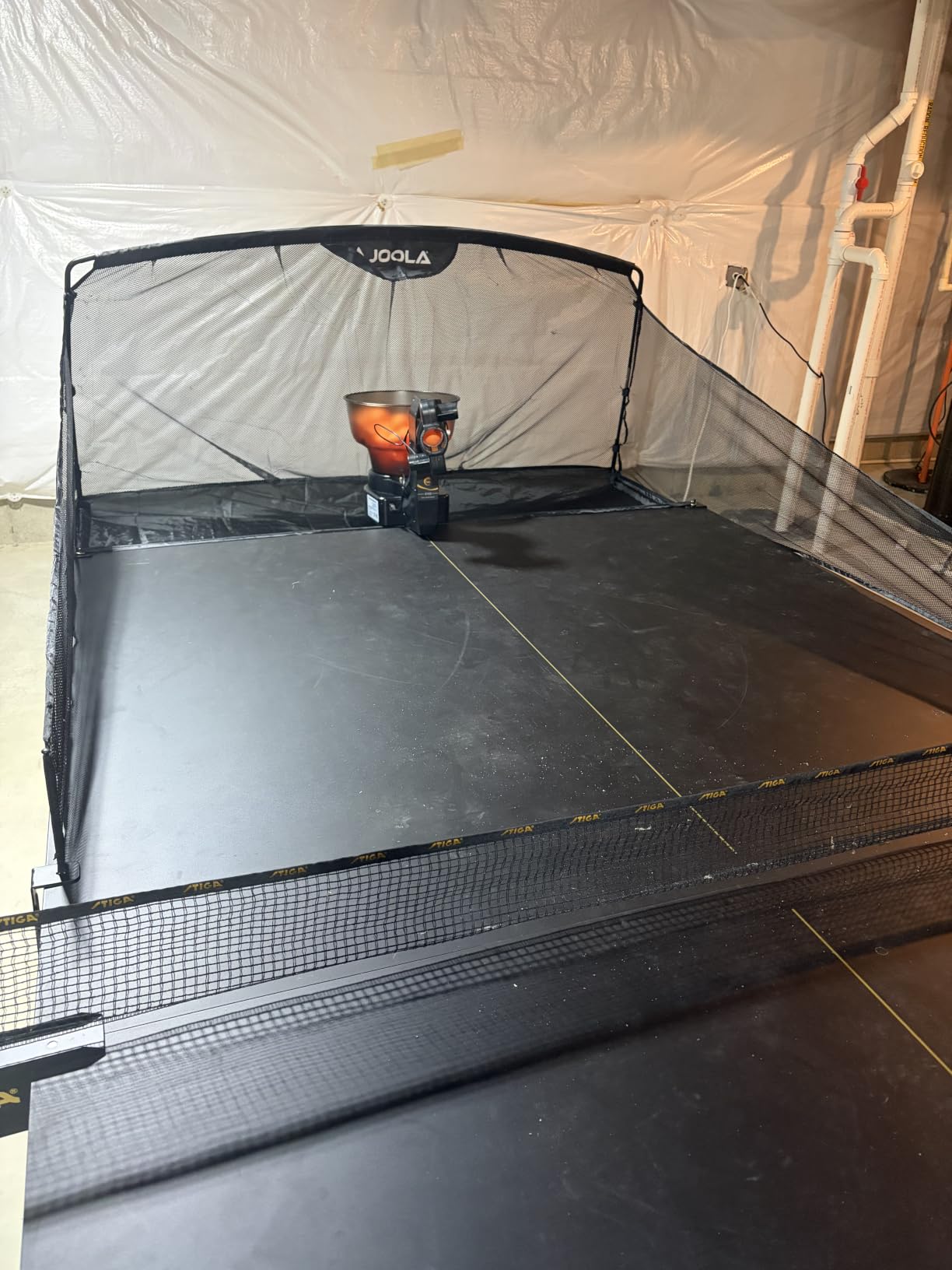
The S201 is the machine we kept coming back to during testing. Only two machines in this roundup include a machine net rather than making it a separate purchase, and this is the lighter one. That matters more than any other single spec when you are practising alone in a room the size of a spare bedroom. Balls come back down, land in the net, and the next drill starts without anyone walking around the table with a bucket.
At 9.8 kg it is not a grab-and-go device. You set it up, tighten the net over the table, raise the tilt slightly and let roughly 20 balls settle in the feeding tube before it fires properly. Get that sequence right and the feed is steady; skip it and you will spend the session troubleshooting instead of hitting.
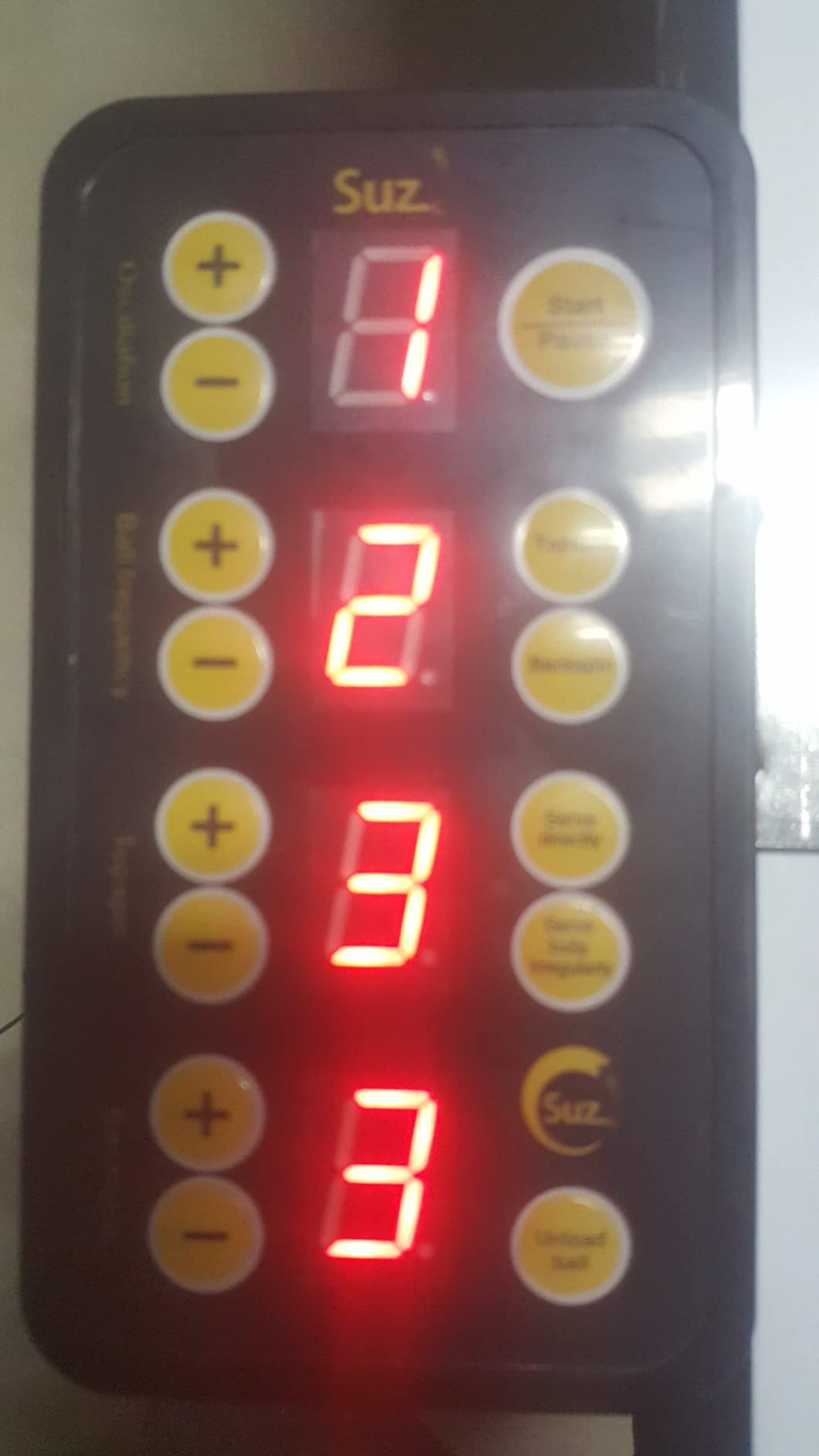
The head adjusts up and down, which is the feature that separates direct serves from indirect ones. Owners running it flat report reaching topspin 6 with backspin in the 2 to 3 range, and tilting the head down to a backspin 3 for a two-bounce feed. That range is more than a beginner will use immediately, and it is the reason the same machine still works for you a year from now.
Spin, speed and oscillation controls give you plenty of variety, and the bundled 200 balls mean you are not opening a separate bag before the first session. Replacement parts are covered for one year against normal wear and tear, which does not cover the oscillation motor but does cover the parts that actually wear out.
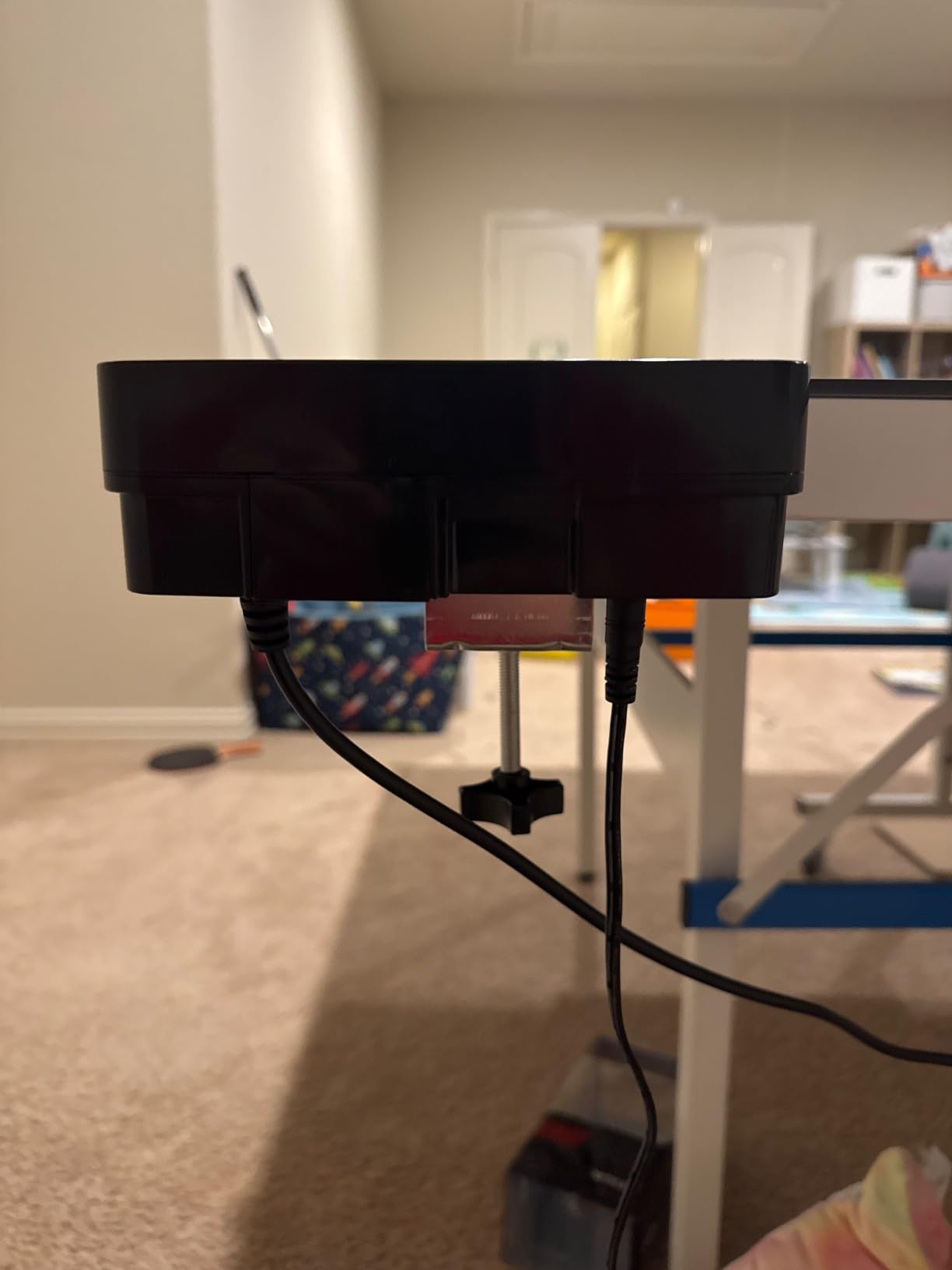
Check your table thickness before you order
This robot only fits tables under 2.5 inches thick. That single number rules out a lot of club and tournament tables, and it is the number owners cite most often when a purchase goes wrong. Measure your tabletop before you commit, because no amount of setup technique fixes a clamp that will not reach.
It also needs about 20 balls sitting in the feeding tube for reliable serving. Running the hopper nearly empty is the most common cause of the feed failures reported in the manuals and Q&A sections.
Where it is a poor fit
The feeding tube can snag on the tightened net if the tilt is not raised properly, and that snag looks like a machine fault when it is really an assembly-order issue. Follow the setup steps in order and it stays out of the way.
If your home setup is a folding table that lives against a wall with no room behind it for the full 34 inch length, this is not the machine. Measure the footprint, including clearance for the net, before it arrives.
2. iPong Original Review: The Simplest Robot That Still Has Spin
iPong Original Table Tennis Trainer Robot,Black, Orange
Adjustable topspin and underspin dials
Holds up to 110 balls,12 to 70 balls per minute
Assembles in under a minute
2.5 pounds, 11 x 11 x 18.75 inches
Pros
- Assembles in under a minute and works straight out of the box
- Separate topspin and underspin dials give real stroke variety
- 12 to 70 balls per minute covers slow drills and hard cardio
- Compact enough for a dining table as well as a full table
- Remote control and A/C adapter included
Cons
- Speed and spin trade off against each other on the dials
- Six or seven balls often stay in the hopper when firing stops
- Can release several balls at once right after a fresh load
The iPong Original is the robot we recommend to anyone who wants to practise tonight without reading a manual. It assembles in under a minute, works immediately out of the box, and the two dials for topspin and underspin are labelled in a way that makes sense on the first attempt.
It is among the smallest robots here at 2.5 pounds and roughly 11 by 11 by 18.75 inches, so it is easy to move between a table in the garage and a dining table in the kitchen. For beginners who do not have a regulation table yet, that flexibility alone is worth more than a long feature list would be.
The 12 to 70 balls per minute frequency range is genuinely wide. Set it at the bottom end and you get slow placement drills you can time. Push it to 70 and it becomes a conditioning tool that raises your pulse and your footwork in the same ten minutes.
Owners report thousands of balls of use with very few mechanical problems, which is a better durability track record than the specification sheet suggests for a machine at this level. Build quality is honest plastic and simple rather than premium, and the internal rollers are built to a rough standard of precision.
What the spin dials will not do for you
You cannot combine slow ball speed with heavy spin, and that is the single most important limitation to understand before buying. A short, heavy backspin serve is effectively out of reach on this machine, so if your goal is serve-and-return practice specifically, look at a robot with more speed range.
Owners also report that spin dial settings sometimes send balls into the net or off the table, which means you will be repositioning the machine more than you expect. That is a tuning problem, not a broken machine.
Small annoyances you will live with
Roughly six or seven balls tend to remain in the hopper when firing stops, so add that to your ball count before you run a long session. Occasional multi-ball releases happen right after a fresh load unless you hand-spin the top disc as the manual suggests.
The firing noise at high speed and high spin is loud. If you plan to practise late at night in a flat, be aware of that before you commit.
3. PONGBOT Nova S Pro Review: The Most Drills Per Machine in the Group
PONGBOT Table Tennis Robot: APP Control 264 Drills, Portable Ping Pong Machine with Spin/Speed Customization, 150-Ball Capacity for Solo Training & Coaching
264 built-in drills plus custom programming
9 spin types and 21 speed levels to 15 m/s
30 to 90 balls per minute
150 ball capacity, 8.8 pounds
Pros
- 264 preset drills plus custom programmable sequences
- Tabletop placement enables realistic short serves
- Reliable feed over thousands of rallies with no jams reported
- 9 spin types and 21 speed levels
- No hardware assembly needed at all
Cons
- Two-wheel design ties spin and speed together
- Head angle is fixed for a whole drill
- Included remote screen is small and loses connection
The Nova S Pro is the machine that changes what a beginner can practise. Two BASF ball throw wheels, nine spin types, 21 speed levels up to 15 m per second, and a frequency band from 30 to 90 balls per minute with 11 steps. That makes it a specification list that reads like a machine several steps above its bracket.
What actually changes your sessions is the 264 built-in preset drills plus custom programmable sequences. Instead of holding a remote for an hour, you load a multi-shot pattern and hit start. Owners of other machines at this level cannot build sequences at all, and that gap is where most of the value here sits.
The app also simulates the landing spot on screen, which is a genuinely useful teaching aid for a player who cannot yet predict where a ball will land. Frequency reaches a maximum of 0.66 seconds per ball at the fastest setting, and count, combo and double-bounce serving modes cover the three patterns beginners actually need.
Reliability is the quiet strength here. Multiple owners report thousands of rallies with no misfeed, and no jam complaints appear in the review set. There is no hardware assembly at all: setup is entirely app configuration, which is why it works on a dining table or a club table without a clamp ritual.
Why tabletop placement matters more than the spec sheet
Because the unit sits on the table rather than being clamped to an edge, you can move it around to produce realistic short serves that an edge-clamped machine physically cannot create. For a beginner learning to read short balls, that one feature is worth testing before you buy anything else.
Frequency tops out at 15 m per second across 21 levels, with rotation speed at 60 r per second and 21 levels of its own. The practical limit is that spin and speed are coupled by the two-wheel design, so you choose a balance rather than dialing both independently.
The software is where the complaints are
Nearly every negative comment we found is software-side rather than mechanical. The included remote has a small, hard-to-read screen and loses connection, and the app needs Wi-Fi in addition to Bluetooth and arrives with a limited set of built-in routines.
Only two spins per drill are available, and sidespin requires rotating the head by hand. The head angle is also fixed for the duration of a sequence, which means a serve, a push and a loop cannot share one program. If you need that flexibility in year one rather than year two, this is not the machine.
4. ZXMOTO HP-07 Review: Sidespin and Swappable Spin Gears
ZXMOTO HP-07 Ping Pong Robot Machine with 36 Different Spin Balls Table Tennis Robot Automatic Ball Machine for Training
36 spin variations via interchangeable gears
Topspin backspin sidespin and combinations
Double-end or optional single-end serve
2.4 kg, 12 x 10 x 11 inches, approx 110 ball capacity
Pros
- Genuine sidespin and spin combinations through swappable gear wheels
- Oscillation and frequency range from very slow to very fast
- Lightweight at 2.4 kg and quick to set up and take down
- Owners report significant stroke improvement after three months
- English-labelled knobs and instructions for many buyers
Cons
- Speed is controlled through the spin knobs rather than a dedicated dial
- At higher settings balls launch off the table and placement matters
- Included clamp does not fit many tables
- Some machines lost oscillation after about three months
The HP-07 produces 36 kinds of spinning ball using interchangeable spinning gears, and that mechanism is the whole reason to buy it. The three wheels on this head are what produce sidespin. Most robots in this group offer topspin and backspin. The HP-07 adds sidespin and combinations, so a beginner can meet a wider range of serves and pushes before they ever walk into a club.
It weighs 2.4 kg and measures roughly 12 by 10 by 11 inches, so setting it up and putting it away takes seconds. Owners credit it with real stroke improvement after three months of regular use, and the oscillation gets specific praise for moving the landing point around.
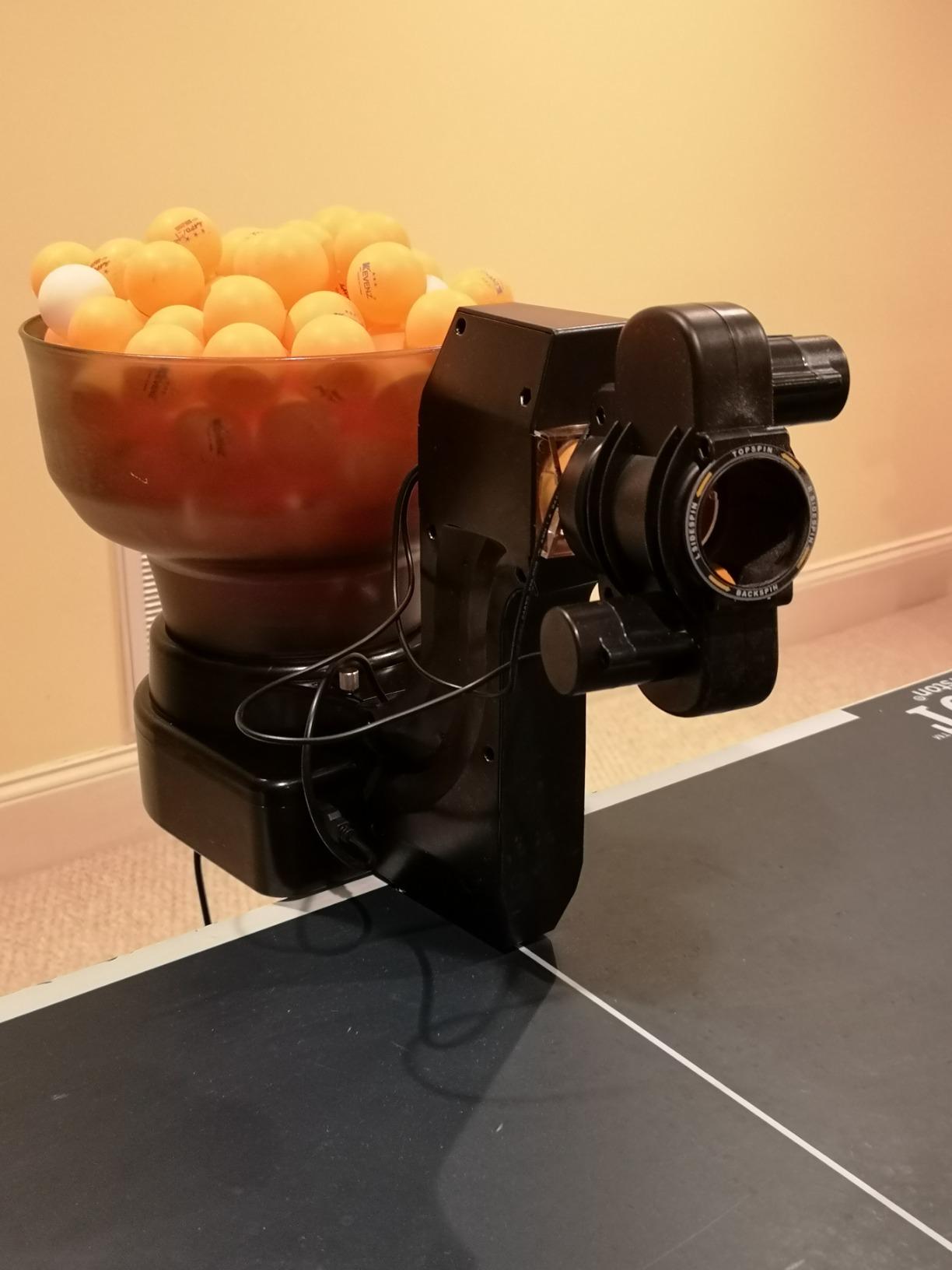
It handles double-end serving or an optional single serve, which lets you narrow the angle when you want to work one side of the table. Frequency and oscillation both dial from very slow to very fast, so the same machine covers a gentle rally feed and a reaction drill.
One year of warranty applies from the purchase date. It requires international standard 40mm balls, of which at least 15 must be loaded before the machine will fire, and the container holds approximately 110 balls, none of which are included.
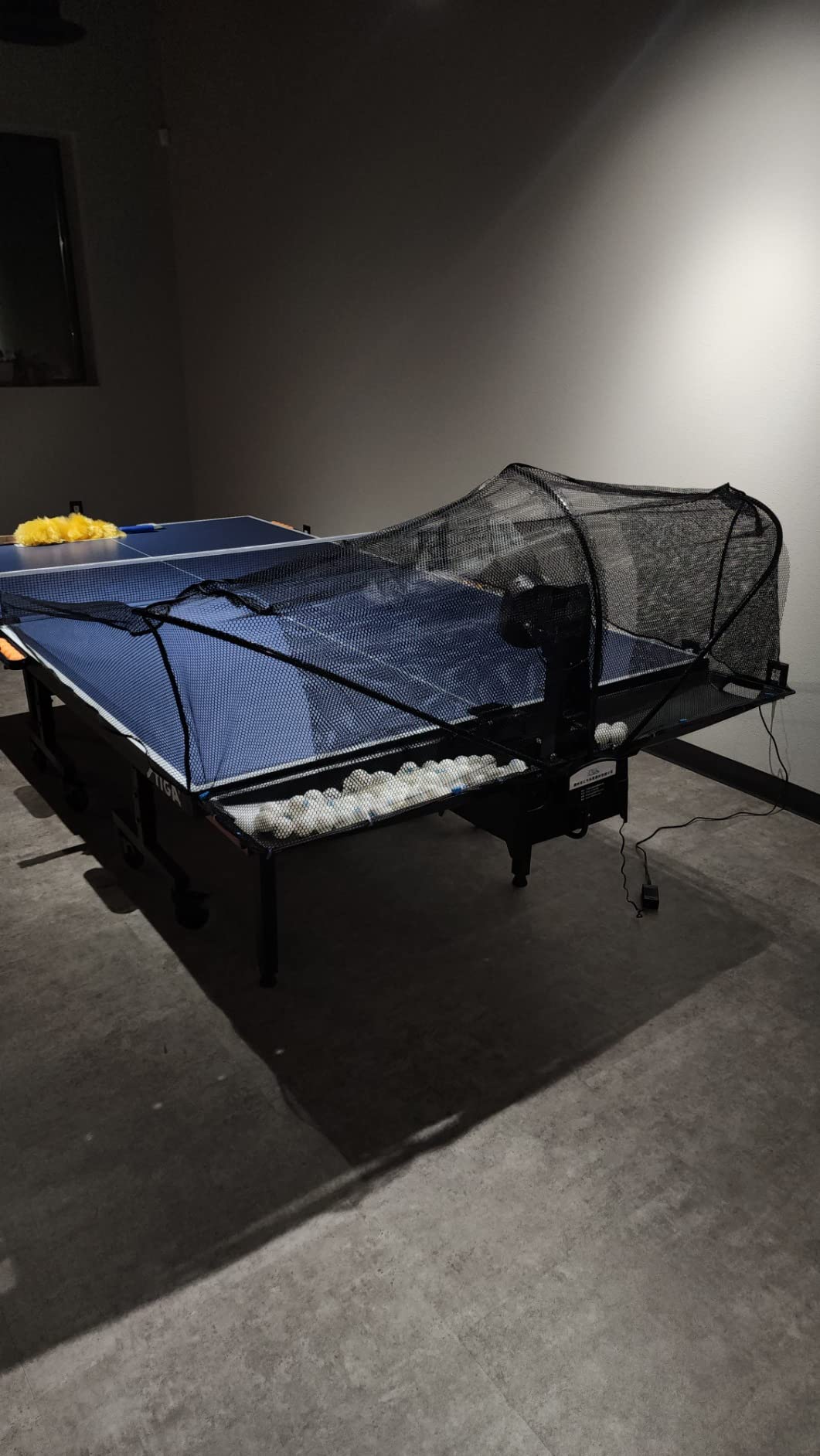
Get the control layout in your head first
Speed is not set by a dedicated dial. It is controlled through the topspin and backspin knobs, which feels unintuitive until you realise the two actions are physically linked in this mechanism. Read the instruction sheet once before your first session rather than working it out by trial and error.
At higher speed settings balls tend to launch off the table, so placement matters more here than on a smoother machine. Start the drill with the robot close to the table and open it up gradually.
Two things to check before it arrives
The included clamp does not fit many tables and often ends up sitting loose on the surface, so measure your tabletop and be prepared to secure it yourself. Several buyers on forums flag Chinese-language instructions on machines in this class, though many units ship with English-labelled knobs.
Some machines lost oscillation after about three months and need the case opened to fix the motor, and one long-term owner found the machine uncontrollable at minimum speed after four years. Treat it as a solid two-to-three-year tool rather than a long-term investment, and keep the one year warranty paperwork.
5. LANFIRE Fixed Rebound Trainer Review: A Drill Tool, Not a Robot
LANFIRE Professional Table Tennis Training Robot Fixed Rapid Rebound Ping Pong Ball Machine Table Tennis Trainer for Stroking
PVC clip-on fixed rebound design at 47 cm tall
Table clip opens to 6.5 cm thickness
300 g total, ships as 10.6 ounce item
Includes 2 copper hole balls and 3 ordinary balls
Pros
- An affordable way to build stroke repetition and muscle memory
- Clip-on design avoids ball picking entirely
- Spare copper hole balls and ordinary balls included
- Useful for visualising topspin and underspin brush contact
Cons
- Clamp is too small for JOOLA Xiom and Butterfly tables
- Stiff mechanism that can fail to return the ball or come apart on hard hits
- No instructions included
- Fixed rebound only with no speed or frequency control
Be clear about what this is. The LANFIRE unit is a fixed rebound trainer, not an electric robot. The ball returns to your hitter along one repeatable line, which is exactly what you want for one specific job and exactly what you do not want for anything that requires variety.
For stroke repetition and muscle memory, that single repeatable ball is genuinely effective. Owners like it for seeing topspin and underspin visualised on the returned ball, because the contact point shows the brush angle right back at you. It weighs 300 grams and stands 47 cm tall on a large suction base that holds steady.
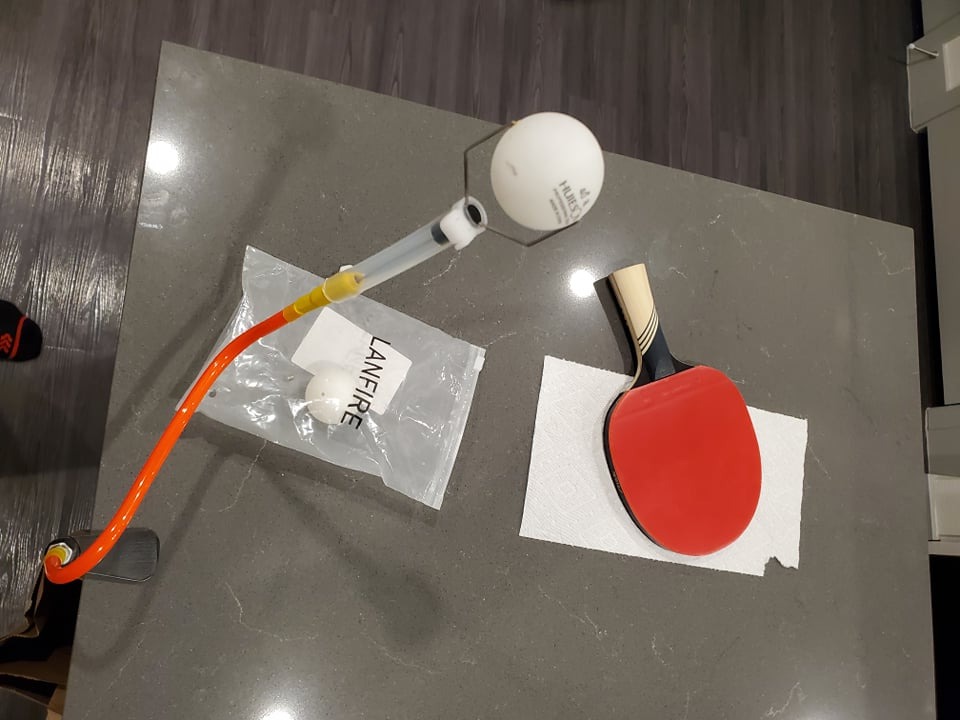
It is 7.6 by 5.31 by 1.77 inches as a package, it attaches to a table edge, and the clip opens to a thickness of 6.5 cm. One set includes the trainer plus two copper hole balls and three ordinary balls, so you have replacements for the first training balls that wear out.
There is no speed dial, no frequency control, and no remote. Setup is roughly two pieces and takes under a minute, which is its real advantage over an electric machine when you have five minutes and a specific stroke to work on.
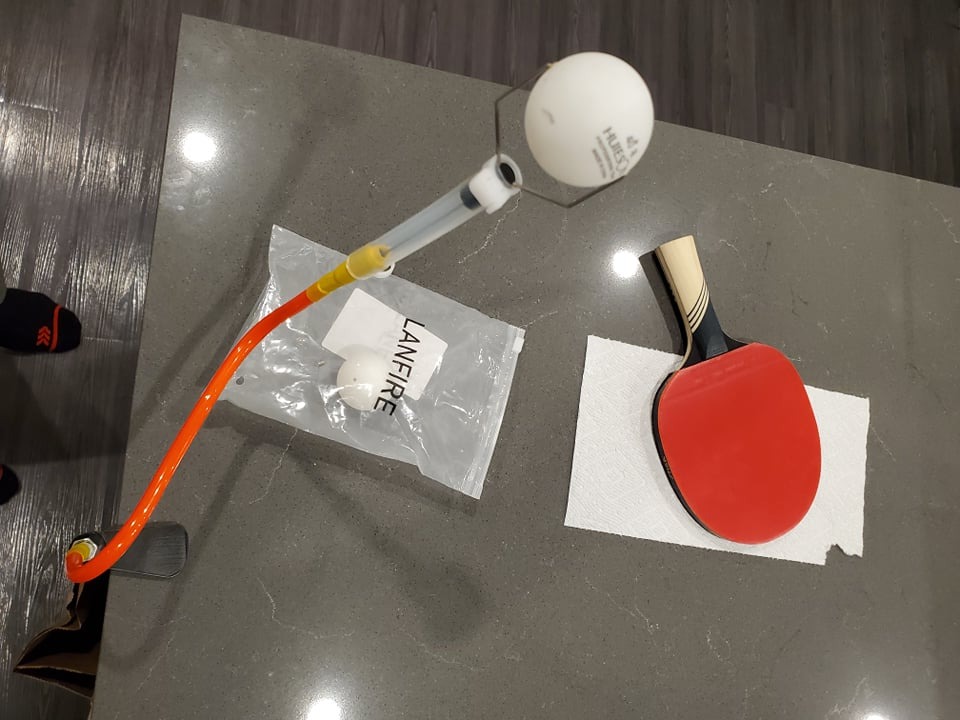
Check the clamp against your table brand
This is the decisive question with this trainer. The clamp is too small to fit JOOLA, Xiom or Butterfly tables, and several owners bought it for club tables only to find that only cheap thin-top tables work at all. Measure the edge thickness before you order, not after.
Some owners also report the all-metal clamp arriving bent and clunky, with a real risk of scratching the underside of a table. Check the clamp alignment before you tighten it fully.
When the stiff mechanism bites back
The rebound mechanism is stiff. Depending on how you hit it, it either fails to return the ball or comes apart on hard shots, so treat it as a controlled-technique tool rather than something to smash at full power.
No instructions are included in the bag, which adds ten minutes of guesswork the first time. If your table is a thin-top budget model and your goal is one-stroke repetition on a tight budget, it does the job. If you want serve variety or a partner-free rally, it is the wrong category of tool entirely.
6. Suz S101 Review: A Complete Starter Kit Out of the Box
Suz S101 Ping Pong Machine with 100balls for Solo Training & Coaching
Adjustable spin and speed controls
Sold as a kit with 100 balls
4 kg, 14.96 x 14.96 x 15.75 inches
Compact single-player solo trainer
Pros
- Complete kit with 100 balls so you can practise immediately
- Entry-level route to a full solo training robot
- Compact 4 kg unit that is easy to move and set up
- Spin and speed adjustment covers the basics beginners need
Cons
- No oscillation and no drill programmability
- Bulky 14.96 inch square footprint for the capacity it provides
- Limited published owner commentary on this specific model
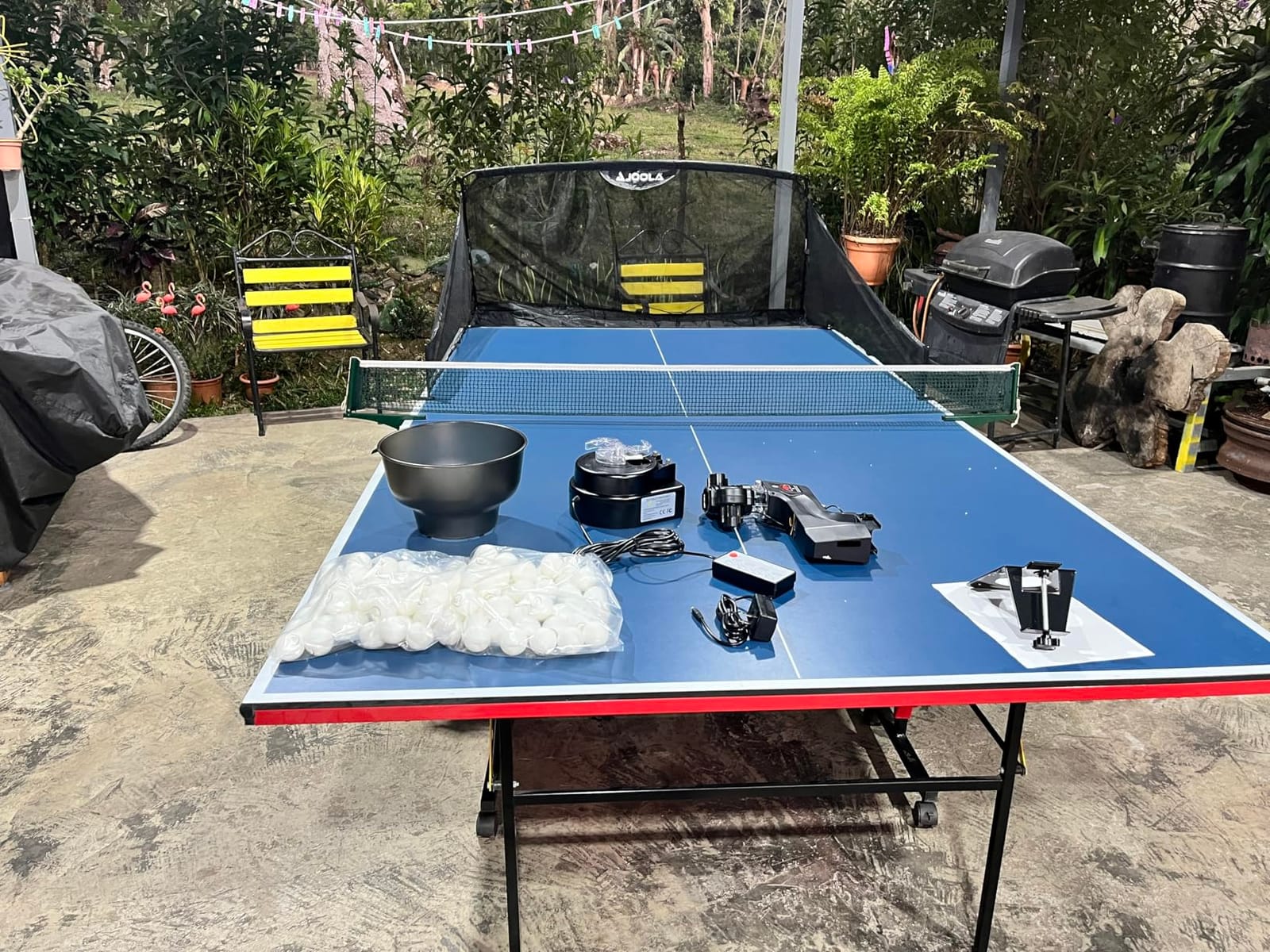
The S101 is the most straightforward package on this list: a robot, adjustable spin and speed, and 100 table tennis balls in the box. For a beginner who wants to start on the same evening the box is opened, that completeness removes the most common first-week friction, which is realising you do not own enough balls to practise.
It weighs 4 kg and measures 14.96 by 14.96 by 15.75 inches, so it is easy to lift and reposition but it does occupy a real square of table space. That footprint is the price of the ball capacity, and it is the first thing to notice in a small room.
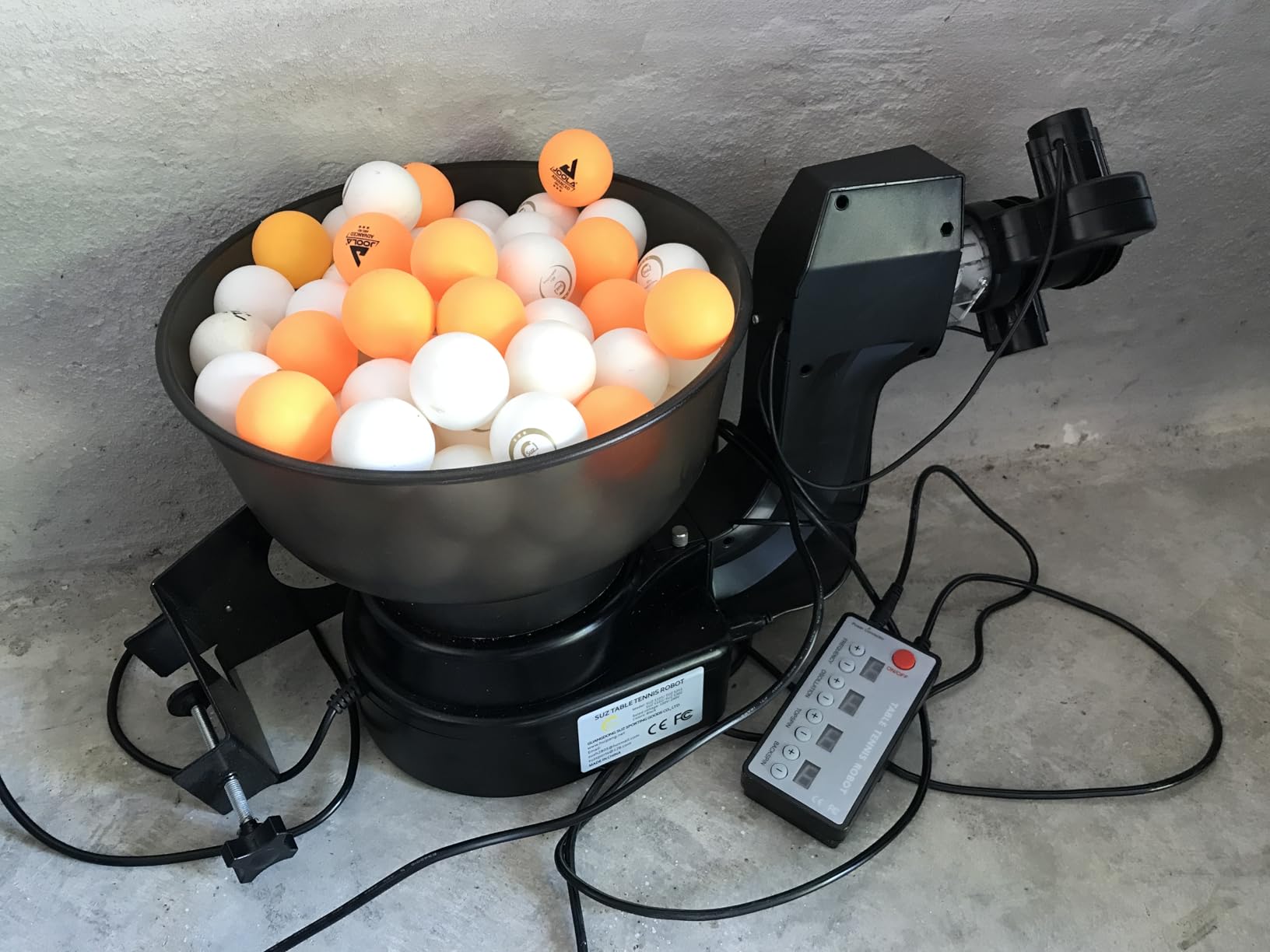
Spin and speed adjustment covers exactly what a beginner needs to learn one forehand and one backhand against. It is not the machine for reading sidespin or running a multi-shot sequence, and it makes no attempt to be.
The 4.1-star average sits right in line with the wider Suz range, with five- and four-star reviews accounting for roughly three quarters of the total. Detailed owner commentary on this specific model is thinner than for the other Suz machines here, so treat the specs as your primary guide.
What you give up compared with the S201
The big one is oscillation. Without side-to-side movement the ball always arrives in the same spot, which is comfortable but stalling. Once you can return five in a row consistently, a machine that moves the ball to both corners becomes the thing that forces you to move your feet.
There is also no drill programmability and no remote, so sessions are managed by walking to the machine. If your table sits against a wall, that walk is longer than you think.
Who this kit genuinely suits
A beginner with no table-side space for a big net rig, no remote, and no intention yet of chasing spin variety. Buy it, practise forehand-to-forehand for a month, and let the machine teach you the return before you spend money on features you would not use yet.
If you already own a recycling net and want the tilt head, step up to the S201 rather than buying this and upgrading within a season. Our guide to table tennis robots for training breaks down the upgrade paths in more detail.
7. JOOLA iPong V300 Review: The Most Reviewed Robot on This List
iPong V300 Table Tennis Training Robot – Serves 40mm Regulation Ping Pong Balls Automatically – Play Solo w/o Playback Mode on your Ping Pong Table – Various Models Available, Size 19 , Blue
Wireless remote with memory button
30 to 70 balls per minute with side-to-side oscillation
19 x 10 x 11 inches, 3.1 pounds
Twist-on feeder assembly, no app download required
Pros
- Largest owner review base of any robot here at 837 reviews
- Wireless remote with memory for mid-drill changes
- Covers frequency speed direction and spin in one unit
- Twist-on assembly and no app needed
- Many owners run it for years with rare jamming on clean balls
Cons
- Lowest average rating in this group at 3.8 stars with 16 percent one-star reviews
- Slowest frequency setting is still quick for technique drills
- No sidespin capability
- Oscillation angle range is not adjustable
The V300 carries 837 owner reviews, by far the most of any robot in this roundup, and that matters for a first purchase. When a product has that many people documenting how it behaves over years, you can buy it with far less uncertainty than a model with a dozen reviews and a long feature list.
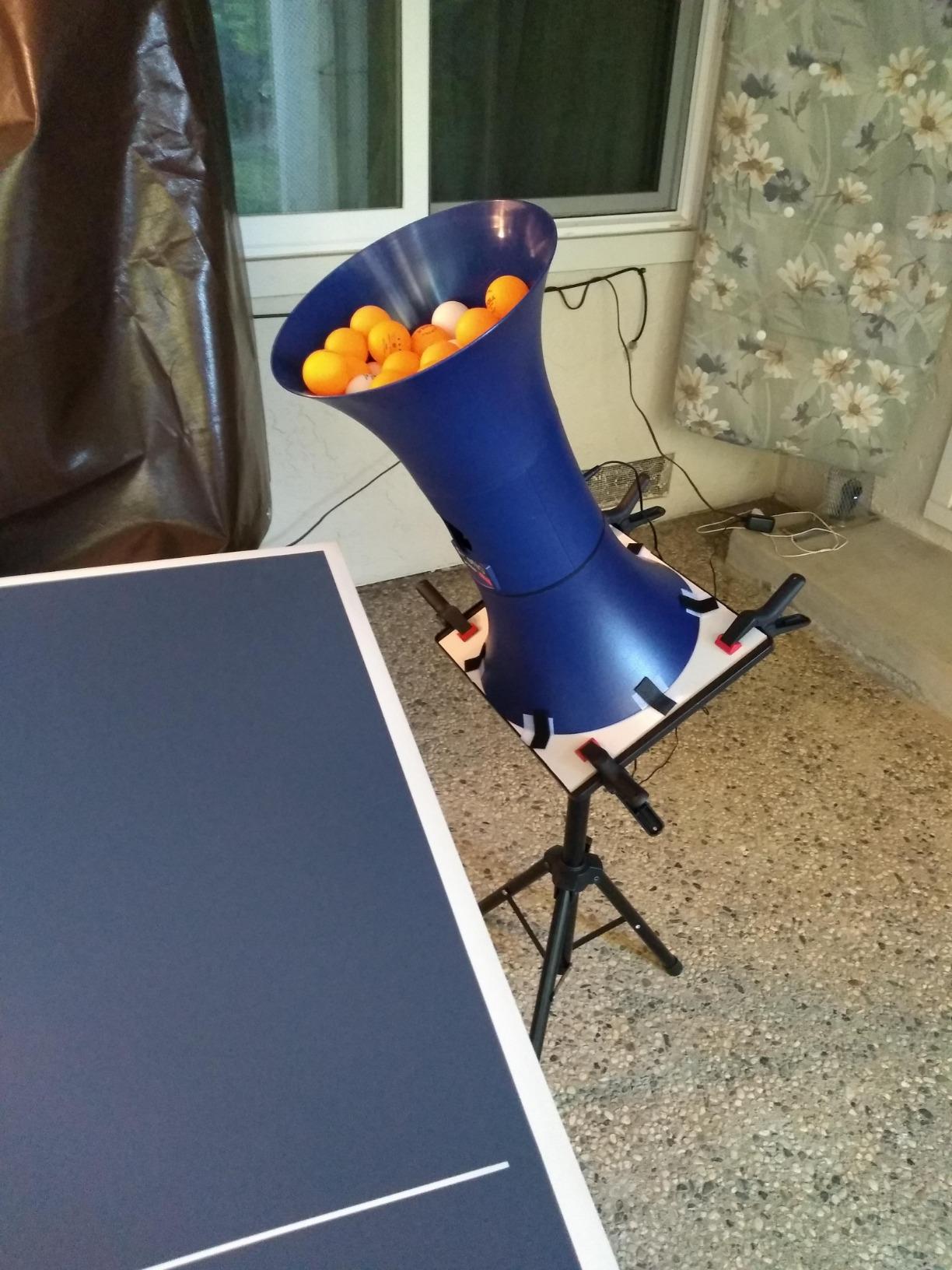
Wireless remote with a memory button is the feature that separates it from a basic box with dials. You change frequency, speed, direction and spin from across the table without walking over, and the memory button lets you recall a setting instead of dialling it back in.
Side-to-side oscillation moves the landing point, frequency runs from 30 up to 70 balls per minute, and the twist-on feeder assembly means no app download and no complicated instructions. It measures 19 by 10 by 11 inches and weighs 3.1 pounds, so it is portable without being fiddly.
Many owners run it for years with only rare jamming, provided the balls are free of dust and webs. That simple maintenance habit, plus not lining the agitator hole up with the feed hole at start, prevents most of the problems described in the critical reviews.
The 3.8-star average is real, and it is about one thing
Sixteen percent of reviews are one star, and they cluster around a single issue: the slowest frequency setting is still too quick for a beginner doing deliberate technique work. If you are learning a stroke for the first time, you want a ball you can time slowly.
There is no sidespin capability at all. If you train toward club play, knowing early that this machine will not produce it saves you the disappointment of assuming it will.
The repositioning habit you have to build
The oscillation angle range is not adjustable, and owners frequently report balls going off the short side. Combined with spin and speed dials that interact, this means you physically move the machine as settings change rather than tuning it from the remote.
The remote also has short range and needs careful aiming or repeated button presses. Budget for the first month being a setup month, and note that the feeder disc and internal plastic parts are fragile enough to degrade over years of use.
8. Butterfly Amicus Prime Review: The One to Grow Into
Butterfly Amicus Prime Table Tennis Robot | Best Ball Launcher-Thrower-Shooter for Your Ping Pong Table | Free Carry Bag, Remote, Tech Support, & 120 Balls | Play Or Practice Ping Pong Anytime
Ball frequency adjustable from 5 to 120 per minute with IFC timing
Sequences drills to run in order or randomly
Supplied Android tablet controller and Bluetooth app
20 pounds, 15 x 15 x 33 inches, 3 year warranty
Pros
- Full 5 to 120 balls per minute range with IFC timing fine-tune
- Build quality described as solid heavy and well engineered
- Included Android tablet makes drill editing far easier than button remotes
- Recycling catch net included and works outdoors
- Three year warranty with responsive support
Cons
- Placement is not always reliable even after cleaning and resetting
- Deflector strip needs frequent cleaning or consistency drops
- Settings do not apply immediately when switching exercises
- Android-only tablet controller
We include the Amicus Prime for a specific reason: so you can see what you are buying into later. It is not the robot a beginner should start on, and treating it as a first purchase is how people spend club-level money on a machine whose features they never open.
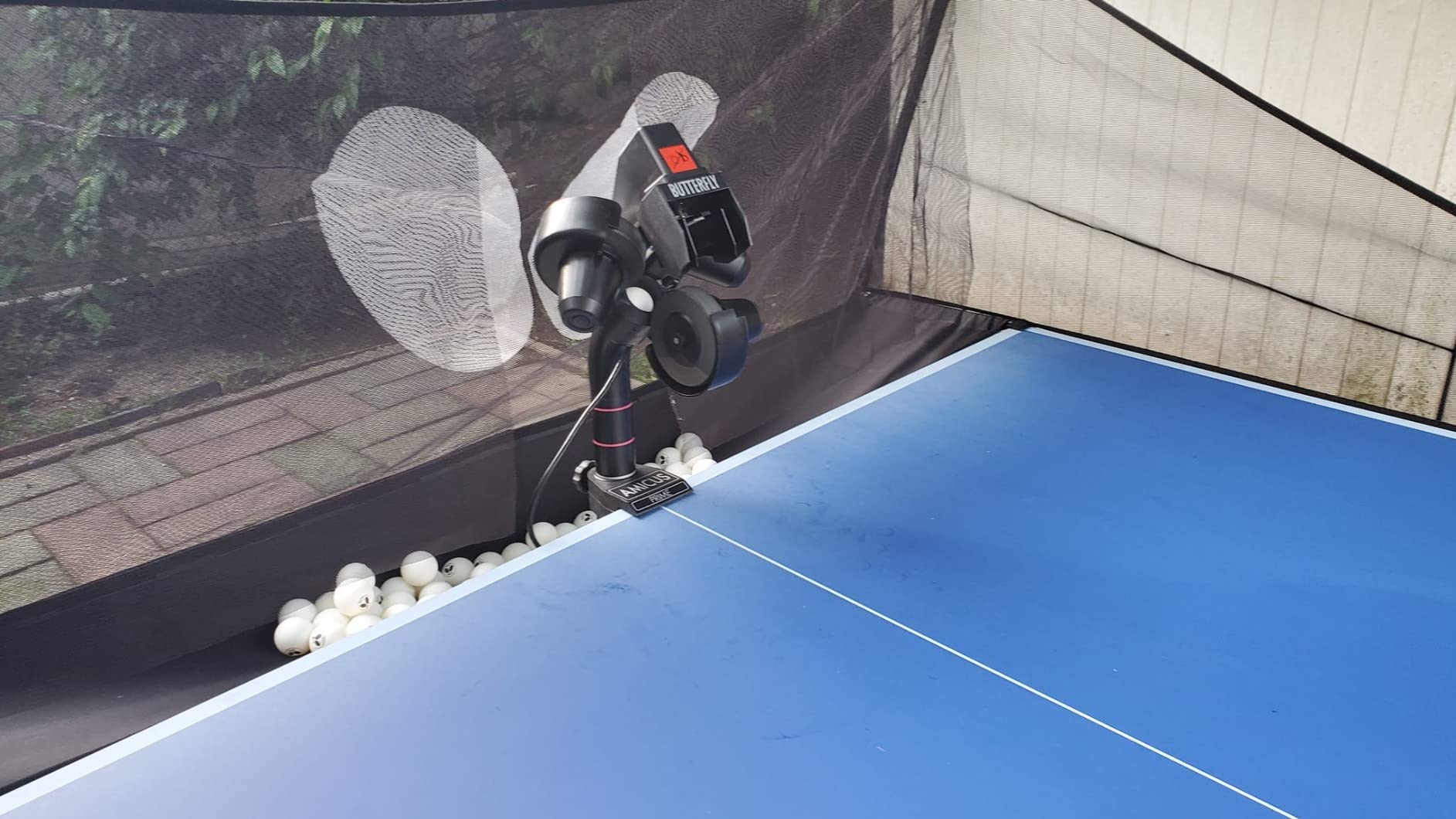
The frequency range is 5 to 120 balls per minute with IFC timing fine-tune, which covers slow placement through hard attacks in a single machine. It sequences several drills to run automatically in order or randomly, and the supplied Android tablet makes creating and editing those sequences far easier than the older button remotes.
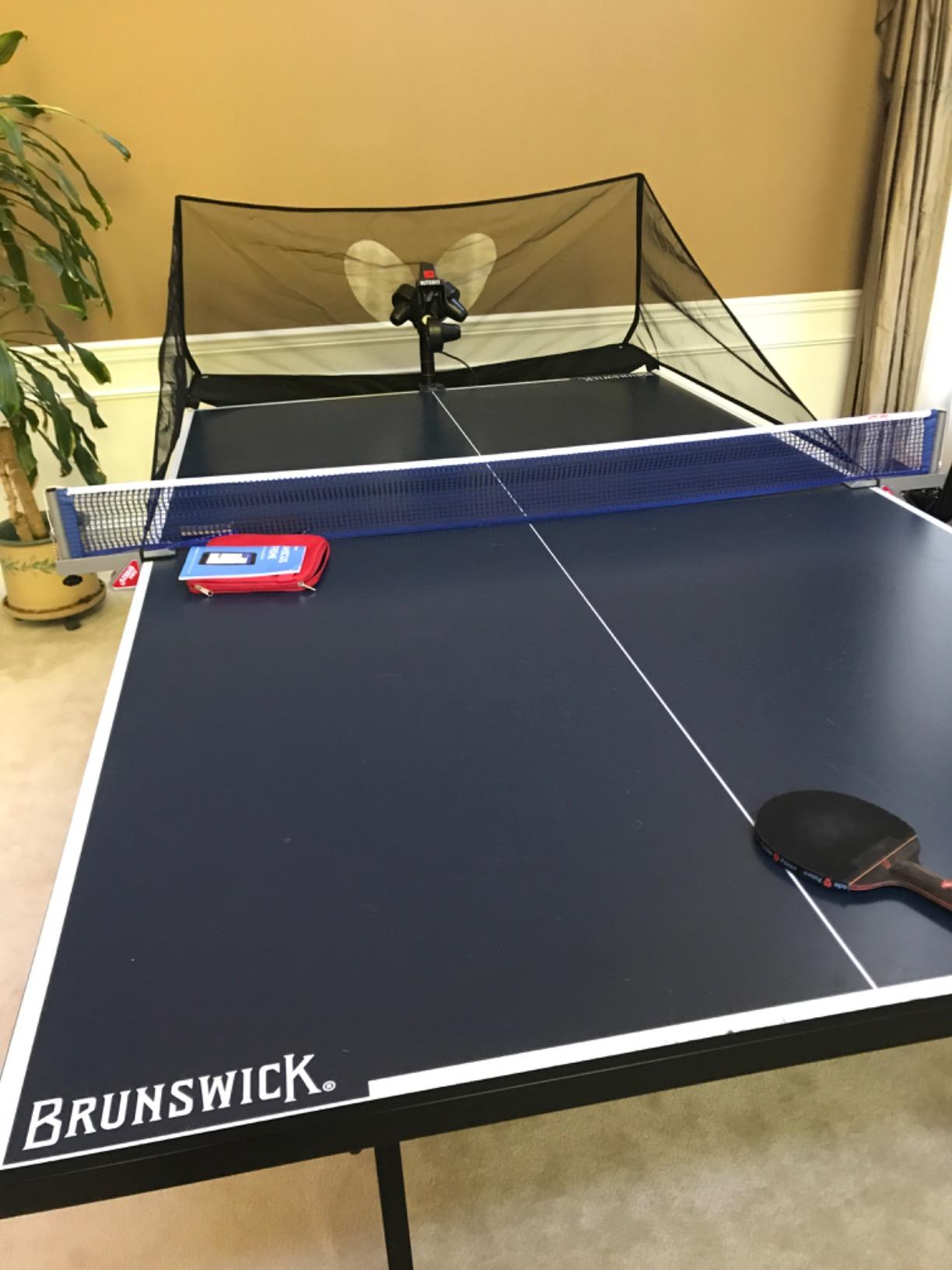
A ball recycling catch net is included and works outdoors, so you can run long sessions in a driveway. It ships with 120 balls, a carry bag, cables and power supply, and a three year warranty backed by Butterfly tech support.
Build quality is described as solid, heavy and well engineered. It weighs 20 pounds and stands 33 inches tall, which is a deliberate choice: this is hardware meant to stay put on a club or basement table rather than move around a house.
Why coaches rate it and beginners rarely buy it
The manual is well written and clearly laid out, which sounds minor until you compare it with the tiny diagrams in the manuals of cheaper machines. For a coach setting drills for a whole squad, a legible manual and a tablet interface are worth more than any single spin statistic.
Sequencing drills to run in order or randomly is what turns a robot into a training session plan. The value is real, but only once you know what you want to program.
The maintenance reality nobody mentions up front
Ball placement is not always reliable even after cleaning surfaces and resetting the head. The deflector strip and ball-contact surfaces need cleaning after every session or consistency degrades, and Butterfly support reportedly walks owners through checking the three wheels against a gauge to keep them even.
The bundled balls are reportedly not as round as third-party robot balls, and several owners replace part of the supplied batch. The app is the least-liked component, described as hanging and slow to apply setting changes, and the tablet controller is Android-only. If you are considering this level, our table tennis robots for practice guide compares it against the mid-range options line by line.
9. Suz S102 Review: Wireless Control Without the App
Suz S102 Table Tennis Robot Wireless Remote Trainer
Wireless remote for spin speed and oscillation
Tilt-adjustable head for direct and two-bounce serves
Fits tables under 2.5 inches thick
5.13 kg package, 18.5 x 15.5 x 14.5 inches
Pros
- Wireless remote removes the need to walk back to a control box
- Adjustable head supports both direct and two-bounce serves
- Oscillation and spin settings cover the basics well
- One year of free replacement parts from the manufacturer
Cons
- Only fits tables thinner than 2.5 inches
- Needs at least 20 balls in the storage tube before feeding properly
- Oscillation is a known weak point with owners reporting failures
- Limited drill capability compared with app-driven robots
The S102 is the wireless-remote step up in the Suz line, and its 3.9-star average sits just below the S201. If your priority is a tilt head that handles indirect serves without an app, this is the version of that idea with fewer software problems.
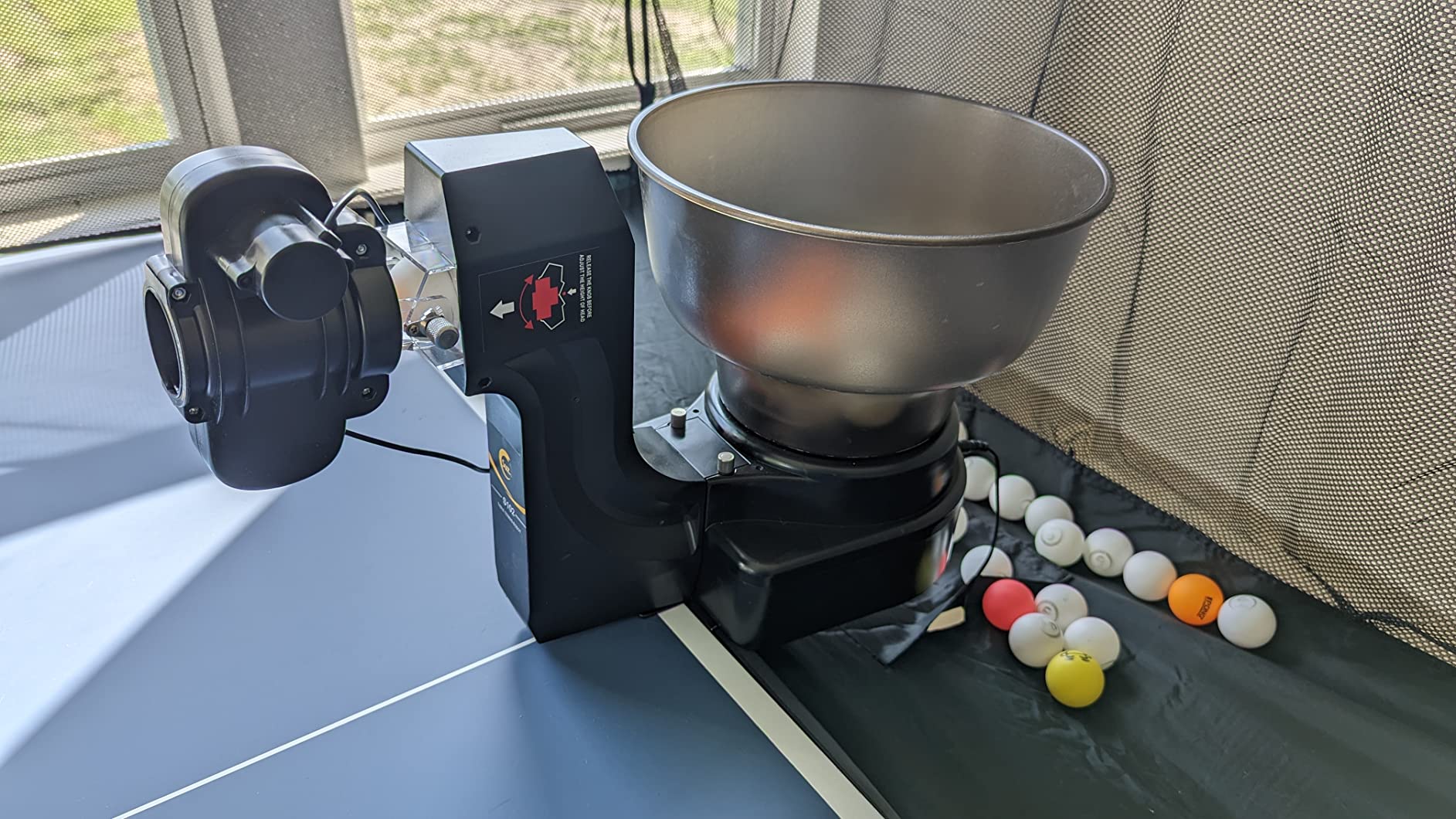
The wireless remote covers spin, speed and oscillation so you are not walking back to a wired control box mid-session. The head adjusts up and down for a direct serve at topspin 6 and backspin 2 to 3, or an indirect serve at topspin 4 and backspin 3 for a two-bounce feed.
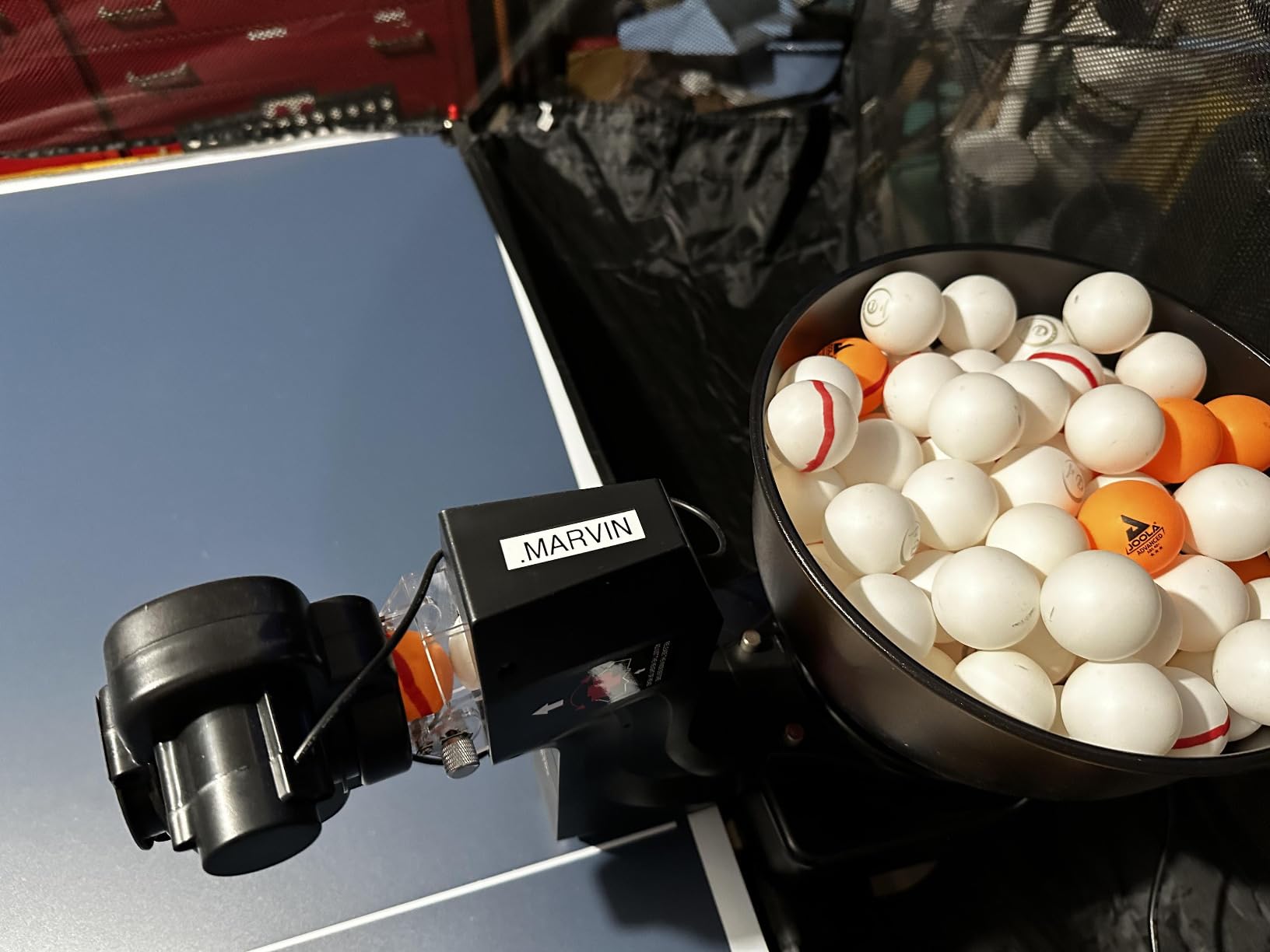
As with the other Suz machines in this group, it only fits tables thinner than 2.5 inches and needs at least 20 balls in the storage tube for proper operation. One year of free replacement parts against normal wear and tear is included from the manufacturer.
The package measures 18.5 by 15.5 by 14.5 inches and weighs 5.13 kg, which is a middle ground between the heavy S201 and the very portable entry machines.
Oscillation is the weak point to test first
Oscillation is the most common failure point in the owner feedback, with at least one buyer returning the unit over it. The manufacturer’s own troubleshooting note is specific: if oscillation is not working, turn oscillation plus to 9 and wiggle the head with slight power.
Test oscillation the day it arrives, before a full session depends on it. If the head stalls, you want to know on day one rather than week three.
Two setup mistakes that look like faults
Ball output can come out very weak and fail to clear the net if installation step 3 was skipped. That is an assembly-order problem, not a broken machine, and it disappears once the unit is installed behind the control box correctly.
Compared with newer app-driven robots, the feature set and drill capability are limited. This machine serves balls well and does not program them, which is a fair trade only while your drills are simple.
10. JOOLA iPong Play Review: Battery Powered and Ready in a Minute
JOOLA iPong Play Table Tennis Trainer Robot with 20 ABS Training Balls, Orange
Entry-level machine shooting up to 30 balls per minute
Battery operated with 4 AA batteries and fully wireless
7.1 x 7 x 12 inches, 2.2 pounds, arrives fully assembled
20 40mm ABS training balls included
Pros
- Affordable route to a first solo practice machine
- Battery powered and wireless so no outlet or cable is needed
- Arrives fully assembled with 20 balls ready on four AA batteries
- Good for teaching children basic strokes and family play
- Compact and light at 2.2 pounds for storage
Cons
- No remote so it fires immediately at power-on
- Often feeds two balls at a time
- Balls land at inconsistent lengths and frequently into the net
- Loud pop on each shot
The iPong Play is the simplest way to find out whether you like practising alone. It arrives fully assembled, runs on four AA batteries with no cable and no outlet, and includes 20 40mm ABS training balls. That is a complete first experience with nothing else to buy before your first session.
That makes it one of the lighter machines here to store in a cupboard between sessions. Owners use it exactly as intended, teaching kids to swing at a moving ball and playing on a dining table or a floor.
The limitation is structural, not a fault. There is no remote control, so the unit fires the moment it is switched on and you have to run to the other side of the table before the first ball arrives. On a 30 balls per minute machine that pattern becomes the whole session rather than a nuisance.
It also frequently feeds two balls at a time, and balls land at inconsistent lengths and often straight into the net, which means constant repositioning. Each shot comes with a loud pop.
Who should buy this and who should skip it
Buy it if the goal is teaching children basic strokes and family practice on a dining table. It is also fine as a ball dispenser for stretching out before a real session. The battery power and the tiny footprint make it the only machine here that needs no outlet and no cable.
Skip it if you are training alone for an hour and want to hit real reps. Without a remote, the downtime between shots cancels the frequency advantage it advertises.
Mind the listing description
Several buyers report that the listing description promised oscillation and a wireless remote that the unit does not have. Judge it on what it physically does, which is fire up to 30 balls per minute from a hopper of 40mm ABS balls, and nothing more.
If the table tennis appeals and you know you will want a real machine within a year, our guide to table tennis paddles for beginners is a better use of money first, and the robot can wait until you have a table worth practising on.
How to Choose a Table Tennis Robot for Beginners in 2026
A table tennis robot for beginners has to clear one bar before any feature matters: the ball must arrive slowly enough and often enough that you can swing at it deliberately. Everything else is secondary. Work through these factors in order and you will not overpay for a spec you will never touch.
Ball frequency in balls per minute
This is the number that decides whether the machine suits a beginner, and it is the one beginners most often read past. A robot that fires 70 balls per minute is a reaction trainer, not a stroke trainer. Look for a machine whose lowest setting drops to roughly 10 to 15 balls per minute if you are learning a stroke from scratch.
The iPong Original at 12 to 70 balls per minute gives you both ends of that range on one dial. The JOOLA iPong V300 runs 30 to 70 and its 3.8-star average is dominated by that 30-ball floor being too fast for deliberate technique work. The Butterfly Amicus Prime reaches down to 5 per minute, which is why coaches like it.
Spin types, and why sidespin needs a third wheel
Most budget robots produce topspin and backspin only. The mechanism behind that is simple: sidespin needs a third friction wheel moving across the ball, and three-wheel heads cost more to build. That is why the ZXMOTO HP-07, which uses interchangeable spinning gears to produce 36 kinds of spinning ball including sidespin and combinations, is unusual at its level.
As a beginner you need topspin and backspin to learn the return. Sidespin matters later, when you are learning to read a serve. Check the head type before you assume a robot can produce a spin you saw in a demonstration video.
Oscillation and ball placement
Oscillation moves the ball side to side so you practise moving your feet rather than standing still. It is the single biggest step up from a fixed launcher, and it is why most beginners hit a wall once they outgrow an entry machine.
Watch the limitation closely: the V300 oscillates but the angle range is not adjustable, so balls often go off the short side. The iPong Play has no oscillation at all. And the PONGBOT Nova S Pro, which is placed on the table rather than clamped to an edge, can be physically moved to create short serves that an edge-clamped machine cannot.
Ball capacity and the recycling net
Ball count decides session length. The S201 bundles 200 balls and includes a machine recycling net. The ZXMOTO HP-07 holds roughly 110 balls but includes none, and needs at least 15 loaded before it will fire. The V300, S201 and S102 all need a meaningful minimum pooled in the feed tube before they fire reliably.
A recycling net is the difference between a 20-minute session and a 90-minute session. It is not a luxury for a beginner practising alone in a small room, and it is the one accessory we would never treat as optional. Plan on buying one even if your robot does not include it.
Table fit, storage and footprint
Check three things before you order. First, table thickness: the Suz S201, S102 and several other clamp machines only fit tables under 2.5 inches thick, which rules out many club and tournament tables. Second, edge clearance for the net and any clamp. Third, the footprint in your actual room, including the 34 inch length and rear clearance the S201 needs.
The LANFIRE trainer is the extreme case. Its clip opens to 6.5 cm and owners report it does not fit JOOLA, Xiom or Butterfly tables at all. Measure before ordering any clamp-mounted machine, and remember that the table is worth buying before the robot.
Remote, app and drill programmability
A wireless remote with a memory button lets you change settings from across the table mid-drill, which is the difference between hitting balls and taking a walk. The S102 and V300 both give you this. App-driven machines add multi-shot sequencing, which is what makes 264 preset drills on the Nova S Pro worth the learning curve.
Expect software friction with app machines. Owners of the Nova S Pro report a small remote screen, slow Bluetooth pairing and Wi-Fi dropouts, and the Amicus Prime app is described as hanging and slow to apply setting changes. A physical remote with no app is more boring and more reliable.
Ball quality and jam prevention
This is the factor owners mention most and competitors rarely explain. Jamming in budget robots is usually caused by old, deformed or dusty 40mm balls, not by a faulty machine. The V300 owners who report years of trouble-free use share the same habits: clean, web-free balls, and not lining up the agitator hole with the feed hole at start.
Buy more balls than the machine holds. A hopper that feeds reliably is the difference between a beginner who practises daily and a beginner who gives up in week two.
What not to buy as a beginner
Do not buy a pro-level machine with drill sequencing and a tablet controller. You will not know what to program yet, and the build quality you are paying for is solving a problem you do not have for another two years.
Do not buy a robot before you own a table good enough to use it on. This is the single most common forum regret among beginners, and it is entirely avoidable. Buy the table first.
Do not buy a machine with no remote if you plan to practise alone. You will spend more time walking to the machine than hitting balls. If you want the simplest first experience, accept that the entry battery machines are really a family-use tool rather than a training tool.
A beginner drill plan for weeks 1 to 8
Robots reinforce whatever you feed them without judgement, including bad habits. That means the order of your drills matters more than the settings. Run the sequence below and you will get a genuine progression rather than an hour of random balls.
Weeks 1 and 2: set frequency at the lowest setting the machine offers, use a slow feed with topspin only, and hit forehand to forehand for 200 contacts. Aim the robot straight at you with no oscillation. Stop each set after three consecutive misses, not after a fixed count.
Weeks 3 and 4: switch to alternating forehand and backhand, still at low frequency with no oscillation. This is the stage where the machine earns its keep, because repetition at a workable pace is what builds the return.
Weeks 5 and 6: turn oscillation on and let the ball move side to side. Keep frequency slow. Your feet start working here, and this is the point at which a robot with no oscillation stops helping you.
Weeks 7 and 8: introduce backspin, then raise frequency gradually. If you have a machine with a tilt head, add an indirect serve feed. Book a coaching session in this window so a human can correct what the robot has been cheerfully reinforcing.
One warning worth repeating: a robot repeats whatever you feed it without judgement, so it will happily make a bad stroke permanent. Get coach feedback at least occasionally, and if you want to know when to move to a programmable machine, check a longer paddle and equipment guide to plan the full setup.
How much should you expect to spend
We avoid quoting figures because they move weekly, but the tiers are stable and useful. The lowest tier is a battery-powered family dispenser with no remote and no side-to-side movement. The beginner band is where you get a wireless remote, oscillation and a proper hopper. The middle band adds programmable drills and wider spin. The top tier buys club hardware with tablet control and multi-year warranties.
For most beginners, the beginner band is the correct answer. The jump from a no-remote machine to a remote-and-oscillation machine changes daily practice more than any price difference above it.
Frequently Asked Questions
Are table tennis robots worth it?
Yes, for a beginner with no regular partner, and mainly because of repetition rather than realism. A robot gives you the same ball at the same pace hundreds of times a week, which is exactly what a new stroke needs. The limitation is that it repeats whatever you feed it without judgement, so it will reinforce a wrong swing unless you get coach feedback occasionally.
Can robots really play table tennis?
They reproduce the repeatable parts of the game very well: placement, spin, speed and frequency, all set in advance. What they cannot do is read your game, change tactics, or serve with intention. A robot is a ball feeder with precision, not an opponent, so it trains consistency and footwork rather than decision-making.
How much does a table tennis robot cost?
Four stable tiers exist. The lowest is a battery-powered family dispenser with no remote. The beginner band covers machines with a wireless remote, oscillation and a usable hopper. The middle band adds programmable drills and wider spin. The top tier buys club hardware with tablet control and multi-year warranties.
Do I need a table tennis robot as a beginner?
Only after you own a suitable table, and only if you lack a regular partner. Buy the table first, because a robot on a table too thin or too wide will fight you every session. If you get one coaching session a week, the robot is most valuable between sessions, not instead of them.
Can a robot replace a training partner?
For repetition and solo drill work, it can, and it never cancels. For reading spin, adapting to a rally, and anything resembling match play, it cannot. The usual pattern is a robot for volume between sessions and a human partner or coach for everything that requires reading another player.
What balls do table tennis robots need, and why does mine jam?
Standard 40mm balls, and fresh ones. Most jamming reports trace back to old, deformed or dusty balls rather than a faulty machine. Several models also refuse to feed until a minimum number of balls has pooled in the tube, so running the hopper nearly empty looks like a fault when it is simply the design.
Conclusion: Which Robot to Buy First
Pick the Suz S201 if you want the best table tennis robot for beginners overall, because the bundled recycling net and 200 balls remove the two things that end most solo sessions. Check your table is under 2.5 inches thick before you order.
Pick the JOOLA iPong V300 if you want one machine with a wireless remote and the largest base of real owner experience behind it, accepting that its slowest feed is still fairly quick. Pick the PONGBOT Nova S Pro if you want programmable drills now rather than later.
Start with the iPong Play only if the goal is finding out whether you like this sport on a dining table. Buy the table before the robot, run the eight-week drill plan rather than random balls, and get a human to watch you at least once a month.