
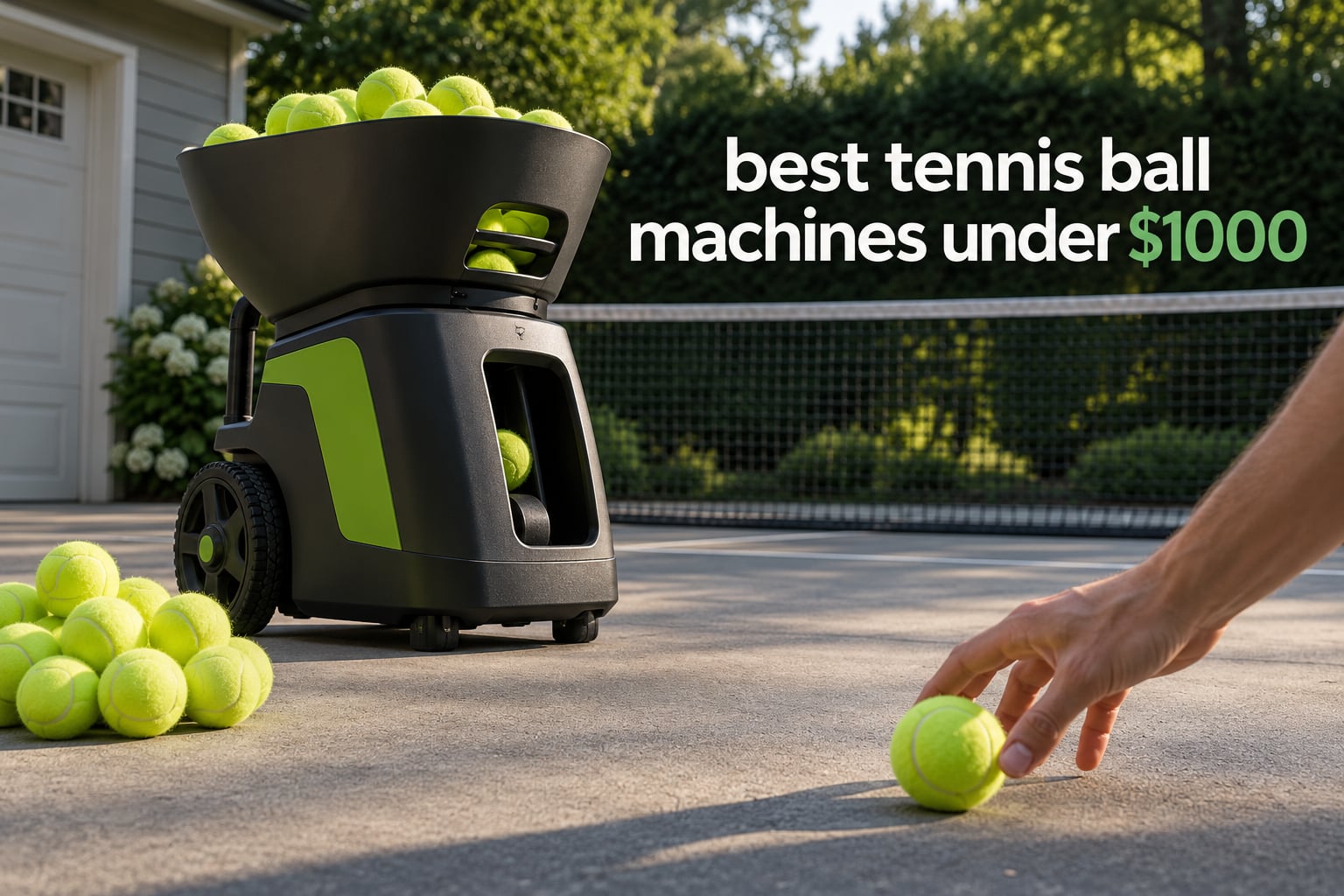
A ball machine is the single biggest upgrade a solo player can make, and the best tennis ball machines under 1000 dollars have dropped in price enough that the question is no longer whether you can afford one. It is which one you should own. I compared ten machines in this price band, checked the specification sheets against the manufacturer claims, and read what buyers actually say after living with them for a season.
What separates a good machine from a disappointing one rarely shows up in the feature list. Ball speed matters less than whether the feed is repeatable. Spin matters less than whether the oscillation sweep stays even. And battery claims matter far less than the number you get when you are running high-spin drills back to back for a full session.
This roundup covers everything you need to pick well: a ranked list of ten machines, a spec comparison you can scan in seconds, a buying guide that explains the four numbers that really matter, and honest notes on reliability. If you want a broader look at ball machines across all price bands, our tested roundup of the best tennis ball machines for practice covers the high end too. Updated for 2026.
Table of Contents
Top 3 Tennis Ball Machines Under $1000 in October 2026
Three machines stood out above the rest. The Nisplay N1 wins on the combination of genuine dual-motor spin, a swappable external battery, and the largest review base in this group. The Veva R3 Pro takes the smart-features crown with 28 programmable shot locations and voice control. The Sports Tutor Tennis Twist is the pick if you are a beginner or a parent buying for a junior player, and it carries the longest warranty in the lineup.

Nisplay N1 Dual Motor Machine
- Topspin and backspin from two motors
- Swappable external battery runs 4+ hours
- 80+ ball hopper with 68 MPH top speed

Veva R3 Pro
- 28 programmable shot locations
- Hey Veva voice control plus four app modes
- 16.5 lb body with up to 6 hours of play

Sports Tutor Tennis Twist
- Toss adjustable from 12 to 20 feet
- Weighs 10 lbs with a built-in handle
- 3-year warranty from a USA maker
Quick Overview of All 10 Machines in October 2026
Here is every machine in this roundup side by side. Hopper capacity, top speed, weight, and control method tell you most of what you need to know about whether a machine fits your court and your game.
| Product | Specifications | Action |
|---|---|---|
| Nisplay N1 Dual Motor Ball Machine |
|
Check Latest Price |
| Veva R3 Pro |
|
Check Latest Price |
| Sports Tutor Tennis Twist |
|
Check Latest Price |
 Furlihong 3819BH Furlihong 3819BH |
|
Check Latest Price |
 PUSUN PT-Mini Pro PUSUN PT-Mini Pro |
|
Check Latest Price |
 TENNIIX Basic Tennis Ball Machine TENNIIX Basic Tennis Ball Machine |
|
Check Latest Price |
 Nisplay L1 Backpack Machine Nisplay L1 Backpack Machine |
|
Check Latest Price |
 Sports Tutor eCannon Sports Tutor eCannon |
|
Check Latest Price |
 ADIBO T500 PRO ADIBO T500 PRO |
|
Check Latest Price |
 Sports Tutor Tennis Cube Sports Tutor Tennis Cube |
|
Check Latest Price |
1. Nisplay N1 Dual Motor Machine: Our Best Overall Pick
Nisplay Portable Tennis Ball Machine (26lbs) – Dual Motor for TopSpin and Backspin, 80+ Balls, Max 68MPH, 4+ Hours Play with External Lithium Battery (Ball Machine + Oscillator Combo)
68 MPH max speed
Topspin and backspin from two motors
4+ hours per battery charge
26 lb rolling frame
Pros
- Genuine two-motor spin rather than simulated topspin
- Battery swaps in seconds and charges separately
- 80+ ball hopper covers a long session
- Excellent customer service on replacements
Cons
- Remote does not move the oscillator
- Y-cable for the battery is reported short
- Oscillation sweep can skew to one side
This is the machine I keep coming back to after working through the whole list. The Nisplay N1 uses two separate motors to generate topspin and backspin rather than faking a single direction, which means you can work both sides of the ball without changing settings. Max speed is 68 MPH, fast enough for intermediate and advanced groundstrokes, and the feed interval runs from 1 to 9 seconds.
The external lithium battery is the detail that wins me over. It runs 4+ hours and it lives in a separate pouch with its own charger, so you can charge a second pack overnight while the first is still feeding. That solves the single most common complaint about built-in batteries, where a dead pack means no practice for the rest of the day. Buyers also praise the service record, with multiple reviews describing quick replacements when something went wrong.
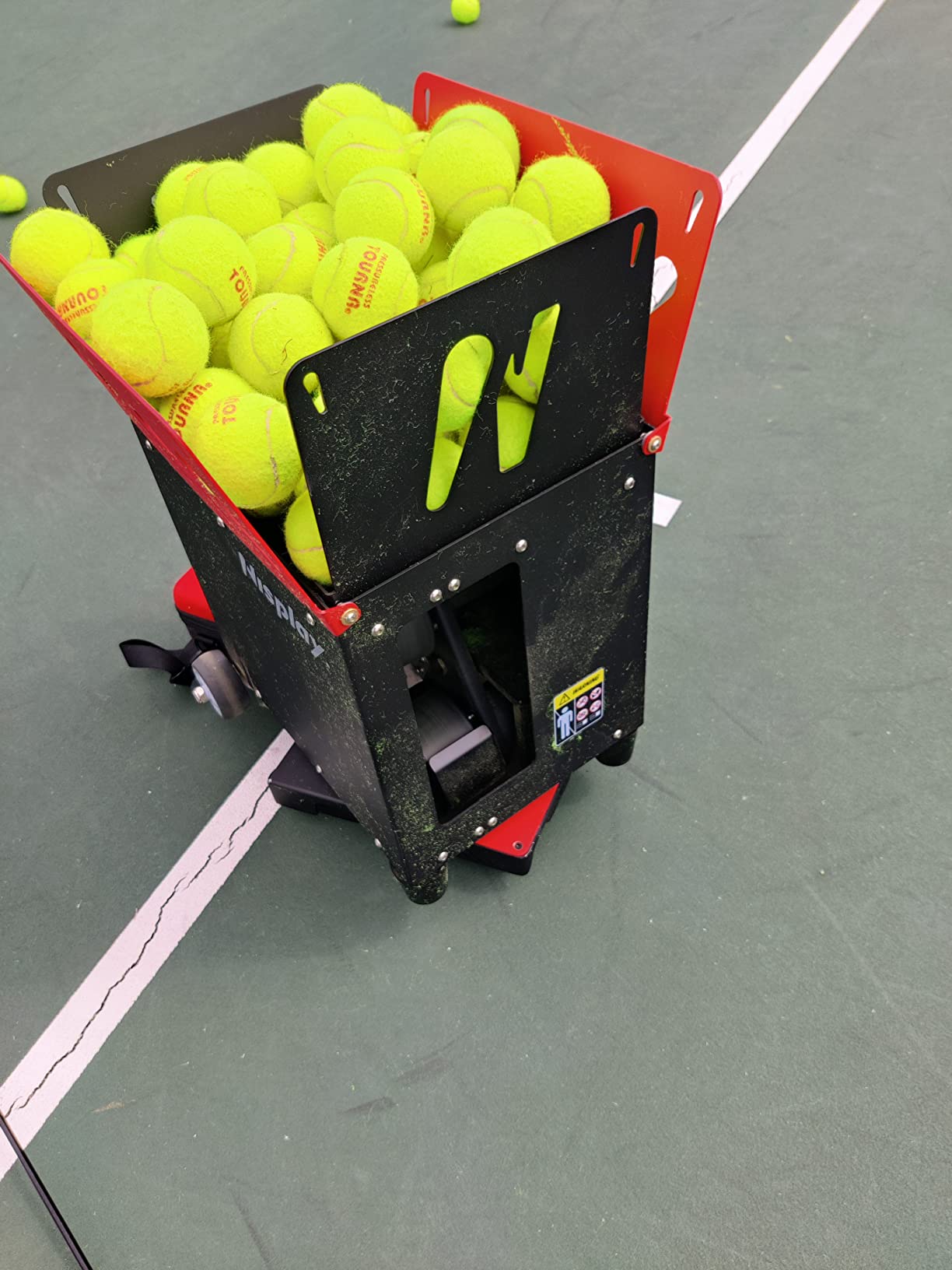
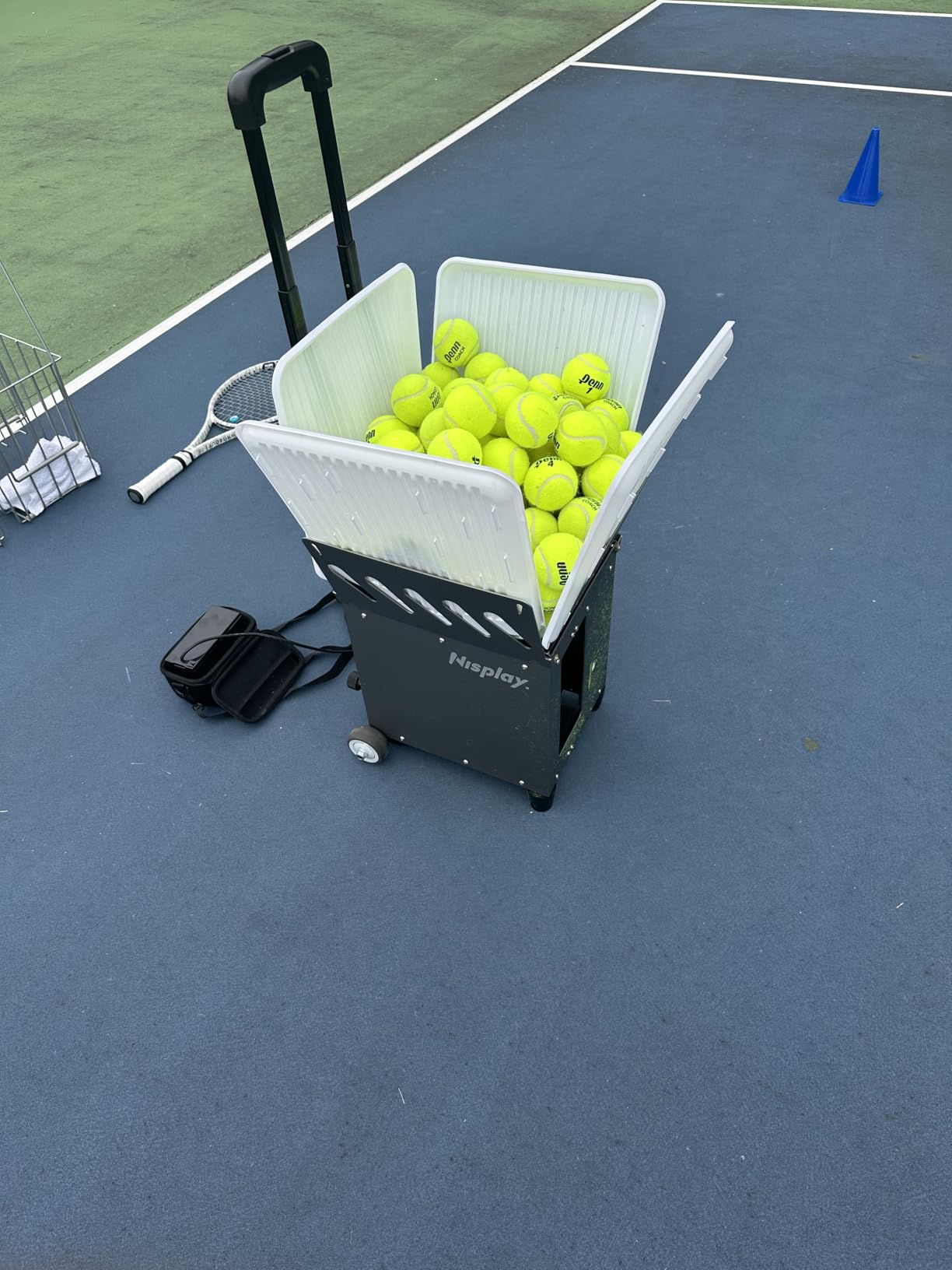
Portability is better than the 26 lb figure suggests. Oversized wheels and a 3-foot folding handle make it manageable across a driveway or parking lot, and the whole body is aluminum. Elevation adjusts from 0 to 50 degrees, which is enough range to work lobs and approach shots as well as flat groundstrokes.
The oscillator is a separate add-on that attaches to the machine, and it sweeps side to side. Be aware that the spray pattern can run wide on one side, so budget a few minutes of adjustment each session. The feed frequency knob is also labeled in a way that feels backwards to most people, where the high setting actually produces fewer balls between shots.
Can the Nisplay N1 run without an app?
Almost every competitor in this price band offers one of two things: spin or battery convenience. The N1 offers both, and it does so with the largest body in the group at 26 lbs. That weight is a real trade-off if you need to carry the machine up stairs, but for anyone loading it into a car trunk or wheeling it across a court, the extra mass buys a sturdier frame.
The 80+ ball hopper also means fewer mid-session refills than the 60 to 70 ball machines in this roundup. If you run long consistency blocks, that difference shows up in how much of your session is actually spent hitting balls.
Will the 26 lb weight stop you using it?
The remote is the weak point. It controls the ball feed but not the launch wheels and not the oscillator, so if you want to change speed you walk over to the machine. The included Y-cable for the battery connection is reported as too short, which can leave the pack hanging awkwardly. Owners also note that the battery connection points can loosen over time, so check them every few sessions.
Spin quality sits a step below the very best two-wheel machines, and there is no app. If you want programmable shot patterns you build yourself rather than a manual oscillator, look at the Veva R3 Pro or the ADIBO T500 instead.
2. Veva R3 Pro: The Best Smart Machine That Still Travels Light
Veva R3 Pro Tennis Ball Machine
28 programmable shot locations
Say Hey Veva to start a session
Up to 6 hours of play
16.5 lb body with a strap
Pros
- Moves at 16.5 lbs with a detachable strap
- 28 shot locations with custom drill building
- Topspin and backspin with horizontal oscillation
- Over-the-air updates keep the app current
Cons
- AI voice and positioning modes reported unreliable
- Carry strap must be removed before use
- Light base can drift during hard oscillation
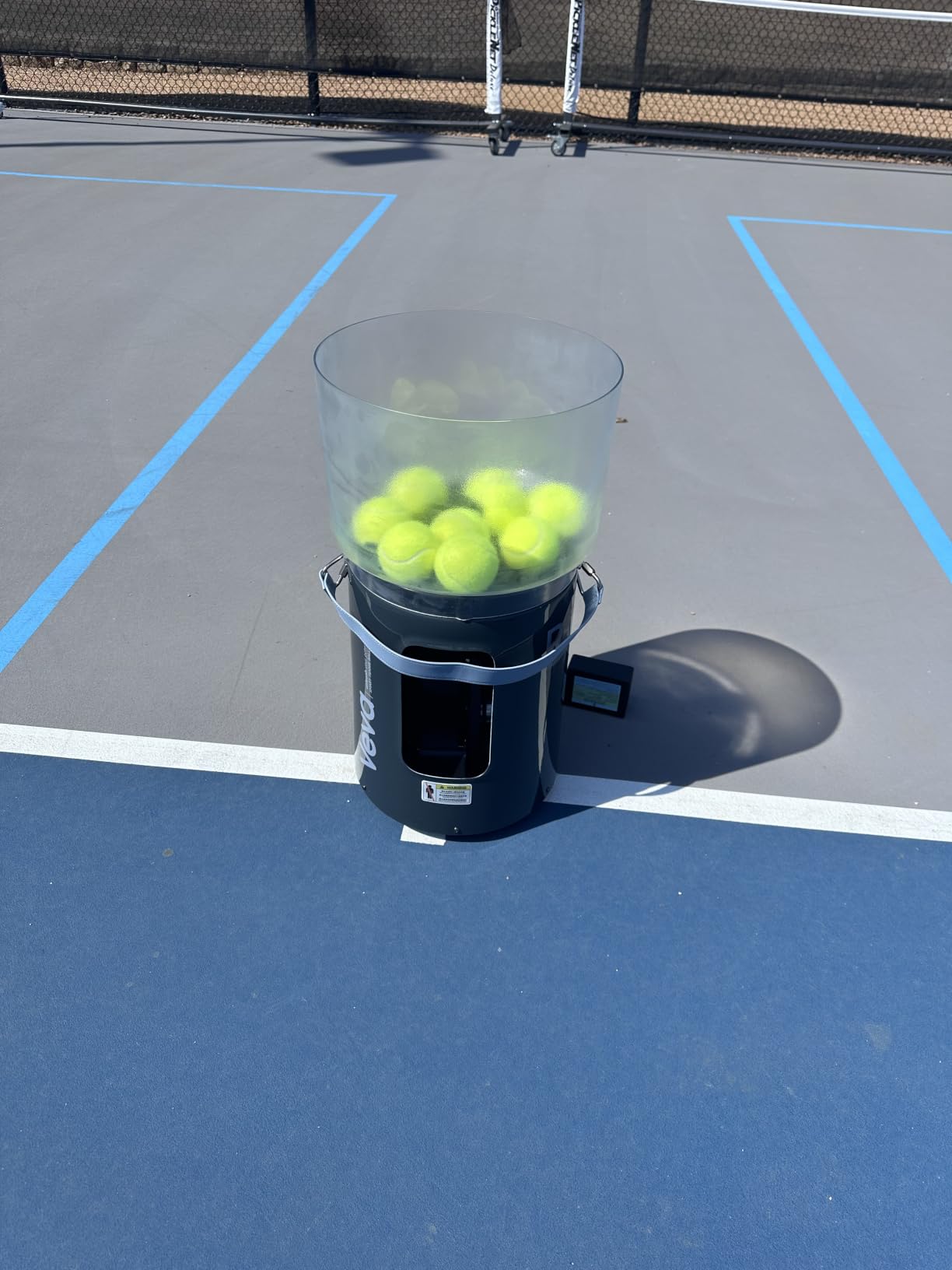
The Veva R3 Pro is the rare machine that is both app-driven and genuinely easy to carry. At 16.5 lbs with a detachable hand strap, it is about ten pounds lighter than the Nisplay N1 and roughly a quarter of the weight of a typical 40 lb club machine. The hopper holds 80 balls and the feed interval runs from 1 to 9 seconds, with a stated improvement of 33 percent over earlier models in this family.
What makes it stand out is 28 programmable shot locations. That is a genuine point-to-point drill system, closer to what a club machine offers than to a random feeder. Spin is real, with independent topspin and backspin plus horizontal oscillation, and battery life is listed at up to 6 hours of practice time.
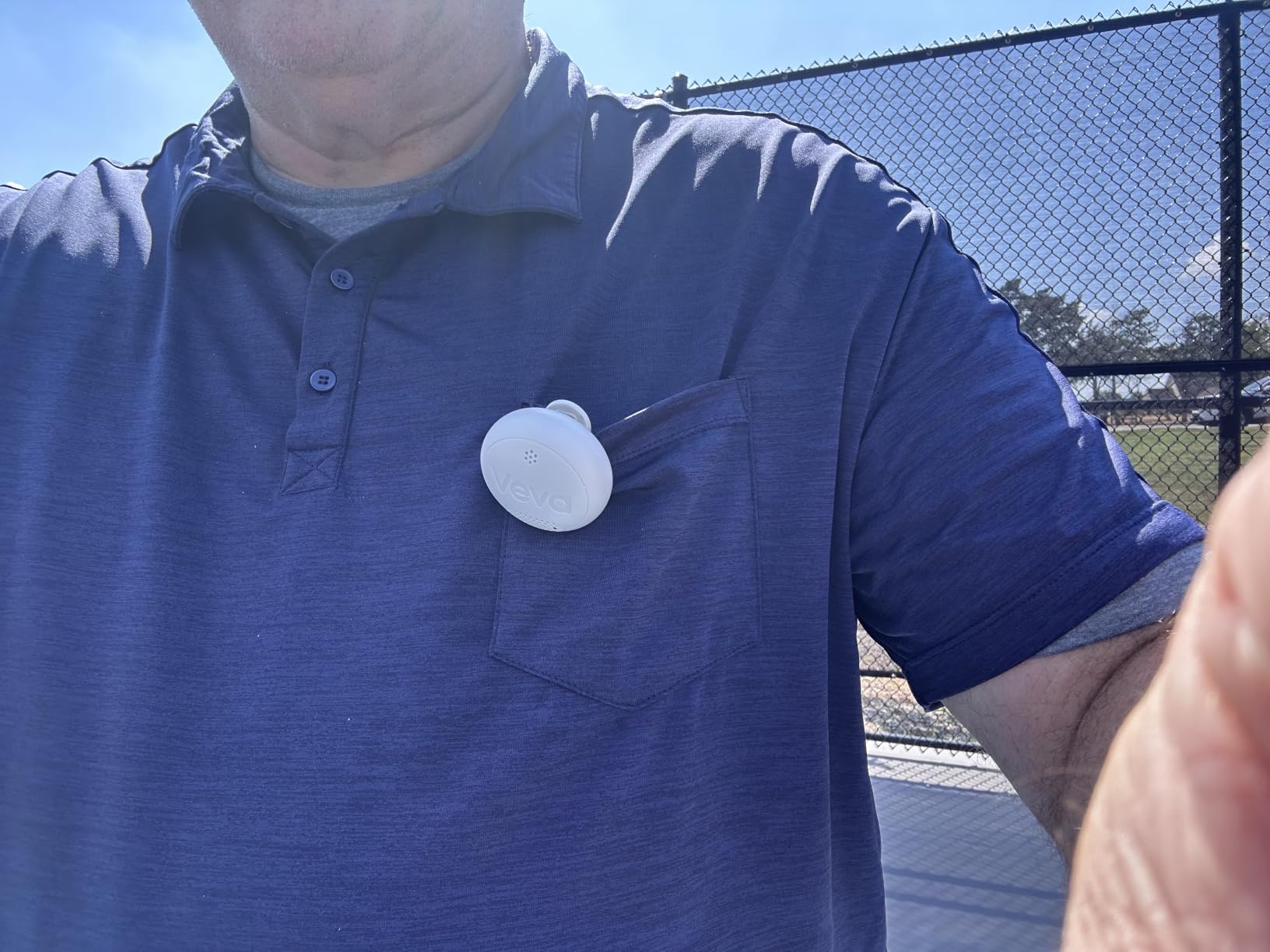
The body uses an ABS and PMMA shell around a carbon brush motor, and the app supports over-the-air firmware updates, so the feature set improves after you buy it. Control runs four ways: a physical panel, the app with basic, custom, advanced and AI modes, voice control with a Hey Veva wake word, and an optional handheld remote.
Here is where I temper the enthusiasm. Buyers rate the core ball delivery highly, which is why the star rating sits where it does, but the AI voice modes and the AI positioning mode are the most common complaints in the reviews. Treat the AI features as experimental and build your sessions in the custom and advanced modes instead.
Does the Veva R3 Pro suit a two-hour structured session?
This machine suits a player who wants programming depth without hauling 40 pounds across a driveway. If you are setting up two-hour sessions with structured point patterns, working on approach shots, and you want to start a drill from your phone, the 28 shot locations and app modes are worth paying for.
It is also the machine I would suggest to anyone practicing on a hard court or driveway with limited storage, since the strap and 16.5 lb weight make short walks and car loading painless. The 80-ball hopper means a full warm-up and a full drill block without stopping.
Do the AI voice modes hold up in practice?
The review base is small, which is the honest caveat on that 4.8 rating. With only a handful of reviews, long-term durability is not proven, and the warranty is 18 months rather than the three years offered by the Sports Tutor machines.
Two physical details annoy owners. You have to remove the carry strap to use the machine, which is a small thing every single time. The battery cable also lacks a dedicated storage slot, and the lightweight base can creep across the surface during aggressive oscillation on a hard court. The leak compensation feature helps with odd ball pressure, which is useful if you feed a mix of cans.
3. Sports Tutor Tennis Twist: Best for Beginners and Junior Players
Sports Tutor Tennis Twist. Tennis Ball Machine – for Beginners. Battery Powered. Adjustable Toss. Made in USA by #1 Tennis Machine Company
12 to 20 foot adjustable toss
10 lb with built-in handle
8-10 hours on 6 D batteries
3-year USA warranty
Pros
- Easiest machine here to set up and use
- Weighs 10 lb with a built-in handle
- Throws pickleballs and oversize balls
- Three-year warranty from a USA maker
Cons
- Fixed 5 second feed interval with no adjustment
- 28 ball capacity means frequent refills
- Flat shots only
- no spin
The Tennis Twist does one job extremely well: it puts a ball in front of a beginner who cannot yet feed themselves a rally. There is no programming, no app, and no learning curve. The toss adjusts from 12 to 20 feet, which is roughly the range a new player needs for forehand and backhand groundstrokes, and it throws a ball every 5 seconds on a fixed interval.
At 10 lbs with an integrated carrying handle, this is the machine I would hand to a parent who wants a junior player practicing without supervision. It runs on 6 D-size alkaline batteries for 8 to 10 hours of operation, so you are not dragging a cable across a driveway or hunting for an outlet on a public court.
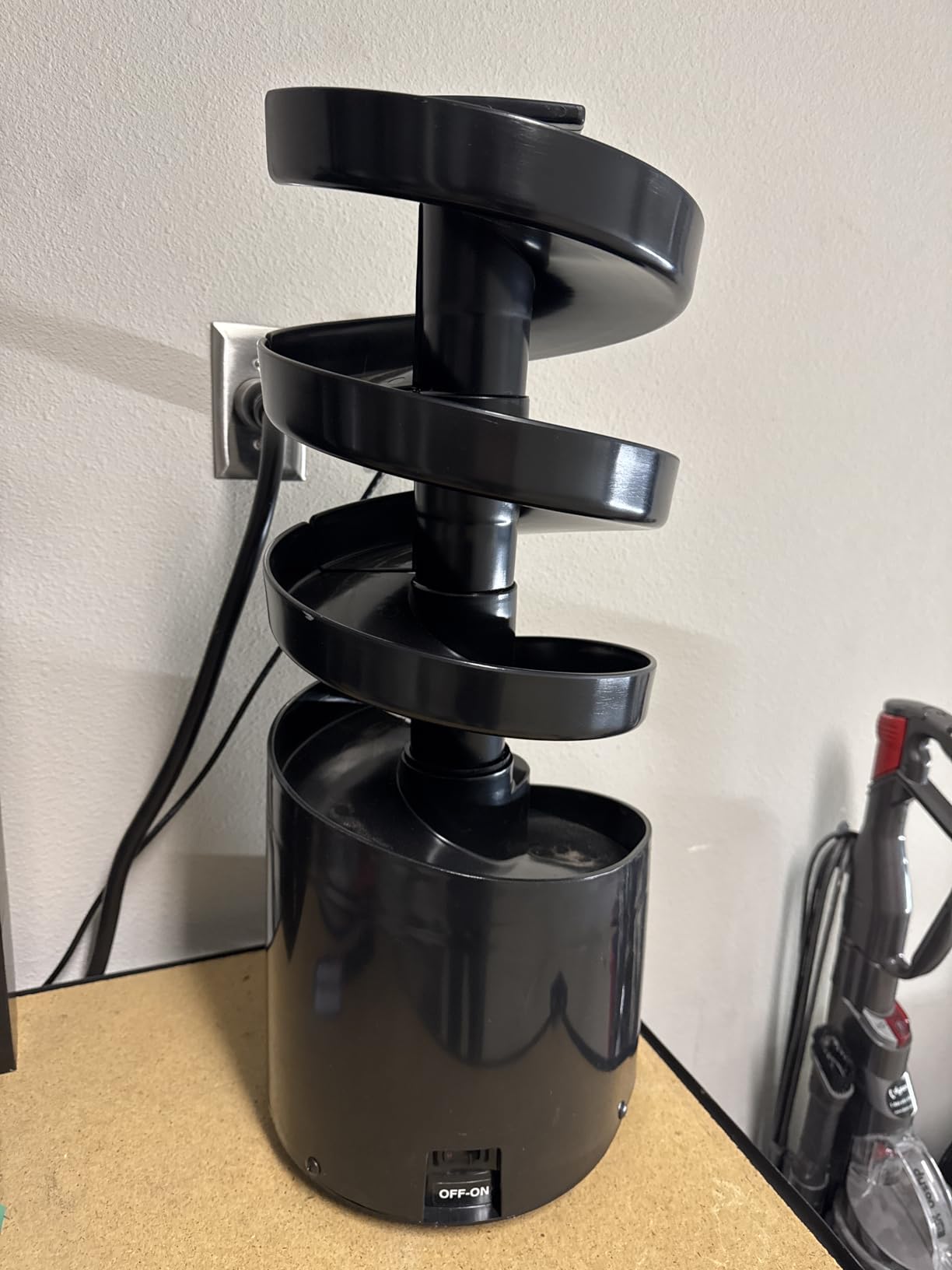
It is made in Burbank, California, and the 3-year warranty is the longest in this roundup. That matters more than the spec sheet suggests. Beginner machines get dropped, carried by younger players, and left in garages, and a three-year warranty means the failure that ends your practice sessions is covered.
It also throws pickleballs and oversize tennis balls, so the same machine works for a multi-sport household. Parents who already own a pickleball setup can check our ball hopper roundup for basket options to pair with it.
Will a 10 lb machine outlast a junior player?
A new player does not need 68 MPH or programmable drills. What a new player needs is a consistent, repeatable feed at a comfortable height, delivered often enough to build a rally. That is exactly what the Tennis Twist does, and its low speed ceiling protects a developing swing from absorbing shots it cannot handle.
The tradeoff is real: 28 balls is a small hopper, so you will refill often. Plan for a refill every few minutes of continuous hitting. The 5-second interval cannot be shortened, so rally-building at pace is not something this machine supports.
When should a beginner outgrow the Tennis Twist?
Move up once you are consistently hitting forehands and backhands at a rally pace, or once you want to work on approach shots and volleys that need more elevation. At that point the missing spin becomes the limiting factor, and a two-wheel machine like the Nisplay N1 or the eCannon makes more sense.
Because batteries are not included, budget for a fresh set of D cells before the first session. The runtime is measured with alkaline cells, and cheap rechargeable cells typically deliver noticeably less.
4. Furlihong 3819BH: The Budget Pick for Lightweight Practice
Furlihong 3819BH Portable Tennis Ball Machine
8.8 lb plastic body
5 adjustable angle settings
2 power levels and 4 intervals
Top speed 30 MPH
Pros
- Weighs under 9 lb and moves easily anywhere
- 5 angle settings for varied stroke shapes
- Two power levels and four serve intervals
- 12-month warranty included
Cons
- AC adapter only
- no built-in battery
- 30 MPH ceiling limits challenging players
- Plastic body feels less substantial
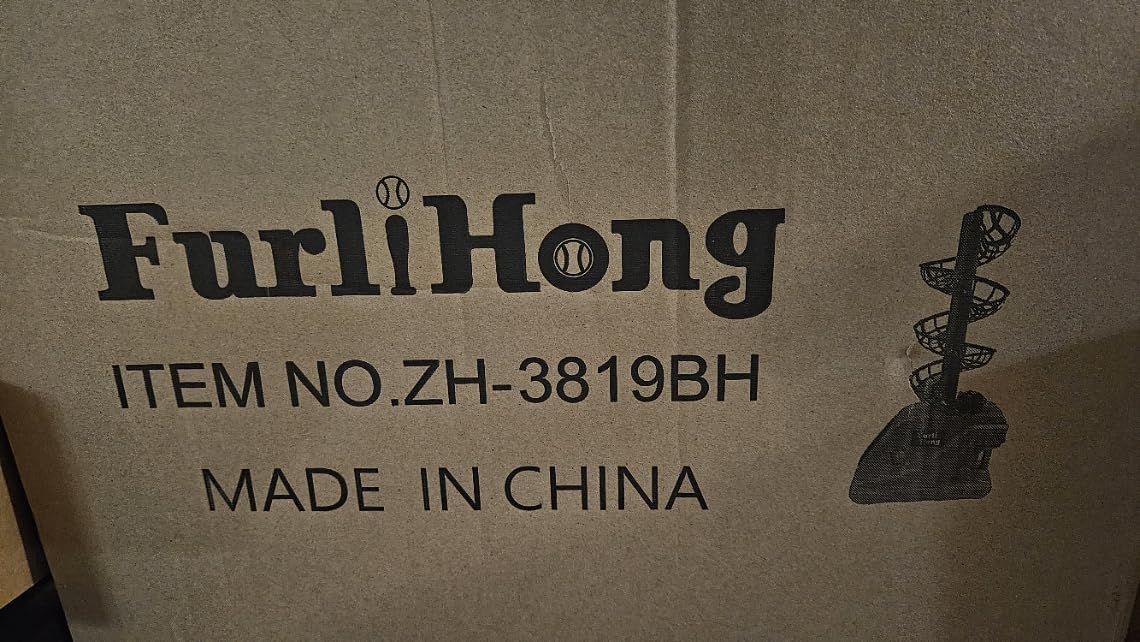
The Furlihong 3819BH sits at the bottom of this price band and the weight scale at 4.01 kg, or 8.8 lb. That is lighter than the Sports Tutor Tennis Twist by a little over a pound, and it is the machine to consider if your practice spot is a balcony, a small driveway, or anywhere you would rather not drag a heavier frame.
Control is manual and simple. Five angle settings cover forehand, backhand, flat, slice and volley trajectories, two power levels give you a coarse speed split, and four serve intervals control the gap between balls. Top speed is 30 MPH, which is genuinely useful for beginners and juniors and pointless for a competitive player.
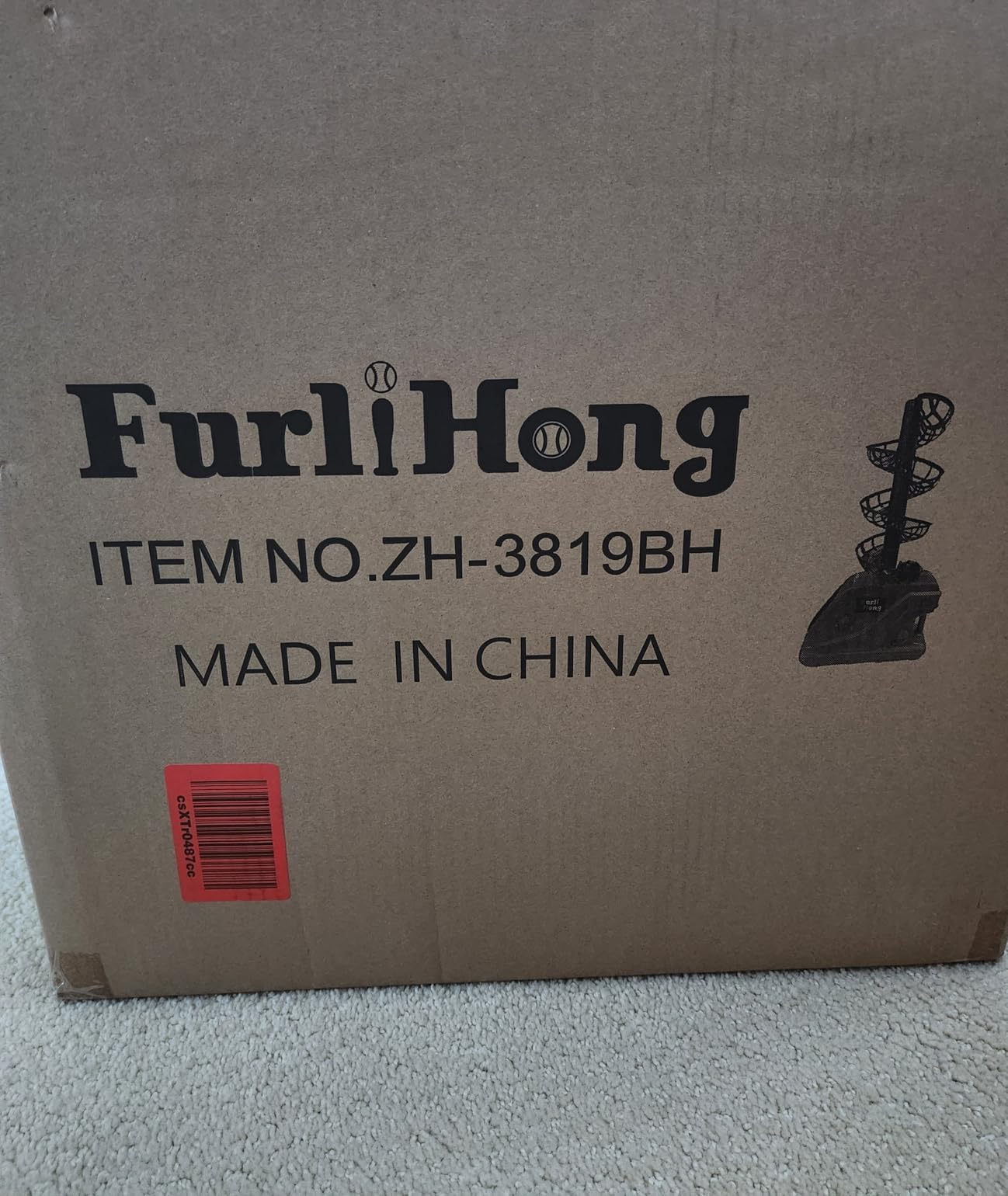
Reviewers consistently praise the portability and the variety the angle settings provide for solo training at low intensity. The top speed of 30 MPH is enough to build a rally and to drill footwork patterns, and the body stays stable at that level.
It ships with six ball tracks, a top track, an AC adapter, and a screwdriver. The multi-track setup is unusual at this tier and gives you more launch options than the two or three positions a bare-bones machine offers. That is a meaningful advantage for a player who wants to vary where balls land without moving the machine.
Is 30 MPH enough to build a rally?
Simplicity and reach. There is no app to pair, no firmware to update, and no account to create. You plug in the AC adapter, pick an angle, and hit balls. For a first machine, a parent, or a player practicing alone in a small space, that is a fair trade for the lack of battery and the modest speed ceiling.
It is also one of only two machines here under 10 lb, which makes it the easiest to move from a storage closet to the court and back. If your constraint is weight rather than features, this is the pick.
Can the Furlihong work without a nearby outlet?
Power comes from an AC adapter, so it only works within reach of an outlet. That rules out public courts and park practice, and it rules out any garage or driveway setup without an outdoor outlet.
The 30 MPH ceiling means no serious pace work, and the plastic construction is the least substantial in the roundup. Buyers with heavy hands or outdoor storage should expect to handle it more carefully than the aluminum or ABS-and-metal bodies above it. The warranty is 12 months, the shortest we cover.
5. PUSUN PT-Mini Pro: Best for Junior Players and Small Spaces
Tennis Ball Machine, Pusun PT-Mini Pro Tennis Serve Laucher for Beginner, Support App&Remote Control, Hold 65+Balls, 60km/h Max Serving Speed,Built-in Batter Last 3-5Hours, Portable and Easy to Use
17.6 lb body with carry handle
5 to 37 MPH speed range
65+ ball hopper
3-5 hour built-in battery
Pros
- 17.6 lb size fits a junior or teen to carry
- Built-in battery means no adapter cable
- App and remote control over Bluetooth
- 3-year warranty
Cons
- Top speed of 37 MPH limits advanced work
- Random oscillation is horizontal only
- Only 7 reviews
- so long-term life is unproven
The PT-Mini Pro is listed for youth players, and the sizing backs that up. At 17.6 lbs with a built-in carry handle and a compact body, it is one of the easier machines for a teenager to move from a car to a court without an adult helping. The item diameter is listed at just over 10 cm, so it genuinely is a small machine.
Speed runs from 8 to 60 km/h, which is 5 to 37 MPH. That range covers rally-building and early development work but stops well short of what an adult club player would need for fast balls. Launch angle adjusts from 20 to 70 degrees and reaches past 14 meters, which covers a good portion of a singles court from the baseline.
Seven drill modes are built in, including forehand, backhand, volley, fixed-point, random horizontal, and adjustable topspin and backspin. Control runs two ways: a pocket remote and a smartphone app over Bluetooth 5.0 with a listed range of 50 to 80 meters. The feed interval adjusts from 1.6 to 8 seconds and the hopper holds 65+ balls.
The built-in lithium battery runs 3 to 5 hours, which is a genuine convenience over machines that need a cable or a separate pack. No charging setup to pack, no cable across the court. That matters most for scheduled practices that happen away from an outlet.
Is 17.6 lb light enough for a teen to carry?
The combination of low weight, a real battery, a 3-year warranty, and a top speed low enough to keep rallies alive makes this the most practical machine in the roundup for a junior. Reviewers highlight exactly this: the app control and portability make practice accessible for kids and new players, and the drill modes give a coach or parent something concrete to program.
Because the speed ceiling is 37 MPH, a junior who graduates past this level will quickly outgrow it. Treat it as a two or three year machine rather than a long-term investment.
Is 37 MPH too slow once the player improves?
With only seven reviews, the long-term reliability picture is thin. Reviewers themselves flag the limited sample, and the plastic-and-metal construction is lighter duty than the aluminum bodies elsewhere in this list.
The random oscillation is horizontal only, with no vertical sweep, so depth variation has to come from your feet rather than the machine. Full feature access also depends on the app and Bluetooth link, which means a dead phone battery costs you the remote and the programming at the same time. Keep the physical remote in your bag.
6. TENNIIX Basic Tennis Ball Machine: Best for Voice Control and Long Sessions
TENNIIX Basic Tennis Ball Machine, 18.7LB Portable Tennis Robot, Black
75 MPH dual-wheel top speed
4 hours per charge
100+ ball hopper
Voice control, 46 keywords
Pros
- Dual motors for genuine topspin and backspin
- Fastest top speed of the group at 75 MPH
- 4 hours and about 1800 shots per charge
- 100+ ball hopper
Cons
- Voice control has a real learning curve
- App dependency for advanced features
- Folds down but still needs two hands to carry
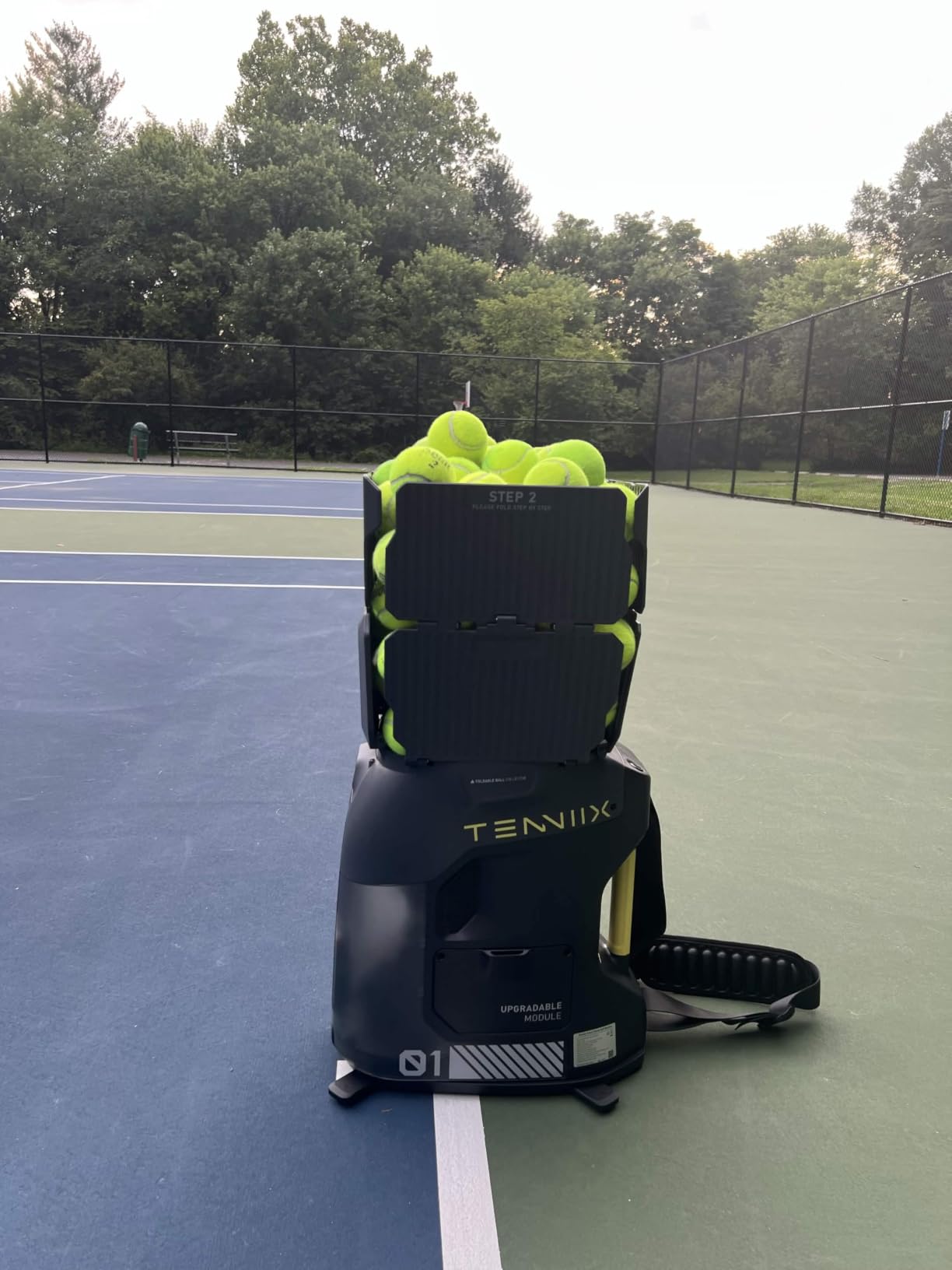
The TENNIIX Basic is the fastest machine in this roundup, with a dual-wheel system rated to 75 MPH. That number covers almost any ball an intermediate or advanced player would want to hit from the baseline, and the dual-wheel layout is the same architecture the top two-wheel machines use to generate genuine spin.
It is also the only machine here that measures output in shots rather than hours. The 7000 mAh battery delivers up to 4 hours and about 1800 shots per charge. For a player running high-volume consistency blocks, counting shots is a more useful metric than counting hours.
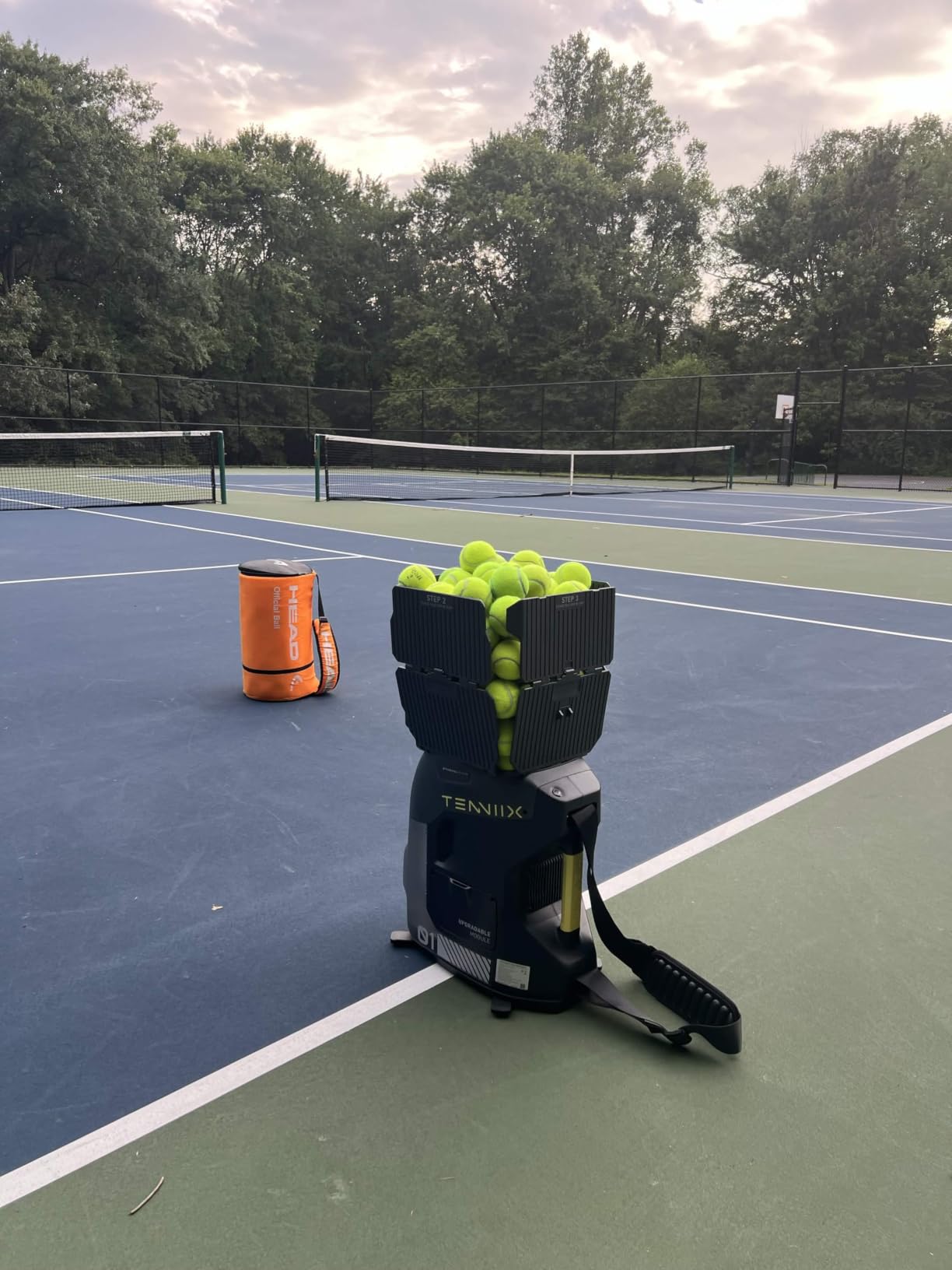
The hopper holds 100+ balls, the largest capacity of any machine here except the ADIBO, which matters on long sessions where you do not want to break rhythm to refill. Training modes include 9 shot patterns and 6 match play modes with NTRP presets at levels 1 through 3, plus an app advertising more than 1000 unique ball combinations.
Control is the reason most people notice this machine. It has a microphone, a speaker, Bluetooth 5.2, and WiFi, and it responds to 46 direct voice keywords. There is also a voice armband in the box and an extended strap, so you can start a session without touching the machine.
Does 75 MPH cover full-speed baseline balls?
Voice control at this level of vocabulary is unique in this price band. When you are hitting 1800 balls in a session, the ability to say the next change out loud instead of walking over to a panel is a real convenience, and the armband means you do not need your phone in hand.
It folds down to roughly 15 by 11 by 18 inches and weighs 18.7 lb with non-slip handles. That is heavier than the Veva and the Nisplay L1 but still manageable for one person, and the folded footprint is genuinely compact for a garage or closet.
Is the voice control reliable enough to run a session?
Voice control has a learning curve, and buyers say so directly. The keywords work, but you have to learn the phrasing, and a misheard command in the middle of a rally breaks your focus. Test the commands in an empty session before you rely on them.
Advanced features live in the app, so this is an app-dependent machine in a way the knob-controlled Sports Tutor models are not. There is also an AI vision module upgrade path, which sounds appealing but inherits the same uncertainty as the AI features on the Veva. The warranty is one year from the manufacturer.
7. Nisplay L1: Best for Carrying It Like a Backpack
L1 Tennis Ball Machine For Practice, 13.2lb Portable Tennis Robot(Black)
13.2 lb cylindrical backpack body
40 MPH top speed
60 ball hopper
App plus pocket remote
Pros
- Carries at 13.2 lb on a shoulder strap
- Backpack-style body needs no wheels
- Red Dot
- iF and IDEA Gold design award
- ABS and metal construction
Cons
- Only 5 reviews
- so reliability is unproven
- 40 MPH ceiling limits advanced players
- No built-in oscillation
- manual angle only
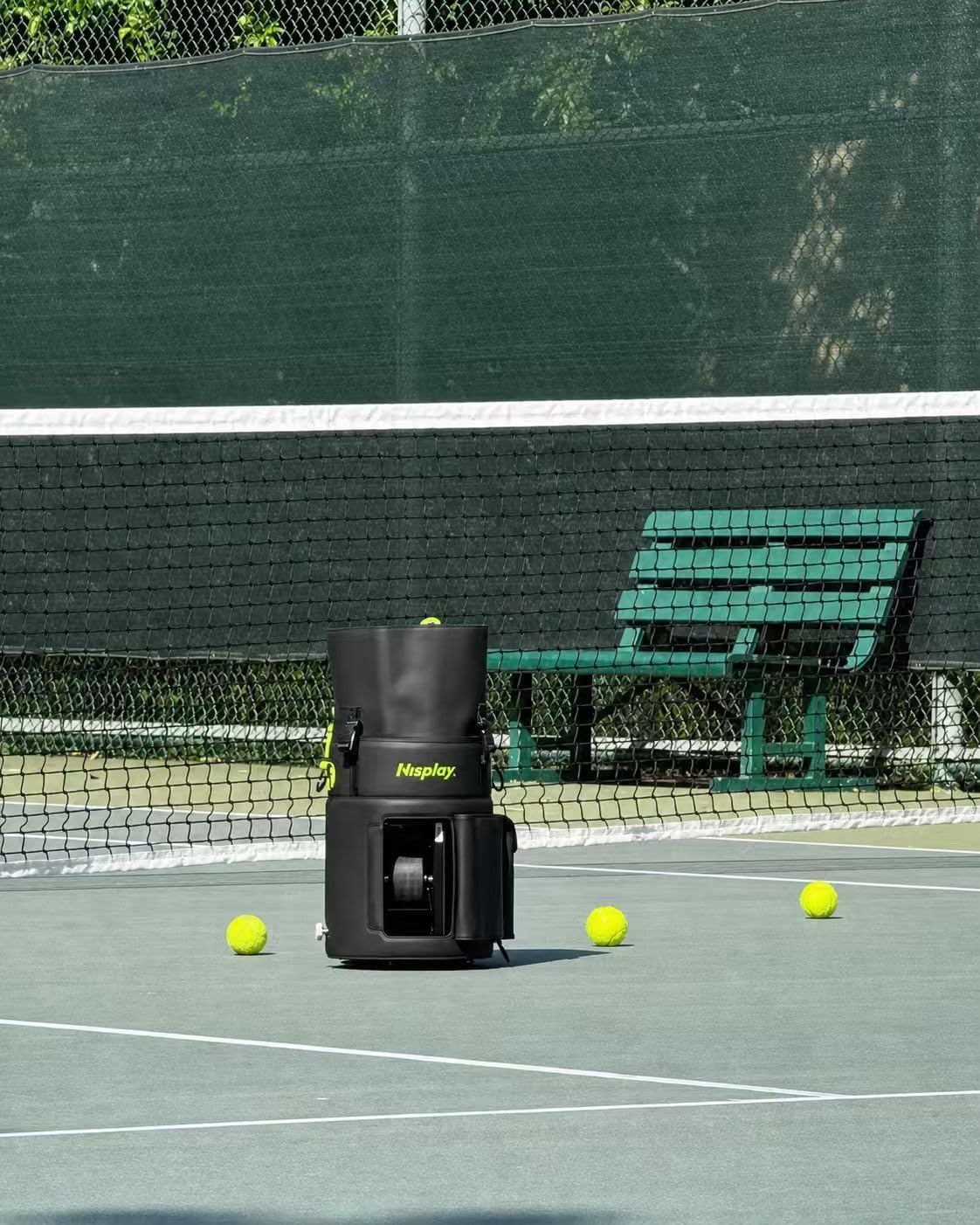
The Nisplay L1 is the one machine here you can genuinely wear. Its cylindrical body and shoulder strap turn a ball machine into something that moves like a large bag rather than something you carry in two hands, and at 13.2 lb it is the lightest full-size machine in the roundup. If your practice spot involves a staircase, a path, or a long carry from a car, that design choice matters more than any spec.
Speed tops out at 40 MPH, feed interval runs from 1 to 9 seconds, and the hopper holds roughly 60 balls. Launch angle adjusts manually from 15 to 55 degrees. The construction is industrial-grade ABS and metal, which is a step up from the plastic-only bodies at the low end.
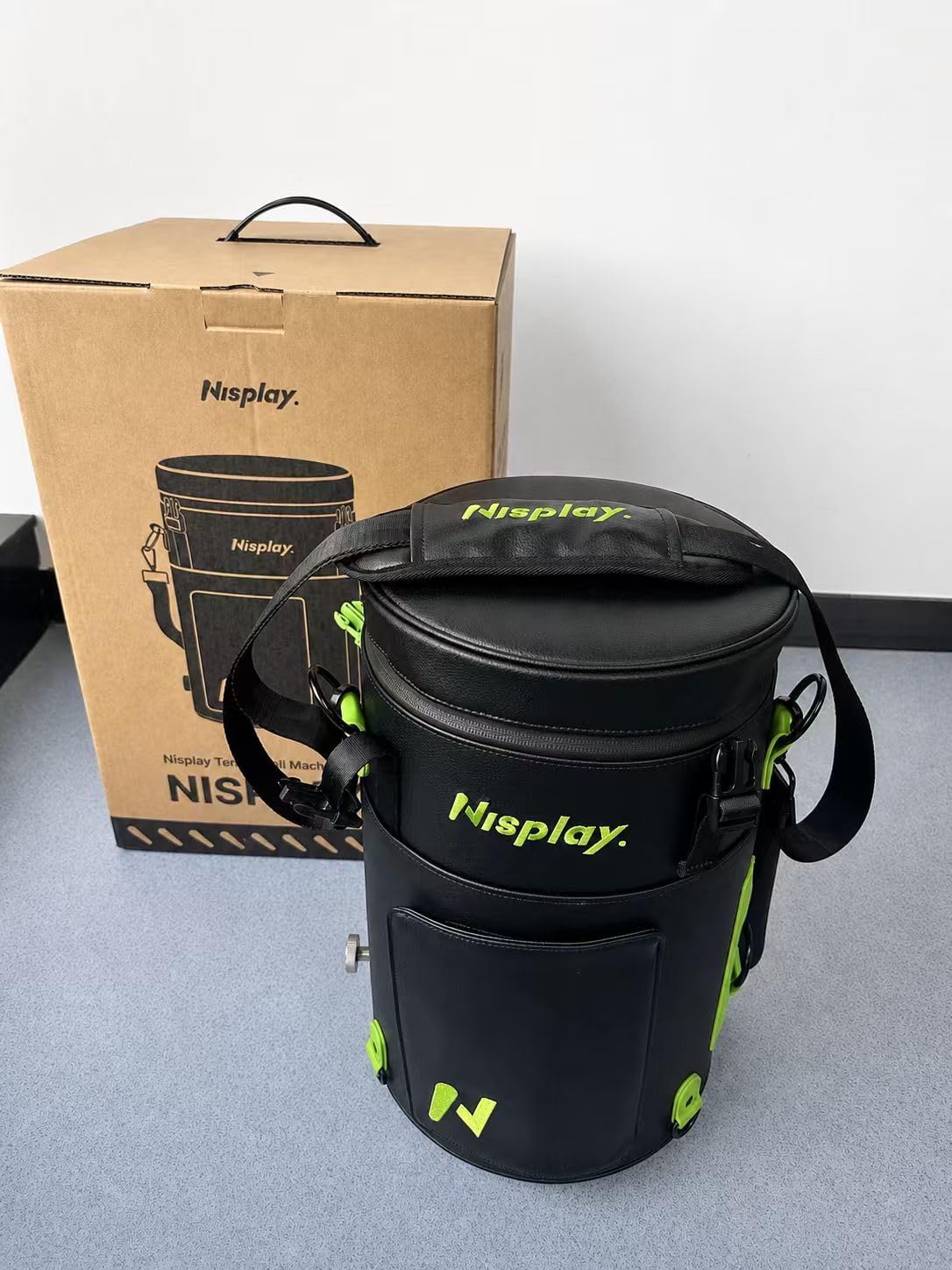
Control runs through the NISPLAY app plus a pocket-sized remote, with multiple training modes and the ability to build custom drills. The company cites a design award slate including Red Dot, iF, and IDEA Gold, and a Kickstarter backing above one million dollars across more than 30 countries.
The 5.0 rating across five reviews reflects genuine enthusiasm for the form factor. Owners describe it as an award-winning design that solves the transport problem cleanly. Take that rating as a signal about design satisfaction rather than as a measure of long-term durability, because five reviews cannot tell you that.
Can a 13.2 lb machine cover a full court session?
This is the machine for a player who practices alone at a location they have to walk to. Ten pounds less than the Nisplay N1 and roughly half the bulk makes it the easiest to bring to a public court or a friend’s place. Nobody has ever skipped a session because the machine was too heavy to move.
For a junior, an older player, or anyone with mobility limits, the strap and low mass are the deciding factors. The 60-ball hopper is enough for warm-ups and short blocks, though you will refill more often than with an 80 or 100 ball machine.
Is 40 MPH the right ceiling for your game?
The 40 MPH limit is a genuine compromise. That is fast enough for solid rally work and footwork patterns but not enough for an advanced player who wants to practice against pace. There is also no built-in oscillation, so you set the launch angle once and move the shot pattern with your feet.
Add the very small review base and the absence of a stated warranty in the listing, and this becomes a design-led choice rather than a risk-averse one. If you need warranty certainty, the three-year Sports Tutor machines are the safer route.
8. Sports Tutor eCannon: Best for Genuine Topspin Work
Sports Tutor eCannon Tennis Ball Machine with TOPSPIN. Compact – Weighs only 23lbs. for Intermediate and Advanced Players. Made in USA by #1 Tennis Machine Company.
Genuine topspin feed
Three speeds: 20, 35, 45 MPH
23 lb with carry handle
3-year USA warranty
Pros
- Genuine topspin rather than a flat feed
- Three distinct speeds
- no app needed
- Built-in rechargeable battery with a smart charger
- USA build with factory support
Cons
- Topspin only
- which rules out beginners and backspin work
- 2 hour battery is one of the shortest here
- Feed interval is tied to the speed setting
The eCannon is built for one specific job: hitting balls with real topspin at a player who is already past the beginner stage. It comes from Sports Tutor, the same USA maker as the Tennis Twist, and it carries the same 3-year manufacturer warranty. The distinction between the two is stark, and it comes down to spin.
Three speed settings sit at 20, 35, and 45 MPH, and the feed interval adjusts automatically based on which one you select. That is a limitation if you want independent control, but it removes a dial that beginners and mid-level players constantly mis-set. Operation is two pushbuttons.
The internal rechargeable battery delivers up to 2 hours of play, and the included smart battery charger is designed for an overnight charge with automatic shutoff. Body weight is 23 lb with a built-in carrying handle, and the unit measures 13 by 11 by 25 inches. Ball capacity is 70 balls, which matches one standard pickup basket.
Shot selection covers groundstrokes and volleys. There is no remote, no app, and no programming, and that is intentional. Nothing to pair, nothing to update, no account, and factory support in Burbank, California if something goes wrong.
Does topspin-only feed actually build a groundstroke?
A heavy topspin feed is what makes groundstroke technique honest. Without spin, a player learns a flat contact point that falls apart against a real ball with rotation. The eCannon gives you a ball that drops into the court, which forces you to hit through it and prepare earlier.
For a player moving from beginner to intermediate, that is the drill you actually need. The feed is also quieter-feeling to play against because the ball lands rather than skids, which makes the practice feel closer to live tennis.
Will a 2 hour battery be enough for a long session?
Do not buy this machine as a first ball machine. A beginner cannot control topspin, and a pure topspin feed frustrates rather than helps at that stage. The Sports Tutor Tennis Twist is the correct pairing for a brand new player in the same family.
The 2-hour battery is the shortest here, and the feed interval cannot be set independently of the speed. If you want long sessions, you will be charging overnight, and if you want a two-second gap at 45 MPH, you do not get a choice. There is also no oscillation in either direction, so every ball comes from the same spot.
9. ADIBO T500 PRO: Best Hopper Capacity and Longest Runtime
ADIBO Tennis Ball Machine, Internal Oscillation, Authentic Programming, Dual Motors with Topspin & Backspin, 160+ Balls, 6-Hour Non-Stop Runtime, Stable Voltage Contro
160+ ball hopper
6 hours of runtime
Internal oscillation, no vibration
Dual motors for spin
Pros
- One of the largest hoppers here at 160+ balls
- 6 hour runtime covers a full long session
- Internal oscillation runs without visible vibration
- Unlimited custom drill storage through the app
Cons
- Very new
- with only 4 reviews
- Weight and full dimensions are not disclosed
- Warranty terms are not stated in the listing
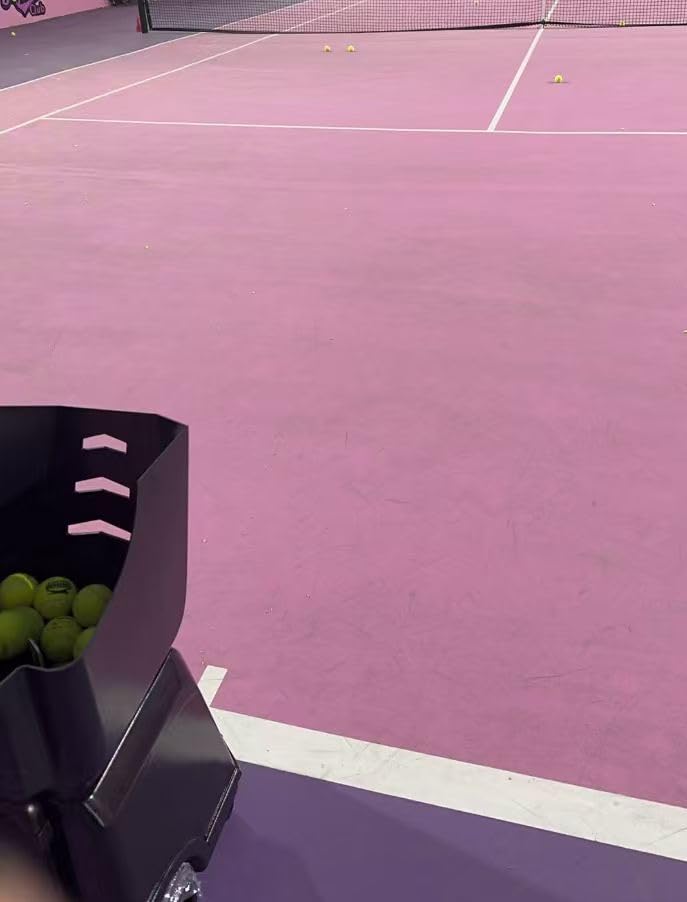
On paper the ADIBO T500 PRO has the biggest numbers in this roundup. The hopper holds 160+ balls, roughly double most of the field. Runtime is listed as 6 hours of non-stop operation with stable voltage control, which matters because output usually sags as a battery drains. Dual motors give independent topspin and backspin.
The oscillator is internal rather than an external arm, and the manufacturer claims it runs without vibration. In practice that is the detail that separates this from a bolted-on oscillator: the machine stays planted, which is what you want when the spray is wide and the feed is fast.
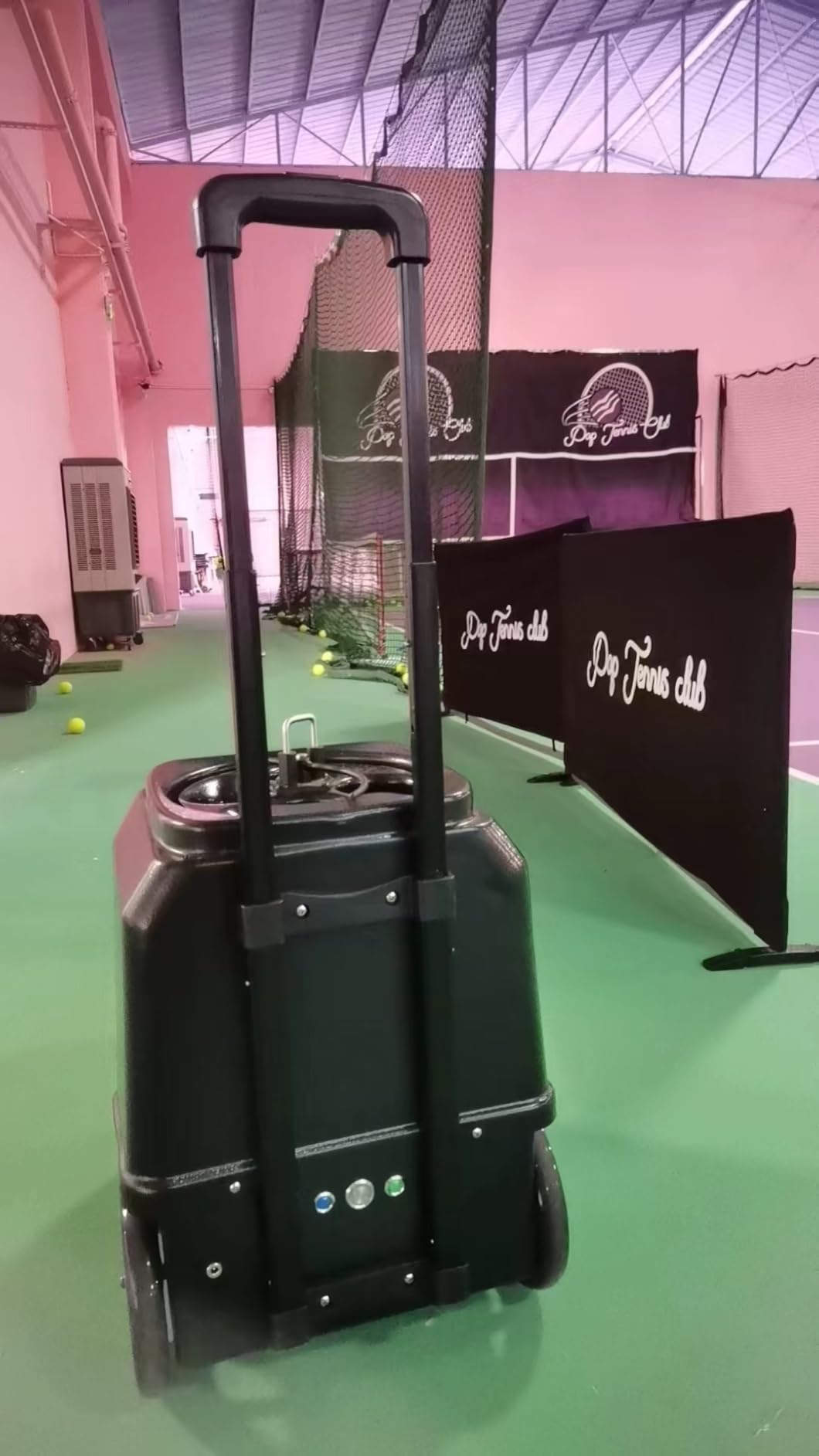
Programming is the other strength. There are hundreds of preloaded drills plus unlimited custom drill storage, with independent adjustment of elevation angle, side-to-side placement, and spin. NTRP levels from 1.0 to 7.0 are supported, and an iOS and Android app receives store updates, so the machine is not frozen at purchase.
That is a compelling feature list. The catch is evidence. The machine is a recent release and has four reviews, a low category sales rank, and no warranty terms stated in the listing. Weight and full dimensions are also not disclosed, which makes transport planning difficult.
Do 160 balls and 6 hours change a session?
A 160-ball hopper changes session structure. You can load once and run warm-ups, a consistency block, a point-pattern drill, and a serve-and-return block without crossing the court to refill. On a machine that holds 60 balls, refilling four or five times eats ten minutes you wanted to spend hitting.
The 6-hour runtime pairs well with that. If your practice window is long and you do not want to stop halfway to charge, this solves the problem better than anything else here. The internal oscillator also means no external arm to assemble or misalign, and no vibration to rattle the frame during a fast feed.
Is four reviews and no stated warranty a risk?
Everything above comes from the specification sheet, not from long-term ownership. Four reviews cannot tell you how the battery holds up after a full year, whether the app stays stable through updates, or how the company handles a warranty claim when none is clearly stated.
There is also a support question. The brand is less established than Sports Tutor or Nisplay, and factory support matters when a machine with 160 balls and internal motors develops a fault. If you want the same spec ambition with a documented warranty behind it, look at the Nisplay N1, which has the largest review base in the roundup at 46 reviews and a documented support record.
10. Sports Tutor Tennis Cube: Best Built-In Random Oscillator
Sports Tutor Tennis Cube Tennis Ball Machine. Super Compact, Weighs just 24 lbs. Speed 50 MPH. Built-in Random Oscillator. Made in USA by #1 Tennis Machine Company
Built-in random oscillator
10 to 50 MPH range
2 to 10 second feed interval
24 lb with handle
Pros
- Random oscillator built into the body
- Speed range of 10-50 MPH on a simple knob
- Adjustable feed interval
- USA made with a 3-year warranty
Cons
- Only 3 reviews
- an extremely small sample
- 2 hour battery life
- Flat shots only with no spin control
The Tennis Cube does something most machines at this size skip: it has a random oscillator built into the body. A ball machine that scatters shots unpredictably forces you to move your feet and recover, and that is the difference between hitting a static feed and training actual court coverage. Having it built in, rather than as a bolt-on arm, keeps the machine at 24 lb with a compact 15 by 12 by 13 inch footprint.
Speed runs from 10 to 50 MPH on a knob, and the feed interval adjusts from 2 to 10 seconds. Both are simple, tactile controls with no app, no programming, and no remote. The internal rechargeable battery runs up to 2 hours and the smart charger is designed for overnight charging with automatic shutoff.
Ball capacity is 70 balls, which corresponds to one standard pickup basket, so filling the hopper is a familiar routine. Shot selection runs from groundstrokes up to lobs, and the knob controls are precise enough for a repeatable session even though they are not digital.
It is made in Burbank, California, with a 3-year warranty and factory support. That warranty is the strongest support position in the roundup, which matters when you are buying a machine with a three-review track record.
Does a built-in random oscillator train footwork?
A fixed feed trains contact. A random feed trains the thing that wins points: getting to the ball, loading, and recovering to a ready position. The built-in oscillator is the reason this machine earns its place on this list even with almost no owner feedback, because footwork work is the least served need in this price band.
It is also a good machine for a player working on consistency under fatigue, or for a junior learning to cover the court. Pair the random setting with the 10 second feed interval for a patient early-level drill, then tighten the speed as the player improves.
Is a flat feed with random placement enough on its own?
There is no spin control. Every ball is flat, which means groundstroke technique practiced on this machine needs to be checked on a spinny feed later. The random oscillator is the only movement mode, so you cannot build a repeatable point pattern.
Two hours of battery is short, and three reviews is an extremely small sample for a 5.0 rating. Treat that rating as encouraging rather than proven. If you need both footwork variety and spin, the PUSUN PT-Mini Pro covers random horizontal movement with adjustable spin at a similar weight class, though at a lower top speed.
How to Choose a Tennis Ball Machine Under 1000 Dollars
Ignore the marketing language and compare four numbers: real feed consistency, spin, portability, and battery reality. Everything else is preference. Here is how to weigh each one for your own court and game.
1. Hopper capacity, and why bigger is not always better
Hoppers in this roundup run from 28 balls to 160+. Capacity matters most for long uninterrupted sessions, and the practical difference shows up in how many times you walk to the machine mid-session. Below about 60 balls you are refilling during every drill block, which breaks the rhythm that makes solo practice effective.
The trade-off is size and weight. The 160-ball ADIBO hopper is the largest, and the 28-ball Tennis Twist is the smallest. For a beginner, 28 balls is genuinely fine because rallies are short. For a consistency block of 100 consecutive balls, you want 80 or more.
2. Spin: two motors or one
Two counter-rotating wheels create spin by varying their relative speed. Machines with a single motor generally produce flat feeds with a slight incidental rotation. The practical difference shows up in how the ball lands: a topspin ball drops, a flat ball skids and stays low.
If you are past the beginner stage, genuine spin is the single feature that most improves practice quality. The Nisplay N1, the Veva R3 Pro, the TENNIIX Basic, and the ADIBO T500 all use dual motors. The Tennis Twist, the Tennis Cube, and the eCannon (topspin only) do not offer full two-way spin.
3. Portability: the constraint that decides usage frequency
Ask yourself honestly where you will practice and how far the machine has to travel. Weight in this roundup runs from 8.8 lb to 26 lb. The Nisplay L1 at 13.2 lb wears like a backpack, the Furlihong at 8.8 lb is a one-hand carry, and the Nisplay N1 at 26 lb wants wheels and a folding handle.
Portability is not a luxury feature. It determines how often you practice, and how often you practice determines whether you improve. A machine you leave in a garage because it is a chore to move gets used half as often as one you grab on the way out the door.
4. Battery claims versus battery reality
Advertised runtime assumes a low feed rate and low spin. Owners running high-spin drills back to back report much shorter sessions than the headline figure. Set expectations on the low end of the claim rather than the high end.
Also check whether the battery is internal or external. An internal battery is more convenient, but when it degrades you may face a costly replacement. An external pack can be swapped or charged separately, which is why the N1 design is convenient. The short runtimes here are the 2-hour internal batteries in the eCannon and the Tennis Cube.
5. Control method: knobs, remote, or app
Knob-controlled machines such as the Tennis Cube and the Furlihong never fail, never need pairing, and never lose features when a phone dies. They are also less precise. App-controlled machines give you programmable drills and shot locations, and they add a dependency: without a working phone you lose the programming.
A middle path works best. The PUSUN PT-Mini Pro and the Nisplay L1 both ship a physical remote alongside the app, so a dead phone does not end your session. Pure app machines are fine if you are disciplined about charging your phone, and voice control on the Veva and TENNIIX is a genuine convenience once you learn the commands.
6. Balls: pressureless versus pressurized
Nearly every machine here works with both. Pressurized balls behave more like a match ball and compress slightly in the wheels, which is why machines with leak compensation feed them more consistently. Pressureless balls are more durable for high-volume practice and are the better choice when you are feeding hundreds of balls a session.
Feed new cans first if your machine has a leak compensation feature such as the Veva’s, and save worn pressureless balls for drill work once you are past the learning stage. If you feed a mix, expect the first several shots after a change to calibrate.
What Real Owners Say About Reliability and Support
Owner feedback across tennis forums and community threads is where the gaps between spec sheets show up. Three patterns come up repeatedly when people talk about machines in this price band.
First, app-dependent machines generate the most support complaints. Connection drops in areas with competing wireless signals, firmware updates that change behaviour without warning, and AI features that do not perform consistently are the three issues raised most often. The machines that draw the fewest complaints are the ones where a knob still works when the app does not.
Second, battery life in practice runs well under the advertised figure when spin and feed rate are high. Owners of dual-motor machines commonly report far shorter sessions than the headline claim once they are running back-to-back high-spin drills. Plan a charge between sessions rather than assuming a full day from one pack.
Third, feed mechanism wear is the durability question that matters. Machines with an external oscillator arm and a mechanical feed flap accumulate the most reported failures over a year or more, because both are moving parts exposed to every shot. Internal-oscillation designs reduce one of those two failure points, which is an underappreciated reason to look at the ADIBO despite its short history.
Support quality is the tiebreaker. Sports Tutor machines carry a 3-year warranty from a USA manufacturer with factory support, which is the strongest coverage in this roundup. Nisplay has the largest review base at 46 reviews and buyers frequently describe quick replacements. The two-year and 18-month terms elsewhere, plus the machines with no stated warranty at all, are where risk concentrates.
One last piece of advice from owners: buy enough balls before you buy the machine, not after. A 160-ball hopper is useless if you only own 60 balls. Our ball hopper roundup covers the baskets that pair well with any of these machines.
Five Drills to Run on Any Machine in This Roundup
Each of these five drills works on every machine above, including the simplest ones. Adjust the feed rate and speed to your level rather than the other way around.
1. Consistency block. Pick one shot shape, set a predictable interval, and hit 50 consecutive balls. Misses reset the count rather than the drill. This is the highest-value session for a solo player because it exposes stroke instability that a variable feed hides.
2. Footwork and recovery. Use a random oscillator, either built in like the Tennis Cube or through a random drill mode. Hit, recover to the ready position, and call out loud where you are. The point is not the shot quality, it is the return to balance.
3. Approach and volley. Place the machine deep, raise the elevation, and add topspin. Take two steps inside the baseline and finish the volley. Run it 20 times from each side, alternating forehand and backhand approaches.
4. Short ball to the drop shot. Set the feed rate wide and the elevation low, then work on reading a short ball and drawing the drop shot. Machines with adjustable placement make this repeatable; on a fixed machine, vary the angle manually every ten balls.
5. Return of serve simulation. Point the machine at the service line, set a fast speed, and add spin. The goal is to build a stable split step and a compact backswing. This is where the highest-speed machines such as the TENNIIX Basic or the Nisplay N1 earn their place.
Run the first three drills most weeks. Add a ball re-stringing session every few months on the side, since grip tension changes how the ball leaves the racquet and how consistent your contact feels. Our stringing machine guide covers that side of the setup.
Frequently Asked Questions
What is the best affordable tennis ball machine?
The Nisplay N1 is the best affordable option for most players. It uses two motors for genuine topspin and backspin, tops out at 68 MPH, and runs on a swappable external lithium battery that delivers 4+ hours per charge. It also has the largest review base of any machine in our roundup, with 46 reviews at 4.5 stars. If you need to spend less, the Sports Tutor Tennis Twist is the cheaper beginner option and carries a 3-year warranty.
Are tennis ball machines worth the money?
For a player who practices alone once or twice a week, yes. The value comes from repetition: a machine delivers the same speed, spin and placement on ball 200 as on ball 2, which is what grooving a stroke requires. The machines under 1000 dollars now cover that job well. The exception is a pure beginner who will outgrow the speed range within a year, and the Furlihong 3819BH at 8.8 lb is the cheapest way to find out whether you will actually use it.
Which machine in this roundup is best for a beginner?
The Sports Tutor Tennis Twist. Its toss adjusts from 12 to 20 feet, it weighs 10 lb with a built-in handle, and it needs no programming at all. It runs 8 to 10 hours on six D batteries, so it works anywhere without an outlet, and it carries a 3-year warranty from a USA manufacturer. A beginner should not start on a high-speed two-wheel machine because the pace is beyond what a developing swing can control.
Can you use pressureless balls in a tennis ball machine?
Yes, and most players should. Nearly every machine in this roundup feeds both pressurized and pressureless balls. Pressureless balls are more durable for high-volume practice, which matters when you are putting 100 or more balls through the wheels per session. Pressurized balls behave more like a match ball and compress slightly in the feed mechanism, so machines with leak compensation, such as the Veva R3 Pro, feed them slightly more consistently. Allow the first few shots to calibrate after switching ball types.
Can a ball machine simulate a real opponent?
Partially, and it helps to know the limits. Machines like the Veva R3 Pro and the ADIBO T500 PRO offer 20-plus programmable shot locations and custom drill storage, which can reproduce a specific pattern of depth and placement. A built-in random oscillator, such as the one on the Sports Tutor Tennis Cube, scatters balls unpredictably and trains recovery. What no machine in this price band replicates is a real opponent adapting to your shot, changing pace mid-rally, and targeting your weakness.
Final Verdict
The best tennis ball machines under 1000 dollars fall into three clear groups. Entry machines at the low end of the band, including the Furlihong 3819BH and the Sports Tutor Tennis Twist, do one thing well and are the right call for beginners and anyone who needs to carry a machine to an outlet-free court. Mid-range machines in the middle of the band, where the PUSUN PT-Mini Pro, the Veva R3 Pro, and the Nisplay N1 sit, are where most players should look, because that is where genuine spin, a real battery, and reasonable portability start to appear together. The upper end buys you either the biggest hopper, the fastest ball, or the deepest programming rather than all three at once.
Our pick is the Nisplay N1, with 46 reviews backing a 4.5 star rating, the most owner history of any machine in this roundup. Buy the Veva R3 Pro if programming depth matters more to you than proven longevity. Buy the Sports Tutor Tennis Twist if the player is new, and buy a three-year warranty while you are at it.
Whichever you choose, buy the balls first, set up the machine before your first real session, and run the consistency drill for a full 50 balls before touching anything more creative. That single habit will do more for your game than any feature on any spec sheet. Check the current price on each machine below, and pick the one whose weight you can imagine carrying on a bad-weather evening.