
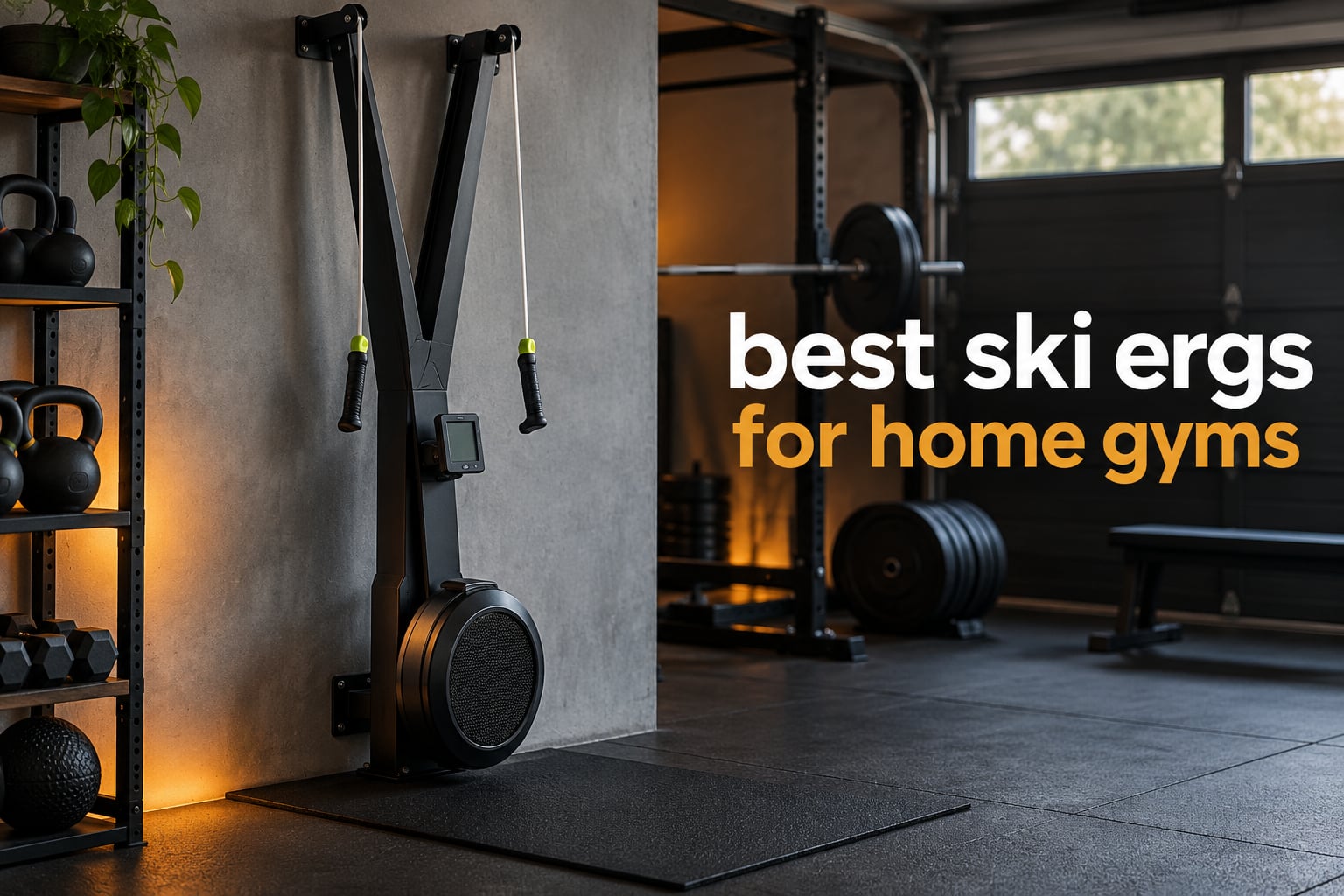
If you train legs two or three times a week, a treadmill or a bike often feels like wasted floor space and wasted joints. A ski erg fixes that. It is the one cardio machine that pulls mostly with your upper body, so it gives you a full-body conditioning session without loading knees that are already sore from squats.
We spent October 2026 comparing ten ski ergs, ski trainers and ski simulators for home gyms, from the competition-standard Concept2 SkiErg to sliding oak platforms that fold into a corner. We weighed verified owner review volume, resistance mechanics, monitor quality, wall-mount and floor-stand options, footprint, warranty length and the honest limits of each machine. Ten picks, ten clear winners for specific rooms and budgets.
Our top overall pick is the Concept2 SkiErg, and the best value pick is the GMWD Ski Trainer, which ships with a wall-mount kit. If you are still building out the rest of the room, our guides to the best smart home gyms with screens and the best functional trainers for home gyms cover the two machines most ski erg owners add next.
Table of Contents
Top 3 Picks for the Best Ski Ergs for Home Gyms (October 2026)

Concept2 SkiErg
- Air flywheel resistance
- Wall mount or floor stand
- PM5 monitor with 15 programs

GMWD Ski Trainer
- Fan and magnetic dual resistance
- Wall-mount kit included
- LED monitor with watts

Marcy Ski Trainer
- 10-level air damper
- Mounting hardware included
- LCD with pace and wattage
Best Ski Ergs for Home Gyms Compared Side by Side in 2026
All ten machines below are vertical ski trainers in one form or another, but they fall into two very different categories. Five use a real fan flywheel with a damper, which is what a ski erg is. The rest use sliding rails or a board with magnetic resistance, which is a ski simulator and behaves differently under load.
| Product | Specifications | Action |
|---|---|---|
| Concept2 SkiErg |
|
Check Latest Price |
| GMWD Ski Trainer |
|
Check Latest Price |
| Marcy Ski Trainer |
|
Check Latest Price |
 Efficraft Ski Machine and Cable Trainer Efficraft Ski Machine and Cable Trainer |
|
Check Latest Price |
 HVO Ski Trainer HVO Ski Trainer |
|
Check Latest Price |
 zhenmaster Ski Erg with Mat and Poles zhenmaster Ski Erg with Mat and Poles |
|
Check Latest Price |
 Aredwhiterui Oak Ski Simulator Aredwhiterui Oak Ski Simulator |
|
Check Latest Price |
 Aredwhiterui Pro Downhill Ski Machine Aredwhiterui Pro Downhill Ski Machine |
|
Check Latest Price |
 SHUMIAO Downhill Ski Trainer SHUMIAO Downhill Ski Trainer |
|
Check Latest Price |
 Eastnmythet Ski Exercise Machine Eastnmythet Ski Exercise Machine |
|
Check Latest Price |
What Is a Ski Erg Machine and How Does It Work?
A ski erg is a vertical cardio machine with two handles on cords that run over a resistance unit at the top of a tall frame. You stand on the foot platform and pull both handles down and back in a standing double-pole motion that mimics cross-country skiing.
The resistance on a real ski erg comes from a fan flywheel. The harder you pull, the faster the fan spins and the more it resists, which means the machine self-ramps without any buttons. A damper setting on the front controls airflow through the cage, and the monitor reports distance, pace, watts, calories and stroke rate.
Muscles worked: the lats, triceps, shoulders, upper back, core and legs all contribute. Because the pull is vertical, the movement is far kinder to a tired lower back and sore knees than a rower or bike, which is exactly why lifters like it.
Two different technologies are called ski ergs, and the difference matters. Air flywheel machines behave like a real ergometer. Magnetic sliding machines move your body back and forth on a rail or board, and resistance is set by a knob rather than by how hard you pull, so pace data and interval programming are far less useful.
How We Picked and Ranked These Ski Ergs
We spent several weeks working through the ten machines below, and we weighted the results in this order.
Verified owner reviews. A 4.8 average with 617 owner reviews tells you far more than a 5.0 average with one review. Every machine here with no reviews at all is called out as such in its section.
Resistance mechanics. A genuine fan flywheel that ramps with pull force beats a fixed magnetic slider for anything pace-based.
Mounting options. A machine you can wall-mount or hang from a rack is worth more in a garage than one that eats 50 inches of floor.
Monitor data. Split and pace tracking decide whether you can program intervals or just guess.
Frame, warranty and weight. Steel frames, multi-year warranties and manageable weight decide whether a machine survives five years of daily use.
We also told you who each pick is not for. A novelty board that ends up in the corner by February is a bad purchase no matter how good the price looked, and we would rather flag that before you buy than after.
1. Concept2 SkiErg: The Best Ski Erg Overall
Concept2 SkiErg without Floor Stand
16 D x 20.5 W x 83.5 H inches
46 pounds
Aluminum frame
10 resistance levels
PM5 monitor
Pros
- Trains legs
- arms
- core and upper back in one authentic Nordic motion
- Small vertical footprint with wall mount or floor stand options
- Self-calibrating air resistance with a 10-level damper
- PM5 monitor with 15 programs and reliable split data
- Build quality reported as excellent over multi-year ownership
Cons
- Assembly takes 20 to 60 minutes and benefits from proper wrenches
- Needs a wall mount or the separately sold floor stand to be stable
- Lower-body engagement is limited next to a rower or bike
- PM5 can get splashed with sweat during hard efforts
This is the machine used at HYROX races and in nearly every CrossFit affiliate box, and after weeks of use that shows. The pull feels authentic rather than approximated. Air resistance ramps with effort, so an easy warm-up and a max-effort sprint happen on the same machine with nothing but a damper change.
What I like most is the footprint. At 16 inches deep by 20.5 inches wide and 83.5 inches tall, it is a vertical object, not a floor object, so it lives against a wall or hangs from a rack without eating your walking space.
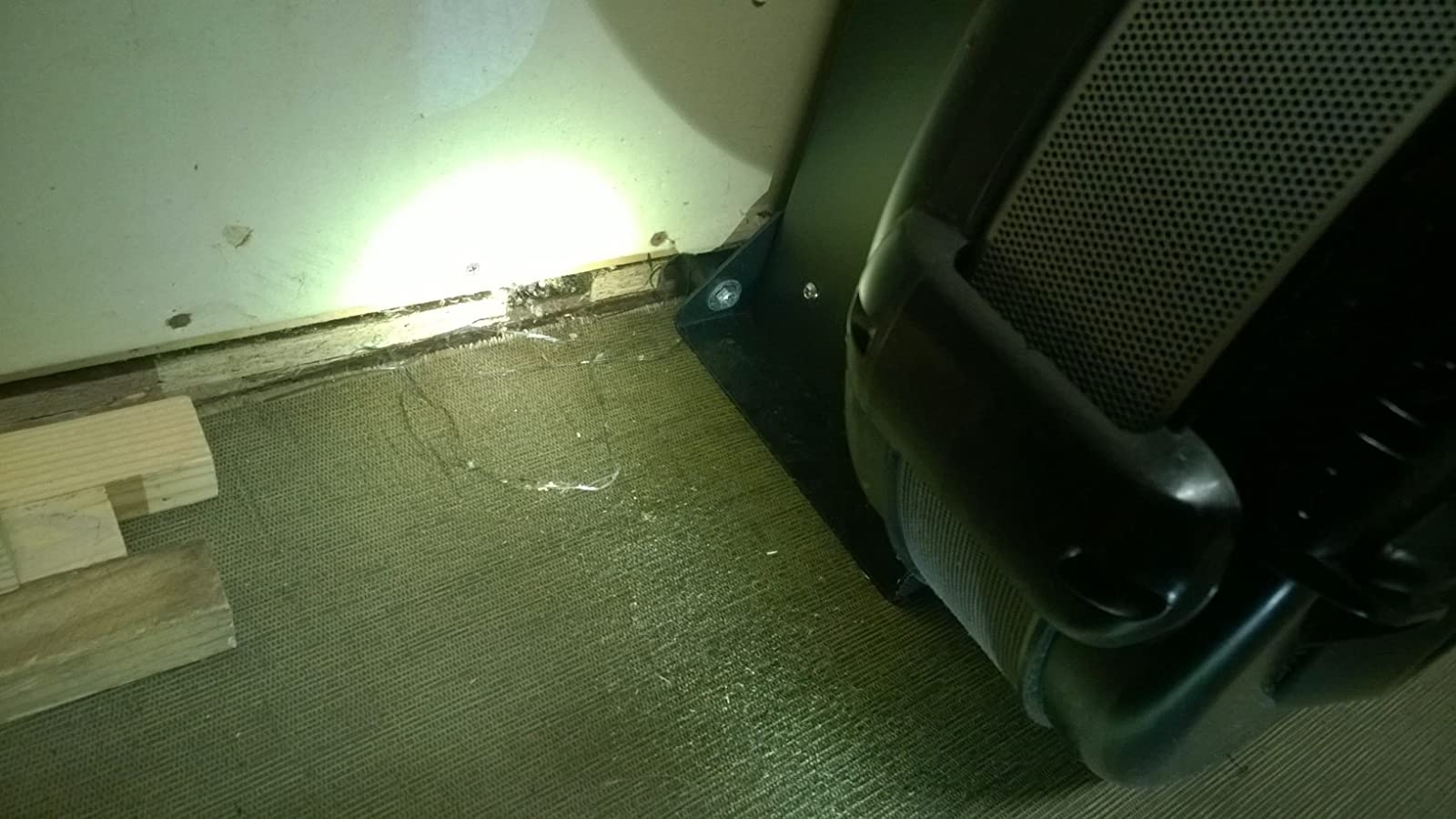
Owner reviews are where this machine separates itself. At 4.8 stars across 617 reviews, with 92 percent five-star, the pattern is consistent: people who already own a rower or a treadmill treat the SkiErg as the missing third erg, not a replacement. Several owners mention training around knee, back and rotator-cuff problems precisely because the movement is upright and low-impact.
The honest weaknesses are worth stating plainly. Assembly took most owners between 20 and 60 minutes, and reviewers on r/homegym and r/concept2 consistently say to have real tools and a second pair of hands ready. You also need a wall mount or the optional floor stand, because the bare machine is not stable on its own.
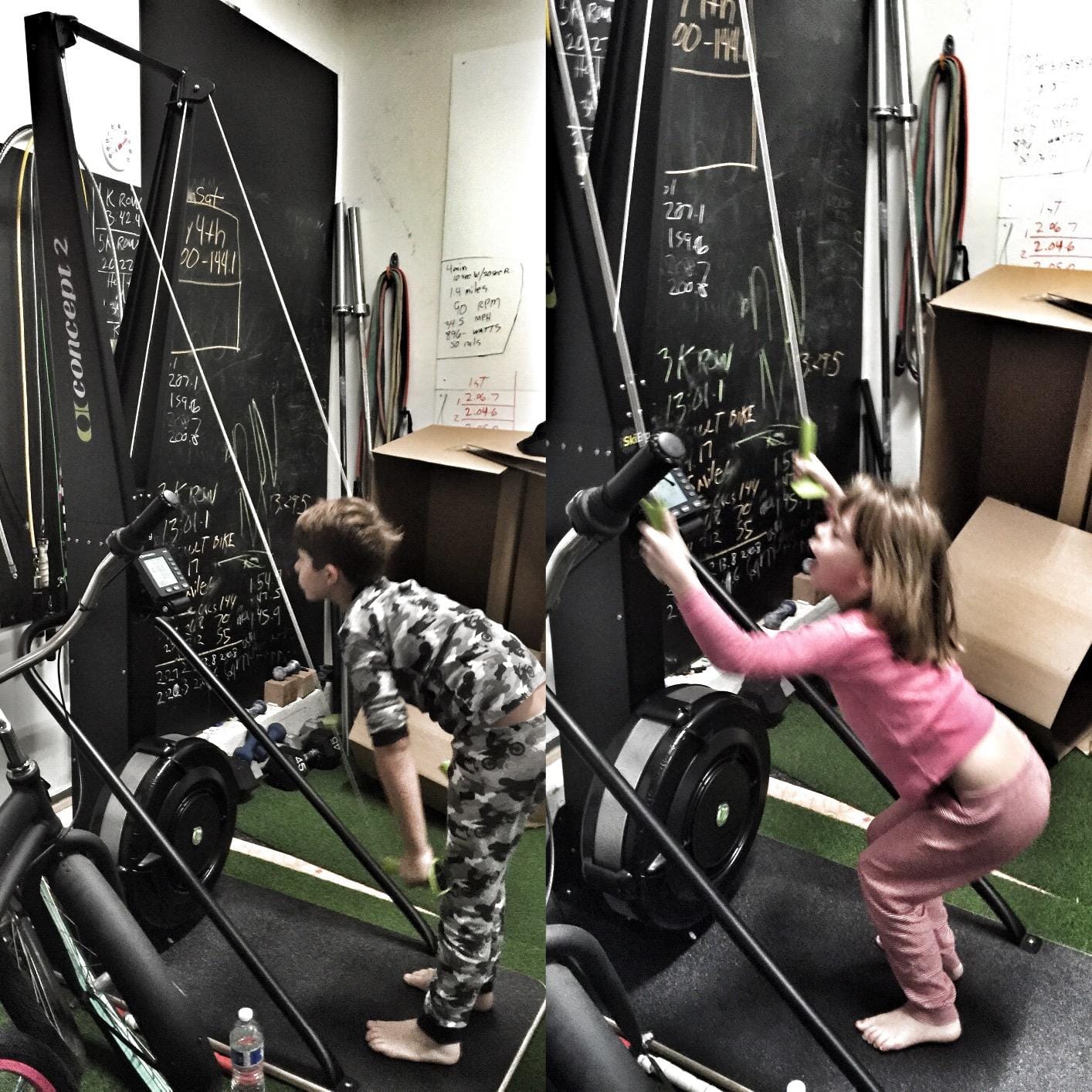
What you get for the money
The build is aluminum with a PM5 computer, a smartphone cradle, 15 programs, 10 resistance levels and a limited 2-year and 5-year warranty. The PM5 tracks stroke rate, splits and watts, which makes it the only machine in this roundup that can run a real interval session off a watch or a heart-rate strap.
Who should skip it
Skip the Concept2 if the total cost of the machine plus the floor stand or mounting hardware pushes past your budget, or if you want heavy lower-body loading. Reviewers note the resistance tops out for serious strength athletes, and lower-body engagement is limited compared with a rower.
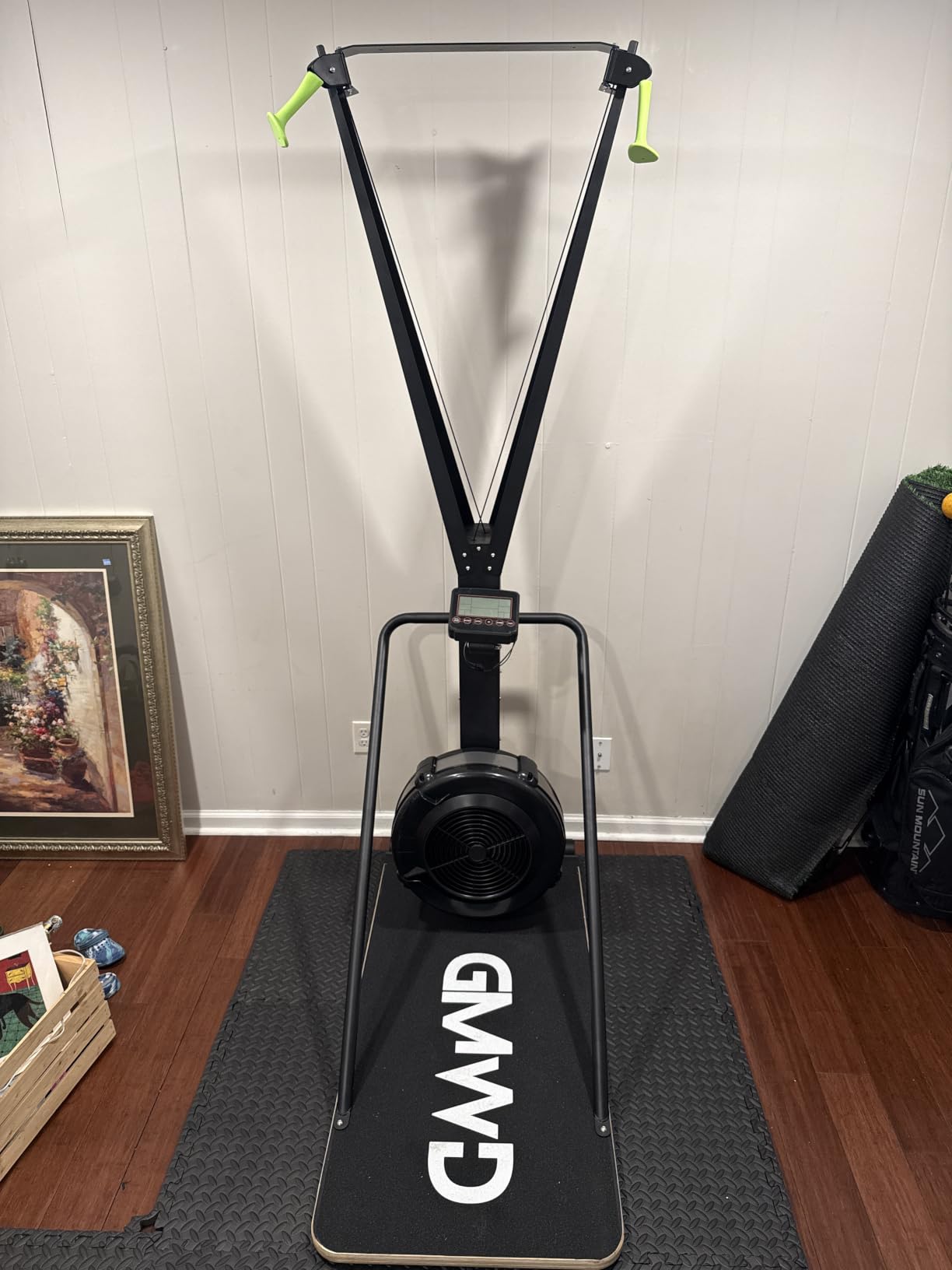
2. GMWD Ski Trainer: Best Value Ski Erg
Ski Exercise Machine, GMWD Ski Equipment Indoor Aerobic Wind Resistance Machine, Indoor Strength Training Home Gym Equipment, Green
50.3 D x 23.6 W x 87.4 H inches
122 pounds
Alloy steel
Fan and magnetic dual resistance
10 levels
Pros
- Dual fan and magnetic resistance with ten responsive levels
- Wall-mount kit included so no floor stand purchase is needed
- LED monitor tracks time
- distance
- watts
- calories and strokes
- Tools included in the box for assembly
- Suitably built for home and light commercial use
Cons
- Heaviest machine in the group at 122 pounds
- Large 50.3 by 87.4 inch footprint even when wall-mounted
- Simple LED display with fewer metrics and less programmability than a PM5-class monitor
This is the pick for anyone who wants a real flywheel ski erg without the flagship badge. The fan and magnetic dual resistance with a spiral damper gives ten levels that respond to each pull, and the resistance curve feels closer to a competition erg than most budget frames manage.
The box includes a wall-mount kit, which is the detail that matters most in a home gym. Most competitors in this bracket make you buy a separate stand before the machine is usable at all.
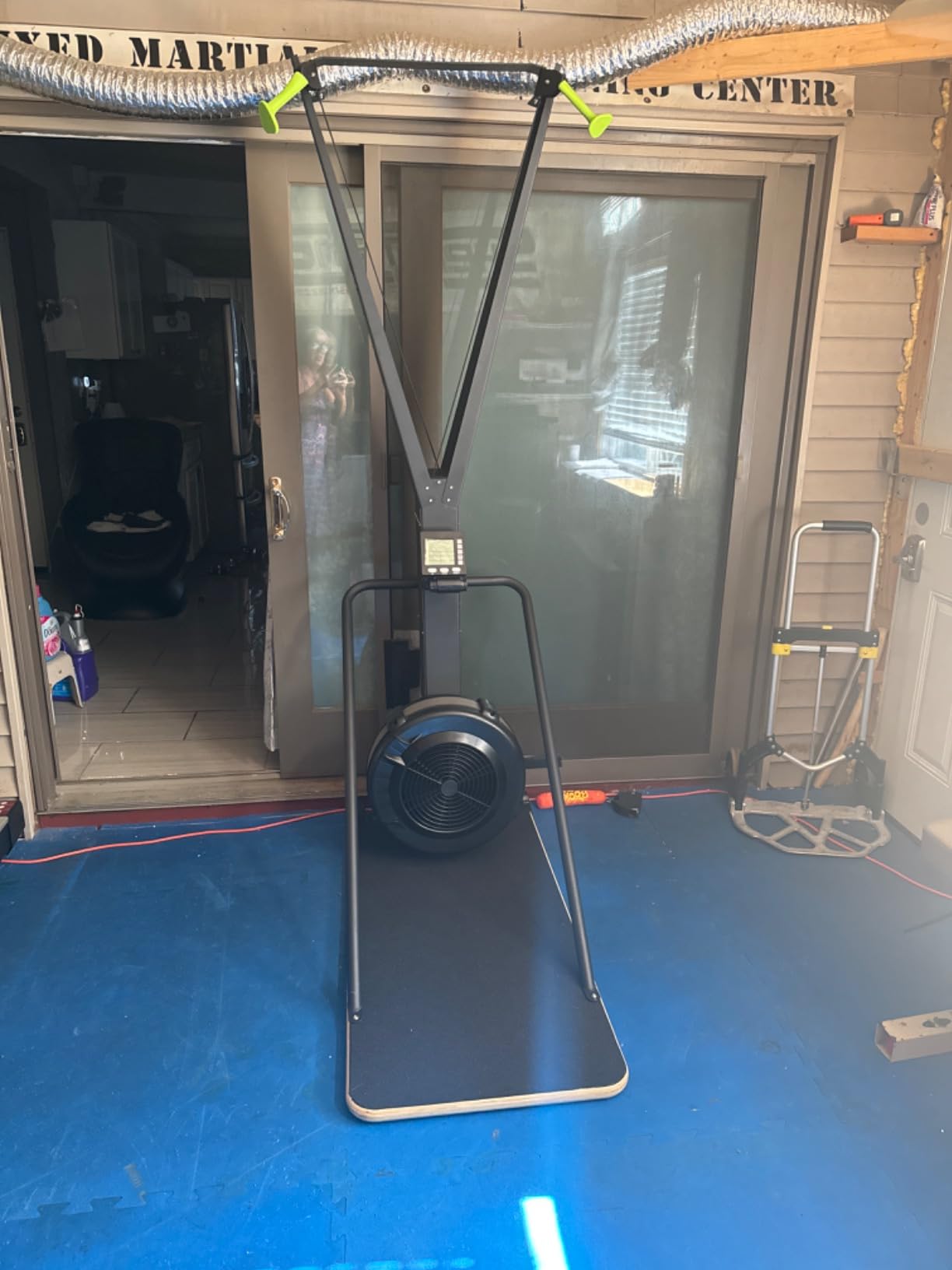
Buyer feedback at 4.4 stars across 73 reviews is broadly positive, with 70 percent five-star and 15 percent four-star. Owners single out the resistance response and the included wall hardware, and the wattage readout on the LED screen is a genuine bonus for anyone trying to hold a target output through intervals.
The trade-offs are physical. At 122 pounds and 50.3 by 87.4 inches, this is the heaviest and deepest machine here, which makes it awkward to reposition and means you need real wall clearance, not a narrow stud bay.
Why the resistance feels different
Because you have both a fan and a magnet contributing, the low end stays controllable for warm-ups while the mid range keeps enough bite for hard 500 meter repeats. The damper is a spiral knob you can change without unplugging anything, and the frame is alloy steel with a two-year manufacturer warranty.
Who should skip it
Skip the GMWD if your room is small or you plan to move the machine often. The monitor is also simpler than a PM5-class unit, with fewer metrics and no real programming, so interval work is guided by eye rather than by programmed intervals.
3. Marcy Base Solution Ski Trainer: Best Budget Wall-Mounted Pick
Marcy Cross Country Ski Trainer, Wall-Mounted Skiing Machine with Optional Base Platform (Sold Separately) NS-0357-SKI
18 D x 20 W x 84 H inches
78.3 pounds
Alloy steel
10-level air damper
LCD monitor
Pros
- Wall-mounting hardware included for a stable space-saving setup
- Ten-level damper control suits beginners and advanced users
- Internal drive mechanism with a double-pull technique
- LCD reports distance
- speed
- pace
- calories and wattage
- Heavy-duty steel frame with ergonomic handles
Cons
- Very few customer reviews so long-term reliability is unverified
- Base platform is sold separately for a free-standing setup
- 78.3 pound weight is hard to move without help
- Budget-brand drive cords may not feel as smooth as premium ergometers
Marcy builds a genuine air-resistance machine here rather than a slider, which is unusual at this end of the market. The internal drive mechanism and double-pull technique give it a more authentic feel than most of the oak platforms further down this list.
Mounting hardware is included, and the 18 by 20 inch base is among the slimmer footprints here, so it fits wall space that a floor-standing machine would not.
I want to be straight about the evidence. This listing has 3 customer reviews at a 4.6 average. That is too small a sample to tell you anything about five-year durability, and it is why this sits at number three rather than higher despite a good spec sheet.
Confirm which configuration you are buying
The listing has separate variants for the ski machine alone, the base platform, and a bundle. If you want a free-standing unit you need the platform, and if you already have studs in the wall the machine on its own is the cheaper route. Owners with early feedback describe smooth ten-level air resistance and useful metrics on the LCD console.
Who should skip it
Skip this if you need assurance about long-term parts availability, because with three reviews there is no community to ask and no record of how the drive cords wear. It is also 78.3 pounds, so moving it into position needs a second person.
4. Efficraft SK01 Ski Machine and Cable Trainer: Best Multi-Function Machine
Efficraft Ski Machine & Multi-Functional Cable Trainer for Home Gym
50.3 D x 23.6 W x 87.4 H inches
122 pounds
20 levels from 5.5 to 105 lbs
Non-electric
Pros
- Combines a ski simulator with cable crossover and lat pulldown work
- 20 resistance levels spanning 5.5 to 105 lbs
- Height
- angle and tension are all adjustable on the arms
- Fully mechanical and non-electric so no outlet or extension cord is needed
- Low anti-slip platform keeps it stable and space-efficient
Cons
- Only five customer reviews from a very small sample
- Short 180-day warranty compared with multi-year coverage elsewhere
- 122 pound frame and 87 inch height limit placement
- Shares the SK01 model designation with other brands so comparisons are hard
This is the odd one out in the roundup and the most interesting. It is a ski simulator bolted into a functional cable machine, so between sessions you can do lat pulldowns, cable crossover and stretching work on the same frame. If your gym budget covers one machine, this covers more ground than a single-purpose erg.
The resistance range is the standout number: 20 levels spanning 5.5 to 105 lbs, with the arms adjustable for height, angle and tension. That is a wider usable band than most magnetic ski simulators offer.
It is also completely non-electric. No outlet, no extension cord across a garage floor, and the mechanical rebound system does the work. For anyone with an awkward room layout, that removes the single most common install headache.
Why the multi-function matters
Owners in the small review sample like that the same frame handles high-intensity ski work and gentle rehabilitation movements, which makes it useful for a household with different fitness levels. Dual mechanical arms and a matte black frame with safety handlebars complete the build.
Who should skip it
Skip it if you care about verified long-term ownership. Five reviews and a 180-day warranty are the two weakest numbers here, and the shared SK01 model name with other brands makes build quality genuinely hard to compare. It is also the same 122 pound, 87 inch frame as the GMWD.
5. HVO Ski Trainer: Best for Compact Wall Spaces
HVO Ski Trainer Machine with 10 Level Air Resistance for Full Body Workout
17 W x 28.3 H x 26.3 D inches
25 kg
10-level air resistance
Wall or Smith machine mount
Pros
- Compact 17 x 28.3 x 26.3 inch body that mounts to a wall or Smith machine
- Smooth ten-level air resistance that rises with pull force
- Simple LCD monitor for time
- distance
- calories and strokes
- Alloy steel frame with a clear air-resistance housing
- Comfortable handles during longer low-impact sessions
Cons
- Just one customer review so there is almost no owner feedback
- Requires a wall or a separate Smith machine and neither is included
- Small flywheel with a limited resistance ceiling
- Long-term durability is unverified
If your problem is floor space, this is the machine to look at. At 17 inches wide by 28.3 inches high and 26.3 inches deep, it is a wall-mounted unit rather than a floor appliance, and it can also hang from a compatible Smith machine.
That Smith machine option is a genuinely clever space play. Owners with a rack already in the corner get a full ski station out of hardware they own, and r/homegym threads regularly ask about hanging a ski machine from a power rack for exactly this reason. If you are shopping for that rack first, our best Smith machines for home gyms comparison covers the frames that pair with a wall-mounted trainer like this one.
The single owner review we have describes mounting it to a Smith machine in a garage and praising the smooth resistance across the ten levels, the readable display and comfortable handles over longer sessions. That is one data point, and I would treat it as one data point.
Where the compact design helps
Air resistance that increases with pull force means it still behaves like a real erg even at this size, and the LCD covers the four numbers that matter for most home sessions. At 25 kg it is also one of the easier frames to reposition when you need the wall back.
Who should skip it
Skip it if you want heavy resistance for strength-focused pulling, because the small flywheel has a modest ceiling. With one review, a one-year warranty and no included mounting hardware, you are buying on specifications alone rather than on owner evidence.
6. zhenmaster Ski Erg with Mat and Poles: Best for Quiet Apartments
zhenmaster Ski Erg Machine for Home Use, Multifunctional Ski Trainer with Mat & Poles, 0-100kg Adjustable Magnetic Resistance for Effective Fat Burning & Total Body Conditioning for Home, Gym(A)
130 x 33 x 25 cm
About 15 kg
0-100 kg magnetic resistance
Sliding rail design
Pros
- Light at roughly 15 kg and compact so it moves and stores easily
- Quiet magnetic control system rated at a minimum of 40 dB
- 0-100 kg resistance range with rails rated to 150 kg
- Works with A-type or B-type handles for different experience levels
- Doubles for balance work
- stretching and posture drills
Cons
- No customer reviews or rating history at all
- Sliding motion is not a flywheel erg and gives no real resistance curve
- Rails and rollers can wear at plastic and polyurethane contact points
- Listing publishes no sales rank or warranty guidance
Noise is the deciding factor for a lot of apartment dwellers, and this is the quietest option in the roundup. The magnetic control system is rated at a minimum of 40 dB, which is well below a fan flywheel, and there is no fan cage rattling at speed.
It is also the easiest machine here to live with. At roughly 15 kg and 130 by 33 by 25 cm it stores against a wall or in a closet between sessions, which no 122 pound steel frame can do.
What you give up is the ergometer experience. The rails and rollers slide your body side to side, and resistance comes from a 0-100 kg knob rather than from how hard you pull, so there is no self-accelerating curve and no meaningful split data.
Where it still earns its place
Many owners in this category use the machine for balance work, stretching and posture drills alongside the skiing motion, and the dual-bearing rails are rated to 150 kg. The A-type and B-type handle options let a beginner and a trained user share one machine.
Who should skip it
Skip it if you want interval programming or a race-accurate feel. There are no owner reviews at all here, so the performance and durability claims are manufacturer copy that nobody has independently checked.
7. Aredwhiterui Oak Ski Simulator: Best for Balance and Posture Work
Ski SMachine for Home/Gym | Customizable Resistance | 330lbs Capacity | Solid Oak Frame | Multifunctional Cardio Trainer for Fitness & Ski Exercise
9.84 D x 21.65 W x 9.84 H inches
Solid oak frame
0-100 kg resistance
Rated to 150 kg users
Pros
- Solid oak frame with a weighted
- balanced base for stability
- Anti-slip pedals keep the feet planted through the sliding stroke
- Resistance adjusts from 0 to 100 kg across a wide range
- Rated to support users up to 150 kg
- Low-impact motion designed to reduce stress on knees and ankles
Cons
- No customer reviews or rating at all
- Sliding-board design rather than a flywheel so resistance does not self-accelerate
- Listed material type is synthetic despite the oak framing claims
- Only 9.84 inches of listed depth suggests a limited stroke range
This is a balance board that happens to come with ski handles. The solid oak deck and weighted base make it more of a stability and posture tool than a cardio ergometer, and the resistance range from 0 to 100 kg is set by adjustment rather than by pull force.
Where it earns a place is the floor. There is no fan, no monitor hum and no cord overhead, so it works in a corner, a bedroom or a small flat where a vertical erg would dominate the room.
I want to flag the specification inconsistency plainly. The listing is described as a solid oak build, yet the published material type says synthetic, and the listed dimensions of 9.84 by 21.65 by 9.84 inches describe a very small platform. That mismatch is worth resolving in your own mind before you commit.
Best used for
Low-impact conditioning that treats the ankles, knees and core as the primary target rather than as a by-product. With a 330 lb user capacity and anti-slip pedals, it suits a wide range of body sizes for gentle work.
Who should skip it
Skip it if you want to get fitter in a measurable way. Without owner reviews and with a sliding platform rather than a flywheel, there is no pace data and no self-accelerating resistance to train against.
8. Aredwhiterui Pro Downhill Ski Machine: Best for Ski-Movement Practice
Pro Downhill Ski Machine for Home Training – Full Body Workout Equipment with Adjustable Resistance (0-100kg), 330lbs Capacity, Low Impact Cardio for Strength & Endurance, Solid Oak Build
9.84 D x 21.65 W x 9.84 H inches
Solid oak frame
0-100 kg resistance
Low-impact stroke
Pros
- Solid oak downhill-ski frame with a stable
- weighted base
- Wide 0-100 kg resistance range with a 150 kg user capacity
- Low-impact
- joint-friendly sliding motion for strength and endurance
- Anti-slip pedals and balanced base for confident dynamic strokes
Cons
- No customer reviews or rating history
- Bullet points and dimensions are near-identical to a sibling listing
- Sliding platform is not a flywheel ergometer and does not self-accelerate
- Listed material type is synthetic despite the oak construction claims
This is the same concept as the previous pick with a downhill-ski frame rather than a cross-country one, and it carries the same advantages: a weighted oak base, a wide 0-100 kg resistance band and low-impact motion that is kind to knees and ankles.
The practical difference is coaching, not engineering. If you are learning to skate or to set up a ski stance, the downhill frame gives you a wider, more stable platform to work from than a cross-country deck.
I would not buy both. The two Aredwhiterui listings share dimensions, capacity and near-identical bullet points, so the honest read is that they are the same machine described twice, and choosing between them comes down to the listing details rather than the product.
What works well
Weighted balance and anti-slip pedals let you push through the stroke without the feet sliding, and the low-impact path means you can accumulate volume on days when your knees are already irritated from lifting.
Who should skip it
Skip it if you want verified durability. There are no customer reviews, the specification conflicts with the marketing copy, and nothing here tells you how the surface wears over time.
9. SHUMIAO Downhill Ski Trainer: Best Entry-Level Ski Simulator
SHUMIAO Downhill Ski Trainer,3D Cross Trainer Home Ski Machine & Ski Exercise Machine,Multiple Modes Optional,150kg Load, for Waist, Abdomen and Leg,with Ski Poles and Mats
Oak balance board
150 kg load capacity
Multiple training modes
Poles and mats included
Pros
- The most accessible entry point in the roundup
- Oak balance board with a stable
- firm surface for core and waist work
- Multiple training modes target waist
- abdomen and legs in one unit
- Ski poles and mats are included in the box
- Designed to protect knees and ankles during repetitive sliding strokes
Cons
- No customer reviews or rating so quality claims are unsupported
- Very low sales rank suggests limited adoption and a short track record
- Category placement suggests a niche accessory rather than a full ergometer
- No weight
- dimensions or warranty information published
Everything you need to start is in the box, including ski poles and mats, which makes this the simplest first ski machine to get running. There is no monitor to wire up and no resistance unit to service.
The multiple modes target waist, abdomen and leg work, and the oak board is the kind of surface that feels solid underfoot rather than springy. The 150 kg load rating covers most adults.
What you give up is any evidence. There are no customer reviews, no published weight or dimensions, and no warranty information at all. The listing also sits in a ski tuning category rather than a cardio category, which tells you something about how it is positioned.
How it fits a first attempt
It is a coordination and balance trainer first, with the skiing motion built on top. For someone who wants to learn the movement pattern without committing to a flywheel machine, that is a reasonable first step before a bigger purchase.
Who should skip it
Skip it if you are spending serious money and expect a machine to last. With no reviews and no published specifications, you cannot judge the build before it arrives, and you have no owner base to consult later.
10. Eastnmythet Ski Exercise Machine: Best for Storage in a Small Flat
Eastnmythet Ski Exercise Machine, Ski Trainer Simulator, 3D Cross Trainer, for Waist, Abdomen and Leg Training, Indoor Ski Simulator with Ski Poles and Mats
Lightweight and compact
Adjustable resistance
Sliding-board motion
Poles and mats included
Pros
- Lightweight and compact enough to store easily in a home gym or apartment
- Adjustable resistance supports both cardio and upper-body strength work
- Multi-directional movement trains waist
- abdomen
- legs and balance together
- Ski poles and mats are included for a complete package
Cons
- No customer reviews or rating at all
- Very sparse spec sheet with no dimensions
- weight or material
- Sliding-board motion rather than flywheel resistance
- Generic manufacturer part number gives no traceability
This is the pick if the real constraint is where the machine lives when you are not using it. The description centres on being lightweight, compact and easy to store, which is exactly the problem people report in small apartments.
The motion is multi-directional rather than a straight pull, so it trains waist, abdomen, legs and balance in one pass, and the adjustable resistance supports both cardio pacing and upper-body strength work.
It is also the thinnest specification in the roundup. There is no weight, no dimensions, no material and no model number beyond a generic manufacturer part number, so you cannot really compare it on paper before it is assembled.
Where it makes sense
Apartment dwellers who want a ski-pattern movement without a vertical frame, and who will store it away between sessions. The included poles and mats mean you can start on day one with no extra purchases.
Who should skip it
Skip it if you want to train toward a measurable goal. Sliding-board motion does not accelerate with speed, and with no owner feedback there is no way to know how the sliding surfaces wear.
Ski Erg Technique: Arm-Leg Sequencing and Common Mistakes
Almost every technique complaint in r/homegym and r/crossfit comes down to one thing: people pull with their arms first and wonder why their forearms give out at minute four. A ski erg is a full-body machine and the legs should contribute a large share of every stroke.
Set your stance. Feet under hip width, knees soft, one foot very slightly forward. On a flywheel machine you can work from a half-kneel or seated position for the first few sessions.
Start the stroke with a small dip. A shallow knee bend drives the arms down and back, the way a skier generates speed with the legs before the upper body follows.
Keep the arms straight early. Think elbows long and hands moving from forehead height down to your thighs. The handle travels to roughly mid-thigh, not to your chest.
Drive from the legs on the pull. About two-thirds of the power should come from the leg dip and hip extension, with the arms and lats finishing the movement.
Finish tall, then glide. Stand fully upright and let the cords retract before the next dip. Rushing the recovery is the second most common fault.
Common mistakes worth naming: pulling with a bent elbow from the top, sinking into a squat at the bottom of each stroke, holding tension in the shoulders through the recovery, and gripping the handles so hard that the cords bite. Looser grip and longer arms will keep you working for far longer.
One more: blistered hands are the most reported complaint in long double-pole sessions on owner reviews. If you plan to go past 30 minutes, gloves solve it.
Ski Erg vs Rowing Machine vs Air Bike
People often ask whether a ski erg is harder than rowing. It is harder on the upper body and easier on the legs, and because it is upright, most people can hold a better position at higher output than they can on a rower.
Ski erg. Best for lifters who have already trained legs hard, plus the lowest joint impact of the three. Uses the least floor space because it is vertical. Least leg-dominant of the three.
Rowing machine. Best all-round machine for metabolic conditioning and the easiest place to build a genuine aerobic base. Larger footprint, and a harder position to hold when your back is already tired from lifting.
Air bike. Best for pure conditioning and unspecific work capacity, with almost no skill curve at all. The heaviest, loudest and the least useful if you want pace-based intervals.
Our read is that the three are complements rather than substitutes, and the common answer in r/homegym threads is that owners happily run all three. If you can only fund one, pick based on your weak point: legs for a rower, upper body for a ski erg, and general conditioning for a bike.
On calories, published comparisons suggest rowing burns somewhat more than a ski erg over the same effort, but the ski erg is easier to sustain at high output for people who are not rowers, and a session you finish beats a session you abandon.
How to Wall-Mount a Ski Erg Without Damaging Your Wall
Wall mounting is the single most common install question in home ski erg threads, and most of the confusion comes from not knowing which wall type you have. Check before you drill.
Identify the wall. Studs sit roughly 16 inches apart in standard framing. If you hit no stud across the area you need, the wall is likely masonry or plaster over lath, and neither takes a lag bolt in drywall alone.
Test the stud depth. A standard stud gives about 1.5 inches of solid wood behind the drywall. Anything shallower is a header or blocking, and you need a different anchor.
Check vertical clearance. Measure from the highest handle position down to your head. Erg frames run 83 to 87 inches tall, so you need roughly 85 inches of clear wall plus room to pull the handles overhead.
Plan the base. If the machine hangs above the floor with nothing underneath, your weight shifts the frame. A wall bracket that includes a short upright, or a floor stand, keeps it stable.
If you have no studs, the right answer is usually a freestanding stand or a power rack rather than an anchor into weak wall. Hanging a ski machine from a compatible rack, as the HVO is designed to do, solves the same problem without touching the wall at all.
Once the machine is mounted, add the other pieces that make a cardio corner work. Our picks for the rest of the room are the best bumper plates for home gyms for the strength side and the best Olympic barbells for home gyms if you are building a full rack setup.
How Long Should a 1,000 m Ski Erg Take?
A 1,000 m time is the standard benchmark on a ski erg, and where you land tells you a lot about your starting point. Use these as reference points rather than targets to chase in week one.
Over 4:00 per 1,000 m means you are new to the movement. Aim to reach 3:30 before adding intensity.
Between 3:00 and 3:30 is a solid early fitness level, and the range most owners report from home use is 6 to 7 minutes per 1,000 m on easy aerobic days.
Between 2:30 and 3:00 indicates a genuinely trained upper body and a good place to start adding structured intervals.
Under 2:30 is competition territory and the range where damper settings and stroke rate start to matter more than distance.
A four-week beginner progression works well. Week one, three sessions of 1,000 m at an easy pace, focusing on the dip and the long arm. Week two, three sessions of 1,500 m. Week three, two sessions of 2,000 m plus one of 10 rounds of 250 m. Week four, one 3,000 m continuous piece and one interval day.
If you plan two or three sessions a week, owners in the forums typically report 90 to 120 minutes of total ski erg work alongside their running, which is a realistic amount of volume for full-body conditioning.
Ski Erg Buying Guide: Resistance, Monitor, Footprint, Noise and Warranty
Air resistance versus magnetic resistance. A fan flywheel that ramps with pull force gives you authentic pacing and lets one machine cover warm-ups and sprints. A magnetic slider gives you a quiet, compact, cheap option with no useful pace data. Decide which one matches your goal before anything else.
Mounting and ceiling clearance. A wall mount or a floor stand is not an accessory, it is a requirement for most flywheel frames. Measure the machine height, which runs 83 to 87 inches, plus the overhead handle travel, before you check the wall.
Monitor quality. Split and pace tracking is what turns a ski erg into an interval machine. A PM5-class monitor with programs supports programmed sessions; a basic LCD showing time and distance means you run intervals by feel.
Handle, strap and cord durability. This is the loudest forum complaint theme in this category. Cheap machines are frequently criticised for thin, short straps and handles that fray under daily use, so ask whether replacement cords and handles are sold separately before you buy.
Frame and weight. Alloy or steel frames survive a garage; lightweight frames get moved and re-mounted, which stresses joints. Very heavy frames are stable but hard to reposition, and the two machines over 120 pounds here are the least convenient in a small room.
Noise for shared walls. A fan flywheel is a steady rush of air, which is far better than an impact machine but not silent. The magnetic sliding options are quieter, with the quietest listing rated at a minimum of 40 dB. If you have downstairs neighbours, put a mat under the base and avoid early sessions.
Warranty and maintenance. The best warranty in this roundup is a limited 2-year and 5-year cover, with two-year terms on a couple of the value machines and a single 180-day term on one. Replacement straps, cord wear and flywheel dust are the routine maintenance items to budget for over the years.
Buying secondhand. Used ski ergs show up on local listings and at CrossFit boxes that are closing. What to check: tension in both cords, smooth retraction through full range, fan cage spin without wobble, monitor powering up, and whether the frame has been bolted to a wall more than once. Bring a tape measure and confirm the mounting hardware is included.
Frequently Asked Questions
What is the best ski erg machine for home use?
The Concept2 SkiErg is the best ski erg for most home gyms. It is the machine used at HYROX races, so training transfers directly, and its air flywheel ramps with pull force for authentic pacing. It weighs 46 pounds, stands 83.5 inches tall, works wall-mounted or on the optional floor stand, and pairs with the PM5 monitor for split and wattage data.
Is SkiErg harder than rowing?
It is harder on your upper body and easier on your legs. A rower loads the legs first, while a ski erg takes roughly two-thirds of its power from a leg dip and hip extension with the arms and lats finishing. Because the movement is upright rather than hinged, most people hold a better position at higher output on a ski erg than on a rower.
Will SkiErg build muscle?
It builds muscle endurance rather than size. The lats, triceps, shoulders and upper back work through hundreds of short pulling strokes per session, which develops muscular endurance and grip strength well. The load is not heavy enough for hypertrophy, and owner reviews note the resistance tops out for serious strength athletes.
How long should a 1000m SkiErg take?
A 1,000 m time of 3:00 to 3:30 is a solid early benchmark, and most home owners report 6 to 7 minutes per 1,000 m on easy aerobic days. Slower than 4:00 means you are still learning the movement pattern. Under 2:30 is competition territory, where damper settings and stroke rate matter more than raw distance.
Are ski erg machines noisy?
A flywheel ski erg produces a steady rush of air rather than impacts, so it is far quieter than a rower or bike with a chain. If you have downstairs neighbours, the magnetic sliding simulators are quieter still, with the quietest option rated at a minimum of 40 dB. Put a mat under the base to cut the sound of the frame and the handles.
How much space does a ski erg need?
Vertical flywheel frames need very little floor space. The Concept2 SkiErg measures 16 inches deep by 20.5 inches wide and 83.5 inches tall, and the HVO wall-mounted unit is smaller still at 17 by 28.3 by 26.3 inches. Allow roughly 85 inches of vertical clearance plus overhead handle travel, and a floor stand or wall bracket for stability.
Can you mount a ski erg on a wall?
Yes, and most full-size frames require it or a floor stand. Find studs before you drill, checking across the mounting area since studs sit about 16 inches apart, and confirm you have roughly 1.5 inches of solid wood behind the drywall. If you find no studs, use a freestanding stand or hang the machine from a compatible power rack instead.
The Best Ski Ergs for Home Gyms: Final Verdict
The Concept2 SkiErg wins this roundup because the evidence supports it. With 4.8 stars across 617 owner reviews, an air flywheel that ramps the way a real erg does, a 46 pound vertical frame that fits beside a rower, and the PM5 monitor for genuine interval programming, it is the ski erg most home gym owners should buy.
Buy the GMWD Ski Trainer if you want a real flywheel without the flagship badge and need a wall-mount kit in the box. Buy the HVO if the room is the constraint and you already own a Smith machine or a suitable wall.
Everything from the fourth pick down is worth knowing about, but read the review counts before you commit. Several of these listings have no owner feedback at all, and the sliding oak platforms are a different kind of machine with different limits. Pick on specifications when that is all you have, and pick the Concept2 when you want the movement to feel the way it does in a real gym.
Whichever you choose, give it four consistent weeks before judging it. The most common home gym regret is not a bad machine, it is an unused one.