
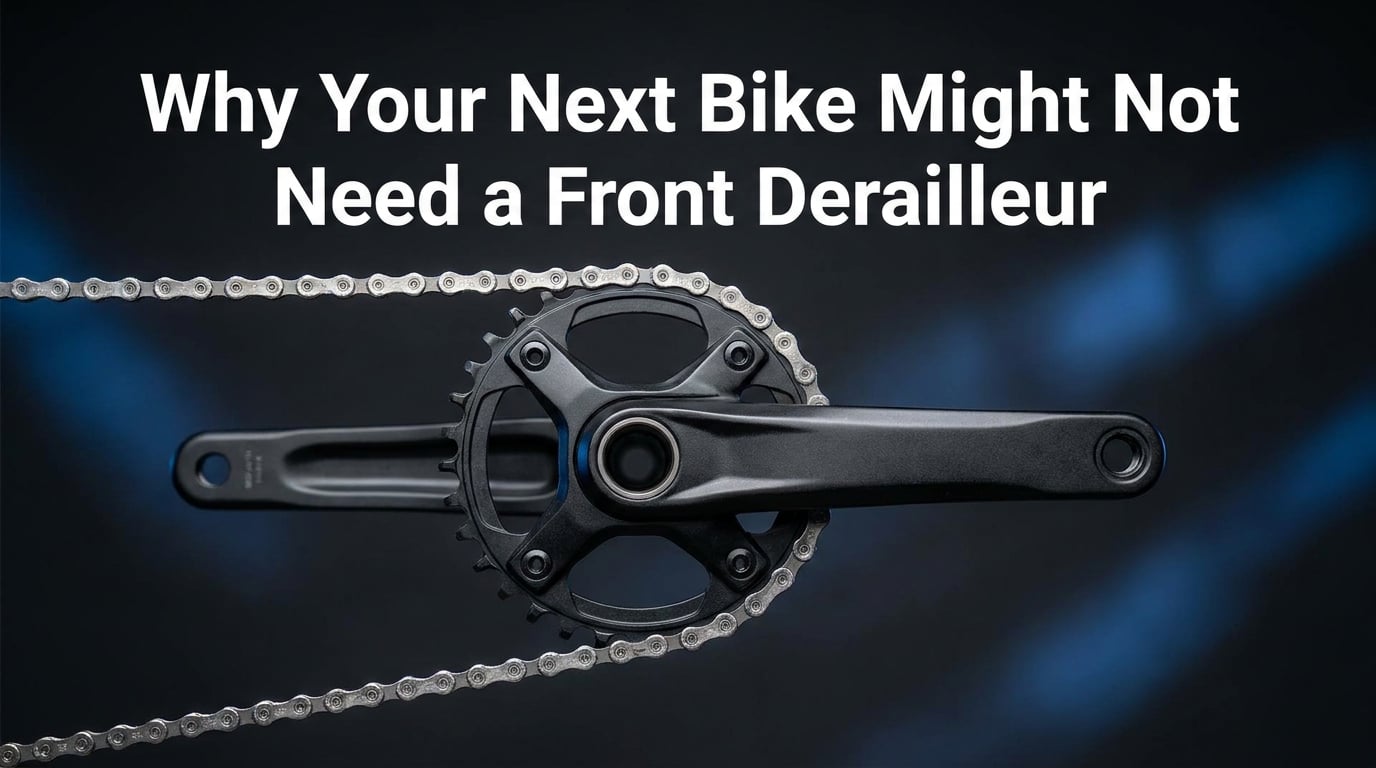
Walk into any bike shop in 2026 and you will notice something missing on a growing number of new models. The front derailleur, that fiddly mechanism that once defined geared cycling, is quietly disappearing. Mountain bikes led the charge, gravel bikes followed, and now even some road bikes are shipping without one.
The reason is simple. Drivetrain technology has advanced far enough that a single chainring up front can deliver the gear range most riders actually need. SRAM, Shimano, and Campagnolo have all poured years of engineering into making 1x drivetrains work as well as, or better than, traditional double chainring setups for the majority of cyclists.
In this guide, we break down exactly why your next bike might not need a front derailleur, what tradeoffs you should understand before going 1x, and which riding styles still benefit from keeping that second shifter. Whether you are buying a new bike or considering converting your current rig, this article gives you the technical context to make that call with confidence.
Table of Contents
What Is a Front Derailleur and How It Works
A front derailleur is a cage-shaped mechanism bolted to the frame near the crankset. Its job is to push the chain sideways between two or three chainrings of different sizes. By combining front chainring shifts with rear cassette shifts, a rider gets access to a wide spread of gear ratios.
On a traditional 2x drivetrain, the smaller inner chainring provides easier climbing gears and the larger outer chainring delivers higher top-end speed. A 3x drivetrain adds a third ring for even more range. The front derailleur is controlled by a left-hand shifter, and the rear derailleur handles the right.
The problem is that front derailleurs are notoriously difficult to keep dialed in. They rely on cable tension, limit screw adjustments, and frame alignment all working in harmony. One knocked cable housing or stretched cable and the chain rubs, drops, or refuses to shift. For something that has existed on bikes for over a century, it remains one of the most complained-about components in all of cycling.
Why Your Next Bike Might Not Need a Front Derailleur
The short answer is that 1x drivetrains have closed the gear-range gap that once made front derailleurs indispensable. With modern 10-52T and 10-51T cassettes, a single chainring can cover the same spread of gears that used to require two or three rings up front.
Mountain biking made the switch nearly a decade ago. By 2026, finding a new mountain bike with a front derailleur is almost impossible at any major retailer. The category proved that 1x worked under the most punishing conditions, and the rest of the industry took notice.
Gravel followed close behind. Riders appreciated the simplicity of one shifter on rough terrain where front shifts often felt clumsy. Even road cycling is seeing cracks in the 2x stronghold. Wout van Aert ran a 1x setup at Paris-Roubaix, proving that single-ring drivetrains can compete at the highest level of professional cycling on pave.
The industry has also invested heavily in electronic and wireless shifting. SRAM AXS and Shimano Di2 systems make rear shifts so crisp and reliable that the complexity of a front derailleur feels like an unnecessary layer. Add in 13-speed cassettes on the horizon, and the front derailleur starts to look like a solution to a problem that no longer exists.
Benefits of Removing the Front Derailleur
Simplicity and One-Shifter Operation
The most immediate benefit riders notice is how much simpler shifting becomes. With a 1x drivetrain, you only think about one shifter. Click harder gears with one direction, easier gears with the other. There is no front-rear coordination, no cross-chaining anxiety, and no mental map of which chainring combination you are currently in.
This simplicity is not just convenient. It reduces cognitive load on technical terrain, in traffic, or when you are exhausted on a climb. Riders on Reddit consistently say the number one thing they love about going 1x is that they no longer have to think about shifting a front derailleur.
Weight Savings
Removing the front derailleur, left shifter, front cable, housing, inner chainring, and mounting hardware eliminates over 200 grams. For road cyclists chasing marginal gains, that matters. For mountain bikers who already count every gram on their race builds, it is a no-brainer.
The weight savings also come with a cleaner cockpit. One fewer shifter means more room on the handlebar for dropper post levers, suspension lockout remotes, or just a less cluttered feel.
Reduced Maintenance and Fewer Adjustments
Anyone who has spent time in r/bikewrench knows that front derailleur adjustment is one of the most common maintenance complaints. The cage needs to sit at the right height, the right angle, and the right distance from the chainrings. Limit screws need constant fine-tuning as cables stretch.
A 1x drivetrain eliminates all of that. There is no front derailleur to adjust, no front cable to replace, and no inner chainring to wear out. The rear derailleur still needs occasional attention, but overall maintenance time drops noticeably.
Improved Chain Retention With Modern Technology
The biggest fear riders had about 1x was chain drops. Without a front derailleur cage to catch the chain, would it fall off on rough terrain? The answer turned out to be no, thanks to two key innovations.
First, narrow-wide chainring teeth alternate between thick and thin profiles that match the inner and outer plates of the chain. This creates a much tighter grip on the chain than a standard chainring. Second, clutch-equipped rear derailleurs use a friction mechanism to resist chain slap and keep tension high.
Combined, these technologies make chain drops extremely rare on modern 1x setups. Riders who switched five years ago report that they have essentially forgotten what a dropped chain feels like.
How Modern 1x Drivetrains Solve Chain Retention
Chain retention is the technical heart of why 1x works, so it deserves a closer look. The chainring is the first line of defense. A narrow-wide chainring has alternating thick and thin teeth. The wide teeth fit between the inner plates of the chain, while the narrow teeth fit between the outer plates. This interlocking design holds the chain firmly even over bumps, roots, and washboard gravel.
The clutch rear derailleur is the second line of defense. A one-way friction clutch inside the derailleur cage resists the forward movement of the derailleur arm. This keeps the chain under consistent tension and prevents the bouncing that causes chains to derail. SRAM calls their version Type-3 Roller Bearing Clutch, and Shimano uses a similar concept in their Shadow RD+ design.
Together, these two systems handle the job that the front derailleur cage used to do incidentally. The difference is that narrow-wide teeth and clutch tension do it better, with fewer moving parts and zero adjustment required.
Gear Range: Can One Chainring Really Be Enough?
This is the question every rider asks before switching to 1x. The honest answer is yes, for most people, but with a tradeoff.
A modern 12-speed cassette like the SRAM Eagle range offers a 10-52T spread. That gives a gear ratio range of 520 percent, which is wider than many older 2x and 3x systems. Paired with a 32T chainring, a mountain biker gets a climbing gear low enough for the steepest trails and a top gear high enough for most descents.
On the road and gravel side, cassettes like the SRAM XPLR 10-44T provide a 440 percent range. That is enough for gravel racing and adventure riding, though dedicated road racers may still want the tighter spacing of a 2x setup.
The tradeoff is in gear steps. Because you are spreading the same number of cogs across a wider range, each jump between gears is larger. A 1x drivetrain might have a 15 percent jump between certain gears where a 2x road setup has 8 percent jumps. For racers who need to hold a precise cadence, those bigger steps can feel jarring.
For everyone else, the simplicity of one shifter far outweighs slightly larger gear jumps. Most recreational and enthusiast riders never notice the difference.
1x vs 2x Drivetrain: Which Makes Sense for You
The right choice depends heavily on what and how you ride. Here is a breakdown by category.
Mountain Biking: 1x Is the Standard
If you ride mountain bikes, the decision is already made. Every major manufacturer ships trail, enduro, and cross-country bikes with 1x drivetrains. The simplicity, chain retention, and weight savings are perfect for off-road riding where conditions are rough and shifts need to be instinctive.
Gravel: Mixed but Trending Toward 1x
Gravel cycling is the most contested category. Some riders love 1x for its reliability on rutted fire roads. Others prefer 2x for the tighter gear spacing on long flat sections. SRAM XPLR and Shimano GRX both offer 1x options designed specifically for gravel, and adoption is growing each season.
Road Cycling: 2x Still Dominates but 1x Is Gaining
Road racing still overwhelmingly uses 2x drivetrains. The tight gear spacing matters when you are riding in a peloton at 28 mph and need to fine-tune your cadence. However, recreational road riders and endurance cyclists are increasingly choosing 1x for its simplicity.
Bikepacking and Touring: It Depends on Your Load
Loaded touring presents a special case. The weight of panniers and gear means you need very low climbing gears, but you also want high gears for long descents. Some bikepackers find that 1x drivetrains are ideal for bikepacking because of their reliability in remote conditions, while others stick with 2x for maximum range.
What About Hub Gears and Auto-Shifting?
The front derailleur is not the only component facing extinction. Internal gear hubs, like those from Rohloff and Shimano Alfine, move all the gearing inside the rear hub. This eliminates both derailleurs entirely and requires almost zero maintenance. The tradeoff is weight and cost, but for commuting and touring, hub gears offer unmatched reliability.
Even more futuristic is Shimano’s Q’Auto automatic shifting system, which uses sensors to detect riding conditions and shifts for you. While still early in development, it points toward a future where mechanical skill is replaced by software intelligence.
Wireless electronic shifting from SRAM AXS and Shimano Di2 has already changed the game. These systems make every shift precise and consistent, removing the cable stretch and contamination issues that plague mechanical drivetrains. As electronic shifting trickles down to lower price points, the argument for keeping a mechanical front derailleur gets weaker every year.
Do You Still Need a Dork Disc With 1x?
The dork disc, more politely called a spoke protector, is that plastic disc sitting between the cassette and the spokes. Its purpose is to prevent the chain from dropping into the spokes if the rear derailleur is misadjusted.
On a 2x bike, a front derailleur can create scenarios where chain-line angles increase the risk of the chain overshooting the largest cog. On a 1x bike, the chainline is more consistent because there is only one chainring position. This reduces, but does not eliminate, the risk of chain drop into the spokes.
The practical consensus is that a dork disc is never a bad idea on any bike. But with a well-tuned 1x drivetrain, the risk it protects against is lower than with a 2x setup. If you are running a clutch derailleur and your limit screws are set correctly, you are unlikely to need it. Still, there is no harm in keeping one installed.
Frequently Asked Questions
Is a front derailleur necessary?
For most modern riders, a front derailleur is no longer necessary. 1x drivetrains with wide-range cassettes provide sufficient gear range for mountain biking, gravel riding, commuting, and recreational road cycling. Front derailleurs are still useful for competitive road racing, loaded touring, and any situation where tight gear spacing and maximum range are both required.
Can you ride a bike without a front derailleur?
Yes, you can absolutely ride without a front derailleur. If your bike has a 1x drivetrain with a narrow-wide chainring and a clutch rear derailleur, the chain stays in place without issue. If you simply remove the front derailleur from a 2x bike, you can still ride but the chain may drop off the chainring on rough terrain.
Why do mountain bikes have no front derailleur?
Mountain bikes dropped the front derailleur because 1x drivetrains are simpler, lighter, more reliable in muddy conditions, and provide better chain retention. With wide-range cassettes offering 500-plus percent gear range, mountain bikers get all the gears they need from a single chainring, and they never have to think about coordinating front and rear shifts on technical terrain.
What are the disadvantages of a 1x drivetrain?
The main disadvantages of 1x are larger steps between gears, slightly less total gear range than a 2x system in some configurations, and the need for a narrow-wide chainring and clutch derailleur to maintain chain retention. Riders who need very tight gear spacing for racing or very wide range for loaded touring may find 2x still serves them better.
Why no front derailleur on modern bikes?
Modern bikes skip the front derailleur because advances in cassette range, narrow-wide chainring design, and clutch rear derailleurs make it redundant for most riders. Removing it reduces weight, simplifies shifting, cuts maintenance, and improves reliability. The cycling industry has invested heavily in 1x technology, making it the default on mountain and gravel bikes.
Conclusion
Understanding why your next bike might not need a front derailleur comes down to one reality. Drivetrain technology has moved past the point where a second chainring is essential for most riders. Wide-range cassettes, narrow-wide chainrings, and clutch derailleurs deliver the performance and reliability that the front derailleur struggled to provide.
If you ride mountain bikes, gravel, or commute recreationally, a 1x setup will simplify your ride, reduce maintenance, and save weight. If you race road at a competitive level or carry heavy touring loads, a 2x drivetrain still earns its place. Either way, the front derailleur is no longer the default it once was, and that is a good thing for cycling.