
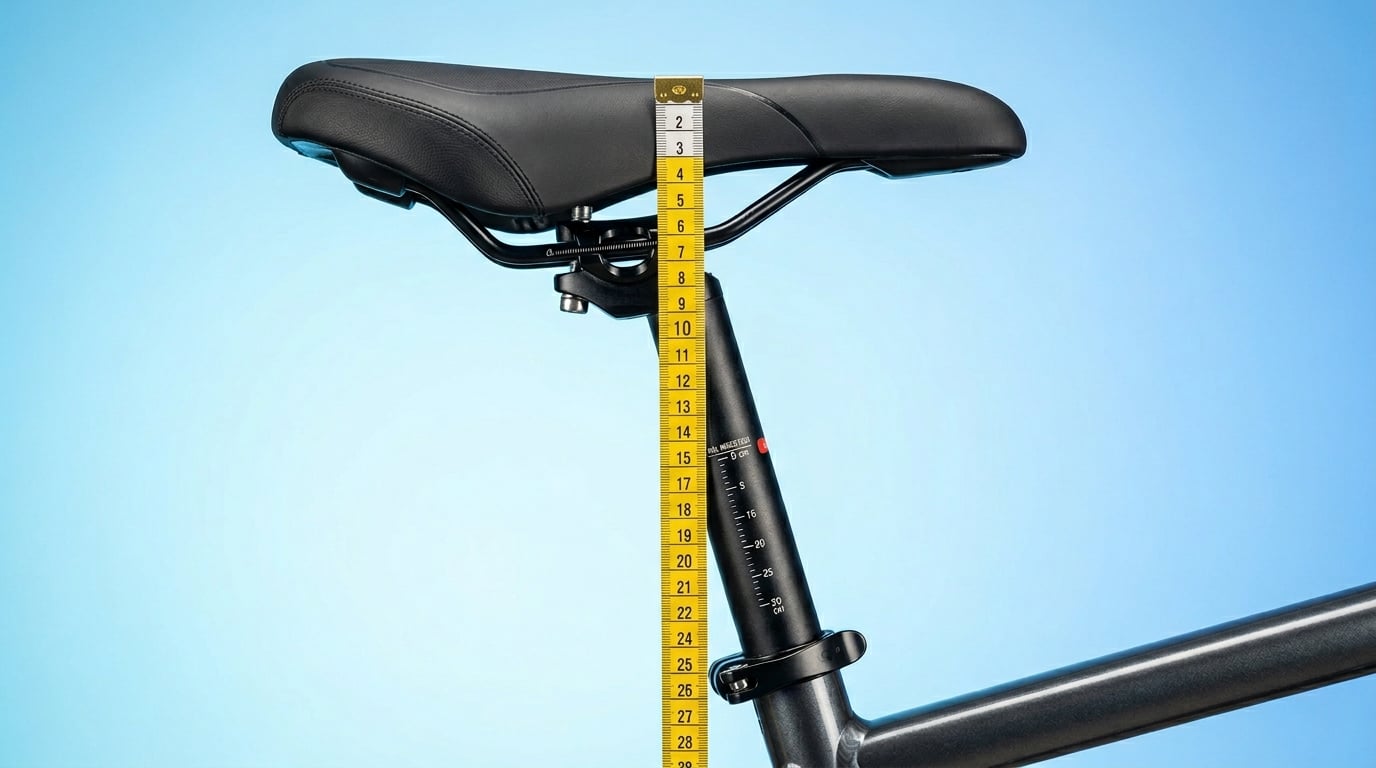
I still remember my first season of serious cycling. Three weeks in, both my knees ached so badly I thought I had damaged something permanently. Turns out, my saddle was nearly two inches too low. Once I fixed it, the pain disappeared within days. If your knees hurt when cycling, saddle height is the first thing you should check, and it is also the easiest fix.
The core issue comes down to knee angle. At the bottom of your pedal stroke, your knee should bend between 25 and 35 degrees. That is the sweet spot where your patellofemoral joint, tendons, and muscles all work without excessive strain. Most cyclists ride outside that range without knowing it. Some are at 10 degrees of flexion with a saddle cranked way too high, overextending with every revolution. Others pedal at 60-plus degrees in a squat-like position that grinds the kneecap into the femur thousands of times per ride.
In this guide, I will walk you through exactly why your knees hurt when cycling, how saddle height causes each type of pain, and how to find your correct height using two simple at-home methods. You will also learn about recovery timelines, prevention strategies, and when knee pain signals something more serious.
Table of Contents
Why Cyclists Get Knee Pain: The Core Problem
Cycling is a repetitive sport. A recreational rider averaging 80 revolutions per minute will complete roughly 4,800 pedal strokes in a single hour. Over a three-hour weekend ride, that is more than 14,000 repetitions per leg. Now imagine each of those repetitions forces your knee joint through a harmful range of motion. That is what happens when your saddle height is wrong.
Your knee is a hinge joint designed to flex and extend within a specific arc. The patellofemoral joint, where your kneecap meets your thigh bone (femur), takes the brunt of cycling forces. When your saddle height positions your leg correctly, the load distributes evenly across the quadriceps, hamstrings, and glutes. When it does not, the kneecap bears excessive pressure with every single stroke.
Research and bike fitting data consistently point to saddle height as the number one factor in cycling knee pain. A study published in the Journal of Science and Cycling found that incorrect saddle height increased patellofemoral compressive forces by up to 45%. That is the difference between a pain-free ride and waking up unable to walk down stairs the next morning.
The problem is that most cyclists set their saddle height based on what feels comfortable or what they saw on a YouTube video. But comfort at rest does not equal biomechanical efficiency under load. Your saddle height needs to match your pedaling mechanics, not just your leg length.
Types of Cycling Knee Pain and Where It Hurts
Knee pain is not a single problem. Where you feel pain tells you a lot about what is causing it. Different saddle height issues produce pain in different locations around the knee joint. Understanding this map is the fastest way to diagnose your own setup problem.
Anterior Knee Pain (Front of the Knee)
Pain at the front of your knee, around or under the kneecap, is the most common cycling complaint. This is called anterior knee pain or patellofemoral pain syndrome. You feel it as a dull ache or grinding sensation when you push down on the pedals, especially under load or climbing hills.
In nearly every case, anterior knee pain means your saddle is too low. A low saddle forces you to pedal in a compressed, squat-like position. Your knee stays bent too far throughout the stroke, which pushes the kneecap hard against the femur. The patellar tendon also gets overstretched and irritated. After thousands of repetitions, the cartilage behind the kneecap becomes inflamed and painful.
Reddit users on r/cycling consistently confirm this pattern. One rider shared that front-of-knee pain vanished completely after raising the saddle by 12mm. Another noted that anterior pain that lingered for months disappeared in a week after correcting a too-low seat.
Posterior Knee Pain (Back of the Knee)
Pain behind the knee is less common but no less frustrating. It typically presents as a sharp or aching sensation in the crease at the back of your knee, where the hamstring tendons cross the joint. You might feel it most at the bottom of your pedal stroke, when your leg is at maximum extension.
Posterior knee pain almost always means your saddle is too high. When your leg overextends at the bottom of the stroke, your hamstrings stretch beyond their natural range on every revolution. The tendon attachments behind the knee take the punishment. Over time, this repetitive overstretch causes inflammation and micro-tears in the hamstring tendons.
If you feel pain specifically at the top of the knee where it meets the thigh, that is also a sign of a saddle set too high. The hip flexors and quadriceps are being pulled too tight at the top of the stroke.
Medial Knee Pain (Inner Knee)
Inner knee pain affects roughly one in three cyclists according to data from Wattbike. This pain sits on the inside of the knee joint and often points to a foot positioning problem rather than saddle height alone. Your cleat position, foot angle, and pedal stance width all play a role here.
If your cleats point your toes inward excessively, or if your feet sit too narrow on the pedals, the knee collapses inward during each pedal stroke. This stresses the medial collateral ligament and the meniscus. While saddle height adjustments can help reduce the overall load, fixing medial knee pain usually requires looking at cleat angle and wedging.
Lateral Knee Pain (Outer Knee)
Pain on the outside of the knee is the signature symptom of iliotibial band syndrome, or IT band syndrome. The IT band is a thick strip of connective tissue that runs from your hip down to the outside of your knee. When it gets tight or inflamed from repetitive flexion and extension, it rubs against the outside of the knee joint, causing sharp pain.
IT band pain in cycling is often linked to saddle fore/aft position (how far forward or back your saddle sits) rather than height alone. A saddle positioned too far forward changes the angle of your leg relative to the pedal, increasing lateral stress on the knee. Saddle height that is too high can also contribute by increasing the stretch on the IT band.
Saddle Too Low: The Most Common Culprit
If I had to bet on the single most common cause of cycling knee pain, I would put my money on a saddle that is too low. It is the setup error I see most often on group rides, and it is the one that causes the most preventable damage to the knee joint.
When your saddle is too low, you pedal in a compressed position. Your knees never get close to full extension at the bottom of the stroke. Instead of your leg extending to a gentle 25 to 35-degree angle at the bottom, your knee stays sharply bent at 50, 60, or even 70 degrees throughout the pedal cycle.
This squat-like pedaling position creates two problems. First, it massively increases patellofemoral compression. Your kneecap gets jammed against your femur with every downward push. Think about holding a partial wall sit for an hour and you get the idea of what this does to the joint surface. Second, it forces your quadriceps to work harder because they never get the mechanical advantage of full extension. Fatigue sets in faster, form degrades, and the knee takes even more abuse.
The symptoms of a too-low saddle are very specific. You feel pain at the front of the knee, under or around the kneecap. The pain worsens when climbing or pushing big gears. You may notice a grinding or crunching sensation when bending your knee. After a ride, walking downstairs becomes painful.
Forum data backs this up. Cyclists on r/Velo frequently report that front-of-knee pain resolved entirely after raising the saddle in 5mm increments. The fix is simple, but you have to know to look for it.
Here is a quick self-check. Sit on your bike with your foot flat on the pedal at the bottom of the stroke (6 o’clock position). If your knee is bent significantly more than 25 to 35 degrees, your saddle is too low. You should see a nearly straight leg with just a slight micro-bend at the knee.
Saddle Too High: The Overextension Problem
The opposite error is a saddle set too high. This is less common than a too-low saddle among beginners, but it happens frequently among experienced riders who have heard “raise your saddle” as generic advice and overcorrected. It also occurs when cyclists switch to shoes with thicker soles or different pedal systems without readjusting their height.
When your saddle is too high, your leg reaches too far at the bottom of the pedal stroke. Instead of the optimal 25 to 35-degree knee flexion, your knee drops to 15 degrees or even straightens completely. This overextension is damaging in a different way than a low saddle.
Overextension strains the hamstring tendons at the back of the knee. Your hamstrings are not designed to be stretched to their absolute limit under load thousands of times per ride. The repetitive overstretch causes inflammation where the tendons attach to the back of the knee joint. You may also feel pain in the hip area, as the hip flexors get pulled tight at the top of the stroke.
The symptoms of a too-high saddle are distinct. Pain appears behind the knee rather than in front. You might feel a rocking sensation in your hips as your body tries to compensate for the overextension. Your lower back may ache after rides. Some riders notice they point their toes down at the bottom of the stroke to “reach” the pedals, which is a clear sign the saddle is too high.
One cyclist on the Road Bike Cycling Facebook group described it perfectly: “I raised my saddle after reading I should have a straight leg at the bottom. Two rides later, the back of my knee was killing me. Dropped it 8mm and the pain was gone in four days.”
The key insight here is that your leg should never be fully straight at the bottom of the pedal stroke. That micro-bend of 25 to 35 degrees is not just acceptable, it is essential for joint health and efficient power transfer.
The 25-35 Degree Knee Angle Rule (The Gold Standard)
Here is the measurement that most cycling resources gloss over or skip entirely. At the bottom of your pedal stroke, when your crank is at the 6 o’clock position, your knee should have between 25 and 35 degrees of flexion. Not straight, not deeply bent, just a gentle angle that allows your muscles to generate power without stressing the joint.
This range comes from biomechanical research on cycling efficiency and injury prevention. At 25 to 35 degrees of knee flexion at the bottom of the stroke, three things happen simultaneously. Your quadriceps can extend the knee with maximum force. Your hamstrings are not overstretched. And your patellofemoral joint experiences the lowest possible compressive force.
Go below 25 degrees (meaning your leg is nearly straight) and you enter the overextension zone. Hamstring tendons get strained. The back of the knee takes a beating. Go above 35 degrees (meaning your knee is still quite bent) and you enter the compression zone. The kneecap gets jammed against the femur. The patellar tendon gets overloaded.
Most bike fitters use a goniometer (a simple joint angle measuring tool) to check this angle during a professional fitting session. But you do not need one to get close. A friend with a smartphone camera can film you from the side at the bottom of your pedal stroke. Draw an imaginary line from your hip joint through your knee to your ankle. The angle at the knee should be that gentle 25 to 35-degree bend.
This single measurement is the difference between years of pain-free cycling and chronic knee issues. If you take away one thing from this article, let it be this number: 25 to 35 degrees. Write it down. Check your position. Adjust your saddle until you hit that range.
How to Set Your Saddle Height: The Heel-to-Pedal Test
You do not need a professional bike fit or expensive tools to get your saddle height close to ideal. The heel-to-pedal test is a proven at-home method that gets you in the right ballpark. From there, small fine-tuning will dial in the perfect position. Here is how to do it step by step.
Step 1: Find a doorway or wall. You need support while sitting on the bike so you can focus on your leg position. Lean against a wall or have a friend hold you steady. Wear the cycling shoes you normally ride in.
Step 2: Place your heel on the pedal. Rotate the crank to the bottom of the stroke (6 o’clock position). Place the center of your heel on the pedal, not the ball of your foot. This is important because your heel represents the longest reach your leg will make.
Step 3: Check for a straight leg. With your heel on the pedal at the bottom of the stroke, your leg should be fully extended but not locked. You should feel a gentle stretch in your calf and hamstring, but no strain behind the knee. If your knee is bent, your saddle is too low. If you have to rock your hip to reach the pedal, your saddle is too high.
Step 4: Adjust and recheck. Raise or lower your saddle in small increments until your leg is straight with your heel on the pedal. Mark this position. This is your baseline saddle height.
Step 5: Clip in and verify. Now put the ball of your foot on the pedal (or clip in normally). At the bottom of the stroke, your knee should have that 25 to 35-degree bend we discussed. The difference between your heel position and your normal foot position creates exactly the right amount of flexion.
Step 6: Fine-tune in 5mm increments. Ride for a few days at your baseline height. If you feel any discomfort, adjust the saddle by no more than 5mm at a time. Small changes have a big impact on knee biomechanics. Give your body at least two rides to adapt before making another adjustment.
The most common mistake during this process is going too fast. Riders often make large height changes based on a single ride’s feedback. Your body needs time to adapt to a new position. Make one small change, ride three times, then evaluate. Patience here prevents a new set of problems from replacing the old ones.
Another mistake is copying someone else’s saddle height. Even riders with the same inseam length can need different saddle heights based on flexibility, foot size, pedal system, and riding style. Your saddle height is personal. What works for your riding buddy may not work for you.
Beyond Saddle Height: Cleat Position and Saddle Fore/Aft
Saddle height is the biggest factor in cycling knee pain, but it is not the only one. Two other setup variables can cause or contribute to knee issues even when your height is correct.
Cleat position affects how your foot sits on the pedal, which in turn affects the alignment of your entire leg. If your cleats are rotated too far inward or outward, your knee will track at an angle rather than in a straight line. This is a common cause of medial (inner) knee pain. A good starting point is to set your cleats so your foot sits in its natural standing position. If you have persistent inner knee pain after fixing saddle height, cleat alignment is the next thing to investigate.
Saddle fore/aft position refers to how far forward or backward your saddle sits on the rails. This affects your knee’s position over the pedal spindle at the 3 o’clock point in the stroke. As a general rule, when your crank is horizontal (3 o’clock), a plumb line dropped from the front of your kneecap should pass through or just behind the center of the pedal axle. If your knee is too far forward, anterior pain can develop. Too far back, and you may experience lateral knee pain or IT band issues.
Seat tilt matters too. A nose-down tilt can cause you to slide forward, effectively changing your saddle height and fore/aft position mid-ride. A nose-up tilt can put pressure on sensitive areas and change your pelvic position. Start with a level saddle and adjust only if needed.
Handlebar height plays a smaller role in knee pain, but an extremely aggressive racing position can shift your weight distribution in ways that affect knee tracking. If you have addressed saddle height, cleats, and fore/aft position and still have pain, consider whether your reach is too long or too low.
How to Prevent Knee Pain When Cycling
Getting your saddle height right is the best single thing you can do for your knees. But prevention is about building habits that protect your joints over the long term. Here are the strategies that work.
1. Warm up before every ride. Spend the first 10 minutes of each ride spinning at a high cadence in a light gear. This warms up the synovial fluid in your knee joint and increases blood flow to the tendons and ligaments. Cold knees forced into hard pedaling are far more likely to develop pain.
2. Increase training volume gradually. The classic rule is to increase your weekly riding time or distance by no more than 10% per week. Sudden jumps in volume are a leading cause of overuse knee injuries. Your cardiovascular system adapts faster than your tendons and ligaments, so even if you feel fit, your knees may not be ready for the extra load.
3. Stretch your quads, hamstrings, and IT band. Tight muscles pull the kneecap out of alignment and increase joint compression. Spend five minutes after each ride stretching your quadriceps, hamstrings, calves, and IT band. Hold each stretch for 30 seconds and do not bounce.
4. Foam roll regularly. Foam rolling your quads and IT band releases tight fascia and muscle adhesions that contribute to knee pain. Two to three minutes per muscle group, three times per week, makes a noticeable difference. Many cyclists report that consistent foam rolling eliminated lingering knee issues that adjustments alone did not fix.
5. Spin, do not mash. Pedaling at a high cadence (80 to 100 rpm) in a lighter gear puts less peak force on your knees than grinding slowly in a heavy gear. If your cadence drops below 70 rpm on a climb, shift to an easier gear. Pushing big gears is a recipe for patellar tendon overload.
6. Rest when your knees talk to you. Mild soreness after a hard ride is normal. Sharp pain, swelling, or pain that changes how you walk is not. Take rest days seriously. A few days off the bike now prevents weeks of forced rest later.
Recovery Timeline: How Long Until Knee Pain Goes Away
No competitor I found in the search results covers recovery timelines, yet this is one of the most common questions cyclists ask. If you have knee pain from cycling, here is what to expect based on the type and severity of the issue.
Mild muscle soreness (front of knee, no swelling): This typically resolves in 3 to 5 days with rest, gentle stretching, and ice. Fix your saddle height before returning to riding. If you come back too soon, the soreness will return and take longer to heal.
Patellar tendon irritation (persistent front-of-knee pain, mild swelling): Recovery takes 1 to 3 weeks. You need full rest from cycling, ice twice daily, and gentle quad strengthening exercises. Do not return to riding until you can walk downstairs pain-free. When you do return, start with short, flat rides at high cadence.
Hamstring tendon strain (behind the knee): Plan on 2 to 4 weeks. Lower your saddle before riding again. Gentle hamstring stretching helps, but avoid aggressive stretching that re-irritates the tendon. Eccentric strengthening exercises, once acute pain subsides, speed recovery.
IT band syndrome (outer knee pain): This is the most stubborn cycling knee issue. Recovery can take 4 to 8 weeks. You need rest, aggressive foam rolling of the IT band and TFL muscle, and correction of your saddle fore/aft position. Returning too early almost always causes a relapse.
When to see a doctor: If your knee is swollen, hot to the touch, locks or catches during movement, or if you cannot bear weight on it, see a medical professional. Pain that persists for more than two weeks despite rest and saddle adjustments also warrants a visit. A sports medicine doctor or physical therapist who understands cycling can identify issues that bike fit alone cannot fix.
FAQ’s
Can a cycling saddle too high cause knee pain?
Yes. A saddle set too high causes your legs to overextend at the bottom of the pedal stroke, which strains the hamstring tendons behind the knee. This typically presents as posterior knee pain (pain at the back of the knee) and can also cause hip discomfort. The fix is lowering the saddle in 5mm increments until your knee has a 25 to 35-degree bend at the bottom of the stroke.
How to stop knees from hurting when cycling?
Start by checking your saddle height using the heel-to-pedal test. At the bottom of your pedal stroke, your knee should bend between 25 and 35 degrees. Warm up for 10 minutes before hard efforts, spin at 80 to 100 rpm instead of mashing heavy gears, stretch after rides, and increase training volume by no more than 10% per week. If pain persists beyond two weeks despite these changes, see a sports medicine professional.
What is the #1 mistake that makes bad knees worse?
The biggest mistake is riding through knee pain without fixing the root cause. Most cyclists assume the pain will go away on its own, but repetitive pedaling with an incorrect saddle height causes cumulative damage. Continuing to ride with a too-low saddle compresses the kneecap thousands of times per ride, turning mild soreness into chronic patellofemoral pain. Always identify and fix the cause before the pain becomes severe.
How do I know if my saddle is too high or too low?
Pain location tells you everything. If you feel pain at the front of your knee (under or around the kneecap), your saddle is likely too low. If you feel pain behind the knee or in your hips, your saddle is likely too high. You can confirm by sitting on the bike with your heel on the pedal at the bottom of the stroke. If your heel barely reaches the pedal, the saddle is too high. If your knee is clearly bent, it is too low.
Wrapping Up: Your Knees Deserve the Right Saddle Height
Knee pain when cycling is not something you have to live with. In the vast majority of cases, the fix comes down to saddle height. Get that 25 to 35-degree knee angle at the bottom of your pedal stroke, and you will eliminate the most common source of cycling knee pain.
Start with the heel-to-pedal test. Fine-tune in 5mm increments. Give your body time to adapt. If front-of-knee pain is your problem, raise the saddle. If the pain is behind your knee, lower it. The answers are that simple, even if getting them exactly right takes some patience.
If you have corrected your saddle height, checked your cleat position, and still have persistent knee pain after two weeks of rest, invest in a professional bike fit. A qualified fitter can identify subtle biomechanical issues that at-home methods miss. Your knees will thank you for every adjustment you make.