
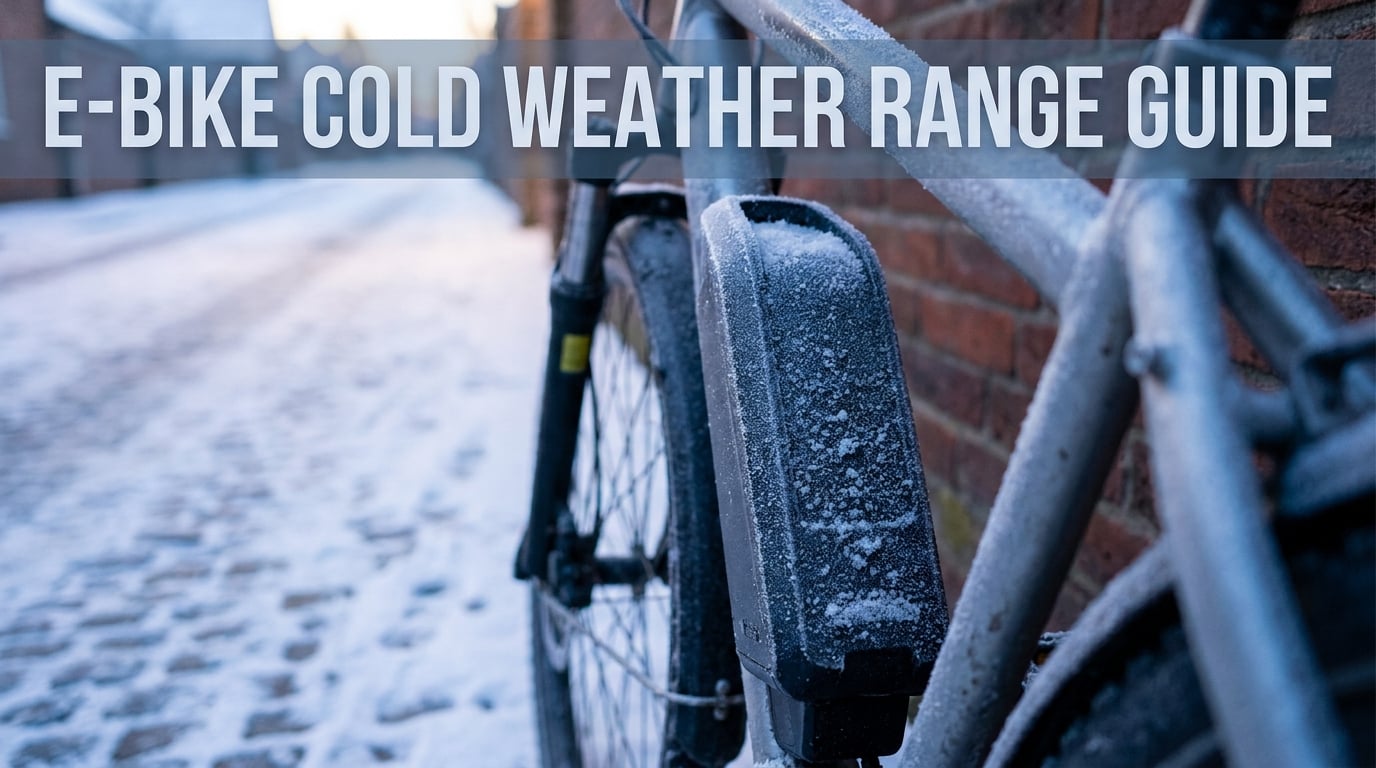
If you have ever started a winter commute with a full battery and watched the percentage plummet before you reached the office, you are not imagining things. Most e-bikes lose between 30 and 50 percent of their normal range when temperatures drop into the 20s and 30s Fahrenheit, and some riders on cold-weather forums report losses as steep as 70 percent during deep freezes.
The good news is that almost all of this loss is temporary, and most of it is preventable with the right habits. The bad news is that one common mistake, charging a freezing battery, can permanently damage the cells and shorten the pack’s lifespan for good.
I have spent the last three winters commuting year-round on a Class 3 e-bike in a climate that regularly dips below 14F, and I have made most of the mistakes this article covers. The strategies below are pulled from battery chemistry, manufacturer guidance, UL 2849 safety standards, and real rider reports from the r/ebikes community. By the end you will understand exactly why your e-bike loses range in cold weather, how to get that range back, and how to avoid the one charging mistake that ruins batteries.
Table of Contents
The Short Answer: Why Cold Cuts Your Range
Cold air itself is not what steals your range. The problem starts inside the lithium-ion battery pack. Here is the short version of why your e-bike loses range in cold weather:
- Cold temperatures thicken the electrolyte gel inside each cell, which slows the movement of lithium ions between the anode and cathode.
- Slower ion movement increases internal resistance, forcing the battery to work harder to deliver the same amount of power.
- Higher internal resistance produces voltage sag under load, so the battery management system (BMS) reads the pack as lower capacity than it actually has.
- The motor also pulls more current to overcome thicker lubricants, stiffer tires, and denser air, compounding the drain.
- Most of this loss is reversible once the battery warms up, but charging a cold battery can cause permanent damage through lithium plating.
Translation: the energy is still in your battery, but cold chemistry makes it harder to get that energy out. Warm the battery back up and most of the missing range returns.
The Science: What Happens Inside a Cold E-Bike Battery
To understand why range drops, it helps to know what a lithium-ion cell actually does. Inside each cylindrical or pouch cell in your e-bike pack, lithium ions move back and forth between two electrodes. The negative electrode is the anode, typically made of graphite. The positive electrode is the cathode, made of a lithium compound such as lithium cobalt oxide, lithium manganese oxide, or lithium iron phosphate.
These ions travel through a liquid or gel electrolyte that sits between the electrodes. When you ride, ions flow from anode to cathode and release energy. When you charge, the flow reverses. At room temperature, this chemical reaction happens quickly and efficiently.
Cold changes everything. As temperatures fall, the electrolyte becomes more viscous, meaning it thickens and flows more like honey than water. This slows the rate at which ions can move between electrodes. The technical term for the slowdown is increased internal resistance, and you can think of it as the battery having to push harder to deliver each watt.
Higher internal resistance creates a phenomenon called voltage sag. Under load, the battery’s voltage temporarily drops below what the BMS expects. The BMS, which exists to protect the cells from damage, interprets this sag as a sign that the pack is nearly empty and shuts off the output early. The result is a sudden drop on your display and a shortened ride, even though the actual energy is still locked inside the cells.
This is why a battery that shows 40 percent on a freezing morning can suddenly read 12 percent under hard pedaling on a hill, then recover to 35 percent after you stop. The capacity has not changed. The chemistry is just struggling to deliver it.
There is one more cold-weather chemical effect to know about, and it is the most important one for long-term battery health. When you charge a very cold battery, lithium ions cannot move into the graphite anode fast enough to keep up with the charging current. Instead of absorbing into the anode, the ions pile up on the surface and form a metallic layer of pure lithium called lithium plating. This plating is permanent. It permanently reduces capacity, and in extreme cases it can create internal shorts that lead to thermal runaway.
Temperature Thresholds: When Range Starts to Drop
Range loss is not an all-or-nothing event. The effect builds gradually as the temperature falls, and there are specific thresholds where behavior changes. The table below summarizes the temperatures that matter most for cold weather e-bike performance.
| Temperature Range | Battery Behavior | Recommended Action |
|---|---|---|
| 68F to 77F (20-25C) | Optimal. Full rated range, fast charging, no special care. | Ride and charge normally. |
| 50F to 68F (10-20C) | Mild range loss, roughly 5-10 percent. Charging still safe. | No changes needed. |
| 32F to 50F (0-10C) | Noticeable range loss, 10-25 percent. Battery feels sluggish on hills. | Pre-warm battery, store indoors, use eco mode. |
| 14F to 32F (-10 to 0C) | Significant range loss, 30-50 percent. Sudden display drops common. | Warm battery before riding, never charge below 32F. |
| Below 14F (-10C) | Severe range loss, 50-70 percent. Motor may feel weak. Risk of BMS shutdown. | Short rides only, full warm-up, consider alternative transport. |
| Below 0F (-18C) | Extreme. Most manufacturers advise against riding or storing. | Avoid riding. Store battery indoors at room temp. |
Two thresholds deserve special attention. The first is 32F, or 0C, which is the hard charging limit for almost every lithium-ion e-bike battery. Charging below this temperature is the single fastest way to permanently damage the pack. The second is 14F, or -10C, which is the practical lower limit for riding. Below this point, range loss becomes severe enough that most commuters will struggle to complete their normal routes.
Forum riders in places like Minnesota and Alberta regularly report that e-bikes still function at -10F, but with dramatically reduced range. One rider on r/ebikes described a 70 percent range loss on a 12-mile commute that normally used 30 percent of the battery. The motor still worked, but the pack was nearly dead on arrival.
The One Charging Rule That Can Save (Or Ruin) Your Battery
If you remember only one thing from this article, make it this: never charge a lithium-ion e-bike battery that is below 32F (0C). This is the single most important rule in cold weather battery care, and breaking it causes damage that cannot be undone.
Charging forces lithium ions into the anode at a controlled rate. When the battery is cold, the ions cannot enter the graphite fast enough to absorb the incoming current. Instead of intercalating, which is the technical term for ions sliding into the graphite layers, they pile up on the surface and plate out as metallic lithium. That plating is permanent, and every cold charge cycle reduces the pack’s total capacity forever.
The fix is simple but easy to forget. Always bring the battery indoors and let it warm to at least 50F before plugging in the charger. For most packs, this means 30 to 60 minutes at room temperature after a cold ride. The battery may feel only slightly cool to the touch on the outside, but the cells inside can take much longer to warm.
A reliable way to know the battery is warm enough is to charge only in a room kept between 60F and 70F, and to wait at least an hour after bringing the pack inside. If you store and charge in a heated space, the battery will always be ready to charge safely.
What happens if you accidentally charge a cold battery once? In most cases, a single cold charge will cause only minor plating and you may not notice the damage. Repeated cold charging is what destroys the pack. Treat the 32F rule as a hard line, not a guideline, and your battery will last for years longer than one that gets abused through winter.
How to Get Your Range Back: 7 Practical Tips
Understanding the science is useful, but most riders just want to know how to get their missing range back. These seven strategies are listed roughly in order of impact, based on rider reports and manufacturer guidance.
1. Warm the Battery Before You Ride
A warm battery delivers far more range than a cold one. If you store the pack indoors at room temperature and install it right before you leave, you will start your ride with a battery that performs close to its summer capacity. The first few miles are where most of the savings happen, because the battery stays warm from indoor storage until the cold air slowly cools the cells.
If you cannot store indoors, some riders warm the battery with a low-heat source like a heating pad for 15 minutes before riding. Never use a heat gun or hair dryer on high, and never warm the pack above 100F. Gentle, even warmth is the goal.
2. Drop to a Lower Pedal-Assist Mode
This is the single most effective in-ride adjustment you can make. Dropping from turbo or boost mode down to eco or tour mode cuts the current draw from the battery, which reduces voltage sag and lets the BMS read the pack more accurately. You will pedal a bit harder, but the battery will last much longer.
Most riders on r/ebikes report that eco mode alone recovers 20 to 30 percent of lost winter range. The motor pulls less current, internal resistance matters less, and the display percentage stops freefalling on hills.
3. Inflate Your Tires to the High End of the Range
Cold air lowers tire pressure by roughly 1 psi for every 10F drop in temperature. A soft tire has more rolling resistance, which makes the motor work harder and drains the battery faster. Check your pressure before every winter ride and inflate to the upper end of the recommended range printed on the sidewall.
For a commuter e-bike with 2-inch tires, that usually means 50 to 60 psi. For fat-tire e-bikes, 8 to 12 psi. The harder tire rolls more easily on cold pavement and the motor draws less current.
4. Ride Smoothly and Avoid Hard Acceleration
Sudden throttle or high-assist bursts draw large spikes of current from the battery. In cold weather, those spikes cause the worst voltage sag and trigger the earliest BMS shutdowns. Smooth, steady pedaling with gradual acceleration keeps the current draw even and lets the battery deliver its full capacity.
Think of it like highway driving versus city driving in a car. Steady speed is always more efficient, and the difference is exaggerated when the battery is cold.
5. Use a Neoprene Battery Cover
A battery cover, sometimes called a thermal sleeve, is a simple neoprene or insulated wrap that fits around the battery pack. It traps the heat the battery generates during riding and slows the rate at which cold air cools the cells. Riders who use them consistently report 10 to 15 percent better winter range.
Covers cost between $15 and $40 and are one of the cheapest range upgrades you can buy. They are most effective on externally mounted batteries and less critical on frame-integrated packs, which already have some insulation from the frame itself.
6. Carry a Spare Battery or Range Extender
If your commute is long and winter range loss makes it unreliable, a second battery is the most straightforward solution. Many e-bike brands sell spare packs that swap in within seconds. A range extender, which is a smaller secondary battery that mounts to the frame or a bottle cage, can add 30 to 50 percent more range without replacing the main pack.
This is not a cheap option, but for year-round commuters who depend on their e-bike, it solves the problem completely. Keep the spare warm in a backpack or pannier until you need it.
7. Plan Shorter Routes and Ride More
The simplest fix is to ride less total distance on the coldest days. Plan a route that is 20 to 30 percent shorter than your summer loop, or combine your e-bike with public transit for part of the trip. A 5-mile ride in 20F weather is far easier on the battery than a 15-mile one.
If you ride regularly through winter, your battery will actually perform better over time because regular use keeps the cells active. A battery that sits unused in the cold for weeks degrades faster than one that gets regular, gentle discharge cycles.
Winter Storage Guidelines: Keep Your Battery Healthy
How you store the battery when you are not riding matters almost as much as how you ride. Bad winter storage is the second most common cause of permanent capacity loss, right behind cold charging.
The ideal storage conditions are simple: store the battery indoors at room temperature, ideally between 60F and 70F, and never in an unheated garage, shed, or car trunk. Even if the air does not feel that cold, prolonged exposure to temperatures below freezing slowly degrades the cells.
Charge level matters as much as temperature. For short-term storage, meaning a few days to a couple of weeks, keep the battery between 50 and 80 percent charged. For long-term winter storage, meaning a month or more when you are not riding, drop the charge to 50 or 60 percent. Storing a fully charged battery accelerates chemical aging, and storing a fully discharged battery can cause the cells to drop below a recoverable voltage.
Check the battery every four to six weeks during long storage. If the charge level has dropped below 30 percent, top it back up to about 60 percent. This prevents deep discharge, which is one of the few ways a lithium-ion battery can fail completely.
If you must store the e-bike itself in an unheated garage, remove the battery and bring it indoors. Most modern e-bikes have quick-release battery mounts that let you pop the pack off in seconds. The bike frame can handle cold without damage, but the battery cannot.
Is the Range Loss Permanent? How to Tell
This is one of the most common questions on r/ebikes every winter, and the answer is reassuring. The range loss you experience during cold rides is almost always temporary. Once the battery warms back up to room temperature, the chemistry returns to normal and the full capacity is available again.
The exception is damage from cold charging or deep discharge during storage. Both of those cause permanent capacity loss through lithium plating or cell degradation. The way to tell the difference is to test the battery at room temperature after a full charge.
If a fully charged, room-temperature battery still delivers close to its rated range, the winter loss was temporary and the pack is healthy. If the range stays well below the original spec even at 70F, the battery has permanent capacity loss and may need replacement.
Most e-bike batteries are rated for 500 to 1,000 full charge cycles before significant degradation. A well-cared-for pack that avoids cold charging and deep discharge will typically last three to five years. One that gets abused through winter may only last one to two seasons.
UL 2849 and Battery Safety in Winter
UL 2849 is the safety certification standard for complete e-bike electrical systems, covering the battery, charger, and motor controller as a unit. A battery that carries the UL 2849 mark has been tested for overcharge, short circuit, temperature, and impact scenarios, and it includes a BMS designed to shut down safely under abuse conditions.
This matters more in winter because cold-weather charging abuse is one of the most common causes of e-bike battery fires. A certified battery with a quality BMS will refuse to charge or will shut down before a dangerous fault develops. A cheap uncertified pack may not have those protections.
If you ride in cold weather, look for the UL 2849 mark on the battery or in the product literature. It is not a guarantee against cold damage, but it is a strong signal that the BMS will protect the cells from the worst outcomes if you make a mistake.
The certification is still relatively new in the e-bike industry, having been adopted broadly in 2026. Many older or budget e-bikes do not carry it. If yours does not, treat cold-weather charging with extra caution and never leave a charging battery unattended.
Frequently Asked Questions
How much range do e-bikes lose in cold weather?
Most e-bikes lose between 30 and 50 percent of their rated range in temperatures between 14F and 32F. Below 14F, losses can reach 60 to 70 percent. The loss is temporary and returns once the battery warms to room temperature.
Is cold weather bad for e-bikes?
Cold weather is not harmful to the bike frame or motor, but it stresses the lithium-ion battery. Riding in cold is safe as long as you avoid charging below 32F, which causes permanent damage through lithium plating.
How cold is too cold for an e-bike battery?
The hard limit for charging is 32F (0C). Below this, charging causes permanent lithium plating. For riding, 14F (-10C) is the practical lower limit for most commuters. Below 0F (-18C), most manufacturers advise against riding.
Will leaving my e-bike in the cold affect it?
Short-term exposure during a ride is fine, but leaving the battery in freezing temperatures for hours or overnight accelerates cell aging. For storage longer than a few hours, bring the battery indoors to room temperature.
How do I warm up my e-bike battery in winter?
Store the battery indoors at room temperature and install it right before riding. For an already cold battery, let it sit indoors for 30 to 60 minutes before use, or use a low-heat warming pad. Never use a hair dryer or heat gun.
What temperature is too cold to ride a bicycle?
For an e-bike, 14F (-10C) is the practical lower limit. Below that, range loss is severe and the motor may feel weak on hills. For a non-electric bike, the limit is mainly rider comfort, typically around 20F for most commuters.
Can I charge my e-bike battery in a cold garage?
Only if the garage stays above 32F (0C). If the temperature drops below freezing, bring the battery indoors to charge. A heated space at 60-70F is the safest and fastest charging environment.
Is the winter range loss permanent?
No. The range loss during cold rides is temporary and returns when the battery warms up. Permanent loss only happens from cold charging, deep discharge during storage, or normal aging over hundreds of cycles.
Conclusion
Cold weather does not have to end your e-bike season. Now you know exactly why your e-bike loses range in cold weather, namely lithium-ion chemistry slowing down as the electrolyte thickens, and you know the single rule that prevents permanent damage: never charge a battery below 32F.
The fastest range recoveries come from warm indoor storage, lower pedal-assist modes, properly inflated tires, smooth riding, and a neoprene battery cover. Combine those habits with smart storage at 50 to 60 percent charge, and your battery will deliver close to summer range on all but the coldest days, while lasting for years longer than a pack that gets abused through winter.