
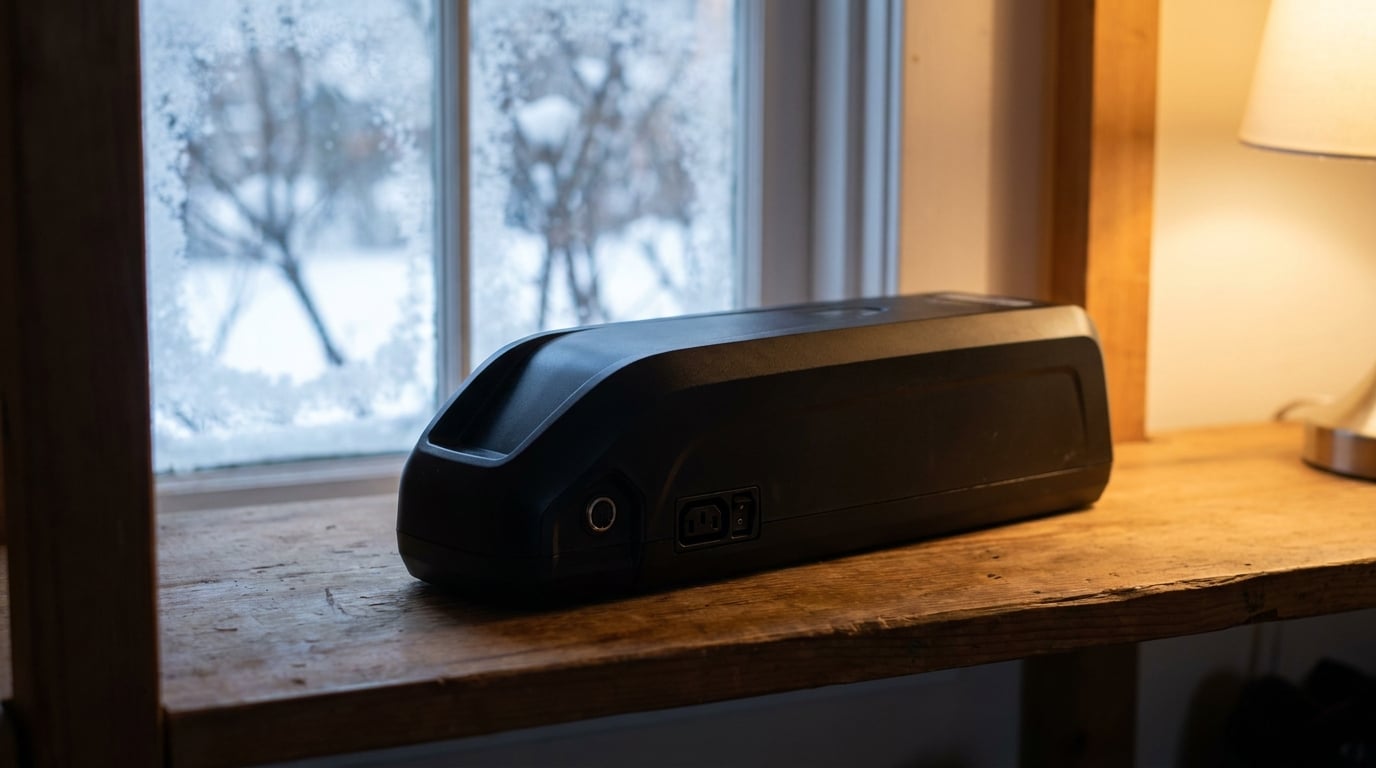
To store an e-bike battery over winter so it lasts longer, keep it indoors at room temperature (between 50 and 77 degrees Fahrenheit), charged to roughly 40 to 60 percent, and check the charge level once a month. Never charge a battery that is colder than 32 degrees Fahrenheit, because permanent lithium plating damage can occur in a single session.
If you want to store your e-bike battery over winter the right way, those four rules cover about 90 percent of what matters. The other 10 percent involves cleaning, removing the battery from the frame, choosing the right spot inside your home, and knowing the warning signs of cold damage. Our team has spent months digging through forum threads from r/ebikes, manufacturer guidelines from Bosch and Shimano, and real rider experiences to put together this guide.
A replacement e-bike battery typically runs between $500 and $900, so getting winter storage wrong is an expensive mistake. The good news is that proper storage is simple once you understand why cold weather harms lithium-ion cells. We will walk through the science, the step-by-step process, and the specific situations that trip people up most.
Table of Contents
Quick Summary: The 4 Rules of E-Bike Battery Winter Storage
If you remember nothing else from this guide, follow these four rules and your battery will survive winter in great shape:
- Store indoors at 50 to 77 degrees F (10 to 25 degrees C). A heated room, closet, or basement works. An unheated garage does not.
- Charge to 40 to 60 percent before storage. Never store fully charged or fully empty.
- Check the charge every 4 weeks. Top it back up to 50 percent if it has dropped below 30 percent.
- Never charge a cold battery. Wait until the battery reaches room temperature (at least 50 degrees F) before plugging in the charger. Charging below freezing causes irreversible damage.
Those four principles apply to every lithium-ion e-bike battery, regardless of brand. Bosch, Shimano, Yamaha, Bafang, and generic hub-motor batteries all use similar cell chemistry. The rules do not change.
Why Cold Weather Damages E-Bike Batteries
E-bike batteries use lithium-ion cells, which rely on chemical reactions to store and release energy. Cold temperatures slow these reactions dramatically. At 32 degrees Fahrenheit, a battery that normally delivers 40 miles of range might only give you 25. That is temporary and reversible. The real problem starts when cold batteries are charged.
Lithium Plating: The Hidden Killer
When you charge a lithium-ion battery below freezing (32 degrees F), lithium ions cannot properly intercalate into the graphite anode. Instead of soaking into the anode like they should, the ions pile up on the surface and form metallic lithium deposits. This process is called lithium plating, and it is permanent.
Once lithium metal forms on the anode, that capacity is gone forever. The battery will hold less charge, deliver less range, and degrade faster with every subsequent cycle. A single cold charge can reduce capacity by several percent. Multiple cold charges can ruin a battery within one winter.
Electrolyte Changes in Cold
The electrolyte inside each cell becomes thicker and more viscous as temperatures drop. Think of it like honey in a refrigerator. When the electrolyte is sluggish, ions move slowly, internal resistance rises, and the battery management system (BMS) works harder to regulate voltage and current. Over time, this stress contributes to cell degradation even without charging.
This is why storage temperature matters even when the battery is just sitting. Extended exposure to freezing temperatures accelerates aging, even if you never plug in a charger. The cells slowly lose capacity through chemical changes that speed up in the cold.
Condensation and Corrosion
Cold storage creates another problem: condensation. When a cold battery is moved to a warmer environment, moisture from the air condenses on and inside the battery casing. That moisture causes corrosion on electrical contacts and can eventually short circuit internal connections. Storing at a stable indoor temperature eliminates this freeze-thaw cycle entirely.
How to Store an E-Bike Battery Over Winter
Now that you understand the why, here is the step-by-step process for how to store an e-bike battery over winter so it lasts longer. Follow these steps in order.
Step 1: Remove the Battery from the Bike
Almost all e-bike batteries are removable. On most models, you turn a key and slide the battery off the frame. If your battery is frame-integrated and cannot be removed, skip to the section on integrated batteries below. For everyone else, removing the battery is essential because the bike frame conducts cold and the battery stays colder when mounted.
Removing the battery also eliminates parasitic drain. Even when the bike is off, the display and controller draw a small amount of current. Over weeks and months, that drain can pull a stored battery below safe levels and trigger deep discharge protection.
Step 2: Clean the Battery and Contacts
Before storage, wipe down the battery casing with a soft, dry cloth. If the contacts are dirty or corroded, clean them gently with a cotton swab lightly dampened with rubbing alcohol. Make sure everything is completely dry before storing. Dirt and moisture trapped against contacts during months of storage will cause corrosion.
If you rode in wet or salty conditions during the fall, pay extra attention here. Salt residue is corrosive and can eat into contact plates over winter. A few minutes of cleaning now prevents connection problems next spring.
Step 3: Charge to the Right Level
This is where people get confused, because you will see different numbers online. Some sources say 75 to 80 percent. Others say 30 to 50 percent. The answer depends on chemistry and how long you plan to store the battery.
For winter storage of one to five months, the consensus among battery engineers and reputable manufacturers is 40 to 60 percent charge. Here is why:
- Storing at 100 percent stresses the cells. A fully charged battery held at high voltage for months experiences accelerated chemical degradation. The cells age faster simply by being full.
- Storing at 0 percent risks deep discharge. Lithium-ion batteries slowly self-discharge over time. If a battery starts empty and sits for months, it can fall below the minimum voltage threshold. When that happens, the BMS may lock the battery permanently as a safety measure, and it will not charge again.
- Storing at 40 to 60 percent hits the sweet spot. The cells are under minimal stress, but there is enough charge buffer to prevent deep discharge during months of self-discharge.
If your bike display does not show percentages, aim for two out of five bars, or roughly half on whatever gauge your bike uses. For Bosch systems, two of five LED bars is about 40 percent. For Shimano STEPS, three of five bars is roughly 50 percent.
Step 4: Choose the Right Indoor Location
The ideal storage spot is a dry, climate-controlled room between 50 and 77 degrees F. Good options include:
- A closet in a heated part of your home
- A spare room or office
- A heated basement (if it stays above 50 degrees F)
- An indoor utility room
Avoid these locations:
- Unheated garages and sheds (temperatures drop below freezing)
- Attics (temperature swings wildly between day and night)
- Next to radiators, heaters, or furnaces (heat degrades batteries too)
- Direct sunlight (UV and heat damage cells)
- Damp basements with humidity problems (moisture causes corrosion)
Forum users on r/ebikes report storing batteries in everything from filing cabinet drawers to coat closets. One rider mentioned keeping theirs on a shelf in the laundry room, which stayed around 65 degrees all winter. The location does not need to be fancy. It just needs to be dry, stable, and above 50 degrees F.
Step 5: Check the Charge Monthly
Lithium-ion batteries self-discharge at roughly 2 to 5 percent per month at room temperature. After three to four months in storage, a battery that started at 50 percent might drop to 35 or 40 percent. That is still safe, but checking monthly ensures you never accidentally hit deep discharge.
Here is the simple monthly routine:
- Turn on the battery and check the charge indicator.
- If it reads above 30 percent, put it back in storage. No charging needed.
- If it reads below 30 percent, charge it back up to about 50 percent using the original manufacturer charger.
- Make sure the battery is at room temperature before charging.
- Disconnect the charger once it reaches 50 percent. Do not leave it plugged in.
Set a phone reminder for the same date each month. January 1, February 1, March 1. That consistency prevents the most common storage failure, which is simply forgetting to check.
Storage Temperature Ranges Explained
Temperature matters more than almost any other factor in winter battery storage. Here is a breakdown of the safe and dangerous ranges for different activities.
- Long-term storage: 50 to 77 degrees F (10 to 25 degrees C). This is room temperature in most homes. The battery ages slowly and predictably in this range.
- Charging: 32 to 113 degrees F (0 to 45 degrees C). The battery must be above freezing before you connect the charger. Charging between 50 and 77 degrees F is ideal.
- Riding: 14 to 140 degrees F (-10 to 60 degrees C). You can ride in cold weather, but expect 30 to 50 percent range reduction below 40 degrees F.
- Never store or charge below 14 degrees F (-10 degrees C). At this temperature, the electrolyte can begin to freeze, causing permanent physical damage to cell structure.
Shimano recommends 10 to 20 degrees C (50 to 68 degrees F) for winter storage. Bosch specifies storing above 10 degrees C (50 degrees F). Aventon suggests 32 to 68 degrees F, though the lower end of that range is riskier for long-term storage. When manufacturers disagree slightly, the safest approach is to stay above 50 degrees F whenever possible.
Frame-Integrated Batteries: Storage When You Cannot Remove the Battery
Some e-bikes have batteries built into the frame that are not designed for easy removal. Specialized Turbo models, certain VanMoof and Cowboy bikes, and some budget hub-motor models fall into this category. Forum users consistently ask how to handle winter storage when the battery stays in the bike.
The simplest solution is to bring the entire bike indoors. If you have space in a hallway, mudroom, or heated garage, store the whole bike at room temperature. The battery stays warm because it never leaves the climate-controlled environment.
If bringing the bike inside is not possible, here are workable alternatives:
- Foam insulation: Riders with frame-integrated batteries report success wrapping the battery compartment in closed-cell foam insulation. This slows temperature changes but does not replace actual warmth. The battery still gets cold eventually, just more slowly.
- Heated storage blanket: Some riders use battery warming blankets designed for motorcycles or cars. These keep the battery above freezing during cold snaps. Use only products designed for batteries, never improvised heating pads that could overheat.
- Brief indoor warming sessions: If the bike must stay outside, bring just the controller and display unit indoors. Then bring the entire bike inside for a few hours every two weeks to let the battery warm up and prevent prolonged deep cold exposure.
Nordic riders have an interesting tip: they bring their bikes indoors about 30 minutes before riding so the frame warms to room temperature. When they head back outside, the warm frame prevents snow from sticking and the battery starts the ride at optimal temperature. This is for riding preparation, not storage, but it shows how temperature management works in cold climates.
Fire Safety and Storage Bags
No major competitor in our research covers fire safety during e-bike battery storage. But forum discussions show this is a real concern, especially for apartment dwellers storing batteries indoors. Lithium-ion batteries store a lot of energy, and while failures are rare, they can be serious when they happen.
Here is what to know about fire-safe e-bike battery storage:
- Use a fireproof storage bag. LiPo guard bags and fireproof battery storage bags are available for under $30. They contain potential thermal events and give you time to react. For a battery sitting in a closet for months, this is cheap insurance.
- Store on a non-flammable surface. Concrete, tile, or metal shelving is better than wood or carpet. If a battery ever vented or sparked, you want it on a surface that will not ignite.
- Keep away from flammable materials. Do not store the battery next to paint cans, fuel containers, paper stacks, or holiday decorations. Give it clearance on all sides.
- Never store a damaged battery indoors. If the casing is cracked, swollen, or dented, that battery is a fire risk. Contact a battery recycling center and replace it.
- Use only the original manufacturer charger. Cheap third-party chargers can overcharge cells, especially during the long unattended charging sessions that happen during monthly maintenance top-ups.
A fireproof bag also protects the battery from dust and moisture during storage. Several riders on r/ebikes mentioned using ammo cans or metal toolboxes as improvised fire-resistant storage. These work in a pinch, but a dedicated battery bag with proper ventilation is safer.
Signs Your Battery Was Damaged by Cold Storage
If you are reading this guide after a winter of questionable storage, you might be wondering whether your battery survived. Here are the warning signs of cold damage.
Range Reduction
The most common symptom is reduced range. If your battery used to deliver 40 miles and now only gives 28, that capacity loss may be from cold damage. A small reduction (5 to 10 percent) over a winter is normal aging. A large drop (25 percent or more) suggests a problem.
Erratic Charge Indicator
If the charge display jumps around, drops suddenly from 50 percent to 10 percent, or shows inconsistent readings, individual cells may be damaged. The BMS measures the combined voltage of all cells. When some cells are weak, the reading becomes unreliable.
Longer Charging Time
A damaged battery often takes longer to charge because the BMS limits current to protect weakened cells. If charging that used to take 4 hours now takes 7, that is a red flag.
Swelling or Heat
Physical swelling of the battery casing is a serious warning. Stop using the battery immediately and take it to a recycling center. Likewise, if the battery feels unusually warm during storage or charging, it may have internal shorting.
The hard truth is that cold damage is cumulative and irreversible. You cannot undo lithium plating. If your battery lost significant capacity over winter, the only real fix is replacement. Proper storage going forward prevents further degradation.
Bringing Your Battery Back After Winter
When spring arrives, do not just throw the battery back on the bike and ride. Follow a brief reactivation process to wake the cells up safely.
First, let the battery sit at room temperature for at least 2 to 3 hours if it was stored somewhere cooler than your riding environment. If the battery feels cold to the touch, it is not ready.
Second, charge the battery to 100 percent using the original charger. This full charge balances the cells and recalibrates the BMS, which has been sitting idle for months. Expect this charge to take longer than usual.
Third, take a short test ride (5 to 10 miles) before relying on the battery for a long trip. This lets you confirm the range is normal and there are no error codes on the display. If everything checks out, you are good for the season.
Frequently Asked Questions
Where should I store my ebike battery in the winter?
Store your e-bike battery indoors in a dry, climate-controlled room between 50 and 77 degrees F. A closet, spare room, or heated basement works well. Avoid unheated garages, sheds, and attics where temperatures drop below freezing.
Can e-bike batteries be left in the cold?
E-bike batteries should not be stored in freezing temperatures. Prolonged cold exposure accelerates cell degradation, and charging a battery below 32 degrees F causes permanent lithium plating damage. If your battery must stay in a cold space, bring it indoors to warm up before charging.
How do you store an ebike battery when not in use?
Remove the battery from the bike, clean the contacts, charge it to 40 to 60 percent, and store it in a dry indoor location at 50 to 77 degrees F. Check the charge level monthly and top it up to 50 percent if it drops below 30 percent. Never store the battery fully charged or fully empty.
Is it bad to leave an e-bike battery at zero percent for storage?
Yes. Storing a battery fully discharged risks deep discharge, which can permanently kill the battery. Lithium-ion cells slowly self-discharge over months, and a battery starting at zero will fall below the safe voltage threshold. Always store at 40 to 60 percent charge.
How often should I charge my e-bike battery during winter storage?
Check the charge level once a month. If the battery is above 30 percent, no charging is needed. If it has dropped below 30 percent, charge it back to roughly 50 percent using the original charger. Make sure the battery is at room temperature before plugging in.
Can I use a heating pad to warm my e-bike battery in winter?
Avoid improvised heating pads, which can overheat the battery and create a fire risk. If you need to warm a battery, let it sit at room temperature for 2 to 3 hours naturally. For frame-integrated batteries in cold storage, use only battery warming blankets designed for the purpose.
Conclusion
Knowing how to store an e-bike battery over winter so it lasts longer comes down to four simple rules: store indoors at 50 to 77 degrees F, charge to 40 to 60 percent, check monthly, and never charge a cold battery. That is it. Follow those rules and your battery will come out of storage ready for spring with minimal capacity loss.
The science behind the rules matters because it keeps you from cutting corners. Lithium plating is permanent. Deep discharge is permanent. Condensation corrosion is permanent. But with a few minutes of preparation and a monthly check, your battery will outlast bikes that were stored carelessly. Set a monthly reminder, find a dry indoor spot, and you are set.