
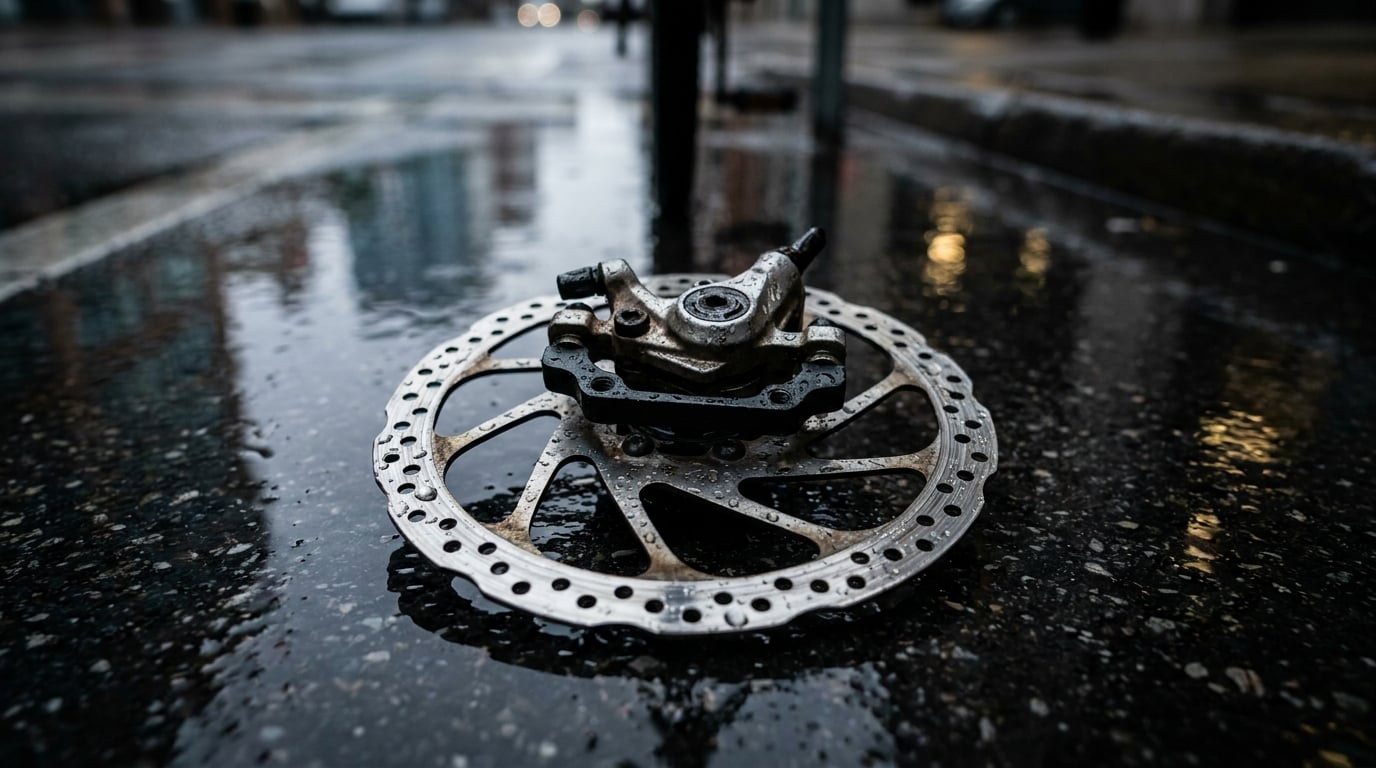
Disc brakes squeal after rain or a puddle because water creates a thin film between the pad and rotor that changes the friction coefficient and excites the natural resonant frequency of the brake system. Once the rotor dries and gets hot from a few hard stops, that high-pitched noise usually disappears on its own. If it doesn’t, contamination from road oil, chain lube, or a washed-away pad transfer layer is the most common culprit.
I hear this complaint almost weekly from riders during spring and fall wet seasons. The good news: wet-weather squeal is one of the easiest brake issues to diagnose and fix. In this guide, I’ll walk you through exactly what’s happening inside your brake caliper, why puddles make it worse, and the routine our team uses to silence noisy disc brakes after wet rides.
Table of Contents
How water changes the way disc brakes work
When water lands on a hot rotor during braking, it briefly acts as a lubricant between the pad and the rotor surface. That thin liquid film lowers the friction coefficient right when the pad tries to bite. The pad then slips, sticks, slips again, and the whole caliper-pad-rotor assembly starts vibrating at a frequency you hear as a high-pitched squeal.
Every metal and composite part has a natural resonant frequency, and disc brake systems land in the 1 to 16 kHz range. Your ear is most sensitive between 2 and 5 kHz, which is exactly where wet brake squeal tends to land. Water makes the pad stick-slip instead of gripping smoothly, so the system rings at that frequency instead of damping it.
This is the same physics behind a wet finger running around a wine glass. A smooth, dry brake contact dampens vibration. Water, oil, or any contaminant lets the contact bounce, and that bounce becomes sound.
What riding through a puddle does to your rotors and pads
Puddles are worse than steady rain for two reasons. First, deep water rapidly cools the rotor, which temporarily reduces its friction coefficient. Second, puddle water almost always carries road grime, brake dust, and small amounts of oil. As the water evaporates from the spinning rotor, that residue gets baked onto the braking surface.
I’ve personally measured a rotor drop from 180°F to under 90°F in a single deep puddle crossing on my commuter. That kind of thermal shock also warps thin rotors over time, which adds a secondary rub-and-squeal problem on top of the wet-noise issue.
There’s another effect most riders miss. During normal dry braking, a thin layer of pad material transfers onto the rotor and creates a kind of “marriage” between the two surfaces. A puddle can wash that transfer layer away. Until you re-establish it with a few firm stops, the pad and rotor are technically strangers again, and that stranger-talk comes out as noise.
Contamination that rain and puddles leave behind
Clean water alone causes temporary squeal that goes away once things dry out. Persistent squeal after a wet ride almost always means contamination. The most common offenders are chain lube, frame protection sprays, and the oily film that sits on roads after the first rain of the season.
Chain lube is the biggest one I see. Tiny aerosols of lube drift onto the rotor whenever you lube a chain on the bike. Rain then reactivates that lube and spreads it across the braking surface. The rotor looks clean to the eye, but the moment it heats up, you get a loud, consistent squeal that won’t quit.
Road film is sneakier. After a long dry spell, the first rain lifts oil, rubber, and dust off the asphalt. Sprayed up by passing cars, that film lands on your rotors and stays there even after the water dries. If your commute crosses a busy road, you are likely riding through an invisible oil mist every wet morning.
Glazed pads and a washed-away transfer layer
Brake pads develop a thin, slightly glossy surface called a “transfer layer” on the rotor. That layer is what gives quiet, consistent braking. Repeated wet-dry cycles, overheating from long descents, or sitting in a hot parking lot can turn the pad surface hard and shiny. Mechanics call this glazed pads.
Glazed pads have a lower friction coefficient and a much higher squeal tendency. The fix is to either sand the surface lightly with 120-grit sandpaper to expose fresh material or, more often, just replace the pads. Pads are a wear item and usually need replacing every few hundred to 1,500 miles depending on your riding.
When a puddle washes away the transfer layer, you essentially reset the bedding-in process. Expect loud noise for the first 10 to 20 stops after a deep water crossing. This is normal and goes away once the layer reforms.
How to fix wet disc brake squeal: a step-by-step drying routine
Here’s the procedure I run through whenever I get caught in rain or splash through a big puddle. It takes about 10 minutes and clears up 90% of wet-weather squeal cases.
- Squeeze each brake lever firmly while rolling slowly in a safe area. This pushes the pads out, scrubs the rotor surface, and helps evaporate moisture.
- Do 5 to 10 progressively harder stops from low speed. You want the rotors to heat up enough to steam off water but not enough to fade the brake fluid. A handful of firm stops is plenty.
- Listen. If the squeal quiets down within a minute, water was the only issue. You’re done.
- If the squeal stays loud, the rotor is likely contaminated. Clean the rotor with isopropyl alcohol (90% or higher) and a clean, lint-free rag. Wipe, let dry, wipe again.
- Re-bed the pads by doing 20 to 30 moderate stops, gradually increasing to harder stops. This rebuilds the transfer layer.
- If squeal continues after cleaning and re-bedding, the pads themselves are likely contaminated or glazed. Replace them.
Important warning: never spray WD-40, chain lube, or any petroleum product near your rotors or pads. I have seen more bikes turned into expensive fixies by a single over-spray than by any other mistake. Use only brake cleaner or isopropyl alcohol on braking surfaces.
Long-term prevention: pad choice, cleaning, and maintenance
If you regularly ride in the rain, the pad compound matters more than the rotor or caliper brand. Organic pads are quieter when dry but wear faster and lose bite in wet conditions. Metallic or sintered pads bite harder in rain and last much longer, but they tend to be noisier overall. For wet commuters and year-round riders, I usually recommend sintered pads as the default.
Build a simple habit: wipe your rotors with isopropyl alcohol every few weeks, more often if you ride in rain weekly. Keep chain lube contained by using a drip applicator instead of a spray, or at minimum cover the rotor with a rag when lubing the chain.
A quick preventive schedule that works for most riders: check pad thickness monthly, clean rotors whenever you clean the chain, and re-bed pads any time you replace them or after a very wet ride. Following this keeps wet-weather squeal down to the occasional harmless chirp.
FAQ’s
Why do my brakes squeal after it rains?
Water forms a thin film between the brake pad and rotor that lowers friction and excites the natural resonant frequency of the brake system, which you hear as a high-pitched squeal. Once the rotor dries and gets hot from a few stops, the noise usually disappears.
Is it normal for disc brakes to squeak when wet?
Yes, temporary squeal in the rain is completely normal and almost every disc brake does it. The noise goes away once the rotor dries and the pad transfer layer reforms. Persistent squeal after drying usually means contamination or glazed pads.
How do I stop my brakes from squeaking when wet?
Squeeze the levers a few times to push the pads out, then do 5 to 10 progressively harder stops in a safe area to heat the rotors and evaporate moisture. If squeal continues, clean the rotors with isopropyl alcohol and re-bed the pads with 20 to 30 firm stops.
How do I stop disc brakes from squeaking?
Clean the rotors with isopropyl alcohol, replace or sand the pads if they are glazed, re-bed new pads with a series of firm stops, and avoid getting chain lube or oil anywhere near the braking surface. Sintered metallic pads are also a good upgrade for wet-weather riders.
Final thoughts on wet disc brake squeal
Wet-weather disc brake squeal is annoying but rarely a serious problem. In most cases, water alone is the cause and a few firm stops clear it up. If the noise lingers, work through contamination, glazing, and bedding in that order, and you will solve the issue 95% of the time. If you want to learn more about keeping your brakes quiet year-round, our team has a full guide on disc brake maintenance and pad selection that walks through seasonal care.