
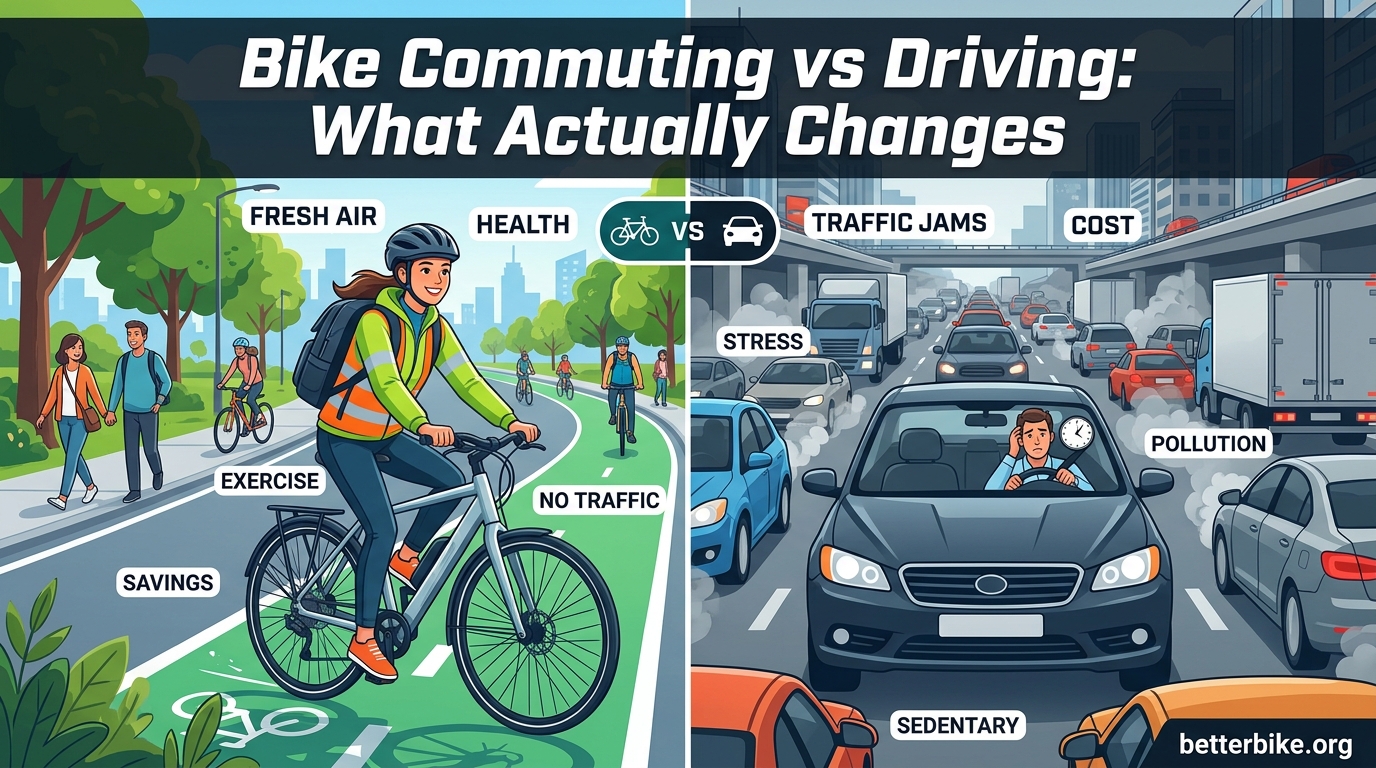
Last spring, I traded my car keys for a bike lock on a 6-mile commute. I expected to save money and get some exercise. What I did not expect was how completely bike commuting vs driving would rewire my mornings, my stress levels, my sleep, and even my relationship with my neighborhood. Six months in, the changes run deeper than I thought possible.
This guide breaks down what actually shifts in your daily life when you swap driving for cycling, drawing on research, real commuter numbers, and lessons I learned the hard way. If you are weighing the switch, here is what to expect.
Table of Contents
Bike Commuting vs Driving: Your Body Changes in 30 Days
Switching from driving to cycling adds meaningful aerobic activity to your day without adding a separate workout. A 5-mile bike commute burns roughly 250 to 350 calories per trip, depending on your pace and terrain. That is real cardiovascular work, performed twice a day, five days a week, and it shows up in your body within weeks.
Research from the Copenhagen Heart Study and other long-term studies has consistently shown that regular cycling commuters have roughly a 30% lower risk of cardiovascular disease compared to non-active commuters. Your resting heart rate drops, blood pressure improves, and insulin sensitivity increases. People who cycle to work also show significantly lower rates of type 2 diabetes, even after researchers control for diet and other lifestyle factors.
For me, the first visible change was sleep. By week three, I was falling asleep faster and waking up more refreshed. My doctor said this tracks with the literature: moderate aerobic exercise in the morning regulates cortisol and improves sleep architecture. I also noticed that my chronic lower back pain from years of desk work started fading, simply because sitting in a car seat is biomechanically much worse for your spine than a properly fitted bike position.
One thing nobody told me: your legs feel different for the first two weeks. The first hill used to wind me. Now it barely registers. Muscle adaptation is faster than most people expect.
The 80% Rule That Cyclists Use
If you have ever wondered about the 80% rule in cycling, it is a training concept where roughly 80% of your riding happens at an easy, conversational pace. For commuters, this is automatic. You do not need interval training or structured workouts. The simple act of pedaling to work and back covers your base aerobic zone without you having to think about it.
How Bike Commuting Reshapes Your Mental and Emotional State
The mental shift surprised me more than the physical one. A landmark study from Portland State University analyzed commute well-being across transportation modes and found that bike commuters reported the highest happiness and life satisfaction of any group, even higher than walkers. Drivers reported the lowest.
The mechanism is straightforward. Cycling produces endorphins, reduces cortisol, and exposes you to natural light and outdoor air, all of which are proven mood elevators. But there is something else: the meditative quality of pedaling. On a bike, you are moving, breathing, and aware. In a car, you are stalled, frustrated, and isolated.
Road rage evaporates. I have not honked my horn once in six months. I have not sat in a single traffic jam. The concept of being stuck in rush hour simply does not apply. One Reddit commuter put it perfectly: “My stress level is lower. I interact more with my neighborhood. I get more exercise. It’s just better.”
Mental clarity improves throughout the workday. I arrive at the office alert and focused rather than groggy and tense. My afternoon energy crashes are gone. There is also a small but real social benefit: baristas, regular shop owners, and other cyclists now know me by name in ways that never happened in a car.
What Happens to Your Time and Daily Routine
Time is the biggest worry for new bike commuters, and the honest answer is that it depends on your city and your distance. A 4 to 6-mile commute typically takes 20 to 30 minutes by bike, compared to 15 to 25 minutes by car in light traffic. The gap shrinks, and sometimes reverses, when you factor in parking, traffic, and post-work errands.
Real commuter data from the r/bikecommuting community is illuminating. One cyclist reports a 4-mile trip taking 19 to 24 minutes, regardless of bike. Another reports a 6.75-mile commute averaging 28 to 32 minutes, compared to 25 minutes driving. The time difference is often only 3 to 7 minutes, but the stress difference is enormous.
For trips under 3 miles, a bike almost always wins once parking is factored in. For trips over 10 miles, multimodal travel (combining cycling with transit) is often the fastest and least stressful option.
How Long Is Too Long for a Bike Commute?
For most people, a commute under 45 minutes each way is sustainable long-term. Beyond 60 minutes, fatigue and time pressure start eroding the mental health benefits. If your drive is longer, consider cycling to a transit station rather than cycling door to door.
The Financial Impact of Switching from Car to Bike
The numbers are striking. The AAA estimates the average cost of car ownership at over 12 cents per mile, covering fuel, insurance, depreciation, maintenance, and registration. A 10-mile daily commute adds up to roughly 3,000 miles a year, or around 3,600 dollars in car-related expenses.
A commuter bike costs a fraction of that over its lifetime. Even a high-quality bike at 1,500 dollars, replaced every 5 years, with 200 dollars a year in maintenance and gear, totals roughly 500 dollars annually. The savings, around 3,000 dollars a year, are life-changing for many families.
Other line items disappear: parking fees, fuel costs, oil changes, tire rotations, emissions tests. Health care spending often drops too. Active commuters visit doctors less frequently and have lower lifetime medical costs. One study from the British Medical Association estimated that regular cycling adds about as many healthy years to your life as quitting smoking.
I personally track my savings in a spreadsheet. After six months, I am ahead by roughly 2,100 dollars once I subtract the bike purchase and gear. My breakeven point arrived at month four.
Environmental and Lifestyle Ripple Effects
The environmental math is simple. A typical car emits about 4.6 metric tons of carbon dioxide per year. Cycling produces essentially zero direct emissions and minimal lifecycle emissions. If you are one of millions of commuters making this switch, the cumulative impact is enormous.
But the ripple effects go beyond carbon. I notice my neighborhood in ways I never did from behind a windshield. I see the bakery that just opened, the new park, the seasonal changes in trees. I stop at a fruit stand that I drove past for years. The geography of my city became three-dimensional, not a corridor between two parking lots.
Weather becomes a factor, and that is real. You will get rained on. You will get cold. With proper gear, a layering system, and fenders, this becomes a minor inconvenience rather than a deal-breaker. Many commuters keep a backup plan for ice storms and use transit for genuinely dangerous days.
Practical Tips for the Transition Period
The first two weeks are the hardest. Your body is adjusting, your route is unfamiliar, and small problems feel big. Here is what I wish I had known on day one.
- Test your route on a weekend before your first workday. You will find shortcuts, low-traffic streets, and hazards that no map will show you.
- Buy a basic repair kit: a spare tube, a multi-tool, a mini-pump, and tire levers. Flat tires are easy to fix once you have done it twice.
- Invest in a good rain jacket and fenders. Wet commutes without fenders are misery.
- Pack your work clothes the night before, or keep a small set at the office. Arriving presentable is easy once you have a system.
- Use a pannier or rack bag. Backpacks on long rides cause shoulder and back pain.
- Start with two or three days a week, not five. Build the habit before you scale it.
Give yourself 30 days. By then, the routine will feel normal, and the morning dread of driving will feel strange instead.
FAQ’s
What happens to your body if you ride a bike every day?
Your cardiovascular fitness improves within 2-4 weeks, with lower resting heart rate and blood pressure. You burn 250-350 calories per 5-mile commute, which leads to gradual fat loss and improved insulin sensitivity. Sleep quality typically improves within the first month, and chronic muscle stiffness, especially in the back and hips, often decreases significantly.
How long is too long for a bicycle commute?
A bike commute under 45 minutes each way is sustainable for most people long-term. Beyond 60 minutes, fatigue starts eroding the mental health benefits. For longer distances, consider cycling to a transit station and combining modes, which preserves the health benefits while reducing total travel time.
Is biking to work really faster than driving?
For commutes under 3 miles, cycling is almost always faster once parking is factored in. For 4-7 mile commutes, the time difference is typically 3-7 minutes in favor of driving, but the stress difference is far larger. For commutes over 10 miles, multimodal travel combining cycling and transit is often the fastest option.
What are the mental health benefits of bike commuting?
Regular bike commuters report higher happiness and life satisfaction than drivers or even walkers. Cycling reduces cortisol, releases endorphins, exposes you to natural light, and eliminates the frustration of traffic. Many commuters also report improved mental clarity throughout the workday and better sleep quality at night.
The Bottom Line on Bike Commuting vs Driving
Bike commuting vs driving is not just a transportation decision. It is a daily life decision that touches your body, your mind, your wallet, and your planet. The physical health gains show up within weeks. The mental health gains show up within days. The financial gains are quantifiable from month one.
You do not have to commit forever. Try it for 30 days. Map a safe route, buy a basic kit, and give yourself permission to take transit on bad weather days. Most people who make it past the first two weeks never go back to a daily driving routine, and for good reason. The changes are real, and they add up.