
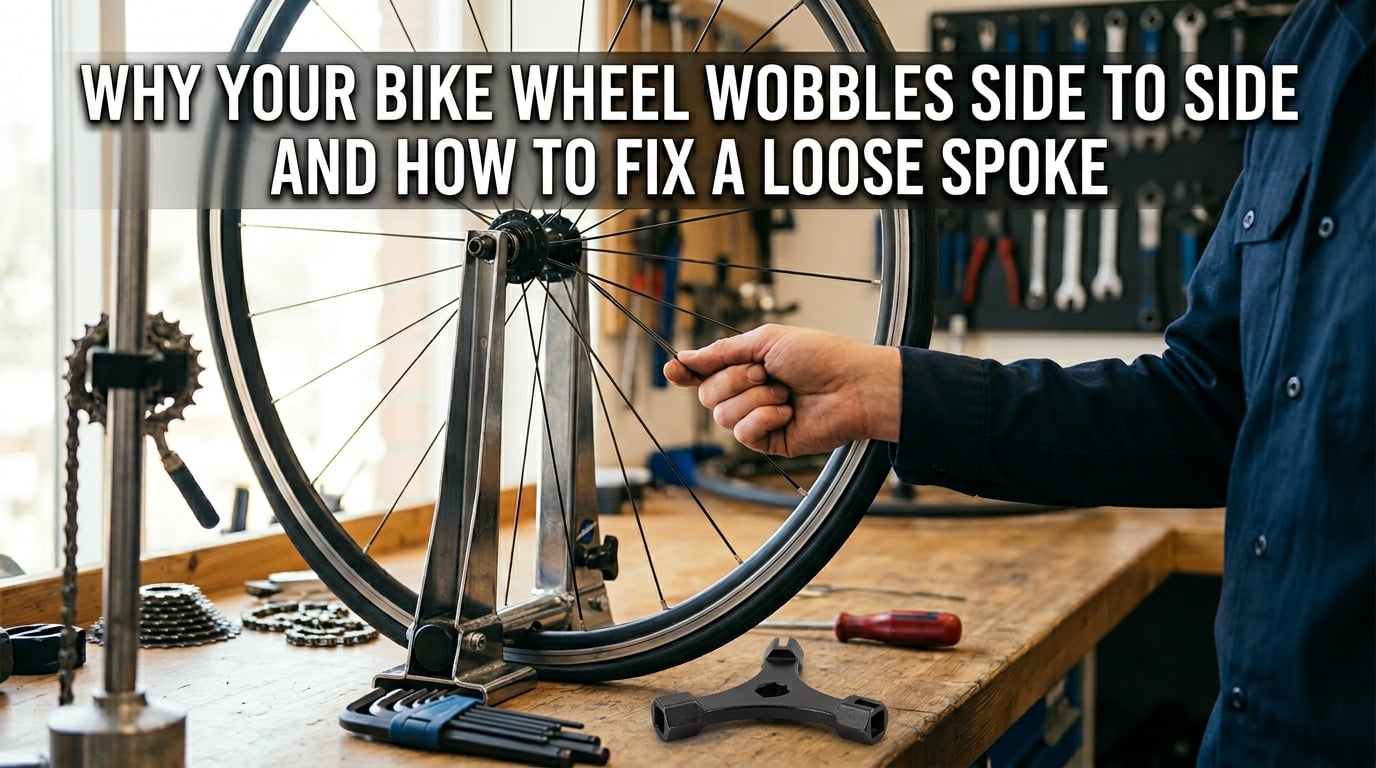
A bike wheel that wobbles side to side is one of the most common issues cyclists face, and a loose spoke is usually the first suspect. I see this problem on everything from brand-new budget bikes to high-end road wheels that have taken a few pothole hits. In our workshop, we run into wobbly wheels every week, and the fix is often simpler than riders expect.
You’ll learn exactly why your bike wheel wobbles side to side, how to tell a loose spoke from a worn bearing, and how to fix a loose spoke using a spoke wrench. I’ll also cover when the wobble means something more serious and when you should walk the bike home instead of riding it.
Table of Contents
Why does a bike wheel wobble side to side?
A bike wheel wobbles side to side when the rim no longer runs perfectly straight through the fork or frame. The most common causes are loose spokes, an untrue rim, worn hub bearings, a bent axle, or a tire that is not seated evenly on the rim. Each of these allows the rim to drift left or right as it rotates, and that drift is what you feel as a wobble under your hands or through the frame.
Out of these, loose spokes and an untrue rim account for the majority of cases I see. Impacts from curbs, potholes, and rocks can stretch a single spoke nipple just enough to unbalance the whole wheel. Without even spoke tension on every side of the hub, the rim pulls toward the tighter side with every revolution.
Hub bearings and axle problems are less common but more serious when they happen. A loose cone nut or a worn cup-and-cone bearing lets the entire hub shift in the dropouts, which translates into rim wobble even if the rim itself is perfectly true.
How to diagnose the cause of wheel wobble
Before you reach for tools, you need to know whether the wobble is in the spokes, the rim, the hub, or the axle. I run through the same four checks on every wobbly wheel that comes into our shop, and they take less than five minutes total.
Step 1: Spin the wheel and watch the rim
Flip the bike upside down or mount it in a stand so the wheel spins freely. Give the wheel a spin and watch the gap between the rim and either the brake pads (if you have rim brakes) or the fork blades. If you can see the rim move side to side as it rotates, the wobble is real and not just your imagination.
Step 2: Pluck each spoke like a guitar string
Run your finger or a small screwdriver down each spoke and listen. A properly tensioned spoke rings with a clear, high-pitched tone. A loose spoke gives a duller, lower-pitched thump. As one experienced mechanic on r/bikewrench puts it, “loose spokes will have a lower pitch sound when plucked.” This is the fastest way to find the loose spoke responsible for the wobble.
Step 3: Check the hub for play
Grip the rim firmly and try to rock it side to side in the fork or frame. If you feel a knocking or clunking and the whole hub shifts, the problem is in the bearings or the axle, not the spokes. Hold the axle itself and see whether it moves in the hub shell. Any movement here is a red flag.
Step 4: Inspect the tire bead
Look at the gap between the tire and the rim on both sides as the wheel spins. If the gap changes, the tire bead may have unseated on one side. A poorly seated tire can mimic a wobbly wheel even when the rim itself is true.
Once you know which category the wobble falls into, the actual repair becomes much more straightforward. If you found a dull-sounding spoke, jump to the spoke fix below. If you felt play in the hub, head to the bearing section. If the tire bead looks uneven, reinflate and reseat the tire.
How to fix a loose spoke on your bike wheel
Tightening a loose spoke is a beginner-friendly repair that takes about 10 to 15 minutes with the right tool. A spoke wrench is the only specialty item you need, and it’s worth carrying in your emergency repair kit for your bike on longer rides.
Step 1: Identify the loose spoke
Use the plucking technique from the diagnosis section. Mark the loose spoke with a piece of tape or a small sticker so you do not lose track of it. Often there are two or three loose spokes in the same area, and they all need attention.
Step 2: Match the spoke wrench to your nipples
Spoke nipples come in different sizes, and spoke wrenches match them. The most common sizes are 3.23mm, 3.30mm, and 3.45mm. Try the wrench on a nipple you know is correctly tensioned first. A properly fitting wrench will slide on snugly without any wobble.
Step 3: Tighten in quarter-turn increments
Place the wrench on the loose spoke’s nipple and turn it clockwise to tighten. Do not turn more than a quarter turn at a time. Spin the wheel and recheck the wobble. The rim should start pulling back toward center where the loose spoke is.
Step 4: Check neighboring spokes
When one spoke goes loose, its neighbors often loosen too. Pluck the two spokes on either side of the one you just fixed and tighten them the same way if they sound dull. You want every spoke in that area ringing at roughly the same pitch.
Step 5: Test ride and recheck
Take the bike for a short ride at low speed. The wobble should be gone or dramatically reduced. If it is not, you may also have an untrue rim that needs separate truing work, which we cover next.
Fixing an untrue wheel: truing the rim
An untrue wheel is one where the rim itself hops or weaves from side to side, even though every spoke might be properly tensioned. A wheel becomes untrue when the rim takes a hard impact that bends it slightly out of plane, or when spokes stretch unevenly over time.
To true a wheel at home, you ideally need a truing stand, which holds the wheel and uses calipers to measure lateral runout. Without a stand, you can do a rough job by spinning the wheel in the bike and watching the gap to your brake pads or fork.
To pull the rim back to center, find the spot where the rim deviates most. On the opposite side of the wheel, tighten the spoke closest to that deviation a quarter turn. This pulls the rim toward the side you just tightened. Loosen the directly opposite spoke a quarter turn if you overshoot. Work in small increments and check after every adjustment.
If the deviation is more than 4 to 5 millimeters, or if you have a deep dent in the rim, take the wheel to a bike shop. A severely bent rim often needs replacement, and forcing it back true will weaken the rim wall.
Hub bearings, axle problems, and other less common causes
When the spokes and rim check out, the wobble is almost always coming from the hub. The hub is the central part of the wheel that holds the axle, and bearings inside it let the wheel spin freely.
Cup-and-cone bearings
Older and mid-range bikes typically use cup-and-cone bearings, where metal ball bearings sit between a cone-shaped nut and a cup machined into the hub shell. Adjusting them involves tightening or loosening the cone nut until the wheel spins smoothly with no play. As one experienced forum user explains, “cone nuts need to be tightened then locked in place” with a locknut on the opposite side of the axle.
Over time, the bearings wear down and develop flat spots, which causes a rhythmic wobble you can feel once per revolution. Replacing the bearings and re-greasing the hub usually fixes this.
Cartridge bearings
Modern wheels often use sealed cartridge bearings instead. These cannot be adjusted, only replaced. If a cartridge bearing is worn, you will need to press out the old bearing and press in a new one of the same size. This is best left to a shop unless you have a bearing press.
Bent axle
A bent axle causes the wheel to wobble at the same point in every revolution, almost like a clock hand. Spinning the axle on a flat surface and watching for a wobble in the metal itself is a quick test. If the axle is bent, replace it. Riding on a bent axle is unsafe and will quickly destroy your hub bearings.
Tire bead issues
Sometimes the tire, not the wheel, is the problem. If the tire bead is not seated evenly, the tire can bulge slightly to one side. Deflate the tire fully, push the bead back into the center of the rim by hand, then reinflate. A loud pop from the tire bead seating correctly is a good sign.
Tools you need for wheel wobble repairs
Most wheel wobble fixes only need a few tools, and most cyclists already own them. Here is the basic kit our mechanics recommend.
- Spoke wrench: A small specialty wrench sized to your spoke nipples. Get a multi-size wrench if you work on multiple bikes.
- Truing stand: Optional for home use, but it makes truing far easier. Basic Park Tool TS-2 style stands work well for home mechanics.
- Adjustable wrench: For cone nuts on cup-and-cone hubs.
- Needle-nose pliers: Helpful for holding spokes steady while turning nipples.
- Floor pump with pressure gauge: For reseating tire beads.
- Grease: Lithium or specific bicycle hub grease for repacking bearings.
If you ride long distances or commute daily, keep a compact multi-tool with a built-in spoke wrench in your saddle bag. Many roadside wobbles come from a single loose spoke and take under five minutes to fix trailside.
Is it safe to ride with a wobbly bike wheel?
A small wobble of 1 to 2 millimeters is usually safe to ride for a short trip to your local shop, but anything beyond that needs immediate attention. A wobble of 4 millimeters or more becomes dangerous above 20 km/h because the rim can catch against the brake pads or fork, locking up the wheel.
If you hear clicking, feel knocking in the hub, or see the rim visibly weaving more than a few millimeters as the wheel spins, stop riding. A wobbly wheel at high speed is one of the most common causes of single-bike crashes, especially on descents.
For the rear wheel specifically, a wobbly freehub or a loose cassette can also feel like a wheel wobble even though the rim is true. Lift the bike, spin the wheel, and look at the cassette. If the cassette shifts on the splines, it needs to be tightened before you ride.
If you notice the wobble after a recent hard impact, walk the bike to a shop. Continued riding after a strong impact can turn a minor spoke issue into a cracked rim or broken hub.
FAQ’s
Why does my bike wheel wobble side to side?
Your bike wheel wobbles side to side because the rim is no longer running perfectly straight through the fork or frame. The most common causes are loose spokes, an untrue rim from an impact, worn hub bearings, a bent axle, or a tire bead that has unseated. Pluck each spoke with your finger to find dull-sounding (loose) ones, then check for play in the hub by rocking the rim side to side.
Can loose spokes make your wheel wobble?
Yes, loose spokes are the leading cause of bike wheel wobble. When one or more spokes lose tension, the rim is pulled toward the tighter side of the wheel with every revolution, which you see as side-to-side movement. Loose spokes also have a lower pitch when plucked, which is the easiest way to identify them. Tightening the loose spoke at the wobble location usually fixes it.
How to fix a loose spoke on a bike?
To fix a loose spoke, first spin the wheel and pluck each spoke with your finger to find the dull-sounding ones. Match a spoke wrench to your spoke nipple size, then turn the loose nipple clockwise in quarter-turn increments until the rim centers and the spoke rings clearly when plucked. Tighten any neighboring spokes that also sound loose, then test ride at low speed to confirm the wobble is gone.
What causes a wheel to wobble side to side?
A wheel wobbles side to side when lateral forces push the rim out of plane during rotation. The main causes are loose or unevenly tensioned spokes, an untrue rim from impact damage, worn cup-and-cone or cartridge bearings in the hub, a bent axle, and a tire bead that has not seated evenly. Each of these allows the rim to drift left or right as the wheel spins.
Is a wobbly bike wheel dangerous?
A wobbly bike wheel can be dangerous depending on the severity. A 1 to 2 millimeter wobble is usually safe for a short ride to a repair shop, but anything over 4 millimeters can cause loss of control, especially above 20 km/h. Stop riding immediately if you feel hub knocking, see the rim visibly weaving, or notice the wobble after a hard impact. Walking the bike is always safer than riding on a badly wobbly wheel.
Final thoughts on fixing a wobbly bike wheel
A bike wheel wobble is almost always fixable without replacing the whole wheel, and most cases come down to a single loose spoke or an untrue rim. The pluck test, the side-to-side wobble check at the hub, and a quarter-turn at a spoke wrench resolve the majority of cases I see. With a basic spoke wrench and about 15 minutes, you can usually get your bike rolling smoothly again.
If you’ve tried tightening the spokes and the wobble persists, or if you feel play in the hub, take the wheel to a local bike shop. Hub bearings, axle replacement, and severe rim damage are jobs where a mechanic’s tools and experience pay for themselves quickly. Repair costs for hub work typically run from $40 to $80, while a new wheel costs anywhere from $150 to over $1,000 depending on the bike.
For ongoing wheel health, give your spokes a quick pluck and visual check once a month, especially if you spend time riding confidently on gravel and loose surfaces where impacts are more frequent. Catching a loose spoke early prevents it from pulling its neighbors loose and turning a five-minute fix into a full wheel rebuild. Updated for 2026, this guide will keep you rolling smoothly through the season.