
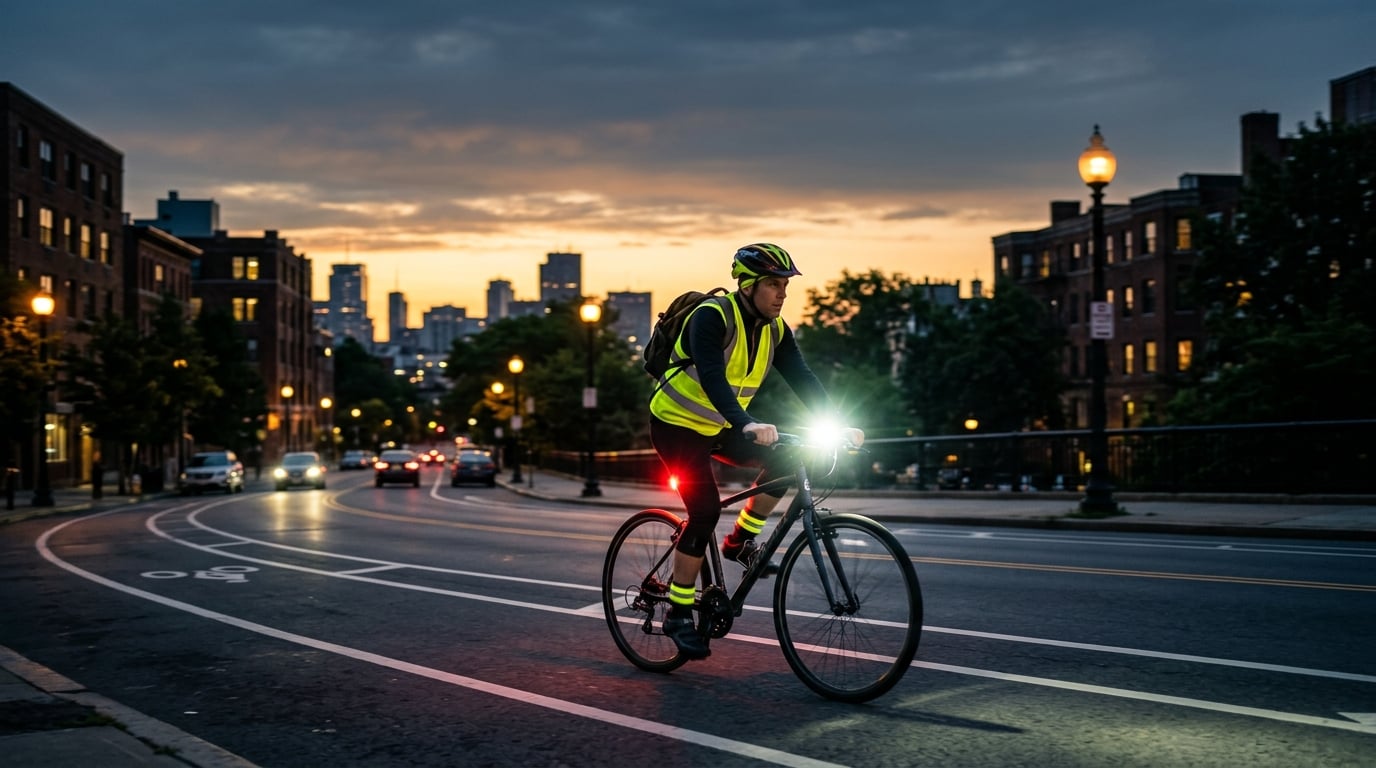
Learning how to stay visible to drivers on an early morning commute can save your life. I have been riding the 5:45 a.m. train-bridge-to-office route for over three years, and I have seen the difference between showing up in a black jacket with a single rear blinker and rolling in fully lit with reflective ankle bands, helmet light, and a high-vis vest. The drivers who nearly hit me never saw the black-jacket version. The fully lit version gets waved through intersections and given full lane changes. Visibility is the single most controllable factor in your morning safety, and it is the one most commuters underinvest in.
This guide covers the exact layering system I use, the science behind why it works, and the morning-specific hazards that catch even experienced cyclists off guard. By the end, you will have a complete pre-ride checklist and a clear understanding of why some reflective gear works dramatically better than others.
Table of Contents
Why early morning commutes are uniquely dangerous for cyclists
Early morning commutes combine three visibility killers that do not exist at any other time of day. First, ambient light is in the worst possible range for the human eye. Dawn lighting falls into the mesopic range, where the eye struggles to process contrast and depth, according to research summarized in cycling visibility research. Drivers are not as blind as they are at midnight, but they are not as sharp as they are in full daylight either.
Second, sun glare hits drivers directly in the eyes during eastbound commutes. A low sun sitting two degrees above the horizon washes out everything in the road, including you on your bike. The glare is worse for drivers than for cyclists because they sit lower and look straight into the light, but you still face the same washout when they look your direction.
Third, drivers in the early morning hours are statistically more likely to be drowsy. The National Highway Traffic Safety Administration has documented that fatigue-related crashes peak during the 4:00 a.m. to 6:00 a.m. window. A drowsy driver scanning the road with slower reaction times needs to see you from farther away. Visibility gear that works at 200 feet may not give a sleepy driver enough warning at 60 mph.
Add iced-up windscreens, dark hoodies, and unlit bikes, and you have a recipe for the most common accident pattern in commuter cycling: the left-hook, the right-hook, and the “I just did not see them” rear-end. None of these are solved by being a better rider. They are solved by being a more visible one.
Front and rear bike lights: the foundation of morning visibility
A solid lighting setup is non-negotiable for any early morning commute. The minimum I recommend is a 400-lumen front white light and a 100-lumen rear red light, both USB rechargeable, both visible from at least 500 feet in clean air.
For the front light, look for a beam pattern that throws a hot spot about 30 feet ahead for spotting road hazards, with enough peripheral spill to mark your presence at intersections. Cheap lights often have wide, dim beams that look bright when you point them at a wall but do not project far enough to matter at road speeds. Beam angle matters as much as raw lumens. A 20-degree beam throws farther. A 40-degree beam spreads wider. For commute use, 25 to 30 degrees is the sweet spot.
For the rear light, 100 lumens is the floor for dawn conditions. In full daylight you can get away with 50 lumens, but the half-light of dawn demands more. Look for a light with a 180-degree beam angle so you are visible from the side as well as directly behind. Many rear lights now include side visibility ports built into the housing. This is the kind of feature you do not appreciate until a car pulls out of a side street and stops because they saw your rear light from two lanes over.
USB rechargeable has won this category. I used to burn through AA batteries twice a week. Now I plug my lights in on Sunday night and they last the entire work week on medium-flash mode. The economics and convenience are not even close.
Quick specs: front vs rear light at a glance
- Front light: 400+ lumens, white beam, 25 to 30 degree angle, USB rechargeable, mounts to handlebar or helmet
- Rear light: 100+ lumens, red beam, 180 degree visibility, USB rechargeable, mounts to seatpost or seat stay
Flashing vs steady lights: which mode works best at dawn
Mode choice is where most commuters get it wrong, and the research is clear. A 2013 study in the journal Accident Analysis and Prevention found that flashing bicycle lights are detected significantly earlier than steady lights in daytime conditions, and the effect is even stronger in low-light dawn and dusk conditions. Flashing lights trigger the human eye’s motion-detection pathway, which is wired deeper into the brain than the conscious color and shape pathways. Drivers literally cannot help but notice them.
My recommendation is to run your rear light in pulse or flash mode at all times during the morning commute. Save steady mode for dark rural roads where you need to mark your exact position and width. In urban dawn conditions, flash wins every time.
For the front light, I use a hybrid approach. Steady low beam for seeing the road, with a flash or pulse mode layered on top during the most dangerous moments: approaching intersections, riding past a line of parked cars, or crossing a merge lane. Some newer lights offer a “daytime running light” mode that combines a steady beam with a high-frequency flash, which is what I run by default.
Helmet-mounted vs frame-mounted lights for dawn visibility
Helmet lights earn their premium price tag during morning commutes. The single biggest advantage is eye-level placement. A light on your handlebar illuminates the road three feet below driver eye level. A light on your helmet illuminates the road at driver eye level, putting you directly in their line of sight when they look up from sun glare or drowsy scanning.
Helmet lights also let you aim your beam exactly where you are looking. When you check over your left shoulder, the beam sweeps across the intersection behind you. This is a powerful visibility tool. Drivers who see that sweep know a cyclist is there even if they were not looking for one.
The downside is weight and battery life. A helmet light plus a handlebar light is more weight on your head and more charging. For most commuters, the right answer is to use both. Handlebar light for the road, helmet light for visibility, and a redundant rear blinker as a third layer. Three lights sounds excessive until you count the cars that see all three.
Reflective and high-visibility clothing for early morning rides
Clothing is the second visibility layer, and it works in two different ways. High-visibility clothing uses fluorescent colors that absorb UV light and re-emit it as bright visible color, which makes you pop in low-light conditions even before any car headlight hits you. Reflective clothing uses retroreflective material that bounces light directly back to its source, making you appear to glow when hit by headlights.
For dawn commutes, you want both. A fluorescent yellow or orange vest handles the low-light ambient visibility. Reflective tape on your ankles, knees, and shoulders handles the headlight-flash visibility. The combination is what makes you visible at both ends of the lighting spectrum drivers experience that morning.
A note on color. Black is the worst color for cyclist visibility, and it is the default color of most bike commuter clothing. The forum posts I have read from r/bikecommuting and r/bicycling show the same pattern: cyclists who get hit are overwhelmingly wearing dark colors. If you take one change from this guide, swap your black commute jacket for a fluorescent one. The “I look goofy” feeling fades after the first time a driver gives you a wide berth because they saw you from three blocks away.
The single most effective reflective accessory is the ankle band. Reflective material on moving joints creates the biomotion effect that drivers detect faster than any other reflective pattern, and that science is so well documented it deserves its own section.
Biomotion: why moving reflectors outperform static ones
Biomotion is the human visual system’s ability to recognize biological movement. Researchers at the University of Toronto found that drivers identify cyclists wearing reflectors on moving body parts (ankles, knees, hips, elbows) up to 3.5 times faster than cyclists wearing the same amount of reflective material on their torso or backpack.
The reason is evolutionary. Our visual system has a dedicated pathway for recognizing human movement, and that pathway lights up when reflective markers move in the way human legs and arms move. A glowing ankle band on a pedaling leg looks like a person. A glowing strip on a jacket looks like a stripe. The difference in driver response is enormous.
Practical implementation: put reflective material on your ankles, knees, and the backs of your wrists. The wrist placement matters because your arms move when you signal turns, putting motion right at the level of driver eyes. A small investment in reflective ankle bands pays off in detection distance far beyond what a $50 high-vis vest delivers on its own.
Road positioning strategies drivers actually notice
Visibility is not just about gear. Where you ride in the lane changes how often drivers see you, even with the same lighting setup. The default position for most new commuters is the far right of the lane, hugging the curb. This is the worst place to ride for visibility. Drivers scan the center of the lane, not the gutter, and parked cars, road debris, and drainage grates all conspire to push you further from their field of view.
The safer position is to ride about a third of the way into the lane, or roughly where a car tire would track. This places you in the driver’s natural line of sight, makes you part of the lane rather than an obstacle to dodge, and discourages unsafe passing on the right. Yes, some drivers will honk. They were going to honk anyway. The drivers who hit cyclists almost never honk first.
At intersections, move to the center of the lane when turning. The “right hook” accident pattern, where a car turns right across a cyclist’s path, almost always involves a cyclist on the far right. By taking the lane, you eliminate the car’s ability to squeeze past on your right. The few seconds you “lose” by making drivers wait are the seconds they use to see you.
Route selection for safer morning commutes
Route choice is the visibility variable you can change once and benefit from for years. Most cyclists default to the most direct route, which is usually the busiest arterial road. This is the opposite of what visibility science recommends.
The safer pattern is to use neighborhood streets with lower speed limits, fewer large vehicles, and better sight lines. A 28 mph residential street is more forgiving than a 45 mph arterial because the speed differential is smaller and drivers have more time to see and react to you. Add protected bike infrastructure where it exists, and avoid multi-lane roads where lane changes create visibility gaps.
For more on how policy and infrastructure shape cyclist safety, the complete streets safety policies report covers how dedicated bike facilities reduce crash rates for commuters across multiple cities.
Pick your route on a Sunday morning when traffic is light. Note where visibility is poor, where sun glare is worst, and where intersections feel sketchy. Adjust your route to avoid the worst of these. The five minutes you add to your commute are worth it.
Pre-ride safety checklist for dawn commuters
Before every morning ride, run through this list. It takes 90 seconds and catches the gear failures that turn a visible bike into an invisible one.
- Front light on, full charge, beam pattern clean (no cracked lens)
- Rear light on, full charge, side visibility ports clear
- Helmet light on if you use one, helmet strap snug
- Reflective ankle bands in place, fluorescent vest zipped
- Helmet fitted correctly, two-finger gap above eyebrows
- Tire pressure checked, brakes tested, quick-release levers tight
For a complete pre-ride bike check including drivetrain and tire wear, our pre-ride bike safety checklist covers the full mechanical walkthrough.
Seasonal adjustments for morning commutes
The same 6:30 a.m. ride in June is full daylight. The same 6:30 a.m. ride in December is pitch black until 7:15. Adjust your gear and your routes by season, not by calendar date.
Winter commutes need stronger lights, more reflective coverage, and routes that prioritize well-lit streets. Frost on the road also reduces tire grip, so brake earlier than you think you need to. Summer dawn commutes need to manage sun glare more than darkness, which means higher-visibility clothing and a sun visor on your helmet to cut the glare drivers are facing.
The transition months of October and March are the most dangerous, when drivers have not adjusted to the new lighting conditions and visibility is changing week to week. Run winter gear through these transition months rather than switching the day after the equinox.
Frequently asked questions about morning commute visibility
What is the best light setup for an early morning bike commute?
A 400+ lumen white front light with a 25 to 30 degree beam angle, paired with a 100+ lumen red rear light offering 180 degree visibility, covers the minimum effective setup. Add a helmet-mounted light for eye-level visibility at intersections, and run your rear light in flash or pulse mode for the best dawn detection. Both lights should be USB rechargeable so you can top them off overnight.
Is high-visibility clothing actually effective for cyclists?
Yes, but only when combined with reflective material and active lights. A 2014 study found a 47 percent reduction in crash risk for cyclists wearing high-visibility jackets during daylight, and the effect is stronger in low-light conditions. Fluorescent colors handle ambient visibility in dawn light, while retroreflective strips and ankle bands handle the headlight-flash visibility drivers experience at distance.
Why do drivers fail to see cyclists in the early morning?
Three factors combine during early morning commutes: drivers are dealing with sun glare that washes out detail, ambient light is in the mesopic range where the human eye processes contrast poorly, and drivers are statistically more likely to be drowsy during the 4 a.m. to 6 a.m. window. Black clothing, single rear blinkers, and riding in the gutter push you further into the visibility gap created by these three factors.
How does biomotion help cyclists stay visible?
Biomotion refers to the human visual system’s ability to recognize biological movement patterns, particularly when reflective markers are placed on moving joints like ankles, knees, and wrists. Research shows drivers detect cyclists with ankle-mounted reflectors up to 3.5 times faster than cyclists with the same amount of reflective material on their torso, because the moving joints trigger dedicated human-recognition pathways in the brain.
What should I wear for a winter dawn bike commute?
Layer a fluorescent vest or jacket as the base, add reflective ankle bands and reflective tape on gloves and wrists, and pair with a 500+ lumen front light and 150+ lumen rear light for the longer winter darkness. Winter also brings frost and black ice, so reduce speed and increase following distance, even on familiar routes.
Final thoughts: layer your visibility for safer dawn rides
How to stay visible to drivers on an early morning commute is not a single trick. It is a layered system of lights, reflective gear, biomotion placement, and road positioning that works because no single layer has to do all the work. The front light, the rear light, the helmet light, the fluorescent vest, the reflective ankle bands, and the lane position each cover a different failure mode. Together, they create redundancy that survives the worst morning light, the most distracted driver, and the occasional dead battery.
Start with the cheapest upgrades first. Swap your black jacket for a fluorescent one, add reflective ankle bands to your shoes, and run your rear light in flash mode. Build out from there with a stronger front light and a helmet mount. Within a month of consistent use, the safer behavior will feel normal, and drivers will start treating you like a permanent part of the road instead of a surprise. That is the goal: not to be noticed, but to be expected.