
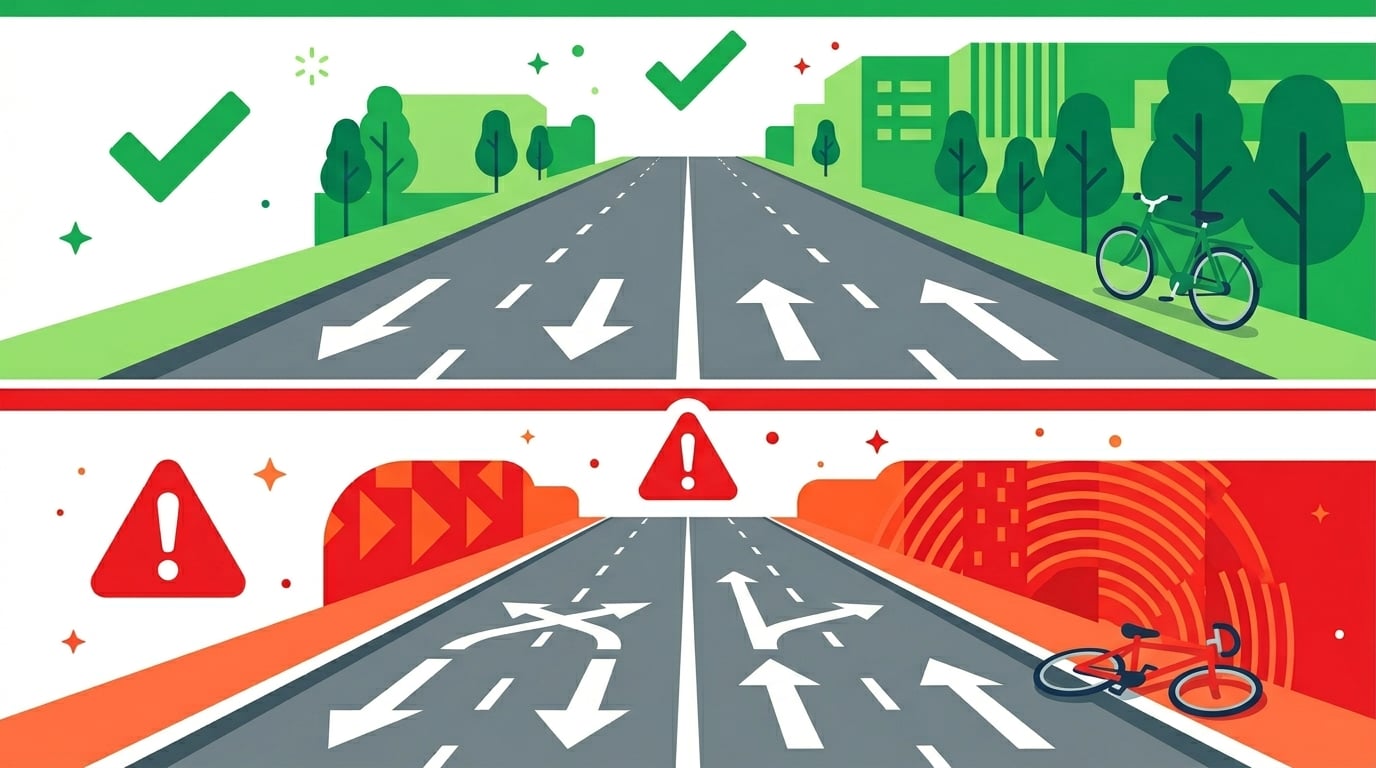
Riding against traffic is more dangerous than it feels because the closing speed between you and oncoming vehicles dramatically reduces reaction time for everyone involved. A landmark Palo Alto study found that cyclists riding against traffic are 3.6 to 4 times more likely to be killed than those riding with traffic.
You might think facing oncoming cars lets you see danger coming and react. That intuition feels powerful. But the reality is that riding against traffic turns manageable situations into deadly ones for reasons that have nothing to do with your ability to see.
I have spent years researching bicycle traffic safety, and this topic comes up constantly on forums like Reddit’s r/bicycling. Cyclists admit they know riding against traffic is wrong, but fear of being hit from behind pushes them to do it anyway. The gap between how safe it feels and how dangerous it actually is represents one of the biggest misconceptions in all of cycling.
This guide breaks down the physics, statistics, driver psychology, and legal reality behind why riding against traffic is more dangerous than it feels. Whether you commute daily or ride occasionally, understanding these principles could save your life.
Table of Contents
The Illusion of Control: Why Wrong-Way Cycling Feels Safer
The core reason wrong-way cycling feels safer comes down to a simple psychological trap: visibility creates a false sense of control. When you can see oncoming cars, your brain tells you that you have time to react and dodge. That feeling is powerful enough to override logic, statistics, and the law.
Think about the classic “sharks versus bears” fear analogy. People are terrified of sharks because attacks are dramatic and visible, even though you are far more likely to be killed by a bear. Similarly, cyclists fear rear-end collisions because they cannot see the car coming, even though only about 5 percent of car-bike crashes happen from behind.
The fear of the unseen dominates cycling psychology. You cannot see behind you without turning your head, so every car approaching from the rear feels like a threat you cannot manage. Riding against traffic eliminates that helplessness by putting every car in your field of vision.
The problem is that feeling safe and being safe are two completely different things. Every cyclist I have spoken with who rides against traffic cites the same reason: they want to see what is coming. But seeing a car does not help when that car is closing on you at 60 miles per hour and the driver has no idea you are there.
This perception gap is why education matters so much. The fear of being hit from behind is real and understandable, but the statistical risk is low. The fear of head-on collisions should be far greater, yet cyclists rarely worry about what they can see coming.
The Physics of Closing Speed: What Really Happens
Closing speed is the combined speed at which you and an oncoming vehicle approach each other, and it is the single most important factor in understanding why riding against traffic is so dangerous. The math is unforgiving.
When you ride with traffic at 15 miles per hour and a car passes you going 45 miles per hour in the same direction, the closing speed is 30 miles per hour. The car is moving away from you at the difference between your speeds. You both have time to see each other, adjust, and avoid conflict.
Now flip the scenario. You are riding against traffic at 15 miles per hour toward a car traveling at 45 miles per hour. The closing speed is 60 miles per hour. The car is approaching you at four times the relative speed compared to riding with traffic.
On faster roads, the numbers get worse. A cyclist riding against traffic on a 55 mph road faces a closing speed of 70 miles per hour. On a 65 mph highway, that closing speed hits 80 miles per hour. At those speeds, neither the driver nor the cyclist has meaningful time to react.
The kinetic energy involved in a collision scales with the square of velocity. A head-on collision at a 60 mph closing speed carries roughly nine times more impact energy than a same-direction collision at a 20 mph closing speed. That is not a marginal difference. It is the difference between walking away and a catastrophic injury.
Momentum works against you too. When a car hits a cyclist from behind at a low closing speed, the cyclist gets pushed forward. When a car hits a cyclist head-on at a high closing speed, the cyclist absorbs the full force of the impact directly. The human body simply cannot withstand that level of deceleration.
This is why impact severity matters more than crash frequency. Even if wrong-way cycling only slightly increased your chances of a crash, the dramatically higher closing speeds would make every crash far more severe. But as the statistics show, wrong-way cycling increases crash frequency too.
Reaction Time: You Get a Quarter of the Time to React
Reaction time is where closing speed becomes personal. The faster two objects approach each other, the less time either has to do anything about it. Riding against traffic gives you roughly one quarter the reaction time of riding with traffic.
Imagine a straight road where a car is 300 feet away. If you are riding with traffic at 15 mph and the car is traveling toward you from behind at 45 mph, you have about 13.6 seconds before the car reaches your position. That is plenty of time for the driver to see you, slow down, and pass safely.
Now imagine the same car 300 feet away, but you are riding toward it head-on. The closing speed is 60 mph, and you have just 3.4 seconds before impact. That barely covers human reaction time, which averages about 1.5 seconds for an alert driver. Add in braking distance, and neither of you can stop in time.
At higher speeds, the situation becomes impossible. A car 500 feet away approaching at a 70 mph closing speed gives you under 5 seconds. Most drivers spend those seconds confused, not braking, because they are not expecting a cyclist coming from the wrong direction.
The same math applies to you as the cyclist. Even if you see the car coming, what are you going to do? Swerve into traffic on your left? Jump off the road? At 15 mph, you cover 22 feet per second, and there is rarely a safe place to go when a car is bearing down on you.
This is the cruel irony of the “I can see what is coming” argument. Yes, you can see the car. But seeing it does not give you the ability to avoid it when closing speeds are this high.
Survival Rates: The Speed at Which You Get Hit Matters
The relationship between collision speed and survival is stark and well-documented. A pedestrian or cyclist struck at 10 miles per hour has a 98 percent chance of survival. At 40 miles per hour, the survival rate drops to roughly 50 percent. Above 50 miles per hour, survival becomes rare.
These numbers explain why riding against traffic is so deadly. The effective collision speed in a head-on crash is the closing speed, which combines your speed and the car’s speed. A cyclist hit head-on by a car going 45 mph while riding 15 mph the wrong way experiences a 60 mph impact.
Compare that to being hit from behind while riding with traffic. A car traveling 45 mph that fails to slow down for a cyclist going 15 mph in the same direction creates a 30 mph impact. The cyclist is pushed forward rather than crushed between opposing forces.
The difference between a 30 mph impact and a 60 mph impact is not double the severity. Because kinetic energy scales with velocity squared, the 60 mph impact carries four times the energy. That translates directly into more broken bones, more head trauma, and more fatalities.
This is why rear-end collisions, while scary, are statistically far less deadly than head-on collisions. The physics guarantee it. When you ride against traffic, you are choosing the crash type with the highest possible severity in exchange for a feeling of control that does not actually protect you.
Driver Visibility: They Are Not Looking for You
Drivers are trained by experience to scan for traffic in specific locations. When they approach an intersection, they look left, then right, then left again. They check crosswalks for pedestrians. They glance at bike lanes for cyclists traveling in the expected direction.
What drivers almost never do is look for a cyclist approaching from the wrong direction. This is not a matter of carelessness. It is a matter of expectation. Human attention is pattern-based, and wrong-way cyclists break every pattern drivers have learned.
The intersection problem is the most dangerous manifestation of this. A driver turning right onto a road checks for traffic coming from the left. They do not check for cyclists coming from the right because no legitimate traffic comes from that direction. A wrong-way cyclist entering that intersection from the right is invisible until it is too late.
The same applies to drivers pulling out of driveways and parking lots. They look in the direction traffic is supposed to come from. A wrong-way cyclist appearing from the opposite direction registers as a surprise, and surprise leads to delayed reactions or frozen drivers.
Night riding makes this exponentially worse. Car headlights are designed to illuminate the road ahead, not to spot objects approaching head-on. When you ride against traffic at night, drivers see your bike light but cannot judge your speed or distance because head-on lighting is difficult to process. Worse, your own headlight can blind oncoming drivers, causing them to swerve toward you.
Forum discussions on r/bicycling repeatedly mention drivers opening doors without checking for approaching cyclists. When you ride against traffic, you are approaching parked cars from the side the driver is not checking. The door zone becomes even more dangerous because neither party expects the interaction.
The Statistics: 3.6x to 4x More Likely to Be Killed
The most cited study on wrong-way cycling comes from Palo Alto, California, where researchers analyzed bicycle crash data and found that cyclists riding against traffic faced 3.6 to 4 times the risk of being killed compared to cyclists riding with traffic. This is not a marginal increase. It is one of the strongest risk factors in all of bicycle safety research.
To put that in perspective, only about 5 percent of car-bike crashes involve a cyclist being hit from behind. That is the scenario cyclists fear most, and it accounts for a tiny fraction of actual incidents. Meanwhile, roughly one third of all car-bike crashes involve wrong-way cyclists. The behavior that feels safest accounts for a disproportionate share of the danger.
These numbers are consistent across studies and jurisdictions. The risk ratio holds whether you are looking at urban cycling or rural roads. For more detailed collision statistics and safety research, our archives contain extensive data on crash types and prevention.
The statistics tell a clear story. The fear that drives cyclists to ride against traffic, the fear of being hit from behind, is largely unfounded. The behavior they adopt to address that fear dramatically increases their actual risk. This is the definition of a counterproductive safety strategy.
Wrong-way cycling is a factor in so many crashes that safety researchers treat it as a primary predictor of crash severity. If you want a single behavior change that will most improve your cycling safety, it is this: always ride with traffic, in the same direction as motor vehicles.
Why Walking Against Traffic Is Different from Cycling
Many cyclists are confused by the apparent contradiction between pedestrian and cycling safety rules. Pedestrians are advised to walk against traffic so they can see oncoming vehicles. Cyclists are told to ride with traffic. Why the difference?
The answer is speed. A pedestrian walks at about 3 miles per hour. Even when facing a car going 45 mph, the closing speed is only 48 mph. More importantly, a pedestrian can step off the road and onto the shoulder in under a second. They have the speed differential and the maneuverability to dodge safely.
A cyclist traveling at 15 to 20 mph cannot simply step aside. You are committed to the road surface, your momentum carries you forward, and dodging requires significant space and time. The closing speed when facing traffic is also much higher because your cycling speed adds to the car’s speed rather than subtracting from it.
There is also a legal distinction. Pedestrians are expected to walk against traffic when there is no sidewalk because they move slowly enough to react. Bicycles are legally classified as vehicles in all 50 states, which means cyclists must follow the same directional rules as cars. The safety advice for pedestrians does not transfer to cyclists because the physics are fundamentally different.
Bike Lane Dangers: Wrong-Way Riding in Bike Lanes
Some cyclists assume that if there is a bike lane, riding the wrong way in it is acceptable. This is both illegal and dangerous. Bike lanes are designed for one-directional traffic, and every element of their design assumes cyclists travel in the same direction as adjacent motor vehicle traffic.
The intersection conflicts are the most dangerous aspect of wrong-way bike lane riding. Bike lanes often cross turning lanes, merge areas, and pedestrian crossings that are designed for cyclists coming from one direction. A wrong-way cyclist enters these conflict zones from an unexpected angle, catching drivers and pedestrians off guard.
Other cyclists are also at risk. When you ride against traffic in a bike lane, you create head-on conflicts with cyclists traveling in the correct direction. Bike lanes are typically 4 to 6 feet wide, which is enough for single-file travel but not for two cyclists passing each other in opposite directions. Someone has to swerve into traffic or off the road.
Contraflow bike lanes, which are intentionally designed for two-way cycling, are a different story. These are engineered with separated space for each direction and include specific intersection treatments. But a standard bike lane is never safe to ride in the wrong direction, regardless of how empty it looks.
Legal Requirements: It Is Against the Law
In all 50 states, bicycles are legally classified as vehicles and must follow the same traffic laws as cars. This means riding with traffic is not just a safety recommendation. It is the law everywhere in the United States.
Every state traffic code requires cyclists to ride as far to the right as practicable when traveling slower than the speed of traffic, and to travel in the same direction as motor vehicles. Riding against traffic is a citable offense that can result in fines. More importantly, it affects your legal rights if you are involved in a crash.
When a wrong-way cyclist is hit by a car, the cyclist is almost always found at least partially at fault. This means your insurance claims, personal injury lawsuits, and medical expense recoveries can be reduced or denied entirely because you were breaking the law when the crash occurred. The legal system does not reward cyclists who ride against traffic, even when a driver also made a mistake.
The same principle applies internationally. Most countries require cyclists to ride with traffic, and wrong-way cycling is cited as a contributing factor in crash reports worldwide. The legal consensus matches the scientific consensus: riding with traffic is the only safe and lawful choice.
How to Overcome the Fear of Riding With Traffic
The fear of riding with traffic is real, and dismissing it does not help anyone. If you are afraid of being hit from behind, that fear deserves a practical solution rather than a wrong-way workaround. Here is what actually works.
Lane positioning is your most powerful tool. Riding too close to the curb encourages drivers to pass too closely, sometimes without fully moving over. Taking the lane, which means riding in the center of the travel lane when it is too narrow to share, forces drivers to change lanes to pass you. This is legal in every state and is a proven technique from vehicular cycling practice. Drivers see you earlier and have to make a deliberate decision to pass safely.
Visibility gear makes a significant difference. Bright clothing during the day, a quality tail light at night, and reflective elements in low light conditions all increase the distance at which drivers can see you from behind. The earlier a driver sees you, the more time they have to adjust their speed and position.
Route selection eliminates fear at its source. Many cyclists ride on busy roads because they assume that is the fastest route, when a quieter parallel street might add only a minute or two to the trip. Bike paths, neighborhood streets, and roads with dedicated bike infrastructure all reduce your exposure to high-speed traffic without requiring wrong-way riding.
Mirror systems, whether handlebar-mounted or helmet-mounted, let you monitor traffic behind you without turning your head. This directly addresses the helplessness that drives cyclists to ride against traffic. When you can see what is approaching from behind, the fear diminishes and riding with traffic feels manageable.
For riders dealing with road emergencies beyond traffic direction, knowing proper safety procedures while riding can build confidence on the road. And understanding cycling safety best practices helps you develop habits that make every ride safer.
FAQ’s
Is it safer to ride your bike with traffic or against traffic?
It is significantly safer to ride with traffic. A Palo Alto study found that cyclists riding against traffic are 3.6 to 4 times more likely to be killed. Riding with traffic reduces closing speeds, gives drivers more time to see you, and aligns with driver expectations at intersections.
Why is it safer to walk against traffic but dangerous to bike against traffic?
Pedestrians walk at about 3 mph and can step off the road instantly, so walking against traffic gives them time to dodge oncoming cars. Cyclists travel at 15 to 20 mph, cannot stop or dodge quickly, and create much higher closing speeds when facing traffic. The physics and maneuverability are fundamentally different.
How much more dangerous is wrong-way cycling?
Wrong-way cycling increases your risk of being killed by 3.6 to 4 times compared to riding with traffic, according to the Palo Alto bicycle crash study. Roughly one third of all car-bike crashes involve wrong-way cyclists, while only about 5 percent involve cyclists being hit from behind.
Why do cyclists ride against traffic if it is more dangerous?
Most cyclists ride against traffic because they feel safer being able to see oncoming cars. The fear of being hit from behind by an unseen vehicle is powerful, and seeing traffic approaching feels like control. This is a psychological trap because visibility does not translate into the ability to avoid high-speed collisions.
Is it illegal to ride a bike against traffic?
Yes, riding against traffic is illegal in all 50 states. Bicycles are classified as vehicles and must follow the same directional rules as cars. Wrong-way cycling can result in fines and significantly reduces your legal protection if you are involved in a crash.
What is the closing speed when riding against traffic?
Closing speed is the combined speed of you and the oncoming vehicle. A cyclist riding 15 mph toward a car going 45 mph has a closing speed of 60 mph. The same cyclist riding with traffic has a closing speed of only 30 mph. Higher closing speeds mean less reaction time and more severe impacts.
What percentage of car-bike crashes involve wrong-way cyclists?
Approximately one third of all car-bike crashes involve wrong-way cyclists. By comparison, only about 5 percent of car-bike crashes involve a cyclist being hit from behind, which is the scenario cyclists fear most when they choose to ride against traffic.
What should I do if I am afraid of riding with traffic?
Use lane positioning to claim your space, wear bright clothing and use lights for visibility, choose quieter routes with bike infrastructure, and use a mirror to monitor traffic behind you. These strategies address the root fear directly and are far safer than riding against traffic.
Conclusion
Riding against traffic is more dangerous than it feels because it combines higher crash risk with dramatically more severe crash outcomes. The Palo Alto study showing a 3.6 to 4 times increase in fatality risk is not a statistical fluke. It reflects the basic physics of closing speed, kinetic energy, and human reaction time.
The perception that seeing oncoming traffic keeps you safe is the most dangerous myth in cycling. Visibility without the ability to react is meaningless. At closing speeds of 60 to 80 miles per hour, neither you nor the driver has time to prevent a crash, and the resulting impact carries four to nine times more energy than a same-direction collision.
If you are currently riding against traffic, the most important step you can take today is to switch directions. Ride with traffic, use lane positioning to stay visible, invest in a good mirror and lights, and choose routes that make you feel confident rather than frightened. The fear of being hit from behind is real, but the solution is visibility and positioning, not wrong-way riding.
Every statistic, every physics calculation, and every traffic law points in the same direction. Ride with traffic. It is safer, it is legal, and it gives you the best chance of arriving home from every ride.