
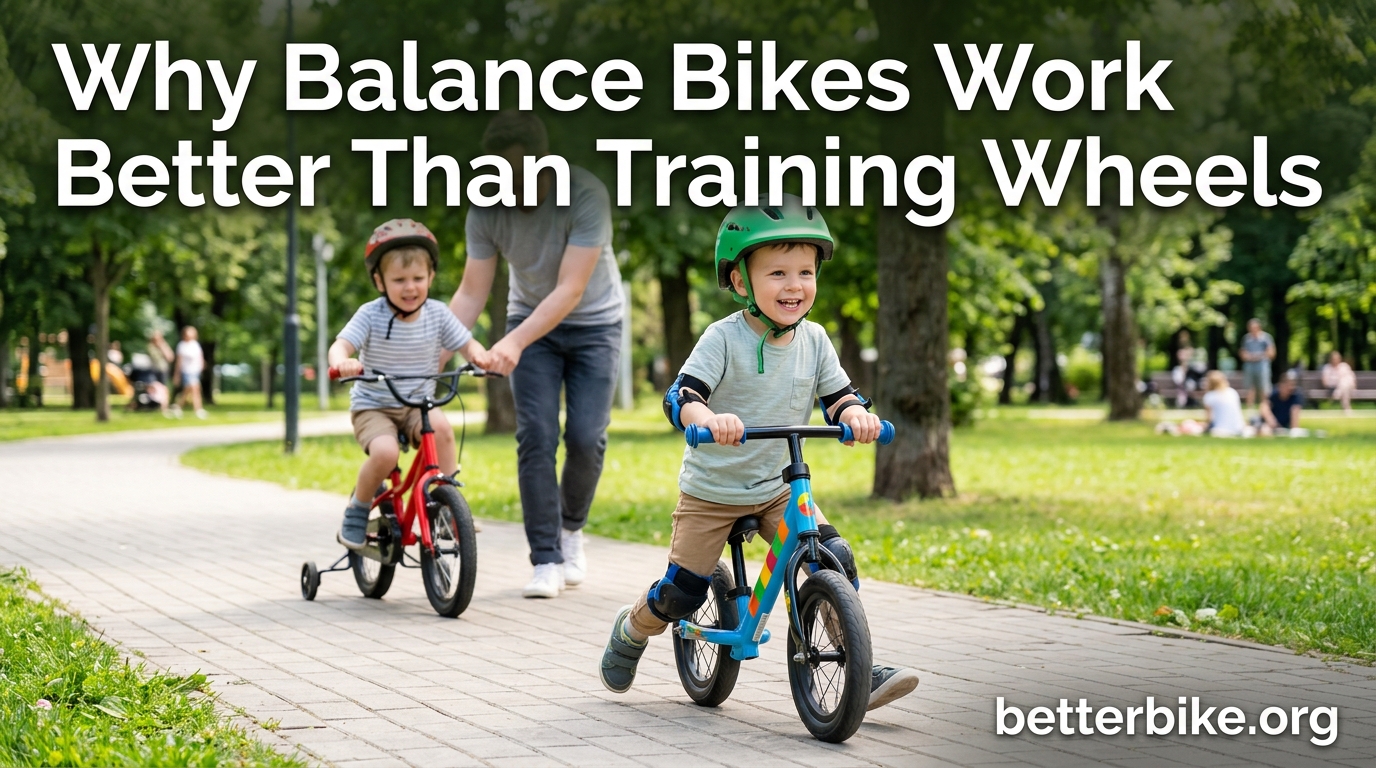
My nephew spent the entire summer of his fourth year pedaling furiously around the driveway on a 12-inch bike with two wobbly training wheels. He could go fast in a straight line. He could even master the pedals. Then we took the stabilizers off. He froze, toppled sideways, and refused to get back on for six months. Meanwhile, his friend down the street, who started on a 6-pound balance bike at age two, was already cruising around the neighborhood on a pedal bike without training wheels by three and a half. If you are weighing why balance bikes work better than training wheels for your own child, that contrast is exactly what this guide is built around.
I have spent the last few months talking to pediatric physical therapists, reading parent forums, and reviewing what the actual research says. The conclusion is clear, and it is not close. Balance bikes teach the foundational skill that training wheels actively prevent. In this guide, I will walk you through the mechanics, the science, the practical trade-offs, and the age-specific guidance so you can make the right call for your kid. I will also cover the cases where training wheels still make sense, because honest advice has to acknowledge the exceptions.
Bottom Line Up Front: Balance bikes work better than training wheels because they teach balance, steering, and weight shifting from day one, while training wheels actively prevent balance development. A 2022 study in the British Journal of Developmental Psychology (n=142) found that balance bike riders reached independent cycling significantly earlier than kids who started on training wheels. Most balance bike graduates can move directly to a pedal bike without stabilizers. The main trade-off is the cost of buying two bikes in sequence, which is usually offset by faster learning and a smoother transition.
Table of Contents
Quick Answer: Are Balance Bikes Better Than Training Wheels?
Yes. Balance bikes are better than training wheels for the vast majority of children learning to ride a bicycle. The reason comes down to which skill each option teaches first. Balance bikes teach balance, which is the hardest part of riding. Training wheels teach pedaling, which is the easy part, while letting the child believe they can already ride.
When the stabilizers eventually come off, the child is suddenly forced to learn the skill that was never there. That moment is where most kids get hurt, lose confidence, and decide they hate bikes. Balance bikes front-load the learning curve at an age when falling feels like a game instead of a failure.
That said, balance bikes are not magic. They require a child who is developmentally ready to walk, run, and steer. They also require a parent willing to let the child take small falls. In the small number of cases where a child has motor delays, sensory issues, or simply refuses to engage, training wheels can still play a role as a bridge. I will cover that nuance in the objections section below.
How Balance Bikes Actually Work to Teach Kids to Ride
A balance bike is a stripped-down bicycle with two wheels, a frame, handlebars, and a seat. There are no pedals, no drivetrain, no chain, no crank arm. That is the whole design. To move, a child sits on the seat with their feet flat on the ground and walks forward. As they pick up speed, they lift their feet and glide. Once they can balance during those glides, they are essentially ready for a pedal bike.
The design has been around for decades in various forms, sometimes called a strider bike, a running bike, or a pre-bike. The modern version traces back to a German design from the early 1800s (the draisine), which was essentially a wooden balance bike for adults. The kids’ version became commercially popular in the early 2000s, and the category has grown every year since.
The Pedal-Less Design Is the Point
By removing the pedals, a balance bike removes the one piece of equipment that forces a child to think about something other than balance. On a regular bike, a kid has to coordinate three things at once: pedaling, steering, and balancing. On a balance bike, the only thing they have to think about is balance and steering, because their feet are doing the propulsion.
That single change is what makes the learning curve so much shorter. Cognitive load research suggests that toddlers and young children can only attend to one or two motor tasks at a time. A balance bike respects that limit. A pedal bike with training wheels pretends the limit does not exist, and pays for it later.
The Progression From Walking to Gliding
Most kids follow a predictable learning progression on a balance bike. In week one, they walk while seated, feet on the ground. By week two or three, they are pushing off and coasting with their feet hovering for a second or two. By week four to six, they can lift their feet for several seconds at a time and glide. Somewhere between weeks six and twelve, most kids can balance well enough to start talking about pedals.
That timeline is dramatically shorter than the training wheel version of events, which often takes a full summer to plateau and then another six months of struggle once the wheels come off. The compounding effect is huge. A child who starts a balance bike at two and a half can be on a pedal bike by three and a half. A child who starts on training wheels at two and a half might not be riding independently until five or six.
What Skills Children Actually Develop
During those weeks, kids are quietly developing the core skills that make a cyclist. They are learning postural control, the ability to keep their body upright over a moving base. They are learning how to lean into turns, a counter-intuitive skill that has to be felt, not told. They are learning steering geometry through trial and error. They are building the proprioception and body awareness that USA Cycling and pediatric PTs both point to as the foundation of independent cycling.
None of those skills develop when a bike is held upright by training wheels. The bike looks stable, but the child’s body is not learning the things it needs to learn. It is the difference between practicing piano on a keyboard with auto-accompaniment and practicing piano on a real piano. The first one feels productive in the moment. The second one is what actually builds skill.
5 Reasons Why Balance Bikes Work Better Than Training Wheels
When you break it down, the case for balance bikes rests on five distinct advantages. Each one matters, but together they explain the dramatic gap in learning outcomes that parents report and that researchers have started to document.
Reason 1: Balance Bikes Teach Balance From Day One
The single biggest reason balance bikes work better than training wheels is that they teach the one skill that cannot be skipped. Balance is the foundation of every cycling skill that follows. Once a child can balance while coasting, pedaling is just a mechanical addition. Training wheels skip the foundation and leave the child to learn the hardest skill at the worst possible moment, after months of false confidence.
Pediatric physical therapists consistently recommend balance-first approaches for this reason. As one PT wrote on her blog, balance bikes let children learn to balance first, which builds confidence quickly, unlike training wheels, which focus more on pedaling while balance remains undeveloped. That professional consensus has been building for over a decade and is now reflected in mainstream parenting publications like the New York Times, which in March 2026 ran a piece arguing that balance bikes are a better way to help kids learn to ride.
Reason 2: Lower Weight Means Better Control
Weight is one of the most underappreciated factors in this whole debate. A typical 12-inch pedal bike with training wheels attached weighs between 15 and 18 pounds. A quality balance bike like the Strider weighs around 6 pounds. For a 30-pound toddler, that means the pedal bike with training wheels weighs 50 to 60 percent of their body weight. The balance bike weighs about 20 percent of their body weight.
That weight ratio difference is the difference between a child being able to pick up their bike after a fall and being trapped under it. It is also the difference between a child being able to steer around a curb and being pushed straight into it. Lighter bikes mean better handling, fewer tip-overs, and more confidence. The math is simple, and it is one of the strongest objective arguments for balance bikes.
Reason 3: Better Terrain Versatility
Training wheels only work on flat, smooth surfaces. The moment the pavement tilts, the grass gets soft, or the sidewalk cracks, the stabilizers can lift the back wheel completely off the ground and the bike becomes unpredictable. Balance bikes, with their low center of gravity and direct ground contact through the child’s feet, work on grass, dirt, sidewalks, gentle trails, and pump tracks.
That versatility matters because real life is not a flat driveway. Kids who can ride on multiple surfaces become real cyclists, not driveway tourists. They can join family bike rides on gravel paths, follow their parents down a dirt shortcut, and handle the kind of imperfect terrain that actually exists in their neighborhood. Training wheel graduates, by contrast, often struggle the moment they leave a paved surface.
Reason 4: Builds Confidence and Independence
Confidence is the invisible skill that makes everything else possible. On a balance bike, a child is always in control because their feet are always within reach of the ground. They cannot truly fall. They can stop instantly by planting a foot. That constant sense of control is what lets toddlers experiment with speed, with leaning, with turning, without the terror that comes from being strapped to a tipped-over pedal bike.
On training wheels, the bike feels stable, but the moment those wheels come off, the entire sense of control vanishes. The child suddenly has to learn balance at an age when fear and self-doubt are louder than they were at two. Many parents describe the same pattern: months of confident riding on training wheels, followed by weeks of refusal once the stabilizers come off. The child has learned that bikes are stable, and now the bike is not stable, and their brain cannot reconcile the change.
Reason 5: Faster, Smoother Transition to Pedal Bikes
The whole point of either method is to get a child riding a pedal bike on their own. Balance bikes get there faster. Most balance bike graduates can move directly to a 14-inch or 16-inch pedal bike without training wheels at all. The typical transition age is somewhere between three and a half and five years old, and it usually happens within a single afternoon.
Training wheel graduates, by contrast, often spend months stuck on a 12-inch or 14-inch pedal bike waiting until a parent has the courage to remove the stabilizers. The day they come off is often a disaster, as my nephew’s story illustrates. The skills that were never built have to be built on the spot, on a heavier bike, with stronger peer pressure to perform. The training wheel transition is the single most common place where a child’s interest in cycling dies.
The Training Wheels Problem: What Bad Habits They Create
It is worth understanding why training wheels fail in detail, because the failure mode is not obvious at first. The bike looks stable. The child looks like they are riding. The problem only shows up on the day the stabilizers come off, and by then, months of habit have been built.
Why Training Wheels Prevent Balance Development
A bike with training wheels held upright does not require balance. The two small rear wheels do the work that balance would normally do. The child can pedal, steer, and feel like they are riding, but their body is not learning the subtle weight shifts and counter-leans that real cycling requires. Months of this can produce a child who is excellent at pedaling in a straight line and completely unable to handle a bike on their own.
The vestibular system, the part of the inner ear and brain that handles balance, has a critical development window in early childhood. Children who do not challenge that system during that window can have a harder time picking up balance skills later. Training wheels keep the system dormant at exactly the age it should be active.
The Dangerous Lean During Turns
There is also a specific safety problem with training wheels during turns. On a real bike, you lean the bike into a turn to keep your balance. On a bike with training wheels, the geometry fights you. The inside training wheel can lift off the ground, the bike can tip the wrong way, and the child learns that turning feels unsafe. That negative association with cornering is hard to undo later.
Parents often describe children who could pedal in a straight line for hours on training wheels but who would refuse to turn at all, or who would fall every time they tried. The training wheels, in trying to make cycling safer, had taught the child that cornering was dangerous. Balance bikes, by contrast, teach leaning and turning together, as a single integrated skill.
The ‘Unlearning’ Problem When Stabilizers Come Off
When you finally take the training wheels off, the child has to unlearn every instinct they developed on the bike. They have to learn that leaning is good, not scary. They have to learn that small inputs to the handlebars produce real balance changes. They have to learn that wobbly is normal and not a sign of falling. That unlearning process is what turns so many summer afternoons into tears, and it is what the balance bike approach skips entirely.
One parent on the r/daddit subreddit put it bluntly: “All training wheels did was teach my older child precisely how not to cycle.” That quote captures the unlearning problem in a sentence. Training wheels create a child who looks like a cyclist but who has none of the underlying skills.
Addressing Common Parent Objections
Even with all of this evidence, parents raise the same handful of objections. They are legitimate, so I want to address each one honestly. The goal is not to convince you to ignore your child’s preferences. The goal is to give you enough information to make a confident decision.
Is a Balance Bike a Waste of Money?
This is the most common objection, and it is understandable. A balance bike is an extra purchase. You still have to buy a pedal bike later. So is the balance bike worth the money? In most cases, yes. A good balance bike runs between $80 and $200 and gets used for two to three years. That works out to less than a dollar a week for a tool that builds the foundational skill that training wheels skip. Parents who skip the balance bike often end up buying a more expensive pedal bike, then replacing it sooner because their child never learned to ride.
There is also a resale market. Quality balance bikes hold their value extremely well because the market for used toddler bikes is strong. You can often recoup 50 to 70 percent of the original price when your child outgrows it, which makes the net cost of the balance bike even lower.
What If My Child Insists on Training Wheels?
Kids want to feel big, and a pedal bike with training wheels looks more like what the older kids ride. If your child refuses the balance bike, you have a few options. You can let them start on the pedal bike with training wheels, knowing that the eventual transition will be harder. You can convert the pedal bike to a balance bike by removing the pedals (many 12-inch bikes allow this). You can wait a few months and try again, because resistance to balance bikes often fades once a friend’s older sibling starts zooming around on one.
The worst option is to force the issue with tears. Cycling is supposed to be fun. If your child genuinely refuses every kind of balance approach, training wheels used for a few months are better than no cycling at all. The skill gap is real, but it is not insurmountable. Plenty of children who start on training wheels end up as capable cyclists. The journey is just longer and more painful than it needs to be.
What About Hilly Areas and Brake Concerns?
Parents in hilly areas often worry that balance bikes are unsafe without brakes. That concern is valid for older, faster kids. The solution is to choose a balance bike with a hand brake, or to stick to flatter terrain until the child is ready to handle hills. Most balance bike injuries are minor slow-speed tip-overs, which is exactly the kind of fall a toddler needs to learn from.
If you live in a particularly steep area, a balance bike with a rear hand brake (and not just a foot brake) is worth the extra cost. Foot brakes, which work by pushing the rear wheel down into the ground, do not work on downhills. A real hand brake does. Look for the same kind of brake lever your child will eventually use on a pedal bike, so the transition includes learning the brake in the process.
Do Balance Bikes Work for Kids With Special Needs?
This is an area where the conversation gets more nuanced. For kids with motor delays, low muscle tone, or sensory processing differences, balance bikes can be a powerful tool, but they often need to be paired with a physical therapist’s guidance. The lighter frame and the ability to stop with their feet gives many special-needs kids access to cycling in a way that training wheels do not.
Convertible balance bikes, which can be fitted with pedals later, are particularly useful in this population because they grow with the child’s skills. Several brands now make adaptive balance bikes with extra support, wider bases, and adjustable geometry. If your child has special needs, a balance bike is not off the table. It might just need to be a specific kind of balance bike.
Age and Timing Guide: When to Start and When to Move On
Age matters, but less than most parents think. The key variable is inseam, not age. A child needs to be able to sit on the seat with their feet flat on the ground. That usually works out to the following ranges.
18 months to 2 years: Tiny balance bikes with a seat height around 10 inches work well. Most kids in this range will only walk the bike at first, but that is the start of the learning progression. Do not expect gliding yet. Walking while seated is the win at this age.
2 to 3 years: This is the sweet spot. Most kids in this age range have the leg length and the attention span to start gliding within a few weeks. They are also developmentally ready to take small falls without losing their nerve. If you can only afford one piece of cycling equipment for your child, this is the age range to invest in.
3 to 4 years: Children this age can pick up balance bikes quickly. Many will be ready for a 14-inch pedal bike within months. Some kids in this range are even ready to skip the balance bike entirely and learn directly on a 16-inch pedal bike with the pedals removed.
4 to 5 years: If your child has not used a balance bike by this age, it is not too late. Many 4-year-olds learn on a balance bike and transition to a 16-inch pedal bike within a single summer. Training wheels at this age are a missed opportunity, not a disaster. But the balance bike path is still meaningfully faster.
5 years and older: Children older than 5 can usually skip the balance bike and learn directly on a 16-inch or 20-inch pedal bike with the training wheels removed, provided they have decent coordination and a patient adult. The key is to lower the seat so their feet can touch, then have them scoot and glide on the pedal bike the same way they would on a balance bike. Within a few hours, the pedaling usually clicks.
What the Research Actually Says
There is one study that changed how pediatric professionals talk about this question. A 2022 paper in the British Journal of Developmental Psychology followed 142 children and tracked how they learned to ride. The conclusion, in plain language, was that balance bike riders reached independent cycling earlier than kids who started on training wheels. The study also noted that kids who started on training wheels were more likely to report finding the eventual transition frustrating.
That single citation is rarely featured in the top articles ranking for this keyword, which is a gap worth filling. Most other advice in this space comes from cycling coaches and parent experience, which is useful but not as rigorous as a peer-reviewed study. Pediatric physical therapists, including the one behind the popular blog Milestones and Motherhood, have been recommending balance-first approaches for years, often without the same level of empirical backing. The 2022 study provides that backing.
It is worth noting that the study is not perfect. The sample size of 142 is moderate, and the study was observational rather than randomized. Parents who chose balance bikes might have been more engaged in the learning process overall, which could partially explain the result. But the direction of the finding aligns with the broader biomechanical reasoning, which gives it credibility.
Comparison: Balance Bike vs Training Wheels at a Glance
Here is a quick side-by-side comparison for parents who want the summary version. This covers the categories that matter most for the early learning years.
Skill taught first: Balance bikes teach balance, the foundational cycling skill. Training wheels teach pedaling while balance remains undeveloped.
Weight of the bike: Balance bikes weigh 4 to 8 pounds. Training-wheel pedal bikes weigh 15 to 18 pounds. That is a meaningful difference for a 25 to 35 pound toddler.
Terrain versatility: Balance bikes work on grass, dirt, sidewalks, and gentle trails. Training wheels only work on flat, smooth pavement.
Time to independent cycling: Balance bike graduates typically ride on their own by age 3.5 to 5. Training wheel graduates often take until age 5 to 7, with a difficult transition moment in between.
Cost over time: Balance bikes cost $80 to $200, plus a $150 to $300 pedal bike later. Training wheel bikes cost $100 to $250, but the longer learning curve often means buying a second, larger bike to replace the one the child outgrew without ever learning to ride.
Confidence and risk: Balance bikes let kids stop with their feet and reduce fall severity. Training wheels give a false sense of security that disappears the moment they come off.
Frequently Asked Questions
Is a balance bike better than a bike with training wheels?
Yes, for most children. Balance bikes teach the foundational skill of balance from day one, while training wheels delay balance development and create habits that must be unlearned later. Most balance bike graduates transition directly to a pedal bike without training wheels.
What are the disadvantages of a balance bike?
The main disadvantages are the upfront cost of buying a separate bike, occasional child resistance to the smaller look of a balance bike, and limited brake options on cheaper models. None of these outweigh the developmental advantage for most kids.
Is a balance bike or training wheels better for 4 year olds?
A balance bike is better for 4 year olds who have not yet started learning. Most 4 year olds have the leg length and coordination to learn balance quickly and can often transition to a 16 inch pedal bike within a single summer.
Do kids need training wheels after a balance bike?
No. Children who learn to balance on a balance bike can typically move directly to a pedal bike without training wheels. The balance skill transfers directly. Training wheels after a balance bike would only reset the learning process.
Why do training wheels slow learning?
Training wheels slow learning because they hold the bike upright, preventing the child from developing the balance, lean, and weight-shift skills that real cycling requires. The child masters pedaling but never builds the foundation needed for independent riding.
What is the best age to stop using a balance bike?
Most children outgrow balance bikes between ages 3 and 5, when their inseam no longer fits or when they are ready for a 14 to 16 inch pedal bike. The transition typically happens within weeks once they can glide comfortably with their feet off the ground.
Conclusion
If you came here asking why balance bikes work better than training wheels, the answer is simpler than the marketing makes it sound. Balance bikes teach the skill that matters. Training wheels teach the skill that does not. The 2022 British Journal study, the weight math, the pediatric PT consensus, and the parent forums all point the same direction. Balance first, pedals second, training wheels last or not at all.
Pick a balance bike that fits your child’s inseam, set the seat height so their feet are flat on the ground, and let them walk, scoot, and glide at their own pace. Within a few months, you will probably be removing the pedals from a 14-inch or 16-inch pedal bike on the same afternoon you bring it home. That is the moment you will know the balance bike did its job. Your child will not have a dramatic transition story to tell. They will just be riding, which is the whole point.